UPDATE 8/26/25: Congregation Membership and Removal resource page
UPDATE 8/29/25: Typos in copying from We Will Not Cancel Us corrected
Repentance and repair must be year-round efforts, but the Jewish calendar emphasizes these needs as a new year approaches. For help in this work, many Jews turn to a centuries-old, five-step process outlined by Maimonides, AKA “Rambam” (acronym for R‘ Moses ben Maimon):
- Naming and Owning Harm
- Starting to Change
- Restitution and Accepting Consequences
- Apology
- Making Different Choices — as outlined by R’ Danya Ruttenberg
This is another in a series on Calendar Notes for a Summer of Collapse.
Beyond some quotations and a few questions, I haven’t got much to offer.
But the questions strike me as non-negotiable, given all we face in- and outside Jewish communities… living in DC and with many friends and family in Chicago, I am so conscious of the disasters coming our way if we cannot figure out how to resist in ways that don’t cause more damage….
Naming Harm and Starting to Change
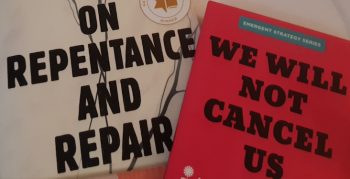
This year, I am exploring these steps within the “unthinkable thoughts” of adrienne maree brown’s We Will Not Cancel Us:
I’ll start with the scariest unthinkable thought for me, which is that maybe we as a species are in a state of apocalyptic fatigue — exhausted in the face of all the changes and endings we are living through. Our current collective circumstances require us to think about death, to grieve, and to consider that everything we have known has to change or come to an end. [p.33]
I, we, have to be able to discern what is me/us and what is fear.
Which leads to my next unthinkable thought: do I really know the difference between my discernment and my fear? [p.37]
…We are full of justified rage. And we want to release that rage. And one really fast and easy way to do this is what I experience as knee jerk collective punishment in movements. [p.40]
We are afraid, and we think it will assuage our fears and make us safer if we can clarify an enemy, a someone outside of ourselves who is to blame, who is guilty, who is the origin of the harm. Can we acknowledge that trauma and conflict can distort our perspective of responsibility and blame in ways that make it difficult to see the roots of the harm? [p.42-43, emphasis added]
…The tools of swift predatory justice feel good to use, familiar, groove in the hand easily from repeated use and training, briefly satisfying. But these tools are often blunt and senseless.
Unless we have an analysis of abolition and dismantling systems of oppression, we will not realize what’s in our hands, we will never put the predator’s tools down and figure out what our tools are and can be.
My third unthinkable thought — why does it feel like we are committed to punishment, and enjoying it? Why do our movements more and more often feel like we are moving with sharp teeth against ourselves? And what is at stake because of that pattern, that feeling? Why does it feel like someone pointing at someone else and saying: “that person is harmful!,” and with no questions or process or time or breath, we are collectively punishing them, tearing them, and anyone protecting them, to shreds?
Sometimes we even do it with the language of transformative justice: claiming that we are going to give them room to grow. They need to disappear completely to be accountable. We are publishing shaming them so that they will learn do do better.
Underneath this logic I hear: we are good and we are getting rid of the “bad” people in our community or movement. We are affirming our rightness and power. [p.44-45, emphasis added]
Knee-jerk call outs say: those who cause harm or mess up or disagree with us cannot change and cannot belong. They must be eradicated. The bad things in the world cannot change, we must disappear the bad until there is only good left.
But one layer under that, what I hear is:
We cannot change.
We do not believe we can create compelling pathways from being harm doers to being healed, to growing.
We do not believing we can hold the complexity of a gray situation.
We do not believe in our own complexity. [p.57-58]
— We Will Not Cancel Us: And Other Dreams of Transformative Justice by adrienne maree brown. AK Press, 2020.
Institutional and Movement Repair
The crucial perspectives of We Will Not Cancel Us return me to Rambam’s process, as R’ Ruttenberg describes it: Maimonides discussion of transformation “precedes his discussion of amends/reparations and apologies. He doesn’t spell out his thinking explicitly, but I think he was trying to tell us that apologies, and even amends and reparations, don’t truly have the needed effect if the work to become different isn’t already underway….The goal here isn’t amends. It’s transformation.” p.34, On Repentance and Repair.
One tricky aspect of work here involves our participation in a variety of institutions: “How can and should we think about the work of repentance when not a single person, but a rather a body, made of many actors with different roles is causing harm?…What are the obligations–and limits to the obligations–of the individuals in charge, and what does repentance look like when undertaken by an institution?” p. 101, On Repentance and Repair.
Again, beyond the questions, I haven’t got much to offer. But I believe we have to be asking them. And the questions lead me back to adrienne maree brown:
“I can’t help but wonder who benefits from movements that engage in public infighting, blame, shame, and knee-jerk call outs? I can’t help but see the state grinning, gathering all the data it needs, watching us weaken ourselves. Meanwhile, the conflicts are unresolved, and/or harm continues.” p. 54 We Will Not Cancel Us
congregation membership and removal resource page (added 8/26/25)
Rambam, Ruttenberg, Repentance
Laws of Repentance, a late 12th Century work, is part of the enormous Mishneh Torah and can be found in several translations at Sefaria. (Useful background on Mishneh Torah as a whole). R’ Danya Ruttenberg provides an overview of Rambam’s five steps and explores them in the context of personal, public, institutional, and national repair: On Repentance and Repair: Making Amends in An Unapologetic World (Beacon Press, 2022).
 "A Song Every Day"