How?! A Roadmap for Transformation

Calendar Notes for a Summer of Collapse — Part 3 (of 10) — songeveryday.org

The “Hows” of this season outline a difficult journey, built into the Jewish calendar. Following this annual journey can remind us that
building community is hard work that can easily get off track.

PDF download — “How?! A Roadmap

— This piece originally appeared in Matir Asurim’s 5783 Tisha B’Av Mailer —

“How” is the sort of word that is used a lot without getting much attention. But this small, often overlooked word is important to a time of transformation in the Jewish calendar. The word creates a kind of roadmap for heading into, and climbing out of, Tisha B’Av, the lowest point of the Jewish calendar.

“How [Eikhah]” is the first word, and the Hebrew title, of the Book of Lamentations, read on Tisha B’av. It is also a key word in the Torah and prophetic readings for “Shabbat Chazon,” the sabbath of vision, right before. Together, the “how” readings cover a lot of emotional territory.

In English, “how” can be used to express different ideas:

Frustration: “How are we supposed to do this?!”

Disbelief: “How could this happen?

Despair: “How awful!”

Questioning: “How does this work?”

The Hebrew word “eikhahhas similar uses in the Bible, generally, and in readings of this season:

Frustration: Moses re-telling complaints about the People’s behavior in the wilderness:

Eikhah/How can I, alone, bear the trouble of you!……the burden, and the bickering!”
— Deuteronomy 1:12, Torah reading for Shabbat Chazon

Disbelief: God criticizing the People in Isaiah’s prophecy, set in 8th Century BCE:

Eikhah/How has the faithful city become perverse?…She was full of justice
righteousness lived in her. But now murderers — “
— Isaiah 1:21, prophetic reading for Shabbat Chazon

Despair: mourning destruction of the First Temple and exile, 6th Century BCE:

Eikhah/How lonely sits the city!…”
Once great with people! She was great among nations, now alone and vulnerable.
Once a powerhouse, now just one of the ruled.” — Lamentations/Eikhah 1:1,* reading for Tisha B’Av

Questioning: Jews trying to find meaning and move forward through disaster:

“How did we get here?” and “How do we go on?”
— centuries of Jewish teaching about destruction and tragedy

(Bible translations adapted from Jewish Publication Society 1985)

These “Hows” outline a difficult journey, built into the Jewish calendar. Following this annual journey can remind us that building community is hard work that can easily get off track.

How did we get here?

The Book of Deuteronomy opens with Moses and the People at the end of a forty-year journey. They stand on the river’s edge, imagining life on the other side. When they first escaped into thewilderness, a “promised land” seemed just around the corner. Decades later, the People have been through a lot. Mosesis listing their mistakes and his disappointments, crying:

“How can I manage this burden!(Deut 1:12)

This is a community in trouble and out of balance. Maybe not all that different from our own?

The Book of Isaiah opens a long time later, on the other side of the river. But the vision of a “promised land” now seems like a nightmare. Isaiah tells the People they are focused on the wrong things and have become a burden, even to God:

“Your rituals are a burden to me…Your hands are full of blood.” (Isaiah 1:14-15).

The prophet’s harsh words point to a whole nation troubled, out of balance, and wondering: How could dreams of justice and righteousness go so deeply wrong?

In Lamentations, the Temple is in ruins, and the People face exile. Vision of a “promised land” seems in the past. Tisha B’Av mourns loss of dreams and hopes, as well as lives and homes. This won’t be the only time in history that Jews ask: “How?! How did our visions turn into this painful mess?!” We have always struggled to share burdens in our communities. We’ve always fallen short of our visions. That is one message of the “How” readings. But it’s not the only message.

How do we go on?

The “How” readings also tell us that we are expected to do better, as individuals and society:

Learn to do good.

Devote yourselves to justice;
Aid the wronged.
Uphold the rights of the orphan;
Defend the cause of the widow
–Isaiah 1:17


Where did our ideas of community fail in the past? What visions must we mourn? Shabbat Chazon prompts us to envision something truly new, and imagine steps toward needed change. Tisha B’Av reminds us to expect failure and to mourn our losses. But the calendar nudges us forward.

There are seven weeks from Tisha B’Av to the new year. The “How” readings give us our homework, well in advance. We have work to do. And that work starts with “Learn.”


Image: Hebrew word Eikhah in Hebrew characters, plus English “How?! How? How!

Summer Breather, Toward Fall

Calendar Notes for a Summer of Collapse

Part 1 (of 10)

Download PDF version — Summer Breather, Toward Fall


The Jewish calendar’s springtime is full:

  • Purim, Passover and the Omer Period, then Shavuot;
  • The months of Adar, Nisan, Iyar, and Sivan mark, on the one hand, winter’s overturning, the early (barley) and the later (wheat) harvests; on the other:
  • unveiling of hidden power, the beginnings of Liberation, the path to Sinai, and Revelation.

After all that, Tammuz holds one minor fast day.

The 17th of Tammuz starts the semi-mourning period of “The Three Weeks” (see below). And that period leads into preparations for the High Holidays and “THE festival” of Sukkot in the fall.

Tammuz itself offers a kind of breather. And For Times Such as These suggests it is a good month to ask:

What’s growing in your garden now?
What is feeding you? What does the sun have to offer?
Where do you see signs of what’s been destroyed in your communities?
What destruction needs attending to?
How are the hurts of your communities/histories manifesting in the collective body?
What grief is unresolved and impacting your community?
— Rabbi Ariana Katz & Rabbi Jessica Rosenberg. For Times Such as These: A Radical’s guide to the Jewish Year (Wayne State University Press, 2024), p.249

As Tammuz comes to a close — the month ends this year on July 25 — we can still ponder, carrying our answers or remaining questions into the next phase of the calendar.

The new month of Av begins on Shabbat, July 25-26 (2025) and For Times Such as These suggests that we ask:

NOTE: Av questions relating to love and sex seem better suited to the post-mourning days of the month; again, see calendar notes below, and check out For Times Such as These for more on the Jewish year.

God’s Questions and Ours

God has a lot of questions for us, according to the prophet Jeremiah*:

1) what? [מַה, mem-hey, mah] — Jeremiah 2:5

2-4) where? where? where? [אַיֵּה, alef-yud-hey, ayyeh] — Jer 2:6, 2:8, and 2:28

5) why? [מַדּוּעַ, mem-dalet-vav-ayin, madua] — Jer 2:14

6-7) whatsoever? or what-in-any-way? [מַה־לָּךְ, mah+lamed-kaf] — twice in Jer 2:18

8) how? [אֵיךְ, alef-yud-kaf, eikh] — Jer 2:23

Interrogatives are not unusual in biblical Hebrew. But eight in the space of 24 verses has an impact. Together, the piled up questions turn this passage into a kind of awareness demand.

Three of these interrogatives — what, where, and how — are part of questions we might already be asking ourselves, and each other, for the months of Tammuz and Av (see page 1).

In addition, the final question, Eikh [How?], hints at a theme in the next week’s readings, which are dominated by “Eikhah / How?!” as lament.

It’s important to ask specific, seasonal questions — and lean into the lament they raise. And it can be oddly comforting to know that the Jewish calendar is designed to stress this need. But it can also be helpful to imagine a less specific dialogue with the divine, one centered around questions as wake-up call: What? Where? Why? What-in-any-way? How?

———–

*Jeremiah 2:4-28 plus 3:4 is read as the second “haftarah of affliction” in preparation for Tisha B’Av. When, as in 5785/2025, the reading comes on Rosh Chodesh Av, two verses about new moons are added to close the haftarah: Isaiah 66:1, 66:23.

** For language geeks and trivia lovers: The form of “where” in Jeremiah 2 is lengthened from the simpler alef-yud, אַי. The Brown-Driver-Briggs biblical dictionary adds about this form:

used of both persons & things (but never with a verb [contrast אֵיפֹה (eifo, alef-yud-pei-hey)]; oft. in poet. or elevated style, where the answer nowhere is expected…

————————-

Broken Cisterns, Holding Water

Amid all the questions, this chapter of Jeremiah includes the following divine complaint:

כִּי־שְׁתַּיִם רָעוֹת עָשָׂה עַמִּי
אֹתִי עָזְבוּ מְקוֹר מַיִם חַיִּים
לַחְצֹב לָהֶם בֹּארוֹת בֹּארֹת נִשְׁבָּרִים
אֲשֶׁר לֹא־יָכִלוּ הַמָּיִם׃

For My people have committed two evils: They have forsaken Me, the fountain of living waters, and hewed them out cisterns, broken cisterns, That can hold no water.

— Jer 2:13, (JPS 1917 translation — a little old-fashioned, but chosen for its rhythms)

Water is often linked with Torah and with healing. So God’s complaint might be understood as accusing the people of failing to value God’s teaching and healing, and of creating faulty containers, unsuitable for gathering and preserving God’s life-giving offerings.

A related passage in Proverbs is used for much commentary on Torah, water, and healing:

שְׁתֵה־מַיִם מִבּוֹרֶךָ
וְנֹזְלִים מִתּוֹךְ בְּאֵרֶךָ׃

יָפוּצוּ מַעְיְנֹתֶיךָ חוּצָה
בָּרְחֹבוֹת פַּלְגֵי־מָיִם׃

Proverbs 5:15) Drink water from your own cistern [borkha],
Running water from your own well.

16) Your springs will gush forth
In streams in the public squares. [Revised JPS 2023]

These teachings, attributed the Talmud’s Rabbi Akiva, focus on the idea of bor [pit/cistern]:

In this season of contemplating all that is broken, in and around us, the Jeremiah and Proverbs images and Rabbi Akiva’s teaching are worth reflection. Here are some questions for this particular season:

  • In what ways have our Torah-containers broken, over time and more recently?
  • Are all such breaks “bad”? How might cracks help us move forward differently?
  • Have we (individuals, communities, society) forsaken divine teaching? How? And, if so, how might we remedy that?
  • What kinds of containers do we need for communal Torah today?
  • What kind of work is required to build what is needed?
  • How does the imagery in Prov 5:15-16 differ from that found in Jeremiah?
    • — Is one vision more universal than the other?
    • — Is either more hopeful?
    • — Many translations, including RJPS, opt for “your own cistern” and “your own well” rather than just “your cistern” and “your well.” What is “ours” or “our own”?
    • — Does sticking to our (own) Torah caution us from “bad” teaching? limit us in some way? Or does it encourage us to bring out our (own) Torah?
    • How does Akiva’s imagery differ from that in the biblical passages?
  • — How does Torah/water get into the cistern in the two sets of images?
  • — A pit may contain no water to start with, but is all Torah poured in by scholars?
  • — Consider, too, this story about Akiva himself, water, and a bor:

Speaking of Broken Things

Akiva (c. 50 – 135 CE) is a huge figure in the Talmud and later lore. For this summer of collapse, it’s particularly worth noting that Akiva was a controversial figure in the politics of responding to Roman occupation and that two of the most quoted stories about him involve major tragedy: his 24,000 students who died in a plague of disrespect (B. Yebamot 62b), and “the four who entered Paradise” (B. Chagigah 14b: Wikipedia’s basic page on the legend of Pardes is pretty useful).

The latter story brings us back to stones and water — in a strange, mystical way:

[Akiva told his fellow travelers:] When you reach the stones of pure marble, don’t say, “Water! Water!” As it states, “One who speaks falsehood shall not endure before My eyes” [Psalms 101:7] — Babylonian Talmud, Chagigah 14b

Four men entered pardes [paradise]: Ben Azzai, Ben Zoma, Acher ([“Other”], Elisha ben Abuyah), and Akiva. We are told: “Ben Azzai looked and died; Ben Zoma looked and went mad; Acher destroyed the plants [became a heretic]; Akiva entered in peace [or wholeness, “shalom”] and departed in peace” (B. Chagigah 14b again). Many teachers assume that this means Akiva was of superior mind or spirit. But the story does raise the question: What does it mean to survive in wholeness amid such disaster, for near friends and so many others? Returning to the For Times Such as These questions for Tammuz:

Where do you see signs of what’s been destroyed in your communities?

What destruction needs attending to?

How are the hurts of your communities/histories manifesting in the collective body?

What grief is unresolved and impacting your community?


Toward Tisha B’Av, “Within the Straits,” and Then Beyond: Calendar Notes for Tammuz and Av and Elul — here as PDF (if anyone needs another format for accessibility, please advise) —

Download Toward Tisha B’Av

Something to Talk About: Split Binding Version

I have a very intense relationship with the book, For Times Such As These: A Radical’s Guide to the Jewish Year by Rabbi Ariana Katz and Rabbi Jessica Rosenberg. (Excerpt here: Tammuz in Times Such as These).

Having been told that it was in the works and pre-ordering it quite early, I felt involved with it before I ever held it in my hands. I’m a big fan of its authors and of Wayne State University Press, with its Jewish studies and midwest-focused titles. Then, as it happened, that fall 2023 pre-order proved a tremendous blessing in ways none of us could have imagined: In those post-Sukkot months, genocidal attacks on the West Bank, as well as Gaza, were launched with justifications based on Jewish survival and Jewish teaching; so many Jews and Jewish institutions seemed ready to turn their backs on Jewish values, so just knowing that there was a book on the way testifying to possibilities of living and organizing in Jewish integrity was a lifeline.

I participated in an on-line book event for Tu B’shvat on January 18 (2024), apparently received one of the first copies Wayne State mailed out (in late January), had my copy signed at the first book reading of the national tour (at Red Emma’s in Baltimore, March 3), and joined a second tour event in Washington, DC (May 22; more on the book and its authors’ tour).

For a book that some would still consider brand new [just over five months together, when I wrote this in July 2024] , me and my copy have been through a lot together. And, today, while deep in conversation, the book’s binding split and some pages began sliding free.

showing several loose pages
pages sliding out of perfect-bound book

…Now, maybe I was too rough. Maybe the perfect-binding did not quite live up to its name. Or, possibly, the break was some kind of organic result of considering the calamities of the month of Tammuz and questions like: “How are the hurts of your communities’ histories manifesting in the collective body?”…

However the binding break happened, I found myself thinking it was a little soon for this particular volume to join the “well-loved/much-used” stage of our relationship: Do we even know one another well enough for that!? Those thoughts led, as these things do with me, to new lyrics for “Something to Talk About.”

So, here, in honor of this whirlwind start to what I expect will be a long, loving, and fruitful relationship, is “Something to Talk About: Me and For Times Such As These” — with love and respect to Shirley Eikhard and Bonnie Raitt.

“Something to Talk About: Me and For Times Such As These

Ooh, Ooh…. People are talking, talking about reading
I hear them whisper, you won’t believe it
They think we’re lovers kept under covers
I just ignore it, but they keep saying
We meet just a little too much
Lean just a little too close
We stay just a little too long
Maybe they’re seein’ something we don’t, darling

Let’s give ’em something to talk about
How ’bout little something to talk about
How about words?

I feel so clumsy, did not expect it
you split your binding, could we be rushing, baby ?
It took the rumor to start things rumbling
Now it seems we’re already tumbling
Travelin’ through Jewish days
Cyclin’ through the whole year long
I’m hoping that you’re up for this trip
If we both know it, let’s really show it, baby

Let’s give ’em something to talk about, babe
A little mystery to figure out
Let’s give ’em something to talk about
I want your love!

Original lyrics by Shirley Eikhard (1955-2022), famously performed by Bonnie Raitt, beginning with 1991 “Luck of the Draw” album

Shirley Eikhard and Bonnie Raitt versions —

A little background on Eikhard [Archive link might be slow to open] and “six songs you should know

Split Binding (Re-)Union

Sometimes, when I wear a book out, I find a new copy. In some cases (Finnegans Wake is one), I keep the old one for sentimental reasons but use the newer copy for practical reasons. With a few books, however, the split-binding copy is the one I continue to use.

Here are the Jewish studies volumes that remain with me, for regular reference, despite binding mishaps:

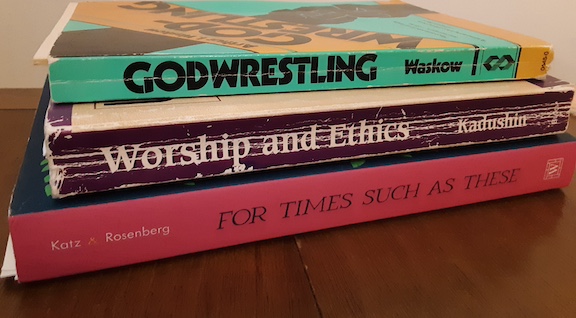
  • Max Kadushin. Worship and Ethics: A Study in Rabbinic Judaism. Bloch Publishing, 1963. (Scotch-tape inside)
  • Arthur I. Waskow. God-Wrestling. Schocken Books, 1978. (Binder clip on open side)
  • Rabbi Ariana Katz and Rabbi Jessica Rosenberg. For Times Such and These: A Radical’s Guide to the Jewish Year. Wayne State University Press, 2024. (String somehow seemed appropriate for this one, but it will depend on shelf situation.)

Statistically speaking, this house has many books on subjects similar to these three. And surely it must be accidental that these particular three comprise the “broken binding/still used” category. Nevertheless, the three books do seem to belong together, both in terms of theme and in terms of how essential I have found each to be, at different points in my life. So, I cannot shake the urge to anthropomorphize my new-ish book by insisting that it prematurely, purposely joined the broken-binding-brigade.

Looking at these three books, I recall that Max Ticktin (June 30, 1920 – July 3, 2016) , z”l, found Kadushin very dry as a JTS professor and was puzzled by my enthusiasm for this work, while he loved Arthur Waskow’s writing and was proud of his connections to Fabrangen Havurah. I cannot help wondering what Max would have made of For Times Such and These. I am quite sure he would have applauded this line: “We read Korah and ask, how do we organize in ways where all of us get to bring our unique and varied skills and power?” (p.326). And maybe that’s the through-line for the books in my broken-binding-brigade.

Image descriptions: 1) stack of three paper-back books — God-Wrestling, Worship and Ethics, and For Times Such as These — showing loose pages and wear. 2) Three books — For Times Such as These, God-Wrestling, and Worship and Ethics — shown cover out: first, held together by string; second, with a large binder-clip; third shows ragged pages (bound with tape).

-#-