
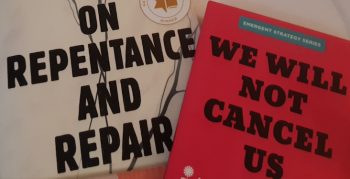
Building communities based on truly transformative justice requires that we strive to “put down the predator’s tools,” according to adrienne maree brown. (We Will Not Cancel Us; more here“). Considering the predator’s tools raises serious misgivings about this week’s Torah portion and many Jewish teachings centering the injunction to pursue “tzedek, tzedek [“justice, justice” or “equity, equity”]. Reflecting on inherited ideas of justice is but one aspect of exploring collapse and the possibility of (re-)building.
This is part of a series on Summer of Collapse.
Updated for more clarity of expression in the “Justice, In/Out of Context” section and addition of “Some History” section below Friday afternoon (8/29/25, around 5 ET)
Justice, In/Out of Context
The Torah portion “Shoftim [Judges]” (Deut 16:18-21:9) is composed of rules about appointing judges and other legal matters. It contains one of the most quoted verses in the Torah, which begins:
tzedek tzedek tirdof…, …צֶדֶק צֶדֶק תִּרְדֹּף
Justice, justice shall you pursue… (JPS 2006)
Equity, equity you are to pursue… (Fox/Schocken 1996)
— Deuteronomy 16:20
Teaching and preaching on this phrase is frequently separated from the context, in both narrow and wider senses.
In one narrow sense, focusing on the phrase alone and not the surrounding verses allows for generalizing the instruction beyond its most likely connection to the previous verse about accepting bribes. On another verse-specific level, many citations of “justice, justice” leave off the second half of the verse, which reads:
וְיָרַשְׁתָּ אֶת־הָאָרֶץ אֲשֶׁר־” אֱלֹהֶיךָ נֹתֵן לָךְ׃
…in order that you may live
and possess the land that YHWH your God is giving you! (Fox)
…that you may thrive and occupy the land that your God [YHVH] is giving you. (JPS)
Ignoring the bulk of the verse’s language allows for generalizing the instruction in ways the full verse doesn’t support. These specifics need not invalidate teachings centering “justice, justice.” And it’s essential to note that Torah text never stands on its own in Jewish tradition; it is interpreted and, in many cases, ameliorated by centuries of post-biblical teaching and legal rulings. Still, Shoftim reminds us that our inherited ideas of justice — in- and outside of Judaism — include ideas such as judicial death penalty (Deut 17:2-7), blood-avenging (Deut 19:11-13), “an eye for an eye” (Deut 19:21), and expectations of warfare (Deut 20).
Abolitionist efforts of any kind require serious examination of these and other punitive ideas we’re inherited and a careful look at how they frame our understanding of justice. Alicia Suskin Ostriker offers powerful teachings on the concept of justice and how it relates to Jewish theology — and ideas about the topic, more broadly.
Strange Invention
Decades ago, Ostriker remarked on the “strange invention of the Jews, God’s ‘justice'”:
It is a strange invention of the Jews, God’s “justice.” That God should be “just,” obliged to reward good men who obeyed his laws, care for widows and the poor and so forth, and punish evil ones who didn’t, was not a notion that occurred to the Egyptians, the Canaanites, the Babylonians, the Greeks. We appreciate, if we step back a bit from our theological assumptions, what a peculiar expectation it is that human justice should be intrinsic to a God, and still more odd, that human beings need to remind god about it….
…[God] was waiting for her [Job’s wife, or each of us] to issue her challenge. That is what really happens. God does not know how to be just until the children demand it….
She wants the unjustly slain to be alive and for singing and dance to come to the victims.
We already know what she wants. She wants justice to rain down like waters. She wants adjustment, portion to portion, so that the machinery of the world will look seemly and move powerfully and not scrape and scream. The children of God do not really say that God is just. But they invent the idea. They chew it over and over, holding it up to the light this way and that. And though blood drips from the concept, staining their hands, they are persistent. It is their idea. They want justice to rain down like waters. Justice to rain like waters. Justice to rain. Justice to rain.
–Alicia Suskin Ostriker, The Nakedness of the Fathers, p.232, 239, 240. Full citation below**
Ostriker was not writing from an abolitionist perspective or directly addressing the portion Shoftim. But her words point to important work we need to undertake around some basic concepts.
As we move through this period of collapse and consider which tools can still serve, it’s crucial to “take a step back” from many assumptions, in theology and beyond. As we move through Elul toward the new year, we are called to reflect on how our assumptions, and the structures built on them, contribute to harm and what steps we can take to remedy that.
Some History
For either Ostriker’s 1986 “Imagining of Justice” or the 1994 “Meditation on Justice,” a quick history reminder might be in order:
In the 1980s, gender was generally treated as a binary in- and outside of Judaism. Women’s leadership — or even full personhood — was not yet accepted in many parts of the Jewish world, although women were ordained as rabbis in some US movements beginning in the 1970s.
Keshet (For LGBTQ+ equality in Jewish life) was not founded until 1996 and, as their story reports: “Not too long ago, lesbian, gay, bisexual, transgender, and queer Jews were largely invisible in American Jewish life. Marriage equality wasn’t on anyone’s radar — certainly not on the radar of most synagogues and Jewish organizations — and there was not a single gay-straight alliance at a Jewish high school.”
Ostriker’s 1986 statement about being a Jewish woman — “I am and am not a Jew” — made sense across all Jewish movements, at that time, even in the equality-focused Havurah movement. By the time Nakedness of the Fathers was released in 1994, gender equity had advanced in some Jewish spaces; the Jewish Orthodox Feminist Alliance was still years away, however, and issues of gender and sexuality in Judaism still had (have) a long road ahead throughout Judaism.
Keeping this history in mind adds layers to the call to “take a step back” from assumptions. And Ostriker’s reminder that we have to imagine justice — and how it might relate to the divine — couldn’t be more timely…. it was in 1986 and in 1994 and the countless moments I’ve found myself turning to her words over the decades.
** Full citation: “Job, or a Meditation on Justice,” from Nakedness of the Fathers: Biblical Visions and Revisions. New Brunswick, NJ: Rutgers, 1994.
Here’s a PDF excerpt — “Job, or a Meditation on Justice”
An earlier version (1986), “Job, Or the Imagining of Justice” — originally in The Iowa Review — is available on Academia.edu.
Author bios at Jewish Women’s Archives and Poetry Foundation
Feature image is largely decorative: The words “Whose tools?” and a two-pan balance.
 "A Song Every Day"