Coates and Tyfereth, Algren and Mobley (Beyond 33)

“Passover is a time of remembrance but also one of renewal — of looking ahead toward the spring and new growth that will sustain us through the seasons to come. Once we spent spring in the desert. It was harsh and difficult but from that journey grew a people who have endured for centuries. What would happen if we took that journey again, not alone in the wilderness but surrounded by friends and allies, leaving no one behind?”
— from JFREJ Haggadah

from Baltimore, 2015, and Chicago, mid-20th Century.
In stereo.
With no comment:

2015

part 1: “Family Breakdown”

Jim Crow was one heck of a barrier to entry, but it hasn’t been legal for decades. If legal barriers are no longer restraining African-American wealth growth, then what is? A cycle of poverty, but why? Coates dismissed family breakdown, but I suspect that’s closer to the truth than white supremacy.
— “Tyfereth,” on-line commenter at Atlantic Magazine, responding 4/30/15 to “Nonviolence as Compliance” by Ta-Nahisi Coates
—- See “In the Wake of Baltimore” — scroll, past the picture of two-year-old Ta-Nehisi, down to Tyfereth’s comments

part 2: “Out-of-Wedlock”

…I’ll leave it to the commenter to define, specifically, what they mean by “family breakdown.” I assume the commenter means children born out of wedlock. As the product of such a family—and as a Dad who fathered his only child out of wedlock—I reject the label. Nonetheless, whatever we call it, the “out of wedlock” theory has a serious problem—the out of wedlock birthrate in the black community is at its lowest point since the CDC began keeping stats. Indeed the gap between black and white women has been shrinking for the last 15 years. (I suspect that much of that shrinkage is the result of the rapid decline in teenage pregnancy in the black community.)

If the main driver of black poverty is black out-of-wedlock birthrate, and yet that birthrate is in decline, what explains the yawning chasm between black and white America?
— Ta-Nehisi Coates, responding to Tyfereth (see above), 5/6/15

1960s

part 1: “Illegitimate…All and on Welfare”

These 200,000-plus fatherless children…equal the combined populations of [Chicago suburbs] Arlington Heights, Evanston, and Oak Park.

No records are kept of how many of these children become public charges. A conclusion may be drown, however, from welfare figures….

In the 1950s my work took me into the homes of many disadvantaged persons. It was common — and shocking and frightening — to walk into a living room and confront 8 or 10 children and women, representing four generations, all on welfare, and more on the way.

…Do men and women, in or or out of marriage, unable or unwilling to emotionally and financially support a child have a moral and legal right to produce that child?
— Columnist Jack Mabley
from a 1970s column in the Chicago Tribune, similar in content to Mabley columns in the long-gone Daily News and longer-gone Chicago American

part 2: “Like Guinea Pigs”

To say “Each man’s death diminishes me” today only rouses cries of “they’re like guinea pigs out there.”

WhoLostNot to be surpassed in public service, the Evening [Chicago] American offers a new crusade by Chicago’s most heavily decorated fink; one whose honors are all self-awarded. While keeping an eagle eye on the broken brutes of Skid Row’s broken walks, he also finds time to expose mothers of illegitimate children found in movie houses while receiving state aid. This Malthusian revisionist’s cry is, “They’re multiplying like guinea pigs out there!” Implying that his kind of people have hit upon a method of reproducing themselves different from that of guineas pigs.
— from Nelson Algren, Chicago: City on the Make (1961 addendum, see also) and Who Lost an American? (NY: Macmillan, 1963)

“What would happen if we took that journey again, not alone in the wilderness but surrounded by friends and allies, leaving no one behind?”

We counted 33 on the evening of May 6. Tonight, we count….

Continue reading Coates and Tyfereth, Algren and Mobley (Beyond 33)

Conversing for Racial Justice (Beyond 32)

Lag B’Omer, the 33rd day of the Omer, brings a symbolic break in this 49-day journey from Passover to Shavuot. The 32-day plague wrought by disrespect among Rabbi Akiva’s students (see yesterday’s post) has ended. Lag B’Omer is a day of transition. We don’t necessarily cease mourning for who and what was lost, or stop analyzing how things went wrong. But, just as Akiva began anew with five students, it is time to for us to focus on rebuilding.

HeartThe plague story warns that a pretense of respect only obscures danger. It urges us to explore our own communities for places where similar hazards lurk, to engage in necessary conversations.

This break in the Omer is an opportunity to examine our journey, how far we’ve come and how far we’ve yet to go.

Now is a great time, too, to check in with others. It is not necessary to follow the same religious calendar in order to join together on a journey from oppression. Counting these days has its own peculiar set of commandments and its own set of benefits. But one need not count the Omer to make these days count.

Rebuilding Tools

Race Forward provides an array of materials designed to educate individuals and groups and facilitate conversations around racial justice. This post includes handy links to a number of their resources, including their relatively new series of videos on systemic racism — all intended for a wide-ranging audience.

SURJ_color_logo
Showing Up for Racial Justice works, more specifically, “with white people who are already in motion.” SURJ endeavors to avoid “the culture of shame and blame” which can be found in some activist circles, instead seeking “to bring as many white people into taking action for racial justice as possible.”

SURF offers resources, including suggestions for launching house parties and other conversational activities. Special Mothers Day materials speak to teachers, parents, and others working with children.

Conversing
Many other groups work to unite people in action and/or further necessary conversations. If you have other resources to share, please post in comments or email me (songeveryday at gmail).

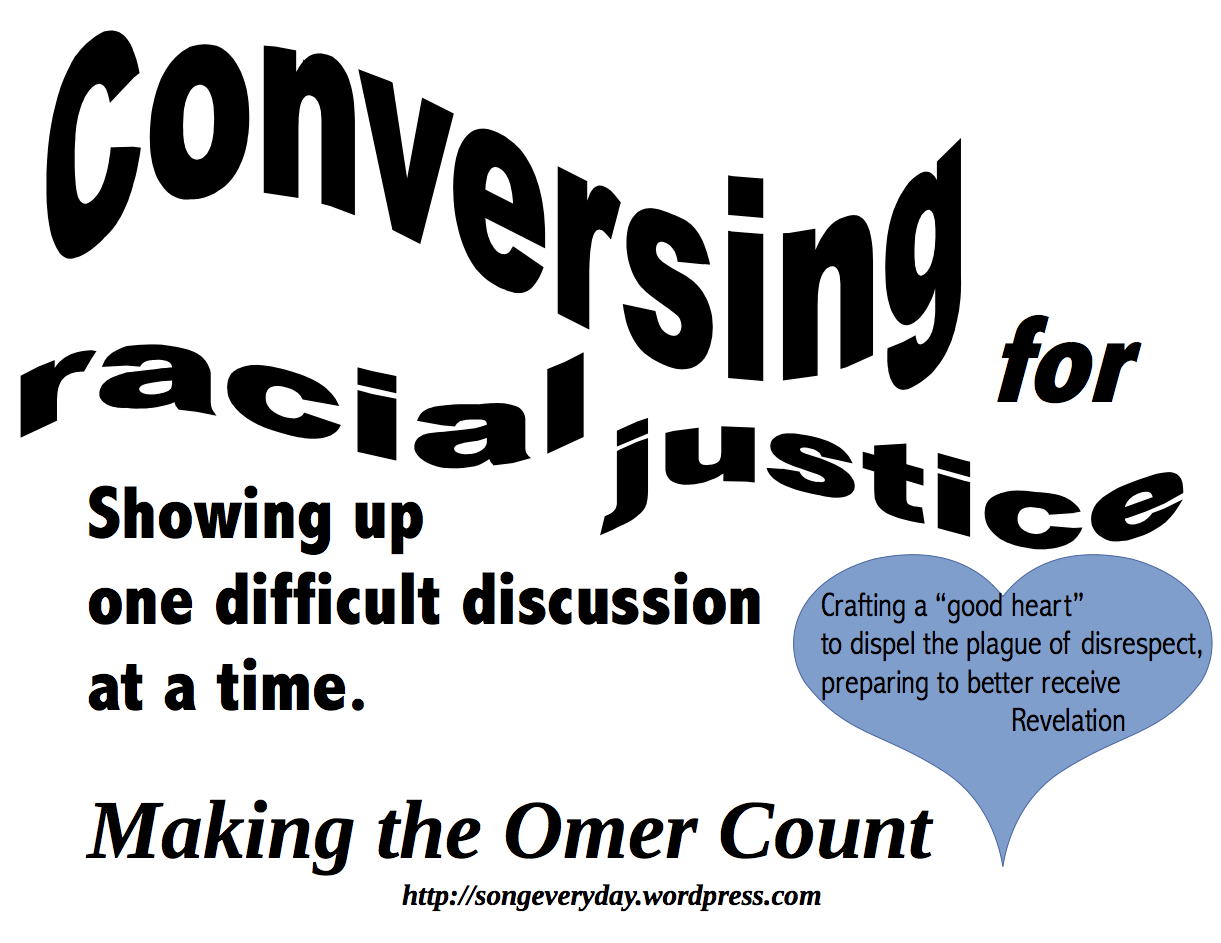
It will enhance our individual journeys to know others are with us. So, please consider using the comment section here to let everyone know you’re committing to begin the conversations we need, or just “like” this post (see star at far bottom of post). In addition, please share this post or the “Conversing for Racial Justice” image to help engage others.

We counted 32 on the evening of May 5. Tonight, we count….

Continue reading Conversing for Racial Justice (Beyond 32)

Death by Disrespect (Beyond 31)


How can we end the plague of disrespect around race-related topics that threatens our country with disaster? Perhaps the Omer journey shows us a way to begin.

Rabbi Akiva, a key player in the story of four who visited Paradise (see yesterday’s post), is also central to a narrative linked with the Omer period. The Talmud relates how 24,000 of Akiva’s students “died at the same time because they did not treat each other with respect.”

Later tradition identifies the “same time” as the first 32 days of the Omer and the proximate cause as a divine plague. (More below on Akiva and the Omer.)

Rampant, Unacknowledged Disrespect: Then…


The Talmud speaks of plague victims as “twelve thousand pairs of students,” referencing the practice of learning with a partner. Among the many questions this brief, symbolic tale raises is one of awareness: Did Rabbi Akiva realize his students were disrespecting one another and fail to intervene? Or did he somehow not notice the disaster brewing among ALL 12,000 pairs of students? How could anyone be that oblivious?

One explanation is that Akiva’s students outwardly gave the impression that all was well, pretending to respect one another’s opinions and learning.

Are we behaving any differently in this country today?

…and Now

How many of us have been vaguely aware that we live in a nation divided by White privilege but failed — whether through indifference, despair, or confusion — to address it, opting instead to go along to get along? And when an uprising occurs in Ferguson or Baltimore, how many of us find the whole thing too painful to consider in any serious way?

from JFREJ in NYC May 2

How many of us have engaged, however unconsciously, in the variety of mental gymnastics that help maintain the “all is well” impression, with any suggestion to the contrary attributed to isolated incidents and (usually “outside”) individual agitators?

How often have perspectives of people of color been dismissed as “extreme” by media, and individual consumers of it, instead of taken seriously?

And how often have we dismissed every perspective but our own, often using labeling — “liberal,” “Tea Party,” “Right,” “Left” — to define others as unworthy of consideration?

Ending the Plague

According to legend, there are 32 days of plague followed by 17 more days in the Omer. The Hebrew numbers “32” and “17” can be read as equivalent to the Hebrew words “lev [heart]” and “tov [good].”**

It is the “good heart” that seems to have been missing from Akiva’s learning community and that is all too often missing from discourse in our country today.

Perhaps we can begin to turn this around by consciously chipping away at the veneer of “all well” and pursuing real respect in its place.

What if each one of us committed to having one difficult, but honest and respectful, conversation about race?

Suppose 12,000 of us engaged in such a conversation, yielding 24,000 people with a slightly broader understanding! And if each of those 24,000 engaged someone else….

Imagine our experience of Revelation, at the end of the omer period, encompassing the many new perspectives gained during this journey. If we approach Sinai this year with hearts each a tiny bit more attuned to the neighbors surrounding us, what more might be revealed?

**lamed + bet = lev/heart (32) and tet + vav + bet = tov/good(17).


Who’s ready? And how might we share our commitments to this effort?

We counted 31 on the evening of May 4. Tonight, we count….

Continue reading Death by Disrespect (Beyond 31)

The Most Dangerous of Dualisms (Beyond 30)


No one knows for certain what the ancient rabbi meant when warned his fellow mystical travelers against saying “Water! Water!”:

When you reach the stones of pure marble, don’t say, “Water! Water!” As it states, “One who speaks falsehood shall not endure before My eyes” [Psalms 101:7]
— Babylonian Talmud, Chagigah 14b

The speaker, Rabbi Akiba, is one of four who “entered Pardes [Paradise],” the only one who “entered in peace and departed in peace.” His instructions are understood as pre-trip warnings to other other three.

Some explanations for Akiba’s words liken pure marble to the place where upper (divine) and lower (mundane) waters meet, arguing against attempting to divide divine and mundane. Many teachings focus on dualisms, warning against dividing God into Light/Dark, Good/Evil, etc.

But Michelle Obama spoke, back in April 2013, to what I consider the most dangerous dualism of all: allowing some of our citizens to grow up “consumed with watching their backs” while others grow up enjoying a city’s riches.

Boundless Promise Lost

I wrote then:

Accepting such a state of affairs implies two sets of rules or, worse, two sets of expectations for human beings. This is tantamount to bowing to two gods.

At the “place of pure marble” — where the Torah tells us all humans are in God’s image — we must acknowledge that “every single child in [Chicago or any city] has boundless promise no matter where they live.” Failing to do so is blasphemy of the deepest kind, it “speaks falsehood” that cannot endure before God’s eyes.
— from Fabrangen Havurah‘s omer-counting blog, 2013

Meanwhile, Chicago, my first hometown, has lost so many to street and police violence, as has DC, my adopted hometown of 27 years. Losses across the country mount at a rate so high as to be numbing.

And this does not even begin to address suffering of, and long-term affects in, communities experiencing grief upon grief. Nor does it approach the dual reality Mrs. Obama described in our mutual hometown:

Today, too many kids in this city are living just a few El stops, sometimes even just a few blocks, from shiny skyscrapers and leafy parks and world-class museums and universities, yet all of that might as well be in a different state, even in a different continent.
— Michelle Obama, April 10, 2013

BlackSpring-HiRes-476x500
As discussed previously, this week’s attribute, Hod, is associated with empathy.

But the literal meaning of the word is “Glory.”

May the energy of this attribute impel us, finally, this week, to see that this dual existence is incompatible with God’s glory and “shall not endure before [God’s] eyes.”

The war on Black people in Baltimore is the same war on Black people across America. Decades of poverty, unemployment, under-funded schools and police terrorism have reached a boiling point in Baltimore and cities around the country.

This past winter our people were presented with hollow reforms. This spring we present to the world our visionary demands. Demands that speak to a world where all Black Lives Matter.

This will be our #BlackSpring.
Ferguson Action

We counted 30 on the evening of May 3. Tonight, we count….

Continue reading The Most Dangerous of Dualisms (Beyond 30)

Empathy: Are We There Yet? (Beyond 29)

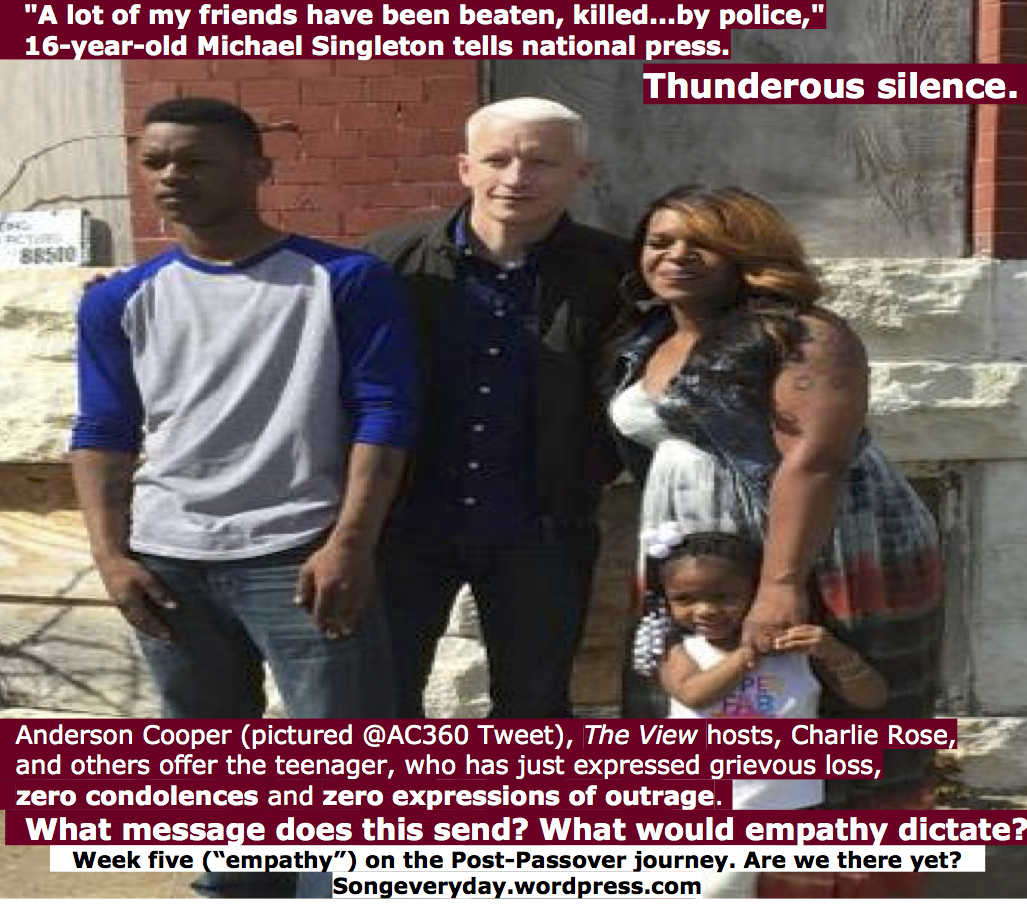
“A lot of my friends have been beaten, killed…by police,” 16-year-old Michael Singleton told Whoopi Goldberg on The View the other day. “I went down there to fight for what I stand for — my Black people.” Thunderous silence.

Six Seconds of Empathy

Singleton is the young man caught on tape being slugged in the face by his mother, who was “in a rage” (her words) upon seeing that he had joined a group throwing rocks at Baltimore police after the funeral of Freddie Gray. Toya Graham was then heralded “mom of the year” by a number of media outlets, and she and Singleton were interviewed a number of times by national media in the ensuing days.

SingletonCooperNicolle Wallace, co-host of The View, did ask Singleton if he was scared in his daily life in the neighborhood. But no one on The View offered condolences to a 16-year-old who had just expressed grievous loss. Not one second of outrage emerged as he related that agents of the state, meant to protect Singleton and his friends, hurt them instead.

Charlie Rose, who also interviewed the pair, did take about six seconds to acknowledge to Singleton, “so yours was an act of protest because of what happened to your friend.” That appears to be a record degree of empathy for Singleton in the many interviews he endured with his mother.

Sherill Ifill, of the NAACP, spoke on Rose’s program before Graham and Singleton, to the fearful circumstances “in which the mother found her son” and the need for systemic changes. She expressed far more compassion for beleaguered mothers of children in neighborhoods like the one Graham and Singleton inhabit.

What is Applauded? and What is Ignored?

It was Graham who was greeted on The View with thunderous applause as she described pummeling her son and then declared “throwing rocks at the police is not going to bring [Freddie Gray] back.” Graham also received a “thank you” from host Whoopi Goldberg, who added that “people need to know there are caring parents out there.”

But “Why is America celebrating the beating of a black child?” —

Praising Graham distracts from a hard truth: It doesn’t matter how black children behave – whether they throw rocks at the police, burn a CVS, join gangs, walk home from the store with candy in their pocket, listen to rap music in a car with friends, play with a toy gun in a park, or simply make eye contact with a police officer – they risk being killed and blamed for their own deaths because black youths are rarely viewed as innocent or worthy of protection….

This celebration of Graham reflects a belief that black youths are inherently problematic, criminal and out of control. The video also supports the idea that black fathers are absent, suggesting that all we need is an angry black mom to beat the “thug” out of an angry young man – and everything will be fine.
— Stacey Patton in a Washington Post opinion piece

Patton is author of the memoir That Mean Old Yesterday and a senior enterprise reporter at the Chronicle of Higher Education. See also, “In America, Black Children Don’t Get to Be Children.”

“What is so disturbing is that white supremacy is let off the hook,” Patton adds.

Moreover: A teenager reports that his friend was beaten by police, that police abuse is a regular part of his life, and earns barely a nod.

What does empathy, this week’s attribute on the omer journey, ask of us here?

Thanks to Amy Brookman for sharing one of the videos above and some concerns about it. Thanks to Kay Elfant for sharing the Charlie Rose link.

We counted 29 on the evening of May 2. Tonight, we count….

Continue reading Empathy: Are We There Yet? (Beyond 29)

Empathy: Withdrawing Ego (Beyond 28)

from JFREJ in NYC May 2

“withdrawing the ego to make room for another”

A key element in cross-racial, and every other kind of, understanding is the focus of this week’s omer journey.

Hod” [literally: “glory”] is understood as representing empathy in the system of thought that relates an attribute/energy of God with each week of the omer. For example, The Holistic Haggadah offers this explanation:

Hod is the attribute of empathy, of withdrawing the ego to make room for another. Aaron was the High Priest, the one that stepped out of the way to let the Divine blessing flow through to the people. He was the peace-maker, the mediator, the mouthpiece for his brother Moses….Hannah, the mother of Samuel, prayed for a child and then withdrew her own desires by giving the boy up to the High Priest for Divine Service.

So how is your Divine service? How well do you listen to others? Do you know when to follow rather than lead?
— Michael L. Kagan, The Holistic Haggadah (Jerusalem: Urim, 2004)

We counted 28 on the evening of May 1. Tonight, we count….

Continue reading Empathy: Withdrawing Ego (Beyond 28)

Endurance and Leadership (beyond 27)

The close of the Netzach [“Endurance” or “Leadership”] week of the omer journey seems an auspicious moment to share some resources for leading conversations and action within the Jewish community.

Are communities in which you’re active having the necessary conversations? It takes many forms of leadership to get discussion started in ways that allow everyone to listen and be heard. And it takes endurance and additional leadership to keep it going for the long-haul.

The omer count below is for Friday night. This post is scheduled to go out early on Friday in case anyone wants to share resources with their congregations this Shabbat.

Conversation and Sermon Sparks

“We are, as Dr. Martin Luther King, Jr. wrote, in the midst of ‘the fierce urgency of now,’ write leaders of Jews United for Justice, introducing a set of resources meant for rabbis, but applicable to anyone who teaches or otherwise leads Jews. “Our partners in the Black community tell us that one of the most important things you can do…is to begin or deepen a conversation with your community about racism, police brutality, and inequality in Baltimore and beyond.” To that end, you’ll find background material, some texts, and sermon starters.

T’ruah: The Rabbinic Call for Human Rights offers serman sparks on mass incarceration, a Prayer for Ferguson, and a number of other useful materials. They also issued a statement standing with Baltimore.

Resolutions: Then and Now

The Union for Reform Judaism adopted a Resolution on the Crisis of Racial and Structural Inequality in the United States in December; action items include two particularly relevant to congregations:

Encourage our congregations to establish and sustain relationships with diverse racial, ethnic and economic sectors of their communities, participate in community-based dialogues pertaining to race and community-police relations, and work to enhance violence prevention and conflict resolution procedures.

When appropriate to the size of a community and in cases of a clear, ongoing pattern of excessive police violence in general or against specific segments of the community, consider the efficacy of establishing a representative police review board with subpoena powers.

The 2014 resolution makes reference to a 1969 resolution, noting with sadness that it “rings as true today– if not more so”:

“Race and the U.S. Criminal Justice System”
50th General Assembly
October 1969
Miami Beach, FL

The current demands made by the American black community painfully remind us of the appalling hurt done by our nation to a long oppressed multitude. Certainly we in the Reform Jewish community cannot allow our country to ignore the plight of America’s impoverished millions. Jewish imperatives require that we be ever sensitive to the aspirations and just demands of our country’s minorities.

WE, THEREFORE, URGE our congregations to redouble their efforts in support of those who have been exploited by our society. Synagogue programs supportive of oppressed peoples, the raising of funds for minority group use, pressure upon our government for massive action, are vehicles that we must employ to heal the deep wounds inflicted.

More

The Religious Action Center of Reform Judaism has materials about Selma and Civil Rights and related topics.

Israeli struggles with race, class, and color are not identical to those in the U.S. but are mutually illuminating. A recent article on 972mag [on on-line publication named for Israel’s telephone code] asks Jews of Central European background to understand the struggles of Syrian and other Jews of Middle Eastern descent:

In a world where skin color has consequences for the future of your children, colorblindness is not a virtue, it’s a serious problem.

Thanks to Michele Sumka for sharing the 972mag article.

Links, suggestions, and guest postings welcome.

We counted 27 on the evening of April 30. Tonight, we count…. Continue reading Endurance and Leadership (beyond 27)

Stumbling Blocks Before Us All

“Do not put a stumbling-block before the blind.” This commandment prohibits anything that “gives the means, or prepares the way for wrong,” according to Rabbi Samson Raphael Hirsch (see Carmi Wisemon’s essay at My Jewish Learning).

There are so many ways in which language can “give the means, or prepare the way for wrong.” And changes to our usage can mean big differences in the way we think and act.

Many of us have seen changes in our lifetime in some of the harmful ways language was employed in early decades. For example, we no longer use “he” to stand for “one” (of any gender) and rarely see locutions like “lady-doctor.” This has helped to address some forms of sexism. But there are many ways in which our language continues to place stumbling blocks in front of us all, including in acceptance of varieties in gender expression. And this is no mere “semantics” issue. How language views certain groups of people translates into rights, respect, and basic safety issues.

The questions raised in yesterday’s post are primarily ones of language: When does language include people and when does it elide over difference? Usage can contribute to acceptance or promote danger for various groups.

Are we experiencing an “uprising” in Baltimore, finally after decades of oppression, or are some random “thugs” rioting? (Just one piece to consider)

Was the Boston Tea Party about revolution or property damage?

Vocabulary in such cases is everything and can mean, ultimately, a difference between life and death.

[Back in 2015, when this blog was running a series counting the Omer, this post closed with the previous night’s count and exact blessing for the date of the post; in an attempt to avoid confusion, the exact info is removed, but the general sentiments about using the Omer to learn and address oppression remains.]

Continue reading Stumbling Blocks Before Us All

Prayers on the Makeshift (Beyond 23)

In his masterpiece of prose poetry, Chicago: City on the Make, Nelson Algren wrote:

…All the creeds that persecution harassed out of Europe find sanctuary on this [Chicago] ground, where no racial prejudice is permitted to stand up.

We insist that it go at a fast crawl, the long way around.

The Negro is not seriously confronted here with a stand-up and head-on hatred, but with something psychologically worse: a soft and protean awareness of white superiority everywhere, in everything, the more infuriating because it is as polite as it is impalpable. Nobody even thought such a thing, my dear.
— in “Love is for Barflies,”
p.45 60th Anniversary Edition (Chicago: Univ. of Chgo Press, 1951)

Algren’s brilliant expression — “No racial prejudice is permitted to stand up. We insist that it go at a fast crawl, the long way around.” — remains all too apt, across much of the U.S.

Does the persistence of this reality have implications for our prayers?

(This post was edited and amended after initial publication.)

Algren’s Chicago, 1951 and 1961

In 1951, Algren quotes Big Bill Broonzy’s “Black, Brown, and White” — “If you’re white, awright…if you’re black, step back” — and continues, telling Black Chicagoans to expect higher rents, and warning:

from Wikipedia page
from Wikipedia;
cover photo from 1951 edition

And no one will ever name the restaurants you mustn’t eat in nor the bars you mustn’t drink at….Make your own little list. Of the streets you mustn’t live on, the hotels where you can’t register, the office you can’t work in and the unions you can never join.
— ibid, p.46

Major Chicago reviewers at the time said the work exhibited a “distorted, partial, unenviable slant” and demanded “revocation of the author’s poetic license.” But ten years later Algren only marveled at others’ failure to recognize what he saw, in 1951 and 1961. In the 1961, he wrote:

One cannot help but wonder what the reaction might have been had the book cut in closer to what the lives of multitudes are really like on the city’s South and West sides. This book didn’t begin to tell that story a decade ago; and the story is fully as terrible today as then.
— ibid, pp.95-97
(Google Books offers a substantial preview)

Bilhah and Zilpah, Text and Prayer

At the start of the week (see “Beyond 21“), we began to explore the idea of including Bilhah and Zilpah, the concubines of Jacob and mothers of four of the twelve tribes, in the opening blessing of the Standing Prayer.

Most prayer books used in non-orthodox congregations have included the four Matriarchs (Sarah, Rebecca, Rachel, and Leah) along with the three Patriarchs (Abraham, Isaac, and Jacob) in the blessing that calls on God who “remembers the love of our fathers (and mothers),” at least as an option, for many years. But most prayer books do not include the maids at this point:

  • Does listing all six mothers foster a sense of inclusion?
  • Or does it serve to gloss over difference, given that backgrounds of Bilhah and Zilpah are not addressed in the biblical text?
  • Does including Bilhah and Zilpah in the blessing raise their status and our awareness of their contributions?
  • Or does it make their inferior legal and social status invisible?
  • Is adding Bilhah and Zilpah an act against allowing prejudice to stand?
  • Or is it asking it to “go at a fast crawl, the long way around”?


A few thoughts to further consideration —

Orthodox prayer books do not include any of the mothers in the Amidah, retaining ancient language and often noting that the phrase “God of Abraham, God of Isaac, God of Jacob” is biblical (Ex. 3:6) and so not to be amended. Chabad notes, in addition, that Bilhah and Zilpah had souls “not as lofty as the Matriarchs” and act as “agents of Rachel and Leah” when they bear children.

Congregation Beth Simchat Torah (CBST) is a NY community that “attracts and welcomes gay men, lesbians, bisexuals, transgender, ‎queer and straight individuals and families who share common values. Their Siddur B’chol L’vav’cha, With All Your Heart, includes Bilhah and Zilpah, “recognizing all of our mothers, not just the ‘legally married ones.'”

The Movement for Reform Judaism (UK) points out that the addition has been controversial, adding a note from a classical source:

A powerful rabbinic midrash asks the question why the children of Israel had to endure slavery in Egypt. It answers that the sons of Rachel and Leah dismissed the sons of Bilhah and Zilpah on the grounds that they were the children of slaves and of less worth. By experiencing slavery in Egypt all the descendants of Jacob were made equal in this regard.
“Prayer Book in the Making”
[cited page from Movement for Reform Judaism now (2020) missing]

What, if anything, does including Bilhah and Zilpah say about our understanding of oppression and how to move beyond it?

More to come.

We counted 23 on the evening of April 26. Tonight, we count….

Continue reading Prayers on the Makeshift (Beyond 23)

“Only to the whole world” (Beyond 22)

Is the call “No Justice, No Peace” a threat or a prayer? “encapsulation of the lex talionis, an eye for an eye,” as Pat Buchanan says? a a statement of fact?

 By OsamaK (Own work) [CC BY-SA 3.0 (Creative Commons)], via Wikimedia Commons

By OsamaK (Own work) [CC BY-SA 3.0 (Creative Commons)], via Wikimedia Commons

This commentary on the Sim Shalom, the closing blessing and prayer for peace, at the end of the Amidah [Standing Prayer] discusses the Barcheinu Avinu verse: “Bless all of us as one, through the light of Your Presence.”

teaching from Shlomo Carlebach on “Sim Shalom

found on the Album “Songs of Peace” (recorded: 1973)
[Begins singing “Barcheinu Avinu,”
verse near the beginning of “Sim Shalom,”
then pauses for this teaching]
If I ask God: “Please give me, give me money, give me health” —
it is possible that I should be healthy,
but, God forbid, the rest of the world should not be.
I could be rich,
but the whole world, God forbid, can be poor.

But there is one precious thing I cannot ask God
just give it to me and not to the rest of the world,
and that is peace.
For it’s for the whole world or it isn’t there at all.
Because peace comes from such a high place in heaven,
it is only given to the whole world.
It’s not given to individuals, because it’s God Himself.

And now the thing is, there are a lot of lights in the world.
If I ask God: “Please put light into my soul, put light into my life,”
the question is: Where is this light coming from?
If I’m just asking for myself,
then the light comes from a very low place.

Everybody knows, everybody knows,
when we davven [pray] Shemona Esrei [“18”/Amidah]
three times a day, we ask all our needs.
But at the end we say: “Please, Almighty, Sim Shalom
– Let there be peace.”
And then we say: “Barcheinu avinu – please bless me**,”
but “kulanu ki echad – all of us like one
b’or panecha – with Your light.”
Because the light of God is only for the whole world:
it’s the light of peace, the light of love, the light of shabbes [sabbath].

So join me….
[Returns to singing again “Barcheinu Avinu”]
** more grammatically:
“bless us, Our Father [or Parent]”

Recalling Psalms 85:11 —
 חֶסֶד-וֶאֱמֶת נִפְגָּשׁוּ;    צֶדֶק וְשָׁלוֹם נָשָׁקוּ.
“Mercy and truth are met together; righteousness and peace have kissed each other”

— what does Shlomo’s teaching tell us about the call “No Justice, No Peace”?

We counted 22 on the evening of April 25. Tonight, we count….

Continue reading “Only to the whole world” (Beyond 22)