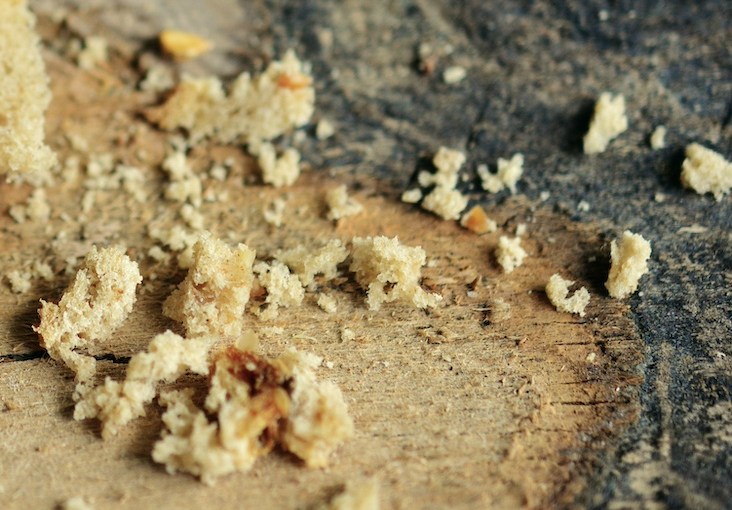
Passover begins to manifest in a tangible way, for many Jewish households, with the nullification of chametz. This year, for the first time I recall, I am noticing the word “chamira [חמירא]” in that nullification ritual and offer a few thoughts about ridding ourselves of “strong” crumbs.
A Few Basics
Instructions for Passover first appear in Exodus 12: “No leaven [שְׂאֹר — s’or] shall be found in your houses for seven days…Anything that ferments [כל־מַחְמֶצֶת — kol-mach’metzet] you are not to eat; in all your settlements, you are to eat matzot” (Exod 12:19-20, Schocken/Fox translation).
This narrative follows a few verses later: “Now they baked the dough which they had brought out of [Mitzrayim] into matzot cakes, for it had not fermented [כִּי לֹא חָמֵץ — ki lo chametz], for they had been driven out of [Mitzrayim], and were not able to linger” (Exod 12:39, Schocken/Fox translation)
The word “chametz [חָמֵץ]” comes to encompass all the grain and fermentable stuff that we’re supposed to avoid for a week in our bodies, homes, and communities. There are many teachings, over centuries and from many perspectives, about the spiritual and ethical ideas inherent in being told to look hard at all the stuff that expands in our lives and to consider how we are called to stop that process, at least for a week, for the holiday of Liberation.
On the morning before the seder, it is customary to take some chametz — breakfast leftovers or crumbs found in pre-Passover cleaning, for example — and symbolically remove it (by burning, composting, or otherwise). Then many recite a statement nullifying any remaining chametz; some add a blessing of commandment for burning the chametz.
Chamira
Rabbi Lawrence Hoffman offers a note on the language of the recitation. He points out that the Aramaic includes “two nouns, roughly synonymous, denoting leaven.” Chamiya, he says, is the result of Aramaic’s tendency to use an ayin [ע] where Hebrew uses a tzadei [ץ], so chametz [חָמֵץ] becomes chamiya [וחמיעא]. But his note about Chamira is what really caught my attention:
“Chamira has the connotation of ‘strong’ and appears, halakhically, as chumra, meaning ‘the strong [as opposed to the lenient] position.’ In English, too, ‘Do you want something strong?’ denotes alcohol (‘strong drink’ [vs. ‘soft drink’]).” — L. Hoffman in My People’s Passover Haggadah: Traditional Texts, Modern Commentaries (Jewish Lights, 2008.), vol. 1, p.94
This year, our household is facing complications due to a serious health issue affecting diet, energy, and almost every other aspect of our lives. In recent weeks, we’ve had to step back from some “strong” positions in terms of responsibilities in the outside world: relationship to paid employment, how many volunteer hours for Courtwatch, which emails to answer, which political causes to let slide. Much harder decisions involve how to show up for others in family and community through exhaustion and angst.
In the midst of all this, for this Passover, we decided — for our own family; not making any kind of halakhic pronouncement — that a lot of the “strong” had to go this year: there is some cleaning we might usually do that we cannot undertake this year, and there are some strictures around diet, to which we usually adhere, that we are relaxing.
Zombie Passover?
As we head into this festival of Liberation, I am just beginning to think about what it might mean to remove “the strong” from our lives, especially at a time when we face so many evils that need opposing and needs that require attention, locally and globally. Like many others, I was incredibly moved by Kelly Hayes recent essay, “The Zombie Dressed Up as an Ordinary Tuesday.” For so many, I believe, and for so many different reasons, this festival week is a Zombie dressed up as Passover.
In the haggadah meditation shared below, we read: “Remove tyrannical governments from the world and all who cause anguish to the Divine Presence. Blow them away with a spirit of justice…” So I ponder: To what extent is it wise to give up “the strong” ourselves and leave that to the Divine? To what extent must we work ever harder to help manifest a spirit of justice and an end to tyranny all around us? What are the lessons in nullifying chametz?
Would love to hear thoughts from others. With wishes for a liberating season to come!!!!
NULLIFYING AND DECLARING OWNERLESS
The Ashkenazi formulation includes both “nullify [בטיל]” and “become ownerless [ולהוי הפקר]” while the Sephardic statement only nullifies.
כל חמירא וחמיעא דאיכא ברשותי, דחזיתיה ודלא חזיתיה, דבערתיה ודלא בערתיה, לבטיל ולהוי הפקר כעפרא דארעא
All chametz or leaven — chamira v’chamiya [חמירא וחמיעא] — in my possession that I have seen and that I have not seen, that I have destroyed and that I have not destroyed, shall be nullified and become ownerless, like the dust of the earth.
Some begin with a blessing of commandment for burning the chametz.
A Different Night includes this meditation:
“God, may it be Your will, that just as we remove all the chametz from our house and from all that we control, so may You help us to remove all the impure forces from the earth and our evil inclinations from within us and renew our heart of flesh. May all negative forces disappear like smoke. Remove tyrannical governments from the world and all who cause anguish to the Divine Presence. Blow them away with a spirit of justice, just as you did to [Mitzrayim] and their idols in those days long ago.” — A Different Night: The Family Participation Haggadah, Rev. 2015, p.14. Shalom Hartman Institute. Noam Zion and David Dishon. No additional permission/citation.
Cropped from image of bread and crumbs by CongerDesign via Pixabay

 "A Song Every Day"