Something to Talk About: Split Binding Version

I have a very intense relationship with the book, For Times Such As These: A Radical’s Guide to the Jewish Year by Rabbi Ariana Katz and Rabbi Jessica Rosenberg. (Excerpt here: Tammuz in Times Such as These).

Having been told that it was in the works and pre-ordering it quite early, I felt involved with it before I ever held it in my hands. I’m a big fan of its authors and of Wayne State University Press, with its Jewish studies and midwest-focused titles. Then, as it happened, that fall 2023 pre-order proved a tremendous blessing in ways none of us could have imagined: In those post-Sukkot months, genocidal attacks on the West Bank, as well as Gaza, were launched with justifications based on Jewish survival and Jewish teaching; so many Jews and Jewish institutions seemed ready to turn their backs on Jewish values, so just knowing that there was a book on the way testifying to possibilities of living and organizing in Jewish integrity was a lifeline.

I participated in an on-line book event for Tu B’shvat on January 18 (2024), apparently received one of the first copies Wayne State mailed out (in late January), had my copy signed at the first book reading of the national tour (at Red Emma’s in Baltimore, March 3), and joined a second tour event in Washington, DC (May 22; more on the book and its authors’ tour).

For a book that some would still consider brand new [just over five months together, when I wrote this in July 2024] , me and my copy have been through a lot together. And, today, while deep in conversation, the book’s binding split and some pages began sliding free.

showing several loose pages
pages sliding out of perfect-bound book

…Now, maybe I was too rough. Maybe the perfect-binding did not quite live up to its name. Or, possibly, the break was some kind of organic result of considering the calamities of the month of Tammuz and questions like: “How are the hurts of your communities’ histories manifesting in the collective body?”…

However the binding break happened, I found myself thinking it was a little soon for this particular volume to join the “well-loved/much-used” stage of our relationship: Do we even know one another well enough for that!? Those thoughts led, as these things do with me, to new lyrics for “Something to Talk About.”

So, here, in honor of this whirlwind start to what I expect will be a long, loving, and fruitful relationship, is “Something to Talk About: Me and For Times Such As These” — with love and respect to Shirley Eikhard and Bonnie Raitt.

“Something to Talk About: Me and For Times Such As These

Ooh, Ooh…. People are talking, talking about reading
I hear them whisper, you won’t believe it
They think we’re lovers kept under covers
I just ignore it, but they keep saying
We meet just a little too much
Lean just a little too close
We stay just a little too long
Maybe they’re seein’ something we don’t, darling

Let’s give ’em something to talk about
How ’bout little something to talk about
How about words?

I feel so clumsy, did not expect it
you split your binding, could we be rushing, baby ?
It took the rumor to start things rumbling
Now it seems we’re already tumbling
Travelin’ through Jewish days
Cyclin’ through the whole year long
I’m hoping that you’re up for this trip
If we both know it, let’s really show it, baby

Let’s give ’em something to talk about, babe
A little mystery to figure out
Let’s give ’em something to talk about
I want your love!

Original lyrics by Shirley Eikhard (1955-2022), famously performed by Bonnie Raitt, beginning with 1991 “Luck of the Draw” album

Shirley Eikhard and Bonnie Raitt versions —

A little background on Eikhard [Archive link might be slow to open] and “six songs you should know

Split Binding (Re-)Union

Sometimes, when I wear a book out, I find a new copy. In some cases (Finnegans Wake is one), I keep the old one for sentimental reasons but use the newer copy for practical reasons. With a few books, however, the split-binding copy is the one I continue to use.

Here are the Jewish studies volumes that remain with me, for regular reference, despite binding mishaps:

  • Max Kadushin. Worship and Ethics: A Study in Rabbinic Judaism. Bloch Publishing, 1963. (Scotch-tape inside)
  • Arthur I. Waskow. God-Wrestling. Schocken Books, 1978. (Binder clip on open side)
  • Rabbi Ariana Katz and Rabbi Jessica Rosenberg. For Times Such and These: A Radical’s Guide to the Jewish Year. Wayne State University Press, 2024. (String somehow seemed appropriate for this one, but it will depend on shelf situation.)
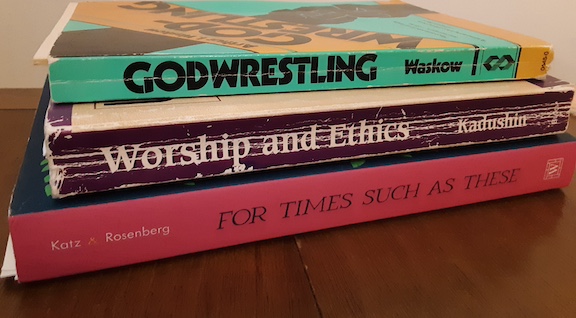
Statistically speaking, this house has many books on subjects similar to these three. And surely it must be accidental that these particular three comprise the “broken binding/still used” category. Nevertheless, the three books do seem to belong together, both in terms of theme and in terms of how essential I have found each to be, at different points in my life. So, I cannot shake the urge to anthropomorphize my new-ish book by insisting that it prematurely, purposely joined the broken-binding-brigade.

Looking at these three books, I recall that Max Ticktin (June 30, 1920 – July 3, 2016) , z”l, found Kadushin very dry as a JTS professor and was puzzled by my enthusiasm for this work, while he loved Arthur Waskow’s writing and was proud of his connections to Fabrangen Havurah. I cannot help wondering what Max would have made of For Times Such and These. I am quite sure he would have applauded this line: “We read Korah and ask, how do we organize in ways where all of us get to bring our unique and varied skills and power?” (p.326). And maybe that’s the through-line for the books in my broken-binding-brigade.

Image descriptions: 1) stack of three paper-back books — God-Wrestling, Worship and Ethics, and For Times Such as These — showing loose pages and wear. 2) Three books — For Times Such as These, God-Wrestling, and Worship and Ethics — shown cover out: first, held together by string; second, with a large binder-clip; third shows ragged pages (bound with tape).

-#-

Map Your Heart Out: A Few Sources

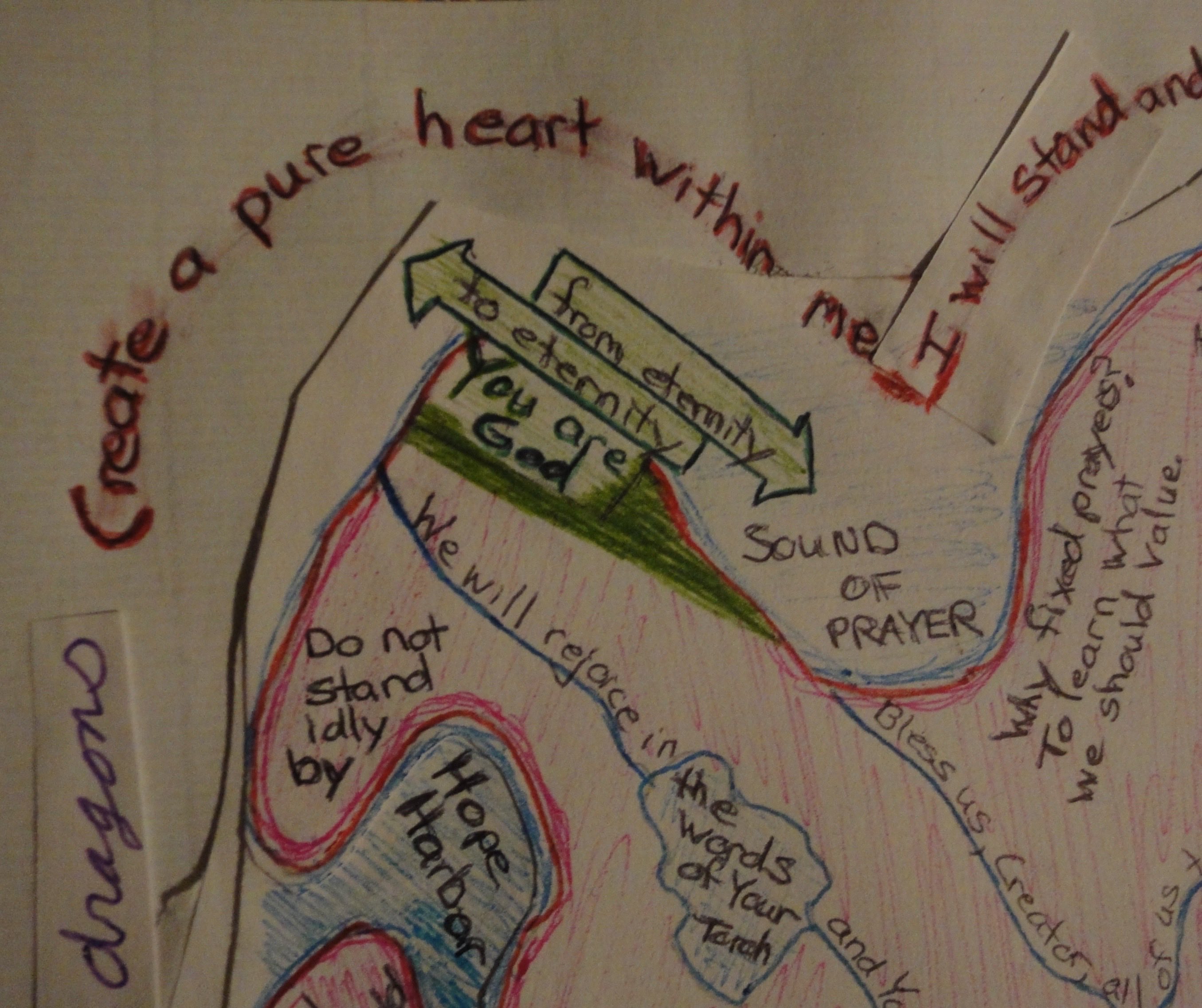
Here, as promised a few days back, are some of the sources that I included in my prayer “heart map”….

Overall structure is formed by two lines from this kavanah [intention] for the Amidah:

heart_corner

Create a pure heart within me
let my soul wake up in Your light.
Open me to Your Presence;
flood me with Your holy spirit.
Then I will stand and sing out
— Stephen Mitchell, based on Psalm 51
Mishkan T’filah, p.75

Orientation

Orienting the map is the phrase, “From eternity to eternity, You are God [מן העולם ו’עד העולם אתה אל],” from the “Nishmat” prayer, in the Shabbat/Festival morning service. Also near the top of the map, to highlight its influence — like minerals in the hills, carried by rivers and run-off to parts below — is this brief commentary:

Why fixed prayers?
To learn what we should value,
what we should pray for…
— Chaim Stern, p. 437 Mishkan T’filah

This note comes from the prominent liturgist Rabbi Chaim Stern (1930-2001); it was also found in Gates of Prayer (1975) and other Reform prayerbooks.

Connection and Points Beyond

Two rivers, running the length of the heart territory and connecting various regions, begin with “We will rejoice in the words of Your Torah…” and “Bless us, Creator, all of us…” (The first is from the Evening service, before the Shema; the second, from the Morning service, at the close of the Amidah).

The prayers themselves remind us over and over again of connections between prayer, study, and acting for justice in the world. See also, to take just two examples, Max Kadushin’s Worship and Ethics (1963, republished 2001 by Global Publications) and Marcia Prager’s Path of Blessing (NY: Belltower, 1998).

At one edge of the map, the injunction, “Do not stand idly by (Leviticus 19:16), hugs “Hope Harbor.” Farther beyond, outside the heart and its surrounding waters, the terrain is less certain.


NOTE

Here’s a link to some background on this project and my whole map. Also linked is information about cordiform maps more generally and about the book suggesting “Personal Geographies.”

The graphic aspect was very helpful to me, but I don’t think it’s necessary to draw or color in order to consider what prayers or texts would play a prominent roll in your own “heart map.”
BACK

Prayer in the Midst of Bullets and Bombs

Decades ago, Yehuda Amichai wrote about the diameter of a bomb — thirty centimeters, with circles of pain outward from its center. (English here).

photo: Treona Kelty
photo: Treona Kelty

Similarly, every bullet leaves pain in circles rippling outward.

We also know that kindness has a ripple effect,
and many people think prayer works this way, too.

The 20th Century rabbi Max Kadushin asks us to notice that the Amidah (“Standing prayer,” the central prayer of a Jewish service) begins with one opening blessing formula and then proceeds with a series of prayers that use only a closing formula.

…Jewish blessings are frequently structured with an opening and closing formula book-ending the content. The unusual structure of the Amidah, he says, creates a “cascade of blessing,” growing from the first blessing outward….

If everyone on the outer edges of pain ripples
sends blessings inward,
a lot of healing energy
will wend its way toward those most in need…
with most of us in a position
to both send and receive.

Max Kadushin. Worship and Ethics: A Study in Rabbinic Judaism. (NY: Bloch, 1963)


Treona Kelty is founder of Beautiful U Yes U, see also Facebook.
This photo is from their office this summer.

Consequences, part 2 (beyond 26)

We passed the mid-point in the omer journey away from oppression, this week, at the same time that Freddie Gray’s death at the hands of Baltimore police evoked response all across the U.S., inspiring the message: #BlackSpring has begun.

BlackSpring-HiRes-476x500
There is still much for privileged and oppressed people to learn about how the system works to keep some people down and what it will take to undo that system. And we are still weeks away from Revelation at the holiday of Shavuot. But this seems a moment of turnaround. And I think perhaps we can find a pivot point in considering language — as both a potential stumbling block before (all of us) blind and as a tool for finding a new path.

One of my favorite teachers on Jewish prayer, Max Kadushin, offers some hints for a way forward.

Larger Self, Collapsed Time

Kadushin describes Jewish prayer, particularly recitation of a blessing, as “an element in a moral experience,” one that engages an individual’s “larger self.” He notes that many Jewish prayers are in the first person plural, even though the pray-er may not, depending on time and circumstances, have the need expressed in the prayer:

How is it that the individual can regard common needs as “his needs,” even when they are not at the same time his own needs at all?

[In recitation of a blessing] not an actual experience, but the sheer knowledge of a common need of man is now the occasion for an individual’s petition and he regards the common need as his need.

The larger self allows an individual to be aware, poignantly aware, that there are others [for example] who are sick; the awareness is so strong that he associates himself with them, though at the same time retaining his self-identity….Self-identity is retained and material circumstances of the individual have not changed; nevertheless, the self has become larger, more inclusive: large enough to include indefinite others and a consciousness of their needs.
— Max Kadushin, Worship and Ethics: A Study in Rabbinic Judaism. (NY: Bloch, 1963), p.108-109

Kadushin also speaks of prayer collapsing time, so that the travails and delights of the past and a future of blessings we have not yet experienced coalesce in the present. It is in this prayer experience, heavily influenced by language, that the seeds of change are nourished.

We counted 26 on the evening of April 29. Tonight, we count…. Continue reading Consequences, part 2 (beyond 26)