What Now? Where to?

Realizing this blog hasn’t posted anything in a long while. Author is working on a book — hope to share in some form sometime soon — and dealing with a variety of pressures from daily life and city and national worries. So, just by way of greeting, sharing pictures of DC Tefillin Barbie in 1) her sukkah, surrounded by message-filled images and a shelter, however shaky; and 2) post-sukkah sparseness, trying to figure out what is next.
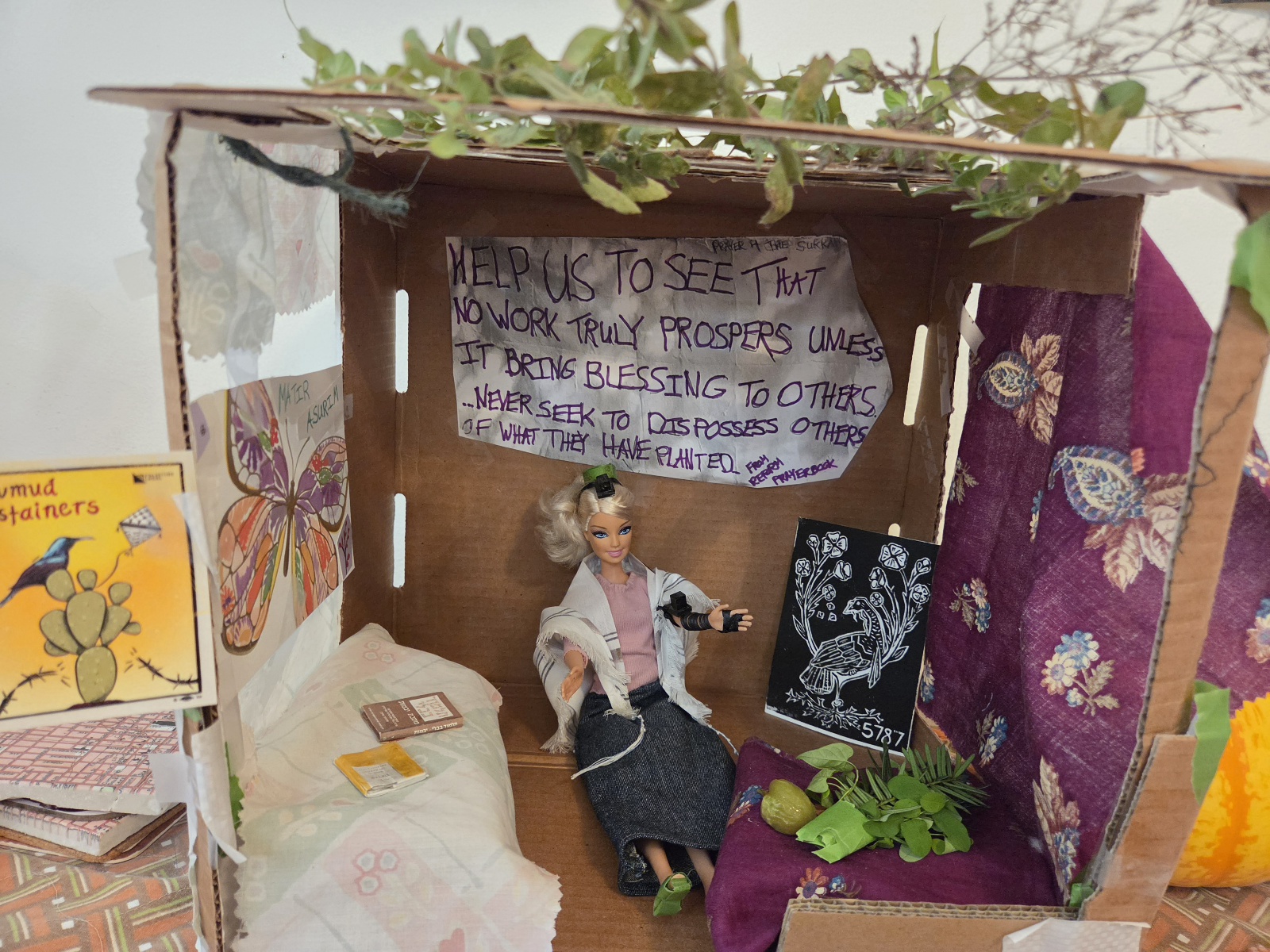
DC Tefillin Barbie in her cardboard and cloth sukkah with dried greenery roofing. Tefillin Barbie wears store-bought clothing, tallit and tefillin crafted by soferet Jen Taylor Friedman plus homemade kippah and shoes. Furnishings and lulav and etrog are homemade. More details in post.
DC Tefillin Barbie in her sukkah, 5787. Full description below.
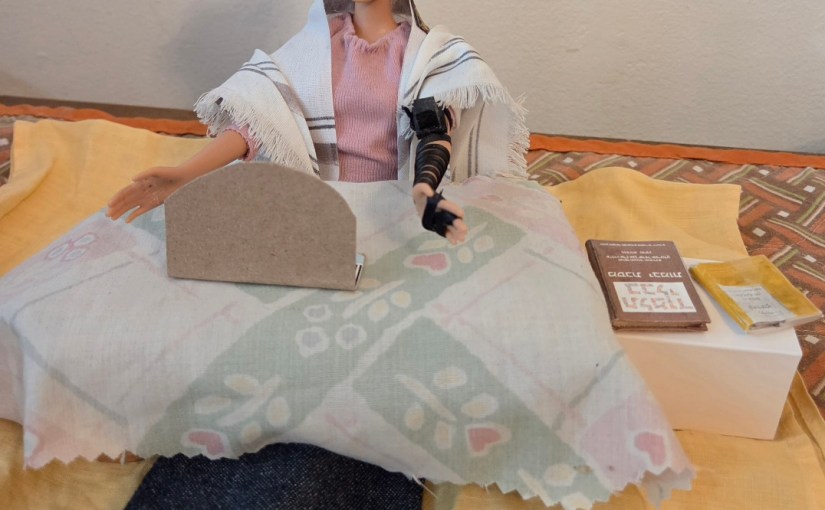
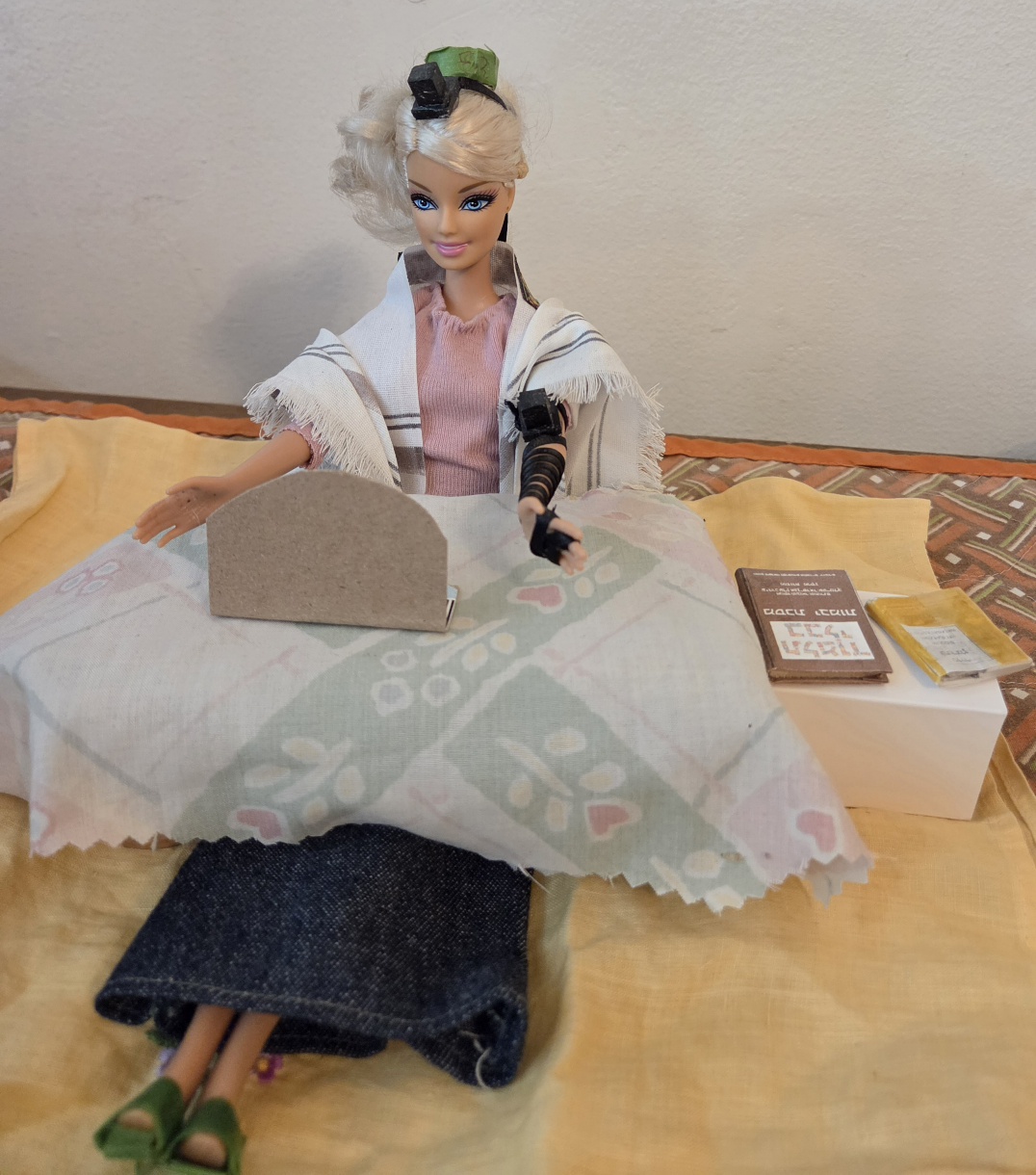
DC Tefillin Barbie (see post for details on her appearance) at a table with a laptop. Talmud volume and siddur are off on a side-table.
DC Tefillin Barbie at her laptop, post-Sukkot 5787.

Barbie in 5787 Sukkah. DC Tefillin Barbie in her cardboard and cloth sukkah with dried greenery roofing. Tefillin Barbie wears store-bought clothing, tallit and tefillin crafted by soferet Jen Taylor Friedman plus homemade kippah and shoes. Furnishings and lulav and etrog are homemade, so is tiny siddur (a replica of Siddur Eit Ratzon). Soferet Friedman supplied the Talmud volume, when Barbie arrived in DC in 2014. Decorations include a sign reading “Help us to see that no work truly prospers unless it bring blessing to others…never seek to dispossess others of what they have planted.– from Reform Prayerbook” (This is included as a wall in her sukkah every year, based on a larger canvass sign that once hung in the Occupy K Street sukkah and now usually hangs outside the larger, outdoor sukkah); a “Sumud Sustainers” image from Palestinian Legal including a keffiyah-kite is visible near the front (new for 5787), and a piece of artwork from a friend is in the back (also new for 5787).

Barbie post-Sukkot. DC Tefillin Barbie (see above for details on her appearance) at a table with a laptop. Talmud volume and siddur are off on a side-table.


Just BTW: We were assured by our local Councilmember that National Guard would be told to honor the law and stay 50′ away from Ballot Drop Boxes. But this was the view on the eve of voting.
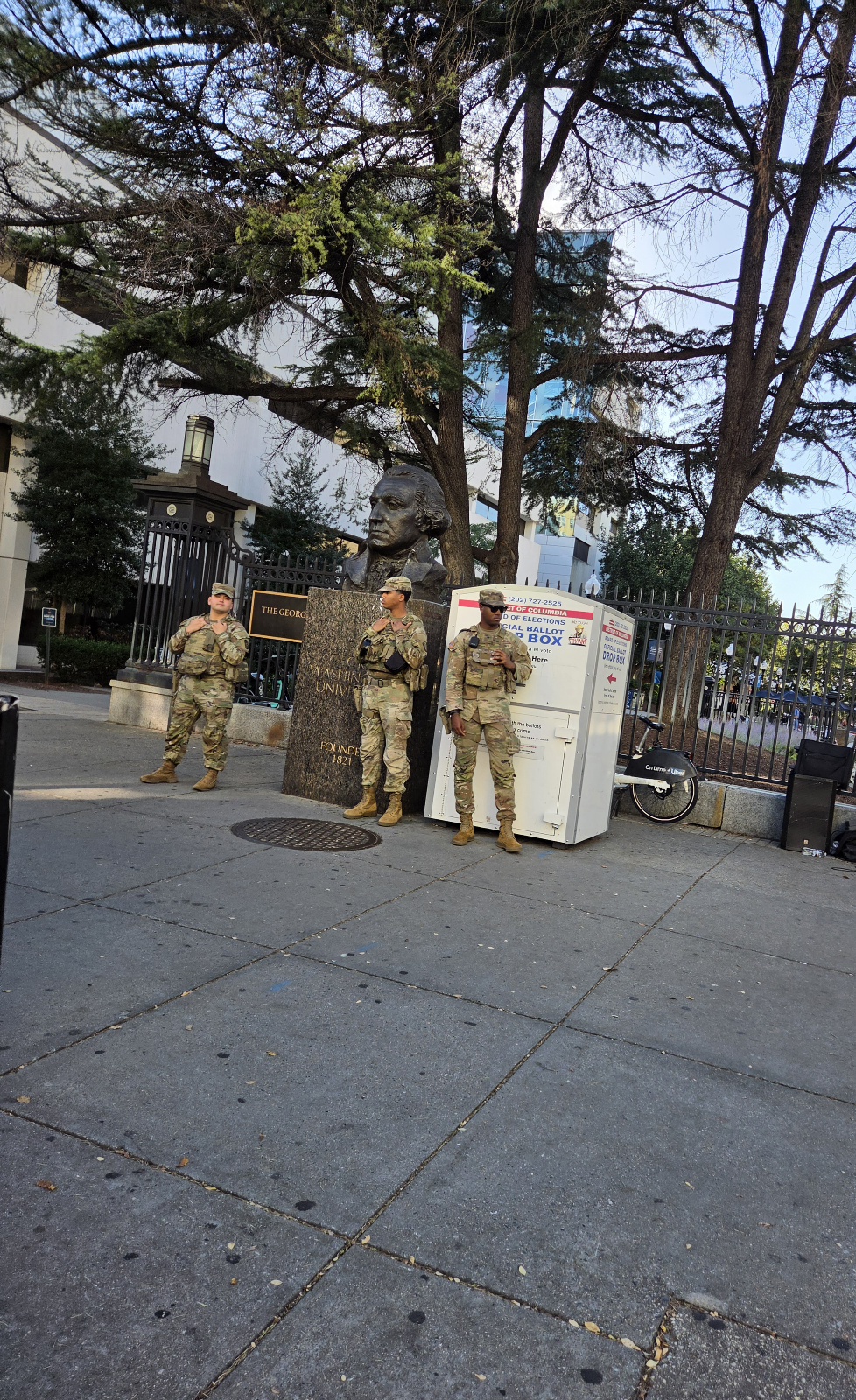
Three National Guard standing at drop box for ballots near Foggy Bottom Metro station and GW University (Northwest DC) at rush hour, October 8, 2026.
National Guard violating law on Oct 8, 2026. Better soon?

Three National Guard standing at drop box for ballots near Foggy Bottom Metro station and GW University (Northwest DC) at rush hour, October 8, 2026. Directly violating current law. See, e.g., Brennan Center, The Conversation, and NPR. See also DC Board of Elections.
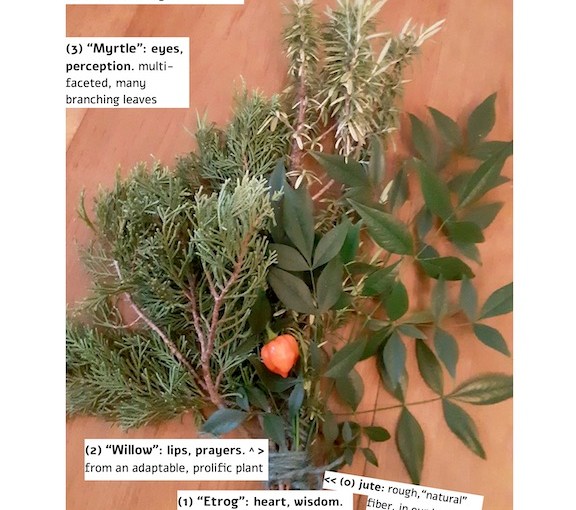
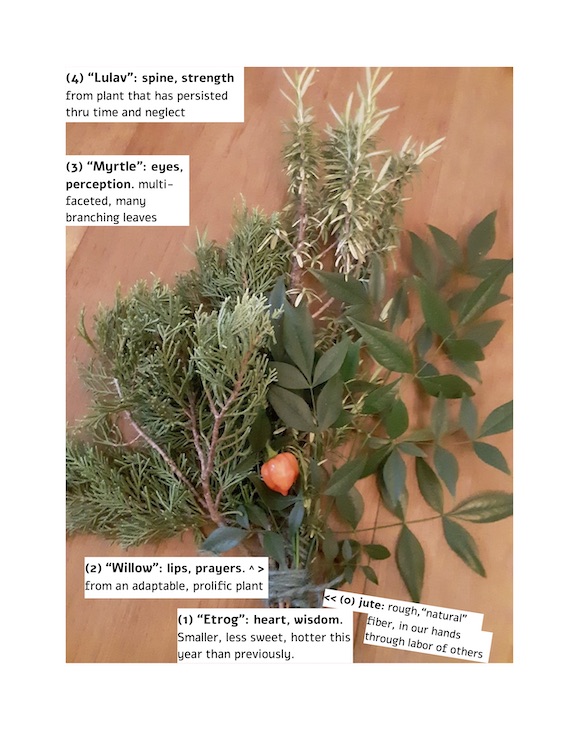
Homemade Lulav for 5784

green branches of three types and tiny orange, somewhat rounded pepper with annotations: 1) "Etrog": heart, wisom. Smaller, less sweet, hotter this year than previously. (2) "Willow": lips, prayers, from an adaptable prolific plant; (3) "Myrtle": eyes, perception. multifaceted, many branching leaves. (4) "Lulav": spine, strength, from plant that has persisted thru time and neglect. (0) jute: rough, "natural" fiber, in our hands through labor of others.
homemade lulav for 5784

Alt test and description: green branches of three types and tiny orange, somewhat rounded pepper with annotations: 1) “Etrog”: heart, wisom. Smaller, less sweet, hotter this year than previously. (2) “Willow”: lips, prayers, from an adaptable prolific plant; (3) “Myrtle”: eyes, perception. multifaceted, many branching leaves. (4) “Lulav”: spine, strength, from plant that has persisted thru time and neglect. (0) jute: rough, “natural” fiber, in our hands through labor of others.

For Shelter Protecting ALL of Us

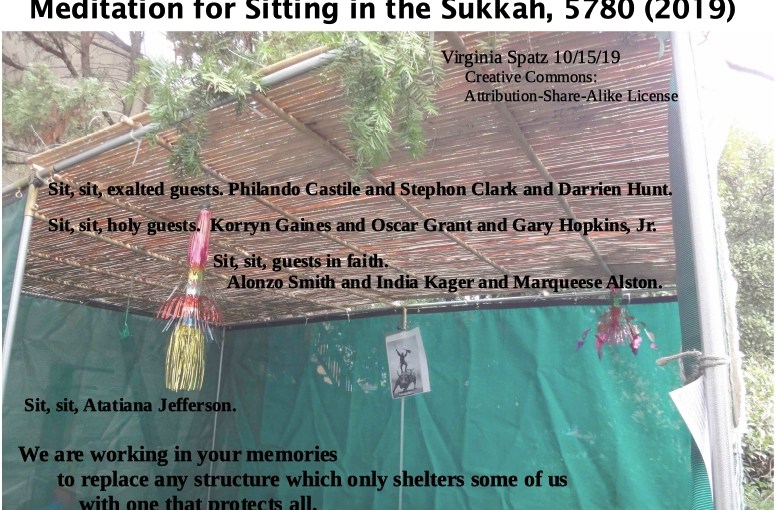
Meditation I wrote today contemplating the sukkah and the state of our shelters: the temporary ones Jews put up this week and the longer term ones that the state pretends to offer to all.

For Shelter Protecting All_Sukkot5780 (PDF) contains meditation for sitting in the sukkah while conscious of the lack of shelter available to Black people when police are around as well as a meditation for waving the lulav on a related theme. Some of the latter is based on an earlier meditation created for Occupy Judaism in 2011.


Dwelling Within a Fallible Construction

Sukkot is the holiday “most closely associated with the Oral Law,” according to Rabbi Joseph Soloveitchik, as so much of the holiday — from identifying “p’ri eitz hadar” [“fruit of goodly trees”] (Lev 23:40) to determining what constitutes a sukkah — is determined via Oral Law (see below). Taking this thought one step further: Throughout this holiday, we dwell, more literally than usual, within a divine-human collaborative construction.

hoshana1Each year, we erect a new structure resembling the ones our ancestors built but using the materials and hands available to us at the time. Each year, our conception of Torah carries the teachings of our ancestors but makes use of new insights and adaptations to changing circumstances.

Sukkot asks us to dwell, for a time, deeply in shakiness: for some this translates into awareness that all depends, ultimately, on God; for others, the focus is on interdependence with others in living through forces far beyond our control.

In the sukkah we also dwell, for a time, deeply in an awareness of the human, fallible construction of our Torah understanding and of our abilities, individually and collectively, to put Torah into practice.

As we prepare to leave the sukkah, we may hope that next year’s construction will be of even stronger, more beautiful materials erected by even surer hands. But that hope for the future need not throw doubt on the value of this year’s construction or diminish our enjoyment in this year’s dwelling place.

Only through the Oral Law, can we identify the words
פרי עץ הדר with an etrog, the fruit of the citron tree. The Beit HaLevi (Derush 18) suggests that it was on Yom Kippur, when Moses came down with the second Tablets, that the Oral Law was conferred on the people of Israel. But while Yom Kippur commemorates the giving of the Oral Law, Sukkot is the holiday which actually celebrates it. The Sadducees and Pharisees argued about some very basic rules involving the Sukkot festival. Indeed, what is a sukka? What should its height be? From what materials may it be made? The vast majority of the rules of Sukkot are oral traditions from Sinai. Sukkot is therefore the festival of the Oral Law.
— Koren Mesorat HaRav Siddur p.891-893

BACK