We’re past, just barely, the lowest point in the Jewish calendar. The climb up from the bottom won’t be easy or swift. This post invites a pause at this point of transition between moments “of affliction” and those “of comfort.” (Calendar note below)
The first “haftarah of affliction” (prophetic reading of warning in lead-up to Tisha B’Av) is Jeremiah 1:1 – 2:3. In this passage, God’s conversation with Jeremiah begins with the prophet in the womb (1:5) and then protesting that he is still a youth and “doesn’t know how to speak” (1:6). It closes with a message of God’s nostalgia a long-past honeymoon period with Yisrael (Jer 2:2-3), more positive in divine recollection than in what the Torah tells us of those “wilderness years.”
The third haftarah of affliction, Isaiah 1:1-27, speaks of the People as rebellious children (1:2) and expresses frustration and despair. But it also offers instruction and hope. (See also “How?! A Roadmap for Transformation” post and PDF).) In one noteworthy expression, God proposes a kind of joint process: “Lekhu nah v’nivakh’cha [לְכוּ־נָא וְנִוָּכְחָה], Let us please walk/move together and let’s understand this.” There’s a lot to unpack here, in terms of power dynamics — see also Computing Failures and Babylon. But one key element seems to be that, even in the midst of disaster, there is a way out.
The middle haftarah of affliction, centering on Jer 2:4-28, includes a verse that seems to resonate with many of us this year in particular:
For My people have committed two evils: They have forsaken Me, the fountain of living waters, and hewed them out cisterns, broken cisterns, That can hold no water.
…Some of these remarks were shared in a slightly different form with Tzedek Chicago for Tisha B’Av 5785 and build on learning within that community…
Stone well with wooden cover. Image by Bernd via Pixabay
Moving Toward Post-Upset Relationship
One way to view this series is as a relationship growing up: That is, it begins in reading 1 with an unrealistic view of relationship — as is common both at the start (when expectations may be great) and later on (in missing the good old days that never were) — of romantic sort as well as in collectives and communities. It closes in reading 3 with the instruction to “Learn to do good” (Isaiah 1:17), which refuses to let the relationship just whither, and the request (1:18) that we work this out together to move ahead… in what might seem like a more equitable and/or realistic relationship.
In the middle, we have God acknowledging brokenness — cisterns that are not functioning in nourishing ways — while simultaneously reminding us that we have access to the source, the Fount of Living Water. As if God were saying, through Jeremiah: “You’ve already got Torah, but human language and problems have realy messed up how you’re perceiving and acting on it: You’re trying to hold Torah in shapes that broke long ago.”
The point is, I think, is that we are not without resources and power. In fact, God seems to be furious that we cannot figure out how to use what we have in ways that nourish everyone.
As Rabbi Brant Rosen, at Tzedek Chicago, and Rabbi Jessica Rosenberg, who helped teach the “Facing Collapse Together” workshop, and many others have said recently: Some things we used to rely on are broken beyond repair, and maybe that’s good.
We’ve got a complex set of traditions that we have to sift through to find what still holds water, so to speak. We’re going to have to find some kind of new container for Torah. We have to do this together in community, even as so many structures and relationships are stretched to the brink, if not beyond. The world is putting so much stress on each of us individually, and ripping at our collectives, so we’re going to have to work harder to be sure that we’re building community that honors each of our participants and helps us figure out how to create cisterns that reflect and nourish all.
Shifting Power
Part of the struggle is in learning how to function in, with, and in opposition to power…. which reminds of this prayer-song, published more than four years ago —
— and somehow more poignant, now, as Jews continue to grapple with what influence we have or do not have in government wherever we are (DC doesn’t even have a Senator or voting representation in the House); what avenues are open to stopping US support for genocidal war and land-grab in Gaza AND the West Bank; and what collaborative efforts are possible, given our shifting communal boundaries.
Maybe we’ve got to approach the border, like that sea, anew and find a new song.
Calendar Note:
Here, for anyone interested, is a summary of the time periods known as “The Three Weeks,” “the Nine Days,” and “the Nine Days of Jerry” (or the “Days Between”):
Jeremiah 1:1-2:3 was read this year on Shabbat Pinchas, July 19, 2025.
Jeremiah 2:4-28 was read this year on Shabbat Mattot-Masei (July 26). Ashkenazi tradition ends with Jer 3:4; Sephardic tradition ends with Jer 4:1-2; some communities include additional verses for Rosh Chodesh Av.
Isaiah 1:1-27 was read this year on Shabbat Devarim (Shabbat Chazon), August 1.
Haftarot of Comfort begin with Isaiah 40:1-26, read in 5785 on August 9, on Shabbat Nachamu, and continue through Av and Elul toward the high holidays.
Presentation title page: “Matir Asurim: Introduction to the Jewish Care Network for Incarcerated People,” Yom Kippur 5785 — Virginia Avniel Spatz. + Tzedek Chicago logo
Some of us have been worshiping together for much of the day. Others may be joining from another context. Either way, I hope this hour will bring focus to one way we can engage in teshuvah/repair for the coming year. The basic concept for this session is that I was asked to share a little about my volunteer work with the organization, Matir Asurim: The Jewish Care Network for Incarcerated People, and bring some text to link that work with Yom Kippur.
Overview, Basics, and Contacts
[SLIDE 2]. The planned shape of the session is:
Basics and contact information for myself and the organization Matir Asurim
Text exploration: Genesis 44
Matir Asurim Guiding Principles
Back to Genesis 44
Thoughts for Yom Kippur and into 5785
So, let’s get started with some basics
[SLIDE 3] Matir Asurim — “One Who Frees Captives”
Who We Are: “We are a collection of Chaplains, Rabbis, Cantors, Kohanot/Hebrew Priestesses, advocates, activists, volunteers, loved ones of incarcerated people, and people with direct experience of incarceration. We are an all volunteer group who began meeting in 2021. We live and work across Turtle Island, in territories, cities, and rural settings of the US and Canada.”
I’ve been volunteering with Matir Asurim for close to two years,
producing the monthly e-newsletter,
serving as a penpal/chevruta partner with an incarcerated Jew,
helping to create resources for readers who are incarcerated,
helping craft materials for outside readers around incarceration,
producing some additional programming,
and working on organizational infrastructure.
We’ll get into some more specifics a bit later. Meanwhile, some contacts:
[Summary] Joseph is 12th of 13 siblings in the family of Jacob, Rachel, Leah, Bilhah, and Zilpah. In his youth, he was the favorite of his father, Jacob, and an annoyance to the rest of the family. So, Joseph’s brothers attempt to get rid of him. Their scheming takes an odd turn, however, and, although his family does not know it, Joseph becomes a powerful government leader in Mitzrayim, second in command to Pharaoh.
When famine strikes in Canaan, Jacob sends the brothers down to Mitzrayim, where grain is plentiful, to beg food. Joseph, still unrecognized by his brothers, treats the brothers to a feast at the palace and grants the requested supplies.
Joseph also orchestrates a criminal charge against the youngest brother – thus creating a situation in which the older siblings can again harm a younger brother, or they can act to avoid such harm.
Genesis 44 starts as the brothers leave the palace with the supplies.
[SLIDE 5] Genesis 44 Revised (2023) Jewish Publication Society translation, via Sefaria
1) Then he [Joseph] instructed his house steward as follows, “Fill the men’s bags with food, as much as they can carry, and put each one’s money in the mouth of his bag.
2) Put my silver goblet in the mouth of the bag of the youngest one, together with his money for the rations.” And he did as Joseph told him.
3) With the first light of morning, the men were sent off with their pack animals.
4) They had just left the city and had not gone far, when Joseph said to his house steward, “Up, go after those men! And when you overtake them, say to them, ‘Why did you repay good with evil?”…
[The house steward follows Joseph’s orders, going after the brothers and accusing them of stealing the goblet.]
12) He searched, beginning with the oldest and ending with the youngest; and the goblet turned up in Benjamin’s bag.
13) At this they rent their clothes. Each reloaded his pack animal, and they returned to the city.
[SLIDE 6] (Genesis 44 cont.)
14) When Judah and his brothers reentered the house of Joseph, who was still there, they threw themselves on the ground before him.
15) Joseph said to them, “What is this deed that you have done? Do you not know that a man like me practices divination?”
16) Judah replied, “What can we say to my lord? How can we plead, how can we prove our innocence? God has uncovered the crime of your servants. Here we are, then, slaves of my lord, the rest of us as much as the one in whose possession the goblet was found.”
17) But [Joseph] replied, “Far be it from me to act thus! Only the man in whose possession the goblet was found shall be my slave; the rest of you go back in peace to your father.”
18) Then Judah went up to him and said, “Please, my lord, let your servant appeal to my lord, and do not be impatient with your servant, you who are the equal of Pharaoh. [Link to bilingual English/Hebrew at Mechon-Mamre]
pray let your servant speak a word in the ears of my lord,
יְדַבֶּר־נָא עַבְדְּךָ דָבָר בְּאׇזְנֵי אֲדֹנִי
and do not let your anger flare up against your servant,
וְאַל־יִחַר אַפְּךָ בְּעַבְדֶּךָ
for you are like Pharaoh!
כִּי כָמוֹךָ כְּפַרְעֹה׃
va’yigash eilav…
This expression, va’yigash eilavis, is worth considering. It comes up in midrash about this Torah story and it appears in Maimonides vocabulary discussion.
Jewish Teachers Discuss “Approaching”
[SLIDE 8] This is a small portion from Maimonides Guide for the Perplexed. Part 1 has many chapters focusing on Hebrew vocabulary.
BTW, I highly recommend checking out Maimonides’ vocabulary chapters, if you can. Sefaria offers free bilingual text with live links to the Tanakh verses mentioned, and I find it a worthwhile exercise to spend some time with the words Maimonides discusses.
Part 1, Chapter 18 is about three similar words: Karov, Naga, and Nagash
קרוב – נגוע – נגוש
Maimonides writes:
“THE three words karab, “to come near,” naga‘, “to touch,” and nagash, “to approach,” sometimes signify “contact” or “nearness in space,” sometimes the approach of man’s knowledge to an object, as if it resembled the physical approach of one body to another.”
He gives examples of each usage, including Gen 44:18: “…And Judah drew near (va-yiggash) unto him”
While we pursue the exchange between Judah and Joseph, it’s worth keeping this expression and the Hebrew vocabulary in mind, more generally: What does it mean to be near to another person in terms of physical space and knowledge of another?
A number of teachers over the centuries have derived lessons from Genesis 44:18. Here are two…
[SLIDE 9] va’yigash eilav yehudah…
It is asked: Judah and Joseph are already in the same room. So, why does the text tell us that Judah vayigash, “drew near” or “came in contact”?
One answer: Jacob ben Asher says:
The last letters of these three words — vayigaSH eilaV yehudaH,shin-vav-hey — spell “shaveh, שָׁוֶה [equal].” Judah’s step forward changes the dynamic, allowing the brothers to speak directly, as equals.
Another answer: The 18th Century teacher, Or Hachayim, from Morocco, cites Prov 27:19: “As face answers to face in water, So does one person’s heart to another”
Building on his teaching, we can see Judah’s step forward as an attempt to create a face-to-face encounter. This was a struggle for Judah, to step across apparent cultural differences and the gap in their positions. The result, ultimately, was reconciliation between the brothers.
This principle of seeking face-to-face interaction can be useful for the season of teshuvah to consider when taking steps in interpersonal reconciliation.
It is also a guiding principle for Matir Asurim as an organization.
Matir Asurim Guiding Concepts
[SLIDE 10] Panim-el-Panim, seeking face-to-face approach, is a guiding principle of Matir Asurim: “Seeking ‘face-to-face’ interactions, despite difference, distance and bars; approaching one another as equals and striving to work in genuine relationship.”
This shapes our penpal relationships, our creation of resources for those who are behind bars, as well as any advocacy on legislation or change of practices, regulations, and conditions inside.
Matir Asurim seeks to provide resources that reflect realities in carceral facilities which often include circumstances that contradict assumptions in much Jewish teaching
reciting prayers or reading Torah right next to toilets;
reciting daily prayers upon waking, which might not align with shacharit, morning prayers, at all;
figuring out how to create community in isolation, when so much of Jewish life assumes access to community (not exclusively an incarceration issue, but a BIG challenge for Jew who are incarcerated)
There are enormous challenges to organizing across bars, and we know that people inside are counting on those of us on the outside to organize and advocate where they cannot.
Still, it’s crucial to take our lead from incarcerated people and those who have experienced incarceration.
All people are created in the image of the Divine.
We all carry a spark of divine goodness as well as the capacity for creative action and transformation.
Teshuva [repentance/return]:
We believe in human resilience and transformation, in our ability to make amends after experiencing and/or perpetrating harm.
We practice this relationally as conflict arises within our organizing, and also strive to create a world that uplifts restorative accountability processes rather than punishment.
Refua Shleima [Complete Healing]:
We work towards collective healing and wholeness, striving to restore balanced relationships within the broader interconnected web of creation and to heal the traumatic effects of white supremacy, colonization, and other systems of oppression that affect our minds and bodies.
Learning from every person:
Learning from every person requires honoring the contributions and voices of people who have been systemically silenced, including through incarceration. In our conversations, we strive to hold awareness around differences in identity and power dynamics.
Kol Yisrael Aravim Zeh Bazeh
[All Jews Are Responsible, One to the Other]/Communal Responsibility:
“All Yisrael is responsible, one for the other.” Jews have many universalist obligations, but we also have a special duty to other Jews.
A little more on this last principle —
[SLIDE 12] Kol Yisrael Aravim Zeh Bazeh
Matir Asurim works with non-Jewish individuals and organizations on issues, trying to address needs of folks who are incarcerated and returning from incarceration in both the US and Canada.
Many non-Jewish groups are larger and better equipped to cope with more general issues, such as solitary confinement and the death penalty. We are also trying to link up with other affected groups regarding what is often called “religious diet.”
But we also focus on specifically Jewish needs: Trying to ensure that incarcerated Jews and those exploring Judaism have access to penpals and spiritual resources. In some carceral facilities, Jews are still offered a Christian bible and told to “ignore the end.” Trying to supply more appropriate resources is one goal. We also seek to fill requests for obtaining a tallit or tefillin – often an issue for those who are not recognized by Aleph (the biggest Jewish organization working in prisons, which provides resources for some Jews but not all).
[SLIDE 13] At a more basic level, we seek to increase awareness in Jewish communities that Jews DO experience incarceration and that we cannot treat incarceration as something that happens to other people.
This awareness also leads, in turn, to more general concerns about incarceration and the toll it takes on individuals, families, and society….
And that takes us back to Maimonides’ idea that “coming near” can be a matter of knowledge as much as one of physical nearness.
Back to “Coming Near”
[SLIDE 14] Back to Genesis 44
[Summary] Judah approaches Joseph and relates the brothers’ previous visit to Mitzrayim for food rations, when Joseph insisted that they return with their youngest brother. Judah includes in his tale the fiction, from years earlier, of a brother killed by a beast and their father’s real grief over the loss. Judah says that incarcerating Benjamin would increase Jacob’s pain and so offers himself as captive instead. At this point, Joseph can no longer restrain himself, clears the room of everyone except his brothers, weeps loudly, and reveals himself.
Gen 45:4-5 – Fox (Schocken) translation:
Then Yosef said to his brothers: I am Yosef. Is my father still alive?
But his brothers were not able to answer him,
for they were terrified before him.
Yosef said to his brothers:
Pray come close to me! [geshu-na eilai גְּשׁוּ־נָא אֵלַי]
They came close. [va’yigashu וַיִּגָּשׁוּ]
He said: I am Yosef your brother, whom you sold into Egypt.
This time, the same verb, nagash, that we saw in Gen 44:18 is used by Joseph to invite approach, and the brother comply. Joseph invites the brothers to hear a truth they previously did not know even though they did know they had a part in causing harm.
In the Torah, Joseph will go on to explain that it’s all good, because even though the brothers meant ill, God meant to put Joseph where he ends up. Still we can consider this verse and what it means for the brothers to hear from Joseph about his direct experience. They come close and learn something they did not know but MUST if they are to understand Joseph’s life and their own roles in the wider world which also includes incarceration as a regular part of its function.
There are ways we all can learn more about the role incarceration plays in our history and our society now and how it impacts individuals and families.
We can opt to get closer to individuals who are or have been incarcerated.
We can also opt to approach through general learning.
[SLIDE 15] They came close: approaching as a matter of knowledge
Explore the complex, interrelated stories of racism, enslavement, and incarceration; of colonialism, displacement and destruction
Learn about the over-representation of Indigenous people in US and Canadian carceral systems
Learn about the Incentive System in the Canadian carceral system
Learn about the Exception Clause in the 13th Amendment to the US Constitution
Learn about the “Auburn system” of incarceration, which predates the US Civil War and the 13th Amendment. We have a video and transcript coming soon about Freeman’s Challenge — and I recommend the book….
One of the things that Robin Bernstein, author of Freeman’s Challenge, says she was trying to do with her book is to stop letting the North off the hook in terms of responsibility for our carceral state. Many of us associate exploiting prisoners for profit with the US South and Reconstruction. But her book describes a prison for profit system that pre-dates the Civil War and originates in the North….
For me, learning about the Auburn system, which originated in upstate New York, was a real shift in my thinking. So, coming on that verse, Gen 45:5 — where Joseph says, “I am the one you sold into imprisonment,” really rings new.
More details on some of the topics above, and some related Jewish texts, are available on Matir Asurim’s Resources page — originally prepared for Passover, but also more widely applicable. For more on Freman’s Challenge, visit this page.
by what can we show ourselves innocent? וּמַה־נִּצְטַדָּק
God has found out your servants’ crime! הָאֱלֹהִים מָצָא אֶת־עֲוֺן עֲבָדֶיךָ
Here we are, servants to my lord, הִנֶּנּוּ עֲבָדִים לַאדֹנִי
so we, גַּם־אֲנַחְנוּ
so the one in whose hand the goblet was found. גַּם אֲשֶׁר־נִמְצָא הַגָּבִיעַ בְּיָדוֹ
[SLIDE 17] When Joseph orchestrates the threatened punishment of Benjamin alone, Judah says “God has found out your servants’ crime!” – ha-elohim, matza et-avon avdeikha
He then repeats the same verb, to find [mem-tzadei-aleph], and offers this poetic statement of collective responsibility:
Many teachers note that Judah seems to be acknowledging the brothers’ long-ago crime. And that verb, mem-tzadei-aleph, finding, might point us to things we might find we are complicit in, like living in a carceral state that relies on ideas of “public safety” leading to people being locked up and tortured.
Judah’s statement — “so we, so the one in whose hand the goblet was found” or “the rest of us as much as he in whose possession the goblet was found” points to an understanding of collective responsibility not unlike what we recite throughout Yom Kippur — when one of us commits a crime, we, all of us, who permitted the conditions that lead to crime, are the ones who sinned.
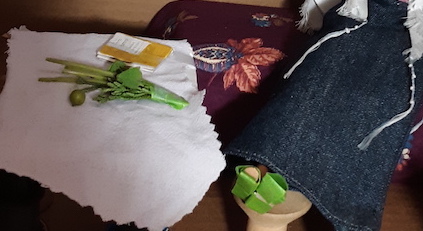
In response to social media showing “Barbie’s Dream Sukkah” (see below), I built this sukkah for DC Tefillin Barbie.
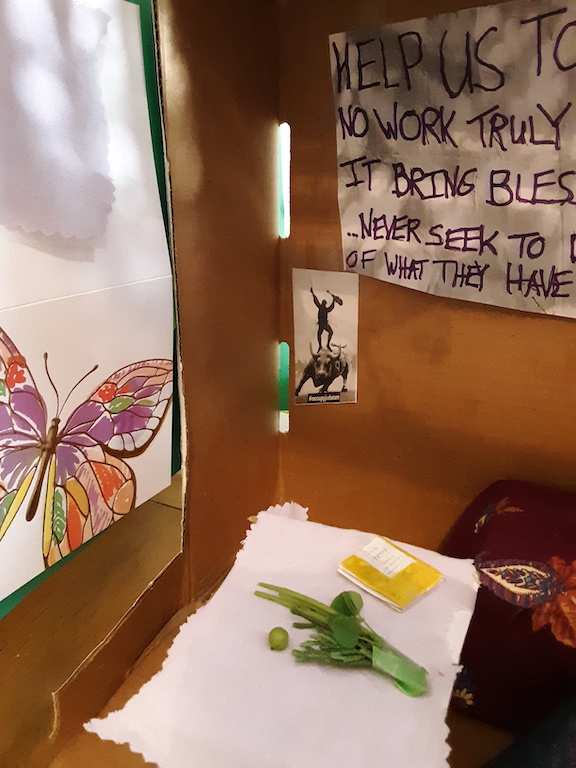
I built it the way doll dwellings were created in my youth, repurposing whatever was at hand and roughly the right scale: cardboard, empty spools of thread, scraps of fabric, an old greeting card with a pretty design…. No one I knew had any kind of “Dream” house or car, although Barbies drove or lived in store-bought items that seemed close to her size. And those “Dream” items are just as foreign today as they were back then. So DC Tefillin Barbie‘s sukkah reflects a different dream: a sheltering peace that covers us all.
DC Tefillin Barbie, Sukkah 5784
This Sukkah’s History
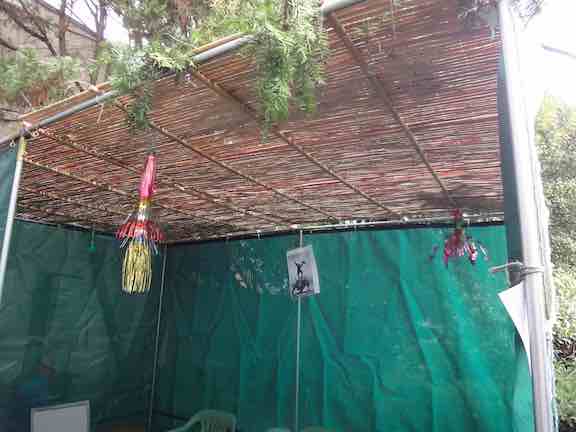
For quite a few years, the sukkah we set up outside our house also looked more like cardboard sukkah 5784 than “Barbie Dream Sukkah.”
2010 sukkah in front yard
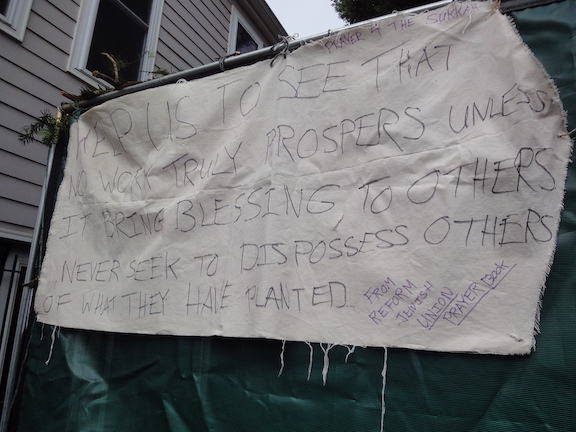
A few years ago, we gave in and bought a Sukkah Project kit; it’s a marvel of ease in so many ways, but ours retains homemade touches. Two signs in our 5780 sukkah (photos here) were created for the local (DC) “Occupy Judaism” sukkah in 2011. (The wooden sukkah once in our yard was erected at McPherson Square; the materials were absorbed into Occupy K Street after the holiday.)
Inside of our Sukkah Project version 5780Outside wall of 5780 Sukkah Project
I copied those signs for DC Tefillin Barbie’s sukkah.
Corner view of Barbie’s sukkahDC Tefillin Barbie and her makeshift “dream” dwelling
Among the items at hand, as the cardboard sukkah was built, were a button from “Coalition of Concerned Mothers,” remembering individuals killed by police, and a sticker from Prison Radio, reading “In American Prisons Life Means Death.”
See related Meditation for Sitting in the Sukkah, 2019, treating those lost to police as ushpizin, mystical invited guests; Michael Zoosman, of Jews Against the Death Penalty, wrote an ushpizin-related meditation this year, focusing on those executed by the state. These items were added as decorations meant to remind DC Tefillin Barbie and visitors to reject “any sense that we are somehow entitled to dwell in safety…when others cannot.”
Barbie, Her Dreams, and Sukkot
This past Shabbat (9/30/23), Tzedek Chicago explored the concept of p’ri eitz hadar — the goodly fruit. So many interesting ideas and related study were raised. In addition, I found this note from some years back about Rabbi Joseph Soloveitchik’s linking Sukkot to the Oral Law and my own prayer for living in the fallible structure of the sukkah and of our individual and collective understanding of Torah.
I wrote at the time (and had completely forgotten): “As we prepare to leave the sukkah, we may hope that next year’s construction will be of even stronger, more beautiful materials erected by even surer hands. But that hope for the future need not throw doubt on the value of this year’s construction or diminish our enjoyment in this year’s dwelling place.” This year, I have really struggled with “the enjoyment of this year’s dwelling place.”
I still haven’t seen the Barbie movie and don’t understand a lot about Barbie culture. But I am find myself hoping there are other Barbies out there enjoying their own “dream” sukkot. May we all dwell — if only for a few moments — in structures that honor life’s fragility and our responsibility to create stronger, more inclusive shelters. And may we find ways to work together to bring the dream closer in the coming year.
Barbie Dream Sukkah
In late September 2023, Hey Alma posted these images on Instagram, saying “this is the vibe we’re going for this year.” Comments varied hugely, from enthusiasm for the “vibe” and the opulence of the sukkah itself to wrath at the AI-generated images. A FB post (not Hey Alma) drew criticism because Barbie’s clothes are not tzniut (modest) and the sukkah is pasul (not kosher). I cannot find any credits for the images, which also appear on this site. I first saw these images, shared by Rabbi Brant Rosen, during Torah study with Tzedek Chicago.
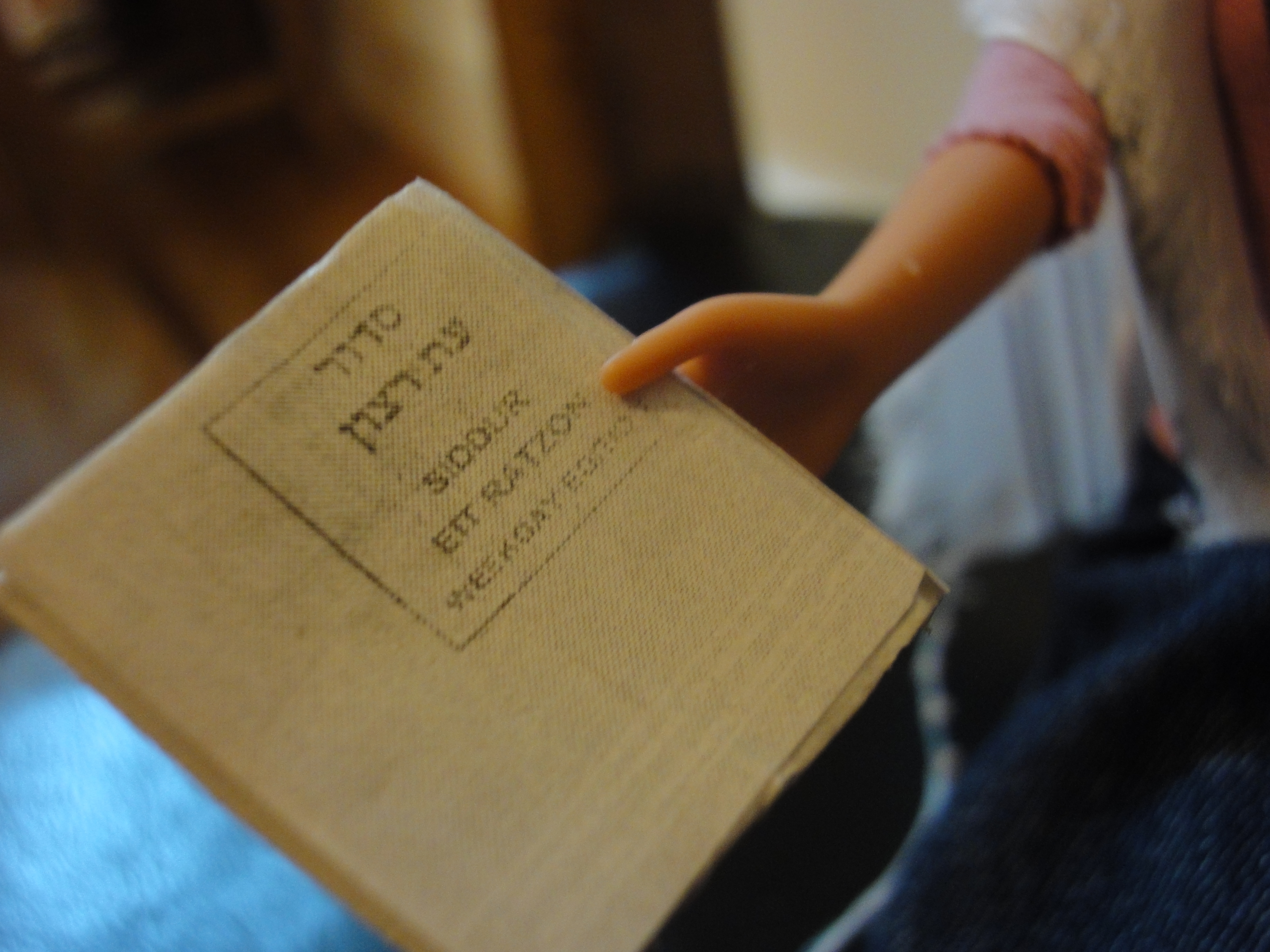
Soferet Jan Taylor Friedman offers much information in relation to her amazing Tefillin Barbie project. Here’s info about my own changes to the Barbie who arrived in 2014. In addition, note: DC Tefillin Barbie holds by Rabbi Isserles who ruled that tefillin are worn on intermediate days of Sukkot — and she lives in her own personal time zone where it’s always eit ratzon, a good time, for prayershawl and tefillin.
Siddur Eit Ratzon
She, like me, is experimenting with locally sourced lulav and etrog as part of a wider exploration of Diaspora Judaism.








 "A Song Every Day"