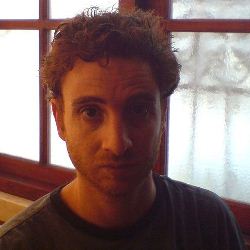
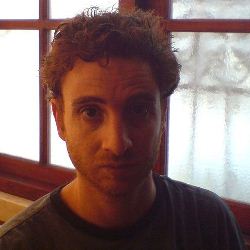
Almog Behar (b. 1978)

Almog Behar was born in Netanya and lives in Jerusalem. He is a scholar, poet, and writer in other genres. More at Poetry International and Institute for the Translation of Hebrew Literature

Here is the poet reading in Hebrew and then Arabic the poem “My Arabic is Mute.” Click through to YouTube to see the full text in an English translation and/or compare different translations in the PDF linked below.

Hebrew, followed by Arabic, reading of “My Arabic is Mute”

Take This Poem and Copy It

This work is described as a “new draft version of collected translations of my poems and stories and some other texts, under the title: ‘Take This Poem And Copy It,’ in a bilingual edition, Hebrew and English.” Behar notes that it’s still a draft and that all are “welcomed to download, read, share and comment.” (He also mentions hoping part will be ready for publication in a year [from 2017]; not clear if that has materialized yet.)

One interesting aspect of this publication is that Behar’s Hebrew poems are followed by more than one English translation, beginning with the eponymous poem in two translations. The PDF also offers a selection of English verse translated into Hebrew by Behar as well as essays, stories, and interviews. Here’s the link to download the full book, free of charge: Take This Poem And Copy It

Here is a brief introduction to the work, including English readings, from 2017 when it was released — from Marcela Sulak’s podcast.

His Academia page shares papers, prose, and poetry in several languages, including an Academia link to the draft described above.

Vaan Nguyen (b. 1982)

Vaan Nguyen lives in Jaffa. In addition to publishing poetry, Vaan has worked as a television actor and on a film documentary, and as a journalist.

Her poetry has been published in Hebrew and translated into English and French. A bilingual (Hebrew/English) print edition of The Truffle Eye is available from Zephyr Press. She is part of Gerila Tarbut (Cultural Guerilla), a collective of Israeli and Palestinian poets, artists and activists.

Poetry International bio and links page

Sitting with Strangeness: A Conversations with Adriana X. Jacobs — 2017 TLV1

Vaan Nguyen’s poetry collection The Truffle Eye — 2020 TLV1

“Where are you from: The poetry of Vaan Nguyen” by A.X. Jacobs can be found at Academia

The poet reads her own work (Hebrew) —

Translator Adriana X. Jacobs reads “Nomad Poem” (English) —

Amichai Chasson (b. 1987)

Poet, film director, editor at Mashiv Haruach, and director of Beit Avi Chai cultural center in Jerusalem. Professional bio, more at Poetry International).

Israel in Translation podcast (from October 2019)

A few of the poems available in bilingual form at Poetry International:
America
“My Father Was a Wondering Aramean (a poet in New York City)”
The Moon Grove
Self-Portrait

Here is “My Grandfather’s Cane” in Hebrew

Photo is still from “My Grandather’s Cane” video.

Admiel Kosman (b. 1957)

Several poems from Admiel Kosman, born in Haifa in 1957, are available — in Hebrew, Hebrew transliterated into Roman alphabet, and English.
at Soul and Gone.

Admiel Kosman is professor of Talmud and rabbinic literature at the School for Jewish Theology at the University of Potsdam and a prolific poet in Hebrew. His first book of poetry translated into English was published in 2011 and is available in a bilingual edition. His blog (apparently stagnant at present), is available in English and Hebrew. See also bio at Institute for the Translation of Hebrew Literature.

Here’s an excerpt from Poetry International’s description‘s of his work:

The speakers in his poems do not recognise the emotional separation wall from the Other and sometimes converge, or acknowledge difference and feel the Other’s pain: one speaker is a biblical Jew and at the same time a Palestinian worker, both in love and barred from the spiritual and physical Jerusalem; in another poem, a Jew talks to God in a ‘foreign’ language, i.e. not in Hebrew, unconcerned that he may be classified (and crucified) as Christian; in yet another, a Jew searches for a sleeping God in four Moslem cities, two of which are at the same time (as they really are) also Jewish holy cities: “Mecca or Medina. / Jerusalem or Hebron.” But Kosman’s focus is not only local. His range is broad: a childhood wound, hidden in the middle of a boast about the ability to make verse out of any material; the influence of English and computers on language; love poems; and poems of ars poetica.

Piyyut, Mashiv HaRuach

Kosman’s “Piyyut for Mussaf of Rosh Hashana” appears in Machzor Lev Shalem (Rabbinical Assembly 2010) in Hebrew and translation by Aubrey L Glazer.

A musical version — composed and sung by Atalya Lavi — was released in 2016. Lyrics are in Hebrew, but the Shevarim page includes Glazer’s translation as well as the full Hebrew.

וְאֵיךְ אַתָּה מַבִּיט מִלְּמַעְלָה? פּוֹתֵחַ עוֹד שָׁנָה
וְאֵיךְ אַתָּה סֻפַּר אוֹתָנוּ, כְּמוֹ כְּבָשִׂים פועים,
קְרֵבִים אֵלַיִךְ, לַבַּמֶּה? [sorry — question marks don’t cut and paste well]
And just how are you looking down from on high?
beginning another year?
and just how do you take account of us, as bleating sheep, approaching you, on the platform?

Anthologies and General Resources

Bilingual, English-Hebrew Publishing

Bilingual editions of poetry originally published in Hebrew are not easy to find. Here are some options, including some from U.S.-based as well as Israeli authors.

Hebrew Poetry in Translation

Just a few sources. More to be added as time permits — and please suggest additions.

Hebrew Poetry Study at Temple Micah

Hebrew Poetry Group, at Temple Micah (DC), explores the poetry of Yehuda Amichai, Rivka Miriam, Leah Goldberg, and others in Hebrew and English. Here are details and related background.

Shimon Adaf (b. 1972)

Shimon Adaf is a poet, novelist, and musician. He is a founding member of Ev, a literary group that seeks to “introduce into Hebrew literature a new poetical language merging ancient and modern Hebrew.”* Born to Moroccan immigrants, he is from and often writes about Sderot. Here are some resources:

Biography at Institute for Translation of Hebrew Literature

Songs of Sderot at TLV1 presents poetry in English translation against background of Adaf’s music, in Hebrew.

*This statement is repeated on many websites, including Adaf’s Institute for Translation of Hebrew Literature page. It appears, e.g., in this Ben Gurion University announcement of the Sapir Prize in 2013; no further information about Ev seems to be available (in English, at least), however.

from 2013 Sapir Prize Announcement

Roy Hasan (b. 1983)

Roy Hasan (b.1983) is a leading figure in the Ars Poetica movement. He has published two books: The Dogs that Barked in our Childhood were Muzzled (Tangiers, 2014) and Golden Lions (Tangiers, 2016) [Hebrew publications, titles as rendered in English].

Some English resources:

TLV1 podcast: “Giving Voice to Those Traditionally Left Out” (2018)

Article about his role in Ars Poetica, at the website, “poetry translation.”

Video reading of “We Never Left Egypt” in Hebrew, followed by English translation

Maya Bejerano (b. 1949)

Maya Bejerano/מאיה בז’רנו‎ (b. 1949) was born in Israel to parents who had immigrated from Bulgaria. She published her first poem in 1970. She is quite prolific in Hebrew. In 2005, she published an anthology of work that runs to 424 pages (Haaretz story; ads are annoying, but story is interesting.) Little is available in English, however.

The Hymns of Job is offered in English translation (no Hebrew) from BOA Editions.* Here’s what BOA says about her work:

Like many poets of her generation – first generation after WWII – Maya was born in Israel to immigrant parents (from Bulgaria). To a large extent, the poetry of these poets gives expression to two states of consciousness, one of existential apprehension inherited from their immigrant parents, and one of a wild sense of freedom and liberation. Most of these poets spoke a different language at home, and their encounter with Hebrew was often bewildering, but also invigorating. A lot has been said about the sepulchral weight that Hebrew has had to carry, but in Israel today the Bible and the “mekorot” (sources) are an integral part of everyday life and speech. Biblical references and allusions are commonly heard and used side by side with new slang words, and with locutions and technical terms borrowed from the English. This fusion of high and low, of the colloquial and the archaic, makes for interesting and exuberant juxtapositions, both in the language spoken on the street and in the poems. Bejerano’s work typifies this fusion and takes it to new and unique levels.

*This publisher offers a number of bilingual poetry editions, with English translations of Hindi, Polish, and other languages as well as Hebrew: Erez Bitton‘s You Who Cross My Path.

A few additional resources:

Page at Institute for the Translation of Hebrew Literature.
“Maya Bejerano’s poetry lab – Israel in Translation” at TVL1

Adi Keissar (b. 1980)

Adi Keissar was born in Jerusalem in 1980, began writing poetry in her 30s, and founded the Israeli movement known as “Ars Poetica” — a pun on Horace’s Latin and a reclaiming of the Hebrew expression “ars,” a derogatory word for Mizrachi men — in 2013.

Here’s an interview in English, from the Institute for Israel Studies at University of Texas-Austin, in which she explains that poetry “was not planned at all,” largely because she long thought it elite and irrelevant to her, and how Ars Poetica is now “doing its own thing…working by itself,” so that she can “move on to the next thing.”

Black on Black” read in original Hebrew by poet Adi Keissar and then in English translation, also at UT’s ISS.

“I’m the Mizrahi: Adi Keissar’s New Wave of Mizrahi Poetry” on TLV1.

Several poems in Hebrew and translation here at Poetry International.

This article, Woman of Her Words, includes background on Ars Poetica and a translation of her poem, “I am the Mizrahi,” which is now one of three of her works included in a national curriculum designed to increase the representation of Mizrachi culture.

Erez Bitton (b. 1942)

Erez Bitton is an Israeli poet and “dominant figure,” possibly “founding father,” of “a new and major tradition in the history of Hebrew poetry — the tradition of Mizrahi Israeli poetry–that is, poetry by Israelis of North African and Middle Eastern descent.” So writes Eli Hirsch in the introduction (p.10) to You Who Cross My Path: The Selected Poetry of Erez Bitton.

Bitton, Erez. Translated by Tsipi Keller. You Who Cross My Path: The Selected Poetry of Erez Bitton. Rochester, NY: BOA Editions Ltd, 2015.

Mizrahi Israeli Poetry
Hirsch goes on to say that Bitton’s early poetry (1960s-70s) was considered “marginal” at the time of its publication, explaining:

The Ashkenazi memory had a solid and official expression in Israeli culture. It was fashioned by the political establishment, playing a central role in the collective national mythos, the mythos of “The Holocaust and the Revival.” The young Ashkenazi poets could therefore reference this memory, while also challenging and undermining it in…the modernist project: to crack or even break the collective “official language” of their parents and predecessors in order to build from its wreckage a more “authentic” speech…

The Mizrahi memory, on the other hand, and the wrenching migration that shaped it, found little expression in the official Israeli culture. The official mythos viewed the Mizrahi Jews as ancillary, as incidentals who had hiteched a ride and joined the national journey….not quite proper Israelis, namely, not modern Ashkenzaim, not “Western.”
— Hirsch, You Who Cross My Path, translated by Tsipi Keller, p. 12

Bitton is quoted extensively in this article “The Mizrahim Are Finding Their Voice” about Israel’s “Ars Poetica” movement, a pun on a derogatory slang word often applied to men of Middle Eastern descent.

Jeffrey Saks’ article, “Words Winged with Light” at Lehrhaus, explores Bitton’s work in its “ethnic” context and beyond. The article also includes links to music and more.

Blindness and Sight
Bitton lost his sight in an accident with a hand grenade at the age of 10. Saks discusses this at some length, as does the introduction to You Who Cross My Path. The latter suggests focusing specific “languages” shared by blind and sighted alike:

  • the language of the heart;
  • the language of the ear and voice;
  • the language of the hand; and
  • the language of the foot

— Hirsch, You Who Cross My Path, translated by Tsipi Keller,
p.20-23

Brief Biography
Bitton arrived in Israel as a child in 1948, after spending time in transit camps in France and Israel. He was born in Algeria to a Moroccan family in 1942. (Some sources list his birth year as 1941, but You Who Cross My Path says 1942.) Here are his Poetry Foundation and Institute for Translating Hebrew Literature pages.

BTW, the poet’s name is sometimes spelled “Biton” in English, making his name identical with that of an Israeli singer/songwriter born 1973 in Beer Sheva.

Ronny Someck (b. 1951)

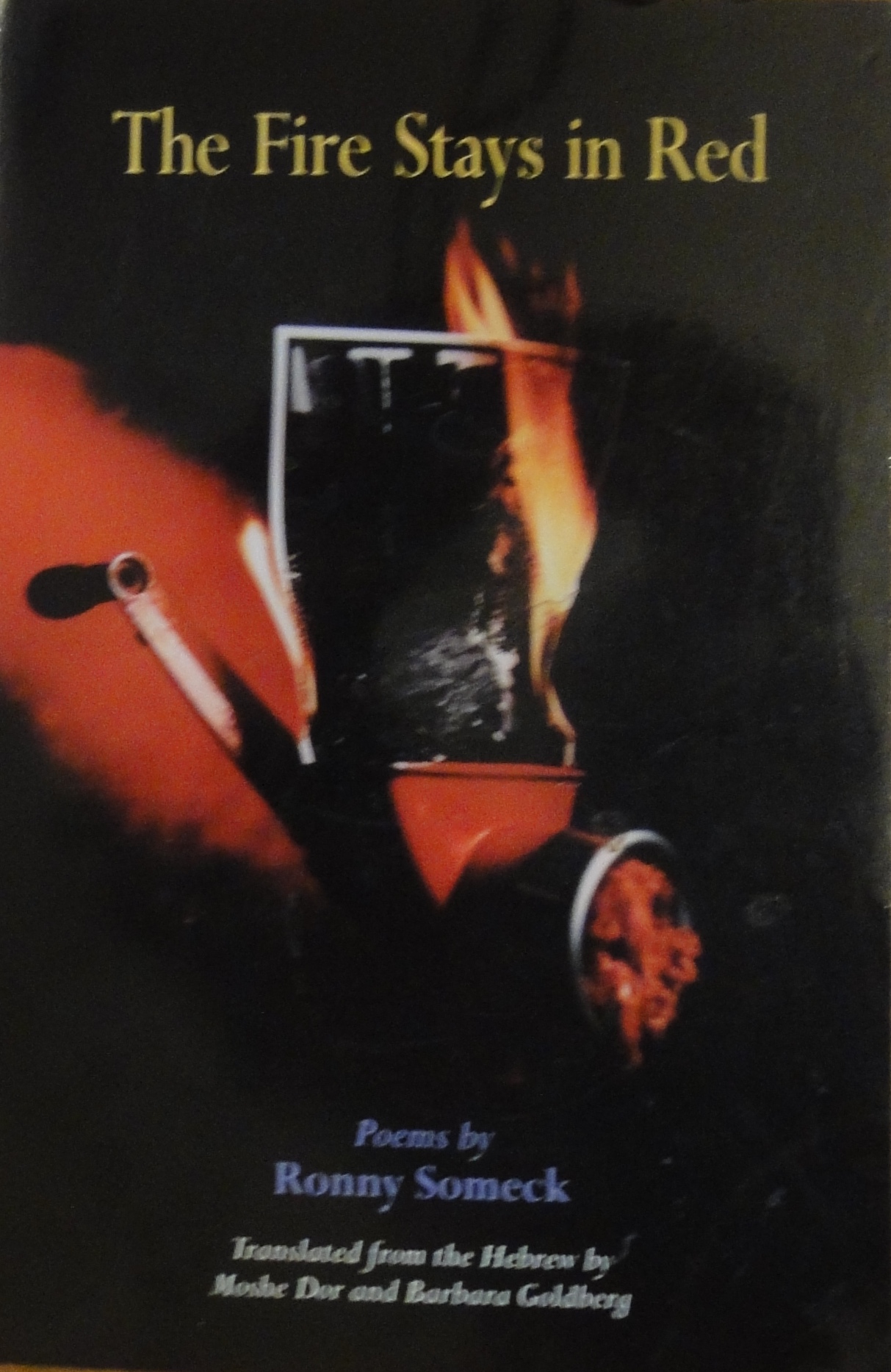
The Fire Stays in Red is one of two Hebrew-English volumes of Ronny Someck’s poetry. The University of Wisconsin published this volume, translated by Moshe Dor and Barbara Goldberg, in 2002. The paperback is available used or from UW Press. (My copy is from the library of Max Ticktin, z”l, and used with gratitude to his family for sharing his resources.)

The other is The Milk Underground, published by White Pine Press in 2015.

In addition, however, Someck’s website is a multilingual poetry resource in itself.

Someck, born in Baghdad in 1951, arrived in Israel as a young child. He is a poet and visual artist who studied Hebrew literature and philosophy at Tel Aviv University and drawing at the Avni Academy of Art. He has published 11 volumes of poetry, translated into 41 languages — winning many prestigious awards along the way — plus two children’s books created with his daughter, Shirly. Here’s his page at the Institute for the Translation of Hebrew Literature.

Someck currently teaches literature and leads creative writing workshops. He is a member in the Public Council of “Batsheva Dance Company” and at the Hebrew-Arabic Theatre.

One of Someck’s poems appears in the newer (2003) bilingual edition of The Hebrew Poem Itself. See Hebrew Poetry in Translation.

Ronny Someck’s Multilingual, Multimedia Site

Ronny Someck (b.1951) maintains a website filled with multilingual, multimedia poetry resources:

  • Someck’s poetry in Hebrew and translation (to English, French, and other languages)
  • visual art created by him and after his poetry
  • video links to recitations in several languages
  • musical renditions of his poetry, mostly in Hebrew

Here, for example, is a musical version of his “Poverty Line,” which is included in The Fire Stays in the Red. The musical rendering, sung by Sahy Zoberi, appears as the opening to a program on Israel’s Ma’abarot [transit camps for new immigrants and refugees]:

See also “Stammering Child’s Revenge,” in English and French with video including Hebrew reading, with musical accompaniment;another reading on this same “and more poetry” page appears as “The Revenge of the Stuttering Child” — this same poems appears in The Fire Stays in the Red as “Retort of the Stuttering Boy.”

A few examples not in The Fire Stays in the Red:

  • Tractors” in English with artwork (Hebrew reading with Flash player);
  • Tali Nov sings Someck’s poem “מַפִּית [Napkin]” to music by Uri Bitan, video has Hebrew lyrics, with English available in pop-up box; and
  • “Tribes,” sung in Hebrew by David Barbi in mixed-media video, with English available in pop-up box.

So much more on the poet’s website to explore!