Are (any) Jews White? (Beyond 3)

Yesterday’s focus, in this Omer journey away from oppression, was on how individuals of different hues are viewed within Jewish communities in the United States. But it is impossible to explore that topic very thoroughly without addressing another one limning its edges: Are (any) Jews “White”?

“…and everybody hates the Jews…”

A passage early on in the #BlackLivesMatter Haggadah Supplement from Jews For Racial and Economic Justice begins “White Ashkenazi Jews have a rich history but are only a part of the Jewish story….” At our seder table — and I would imagine many others — the question arose as to whether Ashkenzim are, in fact, “White,” by self-definition or as viewed by others.

VHidaryBookCoverFINALThis called to mind a passage that Vanessa Hidary, Sephardic Jew and author of The Last Kaiser Roll in the Bodega, added to her signature poem after touring beyond her native New York City:

To many we are seen as part of the white majority

From the standpoint of a white racist

we’re considered part of that other party

Don’t get twisted because you might think of New York City

where you can buy knishes at stands for $1.50

We only make up 2.2% of the population. You see,

many other parts of the country are not feeling me.

–from second version of “Hebrew Mamita”

I thought too of the “…and everybody hates the Jews” line in Tom Lehrer’s old, but not necessarily out-dated, “National Brotherhood Week.”

Is Persecution Past?

Returning to the #BlackLivesMatter Haggadah Supplement:

As Jews we share a history that is overburdened with tales of violent oppression. Though different Jewish communities have varying experiences, none of us have escaped painful legacies of persecution, including genocide. This past is real, and part of why we gather today to remember it. But the past is the past.

–Leo Ferguson, a Jew of color and the Leadership Development & Communications Organizer at JFREJ.

As William Faulkner famously said, however: “The past is never dead. It’s not even past” (Requiem for a Nun, 1950).

And for Jews with family and friends living outside the United States, risk and threat can be an all too contemporary concern.

Moreover, Dr. Carolivia Herron, educator and author, spoke of anti-Israel sentiment in her “Why I’m not going to say anything about Ferguson” last November:

And I’m not saying anything about Ferguson because my soul aches when you use your support of Big Mike of Ferguson as a way to hate Israel. I don’t understand why you use your love of my people to hate my people. I love my people African American, Ferguson, US American – keep trying to get it right, and I love my people Israel – keep trying to get it right.

In my own experience, anti-Semitism — something deeper and of different tone than politically-based anti-Israel sentiment — appears in some #BLM-related activities, sometimes via black nationalist rhetoric and sometimes from the ANSWER Coalition. Therefore, participation in some racial justice efforts means running with, or up against, groups espousing anti-Semitism.

This forces allies into complex, sometimes untenable, situations. It’s problematic, of course, and many movement leaders are working to address the irony of anti-Semitism in a racial justice movement. Even at its worst, is this, given the power dynamics involved, “oppression” or “persecution”?

Conditional Whiteness

To close out today’s exploration, below is the introduction to “After the Maggid: When We Imagine Ourselves Allies” followed by one of six passages exploring different positions in the shifting desert sands:

Having now told the story of Jews’ Exodus from Mitzrayim we have come to know Miriam, Moses, Pharaoh, Tzipporah and the role each of them played. Sarah Barasch-Hagans & Graie Barasch-Hagans use these roles to help us understand our roles in the fight against oppression — when we are strong allies and when we still struggle to be our best selves.


…If everywhere is a desert then the sand we stand is always shifting, and so is our relationship to each other. Let us take a moment to imagine ourselves thus…

Sometimes we are Miriam…

…hoping our brother Moses survives the river, knowing danger and feeling unsafe in our Jewish skin, knowing what it means to be hated because of who we are. And then we are Miriam who, given time, a few chapters later mocks Moses’ Black wife Tzipporah [Numbers 12:1]. She confounds us because she is us, Ashkenazim with conditional whiteness and generations distanced from legal discrimination, not seeing the contradictions in our own character. We are white-skinned Jews celebrating Fifty Years

of Freedom Summer and putting on commemorative panels but escorting out anyone who yells #BlackLivesMatter. Or, acknowledging Tzipporah but refusing to defend her interracial, interfaith family when Jewish talking heads warn that families like hers are the end of Judaism. We are descendants of slaves who do not yell back that Moses had a Black wife and Black children and that #BlackLivesMatter to our people whether or not we acknowledge it.

Jews For Racial and Economic Justice‘s #BlackLivesMatter Haggadah Supplement, p.7

(Download your own copy)

We counted 3 on the evening of April 6. Tonight, we count….

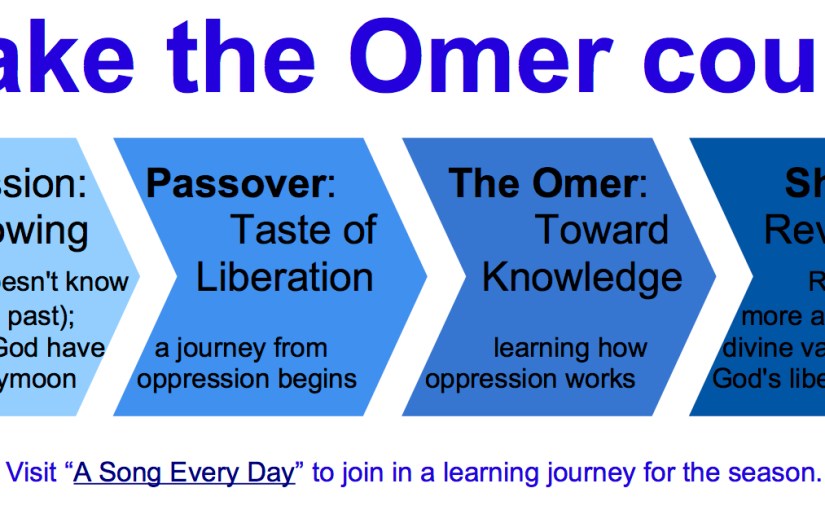
Making the Omer Count

from On the Road to Knowing: A Journey Away from Oppression

A key element in the journey from liberation to revelation is understanding the workings of oppression, and our part in them. We cannot work effectively to end what we do not comprehend.

So this year, moving from Passover to Shavuot, I commit to learning more about how oppression works and how liberation is accomplished. I invite others to join me:

Let’s work together, as we count the Omer, to make this Omer count.

Thoughts and sources welcome.

JourneyOmer

Share this graphic to encourage others to participate.

A Meditation

Aware that we are on a journey toward knowing God — from liberation to revelation — I undertake to know more today than I did yesterday about the workings of oppression.

I bless and count [full Hebrew blessings in feminine and masculine address]:

Blessed are You, God, Ruler/Spirit of the Universe, who has sanctified us with Your commandments and commanded us to count the Omer.

Today is four days in the Omer.

Hayom arba’ah yamim la-omer.

In the spirit of the Exodus, I pray for the release of all whose bodies and spirits remain captive, and pledge my own hands to help effect that liberation.

The Facts of Jewish Diversity (Beyond 2)

Continuing the theme of “not knowing” as a form of callous, insensitive “moral deficiency,” one we seek to leave behind this Passover season, let’s explore some facts about diversity in the Jewish community.

Upwards of 435,000 Jews — possibly as many as 400,000 in the New York City area alone — identify (also) as African American, Asian, Latino/Hispanic, Native American, or mixed-race, for a total of about 435,000 individuals. (See Be’chol Lashon; Bnai Brith).

And yet, the assumption in too many of our communities remains — even if many of us believe, or would like to believe, otherwise — that Jews mostly look like a Central Casting crew of Eastern European Ashkenazim. Most of us believe our communities are inclusive and welcoming, but the experience of many Jews belies this.

Central Casting Sent the Wrong Type

Jews of lighter hues, such as those of Scandinavian or Celtic background, are regularly assumed to be “other,” addressed as visitors or called out as converts, an attitude that is specifically forbidden in the Talmud: “Do not wrong a proselyte by taunting him with being a stranger to the Jewish people seeing that ye yourselves were strangers in Egypt.” (Baba Metzia 59b)

Jews of color across the country continue to tell stories that shame every Jew:

“Many people who are Jews of color have very painful stories to tell about having not been accepted in their congregations and having the veracity of their Jewishness questioned,” says Rabbi Appell, of the URJ. “Some tell of being shown the kitchen because someone assumed that they worked there.”
— from “Jews of Color,” March 2015

A few years ago, women from Washington, DC found a photo of their Rosh Chodesh service plastered in national media with a caption reading: “A non-Jewish woman is among those at a Torah reading at Adas Israel Congregation.” (See Who is a Jew and How Would the Forward Recognize Her?“) JTA and the Forward pulled the photo after widespread complaint without ever apologizing or explaining whom they assumed was a non-Jew. But it seems that at least several pairs of editorial eyes thought it more likely that a non-Jew was wearing a kippa and tallit [ritual garb] and actively participating in the Torah service at a Conservative synagogue [something the movement does not sanction] than that a Jew might vary from the assumed “look of a Jew.”

At Jews United for Justice‘s recent community seder, Michael Twitty of Afroculinaria spoke of fellow Jews demanding to be told how he came to be there, assuming he would want to share the particulars of his spiritual journey with complete strangers. His story surprised many who assume the relative diversity in the DC area would preclude such behavior, but such stories are common to Jews of color.

Jews Have Work to Do

We have much work to do, to make even our more diversity-assuming Jewish communities welcoming to all.

Rabbi Fred Scherlinder Dobb of Adat Shalom, a Reconstructionist synagogue in suburban Bethesda, Md., who is also the father of two adopted African-American [children], is emphatic that this mindset must change: “We must create the norm where we assume that people belong, and never inadvertently ostracize someone whom you may think ‘doesn’t look Jewish.’ Anyone looks Jewish, potentially.”
–from “Jews of Color” (linked above)

And one step in that work is ensuring that our Jewish organizations, congregations, and schools acknowledge the experiences of all parts of the community:

Jews of color are diverse, multihued and proud of it — proud of our Jewishness and proud of our Blackness. But though our lives are joyous and full, racism forces us down a narrow treacherous path. On the one hand we experience the same oppression that afflicts all people of color in America — racism targets us, our family members, and our friends. On the other hand, the very community that we would turn to for belonging and solidarity — our Jewish community doesn’t acknowledge our experience.
— from JFREJ‘s #BlackLivesMatter Haggadah Supplement

jfrej_blm_croppedBe’chol Lashon offers Diversity Training and Community Conversations through its Race Project. Jews for Racial and Economic Justice and several other organizations offer pertinent learning opportunities. How many of our communities are in need of such organized work?

One way to make this Omer count is to begin necessary conversations to ensure that all experiences within our Jewish communities are acknowledged and honored.

We counted two on the evening of April 5.
Continue reading The Facts of Jewish Diversity (Beyond 2)

Pharaoh and the Callousness of Not Knowing (Beyond 1)

As the story of Exodus begins, we learn that a new Pharaoh appeared on the scene, who “did not know Joseph” (Exodus 1:8). This is when the trouble between the Israelites and Egyptians begins: this not knowing eventually becomes Pharaoh’s destruction.

In “Rereading the Plagues,” David Silber writes:

Pharaoh’s “not knowing” carries with it a sense of ingratitude, as Joseph was the savior of his nation; it also suggests callousness and a lack of sensitivity, and the Torah implies that it is not just an intellectual lapse but a moral deficiency.
— p.56, Go Forth and Learn: A Passover Haggadah. Phil., PA: JPS, 2011.

Continue reading Pharaoh and the Callousness of Not Knowing (Beyond 1)

On the Road to Knowing: A Journey Away from Oppression

The Passover journey is launched in “not knowing” — as when a new Pharaoh arises who does not know Joseph (אֲשֶׁר לֹא-יָדַע, אֶת-יוֹסֵף, Exodus 1:8) or God (לֹא יָדַעְתִּי אֶת-יְהוָה, Exodus 5:2) — and it aims for “knowing”:

…You shall know that I am YHVH, your God…
וִידַעְתֶּם, כִּי אֲנִי יְהוָה אֱלֹהֵיכֶם (Exodus 6:7).

The Exodus experiences and our travels in the wilderness are meant to increase our knowledge of the divine so that we can better serve God. (See Silber “Rereading the Plagues”).

A key element in the journey from liberation to revelation is understanding the workings of oppression, and our part in them. We cannot work effectively to end what we do not comprehend.

So this year, moving from Passover to Shavuot, I commit to learning more about how oppression works and how liberation is accomplished. I invite others to join me:

Let’s work together, as we count the Omer, to make this Omer count.
Thoughts and sources welcome.

JourneyOmer

Share this graphic to encourage others to participate.

Continue reading On the Road to Knowing: A Journey Away from Oppression

Mishpatim: Racism and Idolatry

This week’s Torah portion, Mishpatim ([Laws], Exodus 21:1-24:18), warns us severely and often about evils of racism. The bible knew no such word, of course, and, ironically, this portion also contains material that appears to accept “bondage” as a normal part of [ancient] life. But messages about racial justice and related concepts are nonetheless there, and quite strong, if we look carefully.

“God’s wrath” and “idolatry”

The biblical expression “divine wrath” is reserved for cases of idolatry on the part of the whole Nation, according to Maimonides and later scholars. And this understanding calls us to avoid afflicting “widows and orphans”:

In our case [Exodus 22:23: “My wrath will burn (וְחָרָה אַפִּי)”], the same expression is deliberately used in order to equate the affliction of the orphan and the widow to idolatry, teaching us that there is no crime greater than this.
New Studies in Shemot/Exodus, Nehama Leibowitz, p.395

Many teachers understand “widows and orphans” as a biblical expression meaning “the most vulnerable among us,” which surely includes victims of hundreds of years of racism in the U.S. From a somewhat more literal perspective, black communities today include too many widows and orphans, as well as grieving mothers and traumatized communities.

Moreover, idolatry and racism are directly connected:

Few of us seem to realize how insidious, how radical, how universal an evil racism is. Few of us realize that racism is man’s gravest threat to man, the maximum of hatred for a minimum of reason, the maximum of cruelty for a minimum of thinking.

Perhaps this Conference should have been called “Religion or Race.” You cannot worship God and at the same time look at man as if he were a horse.

“Race prejudice, a universal human ailment, is the most recalcitrant aspect of the evil in man” (Reinhold Niebuhr), a treacherous denial of the existence of God.

What is an idol? Any god who is mine but not yours, any god concerned with me but not with you, is an idol.
Abraham Joshua Heschel, Conference on “RELIGION AND RACE” (14 JANUARY 1963)

Both Heschel and Leibowitz stress, based on ancient tradition, that being silent in the face of oppression is as serious as committing the crime ourselves. (No time to explore this further right now — Shabbat is almost upon us — but will return to this theme.)

Strangers

This portion is also one in which we are warned about not oppressing a stranger, reminded again and again that we were once strangers in Egypt.

In addition, we are warned against “false reports” and “running with the multitude,” both of which seem obviously connected to racism. (Again, time has run out for now. More later.)
Continue reading Mishpatim: Racism and Idolatry

Faith Leaders Tell Congress: Take Action on Racial Justice

B75j6iECIAAPpvRMay each die-in act,
symbolically embodying
the last moments of the departed,
bind their deaths more tightly
into our national consciousness
and collective commitment to change.
— from “Grief and Struggle” prayer

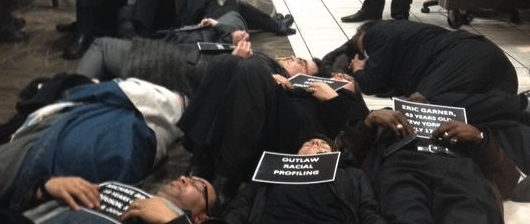
Faith-based action brought the #BlackLivesMatter movement directly into Congressional space. The House Office die-in was designed to interrupt “business as usual” in the halls of Congress just as the new session begins.

“As people of faith, we are calling on Congress to take action on racial justice and heed the demands of the Black Lives Matter movement,” Stosh Cotler of Bend the Arc said, as she and dozens of other faith leaders left the Longworth House Office building, Jan. 21.

MomatCapitolIn addition to Bend the Arc, which has NY and DC offices, participants came from Auburn Seminary (NYC), Jews United for Justice (DC), Standing on the Side of Love, and a number of congregations in different denominations as well as unaffiliated Muslims, Jews, Christians, and others in support of DCFerguson and Black Lives Matter.

SmallCropatCafeteriaAlthough the action’s duration on the Longworth cafeteria floor was short — not quite the planned 4-1/2 minutes, as Capitol Police insisted that the faith gathering disperse — it is hoped the action will inspire further education and action on the part of individuals and congregations across the country… leading ultimately to many needed changes, including Congressional action.

Extend the moment yourself by learning more and following up.

Continue reading Faith Leaders Tell Congress: Take Action on Racial Justice

Exodus Revisited: Pharaoh’s “Hardened Heart” and Contemporary “Criminal Justice”


Pharaoh’s “hardened heart” plays a big role in Exodus, providing a framework for the ten plagues, the eventual freeing of the Israelites from bondage, and serious disaster for biblical Egypt. Policies like “zero tolerance” in schools and mandatory sentences in the United States today are a kind of judicial “hardened heart.” It’s our job to find a way to “let the people go.”
Continue reading Exodus Revisited: Pharaoh’s “Hardened Heart” and Contemporary “Criminal Justice”

Unlikely Answers: At the Burning Bush with Durante, Mamie Smith, and Sherman Alexie


“Without impossible questions and unlikely answers, faith is only dust,” Sherman Alexie writes in a poem that finds Moses at the Burning Bush. Alexie reaches this mountaintop via a circuitous path that touches on roller coasters, obsessive worry about failing to turn off the stove, Jimmy Durante, Dante Alighieri, and another poet‘s obsession with the fact that “Dante” is, in reality, short for “Durante.” (More on Dante/Durante)

Do you think, after Moses talked to the Burning Bush, that he couldn’t stop himself from thinking that the bush was still burning, and presented a clear and present danger? Do you think Moses hiked back up the mountain to make sure? If I claim that, in Hebrew, Moses is spelled Mos Eisley, will you look it up? Of course, you must. Without impossible questions and unlikely answers, faith is only dust.
— “Hell,” IN What I’ve Stolen, What I’ve Earned
(Brooklyn, NY: Hanging Loose Press, 2014), p.51

Of course, I looked it up.

'Star Wars' image (property of LucasFilms)
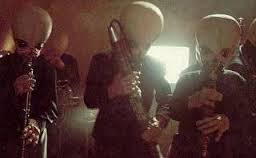
“Star Wars” image: Mos Eisley Cantina musicians (property of LucasFilms)

Wookieepedia explains that Mos Eisley (pronounced “Moss Ize-lee”) is an important location in the Star Wars universe: a “wretched hive of scum and villainy” where wise visitors are cautious, it’s the site of the cantina (right) where Luke Skywalker first meets Han Solo and Chewbacca….Not, as this ignorant Star Trek fan guessed, some odd conflation of Mos Def and the Isley Brothers.

Perhaps Alexie is hinting at some kind of parallel between Luke Skywalker and Moses (spelled “מֹשֶׁה” [Moe-SHEH] in Hebrew, BTW, and thought to come from a verb meaning “to draw out”). If so, I know too little about Star Wars to catch it. Instead, my minimal wiki-knowledge sets me on a different path.

Jimmy Durante's Jazz Band (image: RedHotJazz.com)
Jimmy Durante’s Jazz Band (RedHotJazz.com)
ABC-TV 1964 (Wikicommons)

I imagine Durante, in his jazz years and his later comic persona, with gigs at that alien cantina. Could Alexie have had this in mind, I wonder, when he came up with the inventive spelling for Moses?
Continue reading Unlikely Answers: At the Burning Bush with Durante, Mamie Smith, and Sherman Alexie

Community, Leadership, and Listening

Leadership and community are key elements in the early chapters of Exodus. We see a variety of strong actions and interactions:

1) Moses sees an Egyptian man striking a Hebrew; he responds by killing the Egyptian and then hides the deceased in the sand.

2) Moses sees two Hebrew men fighting and tries to stop the aggressor.

3) The Hebrew fighter replies: “Who made you judge over us? And do you propose to murder me as you did the Egyptian?”

4) Pharaoh learns of Moses’ crime and sets out to kill him. Moses flees from Egypt.

5) Moses witnesses what appears to be an injustice as Jethro’s daughter attempt to water their flocks and intervenes, immediately and physically. (Exodus 2:11-17)

We don’t know, from the text itself, if Moses’ upbringing included grooming in Egyptian leadership skills or if he was taught Israelite ideas and practices through a continuing relationship with his birth parents. Commentators over the centuries have understood his early years in both ways.

We do know that Moses “went out unto his brethren and looked on their burdens [וַיֵּצֵא אֶל-אֶחָיו, וַיַּרְא, בְּסִבְלֹתָם]” (Exodus 2:11). What is not reported is any interaction between Moses and his brethren — or between Moses and the Midianite women at the well — that would help him understand community perspectives and concerns. He seems to have some sort of innate sense of justice, but he isn’t able to turn that inner sense into action that is helpful when faced with real world circumstances.

Like Moses, many attempting to understand and join the #BlackLivesMatter struggle don’t know how to translate a desire for justice into action that is helpful. The first step, the one Moses seems to have missed initially, is to LISTEN. Here, for those interested in taking this step, are video clips from Jews United for Justice’s “Black Lives Matter, Chanukah Action” program.

Hear directly from black activists about their experiences and their advice for white allies. More on the event and full list of speakers.

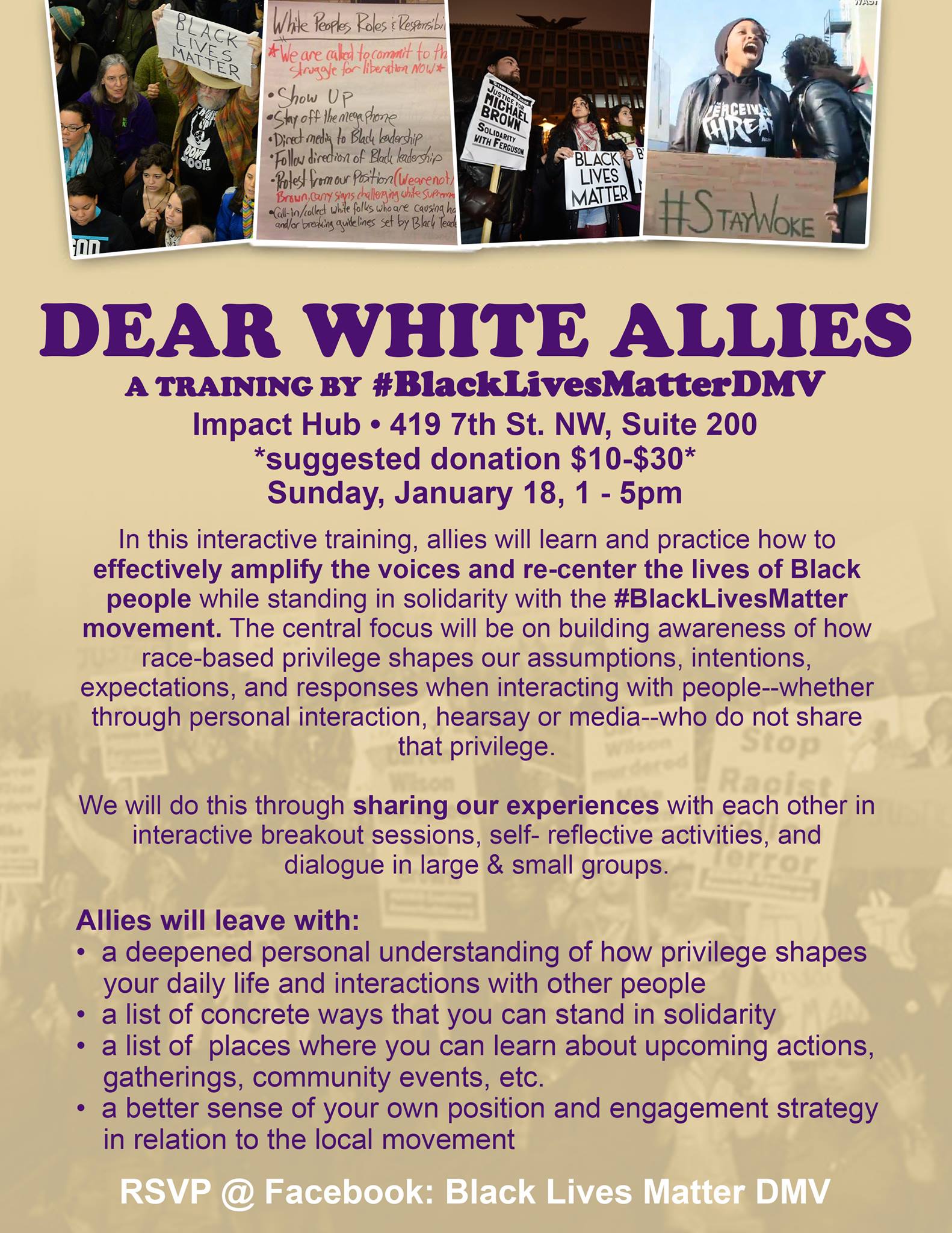
DearWhiteFor those in the DC area, consider joining “Dear White Allies: A Training by #BlackLivesMatterDMV” or one of the many other local opportunities to listen and learn.

Dear White Allies:
Sunday, Jan 18
1-5 p.m.
Impact Hub, 419 4th Street NW

For those beyond DC, look for local anti-racism and white ally training in your area.

Exodus: from state violence to resistance to liberation

The story of Exodus opens with state-mandated oppression and violence against a rapidly growing minority population, increasingly feared by the ruling majority (brief summary). Women of different communities and classes engage in resistance, separately and jointly, that eventually leads to toppling of the entire system.

From Violence to Resistance

Today, many in the U.S. are calling for acknowledgement of “the structural violence and institutional discrimination that continues to imprison our communities either in a life of poverty and/or one behind bars,” and recognition of “the full spectrum of our human rights and its obligations under international law.” Black Lives Matter addresses

…a world where Black lives are systematically and intentionally targeted for demise….an affirmation of Black folks’ contributions to this society, our humanity, and our resilience in the face of deadly oppression….we are talking about the ways in which Black people are deprived of our basic human rights and dignity. It is an acknowledgement Black poverty and genocide is state violence.

Midwives Shifrah and Puah act against the state, we are told, because “they feared God,” prompting them to act in preservation of life. Avivah Gottlieb Zornberg elaborates:

…the very extremity of the edict forces a new moral vision upon the midwives, a radical choice between life and death. Disobedience to Pharaoh becomes more than merely a refusal to kill, it becomes a total dedication to nourishing life.
— Zornberg, The Particulars of Rapture, p.23 (full citation)

Similarly, I think, the Herstory of #BlackLivesMatter exhorts us:

…when Black people cry out in defense of our lives, which are uniquely, systematically, and savagely targeted by the state, we are asking you, our family, to stand with us in affirming Black lives. Not just all lives. Black lives. Please do not change the conversation by talking about how your life matters, too. It does, but we need less watered down unity and a more active solidarities with us, Black people, unwaveringly, in defense of our humanity. Our collective futures depend on it.

Pledging Resistance?

Ferguson Action is asking individuals to declare 2015 their “year of resistance.”

I pledge to make 2015 my year of resistance to state violence against Black lives.

I challenge myself and those in my community to take risks as we confront the many ways that Black lives are diminished and taken from us….

This year, I will declare boldly and loudly through my words and actions, that #BlackLivesMatter.
Ferguson Action Pledge

Does Exodus — with its powerful examples of resistance — call us to anything less?
Continue reading Exodus: from state violence to resistance to liberation