Sharing some kaddish translations and interpretations
Everett Fox’s translation of mourner’s kaddish, found in Anita Diamant, Saying Kaddish: How to Comfort the Dying, Bury the Dead, and Mourn as a Jew. Schocken, 1999. NOTE: Some add “…v’al kol Yishmael, v’al kol yoshvei tevel [and all Ishmael and all who dwell on earth]” after v’al kol Yisrael” in the last verse. Fox’s kaddish translation (PDF — sometimes used for Tzedek Chicago Torah study). Also found at Open Siddur
Richard Heiberger’s translation, for National Havurah Committee, in memory of Mary Morris Heiberger (1946-2003). NHC kaddish (PDF — prepared for Tzedek Chicago’s Hebrew Learning Community)
I have a very intense relationship with the book, For Times Such As These: A Radical’s Guide to the Jewish Year by Rabbi Ariana Katz and Rabbi Jessica Rosenberg. (Excerpt here: Tammuz in Times Such as These).
Having been told that it was in the works and pre-ordering it quite early, I felt involved with it before I ever held it in my hands. I’m a big fan of its authors and of Wayne State University Press, with its Jewish studies and midwest-focused titles. Then, as it happened, that fall 2023 pre-order proved a tremendous blessing in ways none of us could have imagined: In those post-Sukkot months, genocidal attacks on the West Bank, as well as Gaza, were launched with justifications based on Jewish survival and Jewish teaching; so many Jews and Jewish institutions seemed ready to turn their backs on Jewish values, so just knowing that there was a book on the way testifying to possibilities of living and organizing in Jewish integrity was a lifeline.
I participated in an on-line book event for Tu B’shvat on January 18 (2024), apparently received one of the first copies Wayne State mailed out (in late January), had my copy signed at the first book reading of the national tour (at Red Emma’s in Baltimore, March 3), and joined a second tour event in Washington, DC (May 22; more on the book and its authors’ tour).
For a book that some would still consider brand new [just over five months together, when I wrote this in July 2024] , me and my copy have been through a lot together. And, today, while deep in conversation, the book’s binding split and some pages began sliding free.
pages sliding out of perfect-bound book
…Now, maybe I was too rough. Maybe the perfect-binding did not quite live up to its name. Or, possibly, the break was some kind of organic result of considering the calamities of the month of Tammuz and questions like: “How are the hurts of your communities’ histories manifesting in the collective body?”…
However the binding break happened, I found myself thinking it was a little soon for this particular volume to join the “well-loved/much-used” stage of our relationship: Do we even know one another well enough for that!? Those thoughts led, as these things do with me, to new lyrics for “Something to Talk About.”
So, here, in honor of this whirlwind start to what I expect will be a long, loving, and fruitful relationship, is “Something to Talk About: Me and For Times Such As These” — with love and respect to Shirley Eikhard and Bonnie Raitt.
“Something to Talk About: Me and For Times Such As These“
Ooh, Ooh…. People are talking, talking about reading I hear them whisper, you won’t believe it They think we’re lovers kept under covers I just ignore it, but they keep saying We meet just a little too much Lean just a little too close We stay just a little too long Maybe they’re seein’ something we don’t, darling
Let’s give ’em something to talk about Let’s give ’em something to talk about How ’bout little something to talk about How about words?
I feel so clumsy, did not expect it you split your binding, could we be rushing, baby ? It took the rumor to start things rumbling Now it seems we’re already tumbling Travelin’ through Jewish days Cyclin’ through the whole year long I’m hoping that you’re up for this trip If we both know it, let’s really show it, baby
Let’s give ’em something to talk about, babe A little mystery to figure out Let’s give ’em something to talk about I want your love!
— Original lyrics by Shirley Eikhard (1955-2022), famously performed by Bonnie Raitt, beginning with 1991 “Luck of the Draw” album
Sometimes, when I wear a book out, I find a new copy. In some cases (Finnegans Wake is one), I keep the old one for sentimental reasons but use the newer copy for practical reasons. With a few books, however, the split-binding copy is the one I continue to use.
Here are the Jewish studies volumes that remain with me, for regular reference, despite binding mishaps:
Max Kadushin. Worship and Ethics: A Study in Rabbinic Judaism. Bloch Publishing, 1963. (Scotch-tape inside)
Arthur I. Waskow. God-Wrestling. Schocken Books, 1978. (Binder clip on open side)
Rabbi Ariana Katz and Rabbi Jessica Rosenberg. For Times Such and These: A Radical’s Guide to the Jewish Year. Wayne State University Press, 2024. (String somehow seemed appropriate for this one, but it will depend on shelf situation.)
Statistically speaking, this house has many books on subjects similar to these three. And surely it must be accidental that these particular three comprise the “broken binding/still used” category. Nevertheless, the three books do seem to belong together, both in terms of theme and in terms of how essential I have found each to be, at different points in my life. So, I cannot shake the urge to anthropomorphize my new-ish book by insisting that it prematurely, purposely joined the broken-binding-brigade.
Looking at these three books, I recall that Max Ticktin (June 30, 1920 – July 3, 2016) , z”l, found Kadushin very dry as a JTS professor and was puzzled by my enthusiasm for this work, while he loved Arthur Waskow’s writing and was proud of his connections to Fabrangen Havurah. I cannot help wondering what Max would have made of For Times Such and These. I am quite sure he would have applauded this line: “We read Korah and ask, how do we organize in ways where all of us get to bring our unique and varied skills and power?” (p.326). And maybe that’s the through-line for the books in my broken-binding-brigade.
Image descriptions: 1) stack of three paper-back books — God-Wrestling,Worship and Ethics, and For Times Such as These — showing loose pages and wear. 2) Three books — For Times Such as These, God-Wrestling, and Worship and Ethics — shown cover out: first, held together by string; second, with a large binder-clip; third shows ragged pages (bound with tape).
Moses told the scouts to go up and “…see what kind of country it is. Are the people who dwell in it strong or weak, few or many? Is the country in which they dwell good or bad? Are the towns they live in open or fortified? Is the soil rich or poor? Is it wooded or not? And take pains to bring back some of the fruit of the land.” — Numbers 13:18-25
The video below is part of an attempt to “scout out the land” and prompt consideration of what kind of questions we ask about a place that is new to us, and why.
Note to Tzedek Chicago Torah Study participants — you’re welcome to check it out in advance, but I plan to include this in our exploration of parashat Shelach on June 29. To all: maybe I’ll post something more about the actual portion; maybe not.
TEXT used in video The video displays some words, including song lyrics, and that is also available in separate document for anyone who prefers to read in this form. Text of June 29 commentary video (PDF).
200 The USIA film at National Archives (a little more info below, but I cannot find a link to the original music used). NOTE: Video is full of LOTS OF STRONG STROBING
200+ with US Blues The video posted by @LongStrangeTrip710 incorporates the 1973 studio version, from Mars Hotel, of “US Blues.” NOTE: video includes the original film, which contains lots of STRONG strobing.
US BLUES Here’s a link to the lyrics at Dead net. Plenty of performances by (Grateful) Dead and friends available on YouTube, etc.
More Credits/Info
I think this is all the credits, but let me know if I missed something. No full, frame-by-frame image-description for the video, however here’s a summary: Still images from a 1975 “psychedelic” film made as USIA propaganda for 1976 US Bicentennial; includes video performances from Fifth Dimension, Gil Scott-Heron, and Rhiannon Giddens with Paul Simon, plus audio from Chocolate City and some other music. Includes quotes from Numbers 13.
AQUARIUS “Aquarius/Let the Sunshine In” was part of “Hair” and released on the 1969 Age of Aquarius album by the Fifth Dimension (Basic information). The video shown came without much explanation from an “Oldies” music channel.
WHITEY ON THE MOON Two performances by Gil Scott-Heron included: 1970 “Small Talk at 125th and Lenox” album, Flying Dutchman Records, and 1982 “Black Max,” widely available on on internet, although not sure about ownership and don’t know if it’s streamed anywhere; if DVD is an option, try your local library. (Basic info general Wiki and filmmaker’s page) See also this image , from 5783 Shavuot teaching on “faces,” with some words and images from Gil Scott-Heron.
RIVERS/DC Tunes “Conversations Toward Repair” (We Act Radio) page includes credits for Roberta Flack’s “River” and Brent Peterson’s “Clean Rivers.” A brief clip from Rare Essence’s “Don’t Mute DC” was later included in regular intro music.
AMERICAN TUNE Paul Simon, 1973 “There Goes Rhymin’ Simon” Columbia Records (1973 lyrics). Note that the author changed the lyrics in recent years. Brief Billboard note about 2022 Grammy performance with Rhiannon Giddens, for “Homeward Bound: a Grammy salute to the songs of Paul Simon.” In summer 2022, Rolling Stone credited Giddens with changing the lyrics, but Giddens stresses that Simon made the change.
“It’s also very important to say that Paul changed the lyrics, not me – and this song has become one that is so dear to my heart for its ability to say what I have been feeling for a long time.” — July 28, 2022 — @RhiannonGiddens on X
It's also very important to say that Paul changed the lyrics, not me – and this song has become one that is so dear to my heart for its ability to say what I have been feeling for a long time.
NOTE: “Hasidism, Chabad, and Jewish Soul-Language” was originally created for Tzedek Chicago’s Hebrew Learning Community, but this remains entirely the work/opinion of the author.
This began as a few verses from the Tanya with some notes to explore Hebrew words for “soul” and ideas about who has one. It expanded to review translation issues and reflect a little historical context. Now it’s a long, winding, highly idiosyncratic document — complete with PSAs on supporting the kind of internet resources we want to see, plus links to a Teshuvah [answer, solution] on non-Jewish souls.
This was created primarily for Hebrew Learning Community, so it starts out with Hebrew words. This exploration works better via the PDF, I think, so not trying to copy that — here is whole PDF….
…and here is one section — “Authentic” Judaism” and Authoritative Teaching — that has little Hebrew (which doesn’t always copy so well) and is very current and crucial. Or jump to “Non-Jews in Jewish Law and Lore” or To Be a Jew Today
“Authentic” Judaism and Authoritative Teaching
Chabad has long sought to appear as “authentic” Judaism — perhaps, as noted above, originally in response to criticism of more text-centered opponents of Chasidut. They succeeded in recent decades through marketing and by engaging military and carceral settings, where few Jewish institutions worked. Instead of promoting wider Jewish study and practice, in at least some of its variety, they engage in cult-like exclusion of non-Chabad voices, seek to define who counts as a Jew, actively denigrate other movements within Judaism, and call non-Jews expendable when perceived as a threat. Two examples:
“…[R’ Yitzchak] Ginsburgh’s…teachings hold that it is acceptable Jewish practice to kill non-Jews so long as ‘it is clear that they will grow up to harm us.'” – Anton Goodman, Rabbis for Human Rights, Haaretz, Mar 1, 2023, opinion on settler violence
Note: Ginsburgh (b. 1944) is associated with Chabad, and his teachings appear on their website (as of Feb 21, 2024); Ginsburgh is among those who condoned the 1994 massacre by a settler of 29 Palestinians praying at the Ibrahimi Mosque in Hebron. https://tinyurl.com/GoodmanHaaretz
“My considered opinion, as I have reiterated it on several occasions privately and publicly, is based on the undisputable Halachic decision formulated by Rambam (Hilechot Teshuvah 3:8), according to which the doctrines and ideology of the Conservative and Reform movements can only be classed in the category of heretical movements which have plagued our people at one time or another, only to disappear again, having no basis in our everlasting Torah, Toras Emes, Toras Chaim.” — R’ Menachem Mendel Schneerson (1902-1994), 7/21/1959.
Note: still on Chabad website (as of 2024/02/22); shows up when searching “interdenominational thought,” e.g. — https://tinyurl.com/RebbeConsRef
On-line and in-person, Chabad cites only other Chabad views. Where they are the only, most visible, or only sanctioned option — as in prisons — they are often seen as “the authentic Judaism.” Meanwhile, they routinely limit engagement with those who don’t fit their idea of Jewish, effectively controlling who counts as a Jew in some settings….Matir Asurim: The Jewish Care Network for Incarcerated People does some work to address this situation. But there is so much more to be done.
And while Chabad philosophy is not the only, or earliest, set of particularistic Jewish views, they are extremely visible proponents of Jewish supremacy and unusually well-positioned to promote that view as standard Judaism. This is dangerous to Jews everywhere and to the wider world.
In 2016, the Conservative movement issued a Teshuvah (see p.15-16 in PDF and below) declaring any teaching that implies “a distinction between Jewish souls and those of non-Jews…no longer authoritative. These statements are to be rejected, as are any beliefs in racial superiority or inferiority.” The Teshuvah asks “Jewish leaders and educators to incorporate these findings in their preaching and teaching and to emphasize them in all their educational endeavors.” In particular, they call for rejection of the Tanya (Chabad) and Torat HaMelekh (from an Israelli group) and any discriminatory civil laws.
With all this in mind, some general pleas:
ONE) Many schools of Jewish thought tend to cite teachers trained in their own movement and to avoid — by habit, network, or deliberate intention — widely opposing viewpoints.
When using movement-centered sources, note the movement for yourself and in any citation;
Whenever possible, use pluralist Jewish sources for general Jewish research;
Do not use Chabad — which has declared its boundaries so impermeable — as a general Jewish reference source, cite Chabad only on Chabad-specific matters; and exercise caution in citing the Tanya or teaching Chabad ideas
through clicks, citations, links, and, if able, finances;
declare that you (and your organization) prioritize pluralist and non-racist reference material;
contribute writing, editing, etc., if possible, to pluralist and intentional sites;
help reduce the size of Chabad’s web-print by not linking to them or giving them clicks; if inclined to explore Chabad-related text, do so via Sefaria or other non-proprietary sources.
For more on this topic, even if you have nothing to do with the Conservative movement, do check “The Status of Non-Jews in Jewish Law and Lore Today.“
It was issued — as a “Teshuvah” [here used in the sense of a formal response, solution] by the Committee on Jewish Law and Standards of the Rabbinical Assembly of the Conservative (Masorti) Movement, 21 April 2016. Written by R’ Reuven Hammer (1933-2019).
This teshuvah was unanimously approved on April 21, 2016 (19-0-0). Voting in Favor: Rabbis Kassel Abelson, Pamela Barmash, Miriam Berkowitz, Noah Bickart, David Booth, Elliot Dorff, Baruch Frydman-Kohl, Reuven Hammer, Joshua Heller, Jeremy Kalmanofsky, Jane Kanarek, Gail Labovitz, Amy Levin, Jonathan Lubliner, Daniel Nevins, Micah Peltz, Paul Plotkin, Elie Spitz, and Jay Stein.
In 2016, this committee shared this paper, and the Conservative movement released this statement:
“The paper calls upon Jewish leaders and educators to incorporate these findings in their preaching and teaching and to emphasize them in all their educational endeavors. We must deal honestly with the sources, admit that different attitudes have existed over the course of the development of Judaism, and candidly criticize and reject certain parts of the tradition while embracing others as representing the Judaism we wish to promulgate and which we believe represents the true core of Jewish belief beginning with the Torah itself. In view of the terrible suffering brought upon our people and others in the 20th century by doctrines of racial superiority, any teachings that espouse that in any way must be thoroughly rejected.”
Noah Feldman’s book, To Be a Jew Today: A New Guide to God, Israel, and the Jewish People, (just out in early March: Farrar, Straus, Giroux, 2024), has an important section on Ginsburgh plus a great deal about related movements, history, politics, and more.
What name of God is an anchor for you through this period of ever-growing mourning? A recent study session* asked participants to focus on this question, based on text from Psalm 16:8:
Shiviti YHVH l’negeditamid
“I am every mindful of the divine presence”
or “Divine presence is in front of me always”
Participants shared many names — Shekhinah [indwelling presence], Ruach Ha-olam [spirit/breath of all], Ein Sof [without end], “Matir Asurim — the one who releases the bound,” HaTzur (the Rock)….All that came to mind for me was: “Eikha?! [How?!]” —
guide me in Your true way and teach me, for You are God, my deliverer; it is You I look to at all times.
Later, I was reminded of another text, one which relates in a round about way to the Joseph story — from the current Torah reading cycle — and to my own confusions these days….
Joseph and “Your Own Pit”
Proverbs 5:15-17 says:
15) Drink water from your own cistern [bor-kha], Running water from your own well.
16) Your springs will gush forth
In streams in the public squares.
17) They will be yours alone, Others having no part with you
This image from Proverbs echoes language in the Joseph story: His brothers “took him and cast him into the pit [ha-bor]. The pit was empty; there was no water in it” (Gen 37:22).
Commentary on the Proverbs passage links water to Torah and describes an empty pit as a new learner:
R. Akiva says: It is written: “Drink waters from your pit.” A pit, in the beginning, is unable to supply a drop of water of its own, containing, as it does, only what is put into it. So, a Torah scholar, in the beginning, has learned and reviewed only what their teacher has taught them.
“and flowing waters from your well”: Just as a well flows living waters from all of its sides, so, disciples come and learn from the “flowing” Torah scholar. And thus is it written: “Your fountains will spread abroad.” Words of Torah are compared to water. Just as water is life for the world, so, words of Torah, as it is written (Proverbs 4:22) — Sifrei Devarim 48:5
I am sure there is commentary linking this passage to the Joseph story….
…if anyone knows, please advise. Otherwise, I’ll look it up and update….
At the time of this incident, Joseph was young, still what we now call a teenager. And his behavior to his family does seem, at least on the surface, quite immature. So, it is tempting to view him as without Torah yet.
But, many young people have absorbed Torah in all sorts of ways. And different commentary, based on the expression “ben zekunim” (Gen 37:3), says that Jacob had been teaching Joseph “Torah of Exile,” learned from Shem and Eber. (More here.) So, what I’m thinking THIS WEEK — who knows what is to come — is that maybe Joseph did not yet have his own Torah.
And that leads me, as very little in this world does not, to Star Trek.
“I fly the ship”
I am still catching up on Star Trek: Strange New Worlds and recently saw Season Two, Episode 4, “The Lotus Eaters” (originally aired: July 6, 2023). In this episode, the whole Enterprise crew has lost their memories (but not skills), and the ship’s pilot is trying to remind herself of her role.
I’ve shared this to start at 46 seconds in —
WARNING: The only real violence in the last 3 minutes of this clip is to, and from, some space rocks. But the first 45 seconds are very violent and, on their own, add little to the scene with the pilot. So, view with that caution in mind, please.
When Ortegas yells at the ship’s computer — which she does not recognize, due to the odd memory losses, and so addresses as “miss” and “ma’am” — I was right there with her: “Stop the rocks!”
“Yes, ma’am, please, right now: Stop the rocks!” seems very close to what I’m yelling at civic leaders, at Jewish communities, at the universe, at God. All day. Every day.
So, I was immensely moved by her gradual realization that she might be able to do something to improve the situation, for herself and others: “I’m Erica Ortegas, and I fly the ship!”
Earlier in the episode, Ortegas is not pleased to lose a very rare opportunity for an away mission… with its chance to wear a spiffy fur-like hat in the local culture’s style. Her annoyance is presented mostly as a question of boredom. But don’t we all ask ourselves why we don’t get to be on the fun mission instead of stuck with work based on choices we made long ago? or maybe based on how others view us and our skills? I really resonated with her frustration when told she was needed on the ship instead.
I hope Ortegas gets her away mission (although some do point out the perils of being a red-shirt in such circumstance). But I also loved watching her figure out that she could, indeed, do something other than yell about the rocks.
“I am… and I…”
On ordinary days, it can be a struggle to figure out what we can contribute to the world at any moment, however small and unworthy or huge and daunting it may seem. On days when space rocks are bombarding the ship and no one seems in charge… those are the days when all I seem able to manage is a cry of Eikha!?
Some days the answer is: well, I can empty the dishwasher or clean the bathroom. Or, I can answer this letter from a friend or send a gift for the neighbor’s new baby. Some days the answer is: I can assist a colleague in an important electoral campaign, or I can join a protest, or I can share news that seems crucial but ignored. And sometimes, the answer might be: I can sit right here until I figure out what it might mean to “plot a course” for myself and others.
And that brings me back to Psalm 25: Let me know. Teach me. Show me. Guide me.
It is painful to sit with the uncertainty while a crisis unfolds. But maybe sometimes getting to one’s own Torah means staying with the question: “I am Virginia Spatz, and I ask ‘How?!'”
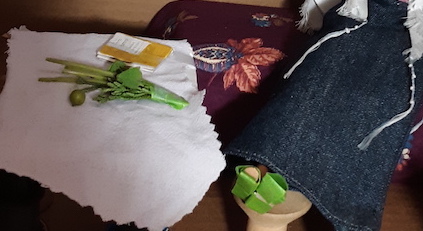
In response to social media showing “Barbie’s Dream Sukkah” (see below), I built this sukkah for DC Tefillin Barbie.
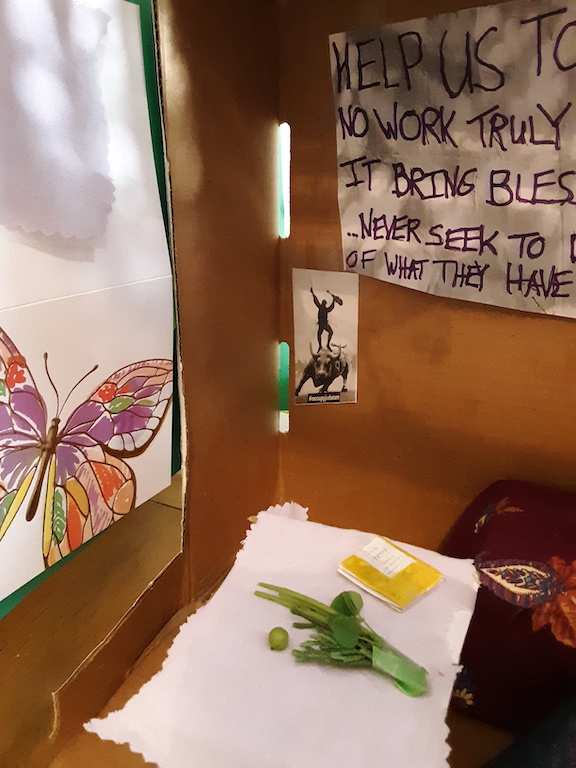
I built it the way doll dwellings were created in my youth, repurposing whatever was at hand and roughly the right scale: cardboard, empty spools of thread, scraps of fabric, an old greeting card with a pretty design…. No one I knew had any kind of “Dream” house or car, although Barbies drove or lived in store-bought items that seemed close to her size. And those “Dream” items are just as foreign today as they were back then. So DC Tefillin Barbie‘s sukkah reflects a different dream: a sheltering peace that covers us all.
DC Tefillin Barbie, Sukkah 5784
This Sukkah’s History
For quite a few years, the sukkah we set up outside our house also looked more like cardboard sukkah 5784 than “Barbie Dream Sukkah.”
2010 sukkah in front yard
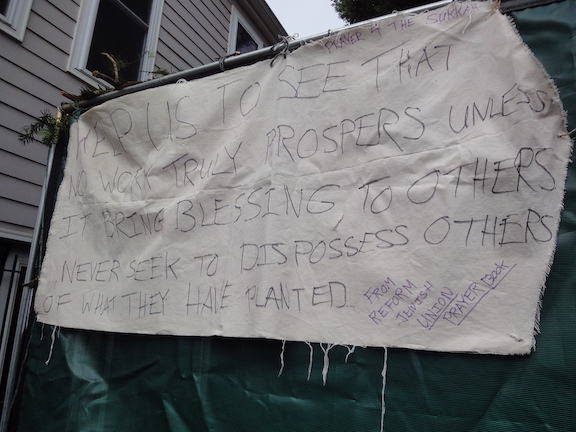
A few years ago, we gave in and bought a Sukkah Project kit; it’s a marvel of ease in so many ways, but ours retains homemade touches. Two signs in our 5780 sukkah (photos here) were created for the local (DC) “Occupy Judaism” sukkah in 2011. (The wooden sukkah once in our yard was erected at McPherson Square; the materials were absorbed into Occupy K Street after the holiday.)
Inside of our Sukkah Project version 5780Outside wall of 5780 Sukkah Project
I copied those signs for DC Tefillin Barbie’s sukkah.
Corner view of Barbie’s sukkahDC Tefillin Barbie and her makeshift “dream” dwelling
Among the items at hand, as the cardboard sukkah was built, were a button from “Coalition of Concerned Mothers,” remembering individuals killed by police, and a sticker from Prison Radio, reading “In American Prisons Life Means Death.”
See related Meditation for Sitting in the Sukkah, 2019, treating those lost to police as ushpizin, mystical invited guests; Michael Zoosman, of Jews Against the Death Penalty, wrote an ushpizin-related meditation this year, focusing on those executed by the state. These items were added as decorations meant to remind DC Tefillin Barbie and visitors to reject “any sense that we are somehow entitled to dwell in safety…when others cannot.”
Barbie, Her Dreams, and Sukkot
This past Shabbat (9/30/23), Tzedek Chicago explored the concept of p’ri eitz hadar — the goodly fruit. So many interesting ideas and related study were raised. In addition, I found this note from some years back about Rabbi Joseph Soloveitchik’s linking Sukkot to the Oral Law and my own prayer for living in the fallible structure of the sukkah and of our individual and collective understanding of Torah.
I wrote at the time (and had completely forgotten): “As we prepare to leave the sukkah, we may hope that next year’s construction will be of even stronger, more beautiful materials erected by even surer hands. But that hope for the future need not throw doubt on the value of this year’s construction or diminish our enjoyment in this year’s dwelling place.” This year, I have really struggled with “the enjoyment of this year’s dwelling place.”
I still haven’t seen the Barbie movie and don’t understand a lot about Barbie culture. But I am find myself hoping there are other Barbies out there enjoying their own “dream” sukkot. May we all dwell — if only for a few moments — in structures that honor life’s fragility and our responsibility to create stronger, more inclusive shelters. And may we find ways to work together to bring the dream closer in the coming year.
Barbie Dream Sukkah
In late September 2023, Hey Alma posted these images on Instagram, saying “this is the vibe we’re going for this year.” Comments varied hugely, from enthusiasm for the “vibe” and the opulence of the sukkah itself to wrath at the AI-generated images. A FB post (not Hey Alma) drew criticism because Barbie’s clothes are not tzniut (modest) and the sukkah is pasul (not kosher). I cannot find any credits for the images, which also appear on this site. I first saw these images, shared by Rabbi Brant Rosen, during Torah study with Tzedek Chicago.
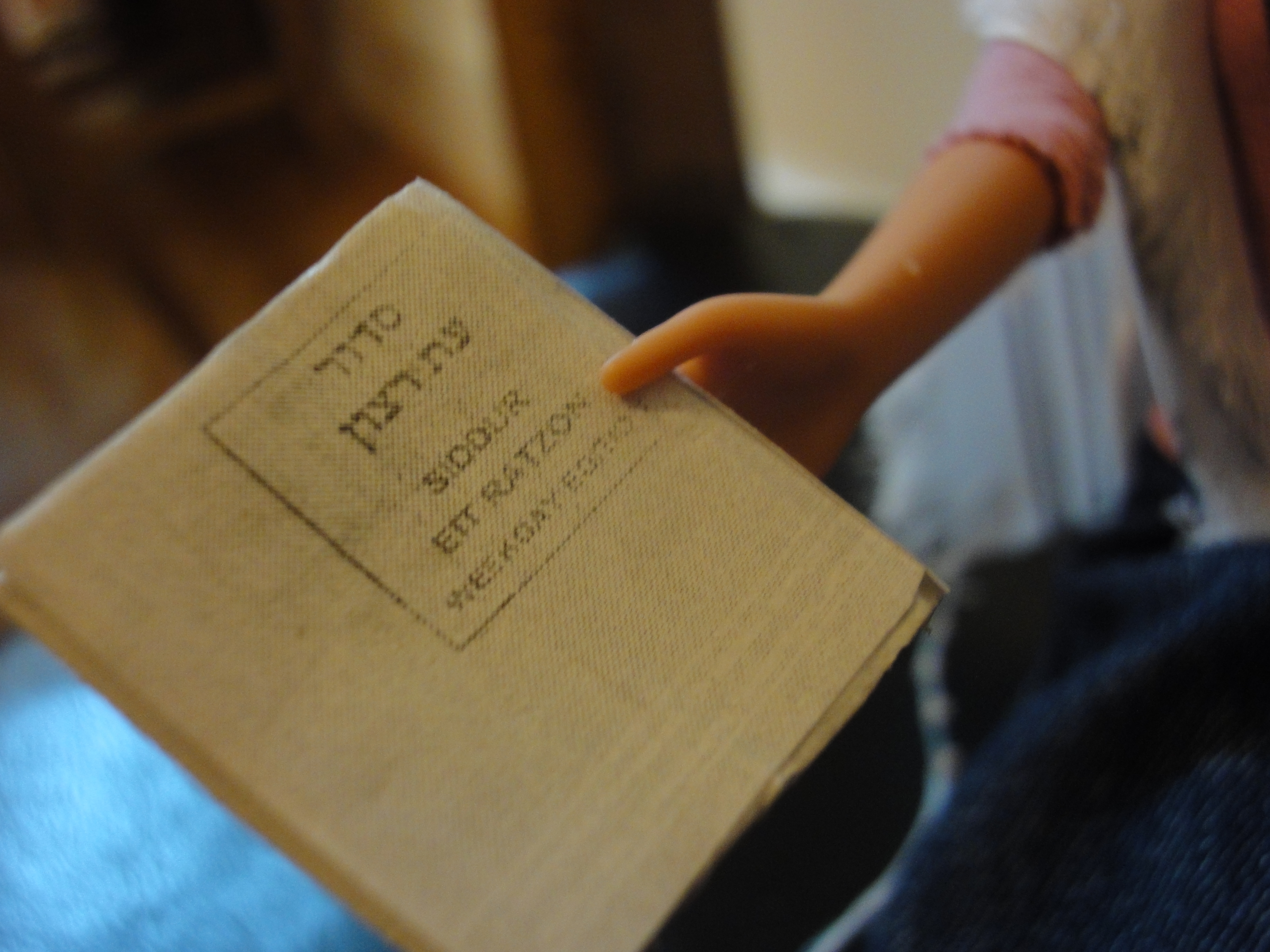
Soferet Jan Taylor Friedman offers much information in relation to her amazing Tefillin Barbie project. Here’s info about my own changes to the Barbie who arrived in 2014. In addition, note: DC Tefillin Barbie holds by Rabbi Isserles who ruled that tefillin are worn on intermediate days of Sukkot — and she lives in her own personal time zone where it’s always eit ratzon, a good time, for prayershawl and tefillin.
Siddur Eit Ratzon
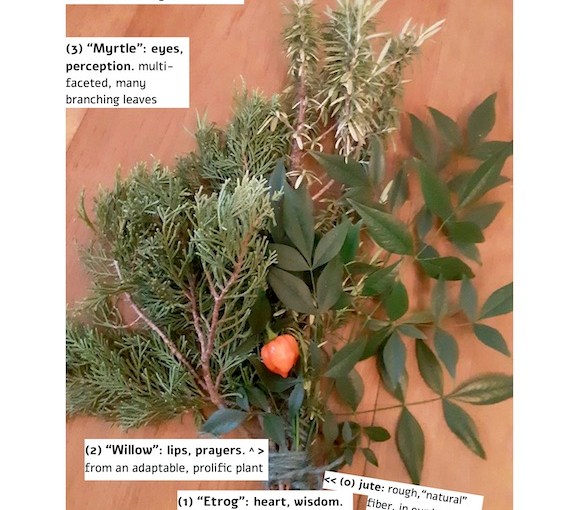
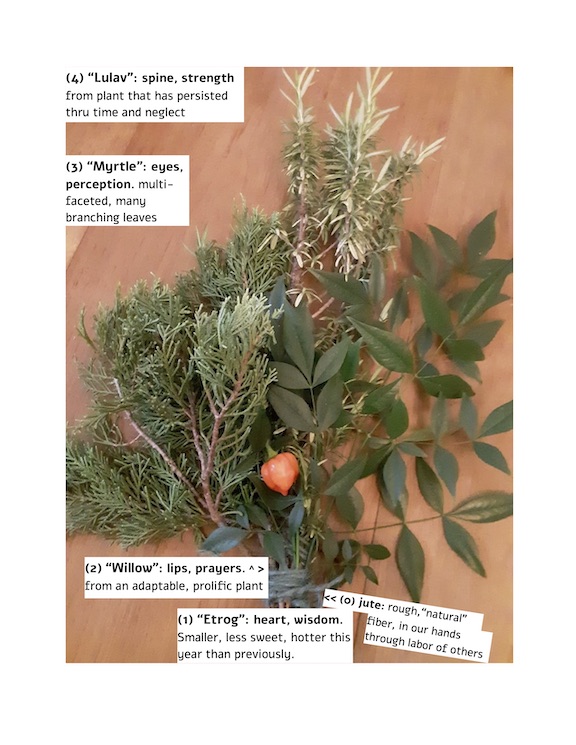
She, like me, is experimenting with locally sourced lulav and etrog as part of a wider exploration of Diaspora Judaism.
Alt test and description: green branches of three types and tiny orange, somewhat rounded pepper with annotations: 1) “Etrog”: heart, wisom. Smaller, less sweet, hotter this year than previously. (2) “Willow”: lips, prayers, from an adaptable prolific plant; (3) “Myrtle”: eyes, perception. multifaceted, many branching leaves. (4) “Lulav”: spine, strength, from plant that has persisted thru time and neglect. (0) jute: rough, “natural” fiber, in our hands through labor of others.
This week’s Torah portion, Beha’alothekha (Number 8:1-12:6) is named for its first command, to “mount the lamps” or “go up and light” — or as my attempt at using an on-line dictionary meant for modern Hebrew-English translation would have it: “In your upload”
In the portion, there are a number of interesting uses of words with the root letters aleph- samech – pei [אסף].
In verse 10:25, we read a description of what is special about the tribe of Dan:
“Then, as the rear guard of all the divisions, the standard of the division of Dan would set out” (JPS 2006)
“Then the standard of the camp of Dan set out, the gatherer of all the camps” (English translation of Onkelos, Drazin/Wagner 2007)
Comment from Onkelos Translation:
Although Onkelos translates Scripture’s me’aseif — from the root a-s-f, “gather” — literally, Saadiah clarifies that it is a metaphor for “the last” of all the camps. Rashi (based on the Jerusalem Talmud, Eruvin 5:1) takes the word literally: the three-tribe division of Dan gathered all the lost articles dropped by the Israelites during their trek in the wilderness. Bechor Schor and Chazkunee offer another, similar interpretation: the division of Dan gathered those who were unable for any reason to travel with their own division. — comment to 10:25 in the above cited Onkelos













 "A Song Every Day"
