This season reminds us – even if we didn’t have recent events screaming reminders at us – that words, and related mind-pictures have tremendous power. And this Torah portion (Re’eh: Deut. 11:26-16:17) warns us that we have an individual and a collective responsibility to ensure that word- and picture-power in the community does not endanger the flow of blessing or somehow impede God’s Mercy from manifesting.
The commandment to see and to recognize blessing and curse, both individually and collectively, is complicated and challenging.
If each of us is challenged to see, as part of a collective awakening, we are also challenged as a community to honor what others see. And what may look like blessing from one perspective might appear as a curse in other quarters.
“The fame we get from fighting for the freedom of others creates a prison for us,” Malcolm X wrote in 1964 to Azizah al-Hibri, then a college student at the American University in Beirut. Their brief in-person connection and subsequent correspondence are still treasured by Dr. al-Hibri, now retired as chair of KARAMAH: Muslim Women Lawyers for Human Rights, the international organization she founded. Moreover, the papers and their story illustrate some important things about leadership, race, gender, and media.
Originally posted in slightly different form on May 19, 2015. Story published in East of the River, July 2012.
from correspondence between Dr. Azizah al-Hibri and Malcolm X
As president of the college debating society, al-Hibri arranged for Malcolm to speak on campus while he was touring and also had the opportunity to get to know him during his brief visit. A shared ice cream at the airport launched a correspondence between the two that continued until his death in February 1965. At his request, al-Hibri kept her correspondence private for over 40 years.
In 2012, al-Hibri released a few pieces of correspondence and donated other papers (still private for now) to America’s Islamic Heritage Museum. She said then, in a speech at DC’s Masjid Muhammad, that she wanted to ensure that Muslims are “proud” and “happy” about connections with the slain leader and to forge bonds between the African American Muslim community, with historical connections to the Nation of Islam, and what many call the “immigrant” Muslim community, with different historical roots.
Here’s more from the July 2012 East of the River Magazine story:
From his correspondence it is clear that he already suspected that his life and work were coming to an end. But he knew, even though al-Hibri didn’t yet, that her future as a leader was ahead of her.
It was unusual in 1964, for a woman to be president of an organization like the college debating society, al-Hibri notes. And she, like many women of that decade, had not yet envisioned for herself anything like her role today as professor of U.S. law and international human rights advocate. It was similarly odd to consider that women might be leaders of Islam. But Malcolm X saw beyond the confines of his time, says al-Hibri, pointing to words of encouragement – to her as a woman and a Muslim leader – inscribed in a book he gave her: “You have and are everything it takes to create a new world – leadership is needed among women as well as among men…”
— full article here
The Power of Small Things
Of all the stories I covered for East of the River Magazine, this is one that sticks with me as most fascinating and important —
the young al-Hibri’s not knowing about U.S. racial dynamics, what her college dean meant about “airing the country’s dirty laundry”
al-Hibri’s struggle to reconcile the man she met with the picture she later saw portrayed in the U.S. media
the race-sensitive context of her later decision to share her experience, while keeping most of the correspondence private
Malcolm X’s interest in corresponding with someone outside the “prison” of his work
his recognition of the need for women leaders in politics and in Islam, before many saw it in 1964
I share this today, in honor of Malcolm X, El-Hajj Malik El-Shabazz (born Malcolm Little, 5/19/25-2/21/65). I share it in recognition of the work of Dr. al-Hibri and KARAMAH — a small, powerful organization. I share it as a shout out to the too-little-known Americas Islamic Heritage Museum. And I share it to acknowledge the hard and complex work of overcoming racism between religious brothers and sisters.
Perhaps most importantly, I return to this story again and again as an example of the power of small interactions to shape our world.
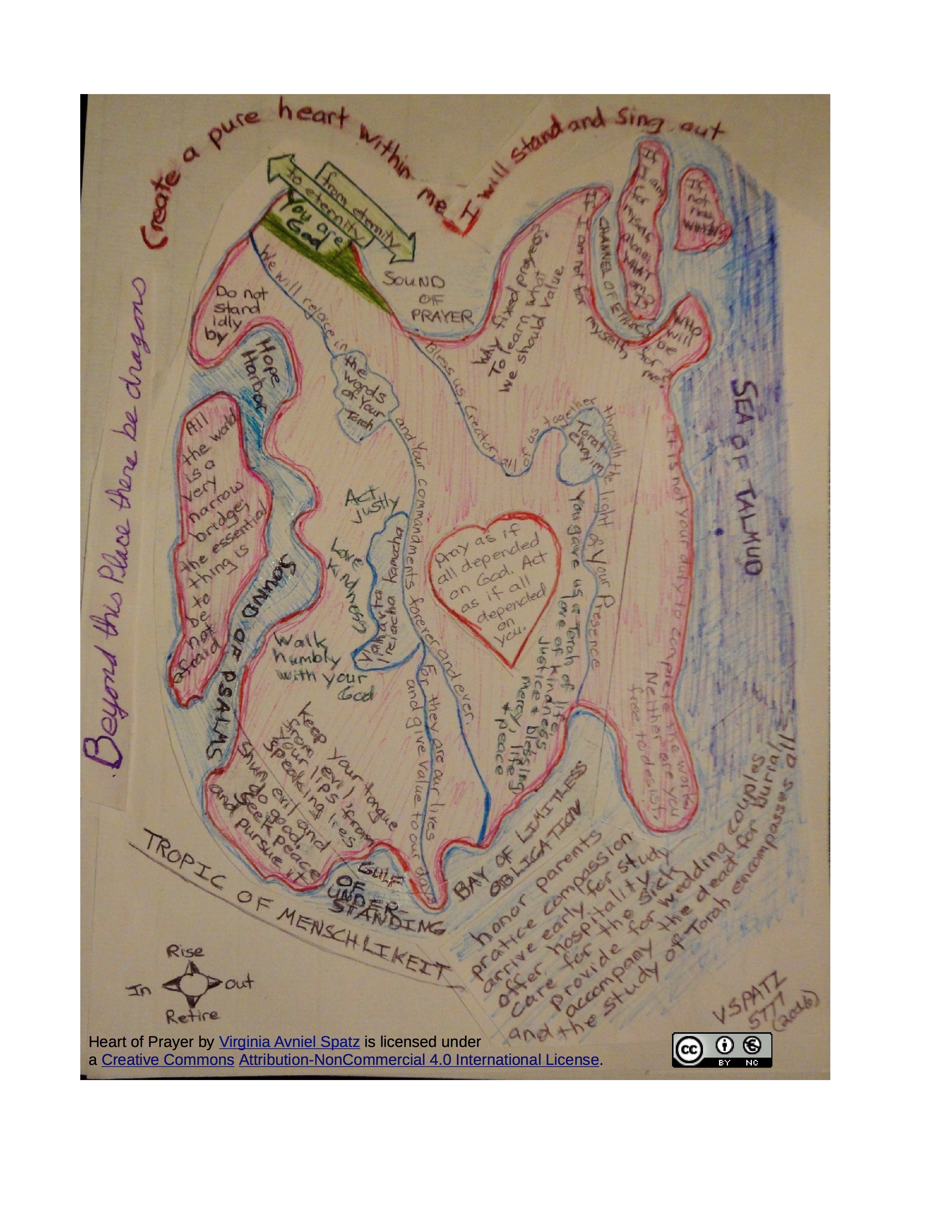
Here, as promised a few days back, are some of the sources that I included in my prayer “heart map”….
Overall structure is formed by two lines from this kavanah [intention] for the Amidah:
Create a pure heart within me
let my soul wake up in Your light.
Open me to Your Presence;
flood me with Your holy spirit. Then I will stand and sing out…
— Stephen Mitchell, based on Psalm 51 Mishkan T’filah, p.75
Orientation
Orienting the map is the phrase, “From eternity to eternity, You are God [מן העולם ו’עד העולם אתה אל],” from the “Nishmat” prayer, in the Shabbat/Festival morning service. Also near the top of the map, to highlight its influence — like minerals in the hills, carried by rivers and run-off to parts below — is this brief commentary:
Why fixed prayers?
To learn what we should value,
what we should pray for…
— Chaim Stern, p. 437 Mishkan T’filah
This note comes from the prominent liturgist Rabbi Chaim Stern (1930-2001); it was also found in Gates of Prayer (1975) and other Reform prayerbooks.
Connection and Points Beyond
Two rivers, running the length of the heart territory and connecting various regions, begin with “We will rejoice in the words of Your Torah…” and “Bless us, Creator, all of us…” (The first is from the Evening service, before the Shema; the second, from the Morning service, at the close of the Amidah).
The prayers themselves remind us over and over again of connections between prayer, study, and acting for justice in the world. See also, to take just two examples, Max Kadushin’s Worship and Ethics (1963, republished 2001 by Global Publications) and Marcia Prager’s Path of Blessing (NY: Belltower, 1998).
At one edge of the map, the injunction, “Do not stand idly by (Leviticus 19:16), hugs “Hope Harbor.” Farther beyond, outside the heart and its surrounding waters, the terrain is less certain.
NOTE
Here’s a link to some background on this project and my whole map. Also linked is information about cordiform maps more generally and about the book suggesting “Personal Geographies.”
The graphic aspect was very helpful to me, but I don’t think it’s necessary to draw or color in order to consider what prayers or texts would play a prominent roll in your own “heart map.” BACK
asks relevant questions and gives appropriate answers;
deals with first things first, and last things last;
about something he has not heard he says, “I have not heard”;**
acknowledges the truth.
—Pirkei Avot [Verses, or Ethics, of the Fathers] 5:9
This translation is borrowed from the Koren Mesorat HaRav Siddur
This means, Rabbi Adam Scheier said in an essay a few years back:
In other words, a wise person is not only defined by acquired knowledge. A wise person is one with whom it is easy to have a productive conversation; a wise person is thoughtful, responds on topic, is sufficiently open-minded to entertain new ideas; a wise person might even consider the possibility that he or she is wrong.
NOTES
*Many translations say “older and wiser” — Hebrew is “מי שגדל ממנו בחכמה” — with some adding that the “superior one” should speak first.
**Another translation: “admit their ignorance.”
NaBloPoMo NOTE: “A Song Every Day” signed up for National Blog Posting Month, a commitment to daily posting for the month of November. Circumstances intervened on some dates. This post is hereby declared, by way of catching up, the official post of November 5. BACK
The “Facing Race” conference concludes on November 12. For those reading early in the day, there’s still time to participate via LiveStream. For those checking in later, there’s useful information at this conference link.
Calls for Jewish Signatures
“To the millions of immigrants, Muslims, people of color, LGBT people, women, people with disabilities, and everyone who is threatened by the President-Elect and his administration, we want you to know: we are with you…”
“We’ve Seen This Before” — open letter; Jews are encouraged to sign.
Sandwiched in a Torah portion packed with narrative is “the war of the kings” with Lot’s capture and rescue (Gen. 14). It begins, really, with Abraham and his nephew Lot separating to avoid quarrel over land for cattle herding (Gen. 13). YHVH spoke to Abraham “after Lot had parted from him,” promising “descendants like dust of the earth,” and Abraham dwelt by the oaks of Mamre and built an altar to YHVH.
He is still living by the oaks of Mamre when the fugitive arrives to tell him that his nephew is in trouble, and Abraham sets off to rescue Lot:
And they took Lot, Abram’s brother’s son, who dwelt in Sodom, and his goods, and departed.
And there came one that had escaped, and told Abram the Hebrew [ha Ivri]…”
Does Abraham’s being an “ivri” — a “crosser-over” or “one from the outside” — have anything to do with expectations about him and his response to Lot’s trouble? Why is this the first time Abraham is called by this name? Does being a Hebrew mean retainining sympathy — and a willingness to help — those on the other side?
NOTE
Lech Lecha (Gen. 12:1-17:27) includes the first “say you’re my sister” incident with Abraham and Sarah (Gen. 12:10-20), the weird episode of the Abraham and the covenant of the pieces (Gen. 15:1ff), and the first installments in the tales of Hagar and Ishmael (Gen. 16, 17:17-27).
Let’s return briefly to the questions which plagued author Sebastian Junger, in his suburban Boston youth, and set him a path that eventually led him to write Tribe: On Homecoming and Belonging:
How do you become an adult in a society that doesn’t ask for sacrifice? How do you become a man in a world that doesn’t require courage?
— Tribe, p.xiv
(See “Covenant and Liturgy” for full citation and more)
Previous posts explored the concept of “sacrifice” and how it translates into Judaism. Here are a few notes on “courage.”
Ometz Lev
Like “sacrifice,” the word “courage” comes into English from Old French (corage) based on Latin (cor = heart). In Hebrew, the expression is “ometz lev [אַמִּיץ לֵב]” — “to strengthen or reinforce [ometz]” one’s “heart [lev].”
One Jewish high school offers some useful remarks on how this value [middah] in Judaism might operate at different points in our lives:
Ometz Lev is the courage that allows us to accomplish goals in face of opposition. Often enough, that opposition comes from within us. The need for Ometz Lev (courage/ bravery) is not limited to outward challenges, but also to challenges from within. For example, neurological studies seem to suggest that in comparison to adult brains, adolescent brains have a tougher time maintaining long term focus. Conversely, the middle-aged brain is slower than the adolescent brain in starting a new task. It might take a bit of ometz lev to deal with pushing past natural inclinations.
— from “The Middah of Ometz Lev“
“Moving Traditions,” another teen-focused program, offers four texts for four types of courage people of all age could profitably consider:
Text #1 The Courage to Be Yourself
When the daughters of Yitro mistakenly called Moses an “Egyptian” Moses kept quiet. This is one of the reasons why he was not allowed into the Promised Land.
Moses cried out to the Holy One: Please, if I cannot enter the land in my life at least let my bones be buried there beside the bones of Joseph.
The Holy One said: Even when Joseph was captured, he said that he was a Hebrew.?But you pretended to be something you are not.
—Tanhuma Buber, 134
Text #2 The Courage to Control Impulses
Ben Zoma taught: Who is mighty? Those who conquer their evil impulse. As it is written: “Those who are slow to anger are better than the mighty, and those who rule over their spirit better than those who conquer a city.”
—Pirkey Avot 4:1
Text #3 The Courage to Question Authority
The finest quality of a student is the ability to ask questions that challenge the teacher.
—Solomon Ibn Gabirol
Text #4 The Courage to Rescue Others
Why do you boast yourself of evil, mighty fellow? (Psalms 52:3). David asked Doeg: “Is this really might, for one who sees another at the edge of a pit to push the other into it? Or, seeing someone on top of a roof, to push the person off? Is this might? When can someone truly be called a ‘mighty person’? When there’s an individual who is about to fall into a pit, and that someone seizes the individual’s hand so that he/she does not fall in. Or, when that someone sees another fallen into a pit and lifts the other out of it.”
“Sacrifice” has been an important concept in baseball since the 1880s and a Christian concept for far longer. The term came into English from Latin, via Old French, and is generally defined as giving up one thing to obtain another.
“Sacrifice” in Hebrew
The word “sacrifice” is sometimes used by English translators of the Hebrew bible, as when Noah performs a ritual action right after leaving the ark:
וַיִּבֶן נֹחַ מִזְבֵּחַ, לַיהוָה; וַיִּקַּח מִכֹּל הַבְּהֵמָה הַטְּהֹרָה, וּמִכֹּל הָעוֹף הַטָּהוֹר, וַיַּעַל עֹלֹת, בַּמִּזְבֵּחַ.
And Noah built an altar [מִזְבֵּחַ] to the LORD and took of every clean animal and of every clean bird and offered [sometimes: “sacrificed”] burnt offerings [וַיַּעַל עֹלֹת] on the altar.
–Genesis 8:20
The Hebrew word for “altar” “mizbeach מִזְבֵּחַ” is linked with “zevach זְבֵּחַ,” one word for biblical sacrifice. But the Torah also uses other words, depending on the purpose and disposition of the offering:
There are also offerings known by their content: “first fruits (bikkurim)” or “wave/sheaf (omer),” for example. Probably the most general term is “korban קָרְבָּן,” from the root for “becoming near.”
“Sacrifice” in Judaism?
A Jew’s obligations to oneself, to other individuals, and to the community are myriad. Here are a few of the most general:
We are warned to be for ourselves as well as for others (Avot 1:14)
We are told that “All Israel is responsible, one for the other [Kol yisrael arevim zeh bazeh]” (Shavuot 39a), and
We are reminded that caring for the poor and practicing lovingkindness are among the obligations without limit (Peah 1:1).
Is “sacrificing” for the community or for a greater goal a Jewish notion?
A pair of questions disturbed journalist Sebastian Junger as a young suburban Boston resident, living “in a time and a place where nothing dangerous ever happened,” he tells us in Tribe: On Homecoming and Belonging:
How do you become an adult in a society that doesn’t ask for sacrifice? How do you become a man in a world that doesn’t require courage?
— Tribe, p.xiv
I found these oft-quoted lines baffling, and I was not alone in this reaction:
I am tempted to remind Junger that sacrifice and courage are necessary in many fields of life, from parenting to volunteering in refugee camps. He could also join a solidarity movement. That is what he claims he is seeking, after all.
—Joanna Bourke in The Guardian
His analysis of life in Boston and its suburbs, for example, totally overlooks the sacrifices made by teachers, nurses, or those fighting for social justice, workers’ rights, against racism or other social ills in his own or other communities as well as the dangers experienced by African Americans or the poor in nearby Somerville or Boston itself.
—Suzanne Gordon in Washington Monthly
But Rabbi Danny Zemel, in his Rosh Hashanah sermon at Temple Micah (DC), explained that he finds these questions “paramount,” understanding them somewhat differently in Jewish terms:
How do we become counter cultural? How do we become breakers of idols?”
Zemel points out that “[the Jewish] covenant commands us to love the stranger because we were strangers in the land of Egypt,” and argues that the synagogue should be a “place where we can learn and absorb” a “counter-cultural” message in a world that can seem to applaud self-interest over group interest. He asks:
How do we learn this call – actually more than just learn it, but feel it in our being? How does it become “us?”
How does it become “us”?
For me, one clear answer is the liturgy, which I tried to express in the “heart map” below. Another is ensuring that we recognize, and regularly celebrate, the many opportunities to prove one’s worth to the community highlighted by Bourke and Gordon above. I remain confused by Junger’s youthful state of mind and join critics of Tribe who find that his “danger” focus led him to glorify war and miss abundant examples of courage.
As it happens, this year’s National Blog Posting Month theme is “Type your heart out.” Look for more daily posts on courage, heart, Judaism, and covenant as November unfolds.
NOTES: Tribe: On Homecoming and Belonging NY. Sebastian Junger. Hatchette Book Group, 2016
Heart map inspired by Personal Geographies: Explorations in Mixed-Media Mapmaking by Jill K. Berry.
The “curse of Ham” — with related ideas about slavery and race, unsupported by the the text itself — emerged over the centuries from the biblical story of Noah. Regardless of our particular faith community’s approach to this curse concept, there is no denying the damage done by what one author calls “the single greatest justification for Black slavery for more than a thousand years” (Goldenberg, The Curse of Ham). Racism and oppression have become inextricably linked with the Noah story.
This moment in U.S. history seems to demand that we acknowledge the damaging legacy of our collective textual heritage. Some readers might find it worthwhile to examine the complex religious career of the “Cursed be Canaan” text, its development in Abrahamic teaching and its role in Western history and culture. A few references are shared here toward that purpose. But we need not pursue an academic route in order to answer the ethical call of this week’s Torah portion.
Immediately after the Flood, God’s introduces a covenant, symbolized by the rainbow (Gen. 9:17): God promises never again to destroy everything by flood, and humans are expected to obey basic laws. The prohibition against shedding human blood and some of the other “Noahide Laws” are specified in this week’s portion; others, according to Jewish tradition, are found in or derived from other passages in Genesis.
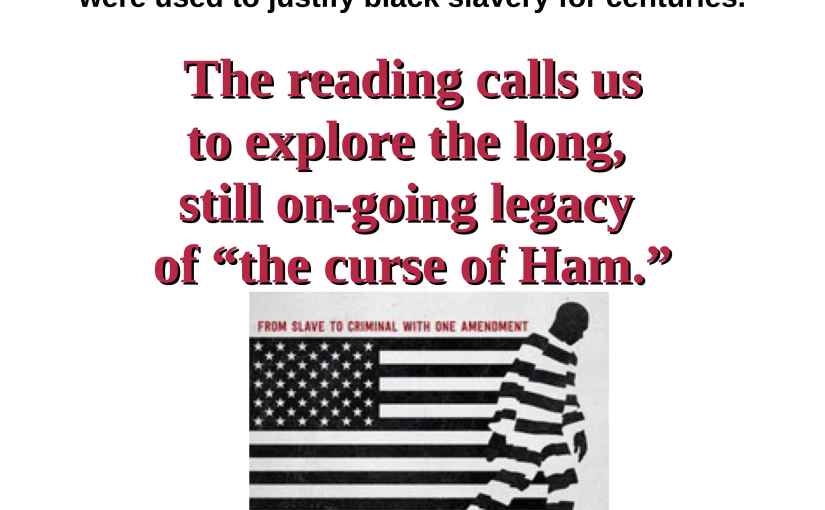
Seeing a rainbow, we are to be reminded of the covenant, of God’s mercy and of our own obligations. Some teachers see the rainbow as a reminder to repent and spur repentance among others. With this in mind, watching Ava DuVarney’s documentary, 13th — about mass incarceration of black people as an extension of slavery — seems a useful step in beginning to respond to the long legacy of “cursed be Canaan.”
Fateful conjunction of slavery and race
Upon realizing “what Ham had done to him,” Noah responded: “Cursed is Canaan; a slave of slaves shall he be to his brothers.” Noah goes on to specify that Canaan, son of Ham, will be a slave to his uncles, Shem and Japheth (Genesis 9:25-27). Only Canaan is mentioned, but the curse is often understood to apply to generations of descendants of all four of Ham’s children. And, while there is no biblical reference to skin color at all, the curse of slavery became associated with black skin.
…it is not clear when to date the fateful conjunction of slavery and race in the Western readings of Noah’s prophecy….the application of the curse to racial slavery was the product of centuries of development in ethnic and racial stereotyping, biblical interpretation, and the history of servitude.
Nevertheless, by the early colonial period, a racialized version of Noah’s curse had arrived in America.
— Stephen R. Haynes. Noah’s Curse, pp.7-8 (citation below)
DuVarney’s 13th looks at slavery — outlawed by the 13th Amendment, except as a punishment for crime whereof the party shall have been duly convicted — and its re-incarnation through mass incarceration. 13th does not explore biblical text or religious teaching. It looks at the U.S. criminal justice system today and its relation to the broader history of racism, oppression and subjugation of black people.
“We take you from 1865 and the abolition of slavery and the enactment of the 13th Amendment all the way to now and this Black Lives Matter movement,” DuVernay told Democracy Now. “And we trace, decade by decade, generation by generation, politician by politician, president by president, each decision and how it has led to this moment.” (more on the movie)
Three of the key Noahide laws are
prohibition on murder, with the reminder that every human is created in God’s image;
prohibition on stealing, understood broadly to include kidnapping and other forms of theft; and
establishment of a courts and a system of law.
What is the rainbow saying with regard to our record on murder, stealing, and courts?
NOTES:
1) The story of the Noah is found in this week’s Torah reading (Genesis 6:9-11:22). The verses discussed here (9:20ff) cryptically describe a post-Flood incident involving drunkenness on Noah’s part and Ham’s witnessing “his father’s nakedness.”
וַיִּיקֶץ נֹחַ, מִיֵּינוֹ; וַיֵּדַע, אֵת אֲשֶׁר-עָשָׂה לוֹ בְּנוֹ הַקָּטָן.
וַיֹּאמֶר, אָרוּר כְּנָעַן: עֶבֶד עֲבָדִים, יִהְיֶה לְאֶחָיו.
Noah awoke from his wine and realized what his small son [Ham], had done to him. And he said, “Cursed is Canaan; a slave of slaves shall he be to his brothers.”
Various explanations have been suggested for why Canaan was cursed rather than Ham. Genesis Rabbah, for example, says that Noah couldn’t curse Ham, because God had already blessed him (Gen 9:1). Another possibility put forth was that Canaan was really the instigator. While the text speaks of individuals and not whole communities, many commentators over the centuries focused on moral factors which they believed might result in one people being subjugated to another. TOP
2) Race and Slavery in early Judaism, Christianity, and Islam. David M. Goldenberg. Princeton, NJ: Princeton University Press, 2003.
[Goldenberg] concludes that in biblical and post-biblical Judaism there are no anti-black or racist sentiments, a finding that some scholars dispute. He also contends that the notion of black inferiority developed later, as blacks were enslaved across cultures. His findings, he said, dovetail with those of other scholars who have not found anti-black sentiment in ancient Greece, Rome or Arabia.
”The main methodological point of the book is to see the nexus between history and biblical interpretation,” Mr. Goldenberg said. ”Biblical interpretation is not static.”
— “From Noah’s Curse to Slavery” in New York Times
3) Stephen R. Haynes. Noah’s Curse: The Biblical Justification of American Slavery. Oxford and NY: Oxford University Press, 2002. BACK
13th: A Documentary
“13th strikes at the heart of America’s tangled racial history, offering observations as incendiary as they are calmly controlled,” writes Rotten Tomatoes, where the film gets a 98% positive rating from critics and a 94% positive audience score.
“A damning but cogent argument for wholesale reconsideration of the so-called prison industrial complex,” is how the Chicago Tribune characterizes 13th.
The New York Times calls it “powerful, infuriating and at times overwhelming.” Many people, this blogger included, report needing to watch the movie in installments.
In addition to some local screenings, 13th streams on Netflix. Sign up for a free month, if you don’t already subscribe or have a friend who does. RETURN




 "A Song Every Day"