Say Uncle for the High Holidays

I found the poetry collection, Say Uncle by Kay Ryan, at my local library and thought two of the pieces useful for the season of returning and repentance:

“Failure 2”
There could be nutrients
in failure–
deep amendments
to the shallow soil
of wishes.
Think of the
dark and bitter
flavors of
black ales
and peasant loaves.
Think of licorices.
Think about
the tales of how
Indians put fishes
under corn plants.
Next time hope
relinquishes a form,
think about that.
— p.69

“Don’t look back”
This is not
a problem
for the neckless.
Fish cannot
recklessly
swivel their heads
to check
on their fry;
no one expects
this. They are
torpedoes of
disinterest,
compact capsules
that rely
on the odds
for survival,
unfollowed by
the exact and modest
number of goslings
the S-necked goose is –
who if she
looks back
acknowledges losses
and if she does not
also loses.
— pp. 32-33
Say Uncle. NY: Grove Press, 1991

Also of possible interest, as we prepare to begin anew in head the book of Genesis, “A Certain Kind of Eden.”

Here is general information about the poet and the Library of Congress resource page. The latter includes a video farewell reading program, from the conclusion of Kay Ryan’s term as poet laureate.

Finally, just because it tickled me — A previous reader of the library volume I borrowed had circled three phrases in red. Together they form a sort of meta-poem or mangled haiku:

elfin tailor

weakness and doubt
are symbionts

that’s water under
the bridge, we say

Maybe there’s a message for the new year in this odd mash-up of Kay Ryan lines.

May we all be inscribed for a good and sweet year to come.

Ishmael, Isaac, and a Reunion of Cousins

What can the story of Ishmael and Isaac, especially its conclusion in Genesis 25:7ff, tell us “about renewing the cousinship of Blacks and Jews — and of people who live in both communities — when white nationalists are threatening both”?

The Shalom Center suggests that the Torah reading(s) for Rosh Hashanah, which highlight the endangerment and separation of Ishmael and Isaac, “cry out for turning and healing.” Toward this end, Rabbi Arthur Waskow proposes an additional reading for Yom Kippur: Gen 25:7-11, wherein the two brothers join together to bury their father and “Isaac goes to live at the wellspring that is Ishmael’s home.”

Arthur suggests that reading this tale at the end of the Days of Awe “can remind us as individuals that it is always possible for us to turn away from anger and toward reconciliation.” In addition it can remind us that the descendants of Isaac (Jewish people) and of Ishmael (Islam and Arab peoples) “need to turn toward compassion for each other.” (More on this idea at “5 Offerings for a Deep and Powerful Yom Kippur.” The “cousins” paragraph, quoted above, is from a print Shalom Center communication elaborating on this Yom Kippur reading suggestion.)

Renewing Cousinship

Arthur taught at Fabrangen Havurah, probably twenty years ago, on the topic of Ishmael and Isaac jointly burying their father. Since then, I’ve thought many times about this part of the tale and its power to point us either toward reconciliation or toward less helpful paths. I don’t think I ever explored it in terms of “renewing the cousinship” of Black and Jewish communities before, however. And, because this is an on-going and strong concern for me, I plan to pursue this in some detail in the days ahead — for the high holidays and beyond. Our communities are much in need of turning and healing.

I am not yet sure if this is a continuation of last year’s #ExploringBabylon or a new direction. Either way, I hope you will join in, by subscribing if you have not already done so — follow buttons are now at the VERY BOTTOM of posts — and contributing your thoughts.

Life at the Wellspring

“Isaac goes to live at the wellspring that is Ishmael’s home.”

This is what struck me most powerfully in Arthur’s teaching this year. In year’s past, I thought in terms of interfaith understanding, of the wellspring as a fundamental source that Isaac and Ishmael share and a common link to Hagar. Viewing the descendants of Isaac and Ishmael as members of Jewish and Black communities today, however, raised new questions:

  • Beer Lahai Roi is where Ishmael settled after being expelled from the family home. So what does it mean that Isaac is now living there?
    • Is this true brotherly reunion, generally accepted by others in the neighborhood?
    • Or does this look to some like colonization of the exiled brother’s home?
    • Do the brothers fairly share a joint family heritage in the wellspring?
    • Or is Isaac somehow appropriating what had been Ishmael’s?
  • Beer Lahai Roi is a powerful place of God-connection at times of severe travail for Hagar. So what does it mean that Isaac settled there?
    • Did separate traumas experienced by Isaac and Ishmael lead them, by divine guidance, perhaps, to a joint source of healing?
    • Or did Isaac seek out Ishmael hoping his older brother could guide him?
    • Do the brothers learn from one another?
    • Or do they, with some rare exceptions, like burying their father, retreat into their own pain?

Perhaps midrash — ancient, modern, or newly discovered — will reveal some answers. Maybe some of these questions are best left open.

Rosh Hashanah Torah Reading(s)

In Reform and some other congregations observing one day of Rosh Hashanah, the Torah reading is generally the story of the Akedah, the binding of Isaac, Genesis 22:1-24. Where two days are observed, common practice is to read the Akedah story on Day Two and the story of Hagar and Ishmael being cast out, Genesis 21:1-34, on Day One.

In midrash, Sarah dies as a result of the near sacrifice of Isaac. So, whether or not Genesis 21 is read at the holiday, these stories highlight endangerment of both sons and both mothers and a family torn apart.

Genesis 25:7ff, when the brothers bury Abraham, is read as part of the regular Torah cycle, parashat Chayei Sarah (Genesis 23:1-25:18) but is not part of the traditional readings for the Days of Awe.
TOP

Now What? Exploring Babylon Stage Two

I launched the “Exploring Babylon” project on this blog in October 2017. Stage One was to run for roughly 40 weeks, from Sukkot through Tisha B’av. WordPress statistics tell me that I’ve posted 40 times in the category, “Exploring Babylon,” although not entirely on the weekly schedule I’d originally planned, and Tisha B’av is fast — no pun intended — approaching (eve of July 21 through dark July 22).

Not sure yet what shape Stage Two will take. Comments and suggestions welcome.

Where Exodus Metaphors Fail

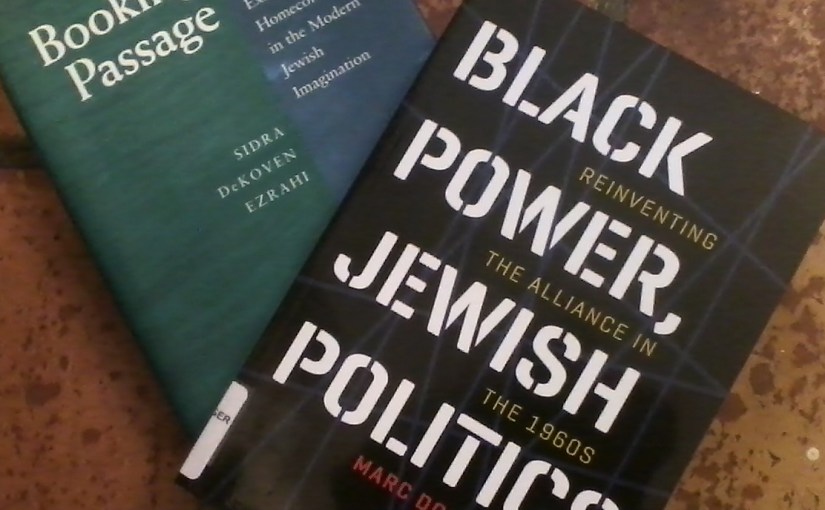
Meanwhile, a recent interview with the author of Black Power, Jewish Politics returns us to the basic challenge that impelled me into this project.

When I talk generally with white Jews about why Jews are involved in social justice or civil rights or racial equality, they’ll talk about this shared history of oppression.

And the problem is that American Jewish history and African-American history are 180 degrees opposite on that question. One of my African-American colleagues, he said, “If I ever go to a Seder and the Jews say that they know what it’s like because they too were once slaves in Egypt,” he’s gonna punch ’em.

Because if Jews have to go back to ancient Egypt to get the slavery metaphor, then they’ve kind of missed that American Jewish history is a story of rapid social ascent, and African-American history is the legacy of slavery. That argument is insulting, and it’s very elementary.

And, of course, I found that the people actually involved in the movement in the 50s, they knew that. And they were quite clear that they were not buying into that.
— Marc Dollinger, 6/4/18 NPR interview

In the struggle for racial and other forms of social justice, might the language and history of Exile serve where Exodus metaphors sometimes fail?

And, as we move through the month of Av and on toward a new year, how might we use ideas about exile and Babylon, in particular, to inform us?

As the source of a long intertextual journey, Psalm 137 generates the poetic vocabulary of exile: “By the waters of Babylon, there we sat down and cried as we remembered Zion.” The pleonastic “there,” repeated in the third verse, calls attention to itself by its very redundancy; syntactically superfluous, “there” defines exile as the place that is always elsewhere. Being elsewhere, being far from Zion, is the pre-text for poetry….(p.9)

With the (re)territorialization of the Jewish imagination in the twentieth century, a radical shift takes place in the relative position of ends and means, of original and mimetic space, of holy and profane, of ownership and tenancy. If exile is narrative, then to historicize the end of the narrative is to invite a form of epic closure that threatens the storytelling enterprise itself–an enterprise that remained alive, like Scheherazade, by suspending endings. Conversely, to claim an absolute place for the exilic imagination is to privilege the story as the thing itself; the map for the territory, language without referent; and to regard “nomadic writing” as the inherently Jewish vocation…. (p.14)
— Sidra DeKoven Ezrahi, Booking Passage

Again, comments and suggestions welcome.

May the mourning of the weeks ahead bring us some new light.

NOTES:
Pleonasm
Although it’s pretty clear from context, and maybe everyone else knows, I did look up “pleonasm” for my own edification. Here’s a useful and not overly ad-filled explanation of pleonasm.
BACK

Citation
Ezrahi, Sidra DeKoven. Booking Passage: Exile and Homecoming in the Modern Jewish Imagination. Berkeley, CA: University of California Press, 2000.
BACK-2

Monsters, Exile, and Storytelling

UPDATE: The event described here, including the brief interview with Díaz, took place on March 15, 2018. The piece below was posted on April 1. The New Yorker article, “The Silence: The Legacy of Childhood Trauma” — which has a LOT to say about monsters and trauma — was not published until April 16. See also, “More on Monsters and Storytelling.”


Exploring Babylon Chapter 19

A new picture book, by Dominican-born author Junot Díaz, has a few things to tell readers of all ages about trauma, exile, memory, and the importance of storytelling — good topics for Passover and #ExploringBabylon.

Islandborn

Islandborn relates the tale of young Lola — who attends a school where “every kid…was from somewhere else” — trying to draw a picture of her native country for a homework assignment. Having left “the Island” before she could remember, she enlists help from community members, and one older neighbor tells her something shocking:

“A long time ago, long before you were born…a monster fell upon our poor Island.

“…For thirty years the Monster did as it pleased. It could destroy an entire town with a single word and make a whole family disappear simply by looking at it.

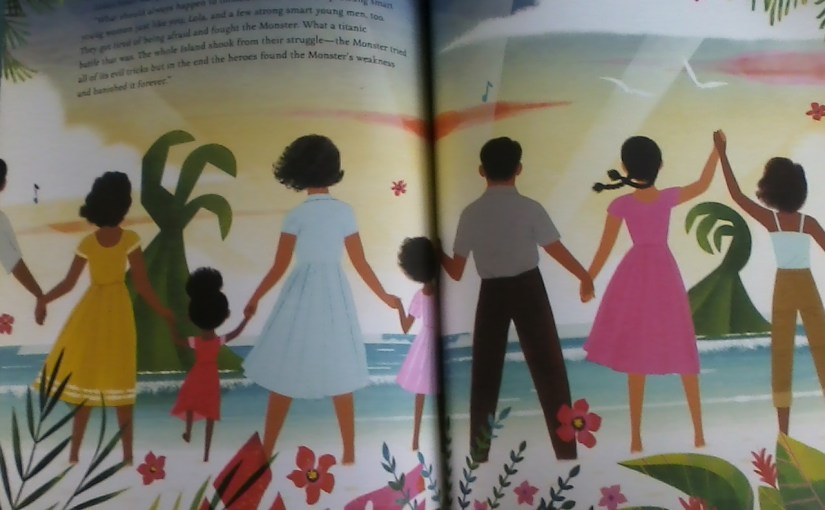
“[Eventually…] heroes rose up…got tired of being afraid and fought the Monster….The Monster tried all of its evil tricks but in the end the heroes found the Monster’s weakness and banished it forever.”

Islandborn, Díaz’s first children’s book, is illustrated by Leo Espinosa, originally from Columbia. (NY: Dial Books for Young Readers, 2018). See Random House and Publisher’s Weekly.

Islandborn
(c) Diaz & Espinosa.Islandborn. Dial 2018.

“The Monster”

The name of “the Island” is not specified. The name of the Monster is also omitted, along with those of heroes who “banished” the Monster.

Many readers will undoubtedly think of the Dominican Republic, where Díaz was born, and the dictator who ruled ruthlessly from 1930-1961, before the author’s time. But the book itself and publisher’s descriptions deliberately do not offer any historical details.

Díaz has explained in public events that he intentionally left the island unnamed so that the reader could bring their imagination to the story. He adds that there are monsters in many countries and there are many kinds of monsters (not all are dictators); he wanted this story to be about more than one place or experience.
Social Justice Books

In addition to allowing for readers to use their imaginations, though, the idea of leaving “the Monster” unnamed has a particular resonance for Jews and other Hebrew Bible readers: After an enemy attacks the most vulnerable members of the community during the Israelites’ trek through the desert, God gives Moses the strange commandment to remember to forget the enemy’s name:

And the LORD said unto Moses: ‘Write this for a memorial in the book, and rehearse it in the ears of Joshua: for I will utterly blot out the remembrance of Amalek from under heaven.’
— Exod 17:14

…thou shalt blot out the remembrance of Amalek from under heaven; thou shalt not forget.
— Deut 25:19

When I told fellow Jews, over a recent Shabbat, about Islandborn and how the book relates its tale, each one mumbled some version of “blot out the name!” And that heritage has raised many questions over the centuries about what and how we remember and what and how we re-tell.

Legacy and Response

Social Justice Books suggest that “one place where young readers could handle a more accurate narrative, than what is offered in the book, is in the description of what happened to” the unnamed heroes:

Lola was told, “No one knows really [what happened to them.] It was so long ago.” The truth is that we actually do know what happened to the Mirabal sisters and countless others….A response that children could handle would be “Sadly, many were killed, but others survived. Their children, like you, continue to work for a better world today.”

Some social studies teachers and individual parents may want to discuss the specifics of Dominican history around Islandborn or use it to discuss motivations behind much immigration. Díaz, however, prefers to steer the conversation in more universal directions.

At a recent Islandborn book talk for young readers and writers — 1st through 5th grade, accompanied by a few pre-schoolers and adults, at a DC Public Library branch — the first young person to speak declared: “Monsters aren’t real.” In response, Díaz spoke generally, first agreeing with the student and then explaining that his home country was, in fact, once “taken over by a very bad man who was kinda like a monster.” The author never mentioned the Dominican context again and never got more specific.

After the event, I asked Díaz if he ever addressed young readers — like those at Capitol View Neighborhood Library, where we met — by helping them name monsters in their lives. Again, he rejected a more specific path: “I don’t think [local youth] need to hear anything from me about the monsters they face….If their lives are anything like mine, they know.”

Instead, the author argues: “The key is to help them confront and work through their experiences, forge friendships and solidarities.”

Toward that end, Díaz asked young readers to look at how the people eventually defeated the monster. He drew attention to the illustration above, noting that all monsters have a weakness that can be used against them, and that people joining together is essential….Students at Capitol View noted, based on the illustration and their own experience, the role of singing in uniting people.

How We Tell the Tale

The tenor of the Islandborn youth discussion at Capitol View remained largely philosophical and literary, rather than historical. Several young readers asked questions around why monsters do what they do. The author suggested several reasons, including the example of an older sibling wanting more than a fair portion of a treat meant for sharing. In response to another student, Díaz raised the concept of literary tropes around monsters.

Still, one ten-year-old did wonder, “What about the good people who are killed by the monsters before it’s defeated?” Díaz suggested, given that the age range present and how close to the end of the allotted time the question arose, that the young person talk to him following the group gathering.

In a similar vein, a local rabbi recently shared that his very young children do not know about the tenth plague [death of the first-born], despite its prominence in the Passover story. Of course, age and maturity of audience must influence content or emphasis in storytelling. Beyond age-appropriateness, however, the question of what to tell and what to omit is a deeper issue:

  • If we don’t relate the horrors, how will we ensure that victims are remembered and future generations informed?
  • How do we ensure memory and sensitivity, without perpetuating trauma?
  • Depending on the depth of our storytelling, how do young people — and the older people they become — relate to our state of exile?

At one point in Islandborn, after neighbors have opened up to Lola about the good and the horrible on “the Island,” child and grandmother have a key exchange:

Abuela, did you know about the Monster?”
“Of course, hija. Why do you think so many of us are here in the North?”

— on this second day of the omer, 5778

The Five Powers, part 3

Exploring Babylon Chapter 11.2

A few notes on Rome, the last of the five foreign powers associated with Chanukah, to round out the discussion of “Ma’oz Tzur [Rock of Refuge].”

Chapter 11.1 outlined the structure of the 13th Century piyyut:

  • an opening stanza calling for future restoration of the Temple and for God to prepare the “slaughter​ of the blasphemi​ng foe”;
  • four stanzas recalling past-tense rescues (Chanukah, Purim, Egypt, Babylon); and
  • and a final, present/future-oriented stanza asking God to “Aveng​e the blood of your servants from the evil nation” and “Push Edom into the shadows and bring the seven shepherds.”

This structure follows a regular, ancient pattern which recalls previous rescue from foreign powers while calling on God for help now, from the ever-present power of “Rome” in its many forms over the centuries. And this piyyut’s history illustrates another pattern associated with “Rome.”

See below for a note on the “seven shepherds” (hint: not average, peaceful flock ovine-tending folk).

The Persistence of “Rome”

When the Talmud and many early midrashim speak of “foreign powers,” rescue from Egypt and from Babylon, Persia, and the Seleucid empire is past tense, while the Roman Empire — often called “Edom” or “Esau,” sometimes “the evil nation” — remains a present danger. We saw this, for example, in midrashim on the Akedah, Jacob’s dream, and “in the beginning.” The same trope is repeated for centuries, with “Edom” or “the evil nation” standing in for the Catholic Church and non-Jewish political powers.

Meanwhile, the Roman Empire and its successors influenced various aspects of Jewish worship through official censorship by the authorities, intimidation and violence, and related self-censorship by Jewish communities. This dynamic is often cited to explain why the narrative of Chanukah shifted from the military-centered tale (Maccabees 1 and 2, usually dated 2nd Century BCE) to the story of one cruse of oil lasting eight days (B. Talmud Shabbat 21b, hundreds of years later, during Roman rule). This is also a key part of the story of how Ma’oz Tzur‘s presentation in various prayer books changed over the years.

For several hundred years, the harsh sixth stanza of the piyyut disappeared from prayerbooks, although the first stanza remained and garnered many musical settings. (See Notes 2 and 3 below.) The evil nation/Edom verses can be found today in Orthodox prayer books today, while non-Orthodox prayer books and musical collections continue to omit them — very often including even more abbreviated versions of Ma’oz Tzur or and/or substitution of the 19th Century song, “Rock of Ages.”

The sixth stanza’s disappearance is now thought to be the result of self- censorship by Jewish communities during periods when relations with “Rome” were troubled at best. Deciding whether and how to (re-)include the sixth stanza is part of the on-going development of relations between Jews and “Rome.”

Singing with Gusto?

A few years ago, the London-based Jewish Chronicle posted a discussion on including, or omitting, the sixth stanza.

Rabbi Naftali Brawer, from Borehamwood and Elstree (Modern Orthodx) United Synagogue, argued for using the existence of harsher prayers, like Ma’oz Tzur, as teaching moments:

As a responsible teacher you cannot hide this fact from your students. Instead, use these prayers as a springboard to discuss the turbulent nature of Jewish history. These are not speeches calling on faithful Jews to commit violence. They are desperate prayers to God asking Him to remove the threat of danger that hangs over our people.

Rabbi Jonathan Romain from Maidenhead (Reform) Synagogue argued to the contrary, noting that “we ask others to remove passages that offend us — such as sections of Christian liturgy that insult Jews,” and declaring that the sixth stanza of Ma’oz Tzur “hardly reflects our understanding of the festival or the positive message of Jewish identity that we derive from it.”

Romain concludes:

The prayer book is the manifesto of Judaism. It is said that the Bible is God’s gift to the Jewish people, and the prayer book is our gift back. It reflects what we believe and stand for. If we are to pray it, then we should mean it.

We should be able to sing Ma’oz Tzur with gusto and without grimacing at the end. Religious values means ditching verse six.

…The two teachers were asked only about the sixth stanza, not about the “slaughter​ of the blasphemi​ng foe” line in the opening stanza. Many progressive congregations do cheerfully belt out the first stanza in Hebrew, with or without a literal English translation nearby; I don’t know what is included in British Reform Jewish siddirum…

Brawer’s position is quite different:

Ma’oz Tzur in particular demonstrates that persecution is unfortunately a recurring theme in our history. Jews must never gloat when an enemy falls and vengeance for vengeance’s sake is distinctly un-Jewish. However, that does not mean we must shy away from asking God to eliminate our enemies. Nor for that matter should we hesitate to celebrate when that happens. That is, after all, the whole story of Chanucah.

But this brings us back to the topic of Chanukah and the ways we tell the story: the Maccabees’ might? Zechariah’s “but by spirit”? The Talmud’s story of lights? And this has always depended, at least in part, on who else might be listening.

Epilogue

This, finally, is the last of three originally-planned posts on Chanukah and the “five powers.” (Apologies for delay and any confusion occasioned by it.) The holiday has been over for awhile now, most likely the wax and wicks finally cleared away as well. But the real point of the holiday — as Gila Sacks writes here — is what we take forward from it:

The lighting of the menorah stands in direct contrast to the dramas of war…..it emphasizes the power of the regular, consistent practice of ritual and law to bring meaning into our lives— rather than waiting for miracles, waiting for enlightenment to find us.

Mai Hannukah? [What is (the reason for) Chanukah?] We focus on the lighting of the menorah, rather than the war that preceded it, to remind us that the real miracles came afterward—in our ability then, and our challenge now, to create an emanating light through small, simple, regular acts of service.
— Gila Sacks, “Creating Light Each Day”
Shema Bekolah: Hear Her Voice


NOTES

NOTE 1: Seven Shepherds
The Book of Micah — dated to the last part of the 8th and first part of the 7th Century BCE — focuses on a the time period around the fall of the Northern Kingdom to Assyria. This prophet is read only once in the liturgical year, as haftarah (5:6-6:8) for the Torah portion Balak (Numbers 22:2 – 25:9). The haftarah includes the famous line (6:8), “You have been told, O man, what is good, and what the LORD requires of thee: only to do justly, and to love mercy, and to walk humbly with your God.”

The haftarah begins with a positive-sounding message: “And the remnant of Jacob shall be in the midst of many peoples, as dew from the LORD, as showers upon the grass…” (5:6) but goes on to speak of violent retribution, wrecking chariots and destroying idols, fortresses and cities (5-8-14). And just preceding the haftarah are more sword-centered, messianic visions:

“And you, O Bethlehem of Ephrath, Least among the clans of Judah, From you one shall come forth To rule Israel for Me— One whose origin is from of old, From ancient times.
“Truly, He will leave them [helpless] Until she who is to bear has borne; Then the rest of his countrymen Shall return to the children of Israel.
“He shall stand and shepherd By the might of the LORD, By the power of the name Of the LORD his God, And they shall dwell [secure]. For lo, he shall wax great To the ends of the earth;
“And that shall afford safety. Should Assyria invade our land And tread upon our fortresses, We will set up over it seven shepherds, Eight princes of men,
“Who will shepherd Assyria’s land with swords, The land of Nimrod in its gates. Thus he will deliver [us] From Assyria, should it invade our land, And should it trample our country.”
— Micah 5:1-5 (1985 JPS, posted by Sefaria)

Rabbi Rabbi Adin Steinsaltz discusses the “seven shepherds” in the context of Sukkot’s ushpizin [mystical visitors to festival booths]. Micah’s messianic verses are much more popular among Christians. In fact, FWIW, the My Jewish Learning article comes from a Christian press.

BACK


NOTE 2:

Cantor David Berger, of KAM Isaiah Israel in Chicago, gave a 2010 presentation for the Union for Reform Judaism which presents many musical settings and includes history and commentary. His presentation to the URJ used an orthodox source (Koren Sacks siddur) for the six stanzas of Ma’oz Tzur, as well as Reform and other sources for the 19th Century song, “Rock of Ages.” (More on this in the previous chapter of #ExploringBabylon.)

NOTE 3:
Although some scholars suggest that the harsh sixth stanza was a later addition, it seems of a piece with the first stanza’s call for God to prepare the “slaughter​ of the blasphemi​ng foe,” as well as with the “You saved us before, get us out of Edom” trope described above. Berger (in above cited webinar) reports that scholars now believe the sixth stanza original and self-censored.

BACK

The Five Powers, part 2

Exploring Babylon 11.1

Episode 10 of #ExploringBabylon began discussing foreign powers associated with Chanukah — Egypt, Seleucid (Syrian-Greek) Empire, Babylon, Persia, and Rome — looking briefly at three of the five. Before the holiday is too distant a memory, let’s look at the remaining powers, Persia and Rome, and the holiday piyyut [liturgical poem] that includes them all.

Ma’oz Tzur [Rock of Refuge]” includes a stanza about restoration and re-dedication of the Temple followed by stanzas reflecting on rescue from each of the five foreign powers. It was composed in Hebrew in 13th Century Germany and credited to “Moredechai,” based on his acrostic “signature.”

The 19th Century song “Rock of Ages” — often confusingly called a “translation” of “Ma’oz Tzur” — adapts the piyyut’s themes of kindling lights and rescue while focusing only on the Chanukah story. The English is credited to two European-born, U.S. rabbis important in the Reform movement, based on an earlier German piece.

For the purposes of #ExploringBabylon, it’s important to note differences between the 13th and 19th Century lyrics in terms of agency, tense, and ultimate aim.

Rock of Refuge, Ages

“Rock of Ages” omits any call for restoration of the Temple, of course, and there is no sense that Jews (some of whom may be “fettered”) are more in need of rescue than any other people. The 19th Century Reform song thanks God for “saving power” (past tense) and then calls on Jews (present, future) to wake and sound their message of universal freedom and an end to tyranny:

“Rock of Ages, let our song, praise Thy saving power;
Thou, amidst the raging foes, wast our sheltering tower.
Furious they assailed us, but Thine arm availed us,
And Thy Word broke their sword, when our own strength failed us.

“Kindling new the holy lamps, priests, approved in suffering,
Purified the nation’s shrine, brought to God their offering…

“Children of the martyr race, whether free or fettered,
Wake the echoes of the songs where ye may be scattered.
Yours the message cheering that the time is nearing
Which will see, all men free, tyrants disappearing.
Which will see, all men free, tyrants disappearing.”
— Marcus Jastrow & Gustav Gottheil

The 13th Century lyrics, on the other hand, use past tense for stanzas about Egypt, Babylon, Chanukah, and Purim, but open and close with the need for God’s future rescue. The poet ascribes deliverance, past and future, to God alone and continues to beg for help for the beleaguered Jewish community:

Ma’oz tzur yeshu’ati
O Fortress,​ Rock of my salvation​​,
lecha na’eh leshabei’ach,

unto thee it is becoming to give praise:
Tikon beit tefilati
let my house of prayer be restored,​
vesham todah nezabei’ach
and I will there offer thee thanksgiv​ings
Le’eit tachin matbei’ach
when thou shalt have prepared a slaughter​
mitzar hamenabei’ach,
of the blasphemi​ng foe,
Az egmor beshir mizmor
I will complete with song and psalm
chanukat hamizbei’ach
the dedicatio​n of the altar.*

Chasof zero’a kadshecha
vekareiv keitz hayeshu’ah,

Expos​e your holy arm
and bring the end of the redemptio​n.

Nekom nikmat dam avadecha
mei’uma haresha’ah,

Aveng​e the blood of your servants
from the evil nation.

Ki archa lanu hayeshu’ah
ve’ein kaitz leyimei hara’ah,

Becau​se the salvation​​ has been a long time coming
and there is no end to the days of evil.

Dechei admon betzeil tzalmmon
hakeim lanu ro’im shiv’ah.

Push Edom into the shadows
(Others: Thrust the enemy into the darkness of death)
and bring the seven shepherds.”***
Zemirot Database
*translation from Authorize​​​d Daily Prayer Book (1890)
***Zemirot Database contributor translation

NOTE: “seven shepherds” from Micah 5:4 (more, eventually, on this verse)

Zemirot Database provides Hebrew and a public domain translation of all six stanzas of “Ma’oz Tzur.” The Milken Archives offers lyrics, without the last stanza, and a little history. Wikipedia presents lots of useful background plus Hebrew and English for both “Ma’oz Tzur” and “Rock of Ages,” and — serious kudos for this important clarification — identifies the latter as a “non-literal” translation of the former….

Rescue from the Powers

Stanzas 2-5 of “Ma’oz Tzur” thank God for rescue (past tense):

  • God “brought forth the treasured people” and Pharaoh’s army “sunk like a stone”
  • The oppressor “came and led me captive” but “through Zerubbabel I was saved after seventy years”
  • “The head of the Benjamite​ thou didst exalt, but the enemy’s name thou Midst blot out”
  • “The Grecians were gathered against me in the days of the Hasmoneans,” towers were broken and oil defiled, “but from one of the last remaining​ flasks a miracle was wrought for thy beloved”

The final verse, quoted above, returns to the present tense; we’ll leave its call for relief from Edom (Rome) — which was missing from prayerbooks for hundreds of years and is still omitted from many versions — for another day.

We’ve previously touched on other powers described above, but we’ve yet to focus in on Persia.

Persia, Purim, and the Temple

As is common in re-tellings of the Purim story, the stress in “Ma’oz Tzur” is on the evil that Haman intended toward the Jews and the violent end he and his sons met instead; the carnage in the final chapters of Esther, when “Jews smote their enemies” (9:5), is not mentioned. And, as in other stanzas of the piyyut, the only real actor in the Purim stanza is God.

The Purim story is set sometime after the far the Persian conquest of Babylon (539 BCE), when Judeans who had been exiled were allowed to return to Jerusalem and rebuild the Temple. Many Jews remained behind in what had been Babylonia, however. And, meanwhile, according to Ezra 4:6ff, permission to re-construct the Temple was rescinded “in the reign of Ahasuerus.”

Rebuilding had stalled during Zechariah’s prophesy. We left off our previous discussion, with the haftarah for Chanukah (Zech 2:14-4:7), as the twin leadership of Zerubbabel — also mentioned in the Babylonian stanza of “Ma’oz Tzur” above — and Joshua ben Jehozadak attempted to rally support for the restoration. Zechariah’s prophesy is specifically dated to 520-518 BCE; it is less clear how we are to understand “in the days of Ahasuerus” (Esther 1:1).

The Book of Esther is set far from Jerusalem, and the text does not mention the Temple. Midrash does, however. For example: Mordechai had been part of a delegation asking the king to allow rebuilding (Pirkei de-Rabbi Eliezer). Ahasuerus rejoices at the Temple’s delay, according to Midrash Rabbah. The king calculated that the Judeans’ exile was exceeding the period prophesied by Jeremiah, and so “brought vessels of the Temple and used them” (BT Megillah 11b).

Persia and Babylon

The vessels used in the king’s feast (1:5) and Queen Vashti’s (1:9) link these festivities to earlier revelry in Babylon, when Belshazzar used the vessels the night of the “writing on the wall” (Dan 5). In this and many other ways, Midrash Rabbah accuses Ahasuerus of prolonging, and sometimes enjoying, Jews’ separation from the Temple begun with Babylonian Captivity. However, the ancient rabbis’ understanding of Babylon as God’s instrument extends to Persia.

Throughout Midrash Rabbah, God is a regular, explicit actor in the Purim story, even though God is not mentioned — except, perhaps, for Mordechai’s comment about help coming “from another place [מִמָּקוֹם אַחֵר]” — in the actual text of Megillat Esther.

Early on in Midrash Rabbah, for example, the apparently superfluous “in those days” of Esther 1:2 is explained by an exchange between God and the angels. The angels complain to God, “Master of the universe! The Temple is destroyed, and this wicked person sits and engages in revelry?!” God responds by saying Redemption had been delayed due to Judeans’ failure to observe the Sabbath:

“Place days opposite days,” thus it is written: In those days I observed in Judah [people] treading on winepresses on the Sabbath (Neh 13:15)
— Esther Rabbah 1:10 (Artscroll, 2011)

Jewish thought over the centuries includes many other views of exile and oppression, but the concept of Redemption coming when God determined it was deserved, so apparent in Midrash Rabbah for Esther, seems to be shared by the writer of “Ma’oz Tzur.” This yields a further blurring of “foreign powers” — beyond Babylon, and its successor, Persia — into a sort of non-specific enemy to be defeated in God’s time. And, while “Rock of Ages” does not hint at oppression as deserved (or list as many previous oppressors), it ultimately points to a similar non-specific tyranny as enemy.

…and that leads, eventually, to the concept of “empire” in Christian commentary. (To take just one example, see Come Out My People! God’s Call Out of Empire in the Bible and Beyond, by Wes Howard-Brook. Maryknoll, NY: Orbis, 2010). More on this, with some Christian and interfaith input, to come….

But there is still “Rome” and far more work, just in clearing up the last bits of Chanukah’s wax, for #ExploringBabylon.


NOTE 1:
A number of sources, including the Reform siddur, Mishkan T’filah (2007), and the Reconstructionist Kol Haneshamah (1994), publish the 13th Century Hebrew side-by-side with the “Rock of Ages” text, calling it a “translation.” It is unsurprising, therefore, that many other educational and music sites follow suit. See, e.g., Teaching Songs, Hebrew Songs), and sadly: My Jewish Learning. “Rock of Ages” is based on an earlier German version and so, in that sense, a translation — just not of the Hebrew.

Some sources, obviously copying Wikipedia — which has enough contributors monitoring Jewish learning pages to pick at any sloppiness — now call “Rock of Ages” a “non-literal translation” of the Hebrew piyyut. A 2010 Reform presentation uses quotation marks: “an English ‘translation.'”

EDITORIALIZING NOTE: Wikipedia is very useful and, as this example indicates, very influential. Many of us make use of it without giving it much consideration, though. ‘Tis the season, however, so please consider saving on 2018 taxes by donating now to this and the other internet resources, Jewish and more general, on which we all rely.
BACK


NOTE 2:
This reflects closely the discussion in B. Talmud Shabbat 21b, which begins with “What is Chanukah?” and goes on to discuss order of candle-lighting and reciting of Hallel, with the briefest mention of the Temple being defiled. In contrast with Books 1 and 2 of Maccabees, which discuss the stories, including military views, of the conflict with the Hasmoneans.
BACK


NOTE 3:
Some contemporary scholars call the Book of Esther a “novella” not linked with specific historical figures; others identify Ahasuerus with Persia’s Xerxes I and its setting to 483-473 BCE (Cf My Jewish Learning) and Jewish Encyclopedia). For the purposes of this discussion, the book’s historicity is not of prime importance.
BACK

Wax and Wicks

Jews have laws and customs for so many ritual details: washing hands in the morning, donning a tallit [prayershawl], the order of blessings before and after a meal, preparing a household for Passover, etc., etc., etc., etc. A special kavanah [intention] can be part of even the most mundane of actions, as well. But, while we do have rituals for bidding holy days farewell, there is a marked lack of ritual and intention for cleaning up afterward. Much ink has been spilled, for example, over the order candles are placed in the Chanukah menorah and the order in which they’re lit each night. Where do we learn, though, how to deal with wax drippings and old wicks, at the end of the eight days?

WaxWicks.jpg

A winter cold meant a pause in #ExploringBabylon after only three of the five powers associated with Chanukah and the piyyut “Ma’oz Tzur.” But this household is still trying to rid itself of wax drippings left on the cookie sheet while cleaning up the hanukkiyot — and we hope that the light from the holiday will not recede but carry us (past the Gregorian new year) on toward the New Year for Trees (1/30/18). So, look for “Chanukah and the Five Powers, part 2” soonish.

Chanukah and the Five Powers

Exploring Babylon Chapter 10

This week in the Jewish calendar (mid-December 2017), we meet the major foreign powers with which ancient Judaism struggled:

  • In the Torah-reading cycle, Joseph is already in Mitzrayim, setting the stage for the whole clan of Yisrael to move, and eventually become enslaved, there.
  • Chanukah (in 2017: 12/12-12/20), reminds us of events in the Seleucid (“Syrian-Greek“) Empire.
  • The haftarah for Shabbat Chanukah, from Zechariah, is set just after the Babylonian Captivity, during Persian rule.
  • In addition, the game of dreidel is sometimes explained with reference to Roman soldiers, and other aspects of the holiday relate to this later empire.

Mitzrayim, Greece, Babylon, Persia, and Rome. That’s a lot of foreign powers converging on any one week.

And there are aspects of Chanukah that tend to equate or conflate oppressors and different experiences of exile. For example, all five of the foreign powers show up in one of the post popular Chanukah songs, based on the 13th Century piyyut, “Ma’oz Tzur.” (More on this soon.) So, there’s an impulse, on the one hand, to roll all the opponents into one enormous, amorphous threat to scrappy, little Yisrael. On the other hand, there’s a tradition of aiming to universalize the Chanukah story, making it into everyman’s battle against tyranny everywhere. Insights can be gleaned by comparing and combining the foreign powers that turn up together this week. But it’s worth examining each of these empires, and its particular arc through Jewish history and thought, to see what light it sheds — on its own and in conjunction with the others.

Doing a thorough exploration is an enormous job, but perhaps we can start where we are, on this day of the third candle of Chanukah.

One Candle: Mikeitz (Mitzrayim)

Mitzrayim has a lot to say about exile and the challenges of a non-homogeneous society, in this week’s Torah portion (Mikeitz, Gen 41:1 – 44:17) alone:

  • Joseph’s precarious status and employment situation, here taking an upswing (Gen 41:41-46) after slavery, a rise to power and fall into incarceration (and, before the pharaoh who doesn’t know Joseph and enslaves all his descendants);
  • New clothes for a new position;
  • A new, foreign name for Joseph;
  • A new, foreign spouse, read alternatively as Asenath joining Yisrael or as Joseph’s acceptance into Mitzrayimite society;
  • Names for Joseph’s children that reflect experience in exile; and
  • Food issues.

Joseph, “the Hebrews,” and the Mitrayimites each eat separately, “because it was abhorrent to the Mitrayimites [כִּי־תוֹעֵבָ֥ה הִ֖וא לְמִצְרָֽיִם]” (Gen 43:32). What was abhorrent? The possibilities are many, including, from various commentators: extremely different customs and manners , snobbery on the part of the Mitzrayimites, and religious taboo (one theory: Mitrayimites revered animals, like the cow, while Hebrews ate beef).

Two Candles: Mikeitz and Chanukah

The story of the Maccabees is multi-layered, and many scholars point to the twin layers of internal strife within Yisrael and the precipitating Greek pressure:

The power the Greeks sought and the threat they posed was not just military, and so it could not be resolved by military means alone; their threat was as much to the identity, faith, and practice of the Jews. What is more, the threat came not just from the Greeks but from the Jews themselves, many of whom, according to the sources, had opted voluntarily to assimilate or gave in rather than resist Greek orders….
— Gila Sacks, “Creating Light Each Day ” (2013)
from JOFA’s Shema Bekolah [hear her voice] series

This dynamic has never yet ceased to be relevant to Jewish communities, in- or outside Israel. When this candle’s light is burned side-by-side with the one from Mikeitz, the combine light raises a host of new questions about Joseph’s story.

Three Candles: Mikeitz, Chanukah, and Zechariah

The Haftarah for Shabbat Chanukah is Zechariah 2:14-4:7. The first eight chapters of Zechariah’s prophecy are dated to 520-518 BCE, during the reign of Darius I of Persia. This is just after the conquest of Babylon, when Judeans were permitted to return and rebuild in Jerusalem. Work on the Temple had stalled “when the leadership refused to allow local population to join in the labor…, and this group interfered with the building down to the second year of Darius 1” (M. Fishbane, JPS Haftarah Commentary. Philadelphia: Jewish Publication Society, 2002, p.163).

Zechariah’s prophecy, which includes several visions, supports a leadership duo for the effort ahead: Joshua ben Jehozadak, heir to the priesthood, and Zerubbabel ben Sheathiel, royal heir. Chapter 4 relates a vision in which Zechariah is shown a complex candelabra of seven lamps, “with a bowl on top of it,” and an olive tree on each side. The prophet asks for the meaning of this, and the angel responds in verses 4:6-14 — beginning with “prologue” (4:6-7) and then interpreting the lamps and trees.

In between, the prophecy includes a comforting declaration: “Zerubbabel’s hands have founded this House and Zerubbabel’s hands shall complete it….Does anyone scorn a day of small beginnings?” (4:9-10).

All of this is part of God’s promise to return from exile along with the people (Zech 1). And the JPS commentary also includes a midrash around the word “gullah [bowl],” that is at the head of the candelabrum (Zech 4:2). One of the themes of Zechariah is that God is at the “head,” but God and the people are united in both “exile (golah)” and “redemption (ge’ulah).”

That’s one aspect of Zechariah, taken on its own. And it can surely lend further light the whole topic of foreign powers. But the Chanukah haftarah stops at what Fishbane called “prologue” above:

Then he explained to me as follows: “This is the word of the LORD to Zerubbabel: Not by might, nor by power, but by My spirit—said the LORD of Hosts.
וַיַּעַן וַיֹּאמֶר אֵלַי, לֵאמֹר, זֶה דְּבַר-יְהוָה, אֶל-זְרֻבָּבֶל לֵאמֹר
לֹא בְחַיִל, וְלֹא בְכֹחַ–כִּי אִם-בְּרוּחִי, אָמַר יְהוָה צְבָאוֹת:

Whoever you are, O great mountain in the path of Zerubbabel, turn into level ground!
For he shall produce that excellent stone; it shall be greeted with shouts of ‘Beautiful! Beautiful!’”
מִי-אַתָּה הַר-הַגָּדוֹל לִפְנֵי זְרֻבָּבֶל, לְמִישֹׁר;
וְהוֹצִיא, אֶת-הָאֶבֶן הָרֹאשָׁה–תְּשֻׁאוֹת, חֵן חֵן לָהּ
— Zechariah 4:6-7

In doing so, Fishbane says, the Rabbis not only emphasize that Zerubbabel’s success will be through God’s spirit alone but “transformed the text into a divine warning. Groups wishing to ‘force the end’ through military might, or support projects promising restoration of the Temple, are given divine notice of the futility of their plans” (p.165).

It’s this appearance of Zechariah that shows up this week, with Mikeitz and the story of Chanukah. And taken together, the three candles shed a different light.


NOTES
Note 1:
To avoid confusion, I’m using “Yisrael,” as both the name given to Jacob after his divine wrestling match (Gen 32:22-32) and the name of the ancient people, as distinguished from the contemporary nation of “Israel.” I also use “Mitzrayim” to similarly distinguish biblical land/culture from any historical location. For the sake of simplicity, I’m leaving as is “Greece,” “Babylon,” “Persia,” and “Rome.” 
TOP

Sukkot and Babylon

Exploring Babylon: Chapter 1.1

“As You rescued the communities You exiled to Babylonia and Your merciful Presence accompanied them — so save us.” — from “Ani Va-ho,” a Sukkot prayer

Prayers begging for rescue and mercy often take the format, “You helped them; help us.” The unusual aspect of this prayer, recited each day of Sukkot in Conservative and Orthodox Jewish liturgies, is its implication that God needs saving, too. Long before Eleazar Kallir (c.570–c.640 CE) developed this poem, however, Jews were teaching that God follows the People into exile.

“These bold interpretations are a way of saying that when there is suffering in the world, God is not to be found on the side of the oppressors” (Or Hadash festival supplement; link below. Click here for basics on ancient Sukkot practices).

Fragility and Sukkot

Many centuries of prayers linked the fragility of Sukkot with exile. For example:

…In the merit of the Mitzvah of Sukkah, redeem us from exile,
protect us, that our enemies not reign over us.
And gather us from the four corners of the earth
and rescue us from captivity and from false imprisonment.
Let no evil eye rule over us ever.
Rebuild Your Holy Temple and restore your presence to Jerusalem….
– from Machzor Rav Peninim (R. Moses ben Hayyim Alshekh c1508-1600)

A different perspective appeared with Haskalah [“Enlightenment”]:


For thousands of years
Israel has been a wandering people.
Our houses are but fragile huts –
And these huts have been torn asunder too many times
By unrest and the hatred of others.
We have only your mercy to thank
That we have not perished from the earth.
Your compassion has held us and carried us
Through storm and flood, over every abyss
That has threatened to devour us,
And now, after generations of wandering,
You have allowed us to taste the sweetness of home.
Thanks to you, we have found a homeland –
A beautiful, wonderful country
That recognizes us as its children.
Safe and free, like ancient Israel
In the shade of its palm and fig trees,
We rest beneath the tent of peace
Provided to us by the law,
Along with all our brothers and sisters in this land….
– “On the first days of Sukkot”
in Fanny Neuda’s Hours of Devotion (1855)

The “homeland” Neuda had in mind was her native Moravia. The first edition of Hours of Devotion was published in German and included a blessing specifically naming Emperor Franz Joseph. Neuda’s family supported Haskalah, promoting the limited citizenship then allowed to Jews as well as sermons in the vernacular, modernizations of of prayers, and other religious adaptations that led to the Reform Movement. The prayerbook was later translated into Yiddish and was being reprinted in both languages up through the early part of the 20th Century.

Some Questions for Consideration

  • Where does the fragility of your personal Sukkot experience take you?
  • In what ways do you feel protected by a “tent of peace, provided to us by law”?
  • In what ways does your experience reflect exile, as expressed by Machzor Rav Peninim?
  • What about the fragility of the Jewish community, locally and worldwide?
  • And what about the wider world?
  • Are there lessons to be drawn from identifying ourselves and God as together in need of rescue?


sukkah78
Spatz-O’Brien sukkah, Oct. 2017

NOTES

In Temple days, hoshanot were recited while circling the altar on Sukkot; some denominations still recite them, while circling the bima — once on the first six days of the Sukkot and seven times on the seventh day, Hoshana Rabba. Hoshana is a contraction of hosha [save] and na [please]. Eleazar Kallir’s hoshana poem is known by its first line: “ani va-ho.”

ani va-ho hoshi’a na” from Mishnah Sukkah 4:5 is variously translated as “Save Yourself and us,” “I and You, may You deliver us both,” or “Please rescue me and the divine name.” Babylonian Talmud (Shabbat 104a) explains that “ho” is one of God’s names.

See commentaries on this prayer in Conservative Siddur Lev Shalem and Orthodox The Koren Mesorat Harav Siddur. Or Hadash: A commentary on Siddur Sim Shalom‘s festival supplement is (available for download here).
See also pages 110-111 in Abraham Joshua Heschel’s Heavenly Torah (more here).

Many Jews, including the Reform movement, do not observe Hoshana Rabba — or perform the hoshanot prayers during the rest of Sukkot.

BACK

interlude: Summer 5777

Tammuz is interlude, reiteration, steady growth,” writes Debbie Perlman, describing the month in the Jewish calendar which began this past weekend. She goes on to reference sprinklers, weeds, and fields already planted, concluding:

Hear us as we move into this time of increase,
As we gather up sunlight and breezes and rains
To lay aside against the unknowns ahead.
Hear us as we call You in truth.
— from “Ninety-One: Rosh Chodesh Tammuz”
IN Flames to Heaven: New Psalms for Healing & Praise

A few words about “interlude” and gathering up “against the unknowns ahead.”

“Against the Unknowns Ahead”

Taking a wide view of the Jewish calendar, we’re in a sort of dip between two peaks: Shavuot, festival of “receiving Torah,” and Simchat Torah, festival of “rejoicing in the Torah.”

For seven weeks, beginning on the second night of Passover, we counted “up” to Shavuot. The next milestone on the calendar, 40 days later, commemorates the incident of the Golden Calf — in other words, our failure to “receive” Torah very well. The Fast of Tammuz (this year: 7/11/17) launches a downward swing with “The Three Weeks” and Tisha B’Av, mourning loss of both Temples and other calamities faced by the Jewish people.

From that lowest point (9 Av, this year: 8/1/17), we begin the climb toward the new year, through the high holidays, Sukkot and, finally, Simchat Torah (this year: 10/13/17).

But right now, we’re still in the 40 days between Shavuot and the Fast of Tammuz. Reading ourselves into the Exodus story: We are still in the early days of liberty from Egyptian slavery; Moses is still on the mountain, obtaining the first tablets, which have yet to be smashed. We know nothing about the Golden Calf or the Spies and the decades of tromping in the desert, realizing the best we can hope for is that the next generation will make it out. Today, still, is about anticipation and hope for immediate changes in the life of our community.

From the vantage point of the Exodus story, this is a great time to “lay aside against the unknowns.” With a view to the Jewish calendar — and to the civic calendar in the U.S. — this is an important interlude to shore up resources for the challenging days ahead.

“When you come…”

The Torah potion Ki Tavo (“When You Come…”; Deut 26:1-29:8) is bookmarked by two fascinating passages: Near the beginning is he passage we read at the Passover seder, recapping our ancestors’ journey and our own through the Exodus; toward the end, we are told that it took forty years for us to understand what happened.

Deuteronomy 26: 5-10

וְעָנִיתָ וְאָמַרְתָּ לִפְנֵי יְהוָה אֱלֹהֶיךָ, אֲרַמִּי אֹבֵד אָבִי, וַיֵּרֶד מִצְרַיְמָה, וַיָּגָר שָׁם בִּמְתֵי מְעָט; וַיְהִי-שָׁם, לְגוֹי גָּדוֹל עָצוּם וָרָב.
And thou shalt speak and say before the LORD thy God: ‘A wandering Aramean was my father, and he went down into Egypt, and sojourned there, few in number; and he became there a nation, great, mighty, and populous.

וַיָּרֵעוּ אֹתָנוּ הַמִּצְרִים, וַיְעַנּוּנוּ; וַיִּתְּנוּ עָלֵינוּ, עֲבֹדָה קָשָׁה
And the Egyptians dealt ill with us, and afflicted us, and laid upon us hard bondage.

וַנִּצְעַק, אֶל-יְהוָה אֱלֹהֵי אֲבֹתֵינוּ; וַיִּשְׁמַע יְהוָה אֶת-קֹלֵנוּ,
וַיַּרְא אֶת-עָנְיֵנוּ וְאֶת-עֲמָלֵנוּ וְאֶת-לַחֲצֵנוּ
And we cried unto the LORD, the God of our fathers, and the LORD heard our voice, and saw our affliction, and our toil, and our oppression.

וַיּוֹצִאֵנוּ יְהוָה, מִמִּצְרַיִם, בְּיָד חֲזָקָה וּבִזְרֹעַ נְטוּיָה, וּבְמֹרָא גָּדֹל–וּבְאֹתוֹת, וּבְמֹפְתִים.
And the LORD brought us forth out of Egypt with a mighty hand, and with an outstretched arm, and with great terribleness, and with signs, and with wonders.

[these two verses are not part of the Haggadah:]
וַיְבִאֵנוּ, אֶל-הַמָּקוֹם הַזֶּה; וַיִּתֶּן-לָנוּ אֶת-הָאָרֶץ הַזֹּאת, אֶרֶץ זָבַת חָלָב וּדְבָשׁ.
And He hath brought us into this place, and hath given us this land, a land flowing with milk and honey.

וְעַתָּה, הִנֵּה הֵבֵאתִי אֶת-רֵאשִׁית פְּרִי הָאֲדָמָה, אֲשֶׁר-נָתַתָּה לִּי, יְהוָה;
וְהִנַּחְתּוֹ, לִפְנֵי יְהוָה אֱלֹהֶיךָ, וְהִשְׁתַּחֲוִיתָ, לִפְנֵי יְהוָה אֱלֹהֶיךָ.
And now, behold, I have brought the first of the fruit of the land, which Thou, O LORD, hast given me.’ And thou shalt set it down before the LORD thy God, and worship before the LORD thy God.

Deuteronomy 29: 1-3

וַיִּקְרָא מֹשֶׁה אֶל-כָּל-יִשְׂרָאֵל, וַיֹּאמֶר אֲלֵהֶם:
אַתֶּם רְאִיתֶם, אֵת כָּל-אֲשֶׁר עָשָׂה יְהוָה לְעֵינֵיכֶם בְּאֶרֶץ מִצְרַיִם, לְפַרְעֹה וּלְכָל-עֲבָדָיו, וּלְכָל-אַרְצוֹ
And Moses called unto all Israel, and said unto them: Ye have seen all that the LORD did before your eyes in the land of Egypt unto Pharaoh, and unto all his servants, and unto all his land;

הַמַּסּוֹת, הַגְּדֹלֹת, אֲשֶׁר רָאוּ, עֵינֶיךָ–הָאֹתֹת וְהַמֹּפְתִים הַגְּדֹלִים, הָהֵם.
the great trials which thine eyes saw, the signs and those great wonders;

וְלֹא-נָתַן יְהוָה לָכֶם לֵב לָדַעַת, וְעֵינַיִם לִרְאוֹת וְאָזְנַיִם לִשְׁמֹעַ, עַד, הַיּוֹם הַזֶּה.
but the LORD hath not given you a heart to know, and eyes to see, and ears to hear, unto this day.

Shabbat Ki Tavo falls this year between Labor Day, the traditional end of the U.S. “summer vacation” (9/4/17), and Rosh Hashanah, the beginning of the new year (9/21/17). A sort of meta-interlude.

Now, in the interlude of early Tammuz, perhaps we can begin to “gather up sunlight and breezes and rains,” our communities’ stories and our own, in preparation for the travels ahead.