“If a corpse be found…”

Chapter 21 of Deuteronomy (Shoftim: Deut 16:18-21:9) tells the Israelites what to do, upon entering the land, “if a corpse be found..the identity of the slayer not being known.” This is the elaborate ritual involving the Red Heifer in which the elders of the nearest town must be prepared to declare, “Our hands did not shed this blood…”

It turns out that this is not so simple, according to commentary across the centuries. First of all, many point out, neglect and indifference are sins and not easy ones to disavow.

Abraham Joshua Heschel taught, in the middle of the 20th Century:
“Few are guilty, but all are responsible.” (See The Prophets, and Essays on Moral Grandeur and Spiritual Audacity, Essays edited by Susannah Heschel)

Ibn Ezra, the 12th Century Spanish commentator, writes that elders in Red Heifer cases have some responsibility for the fact of sinfulness was present in their town, without which the crimes could not have occurred.

Samson Raphael Hirsch, a 19th Century commentator, hypothesized that the only case where a body would be left out in the open, in apparent mocking defiance of public officials, would be if town officials had sent a hungry traveling stranger on his way without food and so he resorted to highway robbery. In this case, Hirsch says, the slayer is guiltless and the blameworthy ones are the officials who failed to exercise Jewish communal duty.

Child Trauma

With this background in mind, here is information from the DC Children’s Law Center on factors contributing to child trauma:

  • One in four District of Columbia school-age children lives in poverty – which is defined as living on less than $24,000 for a family of four.
  • Over 4000 public school students were homeless in the 2013-2014 school year.
  • Adult incarceration is higher among DC residents than anywhere else in the country, leaving many children without one or more of their parents.
  • In DC, forty percent of high school students reported hearing or seeing violence in the previous year. This is far higher in some neighborhoods where gunshots and violent crime are constants.
  • — learn more in this report published in June 2015

This Summer in DC

photo: Treona Kelty
photo: Treona Kelty

A friend who ran two day camps in Southeast housing projects this summer had to help children cope with shootings in both locations. Heartbreaking, but not unusual occurrences there. She also returned to her office, after letting camp out early one day, to find a bullet hole in her window and a bullet lodged in the wall behind her desk.

Other friends are coping as we speak this morning (Temple Micah, August 22) with the aftermath of two juveniles shooting at one another on Tuesday, resulting in serious injuries to both boys and the death of the younger one’s mother. I witnessed the shooting death of a 21-year-old in another neighborhood on the same day, as did many people who were on that street, just going about their business, or inside the church while Amari Jenkins was shot outside.

A number of children witnessed the aftermath of both incidents. I know little about the third shooting of that same day. (All readers are encouraged to #SayThisName for each individual lost to homicide in DC; news stories about the high murder rate in DC and other US cities abound.)

A guest on the Education Town Hall, a weekly radio program I help organize, spoke on August 20 of how an annual back-to-school picnic he arranges now provides children with first-aid kits. Why would that be a back-to-school supply? Because, he says, these kids live in a war zone, and we need to acknowledge it.

Blameworthy Elders?

The history and sociology of how this reality developed is too complex for this dvar Torah. But I think the Torah portion is asking us to consider our communal responsibility for helping children cope with situations that endanger them, lest we become as blameworthy as the elders in Hirsch’s hypothetical town.

Early childhood trauma affects the way the brain develops, and trauma in older children makes it difficult, if not impossible, for students to learn, often appearing in attention and behavioral problems in the classroom. The eventual result, according experts, is that trauma is transmitted, through further violence in many cases, if young people are not helped to transform it.

Taking positive action is important in recovering from the helplessness of a traumatic event, according to psychologists. I continue to seek ways to turn the energy of the tragedy I witnessed into something healing. Several possible courses of action, to help us take positive steps amidst this chaos, are shared here “Prayer, Advocacy, and #RippleEffect.”

Murder Pollutes

Returning to the Red Heifer…

The Plaut commentary focuses on the practicality of the ritual, suggesting that it would attract so much attention as to enhance a sense of communal responsibility and help ensure that the murderer is apprehended.

The 15th Century Portuguese commentator, Abarbanel, said the shock value of the ritual would prevent people from forgetting the murder and keep alive the search for the offender.

SayThisNameHowever, the Mishnah (redacted around 200 CE) reports that the Red Heifer ritual had already ceased when crimes of murder multiplied to such a degree that the ritual was no longer feasible. I didn’t have the heart to read what Sanhedrin says about this (Babylonian Talmud, Sanhedrin 27b and forward), and I cannot imagine what the ancient Rabbis would make of DC and other major US cities today.

But it’s clear that we need some new approaches. And I’ve been thinking about that double “tzedek” in this week’s “Tzedek, tzedek tirdof” [“Justice, Justice you shall pursue] (Deut 16:20).

Toward a New Approach

Justice, justice you shall pursue”

Efforts like the #RippleEffect Campaign and Playing for Change Day are no expiation for murder, of course, and they’re no substitute for direct, head-on, immediate action in pursuit of justice. But we’re not all in a position to effectively take up that work —

The direct approach accounts for only the first “justice” in “justice, justice you shall pursue.” I suggest that the second “justice” calls for something completely different.

“Justice, justice you shall pursue”

Maybe a large public ritual PFC Day — one based on music, not blood — can capture a 21st Century world’s attention, to inspire some introspection and improvements, launch some creative energy and community building.

RippleOne of the reasons given for setting up judges at all the gates — at the start of this week’s Torah portion — is to ensure that justice enters into daily life in every location, a little like those ripples of kindness beginning from a variety of centers.

I also know that those of us facing the constant stress and grief of life today in some parts of the District — and what I experience is minor compared to what many others face — need the joy and release and uplifting power of music now more than ever.

Sometimes I image that music is the conduit the prophet Amos had in mind when he said that justice should roll down — or “well up” — like waters (Amos 5:24; see also below). Like water, music can exert its power with flexibility, perhaps in torrents or flood, perhaps through softer means, carrying us great distances, operating in ways we easily sense, and in ways below the surface and beyond our control that help bring transformation.

Stains and Ripples

The ritual of the Red Heifer warned the People that shrugging or hoping someone else would step up was not an option, reminded the elders that the conditions of their town could leave innocent blood on their hands.

This portion tells us that murdered blood pollutes the land and requires atonement.

I have watched a young man’s blood power-washed off concrete, and I can tell you the stain is still there.

We’re going to need some serious creative collective strength to address all the stains from all the murders in this town — and all the youth left to deal with what their elders should be managing.

Power washing doesn’t work.
Force doesn’t work.
More blood won’t work.
We need a new approach. For, now —

…Let there be songs to fill the air

Ripple in still water
When there is no pebble tossed
Nor wind to blow

Reach out your hand if your cup be empty
If your cup is full may it be again
Let it be known there is a fountain
That was not made by the hands of men
Robert Hunter (Grateful Dead, 1970)


NOTE: Amos, Water, and Justice
I confess that I largely know the quote “until justice rolls down like waters, and righteousness like a might stream,” from its use by Martin Luther King and, consequently, in Maya Lin’s Civil Rights Memorial.

How fascinating and disconcerting, in this context, then, to be reminded just now of what Amos says about music —

Amos 5:כא שָׂנֵאתִי מָאַסְתִּי, חַגֵּיכֶם; וְלֹא אָרִיחַ, בְּעַצְּרֹתֵיכֶם. 21 I hate, I despise your feasts, and I will take no delight in your solemn assemblies.
כב כִּי אִם-תַּעֲלוּ-לִי עֹלוֹת וּמִנְחֹתֵיכֶם, לֹא אֶרְצֶה; וְשֶׁלֶם מְרִיאֵיכֶם, לֹא אַבִּיט. 22 Yea, though ye offer me burnt-offerings and your meal-offerings, I will not accept them; neither will I regard the peace-offerings of your fat beasts.
כג הָסֵר מֵעָלַי, הֲמוֹן שִׁרֶיךָ; וְזִמְרַת נְבָלֶיךָ, לֹא אֶשְׁמָע. 23 Take thou away from Me the noise of thy songs; and let Me not hear the melody of thy psalteries.
כד וְיִגַּל כַּמַּיִם, מִשְׁפָּט; וּצְדָקָה, כְּנַחַל אֵיתָן. 24 But let justice well up as waters, and righteousness as a mighty stream.

BACK

Balak, Dead50, and Frederick Douglass

The U.S. was in a “lingering period of childhood,” said Frederick Douglass on the occasion of Independence Day in 1852. “Were the nation older, the patriot’s heart might be sadder, and the reformer’s brow heavier. Its future might be shrouded in gloom, and the hope of its prophets go out in sorrow. There is consolation in the thought that America is young.”

At this point, we’ve got another 163 years on us, and many a patriot’s heart is indeed sadder, reformers’ brows heavier: Too many of Douglass’ words still ring true today, however much has changed since 1852; for too many U.S. citizens, a day celebrating U.S. ideals is one “that reveals to him, more than all other days in the year, the gross injustice and cruelty to which he is the constant victim.”

Meanwhile, we are about the enter Shabbat Balak, with a fantastical Torah reading that centers around strange visions, an outside prophet’s view of an inchoate nation, and a people’s struggle with diversity.

In addition, tonight begins the final series of Fare Thee Well concerts, prompting many a meditation on youth, age, and the length of the strange trips we’re on as individuals and communities.

Continue reading Balak, Dead50, and Frederick Douglass

Moral State of Emergency (Beyond 34)

“God has declared a state of moral emergency,” writes Rabbi David Kasher in his commentary on this week’s Torah portion.

Kasher points out that a command to care for the poor suddenly appears in the midst of a portion otherwise dedicated to ritual matters stressing holiday observances, and comments:

Mind you, everybody agrees that charity is good and just. Everybody recognizes that feeding the hungry is a wonderfully noble thing to do. But, they think, nobody can be forced to do it. And so, in time, nobody does it. People speak of poverty with eloquence and compassion, but nobody actually gives to the poor.

It is a situation reminiscent of words written by another great 20th-century rabbi, Abraham Joshua Heschel, in a telegram he sent to President Kennedy, in the midst of the civil rights movement of the 1960s:

I look forward to privilege of being present at meeting tomorrow at 4pm. Likelihood exists that Negro problem will be like the weather. Everybody talks about it but nobody does anything about it. Please demand of religious leaders personal involvement not just solemn declaration. We forfeit the right to worship God as long as we continue to humiliate Negroes. Church synagogues have failed. They must repent. Ask of religious leaders to call for national repentance and personal sacrifice. Let religious leaders donate one month’s salary toward fund for Negro housing and education. I propose that you Mr. President declare a state of moral emergency.

Everybody talks about it, but nobody does anything about it. Racism, like poverty, is one of those social ills we can condemn with our reason, but leave completely unattended by our laws. We build up a great society, so orderly and so civilized… but the most vulnerable are left to fend for themselves.

This is what the Meshech Chochmah was worried about when he warned of the savage beast that we could too easily become. That is why he believed that we needed God to help us turn charity from an option into an obligation. Heschel, too, saw religious faith as a force for compelling social action, and the worship of God as all bound up in the preservation of human dignity.
— R. David Kasher, “State of Grace”
Read the whole commentary at ParshaNUT

And we might also call to mind the way Algren closes the 1961 addendum to Chicago: City on the Make (discussed yesterday and “beyond 23”):

For the [1951] essay made the assumption that, in times when the levers of power are held by those who have lost the will to act honestly, it is those who have been excluded from privileges of our society, and left only its horrors, who forge new levers by which to return honesty to us. The present revolution of a new generation of Negro men and women, now forcing the return of the American promise of dignity for all, sustains the assumption.
— Nelson Algren, Chicago: City on the Make, p.105

Thanks to Rabbi Alana Suskin for sharing the link above.

We counted 34 on the evening of May 7. Tonight, we count….
Continue reading Moral State of Emergency (Beyond 34)

In Touch with the Source (Beyond 10)

Three days into the wilderness journey, the promise of freedom seems to fade —

וְלֹא יָכְלוּ לִשְׁתֹּת מַיִם מִמָּרָה
כִּי מָרִים הֵם
they could not drink of the waters of Marah,
for they were bitter [the waters? or the People?]
Exodus 15:23

Despite their recent experiences of leaving bondage and the miraculous, sea-splitting escape from Pharaoh’s army, the Israelites encounter bitterness and are unable to drink.

“Water,” according to Jewish tradition, is linked symbolically with “Torah.” The Israelites’ real problem, therefore, is interpreted as “growing weary” because they “went for three days without Torah.”

The ancient teachers used this story as an explanation for the public Torah reading schedule: Saturdays, Mondays, and Thursdays. In this way, the People “will never go on for three consecutive days without hearing Torah.” In addition, the minimum number of verses for a reading was set at ten, corresponding to the number of people needed to constitute a minyan [public prayer quorum]. (Babylonian Talmud: Baba Kama 82a)

At heart, the message seems to be that we must never drift too long without returning to the Source, however we understand that, and that community is essential in this process.

Nina Simone’s song, “(I Wish I Knew How It Would Feel To Be) Free,” helps me with this “return,” in general, and suggests several lessons for this particular omer journey. There are several wonderful versions, each with its own lessons.

(1) Warning: Most Basic Torah

In her “Live in Montreux 1976” version, Simone pounds out a warning, adding a line not in the usual lyrics:

I wish you could know what it means to be me
If you could see, you’d agree
everybody should be free
’cause if we ain’t we’re murderous
— Live at Montreux 1976, this quote at 2:45ff
(link to clip or whole concert)

The demands here — “see me” and “everybody should be free” — are a call to return to the Source, to the most basic Torah: “I am YHVH thy God, who brought thee out of the land of Egypt, out of the house of bondage.” (Exodus 20:2)

(2) I’d Sing What I Know

This 1968 version, live in Paris —

— stresses “I’d sing what I know.”

This call to learn from — and to share — the direct experiences of people who have suffered oppression is especially apt for this year’s attempt to “Make the Omer Count,” exploring the workings of oppression, and our part in them, with an aim to more effectively move toward liberation for all.

Moreover, Simone urges listeners to participate in a way that echoes for me the rabbis’ embedding of the communal number ten in the Torah reading (above): The artist wants to hear others singing “what I know,” and doesn’t give up when they don’t immediately sing out. At one point she asks band members, “Should I leave ’em alone?” — to which they answer an amused “no!” without missing a beat of their choral response. Still not hearing from enough others, Simone leaves the piano and adds additional verbal and visual cues to facilitate participation.

Finally, I am moved by her addition toward the close of “I’d be a little bit more me.” To me that about sums it up: the journey from Passover to Shavuot is one that is meant to help us each become “a little bit more me,” in our liberation, while striving for a community that honors the need for everyone else to be their own best selves.

SimoneFree

(3) An Anthem Toward…

Several years ago, Elaine Reuben suggested this song as “an appropriate anthem as we count our way toward…” to Fabrangen Havurah‘s Omer Blog). And yes, that’s “toward…” with destination unexpressed, not “forward,” regardless of spellcheck preferences.

The 1967 version, used in the posthumous compilation “The Very Best of Nina Simone” and linked in Fabrangen’s 2010 blog above, is shared without video of the artist. A straight-forward studio version, this rendition serves especially well as “an anthem” in which each of us can join.

This version and Elaine’s “as we count our way toward…” seem apt for this omer journey, with its unknown destination. Of course, we expect to reach 49 and then the holiday of Shavuot. But, our learning about oppression and its workings will be informing where we end up ultimately.

NOTE: In 2013, the Simone estate uploaded an amazing array of resources, including the clip in #2 above, the full concert linked in #1 above, interviews, and more. For more on Nina Simone, visit the website maintained by her estate.

Continue reading In Touch with the Source (Beyond 10)

Mishpatim: Racism and Idolatry

This week’s Torah portion, Mishpatim ([Laws], Exodus 21:1-24:18), warns us severely and often about evils of racism. The bible knew no such word, of course, and, ironically, this portion also contains material that appears to accept “bondage” as a normal part of [ancient] life. But messages about racial justice and related concepts are nonetheless there, and quite strong, if we look carefully.

“God’s wrath” and “idolatry”

The biblical expression “divine wrath” is reserved for cases of idolatry on the part of the whole Nation, according to Maimonides and later scholars. And this understanding calls us to avoid afflicting “widows and orphans”:

In our case [Exodus 22:23: “My wrath will burn (וְחָרָה אַפִּי)”], the same expression is deliberately used in order to equate the affliction of the orphan and the widow to idolatry, teaching us that there is no crime greater than this.
New Studies in Shemot/Exodus, Nehama Leibowitz, p.395

Many teachers understand “widows and orphans” as a biblical expression meaning “the most vulnerable among us,” which surely includes victims of hundreds of years of racism in the U.S. From a somewhat more literal perspective, black communities today include too many widows and orphans, as well as grieving mothers and traumatized communities.

Moreover, idolatry and racism are directly connected:

Few of us seem to realize how insidious, how radical, how universal an evil racism is. Few of us realize that racism is man’s gravest threat to man, the maximum of hatred for a minimum of reason, the maximum of cruelty for a minimum of thinking.

Perhaps this Conference should have been called “Religion or Race.” You cannot worship God and at the same time look at man as if he were a horse.

“Race prejudice, a universal human ailment, is the most recalcitrant aspect of the evil in man” (Reinhold Niebuhr), a treacherous denial of the existence of God.

What is an idol? Any god who is mine but not yours, any god concerned with me but not with you, is an idol.
Abraham Joshua Heschel, Conference on “RELIGION AND RACE” (14 JANUARY 1963)

Both Heschel and Leibowitz stress, based on ancient tradition, that being silent in the face of oppression is as serious as committing the crime ourselves. (No time to explore this further right now — Shabbat is almost upon us — but will return to this theme.)

Strangers

This portion is also one in which we are warned about not oppressing a stranger, reminded again and again that we were once strangers in Egypt.

In addition, we are warned against “false reports” and “running with the multitude,” both of which seem obviously connected to racism. (Again, time has run out for now. More later.)
Continue reading Mishpatim: Racism and Idolatry

Exodus Revisited: Pharaoh’s “Hardened Heart” and Contemporary “Criminal Justice”


Pharaoh’s “hardened heart” plays a big role in Exodus, providing a framework for the ten plagues, the eventual freeing of the Israelites from bondage, and serious disaster for biblical Egypt. Policies like “zero tolerance” in schools and mandatory sentences in the United States today are a kind of judicial “hardened heart.” It’s our job to find a way to “let the people go.”
Continue reading Exodus Revisited: Pharaoh’s “Hardened Heart” and Contemporary “Criminal Justice”

Unlikely Answers: At the Burning Bush with Durante, Mamie Smith, and Sherman Alexie


“Without impossible questions and unlikely answers, faith is only dust,” Sherman Alexie writes in a poem that finds Moses at the Burning Bush. Alexie reaches this mountaintop via a circuitous path that touches on roller coasters, obsessive worry about failing to turn off the stove, Jimmy Durante, Dante Alighieri, and another poet‘s obsession with the fact that “Dante” is, in reality, short for “Durante.” (More on Dante/Durante)

Do you think, after Moses talked to the Burning Bush, that he couldn’t stop himself from thinking that the bush was still burning, and presented a clear and present danger? Do you think Moses hiked back up the mountain to make sure? If I claim that, in Hebrew, Moses is spelled Mos Eisley, will you look it up? Of course, you must. Without impossible questions and unlikely answers, faith is only dust.
— “Hell,” IN What I’ve Stolen, What I’ve Earned
(Brooklyn, NY: Hanging Loose Press, 2014), p.51

Of course, I looked it up.

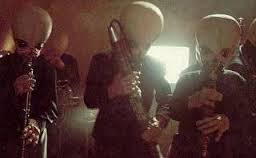
'Star Wars' image (property of LucasFilms)
“Star Wars” image: Mos Eisley Cantina musicians (property of LucasFilms)

Wookieepedia explains that Mos Eisley (pronounced “Moss Ize-lee”) is an important location in the Star Wars universe: a “wretched hive of scum and villainy” where wise visitors are cautious, it’s the site of the cantina (right) where Luke Skywalker first meets Han Solo and Chewbacca….Not, as this ignorant Star Trek fan guessed, some odd conflation of Mos Def and the Isley Brothers.

Perhaps Alexie is hinting at some kind of parallel between Luke Skywalker and Moses (spelled “מֹשֶׁה” [Moe-SHEH] in Hebrew, BTW, and thought to come from a verb meaning “to draw out”). If so, I know too little about Star Wars to catch it. Instead, my minimal wiki-knowledge sets me on a different path.

Jimmy Durante's Jazz Band (image: RedHotJazz.com)
Jimmy Durante’s Jazz Band (RedHotJazz.com)
ABC-TV 1964 (Wikicommons)

I imagine Durante, in his jazz years and his later comic persona, with gigs at that alien cantina. Could Alexie have had this in mind, I wonder, when he came up with the inventive spelling for Moses?
Continue reading Unlikely Answers: At the Burning Bush with Durante, Mamie Smith, and Sherman Alexie

Community, Leadership, and Listening

Leadership and community are key elements in the early chapters of Exodus. We see a variety of strong actions and interactions:

1) Moses sees an Egyptian man striking a Hebrew; he responds by killing the Egyptian and then hides the deceased in the sand.

2) Moses sees two Hebrew men fighting and tries to stop the aggressor.

3) The Hebrew fighter replies: “Who made you judge over us? And do you propose to murder me as you did the Egyptian?”

4) Pharaoh learns of Moses’ crime and sets out to kill him. Moses flees from Egypt.

5) Moses witnesses what appears to be an injustice as Jethro’s daughter attempt to water their flocks and intervenes, immediately and physically. (Exodus 2:11-17)

We don’t know, from the text itself, if Moses’ upbringing included grooming in Egyptian leadership skills or if he was taught Israelite ideas and practices through a continuing relationship with his birth parents. Commentators over the centuries have understood his early years in both ways.

We do know that Moses “went out unto his brethren and looked on their burdens [וַיֵּצֵא אֶל-אֶחָיו, וַיַּרְא, בְּסִבְלֹתָם]” (Exodus 2:11). What is not reported is any interaction between Moses and his brethren — or between Moses and the Midianite women at the well — that would help him understand community perspectives and concerns. He seems to have some sort of innate sense of justice, but he isn’t able to turn that inner sense into action that is helpful when faced with real world circumstances.

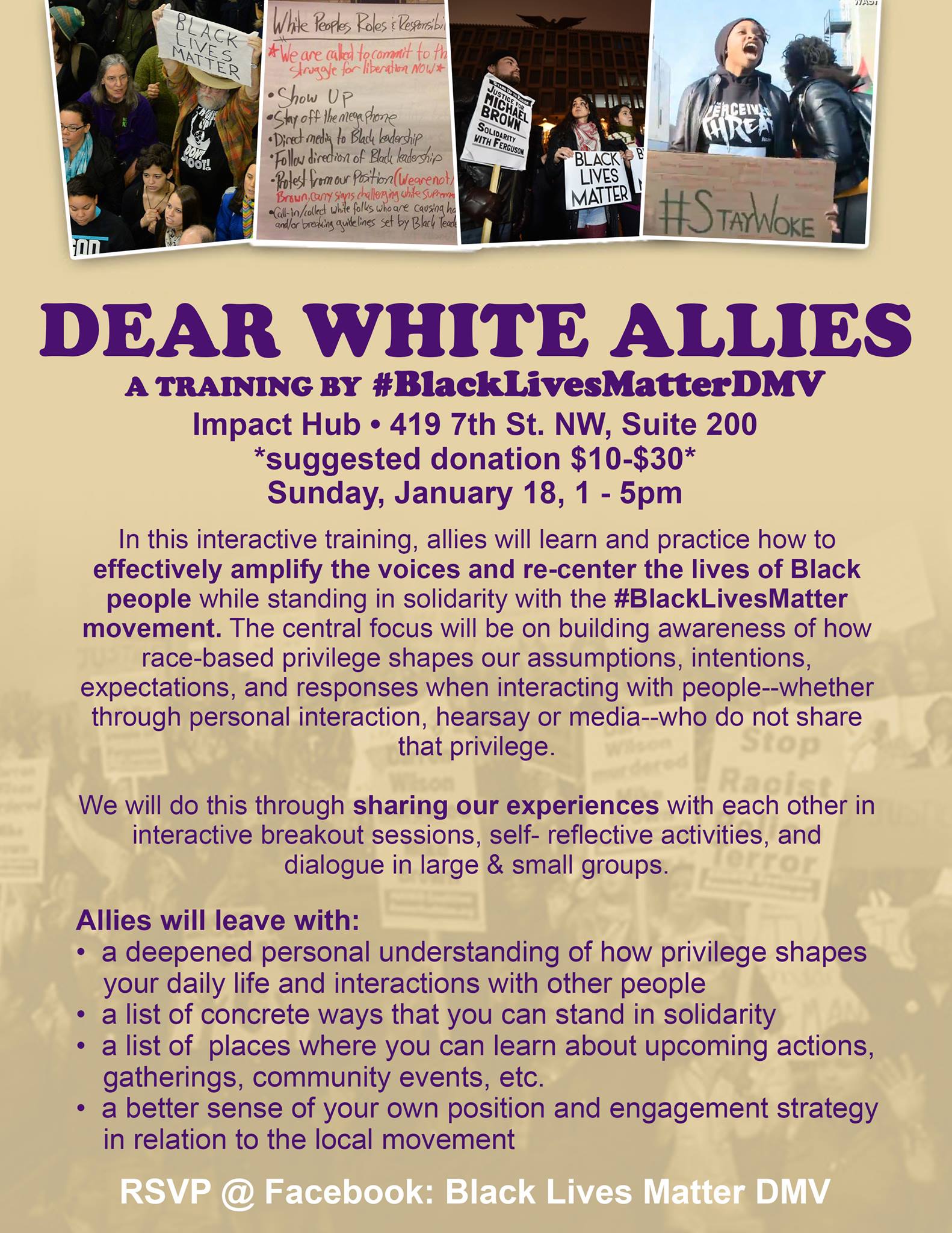
Like Moses, many attempting to understand and join the #BlackLivesMatter struggle don’t know how to translate a desire for justice into action that is helpful. The first step, the one Moses seems to have missed initially, is to LISTEN. Here, for those interested in taking this step, are video clips from Jews United for Justice’s “Black Lives Matter, Chanukah Action” program.

Hear directly from black activists about their experiences and their advice for white allies. More on the event and full list of speakers.

DearWhiteFor those in the DC area, consider joining “Dear White Allies: A Training by #BlackLivesMatterDMV” or one of the many other local opportunities to listen and learn.

Dear White Allies:
Sunday, Jan 18
1-5 p.m.
Impact Hub, 419 4th Street NW

For those beyond DC, look for local anti-racism and white ally training in your area.

Exodus: from state violence to resistance to liberation

The story of Exodus opens with state-mandated oppression and violence against a rapidly growing minority population, increasingly feared by the ruling majority (brief summary). Women of different communities and classes engage in resistance, separately and jointly, that eventually leads to toppling of the entire system.

From Violence to Resistance

Today, many in the U.S. are calling for acknowledgement of “the structural violence and institutional discrimination that continues to imprison our communities either in a life of poverty and/or one behind bars,” and recognition of “the full spectrum of our human rights and its obligations under international law.” Black Lives Matter addresses

…a world where Black lives are systematically and intentionally targeted for demise….an affirmation of Black folks’ contributions to this society, our humanity, and our resilience in the face of deadly oppression….we are talking about the ways in which Black people are deprived of our basic human rights and dignity. It is an acknowledgement Black poverty and genocide is state violence.

Midwives Shifrah and Puah act against the state, we are told, because “they feared God,” prompting them to act in preservation of life. Avivah Gottlieb Zornberg elaborates:

…the very extremity of the edict forces a new moral vision upon the midwives, a radical choice between life and death. Disobedience to Pharaoh becomes more than merely a refusal to kill, it becomes a total dedication to nourishing life.
— Zornberg, The Particulars of Rapture, p.23 (full citation)

Similarly, I think, the Herstory of #BlackLivesMatter exhorts us:

…when Black people cry out in defense of our lives, which are uniquely, systematically, and savagely targeted by the state, we are asking you, our family, to stand with us in affirming Black lives. Not just all lives. Black lives. Please do not change the conversation by talking about how your life matters, too. It does, but we need less watered down unity and a more active solidarities with us, Black people, unwaveringly, in defense of our humanity. Our collective futures depend on it.

Pledging Resistance?

Ferguson Action is asking individuals to declare 2015 their “year of resistance.”

I pledge to make 2015 my year of resistance to state violence against Black lives.

I challenge myself and those in my community to take risks as we confront the many ways that Black lives are diminished and taken from us….

This year, I will declare boldly and loudly through my words and actions, that #BlackLivesMatter.
Ferguson Action Pledge

Does Exodus — with its powerful examples of resistance — call us to anything less?
Continue reading Exodus: from state violence to resistance to liberation

First Steps in an Exodus from Racism

In the mid-20th Century, the Exodus story (neither Charlton Heston nor Christian Bales, but the second book of the bible) became part of the underpinnings of the Civil Rights Movement in the United States. Today, as a new civil rights movement evolves, how can we use the ancient Exodus narrative to once again help us explore key issues and increase understanding and involvement?
Continue reading First Steps in an Exodus from Racism