Mishpatim: Racism and Idolatry

This week’s Torah portion, Mishpatim ([Laws], Exodus 21:1-24:18), warns us severely and often about evils of racism. The bible knew no such word, of course, and, ironically, this portion also contains material that appears to accept “bondage” as a normal part of [ancient] life. But messages about racial justice and related concepts are nonetheless there, and quite strong, if we look carefully.

“God’s wrath” and “idolatry”

The biblical expression “divine wrath” is reserved for cases of idolatry on the part of the whole Nation, according to Maimonides and later scholars. And this understanding calls us to avoid afflicting “widows and orphans”:

In our case [Exodus 22:23: “My wrath will burn (וְחָרָה אַפִּי)”], the same expression is deliberately used in order to equate the affliction of the orphan and the widow to idolatry, teaching us that there is no crime greater than this.
New Studies in Shemot/Exodus, Nehama Leibowitz, p.395

Many teachers understand “widows and orphans” as a biblical expression meaning “the most vulnerable among us,” which surely includes victims of hundreds of years of racism in the U.S. From a somewhat more literal perspective, black communities today include too many widows and orphans, as well as grieving mothers and traumatized communities.

Moreover, idolatry and racism are directly connected:

Few of us seem to realize how insidious, how radical, how universal an evil racism is. Few of us realize that racism is man’s gravest threat to man, the maximum of hatred for a minimum of reason, the maximum of cruelty for a minimum of thinking.

Perhaps this Conference should have been called “Religion or Race.” You cannot worship God and at the same time look at man as if he were a horse.

“Race prejudice, a universal human ailment, is the most recalcitrant aspect of the evil in man” (Reinhold Niebuhr), a treacherous denial of the existence of God.

What is an idol? Any god who is mine but not yours, any god concerned with me but not with you, is an idol.
Abraham Joshua Heschel, Conference on “RELIGION AND RACE” (14 JANUARY 1963)

Both Heschel and Leibowitz stress, based on ancient tradition, that being silent in the face of oppression is as serious as committing the crime ourselves. (No time to explore this further right now — Shabbat is almost upon us — but will return to this theme.)

Strangers

This portion is also one in which we are warned about not oppressing a stranger, reminded again and again that we were once strangers in Egypt.

In addition, we are warned against “false reports” and “running with the multitude,” both of which seem obviously connected to racism. (Again, time has run out for now. More later.)
Continue reading Mishpatim: Racism and Idolatry
Exodus Revisited: Pharaoh’s “Hardened Heart” and Contemporary “Criminal Justice”


Pharaoh’s “hardened heart” plays a big role in Exodus, providing a framework for the ten plagues, the eventual freeing of the Israelites from bondage, and serious disaster for biblical Egypt. Policies like “zero tolerance” in schools and mandatory sentences in the United States today are a kind of judicial “hardened heart.” It’s our job to find a way to “let the people go.”
Continue reading Exodus Revisited: Pharaoh’s “Hardened Heart” and Contemporary “Criminal Justice”

Unlikely Answers: At the Burning Bush with Durante, Mamie Smith, and Sherman Alexie


“Without impossible questions and unlikely answers, faith is only dust,” Sherman Alexie writes in a poem that finds Moses at the Burning Bush. Alexie reaches this mountaintop via a circuitous path that touches on roller coasters, obsessive worry about failing to turn off the stove, Jimmy Durante, Dante Alighieri, and another poet‘s obsession with the fact that “Dante” is, in reality, short for “Durante.” (More on Dante/Durante)

Do you think, after Moses talked to the Burning Bush, that he couldn’t stop himself from thinking that the bush was still burning, and presented a clear and present danger? Do you think Moses hiked back up the mountain to make sure? If I claim that, in Hebrew, Moses is spelled Mos Eisley, will you look it up? Of course, you must. Without impossible questions and unlikely answers, faith is only dust.
— “Hell,” IN What I’ve Stolen, What I’ve Earned
(Brooklyn, NY: Hanging Loose Press, 2014), p.51

Of course, I looked it up.

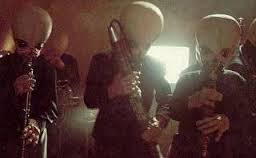
'Star Wars' image (property of LucasFilms)
“Star Wars” image: Mos Eisley Cantina musicians (property of LucasFilms)

Wookieepedia explains that Mos Eisley (pronounced “Moss Ize-lee”) is an important location in the Star Wars universe: a “wretched hive of scum and villainy” where wise visitors are cautious, it’s the site of the cantina (right) where Luke Skywalker first meets Han Solo and Chewbacca….Not, as this ignorant Star Trek fan guessed, some odd conflation of Mos Def and the Isley Brothers.

Perhaps Alexie is hinting at some kind of parallel between Luke Skywalker and Moses (spelled “מֹשֶׁה” [Moe-SHEH] in Hebrew, BTW, and thought to come from a verb meaning “to draw out”). If so, I know too little about Star Wars to catch it. Instead, my minimal wiki-knowledge sets me on a different path.

Jimmy Durante's Jazz Band (image: RedHotJazz.com)
Jimmy Durante’s Jazz Band (RedHotJazz.com)
ABC-TV 1964 (Wikicommons)

I imagine Durante, in his jazz years and his later comic persona, with gigs at that alien cantina. Could Alexie have had this in mind, I wonder, when he came up with the inventive spelling for Moses?
Continue reading Unlikely Answers: At the Burning Bush with Durante, Mamie Smith, and Sherman Alexie

Community, Leadership, and Listening

Leadership and community are key elements in the early chapters of Exodus. We see a variety of strong actions and interactions:

1) Moses sees an Egyptian man striking a Hebrew; he responds by killing the Egyptian and then hides the deceased in the sand.

2) Moses sees two Hebrew men fighting and tries to stop the aggressor.

3) The Hebrew fighter replies: “Who made you judge over us? And do you propose to murder me as you did the Egyptian?”

4) Pharaoh learns of Moses’ crime and sets out to kill him. Moses flees from Egypt.

5) Moses witnesses what appears to be an injustice as Jethro’s daughter attempt to water their flocks and intervenes, immediately and physically. (Exodus 2:11-17)

We don’t know, from the text itself, if Moses’ upbringing included grooming in Egyptian leadership skills or if he was taught Israelite ideas and practices through a continuing relationship with his birth parents. Commentators over the centuries have understood his early years in both ways.

We do know that Moses “went out unto his brethren and looked on their burdens [וַיֵּצֵא אֶל-אֶחָיו, וַיַּרְא, בְּסִבְלֹתָם]” (Exodus 2:11). What is not reported is any interaction between Moses and his brethren — or between Moses and the Midianite women at the well — that would help him understand community perspectives and concerns. He seems to have some sort of innate sense of justice, but he isn’t able to turn that inner sense into action that is helpful when faced with real world circumstances.

Like Moses, many attempting to understand and join the #BlackLivesMatter struggle don’t know how to translate a desire for justice into action that is helpful. The first step, the one Moses seems to have missed initially, is to LISTEN. Here, for those interested in taking this step, are video clips from Jews United for Justice’s “Black Lives Matter, Chanukah Action” program.

Hear directly from black activists about their experiences and their advice for white allies. More on the event and full list of speakers.

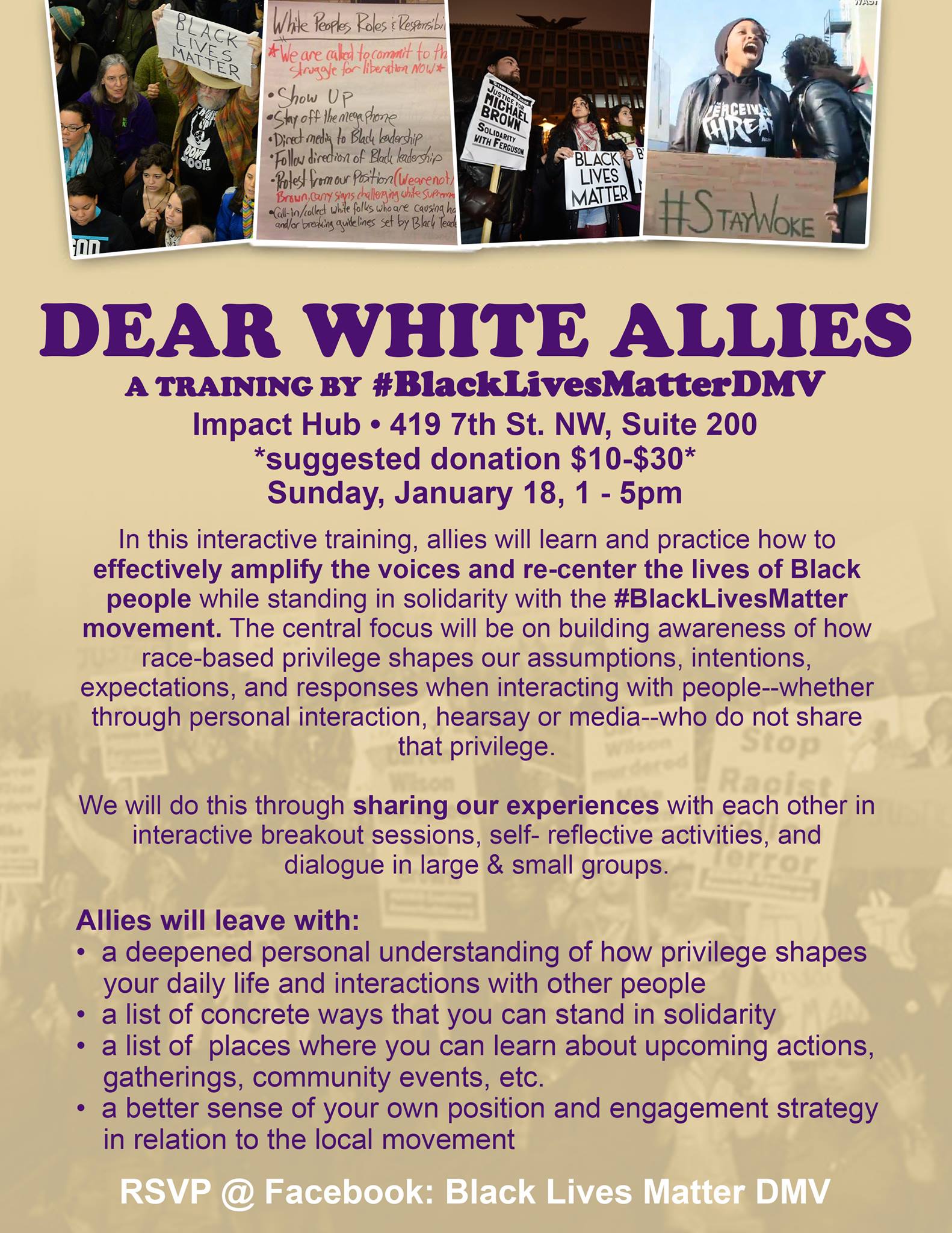
DearWhiteFor those in the DC area, consider joining “Dear White Allies: A Training by #BlackLivesMatterDMV” or one of the many other local opportunities to listen and learn.

Dear White Allies:
Sunday, Jan 18
1-5 p.m.
Impact Hub, 419 4th Street NW

For those beyond DC, look for local anti-racism and white ally training in your area.

Exodus: from state violence to resistance to liberation

The story of Exodus opens with state-mandated oppression and violence against a rapidly growing minority population, increasingly feared by the ruling majority (brief summary). Women of different communities and classes engage in resistance, separately and jointly, that eventually leads to toppling of the entire system.

From Violence to Resistance

Today, many in the U.S. are calling for acknowledgement of “the structural violence and institutional discrimination that continues to imprison our communities either in a life of poverty and/or one behind bars,” and recognition of “the full spectrum of our human rights and its obligations under international law.” Black Lives Matter addresses

…a world where Black lives are systematically and intentionally targeted for demise….an affirmation of Black folks’ contributions to this society, our humanity, and our resilience in the face of deadly oppression….we are talking about the ways in which Black people are deprived of our basic human rights and dignity. It is an acknowledgement Black poverty and genocide is state violence.

Midwives Shifrah and Puah act against the state, we are told, because “they feared God,” prompting them to act in preservation of life. Avivah Gottlieb Zornberg elaborates:

…the very extremity of the edict forces a new moral vision upon the midwives, a radical choice between life and death. Disobedience to Pharaoh becomes more than merely a refusal to kill, it becomes a total dedication to nourishing life.
— Zornberg, The Particulars of Rapture, p.23 (full citation)

Similarly, I think, the Herstory of #BlackLivesMatter exhorts us:

…when Black people cry out in defense of our lives, which are uniquely, systematically, and savagely targeted by the state, we are asking you, our family, to stand with us in affirming Black lives. Not just all lives. Black lives. Please do not change the conversation by talking about how your life matters, too. It does, but we need less watered down unity and a more active solidarities with us, Black people, unwaveringly, in defense of our humanity. Our collective futures depend on it.

Pledging Resistance?

Ferguson Action is asking individuals to declare 2015 their “year of resistance.”

I pledge to make 2015 my year of resistance to state violence against Black lives.

I challenge myself and those in my community to take risks as we confront the many ways that Black lives are diminished and taken from us….

This year, I will declare boldly and loudly through my words and actions, that #BlackLivesMatter.
Ferguson Action Pledge

Does Exodus — with its powerful examples of resistance — call us to anything less?
Continue reading Exodus: from state violence to resistance to liberation

First Steps in an Exodus from Racism

In the mid-20th Century, the Exodus story (neither Charlton Heston nor Christian Bales, but the second book of the bible) became part of the underpinnings of the Civil Rights Movement in the United States. Today, as a new civil rights movement evolves, how can we use the ancient Exodus narrative to once again help us explore key issues and increase understanding and involvement?
Continue reading First Steps in an Exodus from Racism

Getting Exodus Right: Watch the Women and Learn (or: Family Travail Becomes Community Action)


A coffin in Egypt closes the Book of Genesis (Genesis 50:26), and the Exodus story is launched with a basket on the Nile (Exodus 2:3). Joseph’s death, which closely follows that of his father, Jacob (Gen 49:33), brings to an end the patriarchal stories. With Exodus, the focus shifts to the Israelite story, beginning with midwives Shifrah and Puah, Yocheved (Moses’ mother), Miriam (Moses’ sister), and Pharaoh’s daughter. Our focus is thus shifted, as one book ends and the next begins, from death to birth and from stories of individual and family struggle to a communal struggle toward liberation. So, too, in the United States today, we are moving:

  • from individual circles of mourning for black persons killed by police to a national movement against police brutality across the country, and
  • from disjoint demands addressing various forms of racial inequity to a collective struggle for racial justice.

In addition, men dominate at the close of Genesis, while Exodus opens with women in the lead; similarly, women have been primary leaders in the #BlackLivesMatter movement.

The Exodus story looks, on the face of it, like a violent and permanent parting of oppressed and oppressor peoples. But there are elements — particularly evident in watching what the women do at the beginning of the Exodus story — of the tale that can help us learn respectful coexistence.

Change of Mindset

Failure to dehumanize: The Egyptian midwives model for us at Exodus 1:15-22, using Pharaoh’s racist assumptions about the baby-popping Hebrew women to protect the Israelite community. (more on this)

Vision: Moses’ mother shows immense faith in her Egyptian neighbors, assuming that someone will rescue the child. And at least one Egyptian does rescue a child. Both women, thereby, refuse to dehumanize the other. (more on vision)

Passover is still months away (April 3-April 11, 2015). But Jews and Christians, along with others to whom the Exodus story speaks, can begin now to explore how we can use this ancient tale to change today’s realities, in our own communities and beyond. A few more “Passover Lessons” —

  • Crossers-Over
  • “From Privilege, Activism
  • Maybe We’re All Riff Raff
  • Rabbis, Rome and Slaves
  • “School for Freedom”

— from a 2012 crowd-sourcing.

What else can we learn?
Let’s start now to figure it out!
And let’s NOT WAIT to begin learning and acting
Continue reading Getting Exodus Right: Watch the Women and Learn (or: Family Travail Becomes Community Action)

Purposefully Blue

The peculiar blue [תכלת, tekhelet] thread used in tzitzit [ritual fringes] (Numbers 15:37-41) also appears prominently in the construction of Tabernacle (Exodus 25ff). It is used in the inner curtains and the loops that connect them; it also appears throughout the priestly vestments.

Why this blue?

It has been taught: R. Meir used to say: Why is blue [תכלת] specified from all the varieties of colours? Because blue resembles [the colour of] the sea, and the sea resembles [the colour of] heaven, and heaven resembles [the colour of] the Throne of Glory, as it is said: And they saw the God of Israel and there was under His feet as it were a paved work of sapphire stone [לבנת הספיר], and as it were the very heaven for clearness (Exod. 24:10) and it is written: The likeness of a throne as the appearance of a sapphire stone [אֶבֶן-סַפִּיר] (Ezek 1:26).
— Sotah 17a (also: Menachot 43b and Chullin 89a)

Kedushat Levi links the above passage about blue, תכלת, to the stages of a creative act, beginning and ending with its purpose [תכלית]:

[A project from thought to completion] has undergone four distinct stages. 1) original mental image of the project; 2) clarification of the details, etc. 3) translating thought into deed. 4) carrying out the intention which originally prompted the project. [Punctuation follows translation.] When the original mental image of the project is seen reflected after its successful completion, the person inhabiting this building will experience a sense of satisfaction and joy.
— Kedushat Levi, p. 475 (see Source Materials for full citation)

Continue reading Purposefully Blue

Folding, Half-Shekels, and Ego

One of the 30-cubit, goat-hair curtains on the outside of the Tabernacle is folded over the front of the tent (Exodus 26:9; see Thirty Cubits and Cloaking) for more on the curtains). Two aspects of this are emphasized in the commentary of Kedushat Levi, among others:

Folding: Folding [כפל, khaphal] is related to the idea of “klipah” [קלפה], the protective shell covering God’s Light in the world, according to mystical teaching. Kedushat Levi links the folding of the curtain and God’s cloaking, to protect humans from what they cannot withstand, adding that “folding over” implies reinforcing something not otherwise as strong as necessary. (Kedushat Levi, p. 473; full citations for Kedushat Levi, Stone Chumash in Source Materials.)

Half: Kedushat Levi also emphasizes the fact that the curtain is folded in half. He links “half” to “awe” through a play on the Hebrew words: the curtain, folded in “half” [חצי, chatzi], is linked via “crush” [מחץ, machatz] to “awe.” (More below.)

Additional thoughts on the concept of “half,” regarding the command to collect a half-shekel as part of the census embedded in the Tabernacle story, suggest a different direction:

Many commentators interpret homelitically that the requirement of half a coin alludes to the concept that no Jew is complete unless he joins with others; as long as we are in isolation, each of us is only “half” of our full potential.
— Stone Chumash, on Exodus 30:13

Combining these views on folding and half seem to suggest that any approach to God is best accomplished in community.
Continue reading Folding, Half-Shekels, and Ego

Cloaking Improves Vision

Readers of Moby Dick have long skimmed the whaling sections. Love-story followers generally hurry through the “war” part of War and Peace, while others skip through the boring relationship stuff to focus on land distribution. Likewise, many Bible readers’ eyes glaze over at the close of Exodus: Some 200+ Torah verses describe plans for the Tabernacle and its furnishings. Another 200+ verses describe the actual work. Four entire weekly Torah readings are dedicated to the details of the Tabernacle, with Ki Tisa’s story of the Golden Calf in between.

Some teachers focus on general messages extracted from these passages: the importance of working collaboratively, supporting community infrastructure, or honoring the arts, for example. But others take an allegorical view, mining details rather than glossing over them. Kedushat Levi (Rabbi Levi Yitzchak of Berditchev, 1740 – 1809) is one of the later. And some of those details surround the number 30.
Continue reading Cloaking Improves Vision