The Language of There

Exploring Babylon: Chapter 5.2

“When I make a word do a lot of work like that,” said Humpty Dumpty,
“I always pay it extra.”

— Alice Through the Looking-Glass, Lewis Carroll (1871, chapter 6)

A few weeks ago, #ExploringBabylon looked at “them” who traveled with Terah from southern Babylon to northern Mesopotamia and a little of what “back there” meant for Abraham. In this week’s portion, we return with the elder servant (later identified as Eliezer) to what Abraham calls “my kindred” or “my birthplace.”

שָּׁם

Abraham is old and telling the elder servant of his household to go
אֶל-אַרְצִי וְאֶל-מוֹלַדְתִּי
“to my country, and to my kindred [or: the land of my birth”]
to get a wife for my son Isaac” (Gen 24:1-2). The servant (later identified as Eliezer) asks what to do, should he find a potential wife who doesn’t consent to return with him: Should he bring Isaac back…

Genesis 24:5
אֶל-הָאָרֶץ אֲשֶׁר-יָצָאתָ מִשָּׁם
…to the land from which you came?

24:6
פֶּן-תָּשִׁיב אֶת-בְּנִי שָׁמָּה
On no account take my son back there

24:7
וְלָקַחְתָּ אִשָּׁה לִבְנִי, מִשָּׁם
…get a wife for my son from there

24:8
לֹא תָשֵׁב שָׁמָּה
…do not take my son back there

In contrast to Gertrude Stein’s “no there there,” there is a lot of “there” here:

  • שָּׁם = “there”
  • שָׁמָּה = “to there” (ending hey makes a locative form)
  • מִשָּׁם = “from there” (beginning mem adds the preposition)

Commentators across the centuries have explored many “there” details: Did Abraham intend a specific place? Specific kin? Why did the servant later say he’d been sent to Abraham’s “father’s house and family” (Gen 24:38)? Why not encourage marriage with neighbor families? Was the union meant to seal some kind of family reconciliation? One of the most salient answers, for this blog’s purpose, stresses basic there-ness:

Abraham was sent away from his country, kindred and father’s house, so that he should have no further contact with them and be a stranger in a foreign clime…Similarly, his son must not marry [a Canaanite]. For this reason he was called Abraham the Hebrew, “that all the world was on one side and he on the other” (ivri means in Hebrew “a person from the other side” usually taken as a reference to Abraham’s origins in Mesopotamia — on the other side of the river).
— Nehama Leibowitz, New Studies in Breishit, p. 220

Abraham is ivri, from there. As in “not from here.” A key experience that his descendants will repeat — in Egypt, in the wilderness, in later exile. At this point in Genesis, Abraham and his family are becoming separate. That separateness will later help the people survive in Babylonian Captivity.

But this seems to be as much work as “there” is willing to do at the moment, regardless of how well paid.

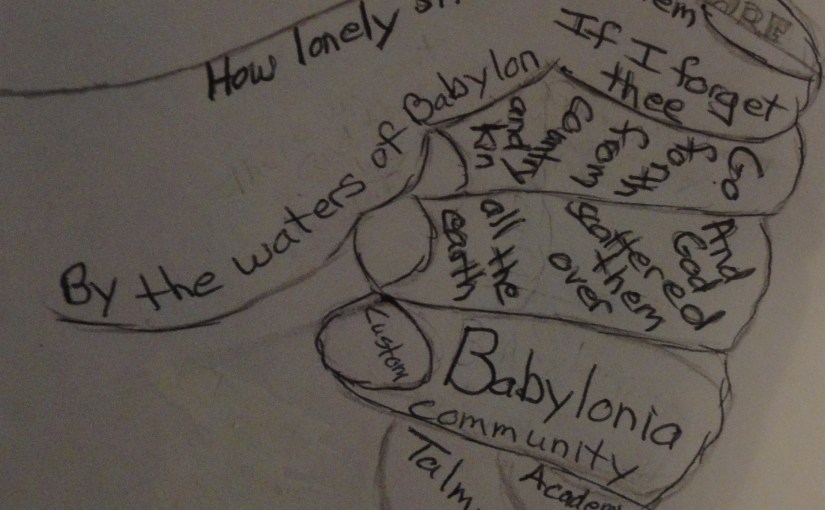
Babylon fist

This is a palm-map illustrating the #ExploringBabylon journey. We’re just not there yet.
(Think the Little Prince and the boa constrictor digesting an elephant.)

Language

Finally, the Rabbinic stories about Babylonian Captivity being in some sense “back home” for people of Abraham, included an important message about the language of “there”: “R. Hanina said: comment that ‘The Holy One exiled them to Babylonia because the language is akin to the language of the Torah.’ To underscore this, a footnote of sorts:

The very success of Jews in adapting to life in a foreign environment poses problems for the would-be compiler of a Jewish sourcebook. Greek was the dominant language of Diasporan Jews and their personal names were mainly Greek or Latin…
The Jews Among the Greeks and Romans: A Diasporan Sourcebook, Margaret H. Williams (Baltimore, MD: Johns Hopkins, 1998), pp. xi-xii

Babylon and the Writing on the Wall

Exploring Babylon: Chapter 5.1

The song, “Mene, Mene, Tekel” (Harold Rome, 1939) takes its name and chorus from the original, now proverbial, “writing on the wall” (Daniel 5:25):

MENE MENE TEKEL UPHARSIN
מְנֵא מְנֵא, תְּקֵל וּפַרְסִין

Rome’s satirical translation of the “writing on the wall” seems as appropriate to 2017 as to 1939, and it’s quite faithful to the biblical text:

King, stop your frolicking, stop your flaunting
you’ve been weighed and you’re found wanting
all your days are numbered days
the Lord don’t like dictators or dictators ways
— H. Rome “Mene, Mene, Tekel”
(Joe Glazer’s version; full lyrics, original and adapted)

This song also leads to further questions about how we understand and interact with sacred text, particularly at times of crisis. And it will give us a slightly different perspective for #ExploringBabylon.

Music of Protest and Power

When new, the song was banned from the radio and protested by both the Daily Worker and the Catholic Archdiocese of New York, among others. It was a later addition to the already controversial musical revue, Pins and Needles, November 1937 to June 1940. The satirical revue ran for 1108 shows, a record for Broadway shows at the time, and was performed throughout most of its run by amateurs from the International Ladies’ Garment Workers’ Union.

Labor and other social justice issues were frequent topics for Rome (1908 – 1993). For more, see 1993 NY Times obituary and the 2014 biography (Lyrical Satirical Harold Rome: A biography of the composer-lyricist. Tighe E Zimmers).

Joe Glazer (1918-2006), known as “Labor’s Troubadour,” often performed “Mene, Mene, Tekel” along with other organizing and protest songs (2006 NY Times obituary). Glazer settled in Silver Spring, MD and lent his voice — including renditions of this song — to early Jews United for Justice Labor Seders.

In a 1981 live performance, Glazer introduced the song’s historical and biblical background:

I want to close with one of the great song’s by Harold Rome. He wrote it at the height of Hilter’s move through Europe, Africa…he was gonna invade England. He was taking over everything, it looked pretty, pretty dark.

Old Harold Rome he took out the Bible, and he checked the Book of Daniel. He saw that old Belshazzar — he was riding high one day, and he got his comeuppance, because he saw the handwriting on the wall. It said: “MENE MENE TEKEL UPHARSIN,” in old Aramaic. “You have been weighed in the balances and you have been found wanting.”

He just took that story and he wrote it up. And that’s what helped to bring old Hitler down, I’ll tell you that.
— from “The Jewish Immigrant Experience in America”
Collector Records, Smithsonian Folkways

Smithsonian Folkways shares Glazer’s introduction and song here–

Rome’s 1962 Anniversary recording, lyrics (Rome and Glazer versions), and more posted here.

Guests were Shagging

Most of Glazer’s alterations to Rome’s lyrics are stylistic, including rhythm and story-telling preferences, and some changes to dialect. One of the biggest changes is the use of “the joint was jumping” in place of Rome’s “guests were shagging.” And this raises some interesting questions about study and use of the bible.

In the US in the 1930s, “shagging” was a relatively new term for a form of jazz dance. Swing dancers, especially in the South, still use the term, although the style has changed over the decades.

Someone more familiar with the history of British slang would know if “shag” was used in the 1930s for sexual intercourse — and if such usage was commonly known in the US; this would create a double-entendre. But it seems likely that the primary meaning in “Mene, Mene, Tekel” was that the banquet included spirited dancing, maybe something like this (from “A Day at the Races”) —

— or maybe this instruction video from Arthur Murray.

By the latter part of the 20th Century, the dance meaning was less generally current, and the Britishism had gained popularity in the US. So saying the “guests were shagging” at that point, when the song was in Glazer’s repertoire, could just sound crude.

This tiny example of how a change in language usage — even among primary speakers of the language alive to recall some of the shifting — is offered as a reminder of just how complex a project it is to interpret an ancient text that has traveled continents and cultures.

It can also point to a bit of what (mostly Christian) bible scholars call “reception history,” that is, how sacred text is understood and used in different generations. More on the general concept in the future.

Guests were Shagging?

Whatever Rome originally intended by “shagging” — an eager student of Broadway and dance could no doubt uncover this, if it’s not already known — sexuality and partner dancing are always closely entwined. Moreover, we are told in the Book of Daniel that Belshazzar is feasting with his “consorts and concubines” — “court and concubines” in the song lyrics (both versions). In addition, sexual license is an aspect of the ill-repute Babylon developed through the centuries (partly via Christian Scripture). More on this later, too.

In this respect, it’s unclear how much “sex” is included in any description of dancing at Belshazzar’s party. But the descriptions of partying in “Mene, Mene, Tekel” don’t sound like a condemnation of sexy jazz dancing, or of anyone but the king.

A musically-oriented interpreter with an ear to Europe in 1939 knows that the Reich was banning jazz as “degenerate music,” for its Jewish and Black associations. (See US Holocuast Memorial Museum just to start.) In that context, what does it mean that “guests were shagging, horns were blowin'” during Belshazzar’s banquet?

We have a hint in the song’s conclusion:

Now, the king of Babylon was slain
But the children of the Lord remain
All his idols turned to rust
crumbled are his kingdom and his power to dust

It’s not the dancers and horn players who turn to dust but the king and his power. More on all this as we continue #ExploringBabylon.

NOTES

Note 1: Daniel and the Writing
The Book of Daniel comes to us partially Hebrew and partially, including Chapter Five, in Aramaic. These four words on the wall, and Daniel’s interpretation of those mysterious words, is the heart of this chapter’s story. So, the words are generally left untranslated and rendered (IN ALL CAPS, e.g) so as to stand out.

It’s pronounced something like “menny, menny, teckle, oo-farseen.”

And this is the writing that was inscribed: MENE MENE, TEKEL UPHARSIN.
This is the interpretation of the thing: MENE, God hath numbered thy kingdom, and brought it to an end.
TEKEL, Thou art weighed in the balances, and art found wanting.
PERES, thy kingdom is divided, and given to the Medes and Persians.’
Then commanded Belshazzar, and they clothed Daniel with purple, and put a chain of gold about his neck, and made proclamation concerning him, that he should rule as one of three in the kingdom.
In that night Belshazzar the Chaldean king was slain.
— Daniel 5:25-30 (Old JPS) Mechon-Mamre

TOP

message to the Hebrew

Sandwiched in a Torah portion packed with narrative is “the war of the kings” with Lot’s capture and rescue (Gen. 14). It begins, really, with Abraham and his nephew Lot separating to avoid quarrel over land for cattle herding (Gen. 13). YHVH spoke to Abraham “after Lot had parted from him,” promising “descendants like dust of the earth,” and Abraham dwelt by the oaks of Mamre and built an altar to YHVH.

He is still living by the oaks of Mamre when the fugitive arrives to tell him that his nephew is in trouble, and Abraham sets off to rescue Lot:

And they took Lot, Abram’s brother’s son, who dwelt in Sodom, and his goods, and departed.

And there came one that had escaped, and told Abram the Hebrew [ha Ivri]…”

Does Abraham’s being an “ivri” — a “crosser-over” or “one from the outside” —  have anything to do with expectations about him and his response to Lot’s trouble? Why is this the first time Abraham is called by this name? Does being a Hebrew mean retainining sympathy — and a willingness to help — those on the other side?

NOTE

Lech Lecha (Gen. 12:1-17:27) includes the first “say you’re my sister” incident with Abraham and Sarah (Gen. 12:10-20), the weird episode of the Abraham and the covenant of the pieces (Gen. 15:1ff), and the first installments in the tales of Hagar and Ishmael (Gen. 16, 17:17-27).

BACK

Sacrificial Notes

“Sacrifice” has been an important concept in baseball since the 1880s and a Christian concept for far longer. The term came into English from Latin, via Old French, and is generally defined as giving up one thing to obtain another.

“Sacrifice” in Hebrew

The word “sacrifice” is sometimes used by English translators of the Hebrew bible, as when Noah performs a ritual action right after leaving the ark:

וַיִּבֶן נֹחַ מִזְבֵּחַ, לַיהוָה; וַיִּקַּח מִכֹּל הַבְּהֵמָה הַטְּהֹרָה, וּמִכֹּל הָעוֹף הַטָּהוֹר, וַיַּעַל עֹלֹת, בַּמִּזְבֵּחַ.
And Noah built an altar [מִזְבֵּחַ] to the LORD and took of every clean animal and of every clean bird and offered [sometimes: “sacrificed”] burnt offerings [וַיַּעַל עֹלֹת] on the altar.
–Genesis 8:20

The Hebrew word for “altar” “mizbeach מִזְבֵּחַ” is linked with “zevach זְבֵּחַ,” one word for biblical sacrifice. But the Torah also uses other words, depending on the purpose and disposition of the offering:

minchah מִנְחָה” — “gift”
olah עֱלָה” — burnt offering, from “going up,”
sh’lamim שלמים” — “complete (or peace)” offering,
chatat חטאת” — “sin” offering, and
asham אשם” — “guilt” offering.

There are also offerings known by their content: “first fruits (bikkurim)” or “wave/sheaf (omer),” for example. Probably the most general term is “korban קָרְבָּן,” from the root for “becoming near.”

“Sacrifice” in Judaism?

A Jew’s obligations to oneself, to other individuals, and to the community are myriad. Here are a few of the most general:

  • We are warned to be for ourselves as well as for others (Avot 1:14)
  • We are told that “All Israel is responsible, one for the other [Kol yisrael arevim zeh bazeh]” (Shavuot 39a), and
  • We are reminded that caring for the poor and practicing lovingkindness are among the obligations without limit (Peah 1:1).

Is “sacrificing” for the community or for a greater goal a Jewish notion?

Stay tuned and/or share your thoughts.