Lyrics and Music

Aaron Levy Samuels

Aaron Levy Samuels is a writer, speaker, and co-founder of the digital community Blavity. His book of poetry, Yarmulkes & Fitted Caps, was published in fall 2013. Additional print poems and videos can be found on his website. from “Ritual,” poetry and dance collaboration We don’t say goodbye, we remember…. We don’t dance, our bodies … Continue reading Aaron Levy Samuels
Poetry in Popular Music

Like everything on this blog, some idiosyncratic, rather than any attempt at encyclopedic, resources. These songwriters and their works include many sorts of relationships to Jewish heritage:
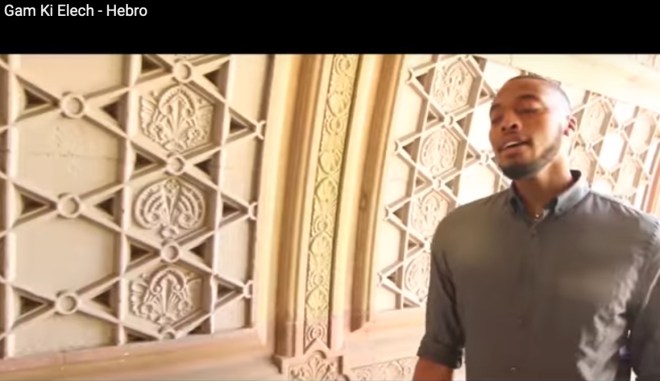
Raphael (Hebro) Fulcher

Raphael Ohr Chaim Fulcher (“Hebro”) was born to African-American Orthodox Jewish parents in Crown Heights Brooklyn. He also lived formative years in North Carolina, St. Louis, and Israel. He says: I imagine [King David’s] music had rhythm and spirit. Put on a Hip-Hop instrumental and read Psalms. It will blow your mind. I personally believe … Continue reading Raphael (Hebro) Fulcher
Rhys Langston

“Language Arts Unit: A Rap Text Book,” by Rhys Langston Podell, is an interactive album comprised of music, video, and audio poetry as well as poetry and essay in print. Visit Langstonia for the full album. (See also Youtube; story at Tablet.) Rhys Langston writes: I am made to be reminded I am or am … Continue reading Rhys Langston

Solomon Ibn Gabirol: Shaar Asher Nisgar

Solomon Ibn Gabirol was born (c. 1022) in Galaga and died in Valencia (c.1055, possibly as late as 1070), living most of his life in Saragossa. Both poet and philosoper, he began publishing while still in his teens. He is considered the first Hebrew poet to introduce Spanish-Arabic styles of the Golden Age into synagogue … Continue reading Solomon Ibn Gabirol: Shaar Asher Nisgar

Orit Gidali (b.1974)

Orit Gidali (b. 1974) is probably the youngest poet explored by Hebrew Poetry Group, although we have read poems written when their authors were quite young.

Twenty Girls to Envy Me. Selected Poems of Orit Gidali. Translated from the Hebrew by Marcela Sulak. (Austin: Center for Middle Eastern Studies at University of Texas, 2016.) Book link at UT Press.

Two poems,
in English and (unpointed) Hebrew, with translator’s note, found in Ilanot Review.

Short review from an Indie books journal. Note, particularly, the reviewer’s point about puns, for those who read
the Hebrew:

Orit Gidali’s poetry reflects segments of the contemporary Israeli
psyche: awareness of fragility; a ferocious love for a complex
inheritance; and a desire for the cessation of violence, as much for one
side as for the other….

Puns await those with a firm grasp of both languages, as the Hebrew
originals are maintained alongside their translated counterparts.
Whether Gidali is wrapping her words tenderly around her children,
pushing aside worries about their futures with the IDF, or contemplating
the evolution of love by aligning it to that for a biblical king, she
arrives at meaning, or strives toward it, poignantly.
— Michelle Anne Schingler, Foreword Reviews (8/22/16)

Short podcast with Marcela Sulak, who translated the 2016 Twenty Girls to Envy Me. Discusses the very funny “Did you pack it yourself?”

Here’s another podcast on the poem, “I, Kohelet, Son of David…”

Somewhere on-line is a discussion of the unusual layout of some of Gidali’s poems — some are circular (literally), or have messages included vertically. I’ll post it when I re-locate it.

(c) Orit Gidali. from Twenty Girls to Envy Me

Maybe it’s Abraham in a convenience store saying,
“Just give me a ten, and we’ll call it even.”
— from “The Binding of Isaac V”
IN Twenty Girls to Envy Me

David Avidan (1934-1995)

When my soul skyrockets to the heavens
an unending rustle of paper will accompany me.
And perhaps if I’m lucky, the crackle of microfilm.

This quotation appears in the Poetry International article on David Avidan, taken from “Fast and Plenty” (cannot find full citation). Poetry International also includes Avidan in an article about “Nano-Poetics.”

Avidan is famous for inventing words, a prominent theme in analysis of the 2017 Futureman:

This translation by Tsipi Keller, who brought great passion to the project, which is called “Futureman” — “very simply, I love him,” she told me — admirably preserves Avidan’s made-up words, such as his famous description of himself as an adamila, or “wordman.” The translation is accompanied by an extensive and helpful introduction by scholar Anat Weisman, which explains Avidan’s place in the history of Hebrew poetry, and shows the effect his radicalism had on other Israeli writers.
— Aviya Kushner (The Grammar of God), “How David Avidan Became Hebrew’s Most Experimental Poet” in The Forward

Futureman. David Avidan. Tsipi Keller, trans. LA: Phoneme Media, 2017 (Goodreads link; Phoneme link)

cover from Phoneme Media

Avidan’s wiki — there is also a page in Hebrew — and ITHL pages.

See also the 2018 podcast, “The Poet Who Longed for the Future.”

Avidan’s work appears in the newer (2003) bilingual edition of The Hebrew Poem Itself, as well as in several English translation collections. See Hebrew Poetry in Translation.

Rivka Miriam (b.1952)

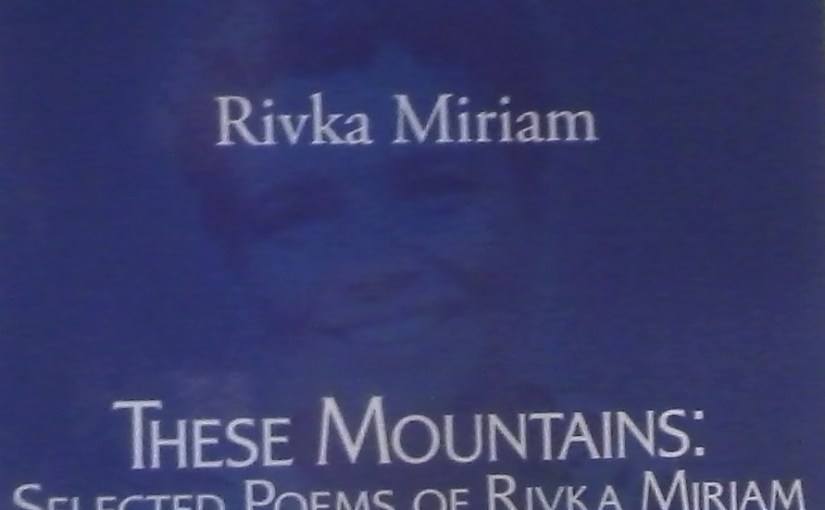
Rivka Miriam of Rivka Miriam is one of the poets discussed by the “Hebrew Poetry Group” at Temple Micah (Washington, DC), using the bilingual These Mountains: Selected Poems of Rivka Miriam (New Milford, CT: The Toby Press, 2009).

One member of the Hebrew Poetry Group shared background on Miriam’s deep personal and artistic connection with the Holocaust:

This article, “Second Generation,” at Jewish Women’s Archive discusses impact of the Holocaust on the arts, and highlights the work of Rivka Miriam.

See also this piece in the Forward‘s Schmooze pages, discusses

A daughter of Holocaust survivors, Rivka Miriam avoids direct encounters with the subject, yet constantly engages the single image, common to all great writers of the Shoah (Appelfeld, Celan, Grossman): that of silence. Appearing in her work in many shades and guises, it is never entirely divorced from that context, as if the very idea of silence itself has now been altered, and could never again be the same for a Jewish reader. More so than any actual image, conjured by creative mind, silence provides a Midrashic commentary to the tradition’s suppositions.
— “Rivka Miriam: Silence as Midrash

Also of note…
“A School of her own: on Rivka Miriam’s Collected Poems [excerpt],” originally in Haaretz (16 Feb 2011), can be found on Poetry International Web. The site also offers a related piece on the same Collected Poems set.

More on Rivka Miriam and the Hebrew Poetry Group in this post.

Chana Bloch (1940-2017)

Chana Bloch, poet, translator, and teacher, died on May 19, 2017. Among her major translation projects are the Song of Songs with Ariel Bloch (then husband) and, with Chana Kronfeld, Yehuda Amichai’s Open Closed Open (NY: Harcourt, 2000). For several years, she edited Persimmon Tree, a publication of the arts by women over 60.

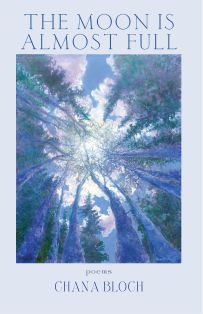
Bloch’s poem about beginnings, “Chez Pierre, 1961,” appeared in Poetry Magazine (1990) and in the more recent collection Far Out: Poems of the 60s. Her final literary work, The Moon Is Almost Full, was published posthumously and is now available from Autumn House Press
Bloch_TheMoonisAlmostFull-2
the poet’s website does not appear to have been updated since shortly after her death. It is still a terrific resource, with links to publications as well as audio files that include introductions and readings from the author herself: click on “selected new work” as well as on individual poetry collections.

“Questions of Faith” a substantial interview about Bloch’s experience of Judaism.

Here is “Dying for Dummies” (PDF), published posthumously in The New Yorker and links to more of her work in the magazine.

Obituaries:
Jewish Weekly
New York Times
Tablet

Information here was updated and supplemented 12/31/18 from that posted in June 2017, shortly after Chana Bloch’s death.