“Do not put a stumbling-block before the blind.” This commandment prohibits anything that “gives the means, or prepares the way for wrong,” according to Rabbi Samson Raphael Hirsch (see Carmi Wisemon’s essay at My Jewish Learning).
There are so many ways in which language can “give the means, or prepare the way for wrong.” And changes to our usage can mean big differences in the way we think and act.
Many of us have seen changes in our lifetime in some of the harmful ways language was employed in early decades. For example, we no longer use “he” to stand for “one” (of any gender) and rarely see locutions like “lady-doctor.” This has helped to address some forms of sexism. But there are many ways in which our language continues to place stumbling blocks in front of us all, including in acceptance of varieties in gender expression. And this is no mere “semantics” issue. How language views certain groups of people translates into rights, respect, and basic safety issues.
The questions raised in yesterday’s post are primarily ones of language: When does language include people and when does it elide over difference? Usage can contribute to acceptance or promote danger for various groups.
Are we experiencing an “uprising” in Baltimore, finally after decades of oppression, or are some random “thugs” rioting? (Just one piece to consider)
Was the Boston Tea Party about revolution or property damage?
Vocabulary in such cases is everything and can mean, ultimately, a difference between life and death.
[Back in 2015, when this blog was running a series counting the Omer, this post closed with the previous night’s count and exact blessing for the date of the post; in an attempt to avoid confusion, the exact info is removed, but the general sentiments about using the Omer to learn and address oppression remains.]
In his masterpiece of prose poetry, Chicago: City on the Make, Nelson Algren wrote:
…All the creeds that persecution harassed out of Europe find sanctuary on this [Chicago] ground, where no racial prejudice is permitted to stand up.
We insist that it go at a fast crawl, the long way around.
The Negro is not seriously confronted here with a stand-up and head-on hatred, but with something psychologically worse: a soft and protean awareness of white superiority everywhere, in everything, the more infuriating because it is as polite as it is impalpable. Nobody even thought such a thing, my dear.
— in “Love is for Barflies,”
p.45 60th Anniversary Edition (Chicago: Univ. of Chgo Press, 1951)
Algren’s brilliant expression — “No racial prejudice is permitted to stand up. We insist that it go at a fast crawl, the long way around.” — remains all too apt, across much of the U.S.
Does the persistence of this reality have implications for our prayers?
(This post was edited and amended after initial publication.)
Algren’s Chicago, 1951 and 1961
In 1951, Algren quotes Big Bill Broonzy’s “Black, Brown, and White” — “If you’re white, awright…if you’re black, step back” — and continues, telling Black Chicagoans to expect higher rents, and warning:
And no one will ever name the restaurants you mustn’t eat in nor the bars you mustn’t drink at….Make your own little list. Of the streets you mustn’t live on, the hotels where you can’t register, the office you can’t work in and the unions you can never join.
— ibid, p.46
Major Chicago reviewers at the time said the work exhibited a “distorted, partial, unenviable slant” and demanded “revocation of the author’s poetic license.” But ten years later Algren only marveled at others’ failure to recognize what he saw, in 1951 and 1961. In the 1961, he wrote:
One cannot help but wonder what the reaction might have been had the book cut in closer to what the lives of multitudes are really like on the city’s South and West sides. This book didn’t begin to tell that story a decade ago; and the story is fully as terrible today as then.
— ibid, pp.95-97
(Google Books offers a substantial preview)
Bilhah and Zilpah, Text and Prayer
At the start of the week (see “Beyond 21“), we began to explore the idea of including Bilhah and Zilpah, the concubines of Jacob and mothers of four of the twelve tribes, in the opening blessing of the Standing Prayer.
Most prayer books used in non-orthodox congregations have included the four Matriarchs (Sarah, Rebecca, Rachel, and Leah) along with the three Patriarchs (Abraham, Isaac, and Jacob) in the blessing that calls on God who “remembers the love of our fathers (and mothers),” at least as an option, for many years. But most prayer books do not include the maids at this point:
Does listing all six mothers foster a sense of inclusion?
Or does it serve to gloss over difference, given that backgrounds of Bilhah and Zilpah are not addressed in the biblical text?
Does including Bilhah and Zilpah in the blessing raise their status and our awareness of their contributions?
Or does it make their inferior legal and social status invisible?
Is adding Bilhah and Zilpah an act against allowing prejudice to stand?
Or is it asking it to “go at a fast crawl, the long way around”?
A few thoughts to further consideration —
Orthodox prayer books do not include any of the mothers in the Amidah, retaining ancient language and often noting that the phrase “God of Abraham, God of Isaac, God of Jacob” is biblical (Ex. 3:6) and so not to be amended. Chabad notes, in addition, that Bilhah and Zilpah had souls “not as lofty as the Matriarchs” and act as “agents of Rachel and Leah” when they bear children.
Congregation Beth Simchat Torah (CBST) is a NY community that “attracts and welcomes gay men, lesbians, bisexuals, transgender, queer and straight individuals and families who share common values. Their Siddur B’chol L’vav’cha, With All Your Heart, includes Bilhah and Zilpah, “recognizing all of our mothers, not just the ‘legally married ones.'”
The Movement for Reform Judaism (UK) points out that the addition has been controversial, adding a note from a classical source:
A powerful rabbinic midrash asks the question why the children of Israel had to endure slavery in Egypt. It answers that the sons of Rachel and Leah dismissed the sons of Bilhah and Zilpah on the grounds that they were the children of slaves and of less worth. By experiencing slavery in Egypt all the descendants of Jacob were made equal in this regard.
“Prayer Book in the Making”
[cited page from Movement for Reform Judaism now (2020) missing]
What, if anything, does including Bilhah and Zilpah say about our understanding of oppression and how to move beyond it?
More to come.
We counted 23 on the evening of April 26. Tonight, we count….
Is the call “No Justice, No Peace” a threat or a prayer? “encapsulation of the lex talionis, an eye for an eye,” as Pat Buchanan says? a a statement of fact?
By OsamaK (Own work) [CC BY-SA 3.0 (Creative Commons)], via Wikimedia Commons
This commentary on the Sim Shalom, the closing blessing and prayer for peace, at the end of the Amidah [Standing Prayer] discusses the Barcheinu Avinu verse: “Bless all of us as one, through the light of Your Presence.”
teaching from Shlomo Carlebach on “Sim Shalom”
found on the Album “Songs of Peace” (recorded: 1973)
[Begins singing “Barcheinu Avinu,”
verse near the beginning of “Sim Shalom,”
then pauses for this teaching]
If I ask God: “Please give me, give me money, give me health” —
it is possible that I should be healthy,
but, God forbid, the rest of the world should not be.
I could be rich,
but the whole world, God forbid, can be poor.
But there is one precious thing I cannot ask God
just give it to me and not to the rest of the world,
and that is peace.
For it’s for the whole world or it isn’t there at all.
Because peace comes from such a high place in heaven,
it is only given to the whole world.
It’s not given to individuals, because it’s God Himself.
And now the thing is, there are a lot of lights in the world.
If I ask God: “Please put light into my soul, put light into my life,”
the question is: Where is this light coming from?
If I’m just asking for myself,
then the light comes from a very low place.
Everybody knows, everybody knows,
when we davven [pray] Shemona Esrei [“18”/Amidah]
three times a day, we ask all our needs.
But at the end we say: “Please, Almighty, Sim Shalom
– Let there be peace.”
And then we say: “Barcheinu avinu – please bless me**,”
but “kulanu ki echad – all of us like one
– b’or panecha – with Your light.”
Because the light of God is only for the whole world:
it’s the light of peace, the light of love, the light of shabbes [sabbath].
So join me….
[Returns to singing again “Barcheinu Avinu”] ** more grammatically:
“bless us, Our Father [or Parent]”
Recalling Psalms 85:11 —
חֶסֶד-וֶאֱמֶת נִפְגָּשׁוּ; צֶדֶק וְשָׁלוֹם נָשָׁקוּ.
“Mercy and truth are met together; righteousness and peace have kissed each other”
— what does Shlomo’s teaching tell us about the call “No Justice, No Peace”?
We counted 22 on the evening of April 25. Tonight, we count….
A story is the easiest, and, I hope, clearest, way for me to convey this thought to open the week of Netzach [“eternity,” also leadership] in the omer journey away from oppression. (apologies for length)
At this morning’s worship service, Temple Micah‘s Rabbi Zemel pointed participants’ attention to the following note, a kavanah [focusing intention] before the Standing Prayer:
Rabbi Ammi taught: A person’s prayer is not acceptable unless one’s heart is in one’s hands. (Taanit 8a)
— Mishkan T’filah, p.243
I attempted to approach the Amidah’s opening blessing in that spirit.
The opening blessing calls on God who “remembers the love of our fathers and mothers” and “brings redemption to their children’s children for the sake of the Divine Name.” Mishkan T’filah includes the matriarchs — “God of Sarah, …Rivkah, …Rachel, and God of Leah” — here. But it does not mention Bilhah and Zilpah, concubines to Jacob and mothers of four of the twelve tribes of Israel.
A Heavy Heart
For some years, I included the names of Bilhah and Zilpah myself in an effort to honor them and the many “fathers and mothers,” Jews or non-Jews, who contribute to the community over the centuries. But a few years ago I stopped on the theory that this, however inadvertently, led to erasing the history of oppression.
Ignoring race or underdog status in an attempt at inclusiveness, I reasoned, can have a negative impact, allowing those of more powerful or privileged status to forget that the underdog/slave still carries effects of that (former?) status.
Nowadays, instead of including the six mothers as equals in the list, I’ve taken to pausing after calling on “God of Abraham…God of Leah,” to specifically call on “God of the Ancestors of all with whom we’ve traveled.”
A note from Judith Z. Abrams on the opening blessing explains
The content of this prayer has to do with the merit of our ancestors. This is traditionally conceived of as a sort of bank account into which the Patriarchs and Matriarchs deposited funds of righteousness that were so great that they covered all future generations.
— Mishkan T’filah, p.244
And, if we’re to invoke the merit of all the ancestors, there are some debts owing as well. So, this morning, I found that my heart, in hand, grew heavy as I invoked the God of all the Ancestors.
By the time I reached Sim Shalom, the closing blessing and prayer for peace, I could hear the wails of so many oppressed descendants of those Ancestors calling on God to “bless all of us as one, through the light of Your Presence” that I wondered how others seemed (apparently) unaware of the din filling the sanctuary.
Open Fingers
In many prayerbooks (outside the Reform Movement), the prayer for peace includes the ancient priestly blessing:
May GOD bless you and keep you.
May GOD shine his face toward you and treat you graciously.
May GOD lift his face toward you and grant you peace (from Numbers 6:26).
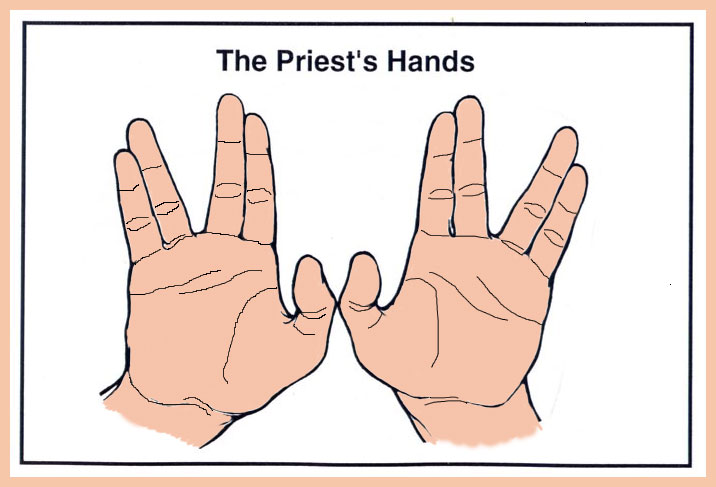
Priests — and in some communities, all the participants — accompany this blessing with an open-fingered gesture. (See right>>>) And so I got to thinking after the service about open fingers and hearts in hand.
I decided to look up Rabbi Ammi’s teaching in the Babylonian Talmud:
R. Ammi said: A man’s prayer is only answered if he takes his heart into his hand, as it is said, “Let us lift up our heart with our hands” (Lam 3:41). [But a teaching of Samuel asks: Do we not also read] “…For their heart was not steadfast with Him, neither were they faithful in His covenant; and yet, But He being full of compassion, forgiveth iniquity etc.” (Psalms 78:36-38)? — This is no contradiction. The one refers to the individual, and the other to the community.
— Soncino translation, from Halakhah.com
[I added quotation marks for the biblical verses; see also note below]
Samuel uses Psalm 78 to suggest that a community can be answered, even when its collective heart is not steadfast — which seems a great mercy.
Loving-Kindness in Leadership
Today is the day of Chesed in Netzach, loving-kindness in eternity or leadership. And in the spirit of this day, I ask:
What is the relationship of heart in hands and an open-fingered prayer?
Can individuals — priests or, in some understandings, all of us — bring blessings on the whole community if our own hearts are in our own hands? Are our own hearts impediments? or an aid to opening our fingers?
What does it mean that Rabbi Ammi’s proof-text is in the plural “lift up our heart with our hands”? Is there, somehow a collective communal heart and an individual one?
And, finally: Who else finds the heart they bring to prayer a heavy one these days? And how can we work together to help bring blessing with, or in spite of, that weight?
We counted 21 on the evening of April 24. Tonight, we count….
NOTES:
Lamentations 3:41 —
נִשָּׂא לְבָבֵנוּ אֶל-כַּפָּיִם, אֶל-אֵל בַּשָּׁמָיִם.
Let us lift up our heart with our hands unto God in the heavens.
The bracketed material above:
[But it is not so. Surely]18 Samuel appointed an amora19 to
act for him and his exposition ran thus:
with these notes —
(18) So Bomberg ed. and inserted in cur. edd. in square brackets, p. 33 n. 1.
(19) Same as Meturgeman. V. supra p. 12, n. 4.
And the supra note on “meturgeman” —
The translator or interpreter. The function of this official in Talmudic times was to interpret to the audience in the Synagogue in a popular manner and to enlarge upon the theme of the rabbi lecturing. Rashi, feeling that in our passage no such official could be referred to, explains that here the lecturing rabbi and interpreter are one and the same person, he who lectures on the first day of Passover, and that he included in his address a prayer for rain. V. however, the commentary of R. Hananel ad loc.
To close out this week of Tiferet [“beauty”], the balancing of Chesed [“loving-kindness”] with Gevurah [“strength” or “boundaries”], a few words of prayer and meditation from the early morning service (Koren Saks translation; meditation [mine]) —
May Your loving-kindness be greatly upon me, and in Your might may my enemies and those who rise against me be subdued.
I pray in the spirit of the Talmudic great, Beruriah, who scolded her husband, Rabbi Meir, for praying that “sinners be no more,” insisting instead that he should instead pray that the sins that should be no more. (See Berakhot 10a; Midrash Psalms 118)
— from “Prayers for a Change”
— and a thought from Ross Gay on “Split this Rock,” a national network of socially engaged poets:
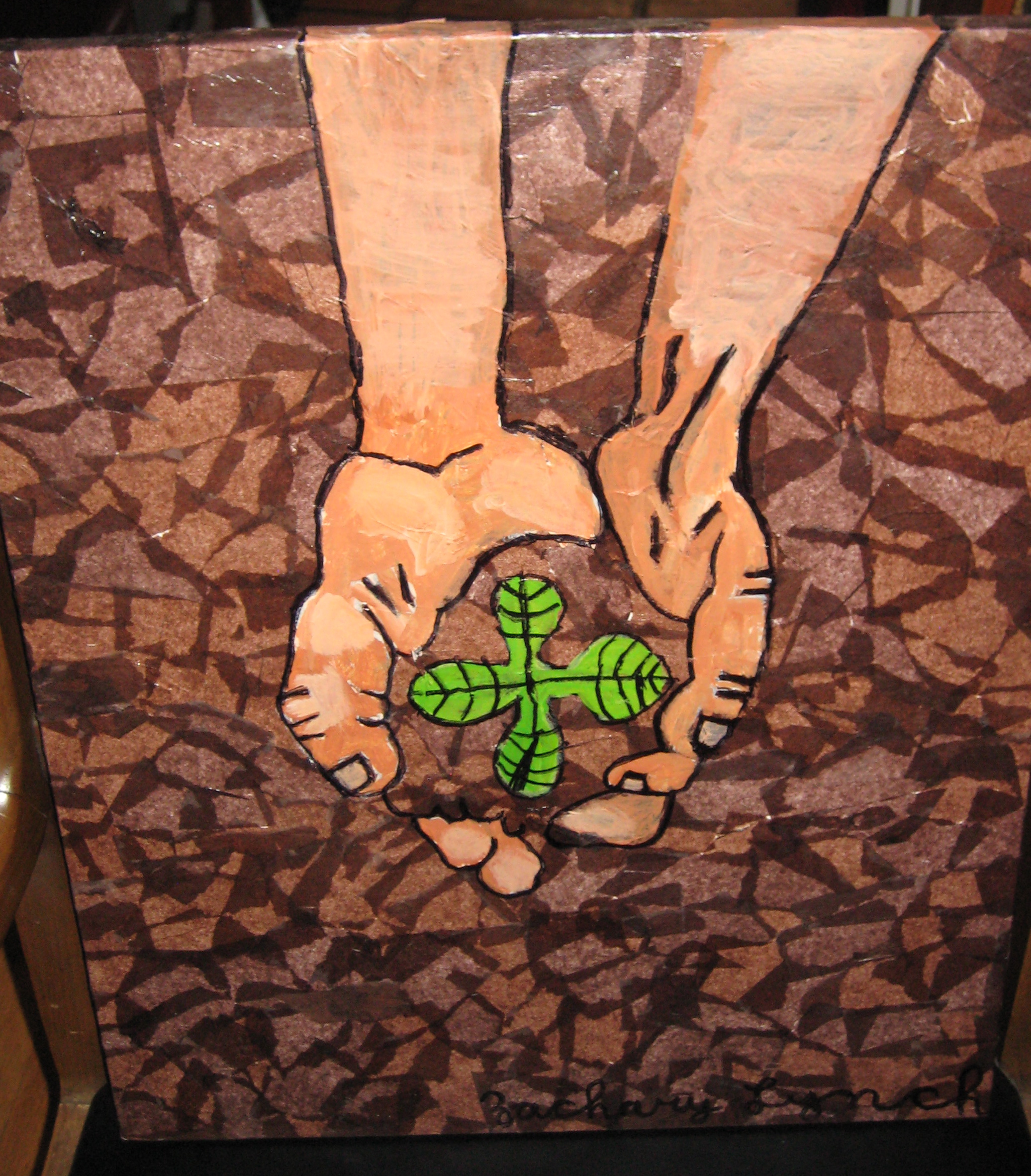
by Zachary Lynch, mixed media/sgraffito boardA Small Needful Fact
Is that Eric Garner worked
for some time for the Parks and Rec.
Horticultural Department, which means,
perhaps, that with his very large hands,
perhaps, in all likelihood,
he put gently into the earth
some plants which, most likely,
some of them, in all likelihood,
continue to grow, continue
to do what such plants do, like house
and feed small and necessary creatures,
like being pleasant to touch and smell,
like converting sunlight
into food, like making it easier
for us to breathe.
***
Used with permission.
***Ross Gay is a gardener and teacher living in Bloomington, Indiana. His book, Catalog of Unabashed Gratitude, is available from University of Pittsburgh Press, 2015.
***
Please feel free to share Split This Rock Poem of the Week widely. We just ask you to include all of the information in this post, including this request. Thanks! If you are interested in reading past poems of the week, feel free to visit the blog archive.
What would it mean for reports about Dante Servin, armed off-duty Chicago police officer, and Rekia Boyd, the unarmed 22-year-old citizen he shot to death in March 2012, “to be systemically aware” (see yesterday’s post)?
Rekia Boyd’s story is not a straightforward example of the “unarmed suspect shot” scenario: Servin was not attempting to arrest Rekia Boyd. He appears to have been reacting to belief that her boyfriend was armed (he wasn’t), complicating any discussion of police response to Black women. Servin defends his actions by invoking police protocol, claiming: “Any police officer especially would have reacted in the exact same manner” (see video in ABC7Chicago story linked above). But he was off-duty, and he shot Rekia Boyd following a complaint about noise because he “feared for his life.” So, really, it comes down to fear….
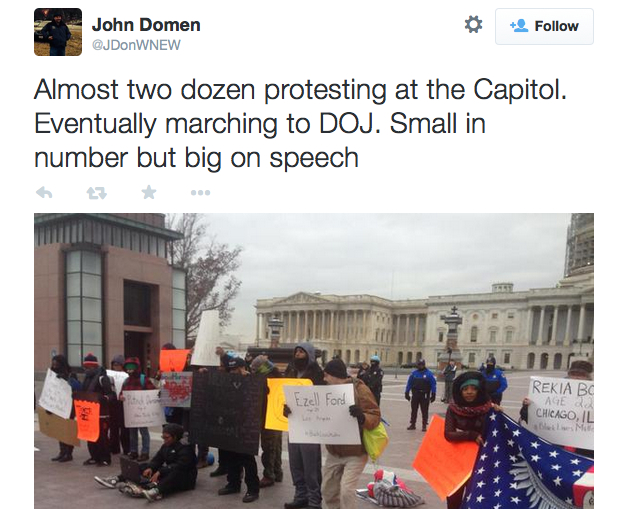
I symbolically embodied Rekia Boyd during a demonstration at the U.S. Capitol followed by a 4-1/2 hour die-in at the Department of Justice on Human Rights Day, December 8, 2014. I chose her name because she was female (like me) and from Chicago (like me). And while I had already left the city by the time I was 22, I feel some connection with a young woman out with friends on her own streets, maybe forgetting that it was late and time to keep the noise down or maybe just forgetting — as my friends and I did often enough — that there were other people around.
During those long, cold hours on the ground outside the Department of Justice, the following passage — one that has stuck in my brain since I first read it — returned to me again and again:
“…Them shootin’ me wasn’t no accident. You don’t take no scared white boys can’t tell the difference between one black man and another, give ’em guns, and let ’em run around the streets of Harlem and then say it was an accident when they one day shoot down an innocent man….”
— Tempest Landry, speaking post-death in Walter Mosley’s Tempest Tales. (NY: Washington Square Press, 2008.)
see also “Declarations of Independence…”
And, while some sectors, particularly Black media, have certainly addressed the topic many times for decades upon decades, mainstream media is still not asking the most fundamental question:
Why do we allow armed police to roam in areas where they fear the residents?
As Collette Flannigan, mother of Clinton Allen (age 25; killed by Dallas TX police), told “Voices of Grief and Struggle” last December:
“Those badges and guns belong to us.
Every time they kill they kill in our name.”
That’s a level of systemic awareness I rarely see and believe we must develop, soon.
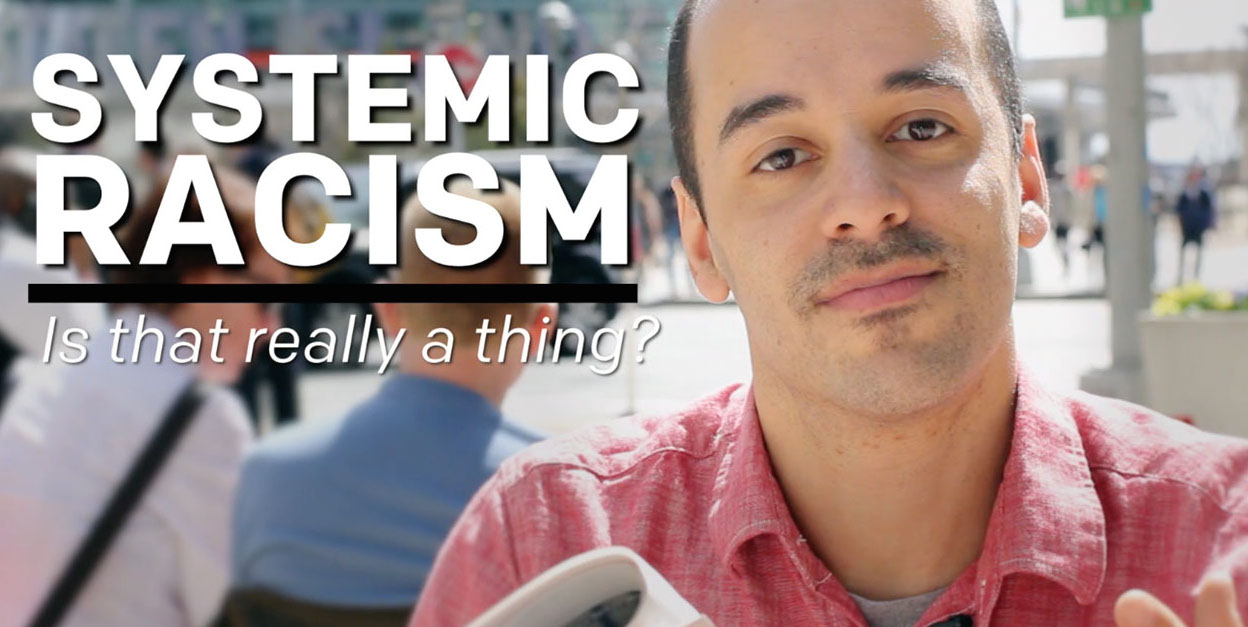
Yesterday’s post warned of the dangers of “pretension to total lucidity,” a concept based on Zornberg’s commentary on the Book of Numbers. (See also quote, citation.) Today, Race Forward released a series of videos responding to the query, “Systemic Racism: Is that really a thing?” — a key element of “lucidity.”
Race Forward, formerly Applied Research Center, has been researching racism and pushing conversations about it since 1981. Its publication, Colorlines, covers “stories from the perspective of community, rather than through the lens of power brokers,” with breaking news, investigative reporting, and dispatches. Jay Smooth is Race Forward’s video and multimedia producer — a cultural commentator with a gift for succinctly addressing complex issues. (See also “Oppression as ‘Normal'” for more from Smooth.)
Looking at each entry in the new series about Systemic Racism, I found myself asking: How will this move the conversation forward? Those who see this, see it already, and who else will take the time to look at the videos? But the video below (separate from the series) cogently explains how Race Forward’s examination of news found that much of it (2/3 of stories examined) “fails to be systemically aware.” Exploring this can only improve our societal “lucidity.” (the related 2014 report)
As the “Tifereth” [“beauty”] week of this journey away from oppression continues, I return again to the biblical concept that all humans (other than Moses) see only a part of any picture:
…The problem arises when one is not aware of one’s own deflections of vision. Imagining oneself clear-eyed, one may become the greatest fantasist of all….the greatest illusion may be the pretension to total lucidity.
— from Bewilderments, Avivah Zornberg’s study of the wilderness travels in the Book of Numbers (see fuller quote and citation in Beyond 14)
In a post published today, Talia Cooper, program director of Ma’yan, provides an example of failing to get the “full picture.” the failure to understand and acknowledge anti-Semitism in the “leftist activist community.”
Anti-Semitism is real. It has and continues to negatively impact our Jewish people.
The leftist activist community doesn’t always do a good job acknowledging or understanding anti-Semitism.
It’s a problem because it means the left won’t have a full picture of society, which is necessary in order to build power and win. And it’s a problem because it perpetuates anti-Semitism itself.
— “A Call to My Beloved Jews: We Gotta Talk About Privilege” on Mayan.org
She goes on to explore the “privilege” factors in the complicated intersectionalities of any one identity expression:
Sometimes it seems so simple: of course it’s possible for me as a white Jewish woman to experience sexism, white privilege and anti-Semitism all at the same time. It’s “simple” because I’ve lived it my whole life.
— Read the rest of Cooper’s piece
Cooper addresses specific conversations she believes Jews must have around intersectionality.
This omer series introduced the topic with “Are (Any) Jews White?” early in the Passover week. Readers are urged to share their thoughts and if/how their thinking has evolved over the course of this omer journey.
The midrash quoted above — insisting that we NEVER have the whole picture — offers a powerful call to remember the dangers of “pretension to total lucidity.”
“Whoever destroys a soul, it is considered as if he destroyed an entire world. And whoever saves a life, it is considered as if he saved an entire world.”
— Babylonian Talmud: Sanhedrin 37a.
There is still much to be learned on the omer journey away from oppression. As our learning journey progresses, the March 2 Justice approaches the U.S. Capitol, providing an opportunity to learn directly from civil rights leaders and marchers themselves.
In their “Why We March,” the NY Justice League notes that JUST THIS YEAR the individuals listed here on the right, many with mental health issues, were killed by police.
In their honor, and in the names of Eric Garner, Akai Gurley, Rekia Boyd, Tamir Rice, Michael Brown, Renisha McBride, John Crawford III, and Ramarley Graham, the NY Justice League is calling for
an end to racial profiling,
stopping the militarization of our local police forces, and
demanding the government invest in our youth and communities.
Yesterday’s post included a note from Bewilderments, Avivah Zornberg’s study of the wilderness travels in the Book of Numbers.
…Moses alone of human beings ‘saw b’aspaklariah meirah— through a clear lens.” All others, including prophets and seers, saw through an unclear glass, a distorted lens of subjectivity (Babylonia Talmud: Yevamot 49b, Rashi to Numbers 12:6). The problem arises when one is not aware of one’s own deflections of vision. Imagining oneself clear-eyed, one may become the greatest fantasist of all….the greatest illusion may be the pretension to total lucidity.
Also yesterday, theGrio — the African American Breaking news site — published “Study: Teachers more likely to label black students as troublemakers,” describing the “black-escalation effect”:
…teachers were shown records of kids with either stereotypical black names (Deshawn or Darnell) or stereotypical white names (Greg or Jake) and asked what disciplinary steps should be taken after certain infractions.
While the response to the first infraction was the same across both races, after the second rule infraction, teachers pushed for more punishment for the black students than the white students.
“It’s not that these are racist people, it’s just that we all are exposed to stereotypes in the world,” Jason Okonufua, the study’s lead researcher, said.
“The problem arises when one is not aware of one’s own deflections of vision.”

![By OsamaK (Own work) [CC BY-SA 3.0 (Creative Commons)], via Wikimedia Commons](https://songeveryday.org/wp-content/uploads/2015/04/no_justice.jpg)




 "A Song Every Day"