Pharaoh’s “hardened heart” plays a big role in Exodus, providing a framework for the ten plagues, the eventual freeing of the Israelites from bondage, and serious disaster for biblical Egypt. Policies like “zero tolerance” in schools and mandatory sentences in the United States today are a kind of judicial “hardened heart.” It’s our job to find a way to “let the people go.”
Continue reading Exodus Revisited: Pharaoh’s “Hardened Heart” and Contemporary “Criminal Justice”
Category: Ethics
Community, Leadership, and Listening
Leadership and community are key elements in the early chapters of Exodus. We see a variety of strong actions and interactions:
1) Moses sees an Egyptian man striking a Hebrew; he responds by killing the Egyptian and then hides the deceased in the sand.
2) Moses sees two Hebrew men fighting and tries to stop the aggressor.
3) The Hebrew fighter replies: “Who made you judge over us? And do you propose to murder me as you did the Egyptian?”
4) Pharaoh learns of Moses’ crime and sets out to kill him. Moses flees from Egypt.
5) Moses witnesses what appears to be an injustice as Jethro’s daughter attempt to water their flocks and intervenes, immediately and physically. (Exodus 2:11-17)
We don’t know, from the text itself, if Moses’ upbringing included grooming in Egyptian leadership skills or if he was taught Israelite ideas and practices through a continuing relationship with his birth parents. Commentators over the centuries have understood his early years in both ways.
We do know that Moses “went out unto his brethren and looked on their burdens [וַיֵּצֵא אֶל-אֶחָיו, וַיַּרְא, בְּסִבְלֹתָם]” (Exodus 2:11). What is not reported is any interaction between Moses and his brethren — or between Moses and the Midianite women at the well — that would help him understand community perspectives and concerns. He seems to have some sort of innate sense of justice, but he isn’t able to turn that inner sense into action that is helpful when faced with real world circumstances.
Like Moses, many attempting to understand and join the #BlackLivesMatter struggle don’t know how to translate a desire for justice into action that is helpful. The first step, the one Moses seems to have missed initially, is to LISTEN. Here, for those interested in taking this step, are video clips from Jews United for Justice’s “Black Lives Matter, Chanukah Action” program.
Hear directly from black activists about their experiences and their advice for white allies. More on the event and full list of speakers.
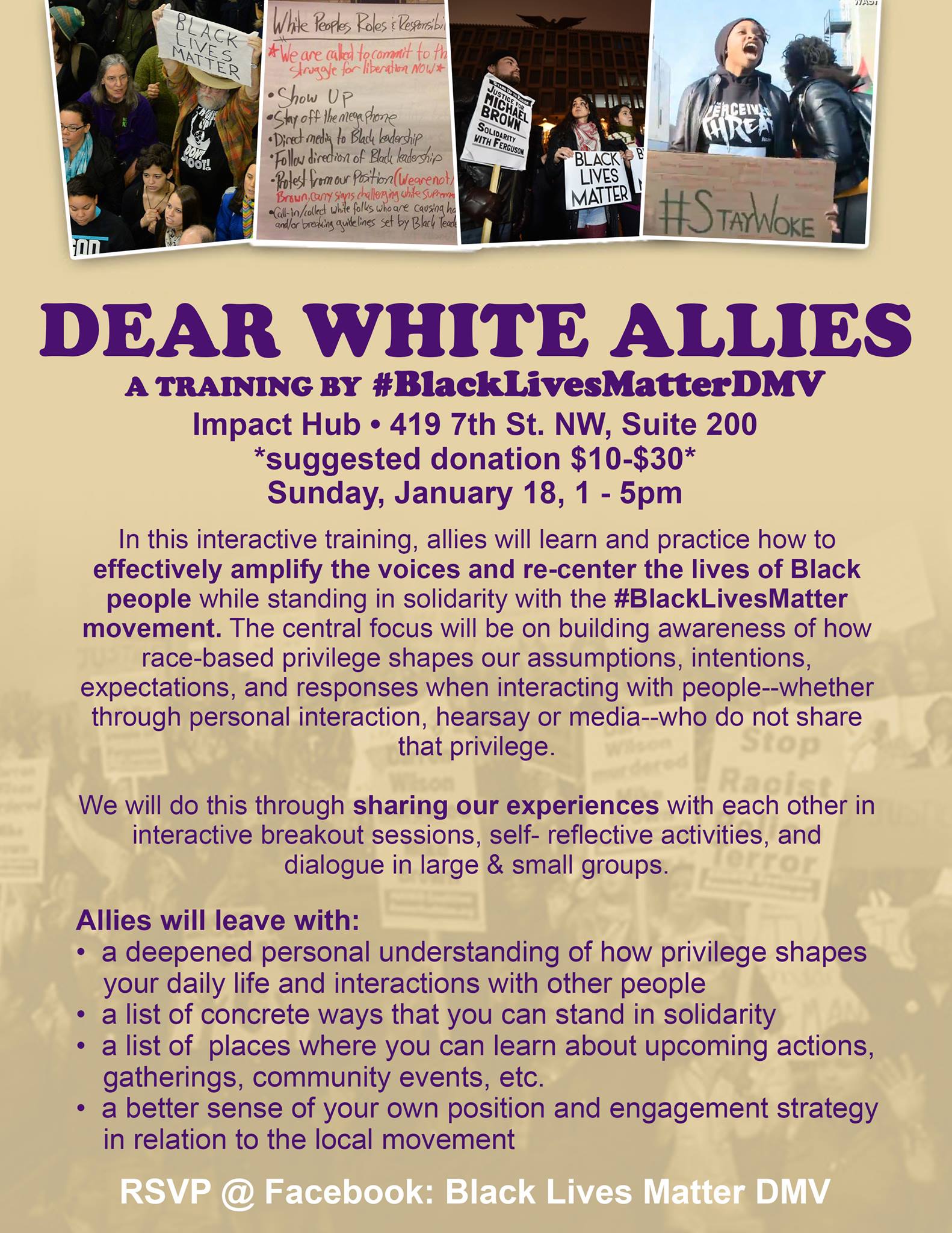 For those in the DC area, consider joining “Dear White Allies: A Training by #BlackLivesMatterDMV” or one of the many other local opportunities to listen and learn.
Dear White Allies:
Sunday, Jan 18
1-5 p.m.
Impact Hub, 419 4th Street NW
For those beyond DC, look for local anti-racism and white ally training in your area.
Exodus: from state violence to resistance to liberation
The story of Exodus opens with state-mandated oppression and violence against a rapidly growing minority population, increasingly feared by the ruling majority (brief summary). Women of different communities and classes engage in resistance, separately and jointly, that eventually leads to toppling of the entire system.
From Violence to Resistance
Today, many in the U.S. are calling for acknowledgement of “the structural violence and institutional discrimination that continues to imprison our communities either in a life of poverty and/or one behind bars,” and recognition of “the full spectrum of our human rights and its obligations under international law.” Black Lives Matter addresses
…a world where Black lives are systematically and intentionally targeted for demise….an affirmation of Black folks’ contributions to this society, our humanity, and our resilience in the face of deadly oppression….we are talking about the ways in which Black people are deprived of our basic human rights and dignity. It is an acknowledgement Black poverty and genocide is state violence.
Midwives Shifrah and Puah act against the state, we are told, because “they feared God,” prompting them to act in preservation of life. Avivah Gottlieb Zornberg elaborates:
…the very extremity of the edict forces a new moral vision upon the midwives, a radical choice between life and death. Disobedience to Pharaoh becomes more than merely a refusal to kill, it becomes a total dedication to nourishing life.
— Zornberg, The Particulars of Rapture, p.23 (full citation)
Similarly, I think, the Herstory of #BlackLivesMatter exhorts us:
…when Black people cry out in defense of our lives, which are uniquely, systematically, and savagely targeted by the state, we are asking you, our family, to stand with us in affirming Black lives. Not just all lives. Black lives. Please do not change the conversation by talking about how your life matters, too. It does, but we need less watered down unity and a more active solidarities with us, Black people, unwaveringly, in defense of our humanity. Our collective futures depend on it.
Pledging Resistance?
Ferguson Action is asking individuals to declare 2015 their “year of resistance.”
I pledge to make 2015 my year of resistance to state violence against Black lives.
I challenge myself and those in my community to take risks as we confront the many ways that Black lives are diminished and taken from us….
This year, I will declare boldly and loudly through my words and actions, that #BlackLivesMatter.
—Ferguson Action Pledge
Does Exodus — with its powerful examples of resistance — call us to anything less?
Continue reading Exodus: from state violence to resistance to liberation
First Steps in an Exodus from Racism
In the mid-20th Century, the Exodus story (neither Charlton Heston nor Christian Bales, but the second book of the bible) became part of the underpinnings of the Civil Rights Movement in the United States. Today, as a new civil rights movement evolves, how can we use the ancient Exodus narrative to once again help us explore key issues and increase understanding and involvement?
Continue reading First Steps in an Exodus from Racism
Do not stand idly by Fox endangerment of your brothers
UPDATE: The Baltimore Fox-affiliate WBFF fired the reporter and photographer who doctored video to create this story (see below). The producer who assigned this story received only a one-day suspension, and the Fox network has not taken responsibility for its lies, defamation of character, or incitement to violence. See City Paper update on this story (12/31/14). The petition is on-going.
“They were terrified,” reads Genesis 42:35, as 11 of Jacob’s sons realize that their brother Joseph faked evidence that would link them to crime against the state [theft from Pharaoh’s household]. Just a few days ago, a Fox station in Baltimore similarly faked evidence of a crime against the state. Bible readers know that Joseph faked the crime for his own reasons, and that the act will eventually leads to a sort of reconciliation in this troubled family. Nonetheless, the brothers and their father are rightly terrified at the dangerous manipulation. Fox acted for its own reasons, as well, but it remains to be seen if there is any kind of reconciliation possible in this situation.
The shortest version: My friend, Kymone Freeman of We Act Radio, was at the large protest march in DC on December 13. He was filmed by C-SPAN holding a mic and portable amp while people are chanting “We won’t stop ’til killer cops are in cell blocks.” But Fox aired the clip, severely edited — on December 21, after the deaths of two police officers in NYC — claiming it was a chant of “kill a cop.”
Insult to injury: Tawanda Jones, who was filmed leading the chant, has been an especially peaceful activist, who persists in advocating for indictment of “killer cops” — including those responsible for death of her brother, Tyrone West, in custody of Baltimore City Police last year — while insisting that the existence of bad (“killer”) police tarnish the reputations of the entire force, which she supports.
Anyone who does evil, according to a medieval Jewish source, “is punished not only for the specific victim but for all who sorrow for him, as it is said, ‘Now comes the reckoning for his blood’ (Genesis 42:22)” — Sefer Hasidim, 131 (found in Zornberg’s Genesis: The Beginning of Desire, on the Joseph story).
- This Fox story has not only damaged the specific victims — Tawanda Jones, Kymone Freeman, and others at the Dec. 13 march — but so many more.
- Fox perpetrated reckless endangerment of individuals and a whole community.
These lies would never have aired without dangerous, racist assumptions
— on the part of Fox staff and viewers — behind them.
Jews know this story.
Anyone who has studied Jewish history knows this story.
Anyone who has studied black history knows this story.
Anyone who has studied Muslim history knows this story.
We all know this story!
It’s time to change the story!!
More Background
Here is a bit more background, the WBFF “apology,” and Kymone’s petition petition in response to being used in this ugly, dangerous manipulation.
Here is Tawanda Jones’ interview with the station that defamed her:
Note, please, that the interviewer has the audacity to say to Ms. Jones “you seem sincere,” as though THEIR distortion of her views deserved as much credence as HER OWN. Also, please note that Ms. Jones says the false story “killed a piece of me.” The Talmudic adage, “Just as the sword can kill so can the tongue” (Arachin 15b), seems amazingly and heart-breakingly apt.
Please read and consider signing and sharing.
Deeper Responses
Kindling Hope with the Fourth Candle
How is Chanukah kindling hope for you and others this season?
In memory of Rekia Boyd, killed at age 22, another victim of (off-duty) police violence from my first hometown, I am kindling hope with ChanukahAction by supporting Ferguson Action Demand #2: contacting the USDOJ to demand a comprehensive review of systemic abuses by local police departments, including publication of data relating to racially biased policing, and the development of best practices.”
It was Rekia Boyd whom I chose to memorialize at the the 4-1/2-hour die-in in front of the USDOJ on December 8, organized to promote human rights for black and brown people in the U.S. While I never knew her, she is forever in my heart (and inspired this prayer).
May every act of remembrance — candle-lighting, mourners’ kaddish, memorial prayer — bind the victims of racial bias more tightly into our national consciousness
and collective commitment to change.
Here is the fourth candle Chanukah Action:
Options for taking action:
Option 1: Share the following message on social media (Facebook, Twitter, etc.): “I support Ferguson Action’s call for a Comprehensive Review of systemic abuses by local police departments, including the publication of data relating to racially biased policing, and the development of best practices. http://www.fergusonaction.com/demands”Option 2: The Department of Justice has been identified as a primary target in the fight to end racialized police violence. This Chanukah, contact the Department of Justice and voice your support for change. Here is a sample script you can use:
“Hello, my name is _______. I am calling to urge the Department of Justice to: Conduct a comprehensive review of systemic abuses by local police departments Publish data related to racially biased policing Develop best practices for racially just law enforcement. Repurpose funds to support community-based alternatives to incarceration.”
You may contact the Department of Justice at: 202-353-1555 or by email at AskDOJ@usdoj.gov.
Here is the full Action Toolkit (PDF).
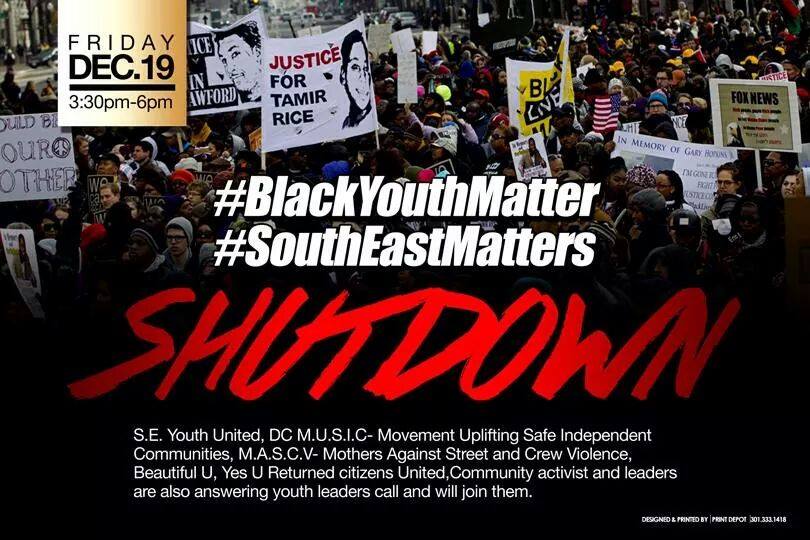
I am taking this action in advance of tonight’s 4th candle in order to enjoy Shabbat when it comes in this evening, right after Chanukah candle-lighting, and to allow for my participation in the local #BlackYouthMatter #SouthEastMatters action just across the river from my DC home.
May the light of our candles and actions help bring about a new way of seeing, in our own lives and in the country.
Power, Language, and Settling: Questions from Joseph’s Story
The Joseph story, which begins in this week’s Torah portion raises questions about language, about power and how it is used, and about the possibility of learning an entirely new narrative about a story of which we are a part:
- How does the language we use, even inside our own heads, affect the way we view an encounter?
- How does the way one individual is described affect our views of others who share some background with that individual?
- What does it mean for one person or group of persons to have power over another? Is it as changeable as a garment? Do we recognize when we are wearing a garment of power?
- Do we sometimes pretend a sense of brotherhood when it suits us and drop it when it doesn’t?
- Can we, today — like the biblical Joseph — create circumstances that lead to a “dizzying awareness of new narrative” that leads to different action?
- Do we, as individuals or as part of a collective, try to settle for our own peace, even if we know others are suffering? How hard do we, like the biblical Jacob, work to remain oblivious to strife before us, even if we helped engender it?
Finally: what does this portion say about “living in the midst of history” and entering the eight days of Chanukah, designed to bring us out of the lowest level of light?
Continue reading Power, Language, and Settling: Questions from Joseph’s Story
Praying with Voices of Grief and Struggle
Jewish memorial prayers ask that souls of the departed be bound up among the living. The living help in this process by doing acts of tzedakah – translated as charity, righteousness, or justice – in the name of their departed loved ones. In that spirit, and inspired by my “die-in” experience on December 8, I offer the following prayer:
May the souls of
Sean Bell
Alan Blueford
Dale Graham
Gregory Chavis
Archie Elliot
Clinton Allen
Maurice Donald
Oscar Grant
Ramarley Graham
John Crawford III
and others lost to police violence
find eternal shelter and rest.
May each personal and communal act of remembrance
bring further solace to their mothers and others who loved these individuals in life.
May the myriad acts of protest for justice
conducted in their names
bind their souls more deeply among the living.
May each die-in act,
symbolically embodying the last moments of the departed,
bind their deaths more tightly into our national consciousness
and collective commitment to change.
As the souls of
Sean Bell
Alan Blueford
Dale Graham
Gregory Chavis
Archie Elliot
Clinton Allen
Maurice Donald
Oscar Grant
Ramarley Graham
John Crawford III
and so many others,
our brothers, our teachers,
rest in eternal Light.
May we continue to find
illumination in their everlasting brightness.
And let us say: Amen.
“Church Synagogue Have Failed. They Must Repent.”
“Church synagogue have failed. They must repent….We forfeit the right to worship God as long as we continue to humiliate Negroes,” Rabbi Abraham Joshua Heschel telegraphed to President John F. Kennedy on July 16, 1963. Heschel called on the president to declare a “state of moral emergency.”
Heschel told Kennedy that race problems were “like the weather: Everybody talks about it but nobody does anything about it.” He then asks the president to issue a variety of demands:
Please demand of religious leaders personal involvement not just solemn declaration. We forfeit the right to worship God as long as we continue to humiliate Negroes. Church synagogue have failed. They must repent. Ask of religious leaders to call for national repentance and personal sacrifice. Let religious leaders donate one month’s salary toward fund for Negro housing and education. I propose that you Mr. President declare state of moral emergency. A Marshall plan for aid to Negroes is becoming a necessity. The hour calls for moral grandeur and spiritual audacity.
— telegram can be found here, along with additional study resources on related topics from the American Jewish World Service’s “on1foot” pages.
Fifty years later, some of Heschel’s suggestions may sound odd. Do we ever speak of “national repentance,” for example? But his call for declaring a “moral emergency” in this country seems all too appropriate:
- police brutality is a both a legal and a moral emergency;
- suppression of the press is a constitutional emergency;
- and the underlying racism is an emergency on every level.
Is any Jewish, or other faith, leader making a similar call at this time? (Please share any such.)
Perhaps individual faith community members must call out to their leaders. And I think we can start by asking our faith communities to ensure that Ferguson MO — and every other police department in this country — gets the message: “The whole world is watching.”
Some “actions” and study materials
Amnesty International’s call for investigation of police brutality
Change.Org petition to U.S. Atty Genl for national action on police brutality
ACLU materials on key issues, including racial profiling, the right to protest, and police practices
Jews for Racial and Economic Justice Campaign Against Police Brutality
Showing up for racial justice and their Police Brutality Action Kit
See also, high schoolers’ new mobile app to rate law enforcement
Continue reading “Church Synagogue Have Failed. They Must Repent.”
Heel-dom: gods of comfort and power
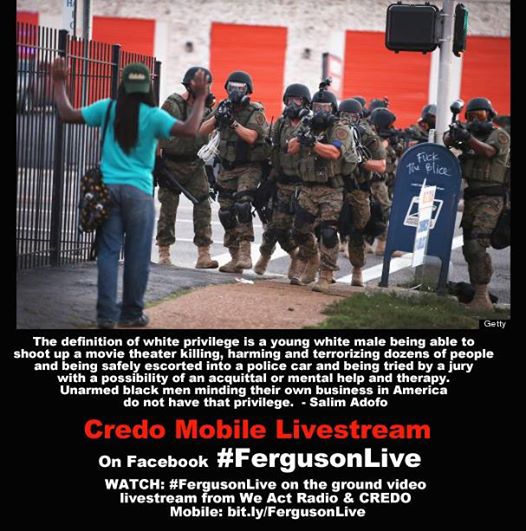 “Every 28 hours across America a black person is killed by security guard, police officer or some other executive of the state,” Georgetown University professor Michael Eric Dyson said on the recent “Face the Nation,” adding that President Obama needs to use his “unique position” to explain the rage emanating from Ferguson, MO:
[Obama needs to explain] to white people whose white privilege in one sense obscures from them what it means that their children can walk home every day and be safe. They’re not fearful of the fact that somebody will kill their child who goes to get some ice tea and some candy from a store.”
— Michael Eric Dyson on August 17 Face the NationThe Torah portion known as “Eikev [heel]” calls us to consider whether we might be, however inadvertently, tugging on the heel of a brother. And Mishkan T’filah‘s adaptation of words taken from this portion demands that we avoid making “gods of own comfort or power.”
Meanwhile, the Torah portion known as “Eikev [heel]” calls us to consider whether we might be, however inadvertently, tugging on the heel of a brother. And Mishkan T’filah‘s adaptation of words taken from this portion demands that we avoid making “gods of own comfort or power.”
If we turn from Sinai
The portion Eikev (Deuteronomy 7:12 – 11:25) includes verses that make up the second full paragraph of the Shema. These words, Deuteronomy 11:13-21, are included within tefillin as well. This passage, therefore, appears several times in many prayerbooks. But it’s far less prominent in, or missing entirely from, some liberal prayerbooks.It’s easy to see why a passage that speaks of reward and punishment as a direct result of the People’s actions was omitted or diminished in Reform Prayerbooks. (See, e.g., Richard Sarason on the Three Paragraphs of the Shema.) But Mishkan T’filah (URJ, 2007) includes, as an alternative reading, a thematic paraphrase of the Shema’s second paragraph.
The reading — by Richard Levy, a member of the editorial committee for the prayerbook and an author of many contemporary liturgical pieces — can be found on page two of these Mishkan T’filah sample pages:
…
But if we turn from Sinai’s words
and serve only what is common and profane,
making gods of our own comfort or power,
then the holiness of life will contract for us;
our world will grow inhospitable.Let us therefore lace these words
into our passion and our intellect,
and bind them as a sign upon our hands and eyes….
— from Mishkan T’filah, p.67 and p.235
Levy’s is one of a number of approaches to this paragraph that take what theologian Judith Plaskow calls “a more naturalistic” view, focusing on the need to avoid thinking that “we can trample on or transcend the constraints of nature.”
The passage also seems to capture what another theologian, Elliott Dorff, calls the insistence that God is ultimately just. He points out that the ancient Rabbis had trouble with the way reward and punishment are described in this portion. Still, he says, they included this passage as a central part of the prayers because of their “deep faith in the ultimate justice of God as the metaphysical backdrop and support for human acts of justice.”
(Both Dorff and Plaskow quotes are from Jewish Lights’ My Jewish Prayerbook, vol 1: The Shema and its Blessings)
I see this idea reflected in the passage which is recited when laying tefillin on the hand (wrapping around the finger three times):
- I will betroth you to me forever;
- I will betroth you to me through justice and rule of law, kindness and compassion;
- I will betroth you to me in trust, and you will know that I am God
— Hosea 2:21-22
 "A Song Every Day"