Toward Harvest, part 2 (Beyond 42)

With the close of this Shabbat, we leave the week of Yesod [“foundation,” power/(pro-)creativity] in this Omer journey away from oppression. We now move into Malkhut [“sovereignty”], the final week in our journey toward Shavuot, celebration of harvest and Revelation.

Leaving Day 42 might also call to mind that ultimately, there are 42 stages in the wilderness journey (see Numbers 33), corresponding to a 42-letter of God. It will also remind some of the answer to “life, the universe, and everything” (…if only we knew the right question).

A Psalm for All the Peoples of the Planet
God, bless us with grace!
Let Your loving Face shine on us!
We want to get to know Your way
here on Earth,
Seeing how Your help is given
to every group of people.
….
Oh, how the various peoples will thank You
All of them will sing, be grateful.

The Earth will give her harvest.
Such blessings come from God, yes from our
God!
— from the Holistic Haggadah, Michael Kagan

We counted 42 on the evening of May 15. Tonight, we count….

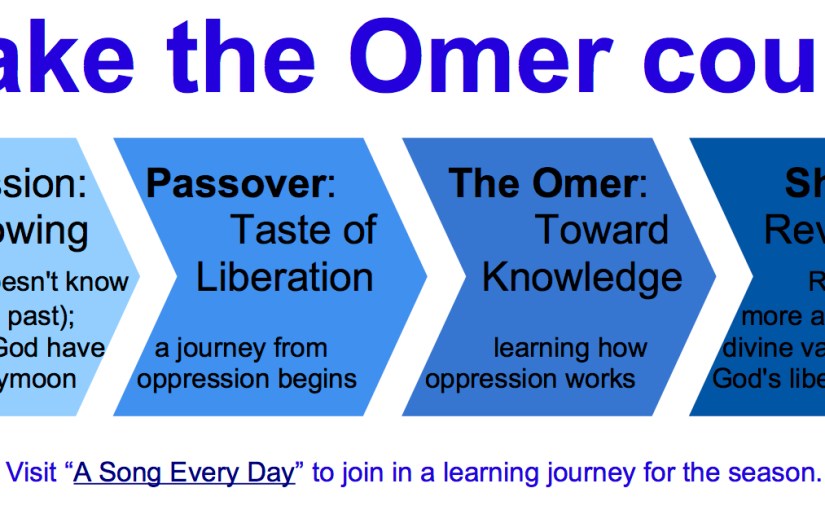
Making the Omer Count

from On the Road to Knowing: A Journey Away from Oppression
A key element in the journey from liberation to revelation is understanding the workings of oppression, and our part in them. We cannot work effectively to end what we do not comprehend.

So this year, moving from Passover to Shavuot, I commit to learning more about how oppression works and how liberation is accomplished. I invite others to join me:

Let’s work together, as we count the Omer, to make this Omer count.

Thoughts and sources welcome.

JourneyOmer

Share this graphic to encourage others to participate.

A Meditation

Aware that we are on a journey toward knowing God — from liberation to revelation — I undertake to know more today than I did yesterday about the workings of oppression.

I bless and count [full Hebrew blessings in feminine and masculine address]:

Blessed are You, God, Ruler/Spirit of the Universe, who has sanctified us with Your commandments and commanded us to count the Omer.

Today is forty-three days which are six weeks and one day in the Omer.
Hayom shloshah v-arba’im yom shehaym shishah shavuot veyom echad la-omer.

In the spirit of the Exodus, I pray for the release of all whose bodies and spirits remain captive, and pledge my own hands to help effect that liberation.

Toward Harvest, part 1 (Beyond 41)

Originally posted during the Omer 2015. References to the exact date of the count have been removed or placed in {{}} to avoid confusion. Also note that Behar, the Torah portion including Jubilee instructions, is read on its own in leap years (like 2019).

The Jewish calendar places us in several different moments simultaneously. We are just over a week away from Shavuot, our re-experiencing of Sinai; but we are also Behar [at the mountain] already, as we close out the reading of Leviticus in the annual Torah cycle (Behar, Lev 25:1-26:2, & Bechukotai, Lev 26:3-27:34). We have counted {{number of}} weeks already, and we have ALSO counted {{number of}} days so far — We are commanded (Lev 23:15-16) to count both 50 days and “seven complete weeks.”

We are also, as Rabbi Joel Mosbacher notes in his commentary on this week’s Torah reading, at a precarious moment in history, as well as in the agricultural cycle:

And since these holidays are also connected with the agricultural cycle, the counting of the omer is a time of trepidation—these days of spring will determine whether we have an abundant harvest or not. Will the hard work of planting and tending come to fruition, or will it be wiped away by drought or pests? It is a time of both fear and anticipation….

As we count the years since the great [Civil Rights] movement [of the 1960s] in our own nation, we also wonder if the planting that was done in the civil rights era will come to fruition, if we will reap the harvest of our predecessors’ hard work. Americans are being crushed once again, with violence and economic and racial inequality. We have not yet achieved the magical, transcendent moment of Sinai.
— see “Free At Last?” from T’ruah: the Rabbinic Call for Human Rights
See also “Jubilee (Beyond 37)

One theme of this omer journey toward Revelation has been working to ensure that we widen our perspectives so that we can absorb more this year at Sinai than we might have in the past. In yet another aspect to the Jewish calendar, we are coming up on Shabbat, a time to set aside worries, take a “breath,” and celebrate being. And, in the spirit of all of the above, I offer links to “Ackee and Saltfish.”

 from film,
from film, “Ackee and Saltfish”, well worth the £3 ($4.53 US). Watch it now.

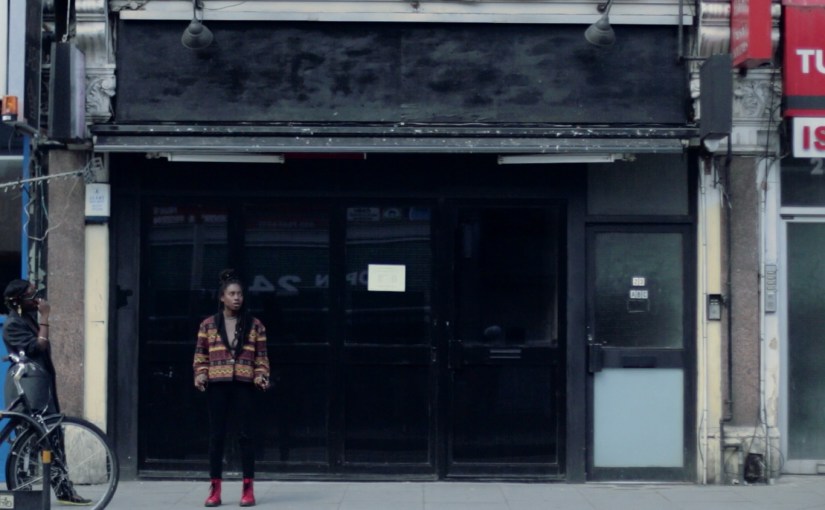
Ackee and Saltfish is a short film and webseries that both celebrate precious, ordinary moments between friends and offer an entertaining commentary on issues of diversity and cultural appropriation.

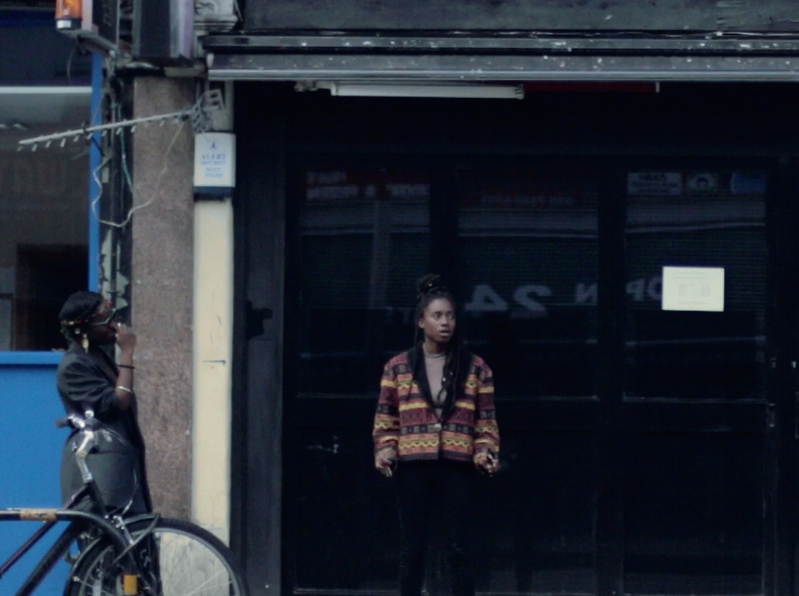
While set in England, the series’ themes are familiar to U.S. viewers. This picture of dismay, as the friends find Olivia’s favorite Jamaican take-out lost to gentrification, might easily be set on Martin Luther King Avenue in DC’s Ward 8 and in other locales across the U.S., as well as in London. Justin Simien, director of Dear White People — a full-length film you should also (re-)see sometime — says on a recent episode of Exhale on Aspire that part of his work is to “debunk the belief that people of color can’t be the everyman.” Cecile Emeke, creator of “Ackee and Saltfish,” brilliantly participates in this work as well.

The first five web episodes, all short and entertaining, are available free of charge (though support is welcomed); the short film is available for small donation ($4.53 or £3).

Making the Omer Count

from On the Road to Knowing: A Journey Away from Oppression
A key element in the journey from liberation to revelation is understanding the workings of oppression, and our part in them. We cannot work effectively to end what we do not comprehend.

So this year, moving from Passover to Shavuot, I commit to learning more about how oppression works and how liberation is accomplished. I invite others to join me.

Wanting Memories to Teach Me (Beyond 40)

Contemplating how near we are to Sinai and how much we have yet to learn, Sweet Honey in the Rock’s “Wanting Memories” came to mind.

I am sitting here wanting memories to teach me
to see the beauty in the world
Through my own eyes

I know that I am you and you are me and we are one
I know that who I am is numbered in each grain of sand
I know that I’ve been blessed
Again
and over again

I am sitting here wanting memories to teach me
To see the beauty in the world
Through my own eyes
I am sitting here wanting memories to teach me
To see the beauty in the world
Through my own eyes

We counted 40 on the evening of May 13. Tonight, we count….

Making the Omer Count

from On the Road to Knowing: A Journey Away from Oppression
A key element in the journey from liberation to revelation is understanding the workings of oppression, and our part in them. We cannot work effectively to end what we do not comprehend.

So this year, moving from Passover to Shavuot, I commit to learning more about how oppression works and how liberation is accomplished. I invite others to join me:

Let’s work together, as we count the Omer, to make this Omer count.

Thoughts and sources welcome.

JourneyOmer

Share this graphic to encourage others to participate.

A Meditation

Aware that we are on a journey toward knowing God — from liberation to revelation — I undertake to know more today than I did yesterday about the workings of oppression.

I bless and count [full Hebrew blessings in feminine and masculine address]:

Blessed are You, God, Ruler/Spirit of the Universe, who has sanctified us with Your commandments and commanded us to count the Omer.

Today is forty one days which are five weeks and six days in the Omer.
Hayom echad v-arba’im yom shehaym chamishah shavuot veshishah yamim la-omer.

In the spirit of the Exodus, I pray for the release of all whose bodies and spirits remain captive, and pledge my own hands to help effect that liberation.

Moral State of Emergency (Beyond 34)

“God has declared a state of moral emergency,” writes Rabbi David Kasher in his commentary on this week’s Torah portion.

Kasher points out that a command to care for the poor suddenly appears in the midst of a portion otherwise dedicated to ritual matters stressing holiday observances, and comments:

Mind you, everybody agrees that charity is good and just. Everybody recognizes that feeding the hungry is a wonderfully noble thing to do. But, they think, nobody can be forced to do it. And so, in time, nobody does it. People speak of poverty with eloquence and compassion, but nobody actually gives to the poor.

It is a situation reminiscent of words written by another great 20th-century rabbi, Abraham Joshua Heschel, in a telegram he sent to President Kennedy, in the midst of the civil rights movement of the 1960s:

I look forward to privilege of being present at meeting tomorrow at 4pm. Likelihood exists that Negro problem will be like the weather. Everybody talks about it but nobody does anything about it. Please demand of religious leaders personal involvement not just solemn declaration. We forfeit the right to worship God as long as we continue to humiliate Negroes. Church synagogues have failed. They must repent. Ask of religious leaders to call for national repentance and personal sacrifice. Let religious leaders donate one month’s salary toward fund for Negro housing and education. I propose that you Mr. President declare a state of moral emergency.

Everybody talks about it, but nobody does anything about it. Racism, like poverty, is one of those social ills we can condemn with our reason, but leave completely unattended by our laws. We build up a great society, so orderly and so civilized… but the most vulnerable are left to fend for themselves.

This is what the Meshech Chochmah was worried about when he warned of the savage beast that we could too easily become. That is why he believed that we needed God to help us turn charity from an option into an obligation. Heschel, too, saw religious faith as a force for compelling social action, and the worship of God as all bound up in the preservation of human dignity.
— R. David Kasher, “State of Grace”
Read the whole commentary at ParshaNUT

And we might also call to mind the way Algren closes the 1961 addendum to Chicago: City on the Make (discussed yesterday and “beyond 23”):

For the [1951] essay made the assumption that, in times when the levers of power are held by those who have lost the will to act honestly, it is those who have been excluded from privileges of our society, and left only its horrors, who forge new levers by which to return honesty to us. The present revolution of a new generation of Negro men and women, now forcing the return of the American promise of dignity for all, sustains the assumption.
— Nelson Algren, Chicago: City on the Make, p.105

Thanks to Rabbi Alana Suskin for sharing the link above.

We counted 34 on the evening of May 7. Tonight, we count….
Continue reading Moral State of Emergency (Beyond 34)

In Touch with the Source (Beyond 10)

Three days into the wilderness journey, the promise of freedom seems to fade —

וְלֹא יָכְלוּ לִשְׁתֹּת מַיִם מִמָּרָה
כִּי מָרִים הֵם
they could not drink of the waters of Marah,
for they were bitter [the waters? or the People?]
Exodus 15:23

Despite their recent experiences of leaving bondage and the miraculous, sea-splitting escape from Pharaoh’s army, the Israelites encounter bitterness and are unable to drink.

“Water,” according to Jewish tradition, is linked symbolically with “Torah.” The Israelites’ real problem, therefore, is interpreted as “growing weary” because they “went for three days without Torah.”

The ancient teachers used this story as an explanation for the public Torah reading schedule: Saturdays, Mondays, and Thursdays. In this way, the People “will never go on for three consecutive days without hearing Torah.” In addition, the minimum number of verses for a reading was set at ten, corresponding to the number of people needed to constitute a minyan [public prayer quorum]. (Babylonian Talmud: Baba Kama 82a)

At heart, the message seems to be that we must never drift too long without returning to the Source, however we understand that, and that community is essential in this process.

Nina Simone’s song, “(I Wish I Knew How It Would Feel To Be) Free,” helps me with this “return,” in general, and suggests several lessons for this particular omer journey. There are several wonderful versions, each with its own lessons.

(1) Warning: Most Basic Torah

In her “Live in Montreux 1976” version, Simone pounds out a warning, adding a line not in the usual lyrics:

I wish you could know what it means to be me
If you could see, you’d agree
everybody should be free
’cause if we ain’t we’re murderous
— Live at Montreux 1976, this quote at 2:45ff
(link to clip or whole concert)

The demands here — “see me” and “everybody should be free” — are a call to return to the Source, to the most basic Torah: “I am YHVH thy God, who brought thee out of the land of Egypt, out of the house of bondage.” (Exodus 20:2)

(2) I’d Sing What I Know

This 1968 version, live in Paris —

— stresses “I’d sing what I know.”

This call to learn from — and to share — the direct experiences of people who have suffered oppression is especially apt for this year’s attempt to “Make the Omer Count,” exploring the workings of oppression, and our part in them, with an aim to more effectively move toward liberation for all.

Moreover, Simone urges listeners to participate in a way that echoes for me the rabbis’ embedding of the communal number ten in the Torah reading (above): The artist wants to hear others singing “what I know,” and doesn’t give up when they don’t immediately sing out. At one point she asks band members, “Should I leave ’em alone?” — to which they answer an amused “no!” without missing a beat of their choral response. Still not hearing from enough others, Simone leaves the piano and adds additional verbal and visual cues to facilitate participation.

Finally, I am moved by her addition toward the close of “I’d be a little bit more me.” To me that about sums it up: the journey from Passover to Shavuot is one that is meant to help us each become “a little bit more me,” in our liberation, while striving for a community that honors the need for everyone else to be their own best selves.

SimoneFree

(3) An Anthem Toward…

Several years ago, Elaine Reuben suggested this song as “an appropriate anthem as we count our way toward…” to Fabrangen Havurah‘s Omer Blog). And yes, that’s “toward…” with destination unexpressed, not “forward,” regardless of spellcheck preferences.

The 1967 version, used in the posthumous compilation “The Very Best of Nina Simone” and linked in Fabrangen’s 2010 blog above, is shared without video of the artist. A straight-forward studio version, this rendition serves especially well as “an anthem” in which each of us can join.

This version and Elaine’s “as we count our way toward…” seem apt for this omer journey, with its unknown destination. Of course, we expect to reach 49 and then the holiday of Shavuot. But, our learning about oppression and its workings will be informing where we end up ultimately.

NOTE: In 2013, the Simone estate uploaded an amazing array of resources, including the clip in #2 above, the full concert linked in #1 above, interviews, and more. For more on Nina Simone, visit the website maintained by her estate.

Continue reading In Touch with the Source (Beyond 10)

The Facts of Jewish Diversity (Beyond 2)

Continuing the theme of “not knowing” as a form of callous, insensitive “moral deficiency,” one we seek to leave behind this Passover season, let’s explore some facts about diversity in the Jewish community.

Upwards of 435,000 Jews — possibly as many as 400,000 in the New York City area alone — identify (also) as African American, Asian, Latino/Hispanic, Native American, or mixed-race, for a total of about 435,000 individuals. (See Be’chol Lashon; Bnai Brith).

And yet, the assumption in too many of our communities remains — even if many of us believe, or would like to believe, otherwise — that Jews mostly look like a Central Casting crew of Eastern European Ashkenazim. Most of us believe our communities are inclusive and welcoming, but the experience of many Jews belies this.

Central Casting Sent the Wrong Type

Jews of lighter hues, such as those of Scandinavian or Celtic background, are regularly assumed to be “other,” addressed as visitors or called out as converts, an attitude that is specifically forbidden in the Talmud: “Do not wrong a proselyte by taunting him with being a stranger to the Jewish people seeing that ye yourselves were strangers in Egypt.” (Baba Metzia 59b)

Jews of color across the country continue to tell stories that shame every Jew:

“Many people who are Jews of color have very painful stories to tell about having not been accepted in their congregations and having the veracity of their Jewishness questioned,” says Rabbi Appell, of the URJ. “Some tell of being shown the kitchen because someone assumed that they worked there.”
— from “Jews of Color,” March 2015

A few years ago, women from Washington, DC found a photo of their Rosh Chodesh service plastered in national media with a caption reading: “A non-Jewish woman is among those at a Torah reading at Adas Israel Congregation.” (See Who is a Jew and How Would the Forward Recognize Her?“) JTA and the Forward pulled the photo after widespread complaint without ever apologizing or explaining whom they assumed was a non-Jew. But it seems that at least several pairs of editorial eyes thought it more likely that a non-Jew was wearing a kippa and tallit [ritual garb] and actively participating in the Torah service at a Conservative synagogue [something the movement does not sanction] than that a Jew might vary from the assumed “look of a Jew.”

At Jews United for Justice‘s recent community seder, Michael Twitty of Afroculinaria spoke of fellow Jews demanding to be told how he came to be there, assuming he would want to share the particulars of his spiritual journey with complete strangers. His story surprised many who assume the relative diversity in the DC area would preclude such behavior, but such stories are common to Jews of color.

Jews Have Work to Do

We have much work to do, to make even our more diversity-assuming Jewish communities welcoming to all.

Rabbi Fred Scherlinder Dobb of Adat Shalom, a Reconstructionist synagogue in suburban Bethesda, Md., who is also the father of two adopted African-American sons, is emphatic that this mindset must change: “We must create the norm where we assume that people belong, and never inadvertently ostracize someone whom you may think ‘doesn’t look Jewish.’ Anyone looks Jewish, potentially.”
–from “Jews of Color” (linked above)

And one step in that work is ensuring that our Jewish organizations, congregations, and schools acknowledge the experiences of all parts of the community:

Jews of color are diverse, multihued and proud of it — proud of our Jewishness and proud of our Blackness. But though our lives are joyous and full, racism forces us down a narrow treacherous path. On the one hand we experience the same oppression that afflicts all people of color in America — racism targets us, our family members, and our friends. On the other hand, the very community that we would turn to for belonging and solidarity — our Jewish community doesn’t acknowledge our experience.
— from JFREJ‘s #BlackLivesMatter Haggadah Supplement

jfrej_blm_croppedBe’chol Lashon offers Diversity Training and Community Conversations through its Race Project. Jews for Racial and Economic Justice and several other organizations offer pertinent learning opportunities. How many of our communities are in need of such organized work?

One way to make this Omer count is to begin necessary conversations to ensure that all experiences within our Jewish communities are acknowledged and honored.

We counted two on the evening of April 5.
Continue reading The Facts of Jewish Diversity (Beyond 2)

On the Road to Knowing: A Journey Away from Oppression

The Passover journey is launched in “not knowing” — as when a new Pharaoh arises who does not know Joseph (אֲשֶׁר לֹא-יָדַע, אֶת-יוֹסֵף, Exodus 1:8) or God (לֹא יָדַעְתִּי אֶת-יְהוָה, Exodus 5:2) — and it aims for “knowing”:

…You shall know that I am YHVH, your God…
וִידַעְתֶּם, כִּי אֲנִי יְהוָה אֱלֹהֵיכֶם (Exodus 6:7).

The Exodus experiences and our travels in the wilderness are meant to increase our knowledge of the divine so that we can better serve God. (See Silber “Rereading the Plagues”).

A key element in the journey from liberation to revelation is understanding the workings of oppression, and our part in them. We cannot work effectively to end what we do not comprehend.

So this year, moving from Passover to Shavuot, I commit to learning more about how oppression works and how liberation is accomplished. I invite others to join me:

Let’s work together, as we count the Omer, to make this Omer count.
Thoughts and sources welcome.

JourneyOmer

Share this graphic to encourage others to participate.

Continue reading On the Road to Knowing: A Journey Away from Oppression

Getting Exodus Right: Watch the Women and Learn (or: Family Travail Becomes Community Action)


A coffin in Egypt closes the Book of Genesis (Genesis 50:26), and the Exodus story is launched with a basket on the Nile (Exodus 2:3). Joseph’s death, which closely follows that of his father, Jacob (Gen 49:33), brings to an end the patriarchal stories. With Exodus, the focus shifts to the Israelite story, beginning with midwives Shifrah and Puah, Yocheved (Moses’ mother), Miriam (Moses’ sister), and Pharaoh’s daughter. Our focus is thus shifted, as one book ends and the next begins, from death to birth and from stories of individual and family struggle to a communal struggle toward liberation. So, too, in the United States today, we are moving:

  • from individual circles of mourning for black persons killed by police to a national movement against police brutality across the country, and
  • from disjoint demands addressing various forms of racial inequity to a collective struggle for racial justice.

In addition, men dominate at the close of Genesis, while Exodus opens with women in the lead; similarly, women have been primary leaders in the #BlackLivesMatter movement.

The Exodus story looks, on the face of it, like a violent and permanent parting of oppressed and oppressor peoples. But there are elements — particularly evident in watching what the women do at the beginning of the Exodus story — of the tale that can help us learn respectful coexistence.

Change of Mindset

Failure to dehumanize: The Egyptian midwives model for us at Exodus 1:15-22, using Pharaoh’s racist assumptions about the baby-popping Hebrew women to protect the Israelite community. (more on this)

Vision: Moses’ mother shows immense faith in her Egyptian neighbors, assuming that someone will rescue the child. And at least one Egyptian does rescue a child. Both women, thereby, refuse to dehumanize the other. (more on vision)

Passover is still months away (April 3-April 11, 2015). But Jews and Christians, along with others to whom the Exodus story speaks, can begin now to explore how we can use this ancient tale to change today’s realities, in our own communities and beyond. A few more “Passover Lessons” —

  • Crossers-Over
  • “From Privilege, Activism
  • Maybe We’re All Riff Raff
  • Rabbis, Rome and Slaves
  • “School for Freedom”

— from a 2012 crowd-sourcing.

What else can we learn?
Let’s start now to figure it out!
And let’s NOT WAIT to begin learning and acting
Continue reading Getting Exodus Right: Watch the Women and Learn (or: Family Travail Becomes Community Action)

Kindling Hope with the Fourth Candle

How is Chanukah kindling hope for you and others this season?

In memory of Rekia Boyd, killed at age 22, another victim of (off-duty) police violence from my first hometown, I am kindling hope with ChanukahAction by supporting Ferguson Action Demand #2: contacting the USDOJ to demand a comprehensive review of systemic abuses by local police departments, including publication of data relating to racially biased policing, and the development of best practices.”

It was Rekia Boyd whom I chose to memorialize at the the 4-1/2-hour die-in in front of the USDOJ on December 8, organized to promote human rights for black and brown people in the U.S. While I never knew her, she is forever in my heart (and inspired this prayer).

May every act of remembrance — candle-lighting, mourners’ kaddish, memorial prayer — bind the victims of racial bias more tightly into our national consciousness
and collective commitment to change.

Here is the fourth candle Chanukah Action:

Options for taking action:
Option 1: Share the following message on social media (Facebook, Twitter, etc.): “I support Ferguson Action’s call for a Comprehensive Review of systemic abuses by local police departments, including the publication of data relating to racially biased policing, and the development of best practices. http://www.fergusonaction.com/demands”

Option 2: The Department of Justice has been identified as a primary target in the fight to end racialized police violence. This Chanukah, contact the Department of Justice and voice your support for change. Here is a sample script you can use:

“Hello, my name is _______. I am calling to urge the Department of Justice to: Conduct a comprehensive review of systemic abuses by local police departments Publish data related to racially biased policing Develop best practices for racially just law enforcement. Repurpose funds to support community-based alternatives to incarceration.”

You may contact the Department of Justice at: 202-353-1555 or by email at AskDOJ@usdoj.gov.

Here is the full Action Toolkit (PDF).

I am taking this action in advance of tonight’s 4th candle in order to enjoy Shabbat when it comes in this evening, right after Chanukah candle-lighting, and to allow for my participation in the local #BlackYouthMatter #SouthEastMatters action just across the river from my DC home.
BlackYouth

May the light of our candles and actions help bring about a new way of seeing, in our own lives and in the country.

Chanukah Rededicates Jews to the Fight

Samuel L. Jackson’s challenge, Chanukah-style.

[Everybody knows that I can’t sing, but]
I can hear my neighbor calling I can’t breathe
Now I’m in the struggle and I can’t leave
Calling out the violence that racism breeds
We ain’t gonna stop til people are free
Chanukah rededicates Jews to the fight
So I’m lighting one candle to increase the light

Hoping someone more tuneful will take up the chant!

Chag sameach [joyful festival] to all

Visit http://www.ChanukahAction.org for resources

BTW, here’s the challenge: