The House and First Fruits

The Mishnah reports that Psalm 30, or at least its opening verse, was recited by the Levites when worshippers brought First Fruits:

THE FLUTE WAS PLAYING BEFORE THEM TILL THEY REACHED THE TEMPLE MOUNT; AND WHEN THEY REACHED THE TEMPLE MOUNT EVEN KING AGRIPPA WOULD TAKE THE BASKET AND PLACE IT ON HIS SHOULDER AND WALK AS FAR AS THE TEMPLE COURT. AT THE APPROACH TO THE COURT, THE LEVITES WOULD SING THE SONG: ‘I WILL EXTOL THEE, O LORD, FOR THOU HAST RAISED ME UP, AND HAST NOT SUFFERED MINE ENEMIES TO REJOICE OVER ME’.
— Bikkurim 3:4
[not meant as shouting: all caps printers’ custom distinguishes Mishnah from Gemara]

The First Fruits ceremony also included the recitation beginning “My father was a wandering Aramean” (Deut 26:5-10) now included in the Passover Haggadah (Bikkurim 3:6). This passage recalls years of affliction and oppression before getting to “Now I bring the first fruits of the soil which You, God, have given me.” Together with Psalm 30, these verses convey the theme that all wealth, success, and well-being come from God.

Together, the “Wandering Aramean” passage and Psalm 30 warn against the kind of complacency described in Ps 30:7: “When I was well, I said, ‘Never will I falter.'” They also convey the theme that struggle, too, is part of relationship with God.

Struggle and God

Sometimes, as in the Pesach recitation, we relate what sounds like a positive conclusion to troubles that were part of a divine plan. And, in the context of First Fruits, Psalm 30 also rings a note of ultimate triumph and praise, concluding with “I will praise You forever.”

In the language of Psalm 30, however, we see at least three models of suffering and response: First, God assists before any call; next, suffering and joy are entwined in a regular cycle; finally, the psalmist calls out and God responds:

  1. I extol You, GOD,
    for you have lifted me up,
    and not let my enemies rejoice over me. (30:1)
  2. …One may lie down weeping at nightfall;
    but at dawn there are shouts of joy. (30:5)
  3. …When You hid Your face, I was terrified.
    I called to You, GOD; to My Lord I made appeal….
    You turned my lament into dancing…(30:8-12)

In the third example, “You hid Your face” is sometimes understood as intentional on God’s part and sometimes opaque, best:

God’s presence is very reassuring, while God’s absence creates panic. The psalmist shares the biblical idea that God sometimes “hides His face” from us….This hiding of God’s face may result from human misbehavior, but equally, God sometimes hides His face for no clear reason at all and needs to be “called back.”
My People’s Prayer Book, p.195 (full citation)

In the context of the morning liturgy, any triumph over anxiety and suffering seems very fragile. We’ll be back at this spot tomorrow morning — not unlike Bill Murray repeating Groundhog Day (Harold Ramis, 1993). And, in the end, this is not all that different from the recitation at First Fruits and Pesach, with its seemingly triumphant conclusion. After all, a good harvest is never guaranteed, and at least some portion of the Jewish people will likely be at a seder table again next year.

fruits market
Photo by Tookapic on Pexels.com

8 of Thirty on Psalm 30

As a National Novel Writing Month Rebel, I write each day of November while not aiming to produce a novel. This year I focus on Psalm 30 (“Thirty on Psalm 30”) in the hope that its powerful language will help us through these days of turmoil and toward something new, stronger and more joyful, as individuals and as community. Whole series (so far)….apologies for days with multiple posts, as the blog catches up with my notes.


My People’s Prayer Book: Traditional Prayers, Modern Commentaries
Vol. 5 — Birkhot Hashachar (Morning Blessings)
Lawrence A. Hoffman, ed. Woodstock, VT: Jewish Lights, 2001. p.195
Comment is from the “Bible” thread provided by Marc Brettler
Marc Zvi Brettler is Dora Golding Professor of Biblical Literature at Brandeis University.
BACK

The House: Soul’s Abode

Ambiguities and outright confusions abound in teaching about Psalm 30. It begins with argument about possible meanings of its superscription — “A Psalm; a Song at the Dedication of the House; of David” — and how this relates to subsequent content. This blog has already touch on some ideas about which “house” is meant and what David’s relationship to that house might be. According to one interpretation, the “house” is the body in which the real David (his soul) resides.

Soul’s Material Home

The 19th Century teacher, Rabbi Meir Wisser (1809-1879), wrote:

A song for the dedication of the house. The entire psalm was crafted to give thanks for his recovery from illness, and there is no connection in it to dedicating a house. It can be explained that the house in question here is a metaphor for the body, which is the residence of the soul and the inner home for the person who dwells within it, because the soul is the real person, while the physical body is only a material home for it to dwell in….
Malbim, 30:1

This commentary appears to be independent of, and at least a century later than, the mystical thread of teaching sometimes referenced to explain how Psalm 30 entered the early morning prayers. Siddur Lev Shalem, for example, notes that the psalm was added to the early morning prayers “in the 17th century under the influence of Lurianic mysticism,” adding:

The mystics who added this psalm to the liturgy thought that it alluded to the human resurrection of the body (that is, the house of the soul) in the morning, and to our entering the fully revealed divine house (that is, a new day).
Siddur Lev Shalem (Rabbinical Assembly, 2016)

In this Lurianic teaching, the emphasis does not appear to be on recovery from illness, as in the Malbim’s interpretation. Instead the focus seems to be on the everyday miracle of awakening from sleep — no small thing, considering that the Talmud calls sleep “one-sixtieth part of death” (B. Ber 57b).

From their separate perspectives, both teachings stress the idea that “the house” in Psalm 30 can be understood as the human body, home for the soul.


7 of Thirty on Psalm 30
As a National Novel Writing Month Rebel, I write each day of November while not aiming to produce a novel. This year I focus on Psalm 30 (“Thirty on Psalm 30”) in the hope that its powerful language will help us through these days of turmoil and toward something new, stronger and more joyful, as individuals and as community. Whole series (so far)…

…For anyone wondering: I am writing each day in November but not necessarily posting every day. Sorry if this is confusing anyone and hope days with multiple posts, as the blog catches up with my notes, are not too annoying.

Notes

Rabbi Meir Leibush ben Yehiel Michel Wisser (sometimes: Weiser), known as “Malbim” (from his initials), 1809-1879.
The commentary is available in Hebrew on Sefaria, with some English translations. As it happens, the commentary for 30:1 is translated.
BACK


Siddur Lev Shalem doesn’t offer any citation for the Lurianic teaching. I’ve seen a reference in this same context to Pri Etz Chaim, Gate of Song 4, the commentary by Rabbi Yitzchak Luria (HaAri, 1534-1572), as rendered by his student, Rabbi Chaim Vital (1543-1620). Pri Etz Chaim can be found on Sefaria in Hebrew only.
BACK

The House: Bricks and Mortar?

Psalm 30 begins with the superscription: “Dedication of the House” —

מִזְמוֹר: שִׁיר-חֲנֻכַּת הַבַּיִת לְדָוִד.
mizmor: shir-chanukat ha-bayit l’David
A Psalm; a Song at the Dedication of the House; of David.


Which House?

Some bricks and mortar possibilities, per The Jerusalem Commentary:

  • First Temple: “The commentators disagree about which dedication and which “house” the psalm is referring to. Some say that it refers to the dedication of the First Temple, and that David himself composed the psalm, and instructed his son Solomon to recite it when the Temple was dedicated.”*
  • Second Temple: “Some commentators suggest that the dedication means that this psalm was recited by the Levites at the dedication of the Second Temple. See Ezra 6:16-18 and 3:10, though in the latter context we are dealing with the laying of the Temple’s foundations and not its dedication. See also Nehemiah 12:27, though there we are dealing with the dedication of the city wall.”**
  • David’s House: “Others suggested that the “house” mentioned here is not the Temple, but rather David’s house, mention in II Samuel 5:11 and 7:1-2.”*
  • Private Home: “Other commentators maintain that the house mentioned here refers to privately owned houses, for there was an ancient custom to celebrate the dedication of a new house (see Deuteronomy 20:5).”**

The Jerusalem Commentary, full citation
*p. 228, **note 14, p.228

Some argue, as noted above, that David wrote the psalm and then instructed Solomon to recite it. We’ve already touched on additional commentary reconciling “Of David” with “the House” as the First Temple. Other teachers take different approaches to its physical and temporal location largely in support of commentary on its emotional content.

And When?

The Mishnah, Bikkurim, reports that Psalm 30 was recited in connection with First Fruits. Other text links the psalm to Chanukah, and it is psalm of the day during that holiday. For several hundred years, Psalm 30 has also been recited first thing in the morning, leading to other associations and interpretations of “house.” More on these ideas to come.

6 of Thirty on Psalm 30
As a National Novel Writing Month Rebel, I write each day of November while not aiming to produce a novel. This year I focus on Psalm 30 (“Thirty on Psalm 30”) in the hope that its powerful language will help us through these days of turmoil and toward something new, stronger and more joyful, as individuals and as community. Whole series (so far)…

…For anyone wondering: I am writing each day in November but not necessarily posting every day. Sorry if this is confusing anyone and hope days with multiple posts, as the blog catches up with my notes, are not too annoying.


Note

The Jerusalem Commentary, The Psalms: 1-57
Jerusalem: Mosad Harav Kook, 2003.
BACK

The Whole Nine Yards?

Following yesterday’s post about the hiddenness of God, alluded to in Psalm 30:8, here is a comment about prevalence of God’s name in the psalm:

Psalm 30 was added to the liturgy in the 17th century under the influence of Lurianic mysticism. It mentions the name of God ten times, and Jewish mystics saw in this a hint of the s’firot, the ten aspects of the Godhead.
Siddur Lev Shalem (Rabbinical Assembly, 2016)

By my count, there are nine uses of the Name, YHVH, in Psalm 30 plus one “My Master” or “My Lord.” In Hebrew the common substitute for the four-letter Name of God [יְהוָה] (often written: ADONAI) and the expression “My Lord” [אֲדֹנָי] (Adonai) are homophones. Thus, e.g., this translation (1985 Jewish Publication Society) uses LORD and Lord:

אֵלֶ֣יךָ יְהוָ֣ה אֶקְרָ֑א וְאֶל־אֲ֝דֹנָ֗י אֶתְחַנָּֽן׃
I called to You, O LORD [יְהוָה]; to my Lord [אֲדֹנָי] I made appeal
— Psalm 30:9

The use of “Adonai” is aurally indistinguishable from the nine uses of “ADONAI.” Perhaps that’s what the Lurianic mystics — or Siddur Lev Shalem — see in Psalm 30. Or maybe the tenth is hidden. But I suspect I’m missing something…or maybe we all are and that’s just fine.

The Whole Nine Names

According to Snopes, the American-English expression, “the whole nine yards,” means that “every conceivable (and quite possibly inconceivable) length has been gone to in pursuit of a specific aim….nothing was missed or skipped over.”

According to Siddur Lev Shalem, ten mentions of God’s name suggest the ten s’firot or aspects of the Godhead. One sefira, Keter [Crown], represents the unknowable aspect of God, though. So maybe reciting Psalm 30 is in some sense going the whole nine yards with nine uses of the Name.

This reminded me a teaching about Psalm 150. Depending on how one reads, the psalm includes nine “instruments” for praising God:

  • horn;
  • harp and lyre;
  • timbrel and dance;
  • lute and pipe;
  • cymbals and clanging-cymbals

In order to make ten, a minyan of praise in its way, we include our voices or our souls to reach the whole nine yards.

MozambiqueAK47
image found years ago on Facebook. No photographer or subject info, except that it comes from Mozambique


Not Yet Awakened

One of the important aspects of starting the morning by reciting Psalm 30, as an individual, is the opportunity to ride its emotional roller coaster and figure out which highs or lows reflect where we are as the day begins. When we recite as a congregation, the psalm gives us a chance to recognize that we are all experiencing different sets of highs and lows in our own lives and in our responses to whatever is befalling the community as a whole, and helps us bring all of that awareness into our communal prayers.

So, perhaps, Psalm 30 is meant to be not quite complete in calling God’s Name, reflecting our not quite awakened state — as individuals and community. By the time we close out P’sukei D’zimrah with Psalm 150, though, we’re ready to add our own voices/souls in a more fully awake HalleluYAH.

5 of 30 on Psalm 30
As a National Novel Writing Month Rebel, I write each day of November while not aiming to produce a novel. This year I focus on Psalm 30 in the hope that its powerful language will help us through these days of turmoil and toward something new, stronger and more joyful, as individuals and as community. Whole series

NOTE:
I don’t have an original source; the siddur doesn’t include a citation, although I see Peri Etz Hayim, Sha’ar haMizmorim ch.4, cited elsewhere in reference to this teaching.
BACK

Where God is Hidden

No one knows where God is hidden. Not even the ministering angels who tend God’s Throne of Glory know where God can be found, nor do the heavenly creatures who carry the Throne, for God has encircled Himself with darkness and cloud all around, as it is said, He made darkness his screen (Ps. 18:12). Indeed, some say that the true meaning of the verse, You hid Your face (Ps. 30:8) is that God is hidden from Himself.
— Howard Schwartz, The Tree of Souls: The Mythology of Judaism, p.13

The passage goes on to explain that this might be “about the absence of God” or “a metaphor for the hidden nature of God: just as no person knows where his soul is located within himself, so too does no one know the place of God.” It also mentions teaching of Rabbi Nachman of Bratslav, which “interprets “You hid Your face (Ps. 30:8) as meaning that God has turned his back on the Jewish people during the Exile” (Likutei Moharan).

Citations are to B. Sanhedrin 39a, Exodus Rabbah 23, Pirkei de-Rabbi Eliezer 4, and Masekhet Hekhalot 3.

PRE 4:6 says:

The Chayyoth stand next to the throne of His glory and they do not know the place of His glory.

Sanhedrin 39a includes:

The Emperor also said to Rabban Gamaliel: I know what your God is doing, and where He is seated. Rabban Gamaliel became, [as it were] overcome and sighed, and on being asked the reason, answered. ‘I have a son in one of the cities of the sea, and I yearn for him. Pray tell me about him.’ [footnote: Literally, ‘show him to me’] ‘Do I then know where he is,’ he replied. ‘You do not know what is on earth, and yet [claim to] know what is in heaven!’ he retorted.

I don’t have easy access to the other sources, and nothing in the material Schwartz presents directly elaborates on how or why God might be hidden from Godself. Thoughts and additional sources most welcome!


4 of 30 on Psalm 30
As a National Novel Writing Month Rebel, I write each day of November while not aiming to produce a novel. This year I focus on Psalm 30 in the hope that its powerful language will help us through these days of turmoil and toward something new, stronger and more joyful, as individuals and as community.

Whole series (so far)

We have met the enemy, and…

Psalm 30, begins its emotional roller-coaster ride with praise for God who has “lifted me up, and not let my enemies rejoice over me.” The whole concept of enemies requires attention, both in general and in the specific context of Jewish communities in the U.S. today. For a start: When, in the name of security, Jews make visitors to their sanctuaries feel unwelcome, that is a shameful cutting off our noises to spite our faces; when we do the same to other Jews, we should just declare, “We have me the enemy, and he is us.”

Showing Up for Shabbat

I was blessed with two powerful, community-celebrating experiences this past Shabbat. My experience on Saturday morning was so positive, in fact, that I wrote to our neighborhood paper praising the supportive feeling that I believe reflects so well on our community. But I was heartbroken to read a first-hand story of a very different experience that began with “Are you invited to be here?” and went downhill from there:

Today, I stood up for myself. I let my tears be seen. I voiced my pain. I flatly rejected the notion that I am the one who doesn’t understand what is going on.

And, then I left. Because, I told the really kind, well-meaning woman who tried to get me to stay, leaving was an act of self-love.

We Jews have a problem. Because we still think that moments like this AREN’T racism. And I am still being told that I don’t understand what is really happening.
— from a Jew of Color attempting to “Show Up for Shabbat”
full story below

I joined worship services in two congregations which had prominently advertised their participation in Refugee Shabbat two weeks earlier.

On Saturday morning, I participated in a basement havurah that meets in a church. Except at high holidays, there is no security personnel or system of “greeters” at the door. The idea of what makes us secure, as Jews and as a wider community arose, as it happens, in the course of our Torah study before services.

On Friday night, I attended a large synagogue with its own building, clearly identifiable as Jewish. I was greeted before entering the building by several new (temporary?) security guards, as well as one regular. I did hold my breath for a moment wondering what they would make of my “Justice for Zo” hat (implicating special police officers in a young man’s death) and the “Black Lives Matter” sign attached to my backpack. (The backpack itself would flag me at some synagogues, a separate security story: No, I don’t a car where I can keep it; and, yes, I need it, coming straight from work). But no one stopped me. Beyond the presence of security personnel, I didn’t see anyone stopped or treated in an unwelcoming way in the short time I was in or near the entryway.

The journalist in me wants to emphasize that I am a regular in both congregations described, while my Jewish sister reports going to a synagogue where she was not know. But I must also stress that, while I don’t “look Jewish” to many eyes, I have gray hair and skin pale enough to sunburn inside of 15 minutes. The latter has, over the years, prompted MANY suspicious looks, rude questions, and a sense of being held apart in some Jewish gatherings; the former, however, seems to neutralize any sense of threat on the part of security personnel or informal synagogue greeter/guards.

Showing Up for Each Other

I have been part of numerous conversations about security in recent years, often over what it means to choose particular security measures when we know the consequences of increased policing on our wider communities and the dangers, in particular, for black and brown people. Those issues are of grave and urgent concern, part of how we let ourselves become “the enemy.”

In the story posted below, however — and in way too many incidents, stretching long before the recent shootings — it was not security personnel who failed to welcome our sister. It was her own people, the folks designated, in a terrible mockery of the word, as “greeters.” (I am trying to determine if and how the greeters were trained, a post for another day.) There is much to do in our individual Jewish communities to ensure that we are inclusive and welcoming.

I was tempted to say “more inclusive and welcoming,” but I think that’s like saying it’s OK, or maybe even “normal” to be a little bit racist or homophobic or able-ist, etc. In addition, we all know that many of our communities are all too willing, regardless of “inclusive policy,” to say, as someone last Shabbat told a fellow Jew: “You have to understand. People are scared. And we don’t know you.”

So, instead, I’ll ask every one of us who recites Psalm 30 in the morning to pause and ask: In what ways am I letting myself be the enemy? How am I contributing to making others feel like they’re in Sheol or the pit? How can I work to help turn our mourning into dance, in a truly collective way?

And, whether we recite this psalm every day or not, let’s find other ways to ask these questions, individually and collectively.

3 of 30 on Psalm 30
As a National Novel Writing Month Rebel, I write each day of November while not aiming to produce a novel. This year I focus on Psalm 30 (“Thirty on Psalm 30”) in the hope that its powerful language will help us through these days of turmoil and toward something new, stronger and more joyful, as individuals and as community. Whole series (so far)

In Her Own Words

This came to me via the Facebook page of MaNishatana. Here is the post in graphic, followed by the full text of the post.
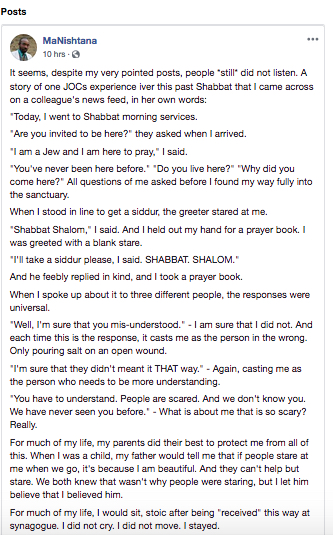
embed Manishtana

Full text of post:

It seems, despite my very pointed posts, people *still* did not listen. A story of one JOCs experience [over] this past Shabbat that I came across on a colleague’s news feed, in her own words:

Today, I went to Shabbat morning services.

“Are you invited to be here?” they asked when I arrived.

“I am a Jew and I am here to pray,” I said.

“You’ve never been here before.” “Do you live here?” “Why did you come here?” All questions of me asked before I found my way fully into the sanctuary.

When I stood in line to get a siddur, the greeter stared at me.

“Shabbat Shalom,” I said. And I held out my hand for a prayer book. I was greeted with a blank stare.

“I’ll take a siddur please, I said. SHABBAT. SHALOM.”

And he feebly replied in kind, and I took a prayer book.

When I spoke up about it to three different people, the responses were universal.

“Well, I’m sure that you mis-understood.” – I am sure that I did not. And each time this is the response, it casts me as the person in the wrong. Only pouring salt on an open wound.

“I’m sure that they didn’t meant it THAT way.” – Again, casting me as the person who needs to be more understanding.

“You have to understand. People are scared. And we don’t know you. We have never seen you before.” – What is about me that is so scary? Really.

For much of my life, my parents did their best to protect me from all of this. When I was a child, my father would tell me that if people stare at me when we go, it’s because I am beautiful. And they can’t help but stare. We both knew that wasn’t why people were staring, but I let him believe that I believed him.

For much of my life, I would sit, stoic after being “received” this way at synagogue. I did not cry. I did not move. I stayed.

Today, I stood up for myself. I let my tears be seen. I voiced my pain. I flatly rejected the notion that I am the one who doesn’t understand what is going on.

And, then I left. Because, I told the really kind, well-meaning woman who tried to get me to stay, leaving was an act of self-love.

We Jews have a problem. Because we still think that moments like this AREN’T racism. And I am still being told that I don’t understand what is really happening.

I pray that those of you who “showed up for Shabbat” today felt the sense of love, strength, pride and community that I longed to feel. That I long to feel everyday.

I pray that there will come a day when I’m not scary to MY OWN PEOPLE simply because I am a different combination of beautiful things than other people might be. And I AM beautiful. Exactly as I am.

I pray that there will come a day when our synagogues will truly be SAFE SPACES – in every sense of that term.

Today, for me, was not that day. But perhaps there will come a day. We sing ani ma’amin – which means “I believe.” And I do. I believe in love. I believe in hope. I believe that we CAN be better than this. I believe that we must be better than this. All of us. Together.
End of Post

BACK

Building with Love

Psalm 30 begins with the idea of dedicating a house, or “the House.”

מִזְמוֹר: שִׁיר-חֲנֻכַּת הַבַּיִת לְדָוִד.
mizmor: shir-chanukat ha-bayit l’David
A Psalm; a Song at the Dedication of the House; of David.

Some translators move the words around for better logical sense to, e.g, “A psalm of David. A song for the dedication of the House.”

Later in the month, I hope to explore more about the meaning of these words and how the psalm has been used over the centuries. Today, let’s focus instead on the concepts of building and dedicating.

Build the World with Love

Rabbi Joseph Soloveitchik (1903-1993) taught:

King Solomon built the physical structure of the Temple, it was King David who imbued it with its sanctity. Because Solomon built the physical structure in a state of prosperity and tranquility, he could not be the one to sanctify it. It was Solomon’s father who hallowed it through his worry, his concern, and his uncertainty. (see notes below)
— commentary in the Koren Mesorat HaRav Siddur

So: worry, concern, and uncertainty can be part of building something important and precious, hallow the building, in fact. Which brings to mind the powerful song, from Rabbi Menachem Creditor, that has inspired so many Jewish gatherings — especially in “the resistance,” however defined — in recent years and days….

…A whole lot of worry, concern, and uncertainty follows governmental attempts to erase transgender individuals, vilify asylum seekers, fuel homophobia and xenophobia and racism and anti-Jewish feeling, plus White Nationalist killings in Louisville and Pittsburgh and attempts elsewhere. Can we harness those feelings to sanctify a building project we cannot even see yet?

Here’s the song’s author, Rabbi Creditor —

Here’s Adas Israel, a synagogue in Washington DC that was the site of an interfaith vigil on 10/29/18 —

Finally, here’s a still from the vigil for Louisville and Tree of Life at Dupont Circle in DC, 10/28, at which the song was also used. dupont_oct28

2 of 30 on Psalm 30

As a National Novel Writing Month Rebel, I write each day of November while not aiming to produce a novel. This year I focus on Psalm 30 (“Thirty on Psalm 30”) in the hope that its powerful language will help us through these days of turmoil and toward something new, stronger and more joyful, as individuals and as community. Whole series (so far)

Look for more tunes and more on building. Shabbat shalom

NOTES

“So Solomon built the house, and finished it”
וַיִּבֶן שְׁלֹמֹה אֶת-הַבַּיִת, וַיְכַלֵּהוּ
— 1 Kings 6:14]

Psalm 30, which is attributed to David, is full of trepidation as well as rejoicing. Many teachers discuss the meaning and timeline inherent in its varied sentiments.

Rabbi Soloveitchik says that it’s about King David having asked “God’s consent to construct the Temple,” and then suffering for “what seemed to be an interminable period” before God answered. See Koren Mesorat HaRav Siddur, Jerusalem: Koren/OU, 2011.

Here’s the full text of Psalm, with commentary on Sefaria and on Mechon-Mamre (older JPS translation)

Note R. Creditor’s introduction to the song (from YouTube):
“I wrote this song for my daughter, born right after 9/11. This world will be built by love: ours and God’s. In the best and worst of moments, non-fundamentalist “believers” and “atheists” are reaching for the same hope using different language. Amen to both.”

BACK

For Beverly: may mourning turn to dance FOR YOU

Alonzo (“Zo”) Fiero Smith, 1/2/1988-11/1/2015, was a poet, father, and teacher. Zo was killed, at age 27, in custody of special police in DC, a stone’s throw from the apartment of his mother, Beverly Smith. I’ve written in the past about Zo’s case, about special policing in DC and beyond, and related topics. This post is for Zo’s mother, Beverly.

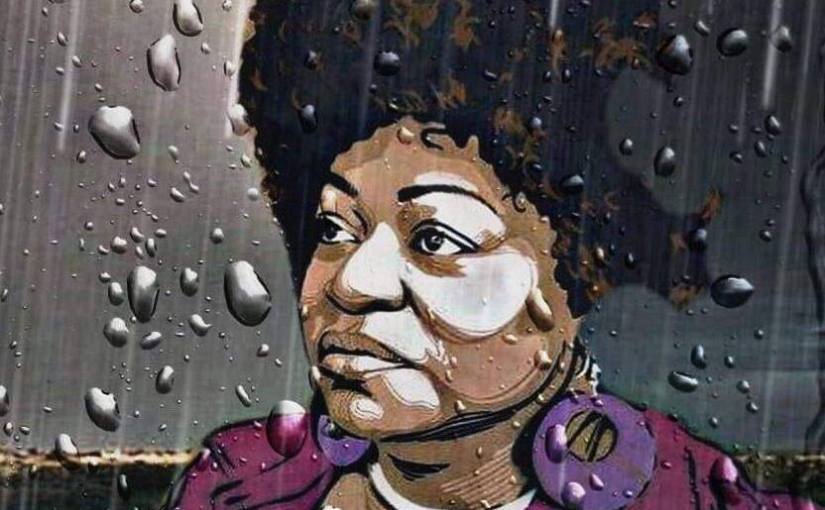
Beverly_rain
Beverly Smith, portrait by Pamela Brooks, both active in Coalition of Concerned Mothers

…weeping may tarry for the night,
but joy comes in the morning…
To You, GOD, I called…
Can dust praise you? Can it speak of your truth?
Hear and answer…
…You turned my mourning into dance for me,
You undid my sackcloth and girded me with joy —
that I might sing of Your glory and not be silent:
HASHEM my God, I thank You, always
— from Psalm 30

As her son’s death anniversary approached, and throughout this day [this post was written in large part on 11/1/18], I have often thought of Beverly’s efforts to speak truth and her determination to not be silent — about Zo’s case as well as broader needs — even in her grief and as she faces serious health challenges. I see her rejoice over her grandchildren and celebrate with friends, as well.

From Our Varied Places

With its range of emotions, from despair to ecstasy, Psalm 30 resonates differently for different people and times. Individuals reading or reciting this psalm on their own might relate to different phrases on different days, or use its variety to work through complex layers of feelings at one time. Psalm 30 should also remind us that our community encompasses, at any given moment, people in very different places, prompting us to acknowledge the varied ways our neighbors may be calling out for someone to “hear and answer.”

In this difficult period of national turmoil, Psalm 30 can help us notice how we can all cry out together from our various situations and states of mind — griefs, or joys, that may be brand new, or three or 20 or 400 years old. We don’t need everyone in the same place or of the same mind to care for one another, work together, and, for those so inclined, pray with and for one another.

On this particular November 1, I find that weeping — for Louisville, for Pittsburgh, for Zo and other victims of police brutality, for the unequal weight of our dreadful system of white supremacy — is more present for me than joy.

In the time that I’ve known Beverly Smith, I’ve seen her turn mourning into dance, as she has generously shared Zo’s story and allowed her own pain to help others focus on needed change. If we look carefully at the Hebrew in Psalm 30:12, though, we see that it reads, “turn my mourning into לְמָחוֹל לִי dancing for me].”

So, my prayer for Beverly on this anniversary of her son’s death, at the hands of a system some of us like to think is meant to protect us, is that this year will not only turn her mourning into dance (for others), but turn it into dance for her.

1 of 30 on Psalm 30
As a National Novel Writing Month Rebel, I write each day of November while not aiming to produce a novel. This year I focus on Psalm 30 in the hope that its powerful language will help us through these days of turmoil and toward something new, stronger and more joyful, as individuals and as community. Whole series (so far)

Hatred of Haters and Turbulent Branching of Thoughts

Put an end to the hatred of haters
those who have made me their foe

Search me out with shovel and torchlight, God
know my heart by means of compassion.

Understand the turbulent branching of my thoughts.

See the road that brings me sadness,
and lead me instead on the path of eternal life.
— Ps. 139:22-24
translation is by Pamela Greenberg,
The Complete Psalms: The Book of Prayer Songs in a New Translation. NY: Bloomsbury, 2010

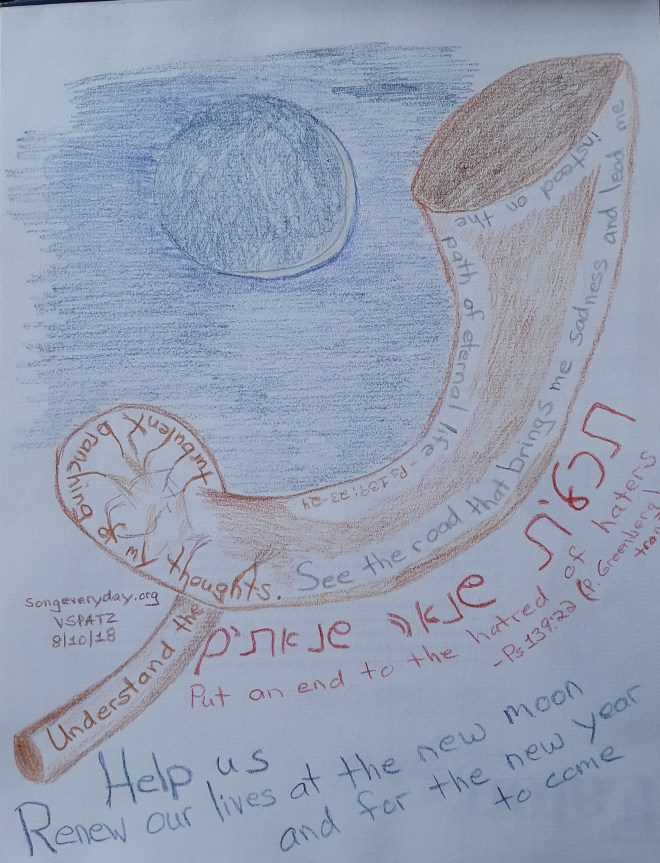
Psalm 139 is one that Jews use at times of trouble to ask for guidance. Eight years ago, just about this time, Pamela Greenberg gave permission for a DC-based group to use her translation for a program in solidarity with Women of the Wall. Many of the sentiments expressed at that time of trouble are just as applicable to this Elul. And her translation of the psalms has provided much solace and challenge in the intervening eight years. Several verses are illustrated here with a particular prayer intention for my hometown of 30 years at this time of unrest and a prayer for all who are experiencing “turbulent branching of thoughts” and seeking an “end to the hatred of haters.”

The new month begins on August 11-12.

new moon shofar

Description of graphic: a sliver of a bright new moon in a dark sky in the background, with the central image a shofar with a single twist near its mouthpiece at the bottom left and its horn upward near the top right. Below the shofar are the words in English, “Put an end to the hatred of haters,” and the Hebrew from Ps. 139:22 — תַּכְלִית שִׂנְאָה שְׂנֵאתִים

Scrolling across the shofar are the words, also from Greenberg’s translation of Psalm 139: Understand the turbulent branching of my thoughts [lettering here includes “branches” that reach up to entwine]. See the road that brings me sadness and lead me instead on the path of eternal life.

Under the shofar is a simple new month prayer for Elul: Help us Renew our lives at the new moon and for the new year to come.

Foreign Languages and Imagination

The brand new Koren Rav Kook Siddur presents commentary, not previously published in English, from Abraham Isaac Hakohen Kook (1865-1935), first Ashkenazic Chief Rabbi of pre-state Israel and a visionary Jewish thinker — including this note which sheds some light for #ExploringBabylon. (See below for book and launch info.)

Exploring Babylon Chapter 12

This commentary on Psalm 81:6-7 weaves three talmudic tales and two odd spellings toward a surprising conclusion.

When Pharaoh appointed Joseph as Viceroy of Egypt (Gen 39), Talmudic legend says, Pharoah’s advisors challenged the appointment, demanding that someone worthy of the post know “the seventy languages.” So, the angel Gabriel came to teach Joseph and, when he didn’t master all the languages at first, “added to his name a letter from the Name of the Holy One, blessed be He, and he learnt [the languages] as it is said: He appointed it in Joseph for a testimony, when he went out over the land of Egypt, where I heard a language that I knew not” (B. Sotah 36b; Ps. 81:6).

Joseph’s name is spelled with an extra “hey” in Ps. 81:6: בִּיהוֹסֵף. Joshua’s name, on the other hand, is missing its “hey” in Nehemiah 8:17: יֵשׁוּעַ. The Talmud’s explanation for Joshua’s diminished named is that the Bible is chastising him for failing to remove the “passion for idolatry [yitsra de-‘avodah zarah” from the country (B. Arachin 32b). But Rav Kook defends Joshua and asserts the power of imagination. He goes on to insist, alluding to a third talmudic story, that trying to shut off imagination can be disastrous for individual and collective spiritual life:

The reason that Joshua did not abolish the hankering for idolatry, which is a function of the imaginative faculty, is because Joshua as a descendant of Joseph, was of the firm conviction that the power of imagination — crucial for prophetic ability — need not be abolished….

Eventually, in the days of Ezra, the Men of the Great Assembly would stop up the yitsra de-‘avodah zarah in a “lead pot” (duda de-avara), and quite predictably, that would in turn bring about the cessation of prophecy in Israel. But in Rav Kook’s reverie, “kapav mi-dud ta’avornah,” “his palms will be set free from the pot.”
Koren Rav Kook Siddur, p.258-260


Pots and Palms

B. Sanhedrin 64a tells of leaders trapping the “passion for idolatry” in a lead pot. The result is that no eggs are produced anywhere in the Land, for the three days it is captive. The Talmud and Rav Kook take this story in different directions.

The Talmudic discussion is concerned with people “engaged in idolatry only that they might openly satisfy their incestuous lusts.” After considering their options, the leaders blind their captive and then let it go. (“This was so far effective that one does not lust for his forbidden relations”). Rav Kook looks beyond the incestuous lust of the Sanhedrin discussion, instead focusing on the underlying issue of converting the “passion for idolatry” to “holy light.”

When Ps. 81:7 says “his palms will be set free from the pot” —

כַּפָּיו, מִדּוּד תַּעֲבֹרְנָה.
kapav mi-dud ta’avornah

Rav Kook reads “kapav” [his palms] as related to prophetic inspiration. (This is possibly related to Exodus 33:32-33, in which God holds puts Moses in the rock cleft and promises, “I will cover you with my palm until I have passed by.” Other links between “palm” and “prophecy” are suggested as well.) He concludes that, once palms are freed from the pot, “Imagination will be liberated and prophecy restored” (Kook Siddur, p. 260).

The “hey” which Gabriel adds to Joseph’s name to help him master the languages “is absorbed into Joshua’s being and empowers him to clarify the imagination, which takes in the entire esthetic dimension” (Kook Siddur, p. 258).

Exploring “the entire esthetic dimension” seems like a large project. But the idea that foreign languages and imagination and prophetic inspiration are somehow linked together seems worth pursuing at some point….

…Meanwhile, I suppose it’s time to move into a situation which “doesn’t know Joseph.”


The siddur text is the Koren Sacks (2009) bilingual edition, and Rav Kook’s teachings are prepared by Rabbi Bezalel Naor, who translated Kook’s 1920 Orot.

For information on the siddur itself visit Koren.

For those in/around NYC, here is a book launch on 1/7/18 at Lincoln Square Synagogue.
BACK


Psalms 81:6-7
עֵדוּת, בִּיהוֹסֵף שָׂמוֹ
בְּצֵאתוֹ, עַל-אֶרֶץ מִצְרָיִם;
שְׂפַת לֹא-יָדַעְתִּי אֶשְׁמָע
He appointed it in Joseph for a testimony,
when He went forth against the land of Egypt.
The speech of one that I knew not did I hear:
הֲסִירוֹתִי מִסֵּבֶל שִׁכְמוֹ;
כַּפָּיו, מִדּוּד תַּעֲבֹרְנָה.
kapav mi-dud ta’avornah
‘I removed his shoulder from the burden;
his hands were freed from the basket.
— JPS 1917 translation, from Mechon-Mamre
BACK