thoughts on nullifying “the strong”

Passover begins to manifest in a tangible way, for many Jewish households, with the nullification of chametz. This year, for the first time I recall, I am noticing the word “chamira [חמירא]” in that nullification ritual and offer a few thoughts about ridding ourselves of “strong” crumbs.

A Few Basics

Instructions for Passover first appear in Exodus 12: “No leaven [שְׂאֹר — s’or] shall be found in your houses for seven days…Anything that ferments [כל־מַחְמֶצֶת — kol-mach’metzet] you are not to eat; in all your settlements, you are to eat matzot” (Exod 12:19-20, Schocken/Fox translation).

This narrative follows a few verses later: “Now they baked the dough which they had brought out of [Mitzrayim] into matzot cakes, for it had not fermented [כִּי לֹא חָמֵץ — ki lo chametz], for they had been driven out of [Mitzrayim], and were not able to linger” (Exod 12:39, Schocken/Fox translation)

The word “chametz [חָמֵץ]” comes to encompass all the grain and fermentable stuff that we’re supposed to avoid for a week in our bodies, homes, and communities. There are many teachings, over centuries and from many perspectives, about the spiritual and ethical ideas inherent in being told to look hard at all the stuff that expands in our lives and to consider how we are called to stop that process, at least for a week, for the holiday of Liberation.

On the morning before the seder, it is customary to take some chametz — breakfast leftovers or crumbs found in pre-Passover cleaning, for example — and symbolically remove it (by burning, composting, or otherwise). Then many recite a statement nullifying any remaining chametz; some add a blessing of commandment for burning the chametz.

Chamira

Rabbi Lawrence Hoffman offers a note on the language of the recitation. He points out that the Aramaic includes “two nouns, roughly synonymous, denoting leaven.” Chamiya, he says, is the result of Aramaic’s tendency to use an ayin [ע] where Hebrew uses a tzadei [ץ], so chametz [חָמֵץ] becomes chamiya [וחמיעא]. But his note about Chamira is what really caught my attention:

Chamira has the connotation of ‘strong’ and appears, halakhically, as chumra, meaning ‘the strong [as opposed to the lenient] position.’ In English, too, ‘Do you want something strong?’ denotes alcohol (‘strong drink’ [vs. ‘soft drink’]).” — L. Hoffman in My People’s Passover Haggadah: Traditional Texts, Modern Commentaries (Jewish Lights, 2008.), vol. 1, p.94

This year, our household is facing complications due to a serious health issue affecting diet, energy, and almost every other aspect of our lives. In recent weeks, we’ve had to step back from some “strong” positions in terms of responsibilities in the outside world: relationship to paid employment, how many volunteer hours for Courtwatch, which emails to answer, which political causes to let slide. Much harder decisions involve how to show up for others in family and community through exhaustion and angst.

In the midst of all this, for this Passover, we decided — for our own family; not making any kind of halakhic pronouncement — that a lot of the “strong” had to go this year: there is some cleaning we might usually do that we cannot undertake this year, and there are some strictures around diet, to which we usually adhere, that we are relaxing.

Zombie Passover?

As we head into this festival of Liberation, I am just beginning to think about what it might mean to remove “the strong” from our lives, especially at a time when we face so many evils that need opposing and needs that require attention, locally and globally. Like many others, I was incredibly moved by Kelly Hayes recent essay, “The Zombie Dressed Up as an Ordinary Tuesday.” For so many, I believe, and for so many different reasons, this festival week is a Zombie dressed up as Passover.

In the haggadah meditation shared below, we read: “Remove tyrannical governments from the world and all who cause anguish to the Divine Presence. Blow them away with a spirit of justice…” So I ponder: To what extent is it wise to give up “the strong” ourselves and leave that to the Divine? To what extent must we work ever harder to help manifest a spirit of justice and an end to tyranny all around us? What are the lessons in nullifying chametz?

Would love to hear thoughts from others. With wishes for a liberating season to come!!!!

NULLIFYING AND DECLARING OWNERLESS

The Ashkenazi formulation includes both “nullify [בטיל]” and “become ownerless [ולהוי הפקר]” while the Sephardic statement only nullifies.

כל חמירא וחמיעא דאיכא ברשותי, דחזיתיה ודלא חזיתיה, דבערתיה ודלא בערתיה, לבטיל ולהוי הפקר כעפרא דארעא

All chametz or leaven — chamira v’chamiya [חמירא וחמיעא] — in my possession that I have seen and that I have not seen, that I have destroyed and that I have not destroyed, shall be nullified and become ownerless, like the dust of the earth.

Some begin with a blessing of commandment for burning the chametz.

A Different Night includes this meditation:

“God, may it be Your will, that just as we remove all the chametz from our house and from all that we control, so may You help us to remove all the impure forces from the earth and our evil inclinations from within us and renew our heart of flesh. May all negative forces disappear like smoke. Remove tyrannical governments from the world and all who cause anguish to the Divine Presence. Blow them away with a spirit of justice, just as you did to [Mitzrayim] and their idols in those days long ago.” — A Different Night: The Family Participation Haggadah, Rev. 2015, p.14. Shalom Hartman Institute. Noam Zion and David Dishon. No additional permission/citation.

bread crumbs

Cropped from image of bread and crumbs by CongerDesign via Pixabay

Glory versus Silence

As noted previously, one of the key aspects of “kavod,” however it and the rest of Ps. 30:13 is translated, is its opposition to silence. We looked at Rabbi Shefa Gold’s practice about “finding the glory inside,” by examining whatever might be silencing us/our glory, and “pouring it out to God” (Gold’s teaching).

Returning to an idea from a few posts back, “I Called, We Called: –chanting separately and together, as we call out in Psalm 30, we offer and receive some of the human connection that Rabbi Polen sees as part of the way prayer is answered — raises the question of if/how we can find our own glory, if others are silenced. Our liberation — and our joy — is bound up together.


17 of 30 on Psalm 30
As a National Novel Writing Month Rebel, I write each day of November while not aiming to produce a novel. This year I focus on Psalm 30 (“Thirty on Psalm 30”) in the hope that its powerful language will help us through these days of turmoil and toward something new, stronger and more joyful, as individuals and as community. Whole series (so far)…. apologies to anyone who finds multiple-post days too much.

There’s Glory for You! — Part 2

In “The Spirit of Prayer,” Abraham Joshua Heschel warned:

It is not enough to know how to translate Hebrew into English; it is not enough to have met a word in the dictionary and to have experienced unpleasant adventures with it in the study of grammar. A word has soul and we must learn how to attain insight into its life.
— see previous post for citation

Translation alone may not be enough, but it can give us some insight into the life of a word or a phrase.

In the previous look at “kavod” in Psalm 30, we saw the word translated in Jewish versions as “glory,” “depths,” “soul,” “whole being,” and just plain “I.” Here, for additional perspectives, are some Christian translations and notes for verse 13 (or 12 — NOTE: Christian scholars generally do not count superscriptions as verses in psalms, so the numbering differs by one from Jewish sources) of the psalm.

More Translations

The book of psalms from the original Hebrew with various readings and notes by the late Alexander Geddes, LL. D (1807):

Therefore I will praise thee, my glory!
Never will I be silent in thy praise
[“f” — as in “filent in thy praife” — changed to “s” for readability]

The Greek interpreters read another word, the English of which is honour; as if the psalmist had said, thou hadst so firmly established mine honour; and this reading by some late translators. The other I think more poetical and expressive – Ver. 12. I will praise thee, my glory!

The present Hebrew runs thus: Glory will praise thee, and will not be silent. But the Syriac translator read both verbs in the first person; and I have no doubt of his being the original lection.

— Geddes, p.46 (London: printed for J. Johnson in St. Paul’s Courtyard by Richard Taylor & Co, Shoe-Lane)

Bay Psalm Book being the earliest New England Version (1862):

That sing to thee my glory may
and may not silent be
Lord my God I will give thanks
evermore to thee

The Psalms: A historical and spiritual commentary offers two readings:

  • many, with the Septuagint (LXXX), “my glory” for “that my glory should make music to you and not be silent,” taken as a reference to “his soul restored in royal glory.”
  • others “change the vowels to give ‘my liver’ and then render ‘my heart,’”
    — J.H. Eaton, The Psalms: A historical and spiritual commentary
    (T&T Clark, A Continuum Imprint 2003), p.143

NIV Study Bible (1985) gives us, “that my heart may sing to you and not be silent,” with the following footnotes:

[30:12] heart. Lit. “glory (see note on 7:5)

[7:5] me. Lit. “my glory,” a way of referring to the core of one’s being (see 16:9; 30:12; 57:8; 108:1 and notes).

Most of the 50+ translations available through “Bible Gateway” similarly use “heart” or “soul,” a few “glory” or “whole being.” But there are also more interpretive offerings:

  • To the end that my tongue and my heart and everything glorious within me may sing praise to You and not be silent.
    Amplified Bible (1965-1987)
  • You have restored my honor. My heart is ready to explode, erupt in new songs! It’s impossible to keep quiet!
    The VOICE (2012)
  • How could I be silent when it’s time to praise you?
    Now my heart sings out loud, bursting with joy—
    a bliss inside that keeps me singing,
    “I can never thank you enough!”
    Passion Translation (2017)


Beyond Translation

“…There’s glory for you!”

“I don’t know what you mean by ‘glory,'” Alice said.

Humpty Dumpty smiled contemptuously. “Of course you don’t—till I tell you….”
more on “glory” Through the Looking Glass

Whatever English is chosen to translate “kavod,” or however we relate to the Hebrew directly, one aspect of its life seems to be that it is antithetical to silence. All the tribulations in the psalm — enemy triumph, the underworld or the pit, God’s anger and hiding of God’s face, mourning and sackcloth — cannot keep it from singing.

Rabbi Shefa Gold teaches a practice to help in “finding the glory inside and pouring it out to God.” She asks us to “examine what it is that silences that glory,” and then “look beneath the obstacle” for the “glory that wants to be acknowledged and celebrated.” Here’s her chanting practice for this verse.

In that sense, we’re all part Alice, waiting for Humpty Dumpty to tell us what “kavod” means in the context of the psalm, and part Humpty Dumpty, knowing that it’s up to us to identify whatever obstacles are blocking our own glory in this particular instance.


16 of 30 on Psalm 30
As a National Novel Writing Month Rebel, I write each day of November while not aiming to produce a novel. This year I focus on Psalm 30 (“Thirty on Psalm 30”) in the hope that its powerful language will help us through these days of turmoil and toward something new, stronger and more joyful, as individuals and as community. Whole series (so far)…. apologies to anyone who finds multiple-post days too much.

Maintaining Self and Struggle

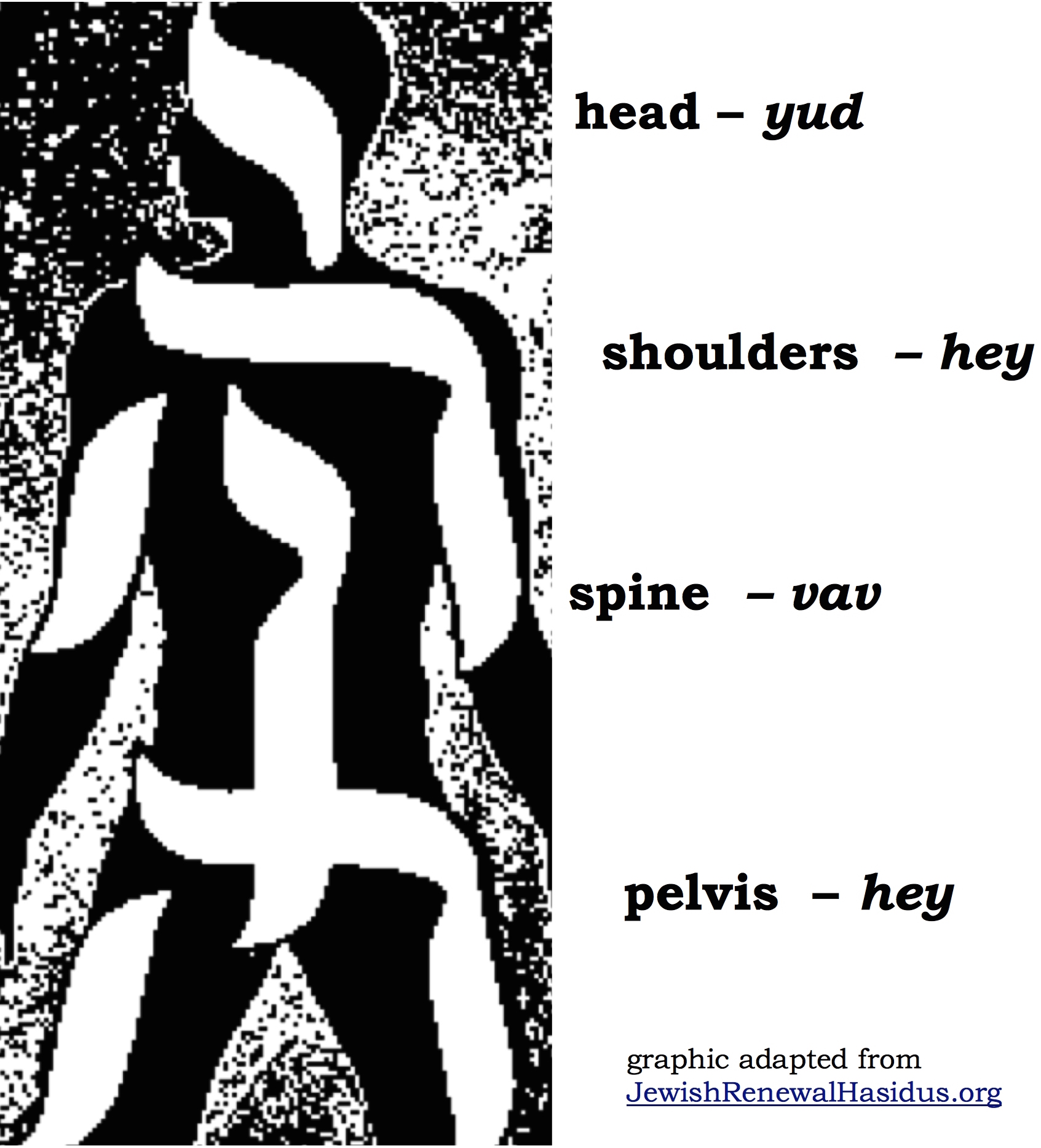
A meditation linking God’s four-letter name – YHVH (yud-hey-vav-hey) – with the human body/soul can help focus on God’s presence and power in our lives. I have relied on this meditation since Rabbi David Shneyer taught it to me some years ago.

yhvhgraphic
The variation presented here, incorporates a teaching from the prophet Micah on what God requires of us —

הִהִגִּיד לְךָ אָדָם, מַה-טּוֹב; וּמָה-יְהוָה דּוֹרֵשׁ מִמְּךָ,
כִּי אִם-עֲשׂוֹת מִשְׁפָּט וְאַהֲבַת חֶסֶד, וְהַצְנֵעַ לֶכֶת, עִם-אֱלֹהֶיךָ.
You have been told, human, what is good,
that is, the traits that God expects from you:
acting justly, a passion for loving kindness, and walking humbly with your God.
– Micah 6:8 (translation from Siddur Eit Ratzon)

It is offered as support for social justice work in difficult times.

Shared here are the bones of the practice, so to speak, along with a PDF with additional graphics, 4-part Meditation, for easy carrying in a pocket or bag. Originally intended for use at the start of the day, this brief practice also serves throughout the day, especially when circumstances threaten to pull us off center, to realign with divine connection and our own strength and flexibility.

Fabrangen West tried a group chant based on this practice at the December 2016 gathering. Several participants more knowledgeable about renewal hasidus and kabbalah found connections between the sefirot and the words of the Micah verse. Further thoughts on this meditation — or on other Jewish practices for times of challenge — are welcome.

As always, “A Song Every Day” seeks comments or guest posts.

(1) Begin

Begin with meditation or chant using the four-letter name to focus on God’s presence before and within:


(2) “You’ve been told, human…”

Cycle through first half of verse, Y-H-V-H, head to legs, several times. At each reflection stage, try to release any barriers to embodying those attributes God expects; where appropriate, note areas in need of further attention:

  • (Y) Consider your humanity and connection to God. If you are feeling depleted, this is a moment to be open to the spiritual support you need.
  • (H) Is anything – distraction, anger, injury, e.g. – impeding your ability to reach for “what is good”? If so, can you release the barrier now? Or,should you set aside more time for this, to keep your reach from straying?
  • (V) Are you centered, with YHVH as backbone? What might pull you away? How are you working to stay upright?
  • (H) Are you prepared to pursue what God seeks of you? Does body or soul require attention first? Ready for more instruction? (Or ↑)


(3) “…acting justly, a passion for loving kindness,
and walking humbly with your God.”

Cycle through second half of verse, Y-H-V-H, head to legs, several times. Again, at each reflection stage, release barriers if you can and make note of areas where further attention, including assistance from others, would be helpful:

  • (Y) Are you committed to embodying the traits we are told to share with God?
  • (H) Do you join hands with others, or just push your own ideas, in acting justly? Do you need more partners, assistance? To whom can you reach out?
  • (V) Is your spine ready to stand and bend in loving kindness? Do you need help – maybe learning or rest – to avoid damage to yourself or others?
  • (H) Ready to take steps in the world, humbly with your God, and in healthy company with others, in the struggle? (Or ↑)

Brief journaling – either at this point, before closing out the meditation, or shortly afterward – can be helpful.

(4) Close

Return to a chant of the four-letter Name, preparing to bring your newly-aligned self into the outside world and the on-going struggle.

verseandgraphic