UPDATE 8/29/25: Typos in copying from We Will Not Cancel Us corrected
Repentance and repair must be year-round efforts, but the Jewish calendar emphasizes these needs as a new year approaches. For help in this work, many Jews turn to a centuries-old, five-step process outlined by Maimonides, AKA “Rambam” (acronym for R‘ Moses ben Maimon):
Beyond some quotations and a few questions, I haven’t got much to offer.
But the questions strike me as non-negotiable, given all we face in- and outside Jewish communities… living in DC and with many friends and family in Chicago, I am so conscious of the disasters coming our way if we cannot figure out how to resist in ways that don’t cause more damage….
Naming Harm and Starting to Change
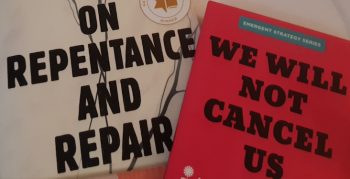
This year, I am exploring these steps within the “unthinkable thoughts” of adrienne maree brown’s We Will Not Cancel Us:
I’ll start with the scariest unthinkable thought for me, which is that maybe we as a species are in a state of apocalyptic fatigue — exhausted in the face of all the changes and endings we are living through. Our current collective circumstances require us to think about death, to grieve, and to consider that everything we have known has to change or come to an end. [p.33]
I, we, have to be able to discern what is me/us and what is fear.
Which leads to my next unthinkable thought: do I really know the difference between my discernment and my fear? [p.37]
…We are full of justified rage. And we want to release that rage. And one really fast and easy way to do this is what I experience as knee jerk collective punishment in movements. [p.40]
We are afraid, and we think it will assuage our fears and make us safer if we can clarify an enemy, a someone outside of ourselves who is to blame, who is guilty, who is the origin of the harm. Can we acknowledge that trauma and conflict can distort our perspective of responsibility and blame in ways that make it difficult to see the roots of the harm? [p.42-43, emphasis added]
…The tools of swift predatory justice feel good to use, familiar, groove in the hand easily from repeated use and training, briefly satisfying. But these tools are often blunt and senseless.
Unless we have an analysis of abolition and dismantling systems of oppression, we will not realize what’s in our hands, we will never put the predator’s tools down and figure out what our tools are and can be.
My third unthinkable thought — why does it feel like we are committed to punishment, and enjoying it? Why do our movements more and more often feel like we are moving with sharp teeth against ourselves? And what is at stake because of that pattern, that feeling? Why does it feel like someone pointing at someone else and saying: “that person is harmful!,” and with no questions or process or time or breath, we are collectively punishing them, tearing them, and anyone protecting them, to shreds?
Sometimes we even do it with the language of transformative justice: claiming that we are going to give them room to grow. They need to disappear completely to be accountable. We are publishing shaming them so that they will learn do do better.
Underneath this logic I hear: we are good and we are getting rid of the “bad” people in our community or movement. We are affirming our rightness and power. [p.44-45, emphasis added]
Knee-jerk call outs say: those who cause harm or mess up or disagree with us cannot change and cannot belong. They must be eradicated. The bad things in the world cannot change, we must disappear the bad until there is only good left.
But one layer under that, what I hear is:
We cannot change.
We do not believe we can create compelling pathways from being harm doers to being healed, to growing.
We do not believing we can hold the complexity of a gray situation.
We do not believe in our own complexity. [p.57-58]
— We Will Not Cancel Us: And Other Dreams of Transformative Justice by adrienne maree brown. AK Press, 2020.
Institutional and Movement Repair
The crucial perspectives of We Will Not Cancel Us return me to Rambam’s process, as R’ Ruttenberg describes it: Maimonides discussion of transformation “precedes his discussion of amends/reparations and apologies. He doesn’t spell out his thinking explicitly, but I think he was trying to tell us that apologies, and even amends and reparations, don’t truly have the needed effect if the work to become different isn’t already underway….The goal here isn’t amends. It’s transformation.” p.34, On Repentance and Repair.
One tricky aspect of work here involves our participation in a variety of institutions: “How can and should we think about the work of repentance when not a single person, but a rather a body, made of many actors with different roles is causing harm?…What are the obligations–and limits to the obligations–of the individuals in charge, and what does repentance look like when undertaken by an institution?” p. 101, On Repentance and Repair.
Again, beyond the questions, I haven’t got much to offer. But I believe we have to be asking them. And the questions lead me back to adrienne maree brown:
“I can’t help but wonder who benefits from movements that engage in public infighting, blame, shame, and knee-jerk call outs? I can’t help but see the state grinning, gathering all the data it needs, watching us weaken ourselves. Meanwhile, the conflicts are unresolved, and/or harm continues.” p. 54 We Will Not Cancel Us
Laws of Repentance, a late 12th Century work, is part of the enormous Mishneh Torah and can be found in several translations at Sefaria. (Useful background on Mishneh Torah as a whole). R’ Danya Ruttenberg provides an overview of Rambam’s five steps and explores them in the context of personal, public, institutional, and national repair: On Repentance and Repair: Making Amends in An Unapologetic World (Beacon Press, 2022).
Presentation title page: “Matir Asurim: Introduction to the Jewish Care Network for Incarcerated People,” Yom Kippur 5785 — Virginia Avniel Spatz. + Tzedek Chicago logo
Some of us have been worshiping together for much of the day. Others may be joining from another context. Either way, I hope this hour will bring focus to one way we can engage in teshuvah/repair for the coming year. The basic concept for this session is that I was asked to share a little about my volunteer work with the organization, Matir Asurim: The Jewish Care Network for Incarcerated People, and bring some text to link that work with Yom Kippur.
Overview, Basics, and Contacts
[SLIDE 2]. The planned shape of the session is:
Basics and contact information for myself and the organization Matir Asurim
Text exploration: Genesis 44
Matir Asurim Guiding Principles
Back to Genesis 44
Thoughts for Yom Kippur and into 5785
So, let’s get started with some basics
[SLIDE 3] Matir Asurim — “One Who Frees Captives”
Who We Are: “We are a collection of Chaplains, Rabbis, Cantors, Kohanot/Hebrew Priestesses, advocates, activists, volunteers, loved ones of incarcerated people, and people with direct experience of incarceration. We are an all volunteer group who began meeting in 2021. We live and work across Turtle Island, in territories, cities, and rural settings of the US and Canada.”
I’ve been volunteering with Matir Asurim for close to two years,
producing the monthly e-newsletter,
serving as a penpal/chevruta partner with an incarcerated Jew,
helping to create resources for readers who are incarcerated,
helping craft materials for outside readers around incarceration,
producing some additional programming,
and working on organizational infrastructure.
We’ll get into some more specifics a bit later. Meanwhile, some contacts:
[Summary] Joseph is 12th of 13 siblings in the family of Jacob, Rachel, Leah, Bilhah, and Zilpah. In his youth, he was the favorite of his father, Jacob, and an annoyance to the rest of the family. So, Joseph’s brothers attempt to get rid of him. Their scheming takes an odd turn, however, and, although his family does not know it, Joseph becomes a powerful government leader in Mitzrayim, second in command to Pharaoh.
When famine strikes in Canaan, Jacob sends the brothers down to Mitzrayim, where grain is plentiful, to beg food. Joseph, still unrecognized by his brothers, treats the brothers to a feast at the palace and grants the requested supplies.
Joseph also orchestrates a criminal charge against the youngest brother – thus creating a situation in which the older siblings can again harm a younger brother, or they can act to avoid such harm.
Genesis 44 starts as the brothers leave the palace with the supplies.
[SLIDE 5] Genesis 44 Revised (2023) Jewish Publication Society translation, via Sefaria
1) Then he [Joseph] instructed his house steward as follows, “Fill the men’s bags with food, as much as they can carry, and put each one’s money in the mouth of his bag.
2) Put my silver goblet in the mouth of the bag of the youngest one, together with his money for the rations.” And he did as Joseph told him.
3) With the first light of morning, the men were sent off with their pack animals.
4) They had just left the city and had not gone far, when Joseph said to his house steward, “Up, go after those men! And when you overtake them, say to them, ‘Why did you repay good with evil?”…
[The house steward follows Joseph’s orders, going after the brothers and accusing them of stealing the goblet.]
12) He searched, beginning with the oldest and ending with the youngest; and the goblet turned up in Benjamin’s bag.
13) At this they rent their clothes. Each reloaded his pack animal, and they returned to the city.
[SLIDE 6] (Genesis 44 cont.)
14) When Judah and his brothers reentered the house of Joseph, who was still there, they threw themselves on the ground before him.
15) Joseph said to them, “What is this deed that you have done? Do you not know that a man like me practices divination?”
16) Judah replied, “What can we say to my lord? How can we plead, how can we prove our innocence? God has uncovered the crime of your servants. Here we are, then, slaves of my lord, the rest of us as much as the one in whose possession the goblet was found.”
17) But [Joseph] replied, “Far be it from me to act thus! Only the man in whose possession the goblet was found shall be my slave; the rest of you go back in peace to your father.”
18) Then Judah went up to him and said, “Please, my lord, let your servant appeal to my lord, and do not be impatient with your servant, you who are the equal of Pharaoh. [Link to bilingual English/Hebrew at Mechon-Mamre]
pray let your servant speak a word in the ears of my lord,
יְדַבֶּר־נָא עַבְדְּךָ דָבָר בְּאׇזְנֵי אֲדֹנִי
and do not let your anger flare up against your servant,
וְאַל־יִחַר אַפְּךָ בְּעַבְדֶּךָ
for you are like Pharaoh!
כִּי כָמוֹךָ כְּפַרְעֹה׃
va’yigash eilav…
This expression, va’yigash eilavis, is worth considering. It comes up in midrash about this Torah story and it appears in Maimonides vocabulary discussion.
Jewish Teachers Discuss “Approaching”
[SLIDE 8] This is a small portion from Maimonides Guide for the Perplexed. Part 1 has many chapters focusing on Hebrew vocabulary.
BTW, I highly recommend checking out Maimonides’ vocabulary chapters, if you can. Sefaria offers free bilingual text with live links to the Tanakh verses mentioned, and I find it a worthwhile exercise to spend some time with the words Maimonides discusses.
Part 1, Chapter 18 is about three similar words: Karov, Naga, and Nagash
קרוב – נגוע – נגוש
Maimonides writes:
“THE three words karab, “to come near,” naga‘, “to touch,” and nagash, “to approach,” sometimes signify “contact” or “nearness in space,” sometimes the approach of man’s knowledge to an object, as if it resembled the physical approach of one body to another.”
He gives examples of each usage, including Gen 44:18: “…And Judah drew near (va-yiggash) unto him”
While we pursue the exchange between Judah and Joseph, it’s worth keeping this expression and the Hebrew vocabulary in mind, more generally: What does it mean to be near to another person in terms of physical space and knowledge of another?
A number of teachers over the centuries have derived lessons from Genesis 44:18. Here are two…
[SLIDE 9] va’yigash eilav yehudah…
It is asked: Judah and Joseph are already in the same room. So, why does the text tell us that Judah vayigash, “drew near” or “came in contact”?
One answer: Jacob ben Asher says:
The last letters of these three words — vayigaSH eilaV yehudaH,shin-vav-hey — spell “shaveh, שָׁוֶה [equal].” Judah’s step forward changes the dynamic, allowing the brothers to speak directly, as equals.
Another answer: The 18th Century teacher, Or Hachayim, from Morocco, cites Prov 27:19: “As face answers to face in water, So does one person’s heart to another”
Building on his teaching, we can see Judah’s step forward as an attempt to create a face-to-face encounter. This was a struggle for Judah, to step across apparent cultural differences and the gap in their positions. The result, ultimately, was reconciliation between the brothers.
This principle of seeking face-to-face interaction can be useful for the season of teshuvah to consider when taking steps in interpersonal reconciliation.
It is also a guiding principle for Matir Asurim as an organization.
Matir Asurim Guiding Concepts
[SLIDE 10] Panim-el-Panim, seeking face-to-face approach, is a guiding principle of Matir Asurim: “Seeking ‘face-to-face’ interactions, despite difference, distance and bars; approaching one another as equals and striving to work in genuine relationship.”
This shapes our penpal relationships, our creation of resources for those who are behind bars, as well as any advocacy on legislation or change of practices, regulations, and conditions inside.
Matir Asurim seeks to provide resources that reflect realities in carceral facilities which often include circumstances that contradict assumptions in much Jewish teaching
reciting prayers or reading Torah right next to toilets;
reciting daily prayers upon waking, which might not align with shacharit, morning prayers, at all;
figuring out how to create community in isolation, when so much of Jewish life assumes access to community (not exclusively an incarceration issue, but a BIG challenge for Jew who are incarcerated)
There are enormous challenges to organizing across bars, and we know that people inside are counting on those of us on the outside to organize and advocate where they cannot.
Still, it’s crucial to take our lead from incarcerated people and those who have experienced incarceration.
All people are created in the image of the Divine.
We all carry a spark of divine goodness as well as the capacity for creative action and transformation.
Teshuva [repentance/return]:
We believe in human resilience and transformation, in our ability to make amends after experiencing and/or perpetrating harm.
We practice this relationally as conflict arises within our organizing, and also strive to create a world that uplifts restorative accountability processes rather than punishment.
Refua Shleima [Complete Healing]:
We work towards collective healing and wholeness, striving to restore balanced relationships within the broader interconnected web of creation and to heal the traumatic effects of white supremacy, colonization, and other systems of oppression that affect our minds and bodies.
Learning from every person:
Learning from every person requires honoring the contributions and voices of people who have been systemically silenced, including through incarceration. In our conversations, we strive to hold awareness around differences in identity and power dynamics.
Kol Yisrael Aravim Zeh Bazeh
[All Jews Are Responsible, One to the Other]/Communal Responsibility:
“All Yisrael is responsible, one for the other.” Jews have many universalist obligations, but we also have a special duty to other Jews.
A little more on this last principle —
[SLIDE 12] Kol Yisrael Aravim Zeh Bazeh
Matir Asurim works with non-Jewish individuals and organizations on issues, trying to address needs of folks who are incarcerated and returning from incarceration in both the US and Canada.
Many non-Jewish groups are larger and better equipped to cope with more general issues, such as solitary confinement and the death penalty. We are also trying to link up with other affected groups regarding what is often called “religious diet.”
But we also focus on specifically Jewish needs: Trying to ensure that incarcerated Jews and those exploring Judaism have access to penpals and spiritual resources. In some carceral facilities, Jews are still offered a Christian bible and told to “ignore the end.” Trying to supply more appropriate resources is one goal. We also seek to fill requests for obtaining a tallit or tefillin – often an issue for those who are not recognized by Aleph (the biggest Jewish organization working in prisons, which provides resources for some Jews but not all).
[SLIDE 13] At a more basic level, we seek to increase awareness in Jewish communities that Jews DO experience incarceration and that we cannot treat incarceration as something that happens to other people.
This awareness also leads, in turn, to more general concerns about incarceration and the toll it takes on individuals, families, and society….
And that takes us back to Maimonides’ idea that “coming near” can be a matter of knowledge as much as one of physical nearness.
Back to “Coming Near”
[SLIDE 14] Back to Genesis 44
[Summary] Judah approaches Joseph and relates the brothers’ previous visit to Mitzrayim for food rations, when Joseph insisted that they return with their youngest brother. Judah includes in his tale the fiction, from years earlier, of a brother killed by a beast and their father’s real grief over the loss. Judah says that incarcerating Benjamin would increase Jacob’s pain and so offers himself as captive instead. At this point, Joseph can no longer restrain himself, clears the room of everyone except his brothers, weeps loudly, and reveals himself.
Gen 45:4-5 – Fox (Schocken) translation:
Then Yosef said to his brothers: I am Yosef. Is my father still alive?
But his brothers were not able to answer him,
for they were terrified before him.
Yosef said to his brothers:
Pray come close to me! [geshu-na eilai גְּשׁוּ־נָא אֵלַי]
They came close. [va’yigashu וַיִּגָּשׁוּ]
He said: I am Yosef your brother, whom you sold into Egypt.
This time, the same verb, nagash, that we saw in Gen 44:18 is used by Joseph to invite approach, and the brother comply. Joseph invites the brothers to hear a truth they previously did not know even though they did know they had a part in causing harm.
In the Torah, Joseph will go on to explain that it’s all good, because even though the brothers meant ill, God meant to put Joseph where he ends up. Still we can consider this verse and what it means for the brothers to hear from Joseph about his direct experience. They come close and learn something they did not know but MUST if they are to understand Joseph’s life and their own roles in the wider world which also includes incarceration as a regular part of its function.
There are ways we all can learn more about the role incarceration plays in our history and our society now and how it impacts individuals and families.
We can opt to get closer to individuals who are or have been incarcerated.
We can also opt to approach through general learning.
[SLIDE 15] They came close: approaching as a matter of knowledge
Explore the complex, interrelated stories of racism, enslavement, and incarceration; of colonialism, displacement and destruction
Learn about the over-representation of Indigenous people in US and Canadian carceral systems
Learn about the Incentive System in the Canadian carceral system
Learn about the Exception Clause in the 13th Amendment to the US Constitution
Learn about the “Auburn system” of incarceration, which predates the US Civil War and the 13th Amendment. We have a video and transcript coming soon about Freeman’s Challenge — and I recommend the book….
One of the things that Robin Bernstein, author of Freeman’s Challenge, says she was trying to do with her book is to stop letting the North off the hook in terms of responsibility for our carceral state. Many of us associate exploiting prisoners for profit with the US South and Reconstruction. But her book describes a prison for profit system that pre-dates the Civil War and originates in the North….
For me, learning about the Auburn system, which originated in upstate New York, was a real shift in my thinking. So, coming on that verse, Gen 45:5 — where Joseph says, “I am the one you sold into imprisonment,” really rings new.
More details on some of the topics above, and some related Jewish texts, are available on Matir Asurim’s Resources page — originally prepared for Passover, but also more widely applicable. For more on Freman’s Challenge, visit this page.
by what can we show ourselves innocent? וּמַה־נִּצְטַדָּק
God has found out your servants’ crime! הָאֱלֹהִים מָצָא אֶת־עֲוֺן עֲבָדֶיךָ
Here we are, servants to my lord, הִנֶּנּוּ עֲבָדִים לַאדֹנִי
so we, גַּם־אֲנַחְנוּ
so the one in whose hand the goblet was found. גַּם אֲשֶׁר־נִמְצָא הַגָּבִיעַ בְּיָדוֹ
[SLIDE 17] When Joseph orchestrates the threatened punishment of Benjamin alone, Judah says “God has found out your servants’ crime!” – ha-elohim, matza et-avon avdeikha
He then repeats the same verb, to find [mem-tzadei-aleph], and offers this poetic statement of collective responsibility:
Many teachers note that Judah seems to be acknowledging the brothers’ long-ago crime. And that verb, mem-tzadei-aleph, finding, might point us to things we might find we are complicit in, like living in a carceral state that relies on ideas of “public safety” leading to people being locked up and tortured.
Judah’s statement — “so we, so the one in whose hand the goblet was found” or “the rest of us as much as he in whose possession the goblet was found” points to an understanding of collective responsibility not unlike what we recite throughout Yom Kippur — when one of us commits a crime, we, all of us, who permitted the conditions that lead to crime, are the ones who sinned.
Aaron Levy Samuels wrote “Letter from Octavia Butler to Rabbi Moses Maimonides” in his book, Yarmulkes & Fitted Caps. (Austin, 2013). Visit his website. For this high holiday season, I added some texts from Octavia Butler and Maimonides here to support some of my favorite passages.
The distance between people and God, and if/how that distance may be bridged, is a major question in theology, philosophy, and the arts, including contemporary Hebrew poetry. The previous post looked at related ways that “touch” [Hebrew: נָגַע] occurs both in Maimonides’ Guide for the Perplexed and in some verses from Yehuda Amichai. The distance between people and God is explored in a different way in the poetry of Leah Goldberg, according to Rabbi Dalia Marx in “Israeli ‘Secular’ Poets Encounter God.”
Goldberg’s God
Marx’s essay explores three Israeli poets, all considered “secular” rather than “religious,” in order to show that “religiosity and engagement with God are not limited to classical forms of prayer and to ‘religious’ circles.” In addition to Goldberg, poets discussed are Yona Wallach (1944-1985) and Orit Gidali (b. 1974).
Marx analyzes several Goldberg poems, including the series “From the Songs of Zion.” This four-poem series, Marx tells us, looks at the question raised in Psalm 137: How can we sing God’s song in a strange land? It concludes with “Journeying Birds” (translated here by Marx):
That spring morning
heaven grew wings.
Wandering westward,
the living heavens recited T’fillat Haderekh: [22]
“Our God,
bring us in peace
beyond the ocean
beyond the abyss,
and return us in fall
to this tiny land
for she has heard our songs.” [23]
— Leah Goldberg IN Marx, pp.188-189
The essay continues:
Unlike Goldberg’s other poems discussed here, “Journeying Birds” reflects no distance from God — who appears like the God of tradition and who is addressed in a heartfelt prayer for a safe journey. Yet the prayer emanates from the mouth of birds, not the poet’s. What is impossible for her, who does not possess the language of prayer, can be uttered freely and naturally by the birds.
This is not a typical poem for Goldberg in the sense that she uses a familiar liturgical phrase, T’fillat Haderekh, even drawing upon its contents, which, traditionally, asks God “to bring us to our destination for life…and peace…and to return us to our homes in peace.” Like traditional Jewish prayer too, the birds speak in the first person plural [24]. Goldberg, by contrast, could only address “my God,” not the “traditional God” of common Jewish prayer [25].
…Goldberg often writes about birds, who symbolize, for her, joy and freedom. [26]. In this very native and local poem she allows birds to address the ineffable with a joyful prayer that she cannot make herself.
— Marx, “Israeli ‘Secular’ Poets Encounter God,”
IN Encountering God, p.189
The comment above about Goldberg’s use of “my God” refers to two poems also discussed in Marx’s essay: “I Saw My God at the Cafe” and “The Poems of the End of the Journey, 3.” The former does not address God, but describes “my God” in the third person. The latter begins, “Teach me, my God…,” and remains singular and personal throughout:
Teach me, my God, to bless and to pray
Over the secret of the withered leaf, on the glow of ripe fruit…
…Lest my day become for me simply habit.
— Goldberg, from “The Poems of the End of the Journey” Poems II. Tel Aviv: Hakibbutz Hame’uchad, 1986
NOTE: See Marx’s essay for her translations and discussion of these poems. The full three-part “Poems of the Journey’s End,” translated by Rachel Tzvia Back, appears as a Haaretz poem of the week. (Requires a little patience with ads, but the poem will show up, free of charge).
Tradition and Alienation
In “Poems of the Journeys End,” Goldberg “negotiates with the living God from whom she feels alienated,” Marx tells us: “Traditional prayers are a manifestation of faith; this one is a supplication for faith to arise” (Encountering God, p. 188).
Perhaps it’s a question of chicken and egg, in terms of who picks up a siddur in the first place. But traditional prayers, in contrast to Marx’s declaration, are filled with words and imagery meant to spark a prayerful attitude…a sense of faith, one might say, which the siddur does not take for granted. (Imagining that we are imitating choruses of angels, joining our voices with “all living things who praise,” outright begging God to “open our lips.”)
Moreover, far from being new or unique in Goldberg’s poem(s), a feeling of distance or alienation from God is a major theme in the Book of Psalms. The Jerusalem Commentary on Psalms, e.g., includes a category called “descriptions of the spiritual distress of the psalmist, who feels himself far away from God” (p.xxiii).
It seems hard to believe, in fact, that Goldberg’s “Poems of the Journeys End” is not in active in dialogue with these themes in the psalms:
And he shall be like a tree planted by streams of water,
that brings forth its fruit in its season, and whose leaf does not wither;
and all that it produces prospers.
— Psalm 1:3
So teach us to number our days, that we may get us a heart of wisdom.
— Psalm 90:12
But, somehow, her poetry seems to be read as oddly disconnected from the tradition that helped forge it:
As the orison of an ever-receding horizon, Lea Goldberg’s poems blur the line between the secular and religious divide. They reach for a “contiguity” (Dan Miron’s term) between tradition and a breach with that tradition, awakening anew the religious power of the Hebrew language. And so, this volume of poetry speaks uniquely to this generation of Jewish readers. It should be kept by one’s bedside, read as meditations, “blessings” or “hymns of praise” each morning and night, just as God renews Creation each day (Psalms 104), in the glory of dappled-things, a “withered leaf” or “ripe fruit”, reviving “all things counter, original, spare, and strange” (Gerard Manley Hopkins, “Pied Beauty”), so that your words do not blur in vulgar gibberish, so that your days not turn mundane.
— Rachel Adelman, 2005 review of a Goldberg volume
Hers? Mine? Ours?
Psalms are an odd hybrid of poetry and prayer. It’s not clear where they would fall when Marx declares, in “Israeli ‘Secular’ Poets Encounter God,” that prayer and poetry share an affinity but differ in essentials. But it seems odd that Marx makes so much of Goldberg’s shift from first-person singular to plural in the three poems discussed, without even mentioning that the psalms also include first-person singular and plural language, for both narrator and address to God.
Marx concludes her essay by reiterating the hope, expressed by poet Avot Yeshurun, that “Hebrew literature should renew prayer.” And she does make her point that ‘secular’ poets participate in a “vivacious religious sentiment…far richer and more bountiful than initially expected” (Encountering God, pp.196-197). But her decision to contrast poetry with “traditional prayer,” without mentioning psalms serves to dissociate Goldberg’s work from its background.
Psalms have, it seems, been considered somewhat old-fashioned for millenia —
When the sages in the Second Temple period composed the prayers and blessings that all Jews are obligated to recite, they created new texts rather than selecting chapters from Psalms….The main reason for this tendency seems to have been that the psalms were written in an ancient poetic style not easily understood in the Second Temple period. The rabbis used a style similar to the spoken language of their day, so that ordinary Jews could understand them.
— Jerusalem Commentary on the Psalms, p. xliii
— but also demand their own renewal: “Sing unto the LORD a new song” (Psalm 149:1).
Goldberg’s “withered leaf” and desire to avoid the mundane are a fine example of renewing an old theme — except when authors, like Adelman, fail to mention the theme being renewed.
NOTES
“Israeli Secular Poets Encounter God” by Rabbi Dalia Marx
IN Encountering God: El Rachum V’chanun: God Merciful and Gracious. Lawrence A. Hoffman, editor. Woodstock, NY: Jewish Lights, 2016
Full paper also posted on Academia TOP
Marx’s end-notes:
22. T’fillat Haderekh (literally, “the Road Prayer”) is the title of the traditional prayer for beginning a journey.
23. Leah Goldberg, Milim Achronot (Last Words) (Tel Aviv, 1957) reprinted in Poems II, 221 (my translation, DM). BACK
24. Talmud, Berakhot 29b
25. For another exception, see Amir, “Prophecy and Halachah,” 52-53.
[Yehoyado Amir, “Prophecy and Halachah: Toward Non-Orthodox Religious Praxis in (Eretz) Israel. Tikvah Working Paper 06/12 (New York: NYU School of Law, 2012)]
26. Lieblich, Learning about Lea, 237
[Amia Lieblich, Learning about Lea (London: Athena Press, 2003)] BACK
“Touch” [Hebrew: נָגַע] is a word-of-the-week, as my study partner and I plow slowly through Maimonides’ Guide for the Perplexed. This common verb, as it happens, is central to a Yehuda Amichai piece Temple Micah’s Hebrew Poetry group discussed this past Shabbat. The two explorations of touch shed a little extra light on one another — and on the Leah Goldberg poem, “Journeying Birds,” which our group also considered. (more on Amichai and the Hebrew Poetry group) Note: this post updated slightly 5/18/17.
Highway to Heaven
Maimonides’ non-stop stress on God’s non-corporeal nature might seem, for contemporary readers, like way too much attention on the obvious. Until very recently, I confess, I thought The Guide for the Perplexed was engaged in page after page of beating a horse long-dead, if ever it lived: After all, who among us, in this day (or in 1200 CE, for that matter), is convinced that the God of the Jews has literal feet? But I’ve come to appreciate a subtle truth in The Guide that shares a lot with Amichai’s use of playful irony and with Leah Goldberg’s God-approaching themes.
In Chapter XVIII of The Guide, the Rambam discusses the verb “touch” [נָגַע] and two others:
The three words karab, “to come near,” naga’, “to touch,” and nagash, “to approach,” sometimes signify “contact” or “nearness in space,” sometimes the approach of man’s knowledge to an object, as if it resembled the physical approach of one body to another.
…Wherever a word denoting approach or contact is employed in the prophetic writings to describe a relation between the Almighty and any created being, it has to be understood in the latter sense.
— Maimonides, The Guide for the Perplexed
(M. Friedlander, trans., pp.50-51)
The path “nearer” to God is a “spiritual approach, i.e., the attainment of some knowledge, not, however, approach in space,” Maimonides explains, citing these texts:
The LORD is near [קָרוֹב] to all who call Him,
to all who call Him with sincerity
קָרוֹב יְהוָה, לְכָל-קֹרְאָיו– לְכֹל אֲשֶׁר יִקְרָאֻהוּ בֶאֱמֶת.
— Psalms 145:18
Observe therefore and do them; for this is your wisdom and your understanding in the sight of the peoples, that, when they hear all these statutes, shall say: ‘Surely this great nation is a wise and understanding people.’ For what great nation is there, that hath God so nigh [קְרֹבִים] unto them, as the LORD our God is whensoever we call upon Him?
And what great nation is there, that hath statutes and ordinances so righteous as all this law, which I set before you this day?
— Deuteronomy 4:6-8 (The Guide cites 4:7)
But as for me, the nearness of God [קִרְבַת אֱלֹהִים] is my good;
I have made the Lord GOD my refuge, that I may tell of all Thy works.
— Psalms 73:28
Yet they seek Me daily, and delight to know My ways; as a nation that did righteousness, and forsook not the ordinance of their God, they ask of Me righteous ordinances, they delight to draw near unto God [קִרְבַת אֱלֹהִים יֶחְפָּצוּ].
— Isaiah 58:2 (Yom Kippur’s “Is this the fast I require?” passage)
—-“spiritual approach” citations from The Guide, chapter XVIII
While the philosopher often speaks of “knowledge” as essential in “spiritual approach,” his illustrative texts here suggest that the real requirement is intention or focus.
Bow Thy Heavens
Maimonides closes his chapter on “contact by comprehension,” with a return to the verb “touch.”
In the passage “Touch (ga’) the mountains, and they shall smoke” [Ps. 144:5], the verb “touch” is used in a figurative sense, viz., “Let my word touch them”….as if he who now comprehends anything which he had not comprehended previously had thereby approached a subject which had been distant from him. This point is of considerable importance.
— The Guide, p.51
The verse Rambam cites —
יְהוָה, הַט-שָׁמֶיךָ וְתֵרֵד; גַּע בֶּהָרִים וְיֶעֱשָׁנוּ
O LORD, bow Thy heavens, and come down;
touch [גַּע — ga’] the mountains, that they may smoke.
— is often linked with Exodus 19:18 with its smokey revelation: “Now mount Sinai was altogether on smoke, because the LORD descended upon it in fire.”
Maimonides has already gone to great pains to explain that God is no nearer “whether a person stand at the center of the earth or at the highest point of the ninth sphere, if this were possible.” But he doesn’t argue that asking God to “touch the mountains” or “bow the heaves” is meaningless. To the contrary, he takes the verse’s extreme imagery as a comment on the power of God’s “touch,” understood as comprehending a “subject which had been distant.”
For Maimonides, any biblical images of God “approaching,” “nearing,” or “touching” serve to emphasize change of human cognition. In a similar literary move, Amichai gives agency to a paved road in order to emphasize a human couple’s state of mind.
Highway Decision-making
While most of his later works use free verse, some of Amichai’s earlier pieces, including “Pinecones on the Tree Above,” rhyme. This long piece begins with a few verses about a highway and two lovers:
[It] reached (הגיע) almost here — but thinking of
The bit of eternity that a lover and his love
Found here, close to their everyday drone
Made a detour and left them alone.
— Amichai, “Pinecones on the Tree Above”
IN Yehuda Amichai: A Life in Poetry, 1948-1994
Benjamin & Barbara Harshav, translators (NY: Harper Collins, 1994).
The highway’s apparent consciousness — making the decision not to touch the couple — is happily accepted within the context of the verses: The playful image only enhances the reader’s understanding that it’s the couple who feel that the road, and world beyond, cannot touch them for the moment.
My contemporary Bilingual Learners Dictionary notes that the Hebrew verb naga’ — nun-gimmel-ayin — means “touch,” “concern,” and “connection.” A more prosaic description of Amichai’s scene might have said the road “didn’t concern them” or that the couple’s intimate connection dis-connected them from the nearby road. The couple’s state of mind, their lack of connection/concern with the road, is only emphasized by poetically giving (their) agency to the highway.
Should a reader object to the playful granting of decision-making ability to the highway, the poetry would cease to function. The poetry would equally fail for a reader who somehow believed that roads do, in fact, make choices. In a similar vein: Should a budding philosopher object to a God capable of sky-bending and mountain-smoking, Psalms 144:5 would lose its power. The verse also fails when such extraordinary imagery is taken as even potentially factual.
God Approaches
I’m still at start of The Guide, and remain pretty seriously perplexed, but I am increasingly sympathetic to Maimonides’ approach and find it oddly poetic — or, perhaps, oddly “Amichai-ish.” In approach, that is, not in content. (Although Amichai’s themes sometimes involve God and the distance between man and God, I don’t think “Pinecones on the Tree Above” is intended to explore this territory.) Leah Goldberg’s “Journeying Bird,” on the other hand, shares some of the philosopher’s quest for understanding how humans and God might approach one another. [Next post]
And whenever God sits upon His Throne of Glory He immediately thinks of the blue thread of the fringes worn by Israel, and bestows upon them blessings.
— footnote in Soncino edition, Chullin 89a
Does the color sapphire [sapir] somehow remind God of tekhelet [the blue of ritual fringes]? Or are the blues and God’s thoughts linked some other way? Are blessings contingent on the fringes? The process or causality described here is obscure to me. But I think the image can still inform this thread exploring tzitzit and “light” (minor) commandments. The key seems to be the importance of connection. Continue reading Throne, Heel, and Holidays


 "A Song Every Day"