New Year: (Re-)New Relationships

Prepare for the new Jewish year by joining with others working to “Stop the Hate” in the last weeks of 5778. The #AllOutDC rally celebrates a united, diverse community and promotes further work to dismantle white supremacy.

The rally is “creating a space for our movements to establish relationships with one another, learn from each other’s experiences, acknowledge and dismantle oppression within our spaces, and build a more loving, more powerful community in DC.” Participating in and/or financially supporting this fully-permitted gathering in Freedom Plaza on August 12 is a useful way to mark Rosh Hodesh Elul and begin the work needed for a better new year.

StopGraphic.jpg

Our very existence is resistance and we are coming together to celebrate ourselves, our ancestors, and our generations to come, through our voices, art, music, community members, and accomplices. We will not destroy white supremacy on August 12th, but we are part of the local and global ongoing resistance to those who wish us harm.

The #AllOutDC rally announcement continues:

“We will join together to chip away at these hateful forces, and build a world of justice and love. We will be there in peace and solidarity, but we will not back down.

“We need you to come out and join us to show that we will love and defend each other. We’ll rally in solidarity to protect our communities and reject racism, sexism, transphobia, anti-Semitism, Islamophobia, ableism, and all forms of hate and oppression.

“We will show a united community in the face of alt-right hate.”

In addition to Freedom Plaza rally, other approaches include a three-day mobilization organized by Black Lives Matter DC and direct action from #DefendDC. Actions are also planned in other locations affected by “unite the right” calls and/or standing in solidarity with “Stop the Hate” work.

Spin grief’s straw into gold: Moving on from Tisha B’Av

UPDATE: Please note that the “DC Against Hate” website has been updated with more details about three inter-connected actions. See also this blog’s update.

Jewish tradition teaches that much was lost in our history due to “baseless hatred” and that few things require more of our attention than making our communities welcoming to all, strangers included. We use Tisha B’Av — the day of mourning for destruction and calamities over the ages, the lowest point of the Jewish calendar — to help us consider all that needs changing if we are to move toward a better new year for all. (Tisha B’Av fell on 7/21-22 this year, and the new year begins 9/10-11.)

The month of Elul, an important point in this journey and the last of the old year, starts on August 12 this year — which happens to be the date a group of Klan and Nazi supporters have chosen for their “Unite the Right II” rally in DC, celebrating the anniversary of the violence at Charlottesville, VA last year (because they were refused a permit in Charlottesville).

National and local Jewish groups are planning responses, but none have been announced yet (7/24), to the best of my knowledge. Meanwhile, I hope Jews, in DC and beyond, are thinking of ways to celebrate Rosh Chodesh Elul, by joining with others who oppose baseless hatred and maltreatment of strangers and the most vulnerable among us.

…get back to work
you don’t have forever

…the wounded world
is still in your hands

…get on with it
gather grief like straw
spin it into something like gold
— from Alicia Suskin Ostriker’s “Drone”
The Book of Seventy
Pittsburgh: Univ. of Pittsburgh Press, 2009.

Some of us will be joining already planned mobilization efforts standing together for “ICE abolition, open borders, dismantling the prison industrial complex, and ending the settler colonial system. We will confront fascism, antisemitism, Islamophobia, white supremacy, and state violence.”

Others will find alternative ways to move into the new year with (re-)new commitment to opposing hate in its many forms.

I pray that none of us will be silent in the face of Klan- and Nazi-supporters gathering outside the White House.

DC Against Hate.jpg

“Lean on Me” Day

Please swallow your pride
if I have things you need to borrow
for no one can fill
those of your needs
that you won’t let show
— Bill Withers, “Lean on Me,” 1972
(AZ Lyrics)

Many of us have loved the song, “Lean on Me,” for a long, long time. And, as it happens, July 8 is the anniversary of the single hitting #1 on the Billboard Hot 100. So, here are some thoughts about the song, which has been on my mind a lot recently, particularly the line above about letting needs show.

Things You Need to Borrow

How often is a failure to communicate needs at the heart of a serious problem, between friends, in a couple, or in a larger group? And yet, how regularly do people hope for someone(s) who will know their needs without them having to ask?

Withers has said many times — to the Soul Train crowd in 1974, to NPR in 2007, and often in between — that the song is meant to be about friendship. And one of its great strengths is the powerful sense of mutuality: Lean on me now, because I’ll need to lean on you later. But how does that work, in real life, especially when needs go unexpressed?

There are a lot of Jewish teachings around friendship and community. For example, just a few lines from Pirkei Avot [Ethics of the Ancestors]:

  • Make for yourself a mentor, acquire for yourself a friend and judge every person as meritorious. (1:6)
  • If I am not for me, who will be for me? And when I am for myself alone, what am I? And if not now, then when? (1:14)
  • …Do not separate yourself from the community. Do not believe in yourself until the day of your death. Do not judge your fellow until you come to his place…. (2:4)
  • The honor of your friend should be as dear to you as your own… (2:10)
  • Do not assuage the anger of your friend at the time of his anger; do not console him at the time when his deceased lies before him; do not question him at the time of his vow; and do not seek to see him at the time of his humiliation. (4:18)

These teachings suggest that we should know a great deal about others: “the place” of our fellows as well as our friends’ anger, grief, vows, humiliations, and honor. We are asked here to anticipate, or act to obviate, lots of emotional needs, while other parts of the tradition speak more to meeting our fellows’ physical needs. In this way, Pirkei Avot seems to be asking us to make sure that there’s plenty for everyone “to borrow,” without vulnerable people necessarily having to put needs on display.

Still, the “Lean on Me” advice to swallow pride and speak up remains important, if for no other reason than to keep our friends from failing in their duties.

A Shift of Understanding

The mutuality and inter-connectedness of the whole “Lean on Me” concept is brought home by a slight change to one line, in Playing for Change’s 2015 “Song Around the World” version. Withers sang, “I just might have a problem that you’ll understand” (I’ll lean on you). But Playing for Change has it, instead: “You just might have a problem that you don’t understand” (You can lean on me). And their video, with its mixing of performances from so many people, generations, and locales around the world seems to emphasize that people in any one situation might have problems that could benefit from a wider perspective.

Playing for Change’s “Songs Around the World” give physical embodiment to the idea that we all lean on each other…to make music and for so many other things. [Descriptions follow embedded video below].

The original —

The above is video from NBC’s “The Midnight Special” (March 1974).
Description: Most of the video shows Withers at the piano in front of a studio audience, some close ups of him, some panning of audience; near the close of the video is a still of the album cover from the 1972 “Still Bill,” which included this song.

And Playing for Change —

The above video is one in a series of “Songs Around the World” staged by the non-profit Playing for Change.
Description:
The opening guitar chords are performed by Renard Poche of New Orleans, followed by Robert Lutti in Livorno Italy. Niki La Rosa, of Rome Italy, begins the lyrics. Grandpa Elliott, a New Orleans street musician, is heard singing the chorus, while we see: drumming on a beach in Chennai, India; a group of students in Kigali, Rawanda; and young dancers in Kirina, Mali. Elliott then appears briefly.

The “things you have to borrow” verse is sung by Clarence Bekker, Suriname native performing in Amsterdam. Bekker’s voice continues while we see Poche again and then Keiko Komaki of Kagoshima Japan is seen playing keyboard. Musicians and vocal artists in Chicago, Melbourne, Los Angeles and other locations join the mix. Titi Tsira, from Guguletha, South Africa, sings the “right up the road” verse. [More details as time permits, but hope this gives an idea of the visuals.]

Call and Response

Thanks to Bill Withers and so many others for helping us all believe there is someone to help carry a difficult load or just plain carry on while reminding us all that we need to be that someone as well:

Lean on me when you’re not strong
And I’ll be your friend
I’ll help you carry on
For it won’t be long
‘Til I’m gonna need somebody to lean on

If there is a load
You have to bear
That you can’t carry,
I’m right up the road
I’ll share your load
If you just call me.
— Bill Withers, 1972 (from AZ Lyrics

Now What? Exploring Babylon Stage Two

I launched the “Exploring Babylon” project on this blog in October 2017. Stage One was to run for roughly 40 weeks, from Sukkot through Tisha B’av. WordPress statistics tell me that I’ve posted 40 times in the category, “Exploring Babylon,” although not entirely on the weekly schedule I’d originally planned, and Tisha B’av is fast — no pun intended — approaching (eve of July 21 through dark July 22).

Not sure yet what shape Stage Two will take. Comments and suggestions welcome.

Where Exodus Metaphors Fail

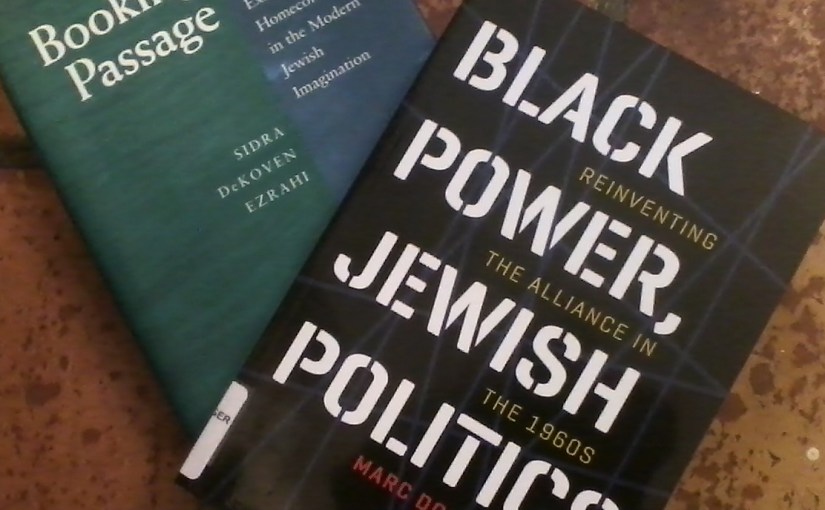
Meanwhile, a recent interview with the author of Black Power, Jewish Politics returns us to the basic challenge that impelled me into this project.

When I talk generally with white Jews about why Jews are involved in social justice or civil rights or racial equality, they’ll talk about this shared history of oppression.

And the problem is that American Jewish history and African-American history are 180 degrees opposite on that question. One of my African-American colleagues, he said, “If I ever go to a Seder and the Jews say that they know what it’s like because they too were once slaves in Egypt,” he’s gonna punch ’em.

Because if Jews have to go back to ancient Egypt to get the slavery metaphor, then they’ve kind of missed that American Jewish history is a story of rapid social ascent, and African-American history is the legacy of slavery. That argument is insulting, and it’s very elementary.

And, of course, I found that the people actually involved in the movement in the 50s, they knew that. And they were quite clear that they were not buying into that.
— Marc Dollinger, 6/4/18 NPR interview

In the struggle for racial and other forms of social justice, might the language and history of Exile serve where Exodus metaphors sometimes fail?

And, as we move through the month of Av and on toward a new year, how might we use ideas about exile and Babylon, in particular, to inform us?

As the source of a long intertextual journey, Psalm 137 generates the poetic vocabulary of exile: “By the waters of Babylon, there we sat down and cried as we remembered Zion.” The pleonastic “there,” repeated in the third verse, calls attention to itself by its very redundancy; syntactically superfluous, “there” defines exile as the place that is always elsewhere. Being elsewhere, being far from Zion, is the pre-text for poetry….(p.9)

With the (re)territorialization of the Jewish imagination in the twentieth century, a radical shift takes place in the relative position of ends and means, of original and mimetic space, of holy and profane, of ownership and tenancy. If exile is narrative, then to historicize the end of the narrative is to invite a form of epic closure that threatens the storytelling enterprise itself–an enterprise that remained alive, like Scheherazade, by suspending endings. Conversely, to claim an absolute place for the exilic imagination is to privilege the story as the thing itself; the map for the territory, language without referent; and to regard “nomadic writing” as the inherently Jewish vocation…. (p.14)
— Sidra DeKoven Ezrahi, Booking Passage

Again, comments and suggestions welcome.

May the mourning of the weeks ahead bring us some new light.

NOTES:
Pleonasm
Although it’s pretty clear from context, and maybe everyone else knows, I did look up “pleonasm” for my own edification. Here’s a useful and not overly ad-filled explanation of pleonasm.
BACK

Citation
Ezrahi, Sidra DeKoven. Booking Passage: Exile and Homecoming in the Modern Jewish Imagination. Berkeley, CA: University of California Press, 2000.
BACK-2

Black and Jewish Communities Sharing History

UPDATED 9/3/18

We Act Radio “Sharing History” for the District and for every place where black and Jewish communities have some things to learn about one another.

Listen here —

“We Act Radio: Black and Jewish Communities Sharing History”
Audio excerpts below

Previous We Act Radio piece, “Misunderstandings are growing…”

Our “Junetenth Building Bridges” party led to further meetings between some interested community members and the launching of the “Cross River (Black and Jewish) Dialogue.” Stay tuned for more as this work develops. Our first effort was the placement of this essay on the Anniversary of Charlottesville in the Forward’s Scribe section.

juneteenth_sharing.jpg

Audio Excerpts:
…Jews always know, from history, that any sense of physical security or relative economic ease is a fragile thing, easily destroyed by the kind of hate speech that labels Jews as others to fear and defeat. We know it’s not a long stretch from muttered conspiracies about Jews controlling world capital to crowds chanting, “Jews will not replace us.” And we can’t forget how quickly co-existence in Europe devolved into destruction and death camps.

At the risk of sounding flip, I adapt a slogan from my youth: “Just because a Jew seems paranoid or over-reacting doesn’t mean folks aren’t out to get them.”

By the same token, if someone from east of DC’s Anacostia River sounds overly-sensitive or paranoid, it doesn’t mean they’re wrong….

…Black people know from history that any level of economic ease or sense of physical security – such as the ability to enjoy a public park, or close one’s eyes in a common college space, or meet colleagues in a coffee house, or work or vacation or walk to grandma’s house – is an extremely fragile thing. It’s not a long stretch from a few muttered remarks about people not knowing their place to a police call that can so quickly destroy one life, or many. And black communities in the U.S. today suffer disproportionate levels of incarceration, unemployment, and poverty because of centuries of anti-Black sentiment, policy, and action.

The city of DC, like much of this country, has arranged life for many White people so that the dangers and suffering black communities face today are out of sight and out of mind. Another result of our segregated lives, in DC & much of the country, is that black and Jewish communities are too often strangers, even when our communities overlap. This means we are too readily convinced to believe evil stories about the other without easy avenues of communication to correct misunderstandings or opportunities for community building.

We Act Radio, WPFW, and additional partners are working on opportunities for more bridge building, including an Election Day-Juneteenth gathering.
Juneteenth Building Bridges Election Watch Party

Korach and Dysfunctional Systems

Earlier this week, my town experienced a police-involved killing, and an elected representative of the community was on the scene shortly afterward. He told reporters he did not want to repeat he-said/she-said but was awaiting video and other evidence: “My job is to get the facts – what happened.”

I’m sure many readers know or can guess the specifics, but I’m leaving them out because I think this situation, like the tale of Korach and his followers — a narrative, which Jews read this week in the annual Torah cycle (Numbers 16:1-18:32), about community and power — has something more universal to teach.

The Official Job

My first thought on hearing this official say his job was to “get the facts” was: No, that’s the job of police detectives and journalists; your job is legislative, budgetary, and related responses to the town’s many challenges. I realized immediately, however, that my first thought came from a fantasy world.

Leaving the facts to journalists and police only works in a world where community members can rely on those individuals and their institutions to pursue the full story, where some level of trust exists.

Officials from some other parts of town have the luxury of sticking to the duties for which they were elected, the privilege of living and working where basic systems appear to be functioning — at least for the people they represent. In the hugely unlikely event that a police-involved killing (God forbid any more anywhere) were to arise on the streets of some other districts in town, elected representatives and constituents could continue their own work, while expecting investigative professionals to do theirs.

This particular official, however, operates amid systems which have long since ceased to function for too many of the people he represents.

So, what exactly is his job? Can it possibly be similar to those of his official colleagues?

The Rebellion

In the bible story, Korach and his followers accuse Moses and Aaron of exalting themselves over the congregation of God. Although teachers over the centuries have made efforts to find some merit in Korach’s argument, he remains the poster child for the evils of greed, self-aggrandizement, and self-interested politics.

We also read that Dathan and Abiram call Moses unfit to lead the People, given that his leadership has already resulted in them being condemned to die in the wilderness (Num 16:13). Just a few chapters earlier, God announced a punishment, following the incident of the spies, for all the adults: “your carcasses shall drop in this Wilderness. Your children will roam for forty years and bear your guilt…” (Num 14:32-33).

The argument from Dathan and Abiram fares no better, in the bible narrative, than Korach’s initial challenge, and the result is catastrophic:

So Moses stood up and went to Dathan and Abiram, and the elders of Israel followed him. He spoke to the assembly, saying, “Turn away from near the tents of these wicked men, and do not touch anything of theirs, lest you perish because of all their sins.” So they got themselves up from near the dwelling of Korah, Dathan, and Abiram, from all around….

When he finished speaking all these words, the ground that was under them split open. The earth opened its mouth and swallowed them and their households, and all the people who were with Korach, and the entire wealth.
— Num 16:26-27, 31-32

Things go from bad to worse in the bible story, and the Children of Israel eventually tell Moses: “Behold! we perish, we are lost, we are all lost….Will we ever stop perishing?” (Num 17:27-28)

Our Job

Every year when we come to this Torah portion, I find myself worrying about the failures of communication involved in the rebellions and wondering how differently things might have evolved, given better listening.

Why are Moses and Aaron, and God, so surprised and unhinged by the People’s lapse of faith (in the spies incident, previous portion)? What if God had just heard their worries instead of responding so negatively to their hesitation?

Why are Moses and Aaron, and God, unable to hear the people’s desperation and anger, in the face of completely failed expectations?

And what is our job, as community members — and, if appropriate, as Jews — whether we live in an area suffering from severe system break-down or not? How might better listening, and closer attention to circumstances behind complaints and rebellion, change things?

Strange and Familiar

Exploring Babylon Chapter 23

Although just published (May 2018), Barracoon: The Story of the Last “Black Cargo” was completed in 1931, based on work begun in the 1920s. Zora Neale Hurston’s Barracoon relates the story of a West African and his experience, before, during, and after U.S. slavery. Some of the content, as well as story of its publication, shed light on #ExploringBabylon.

Oluale Kossola (Cudjo Lewis) was born in Benin, West Africa, around 1841. He was captured by Dahomian warriors and temporarily held in a barracoon, before being sold to slavers. He was then transported to the U.S. on the Clotilda, the last known trans-Atlantic slave ship. At age 86, Kossola granted Hurston interviews that became Barracoon. The long trail from Hurston’s work to publication is related in the current volume by its editor, Deborah G. Plant.

One reason the publication did not appear back in the 1930s was Hurston’s refusal to rewrite Kossola’s vernacular speech in more standard English. I find that listening to Hurston’s voice helps set the scene and prepare the reader for her rendering of Kossola’s speech:

Kossula ceased speaking and looked pointedly at his melon rind. There was still lots of good red meat and a quart or two of juice. I looked at mine. I had more meat left than Kossula had. Nothing was left of the first installment, but a pleasant memory. So we lifted the half-rinds to our knees and started all over again. The sun was still hot so we did the job leisurely.

Watermelon halves having ends like everything else, and a thorough watermelon eating being what it is, a long over-stuffed silence fell on us.
— Hurston, Barracoon, p.40-41


Songs and Names in a Strange Land

Oluale Kossola (Cudjo Lewis) explains the naming of his children:

“In de Afficky we gottee one name, but in dis place dey tell us we needee two names. One for de son, you unnerstand me, and den one for the father. Derefo’ I put de name of my father O-lo-loo-ay to my name. But it too long for people to call it. It too crooked lak Kossula. So dey call me Cudjo Lewis.

“So you unnerstand me, we give our chillun two names. One name because we not furgit our home; den another name for de Americky soil so it won’t be too crooked to call.”
— Kossola, Barracoon, p.72-73

Kossola describes for Hurston the funeral of the first of his children to die:

“We Christian people now, so we put our baby in de coffin and dey take her in de church, and everybody come look down in her face. Dey sing, ‘Shall We Meet Beyond De River’. I been a member of de church a long time now, and I know de words of de song wid my mouth, but my heart it doan know dat. Derefo’ I sing inside me, ‘O todo ah wah n-law yah-lee, owrran k-nee ra ra k-nee ro ro.’ [not translated].”
— Kossola, Barracoon, p.74

Exiles in Babylon believed they would one day return home, meanwhile pining: “How shall we sing the LORD’S song in a foreign land?” (Ps. 137:4). Kossola seems to ask, instead: Can we ever sing our own songs in this land from which there seems no escape?

Strange, Familiar, Tales

This parable, among several Kossola shared, was told after the death of his wife:

“’You see Ole Charlie dere. S’pose he stop here on de way to church. He got de parasol ’cause he think it gwine rain when he leave de house. But he look at de sky and ‘cide hit ain’ gwine rain so he set it dere by the door an’ go on to church. After de preachin’ he go on home ’cause he think de parasol at Cudjo house. It safe. He say, “I git it nexy time I go dat way.” When he come home he say to one de chillun, “Go to Cudjo house and tellee him I say sendee me my parasol.”

“’De parasol is pretty. I likee keep dat one.’ But I astee dem all, ‘Is it right to keep de parasol?’ Dey all say, ‘No it belong to Charlie.’

“’Well,’ I say, ‘my wife, she b’long to God. He lef’ her by my door’
— from Kossola’s parables, Barracoon, p.92

This tale comes from a medieval collection of midrash:

[Rabbi Meir is at the house of study, and Beruriah is at home, when their two sons both die suddenly on the Sabbath. After Meir returns home and the Sabbath comes to a close…]

“Rabbi,” she then said, “some time ago a deposit was left with me for safe-keeping, and now the owner has come to claim it. Must I return it?”

“Can there be any question about the return of property to its owner?” said R. Meïr, half astonished and half indignant that his wife should entertain a doubt.

“I did not care to let it go out of my possession without your knowledge,” replied Beruriah, seemingly in excuse, and, taking him by the hand, led him into the room in which the bodies of their two sons were lying on the bed. When she withdrew the cover, R. Meïr broke out in tears and plaints. Gently Beruriah reminded him of his answer to her question about the return of a treasure entrusted to one for safe-keeping, adding the verse from Job (i. 21): “The Lord gave, and the Lord hath taken away; blessed be the name of the Lord.”
— from Proverbs 964, Yalkut Shimoni
as quoted in the Jewish Encyclopedia

I would be very interested to learn if Christian lore includes stories similar to the tale about Beruriah and Meir (2nd Century CE) and Kossola’s early 20th Century parable.

Strangeness in the Story

One more note from Deborah G. Plant’s comments:

In face of Kossola’s recollections, the social constructions of “My People” and “Africans” were deconstructed by the reality of ethnic identifications, which not only distinguished tribes and clans but also generated the narrative distance and the ideological difference that rendered one ethnic group capable of regarding another as “stranger” or “enemy,” and allowed that group to offer up the “Other” to “the Trans-Atlantic trade.”

“One thing impressed me strongly from this three months of association with Cudjo Lewis,” Hurston writes. “The white people had held my people in slavery in America. They had brought us, it is true and exploited us. But the inescapable fact that stuck in my craw, was: my people had sold me and the white people had bought me. That did away with the folklore I had been brought up on – that the white people had gone to Africa, waved a red handkerchief at the Africans and lured them aboard the ship and sailed away.” [footnote]
— Plant, editor, Barracoon, p.124-125

Hurston’s struggle, comparing what she learned from Kossola with what she’d been previously taught, is reminiscent in some ways of David W. Stowe’s comparison of the Exodus story with that of Babylonian Exile.

NOTES

Zora Neal Hurston (1891-1960)
Barracoon: The Story of the Last “Black Cargo.”
Foreword: Alice Walker. Editor: Deborah G. Plant
NY: Amistad (HarperCollins), 2018.
Interviews were conducted in 1927. Book was completed in 1931.
More on this volume from HarperCollins
Short, clear background piece.
NPR story about the publication
BACK


Footnote in Barracoon cites Zora Neale Hurston, Dust Tracks on a Road: An Autobiography. Urbana, IL: University of Illinois Press [1942], 1984. p. 200
RETURN


A Song of Reward and Punishment

Exploring Babylon Chapter 22

Here is further response to a long-ago comment of Max Ticktin (z”l), based on the words of Jeremiah and in a sort of homage to Leonard Cohen.

“Has this song gone on too long?
A song of reward and punishment
for exiles in Babylon and elsewhere”

The theme repeats again and long
this song of punishment and reward
Is our pain fault or accident?
The heart is indeed most devious!

You say that we’ll be cursed if we
trust in folks whose strength is flesh
that we’ll lose heart,
turn our thoughts away

We’ll feel just like a desert bush,
parched, alone, and unaware
that good might come
that water could be flowing

And then You say that we’ll be blessed
if we trust You
and You alone
We’ll be like trees that will not lack for water

You promise we’ll not think of drought,
our leaves will be forever fresh
we’ll have strong roots and bear more fruit
But is it wise to pretend no heat is coming?

The theme repeats again and long
this song of punishment and reward
What could it harm, I’m bound to ask,
if I were just a wealthy fool?

Saved or doomed? God only knows!
You’re refuge, you’re chastisement
Probe my heart and heal me now
Or has this song gone on too long?

Who gets justice in this world?
I’m a shepherd who has lost the way
The theme repeats again and long
this song of punishment and reward
— V. Spatz, 2018
from Jeremiah 17:5-8 and surrounding verses


NOTE

As noted in previous post, “A Song of Reward and Punishment,” which is what Max called Jeremiah 17:5-8, just seems like something Leonard Cohen would have written. I imagine something that sounds somewhere between “Darkness” (“Old Ideas,” 2012) and “You Want It Darker” (eponymous album, 2016).


TOP

Notes on Jeremiah: Max Ticktin’s Scribbles

Exploring Babylon Chapter 21

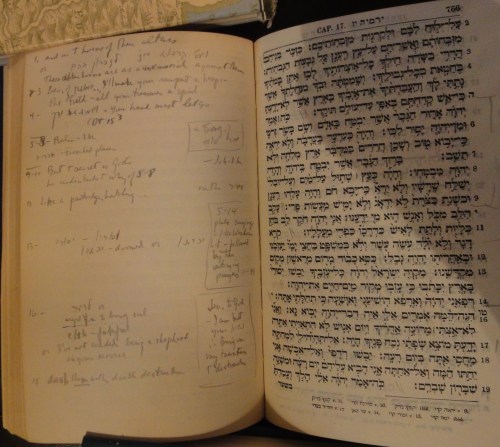
Several updates below. In addition to the many other things he left us, Max Ticktin z”l (1920-2016) left behind a lot of books, and his family kindly offered them to interested community members. Some of the volumes I inherited this way are from a Tanakh that was re-bound, as a gift for Max early in his rabbinical career, with pages opposite the text for his own notes.*

Some of Max’s notes are straightforward translation or links to related verses. Some are literary, some theological. Occasionally, his chuckle is obvious. Sometimes the notes are just opaque, to me anyway. Whatever the content, I consider it a great privilege and pleasure to have Max’s scribblings accompany me in my studies. (See also The Hebrew Bible (Greenspan).)

Some Notes and Questions

Here, pertinent to this week of Behar-Bechukotai, are some annotations for Jeremiah Chapter 17 (Haftarah for Bechukotai  is Jer 16:19-17:14).

Max on Jeremiah_Cropped
Notes by Rabbi Max Ticktin on Jeremiah 17

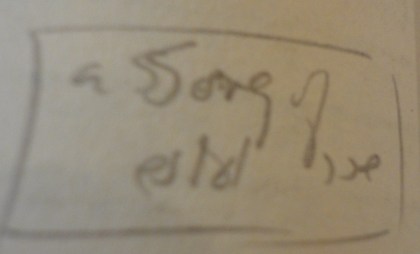
I am hoping someone with more background and/or better skill at reading Hebrew script can decipher this comment:

A Song of.jpg
Close-up: “A song of…,” annotation to Jer. 17:5-8

“A song of…[??]”
?? שכר ועונש ??
?? retribution? punishment? payback?

UPDATE 5/11: sources tell me my rendering of the Hebrew “שכר ועונש” is correctly spelled and can be transliterated “sachar va’onesh” and translated as “reward and punishment.”**.

 
And maybe some experts at English handwriting can fill in what I’m missing here:

Max on Chapter 16
Notes on Jeremiah 16:18 – 17:1

19ff — dialogue of Jeremiah and God on God’s [??] the transformation of people!

Note: based on other passages, that lonely lowercase “a” = “and,” and the lowercase “t” = “the.”

UPDATE 5/13: A member of the Fabrangen community suggest that the word I couldn’t read may be “inclination.” Another points out that “the letter ‘C’ with a bar over it is often an abbreviation for ‘with’ in the form ‘cum’.” So, then we’d have something like: “dialogue of Jeremiah and God on God’s inclination with the transformation of people!”


Babylon and Transformation

Not sure exactly what this haftarah, with or without Max’s commentary, adds to #ExploringBabylon. But I am very interested in two images for God, both found in Jer 17:13 —

  • mikveh yisrael [מִקְוֵה יִשְׂרָאֵל]” or “hope of Israel” and
  • mekor mayim chayyim [מְקוֹר מַיִם-חַיִּים],” or “fountain of living waters”

and how these are related to “the transformation of people!”

More to come, maybe. Meanwhile, please let me know your ideas about how to read the above comments.

[On this 40th day of the omer, making five weeks and five days. — 5778]

NOTES

* I recall Max mentioning this gift and how much it meant to him several times, and I expected that regulars at Fabrangen and Jewish Study Center activities would share similar recollections. But I have not heard from others who remember him saying this….which makes it all the more interesting that it turns out I know family members of the rabbi who gave Max these books.

ADDITION 5/11 (not exactly “Update”): It’s not the most common of conversation topics, but somehow, long before Max died, Rabbi Danny Zemel of Temple Micah (DC) mentioned to me that his grandfather had once related, with great fondness, giving the special, re-bound copy of the Tanakh. Rabbi Zemel’s grandfather, Rabbi Solomon Goldman (1893-1953), served Anshe Emet Synagogue in Chicago from 1929-1953, where he and young Max connected.

Long after that brief conversation, while exploring the books the Ticktins were giving away, I happened upon two volumes that resembled the ones Max and Rabbi Zemel had both described. I was so excited, I had to double-check that the family meant to part with them. I was reassured and gratefully added them to my pile.

When I emailed a picture of the fly leaf to Rabbi Zemel, he recognized his grandfather’s writing. So I was delighted to be able to share one of the volumes with Rabbi Goldman’s family.

On occasion, I marvel at the odds of that book making it back “home,” in a sense. The Jewish world is sometimes small, but Reform and havurah circles — like Temple Micah and Fabrangen — don’t interact all that much; my participation in both communities is unusual. So, I am tempted to call it “bashert [fate, destiny].” But then I see Max rolling his eyes at me and explain it instead as follows.

Max had an uncanny ability to connect deeply, and very specifically, with so many people: Everyone who passed through that Ticktin library after Max’s passing surely found a special treasure that seemed destined just for them. In addition, although I never knew him, Rabbi Goldman had a large impact on Judaism far beyond his own, influential congregation — and clearly he made an impression on Max who, however accidentally, impressed on me, as Rabbi Goldman did on a young Danny Zemel, that these books embody an enduring connection between lifelong students of bible.
TOP


** “A Song of Reward and Punishment”? Didn’t Leonard Cohen write that? Maybe Sarah Rindner’s recent piece on “The Lehrhaus” — which links Leonard Cohen and this week’s Torah portion — put the idea in my mind. But I can somehow hear him singing it, even though I’m pretty sure there’s no such song in his opus. In any case, establishing that the words on the page say something like, “A Song of Reward and Punishment,” is only prelude to understanding the passage from Jeremiah and its context….

UPDATE 5/13: Here’s my homage to Leonard Cohen and the prophet Jeremiah.

BACK

Trauma and Migration Studies, The Book of Job, and Babylon

Exploring Babylon Chapter 20.2

Chapter 20.1 focused on monsters and storytelling, touching on the intersection of migration experiences and trauma. In follow up (with apologies for the delay), a few notes about the academic fields of migration and trauma studies and their relevance to #ExploringBabylon.

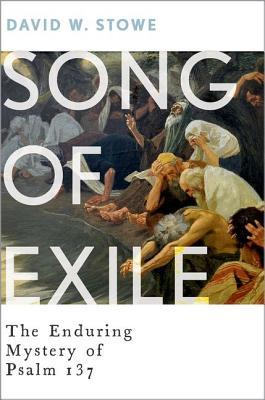
To begin, David W. Stowe discusses the application of trauma and migration theories to biblical studies* and, in particular, to his exploration of Psalm 137.

Migration and Trauma

On trauma theory and bible, Stowe writes:

Certainly the Bible provides voices that resonate with pain caused by the experience of the Exile in Babylon….

Reading the biblical literature through the lens of trauma theory suggests an agonizing experience during the Golah [Babylonian Exile]. Recent work in trauma theory and post-traumatic stress disorder (PTSD) shows that symptoms associated with psychosis and other mental illness are symptoms of the human psyche struggling against an overload of anguish. Distortions in verbal and written communication [which Stowe and many others identify in the Book of Ezekiel, for example], even a failure to communicate at all — to become mute — reflect strategies of self-defense….
— Stowe, Song of Exile, p.8-9

Stowe looks at migration theory in the same context:

Because we learn so much about Moses’ long attempts to win freedom from bondage for his compatriots, we assume that Egyptian slavery must have been harsher [than that of Judean exiles in Babylon]….

To flesh out this monochromatic picture of the Golah experience, scholars have brought to bear analytic tools from the social sciences, in particular the recent field of migration studies….An important contribution in the recent scholarship lies in drawing distinctions between different categories of people who formerly might have been simply labeled “exiles” or “refugees.” These blanket terms obscure a host of subtle variations: between migrants, exiles, refugees, and members of a diaspora; between voluntary and involuntary migrations; between internal migration and migration that crosses political boundaries.
— Stowe, Song of Exile, p.10

Stowe’s specific discussion of Psalm 137 awaits another day and another post. Meanwhile, though, his remarks above link back to Junot Díaz’s Islandborn: how differing immigration experiences lead to different recollections and relationships around the country departed — including, in many cases, a silence hard that can make it difficult for younger generations to learn their family’s past.

Stowe’s remarks also relate to a very different style of biblical study.

The Book of Job

The Book of Job offers linguistic, literary, and theological challenges when it comes to assigning authorship or even declaring the century in which it was committed to writing, in whatever form. See, for example, these authorship pieces by Columbia’s Brennan Breed and Elon Gilad of Haaretz. Moses Sokolow explores Talmudic ideas about authorship and elaborates on those with another suggestion.

Sokolow first argues, in Tanakh: An Owner’s Manual (full citation below), that three or four of the seven Talmudic suggestions for Job’s authorship overlap chronologically so as to suggest a consensus around authorship in the time of the Chaldeans (Babylonians). He then goes on to present a hypothesis:

Since Ezekiel lived during the era of the Chaldeans and was the only biblical author acquainted with Job, it is not a priori unreasonable to ascribe the Book of Job to him, particularly if we now take note of the one Talmudic opinion [of seven] we have thus far omitted: “Iyyov lo’ hayah ve-lo nivra’” – “Job never existed”; his story is only a parable (Bava Batra 15a).

The usual understanding of the Book of Job is that it addresses the question of theodicy….

But what if Job were the personification of the Jewish people? What if the destruction of his home, the loss of his wealth, and the death of his sons were parables for the destruction of the Temple, the forcible exile, and the many concomitant deaths and privations suffered by the Jewish nation? Ezekiel’s prophetic mission was devoted to reassuring the exiles that God’s presence was among them even in Babylonia, and that there would be a return to Zion and a restoration of the Temple. Could the Book of Job, then, not be Ezekiel’s own “Holocaust theology,” offering the conventional explanation for suffering (sin), rejecting it, and replacing it with the reassurance that there was a divine plan for history as there was for nature, and that our inability to perceive the former is in no way different from our like inability to comprehend the latter?
— Sokolow, p.43

Sokolow’s suggestion is presented in a different framework from biblical studies working from predominantly Christian sources. Both methodologies lead, however, to further discussion of trauma and migration in relation to biblical stories.


on this 27th day of the omer, making three weeks and six days

NOTES:

Here are two fairly recent relevant collections on migration, trauma and other theories of exile:

Interpreting Exile: Displacement and Deportation in Biblical and Modern Contexts. Ranier Albertz, ed. Atlanta, GA: Society of Biblical Literature, 2011.

By the Irrigation Canals of Babylon: Approaches to the Study of Exile. John J. Ahn and Jill Middlemas eds. NY: T & T Clark International (Continuum), 2012.

Note, please, that Stowe, like many other scholars in the field called “biblical studies,” cites predominantly Christian sources. Moreover, some remarks in Song of Exile suggest his exposure to Jews is limited (see Song of Exile page) — which is not uncommon in Christian biblical studies. For more on this topic generally, see also “Babylon and Adventures in Bibleland” as well as “Babylon Basics.”
BACK


Tanakh: An Owner’s Manual: Authorship, Canonization, Masoretic Text, Exegesis, Modern Scholarship, and Pedagogy. Moshe Sokolow. NY: Ktav, 2015.
BACK