It is time to re-order our national priorities. All those who now speak of good will and praise the work of such groups as the President’s Commission* now have the responsibility to stand up and act for the social changes that are necessary to conquer racism in America. If we as a society fail, I fear that we will learn very shortly that racism is a sickness unto death.
— “DR. KING CALLS FOR ACTION AGAINST POVERTY AND RACISM CITED IN RIOT STUDY; POOR PEOPLE’S CAMPAIGN STARTS APRIL 22 IN WASHINGTON,” 3/4/68 SCLC press release (see King archives)
*Nat’l Advisory Commission on Civil Disorder (report summary)
The president of the Southern Christian Leadership Conference continues, calling racism a “congenital deformity” of the United States:
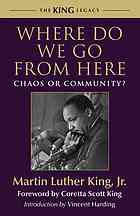
Ever since the birth of our nation, white America has had a schizophrenic personality on the question of race. She has been torn between selves—a self in which she proudly professed the great principles of democracy and a self in which she sadly practiced the antithesis of democracy. This tragic duality has produced a strange indecisiveness and ambivalence toward the Negro, causing America to take a step backward simultaneously with every step forward on the question of racial justice, to be at once attracted to the Negro and repelled by him, to love and to hate him. There has never been a solid, unified and determined thrust to make justice a reality for Afro-Americans…. What is the source of this perennial indecision and vacillation? It lies in the ‘congenital deformity’ of racism that has crippled the nation from its inception.
— Martin Luther King, Jr., Where Do We Go From Here: Chaos or Community?
1967; Reprinted, Boston: Beacon Press, 2010
One month later, 48 years ago today, Martin Luther King was assassinated.
This year, Passover begins on April 22. Where do we go from here?
While everyone in the U.S. must be asking this question, it seems particularly incumbent on Jews as the annual festival of freedom approaches: None of us is free unless all of us is free.
How are faith communities responding to the ever-growing plague of gun violence in our midst? As some communities are just beginning to find their voices on this issue.
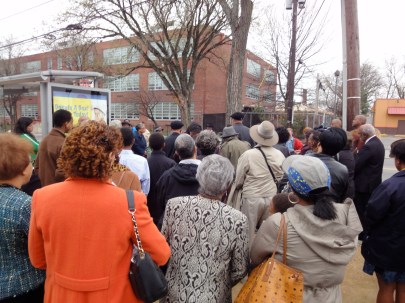
Prayer rally at Naylor Road, near Alabama Avenue, SE, March 13 (photo copyright: V. Spatz)
East Washington Heights Baptist Church held its first public response to gun violence just recently, for example. The church, in DC’s Hillcrest neighborhood (Ward 7), organized a prayer march and rally against gun violence on March 13. The prayer event came in the wake of a multiple shooting in a nearby bus stop on Sunday afternoon, March 6, which resulted in the death of 39-year-old Ivy Tonett Smith. Charnice Milton, my 27-year-old colleague at Capital Community News, was shot to death at the bus stop across the street on May 27, 2015. Look for more on this in the April edition of East of the River.
Others, like Presbyterian churches in and around Washington DC, have been active in responding to gun violence for many years. Area churches, along with others concerned, continue to protest outside one “bad dealer” store — linked to more than 2500 guns used in crimes over the course of 18 years — every fourth Monday at 4:00 p.m.
Presbyterian churches have also hosted this T-Shirt Memorial to 2015 victims of gun violence in DC. Here’s a slideshow from the memorial installed at Fifteenth Street Presbyterian.
Finally, for now: The sermon at the heart of the movie Chi-Raq, despite controversies and faults of the film, gives us a glimpse of how St. Sabina, on Chicago’s Southside has been approaching this plague.
How is your community responding? What (else) would you hope to see?
What roots do you want to tap for your community’s future? What seeds do you want to nurture?
This community-tree “seder” was crafted during Snowzilla and seems appropriate to share on another snowy day in DC. This may seem odd timing – celebrating trees when branches are bare and everything is covered with a thick layer of snow. But the holiday; marks the point when last year’s leaves are long gone and new buds are still weeks away. The challenge is to celebrate future blooms when things look bleakest.
Even though the holiday has come and gone (Jan. 24-25, 2016) this year, the cold, tree-less conditions have not abated in many places. And envisioning new growth and planning for new blossoming is never out of season.
This seder can be used to consider any community’s seeds, roots, and hopes for fruit. It was written specifically for the area east of DC’s Anacostia river, however, and the full story is available on-line and in PDF: Frozen to Bloom).
The New Year for Trees is one of four new years in the Jewish calendar. It generally falls at a time when much of the northern hemisphere is at its most frozen and inhospitable.
“Claiming the center stage, just like Pharaoh and Caesar did in their time, has always been a blasphemous overreach that actually places oneself on the margins of God’s reign,” thus writes Drew G.I. Hart in Trouble I’ve Seen.
This new title focuses on “Changing the Way the Church Sees Racism,” but much of what Hart says needs equal attention in the Jewish thought. (Trouble I’ve Seen: Changing the Way the Church Sees Racism. Harrisonberg, VA: Herald Press, 2016.)
Religious Thought and Practice
Hart notes the optional or alternative status of “women’s,” “peace,” or “black” theology:
According to [teacher John Franke] white male theologians have often seen themselves as objective and neutral overseers of Christian tradition. They function as “theological referees” for everyone else, while imagining their position as neutral and unbiased in the center of all the action….Missing is that white men have a social context too.
— p. 163, Trouble I’ve Seen
A parallel situation still applies all too well in much of the Jewish world. As does his analysis of how well-intentioned attempts at diversity and inclusion often fail to create real change. Many of his recommendations for the Church are ones other faith communities should explore as well:
“See the world from below,” by changing reading habits, for example. (See “Range of Possibilities” for some suggestions.)
“Subvert racial hierarchy in the [religious infrastructure].”
“Soak in scripture and the Spirit for renewed social imagination.” (Explore “Pharaoh’s Hardened Heart,” e.g. and these resources from Reform Judaism’s Religious Action Center.)
“Seek first the kingdom of God.”
Engage in self-examination.
— from p. 176, Trouble I’ve Seen
Current and Historical Re-Examination
Hart’s exploration of “White Jesus” and related Church history may seem irrelevant to those outside the Christian faith. This is important background for every U.S. citizen, however, and worth review for those as yet unfamiliar.
Moreover, Jewish communities would do well to consider whether our members are aware of essential demographics — such as a recent study showing white men with criminal convictions more likely to get positive job-application responses than black men without a record (see p. 145) — and the individual and cumulative effect of everyday racism experienced by the author of Trouble I’ve Seen.
Most importantly, Jews must join our Christian neighbors in examining how we “resemble this remark”:
Too many in the American Church have perpetuated the myth that this land was build on Christian principle rather than on stolen land and stolen labor.
p.145, Trouble I’ve Seen
Hart’s new volume provides important food for thought as we continue to read Exodus this winter and experience it in the upcoming Passover season.
“…but they did not heed because of shortness of spirit-breath” (Exodus)
“It’s complicated…” (“Wrestling Jerusalem”)
Early on in the Exodus story, we learn that the Hebrew slaves in Egypt were unable to absorb Moses’ message of imminent redemption because of “shortness of breath” or “crushed spirit” due to “hard work” or “cruel bondage” (Exodus 6:9; see note below).
At this point, Moses asks God how it is that he, of “blocked speech,” will be able to communicate God’s message to Pharaoh, when even the Israelites won’t listen to him. The story continues with a strong focus on Pharaoh’s inability to hear, alternately attributed to “stubbornness” (e.g., Ex 7:13) and “hardness of heart” (e.g., Ex 8:11). Hebrew below.
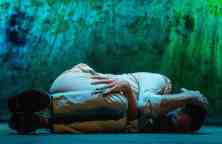
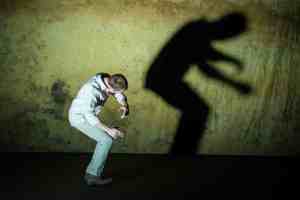
Aaron Davidman in “Wrestling Jerusalem,” now at DC’s Mosaic Theater (Photo: Teddy Wolff)
So, at the center of the Exodus story is a massive, multi-faceted failure to communicate: a prophet/leader with blocked speech (more literally: “uncircumcised lips”), slaves who cannot breathe well enough to communicate clearly, and a ruler who cannot even hear his own magicians (Ex 8:15) and servants (Ex 10:7). The story reminds us how difficult it is for communication to succeed across communities and through oppression. And the story warns us of the dangers of failing in those communication attempts.
Aaron Davidman‘s one-man play, “Wrestling Jerusalem” — currently [January 2016] at Mosaic Theater Company of DC — embodies at least 17 different voices, from across Israel and Palestine, in monologue and in argument. Each voice provides a very specific perspective, unique to the conflict he is exploring. Throughout the performance, however, echoes of the U.S. conflict come through loud and clear.
Wrestling Jerusalem and the U.S.
In the play, one Palestinian voice explains that the only Israelis he has met are soldiers who often mistreat him and rarely recognize his humanity. How many people of color in the U.S. have a similar experience with white people?
Photo: Teddy Wolff
Many Black communities in the U.S. view police, not as protectors of peace, but as a “White” power structure occupying and terrorizing their neighborhood. Too many people of color know white people only as government representatives and developers ready to view them as problems to be “fixed.”
“Wrestling” characters, alternately inhabiting Davidman’s body, argue about Hamas: Is it a community organization with a strong feeding program? or an armed group bent on the destruction of Israel? Would donations ear-marked for food programs simply enable violent resistance? With minor changes, these same words have been used to discuss the Black Panther Party or the Nation of Islam: Caring for the ‘hood? Or plotting the downfall of the U.S. power structure?
It’s Complicated
The performance opens with a brilliant “multi-logue” beginning with the pronouncement: “It’s complicated.” Davidman tries to identify the conflict’s start: With the ’67 war? Or 1948 — called either “the Catastophe” or the “War of Independence,” depending on one’s perspective? Maybe with earlier Arab or Jewish violence…or with the British or the Romans? It closes with cries of “If only the world would just leave us alone!” and “If only the world would get involved!”
It’s hard not to hear another set of wrestlers with a parallel litany of “how it started.” Beginning perhaps with Sandra Bland or Trayvon Martin, extending to Emmett Till and Medgar Evers, lives and livelihoods lost in riots of the 20th Century or the 19th, uprisings and mobs of the 18th Century. Then stretching back through U.S. economic dependence on labor of enslaved people and beyond to European views of the “Dark Continent.”
“Help us!” “Leave us alone!”
We might also hear, echoed in the final lines, calls for police to stop “occupying” black neighborhoods and for “Displacement Free” development zones, on the one hand, and on the other, attempts to involve the the U.N. in human rights violations within the United States.
Photo: Teddy Wolff
The “Aaron” character of “Wrestling Jerusalem” tells us, as he rides the bus through security checkpoints, that he’s been to Israel many times but never before crossed into Ramallah. Likewise, how many residents of north or west Chicago rarely, if ever, cross 75th Street to the South? How many residents of western Washington, DC, seldom cross the Anacostia River? And, of course, vice versa.
Listen!
So many other elements of “Wrestling Jerusalem” — from description of inter- generational trauma to discussion of if/when to take up arms — apply equally to the United States. Davidman’s gift to the conflict around Israel is in embodying and weaving together, with respect, so many voices: Arab and Jew, Israeli and Palestinian, settler and soldier, partier, tourist, and long-time Liberal Israeli rabbi. Each is given the floor and heard in turn. In giving them each something of himself as well as their own unique voices, commonality and difference, Davidman helps us listen across conflict and through oppression.
In a sense, “Wrestling Jerusalem” is an antidote for the Exodus’ failures to communicate. May we listen equally well to the many, often-overlooked perspectives of conflict in the United States.
Tickets still available for limited DC run, through January 24.
Thanks to Elliot Eder and participants in Fabrangen West and to the LCVY Hill Torah Discussion Group for Exodus insights that inspired these remarks.
Exodus 6:9 וַיְדַבֵּר מֹשֶׁה כֵּן, אֶל-בְּנֵי יִשְׂרָאֵל; וְלֹא שָׁמְעוּ, אֶל-מֹשֶׁה, מִקֹּצֶר רוּחַ, וּמֵעֲבֹדָה קָשָׁה.
Moses [delivered God’s message of imminent redemption] to the Children of Israel. But they did not heed Moses, because of shortness of breath and hard work [or crushed spirits due to cruel bondage].
מִקֹּצֶר רוּחַmi-kotzer ruach ruach = “breath” and “spirit” mi-kotzer ruach = “shortness of breath” or “crushed spirit”
וּמֵעֲבֹדָה קָשָׁהm’avodah kashah avodah = “work,” “bondage,” and “worship” m’avodah kashah = “hard work” or “cruel bondage”
וַיֶּחֱזַק לֵבchazak lev
“stubbornness” (literally: strong of heart; e.g., Ex 7:13)
וְהַכְבֵּד אֶת-לִבּוֹkh’veid et-libo
“hardness of heart” (literally: heavy of heart; e.g., Ex 8:11) BACK
Sandra Bland.
Alonzo Smith.
Natasha McKenna.
Jamar Clark.
The heartbreaking and indicting list goes on.
Activists and mourners from the DC area and around the country joined together last year, at this season, for “Voices of Grief and Struggle,” focusing on ten mothers who lost black sons in police custody around the U.S.
Since, then, sadly and to our shame, we have lost too many more in similar circumstances.
It is time to listen again to these mothers:
Deborah Copp Elliott, mother of Archie (“Artie”) Elliott III (Age 24)
Collette Flannigan, mother of Clinton Allen (Age 25)
Darlene Cain, mother of Dale Graham (Age 29)
Rev. Wanda Johnson, mother of Oscar Grant, III (Age 22)
and the others who shared their powerful messages, “ Voices of Grief and Struggle,” in the nation’s capital last year.
It is also time to stand with Beverly Smith, mother of Alonzo Smith (age 27), discovered dead in custody of private security at Marbury Plaza Apartments in Southeast Washington, DC, on November 1.
Prayers and support are needed to uplift Beverly Smith (left, at December 1 vigil), all who knew Alonzo (“Zo”) Smith, all who seek justice for this young man and the many others lost to police brutality, and all who demand an end to this on-going horror.
In the DC area, consider joining the rally on December 12. (See flyer)
Readers may have noticed a long silence on this blog. But I have not been entirely silent.
At start of June 2015, I began an additional blog, #SayThisName, to mark those lost to homicide and police action in the District of Columbia. Since then, I have personally typed out and said aloud the names of 95 individuals lost in our city in less than six months. The list includes friends of friends, a domestic murder-suicide a few blocks from my home, and a shooting on the steps of a church across from my work. I glimpsed a few seconds of the latter scene nearly three months ago, and the picture rarely leaves me for long. These are not statistics or abstractions. And this recitation has, it seems, captured a large part of my voice.
I am grateful to Temple Micah (DC), one of my spiritual homes, for their practice — several months old now — of listing the names of those lost to violence in the city as we rise to recite Mourners Kaddish. It is clearly having an effect on many in the congregation, including our new rabbi, Susan Landau, who is also new to DC. While guns are not behind every death in our town, they play a big role. And Rabbi Landau is joining with others nationally to address this problem.
Rabbi Landau spoke powerfully at the interfaith “United to Stop Gun Violence,” November 3, at the National Cathedral.
Project End Gun Violence activists with Rep. Elizabeth Esty (D-CT 5th, Newtown-Sandy Hook) at the Cathedral 11/3/15
Rabbi Landau’s remarks begin at 23:00 above.
Imam Talib Shareef of DC’s Masjid Muhammad speaks at 28:00.
Film includes other local and national activists, prayers, and song.
Many national groups working on gun violence from one angle or another participated in the November 3 event. Some of the resources shared there appear on this page.
To support National Gun Violence Prevention Sabbath, which is coming up December 10-14, 2015, I am crafting a prayer to be part of Temple Micah (DC) services on that weekend.
It is based on the prayer “for our country” in Mishkan T’filah, the most recent prayerbook of the Central Conference of American Rabbis. (Mishkan T’filah, NY: CCAR, 2007. This prayer is on p.258 here.)
[this blog originally shared a draft for comments]
Here is an updated version for considering, sharing, and, most importantly, for praying!
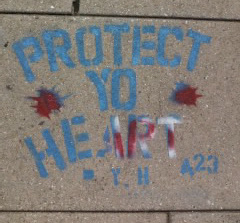
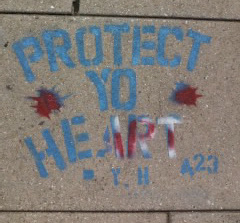
Early in the holidays, I shared a message I’d found stenciled on the sidewalk, suggesting that maybe, when one’s heart is already broken, “protect yo heart” might be Days of Awe advice worth considering. Comments included thoughts about the Shekhinah’s wings sheltering “the bereaved, the brokenhearted” and a warning: “…the fact that your heart is broken as an existence proof that you have a heart that can be broken.”
Both comments have stayed with me through the ensuing days. But I admit to finding this breakable heart more debit than asset at the moment, and, while I’ve experienced shelter in my own personal griefs, I am not convinced that it extends to those most in need, in my town or beyond, in the vast, and sadly expanding, diameter of so many bullets and attendant trauma.
…Although I witnessed only one, the District has seen 116 homicides, as of 9/25/15; of course, this figure does not take into account the many other violent crimes in DC — or elsewhere — nor does it calculate the trauma for families, friends, and neighbors of each crime or the disastrous conditions that contributed to the crimes….
“…and I can’t hear the song for the singer”
This morning, the L’Chayim V’Yayin Torah study group completed a year of weekly studies by reading V’zot HaBrachah [“this is the blessing”] (Deut 33:1 – 34:12). We noted how different it was to focus on the death of Moses in this format, where we had time to really consider the scene and his final words. We usually meet this portion as part of a Simchat Torah celebration — in which the final words of the Torah are quickly linked to the initial words, as we begin a new reading cycle.
I personally do not usually mourn, or even much consider, Moses’ death: He remains centered forever, after all, in the narrative of the People’s trek out of bondage and toward freedom. Like Moses, we never quite make it out of the Wilderness, but go around again each year, glimpsing, perhaps, but never getting beyond the River Jordan.
Our study group paused, however, to consider the position of a revolutionary who can only lead the folks so far, who sees but does not cross over. We discussed an essay on this portion — “This is the Blessing: The ‘First Openly Gay Rabbi’ Reminisces” (more below) — which relates the life of Moses to that of a “social pioneer,” being “first” when young and “last” when old.
“When the strings of my heart start to sever”
Meanwhile, a few days ago, I stumbled upon a recording (20 years old, but new to me; see below) from a different sort of revolutionary He is also at the banks of a river — although, unlike Moses, he has not seen the other side. Somehow, “when the strings of my heart start to sever” put me in mind of an oddity of the first and last words of the Torah:
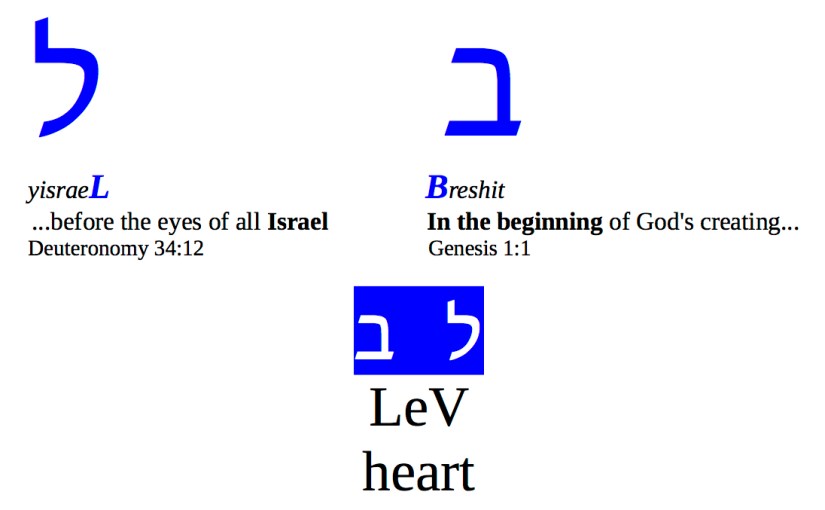
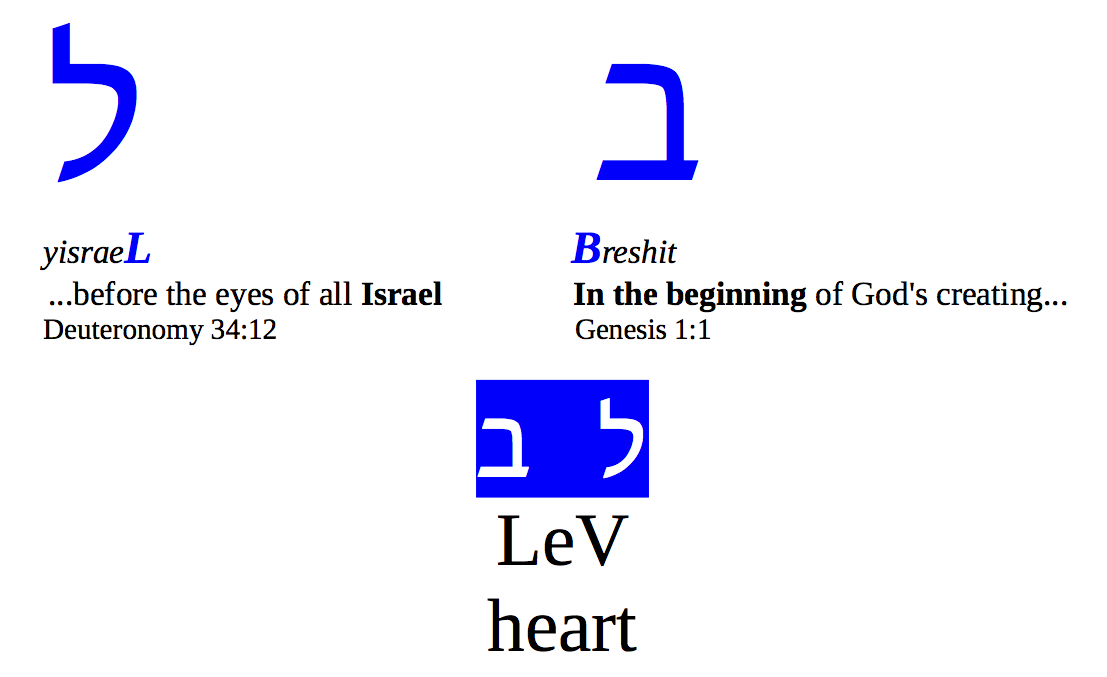
The last word of the Torah is ישראל (Yisrael), making the final letter of the Torah ל, lamed. The first word is בראשית [“in the beginning”], with the initial letter ב, bet. Linking the two letters forms the word “heart [לב, lev]” — either read “backward,” so the Torah is seen as the “heart” of the Jewish people, or stretching the lamed around to meet the bet, as we do when one reading cycle completes and the next begins on Simchat Torah. (more on this here)
“If I were at the border of the promised land, knowing I couldn’t get in,” writes the “social pioneer”(see above):
…I’d say, “Be true to yourself.” I don’t say it glibly: it’s one of the most difficult challenges any of us face….Whatever it costs you to live a life of integrity, you have to do it.
— “This is the Blessing: The ‘First Openly Gay Rabbi’ Reminisces,”
by Allen Bennett as told to Jane Rachel Litman Torah Queeries. NY: NYU Press, 2009. p.280
The author of “Black Muddy River,” though younger than I am now when he wrote these lyrics, reported later that the song
…is about the perspective of age and making a decision about the necessity of living in spite of a rough time, and the ravages of anything else that’s going to come at you.
— Robert Hunter, quoted in David Dodd’s “Greatest Stories Ever Told”
May all find healing in the rolling to come
Black Muddy River
This particular rendition is an encore at July 9, 1995 Grateful Dead concert (the last before Jerry Garcia died). Vocals are some of Jerry’s last public words.
“Black Muddy River”
When the last rose of summer pricks my fingers
And the hot sun chills me to the bone
When I can’t hear the song for the singer
And I can’t tell my pillow from a stone
I will walk alone by the black muddy river
And sing me a song of my own…
…I don’t care how deep or wide
If you got another side
Roll muddy river…
…When the strings of my heart start to sever
And stones fall from my eyes instead of tears
I will walk alone by the black muddy river
and dream me a dream of my own
I will walk alone by the black muddy river
And sing me a song of my own
And sing me a song of my own
— Robert Hunter, 1986 Full lyrics at Dead-net
David Dodd’s annotated lyrics
One common, powerful theme of the high holidays is the idea of the broken heart. This is encapsulated prominently in the blowing of the shofar, with its shevarim [shattered] call. (See, e.g., The Shofar as Prayer at My Jewish Learning.)
All who hear the ram’s horn — during the preparatory month of Elul and the Days of Awe — are meant to experience a broken heart. And, so according to this story, is the one who sounds the shofar:
Rabbi Wolf, shofar blower in the synagogue of the Baal Shem Tov, has been studying special intentions for his annual role, but loses his crib sheet on the bima; forgetting everything, he blows the shofar with a broken heart. The Baal Shem Tov tells him,
“In the Palace of the King there are many rooms and halls, and each door to a room or a hall has a different key. But there is a better way to enter than to use the key, and this is to use an ax, which can open the locks of all the doors. The same is true of proper intentions. They are the keys to each and every gate, and every opening has the proper intention for it. However, the broken heart is an ax. It allows every person to enter all the gates and the halls of the King of Kings, the Holy One, Blessed be He.”
— Moshe Chaim Kalman, Or Yesharim.
see also The Light and Fire of the Baal Shem Tov.
Yitzhak Buxbaum. NY: Continuum, 2006.
Broken-heartedness is often described as requisite for prayer, particularly at the Days of Awe, as in this teaching from Abraham of Slonim (19th Century CE):
You should act in prayer as if you were a farmer: first you plow, then you seed, afterward you water, and finally things begin to grow. In prayer, first you have to dig deeply to open your heart, then you place the words of prayer in your heart, then you allow your heart to cry.
— found in Machzor Lev Shalem
At McPherson Square Metro Station, 9/15/15
In a season dedicated to atonement and forgiveness, reminders to open one’s heart are important. But how are we meant to respond to this call when our hearts are already broken? when we’re just barely hanging on?
Around the corner from the temporary synagogue where Fabrangen Havurah holds high holiday services, this message was painted on the sidewalk.
…An alternative thought for Shabbat Shuvah [the sabbath of “return”].
In her The Days Between, Marcia Falk writes of the “We cast into the depths” declaration of Tashlikh, the Rosh Hashana afternoon ritual of symbolic sin/crumb/twig tossing: “We seek in this declaration to free ourselves from whatever impedes our moving into the new year with clarity, lightness, and hope.”
In addition, I suggest, we need to look at where we might be responsible for impeding anyone else’s movement, clarity, lightness, or hope — and prepare to open that blockage wherever possible.
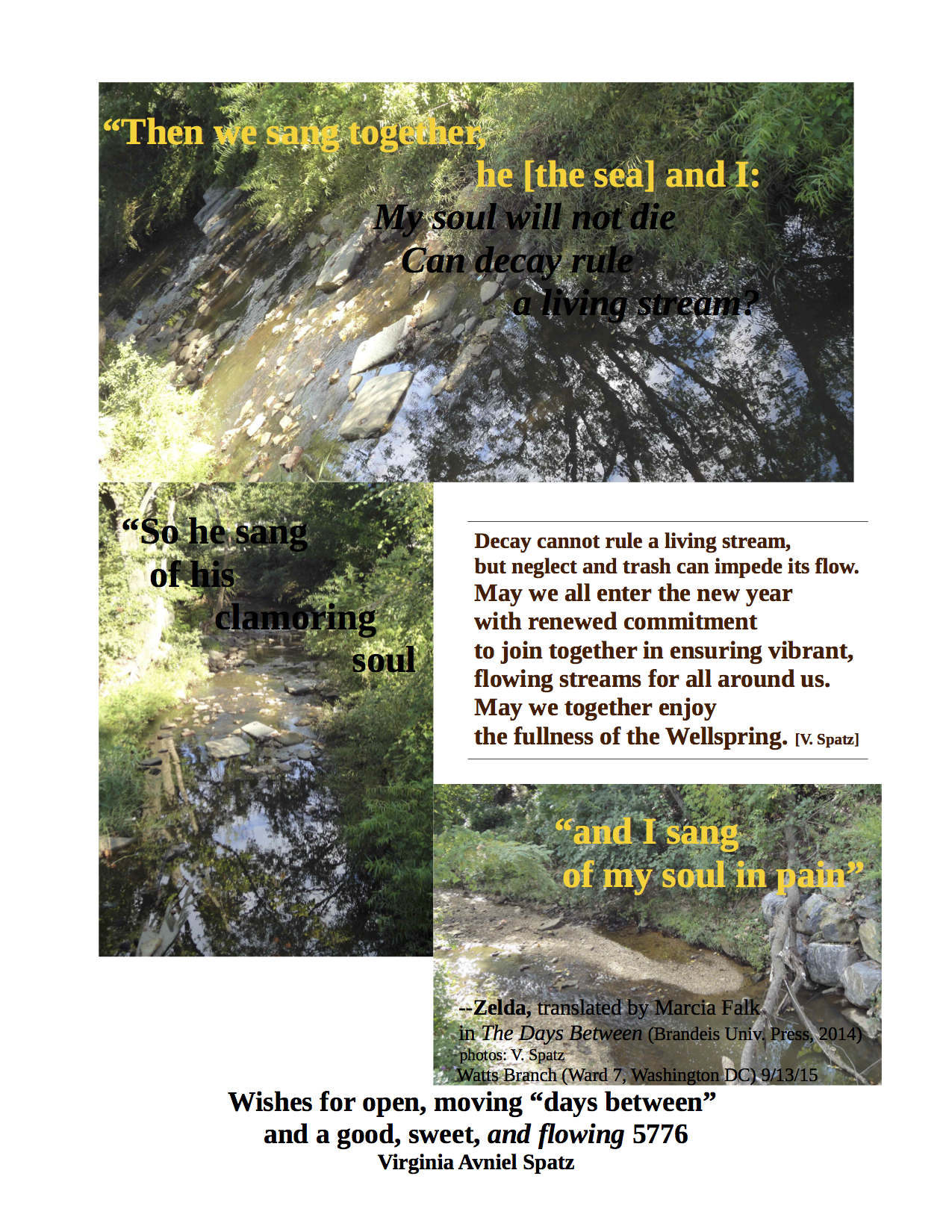
Open, moving “days between” to all,
followed by a good, sweet, and flowing 5776
The Days Between: Blessings, Poems, and Directions of the heart for the Jewish High Holiday Season. Marcia Falk. (Waltham, MA: Brandeis University Press, 2014)
Ever since the birth of our nation, white America has had a schizophrenic personality on the question of race. She has been torn between selves—a self in which she proudly professed the great principles of democracy and a self in which she sadly practiced the antithesis of democracy. This tragic duality has produced a strange indecisiveness and ambivalence toward the Negro, causing America to take a step backward simultaneously with every step forward on the question of racial justice, to be at once attracted to the Negro and repelled by him, to love and to hate him. There has never been a solid, unified and determined thrust to make justice a reality for Afro-Americans…. What is the source of this perennial indecision and vacillation? It lies in the ‘congenital deformity’ of racism that has crippled the nation from its inception.
 What roots do you want to tap for your community’s future? What seeds do you want to nurture?
 A parallel situation still applies all too well in much of the Jewish world. As does his analysis of how well-intentioned attempts at diversity and inclusion often fail to create real change. Many of his recommendations for the Church are ones other faith communities should explore as well: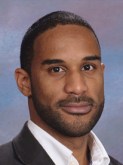






 "A Song Every Day"