Notes on Jeremiah: Max Ticktin’s Scribbles

Exploring Babylon Chapter 21

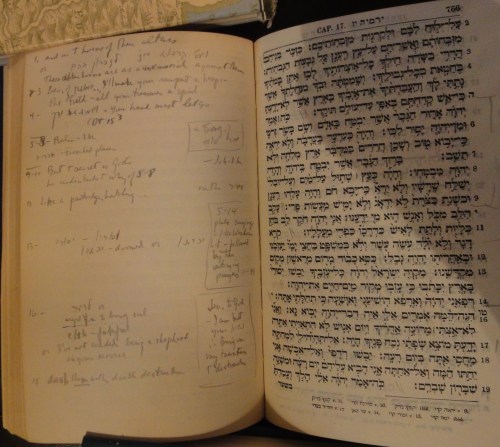
Several updates below. In addition to the many other things he left us, Max Ticktin z”l (1920-2016) left behind a lot of books, and his family kindly offered them to interested community members. Some of the volumes I inherited this way are from a Tanakh that was re-bound, as a gift for Max early in his rabbinical career, with pages opposite the text for his own notes.*

Some of Max’s notes are straightforward translation or links to related verses. Some are literary, some theological. Occasionally, his chuckle is obvious. Sometimes the notes are just opaque, to me anyway. Whatever the content, I consider it a great privilege and pleasure to have Max’s scribblings accompany me in my studies. (See also The Hebrew Bible (Greenspan).)

Some Notes and Questions

Here, pertinent to this week of Behar-Bechukotai, are some annotations for Jeremiah Chapter 17 (Haftarah for Bechukotai  is Jer 16:19-17:14).

Max on Jeremiah_Cropped
Notes by Rabbi Max Ticktin on Jeremiah 17

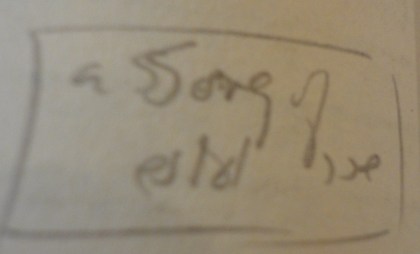
I am hoping someone with more background and/or better skill at reading Hebrew script can decipher this comment:

A Song of.jpg
Close-up: “A song of…,” annotation to Jer. 17:5-8

“A song of…[??]”
?? שכר ועונש ??
?? retribution? punishment? payback?

UPDATE 5/11: sources tell me my rendering of the Hebrew “שכר ועונש” is correctly spelled and can be transliterated “sachar va’onesh” and translated as “reward and punishment.”**.

 
And maybe some experts at English handwriting can fill in what I’m missing here:

Max on Chapter 16
Notes on Jeremiah 16:18 – 17:1

19ff — dialogue of Jeremiah and God on God’s [??] the transformation of people!

Note: based on other passages, that lonely lowercase “a” = “and,” and the lowercase “t” = “the.”

UPDATE 5/13: A member of the Fabrangen community suggest that the word I couldn’t read may be “inclination.” Another points out that “the letter ‘C’ with a bar over it is often an abbreviation for ‘with’ in the form ‘cum’.” So, then we’d have something like: “dialogue of Jeremiah and God on God’s inclination with the transformation of people!”


Babylon and Transformation

Not sure exactly what this haftarah, with or without Max’s commentary, adds to #ExploringBabylon. But I am very interested in two images for God, both found in Jer 17:13 —

  • mikveh yisrael [מִקְוֵה יִשְׂרָאֵל]” or “hope of Israel” and
  • mekor mayim chayyim [מְקוֹר מַיִם-חַיִּים],” or “fountain of living waters”

and how these are related to “the transformation of people!”

More to come, maybe. Meanwhile, please let me know your ideas about how to read the above comments.

[On this 40th day of the omer, making five weeks and five days. — 5778]

NOTES

* I recall Max mentioning this gift and how much it meant to him several times, and I expected that regulars at Fabrangen and Jewish Study Center activities would share similar recollections. But I have not heard from others who remember him saying this….which makes it all the more interesting that it turns out I know family members of the rabbi who gave Max these books.

ADDITION 5/11 (not exactly “Update”): It’s not the most common of conversation topics, but somehow, long before Max died, Rabbi Danny Zemel of Temple Micah (DC) mentioned to me that his grandfather had once related, with great fondness, giving the special, re-bound copy of the Tanakh. Rabbi Zemel’s grandfather, Rabbi Solomon Goldman (1893-1953), served Anshe Emet Synagogue in Chicago from 1929-1953, where he and young Max connected.

Long after that brief conversation, while exploring the books the Ticktins were giving away, I happened upon two volumes that resembled the ones Max and Rabbi Zemel had both described. I was so excited, I had to double-check that the family meant to part with them. I was reassured and gratefully added them to my pile.

When I emailed a picture of the fly leaf to Rabbi Zemel, he recognized his grandfather’s writing. So I was delighted to be able to share one of the volumes with Rabbi Goldman’s family.

On occasion, I marvel at the odds of that book making it back “home,” in a sense. The Jewish world is sometimes small, but Reform and havurah circles — like Temple Micah and Fabrangen — don’t interact all that much; my participation in both communities is unusual. So, I am tempted to call it “bashert [fate, destiny].” But then I see Max rolling his eyes at me and explain it instead as follows.

Max had an uncanny ability to connect deeply, and very specifically, with so many people: Everyone who passed through that Ticktin library after Max’s passing surely found a special treasure that seemed destined just for them. In addition, although I never knew him, Rabbi Goldman had a large impact on Judaism far beyond his own, influential congregation — and clearly he made an impression on Max who, however accidentally, impressed on me, as Rabbi Goldman did on a young Danny Zemel, that these books embody an enduring connection between lifelong students of bible.
TOP


** “A Song of Reward and Punishment”? Didn’t Leonard Cohen write that? Maybe Sarah Rindner’s recent piece on “The Lehrhaus” — which links Leonard Cohen and this week’s Torah portion — put the idea in my mind. But I can somehow hear him singing it, even though I’m pretty sure there’s no such song in his opus. In any case, establishing that the words on the page say something like, “A Song of Reward and Punishment,” is only prelude to understanding the passage from Jeremiah and its context….

UPDATE 5/13: Here’s my homage to Leonard Cohen and the prophet Jeremiah.

BACK

Trauma and Migration Studies, The Book of Job, and Babylon

Exploring Babylon Chapter 20.2

Chapter 20.1 focused on monsters and storytelling, touching on the intersection of migration experiences and trauma. In follow up (with apologies for the delay), a few notes about the academic fields of migration and trauma studies and their relevance to #ExploringBabylon.

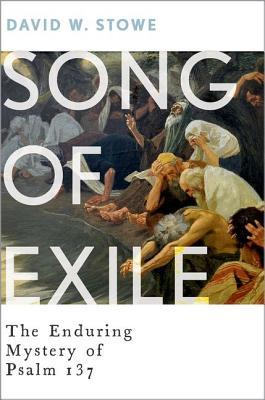
To begin, David W. Stowe discusses the application of trauma and migration theories to biblical studies* and, in particular, to his exploration of Psalm 137.

Migration and Trauma

On trauma theory and bible, Stowe writes:

Certainly the Bible provides voices that resonate with pain caused by the experience of the Exile in Babylon….

Reading the biblical literature through the lens of trauma theory suggests an agonizing experience during the Golah [Babylonian Exile]. Recent work in trauma theory and post-traumatic stress disorder (PTSD) shows that symptoms associated with psychosis and other mental illness are symptoms of the human psyche struggling against an overload of anguish. Distortions in verbal and written communication [which Stowe and many others identify in the Book of Ezekiel, for example], even a failure to communicate at all — to become mute — reflect strategies of self-defense….
— Stowe, Song of Exile, p.8-9

Stowe looks at migration theory in the same context:

Because we learn so much about Moses’ long attempts to win freedom from bondage for his compatriots, we assume that Egyptian slavery must have been harsher [than that of Judean exiles in Babylon]….

To flesh out this monochromatic picture of the Golah experience, scholars have brought to bear analytic tools from the social sciences, in particular the recent field of migration studies….An important contribution in the recent scholarship lies in drawing distinctions between different categories of people who formerly might have been simply labeled “exiles” or “refugees.” These blanket terms obscure a host of subtle variations: between migrants, exiles, refugees, and members of a diaspora; between voluntary and involuntary migrations; between internal migration and migration that crosses political boundaries.
— Stowe, Song of Exile, p.10

Stowe’s specific discussion of Psalm 137 awaits another day and another post. Meanwhile, though, his remarks above link back to Junot Díaz’s Islandborn: how differing immigration experiences lead to different recollections and relationships around the country departed — including, in many cases, a silence hard that can make it difficult for younger generations to learn their family’s past.

Stowe’s remarks also relate to a very different style of biblical study.

The Book of Job

The Book of Job offers linguistic, literary, and theological challenges when it comes to assigning authorship or even declaring the century in which it was committed to writing, in whatever form. See, for example, these authorship pieces by Columbia’s Brennan Breed and Elon Gilad of Haaretz. Moses Sokolow explores Talmudic ideas about authorship and elaborates on those with another suggestion.

Sokolow first argues, in Tanakh: An Owner’s Manual (full citation below), that three or four of the seven Talmudic suggestions for Job’s authorship overlap chronologically so as to suggest a consensus around authorship in the time of the Chaldeans (Babylonians). He then goes on to present a hypothesis:

Since Ezekiel lived during the era of the Chaldeans and was the only biblical author acquainted with Job, it is not a priori unreasonable to ascribe the Book of Job to him, particularly if we now take note of the one Talmudic opinion [of seven] we have thus far omitted: “Iyyov lo’ hayah ve-lo nivra’” – “Job never existed”; his story is only a parable (Bava Batra 15a).

The usual understanding of the Book of Job is that it addresses the question of theodicy….

But what if Job were the personification of the Jewish people? What if the destruction of his home, the loss of his wealth, and the death of his sons were parables for the destruction of the Temple, the forcible exile, and the many concomitant deaths and privations suffered by the Jewish nation? Ezekiel’s prophetic mission was devoted to reassuring the exiles that God’s presence was among them even in Babylonia, and that there would be a return to Zion and a restoration of the Temple. Could the Book of Job, then, not be Ezekiel’s own “Holocaust theology,” offering the conventional explanation for suffering (sin), rejecting it, and replacing it with the reassurance that there was a divine plan for history as there was for nature, and that our inability to perceive the former is in no way different from our like inability to comprehend the latter?
— Sokolow, p.43

Sokolow’s suggestion is presented in a different framework from biblical studies working from predominantly Christian sources. Both methodologies lead, however, to further discussion of trauma and migration in relation to biblical stories.


on this 27th day of the omer, making three weeks and six days

NOTES:

Here are two fairly recent relevant collections on migration, trauma and other theories of exile:

Interpreting Exile: Displacement and Deportation in Biblical and Modern Contexts. Ranier Albertz, ed. Atlanta, GA: Society of Biblical Literature, 2011.

By the Irrigation Canals of Babylon: Approaches to the Study of Exile. John J. Ahn and Jill Middlemas eds. NY: T & T Clark International (Continuum), 2012.

Note, please, that Stowe, like many other scholars in the field called “biblical studies,” cites predominantly Christian sources. Moreover, some remarks in Song of Exile suggest his exposure to Jews is limited (see Song of Exile page) — which is not uncommon in Christian biblical studies. For more on this topic generally, see also “Babylon and Adventures in Bibleland” as well as “Babylon Basics.”
BACK


Tanakh: An Owner’s Manual: Authorship, Canonization, Masoretic Text, Exegesis, Modern Scholarship, and Pedagogy. Moshe Sokolow. NY: Ktav, 2015.
BACK

Monsters, Exile, and Storytelling

UPDATE: The event described here, including the brief interview with Díaz, took place on March 15, 2018. The piece below was posted on April 1. The New Yorker article, “The Silence: The Legacy of Childhood Trauma” — which has a LOT to say about monsters and trauma — was not published until April 16. See also, “More on Monsters and Storytelling.”


Exploring Babylon Chapter 19

A new picture book, by Dominican-born author Junot Díaz, has a few things to tell readers of all ages about trauma, exile, memory, and the importance of storytelling — good topics for Passover and #ExploringBabylon.

Islandborn

Islandborn relates the tale of young Lola — who attends a school where “every kid…was from somewhere else” — trying to draw a picture of her native country for a homework assignment. Having left “the Island” before she could remember, she enlists help from community members, and one older neighbor tells her something shocking:

“A long time ago, long before you were born…a monster fell upon our poor Island.

“…For thirty years the Monster did as it pleased. It could destroy an entire town with a single word and make a whole family disappear simply by looking at it.

“[Eventually…] heroes rose up…got tired of being afraid and fought the Monster….The Monster tried all of its evil tricks but in the end the heroes found the Monster’s weakness and banished it forever.”

Islandborn, Díaz’s first children’s book, is illustrated by Leo Espinosa, originally from Columbia. (NY: Dial Books for Young Readers, 2018). See Random House and Publisher’s Weekly.

Islandborn
(c) Diaz & Espinosa.Islandborn. Dial 2018.

“The Monster”

The name of “the Island” is not specified. The name of the Monster is also omitted, along with those of heroes who “banished” the Monster.

Many readers will undoubtedly think of the Dominican Republic, where Díaz was born, and the dictator who ruled ruthlessly from 1930-1961, before the author’s time. But the book itself and publisher’s descriptions deliberately do not offer any historical details.

Díaz has explained in public events that he intentionally left the island unnamed so that the reader could bring their imagination to the story. He adds that there are monsters in many countries and there are many kinds of monsters (not all are dictators); he wanted this story to be about more than one place or experience.
Social Justice Books

In addition to allowing for readers to use their imaginations, though, the idea of leaving “the Monster” unnamed has a particular resonance for Jews and other Hebrew Bible readers: After an enemy attacks the most vulnerable members of the community during the Israelites’ trek through the desert, God gives Moses the strange commandment to remember to forget the enemy’s name:

And the LORD said unto Moses: ‘Write this for a memorial in the book, and rehearse it in the ears of Joshua: for I will utterly blot out the remembrance of Amalek from under heaven.’
— Exod 17:14

…thou shalt blot out the remembrance of Amalek from under heaven; thou shalt not forget.
— Deut 25:19

When I told fellow Jews, over a recent Shabbat, about Islandborn and how the book relates its tale, each one mumbled some version of “blot out the name!” And that heritage has raised many questions over the centuries about what and how we remember and what and how we re-tell.

Legacy and Response

Social Justice Books suggest that “one place where young readers could handle a more accurate narrative, than what is offered in the book, is in the description of what happened to” the unnamed heroes:

Lola was told, “No one knows really [what happened to them.] It was so long ago.” The truth is that we actually do know what happened to the Mirabal sisters and countless others….A response that children could handle would be “Sadly, many were killed, but others survived. Their children, like you, continue to work for a better world today.”

Some social studies teachers and individual parents may want to discuss the specifics of Dominican history around Islandborn or use it to discuss motivations behind much immigration. Díaz, however, prefers to steer the conversation in more universal directions.

At a recent Islandborn book talk for young readers and writers — 1st through 5th grade, accompanied by a few pre-schoolers and adults, at a DC Public Library branch — the first young person to speak declared: “Monsters aren’t real.” In response, Díaz spoke generally, first agreeing with the student and then explaining that his home country was, in fact, once “taken over by a very bad man who was kinda like a monster.” The author never mentioned the Dominican context again and never got more specific.

After the event, I asked Díaz if he ever addressed young readers — like those at Capitol View Neighborhood Library, where we met — by helping them name monsters in their lives. Again, he rejected a more specific path: “I don’t think [local youth] need to hear anything from me about the monsters they face….If their lives are anything like mine, they know.”

Instead, the author argues: “The key is to help them confront and work through their experiences, forge friendships and solidarities.”

Toward that end, Díaz asked young readers to look at how the people eventually defeated the monster. He drew attention to the illustration above, noting that all monsters have a weakness that can be used against them, and that people joining together is essential….Students at Capitol View noted, based on the illustration and their own experience, the role of singing in uniting people.

How We Tell the Tale

The tenor of the Islandborn youth discussion at Capitol View remained largely philosophical and literary, rather than historical. Several young readers asked questions around why monsters do what they do. The author suggested several reasons, including the example of an older sibling wanting more than a fair portion of a treat meant for sharing. In response to another student, Díaz raised the concept of literary tropes around monsters.

Still, one ten-year-old did wonder, “What about the good people who are killed by the monsters before it’s defeated?” Díaz suggested, given that the age range present and how close to the end of the allotted time the question arose, that the young person talk to him following the group gathering.

In a similar vein, a local rabbi recently shared that his very young children do not know about the tenth plague [death of the first-born], despite its prominence in the Passover story. Of course, age and maturity of audience must influence content or emphasis in storytelling. Beyond age-appropriateness, however, the question of what to tell and what to omit is a deeper issue:

  • If we don’t relate the horrors, how will we ensure that victims are remembered and future generations informed?
  • How do we ensure memory and sensitivity, without perpetuating trauma?
  • Depending on the depth of our storytelling, how do young people — and the older people they become — relate to our state of exile?

At one point in Islandborn, after neighbors have opened up to Lola about the good and the horrible on “the Island,” child and grandmother have a key exchange:

Abuela, did you know about the Monster?”
“Of course, hija. Why do you think so many of us are here in the North?”

— on this second day of the omer, 5778

Poverty and the White Horse’s Red Strap

Exploring Babylon Chapter 18-1/2

The previous chapter, “Exile, Passover, and Melting Pot,” looked at nine bible verses using the word “kur,” usually translated as “crucible” or “furnace.” This addendum shares the odd midrash on one such verse, mentioned in the earlier post, which suggests some ideas about Passover, exile, and learning.

Furnace Midrash

Each appearance of “kur” involves “great trouble and misery” (1906 Jewish Encyclopedia) and all relate suffering to sin. The phrase, kur ha-barzel — “iron blast furnace” or “iron crucible” — appears three times as a reference to Egypt, from which the people were rescued to become “God’s own.”

Isaiah employs a similar metaphor, the phrase “kur oni,” in reference to the Babylonian exile:

הִנֵּה צְרַפְתִּיךָ, וְלֹא בְכָסֶף; בְּחַרְתִּיךָ,
בְּכוּר עֹנִי
Behold, I have refined thee, but not as silver; I have tried thee
in the furnace of affliction [or poverty].
— Isaiah 48:10
(more of this passage below)

A midrash, retold in Sefer Ha-Aggadah, discusses the meaning of Isaiah’s “furnace”verse:

[The prophet] Elijah said to Ben He He (some say to R. Eleazar): The verse “Behold, I refine you, but not as silver; I test you in the furnace of poverty” (Isa. 48:10) implies that, among all the good states of being that the Holy One scrutinized to give to Israel, He found none better than poverty.
Sefer Ha-Aggadah, Bialik & Ravnitsky, 341:57

The Talmud passage, on which this is based, adds a “folk saying” meant to further elucidate the point:

א”ל אליהו לבר הי הי וא”ל לר’ אלעזר מאי דכתיב (ישעיהו מח, י) הנה צרפתיך ולא בכסף בחרתיך בכור עוני מלמד שחזר הקב”ה על כל מדות טובות ליתן לישראל ולא מצא אלא עניות אמר שמואל ואיתימא רב יוסף היינו דאמרי אינשי יאה עניותא ליהודאי כי ברזא סומקא לסוסיא חיורא:
Elijah the Prophet said to bar Hei Hei, and some say that he said this to Rabbi Elazar: What is the meaning of that which is written: “Behold, I have refined you, but not as silver; I have tried you in the furnace of affliction [oni]” (Isaiah 48:10)?

This teaches that the Holy One, Blessed be He, sought after all good character traits to impart them to the Jewish people, and He found only poverty [aniyut] capable of preventing them from sin.

Shmuel said, and some say it was Rav Yosef: This explains the folk saying that people say: Poverty is good for the Jewish people like a red bridle [barza] for a white horse. Just as a red bridle accentuates the white color of the horse, so the challenge of poverty draws out the purity of the Jewish people.
— B. Chagigah 9b
Wm Davidson Talmud, via Sefaria.org
line breaks added for ease of reading


Further Commentary

Hershey H. Friedman discusses the red strap midrash within the context of economics and Jewish history:

The enigmatic statement quoted in the Talmud (Babylonian Talmud, Chagiga 9b), “Poverty is so fitting for the Jew, like a red strap (or saddle) on a white horse,” is interpreted by Rabbi Elijah, Gaon of Vilna, in the following manner. A horse is saddled up when it goes out; in the stable everything is removed. So too, the Jewish people should wear their poverty when they go out in order not to arouse the envy of the gentiles. Within the privacy of one’s house, however, wealth is good (Kreuser, p. 171*).
— “The Simple Life: The Case Against Ostentation in Jewish Law”
*Kreuser, Yissachar Dov. Genuzas Ha’GRA. Jerusalem: self-published (in Hebrew), 2000.

Friedman concludes on the ethics of ostentation and wealth:

The sages recognized that very little good can result from a splashy, gaudy lifestyle. On the contrary, it produces envy, suffering, arrogance, dishonesty, and shaming of the impecunious. The Torah teaches us that ostentation is not the true purpose of wealth, helping others is.

CooCoo for Coco argues differently from a fashion perspective and use of red in ancient Jewish ritual:

Similarly, poverty is neither romantic nor exotic nor aesthetic….Nonetheless, often the most challenging situation, that which pumps blood and flushes faces, is that which accentuates inherent virtues, allowing the best in us to take a well awaited strut down the runway….Evidently, poverty and predicaments in general, draw out the best in man, like a scarlet strap on a white horse….

Thus, the pages of Hagiga advise not an abstention from all fiery passions but, in fact incorporation of these powers in appropriate amounts in order to enhance one’s unadulterated virtues; the secret to salvation lies in complementary accessories accentuating natural qualities. White purity is all the more noticeable when countered by a tempered amount of florid flush…
–“Horsing Around the Right Way: Fashion Lessons from the Talmud”


Questions

Isaiah’s phrase “kur oni,” a furnace of affliction or poverty, resonates in the Passover seder, when we eat “lechem oni,” bread of affliction or poverty. Isaiah’s prophecy suggests that God is teaching the People through exile, a common understanding of the Exodus as well (the “iron furnace”). Moreover, the passage from Isaiah seems to say that the People could not, or at least did not, learn from prior experiences.

Some questions this raises:

  • Are there lessons from Exodus and Exile that are uniquely learned from those experiences?
  • What was NOT learned in the Exodus that was to be learned in Exile?
  • What about poverty: does it teach specific lessons? or is that romanticizing a difficult state of being?
  • Do we need some kind of “affliction” to learn?
  • How do we use the seder to (re)create experiences that bring important learning?

NOTE:

Isaiah 48:6-11
“You have heard all this; look, must you not acknowledge it? As of now, I announce to you new things, Well-guarded secrets you did not know.
Only now are they created, and not of old; Before today you had not heard them; You cannot say, “I knew them already.”
You had never heard, you had never known, Your ears were not opened of old. Though I know that you are treacherous, That you were called a rebel from birth,
For the sake of My name I control My wrath; To My own glory, I am patient with you, And I will not destroy you.
See, I refine you, but not as silver; I test you in the furnace of affliction.
For My sake, My own sake, do I act— Lest [My name] be dishonored! I will not give My glory to another.”
More at Sefaria or Mechon-Mamre

BACK

Ezekiel, Exodus, and Babylon

Exploring Babylon Chapter 17

Recent scholarship concerning the prophet Ezekiel touches on some fascinating questions about the extent to which Judeans in Babylonian exile were acculturated and how cultural contact between Babylon and Israel might have affected Jewish sacred text. Much of the discussion revolves around links between the Book of Exodus and Ezekiel’s visions. And this week — which includes both the final readings in the Book of Exodus and a reading from Ezekiel — seems a good one to begin exploring some of the scholarship.

Background on the prophet Ezekiel comes exclusively from biblical evidence (i.e., no extra-biblical references have been found). He lived first in Judea, part of a priestly family, and was then forcibly relocated as in the first Exile to Babylon in 597 BCE. Because he served in the Temple, it is assumed that he was at least 20 years old while still living in Jerusalem. The visions he records encompass both Jerusalem and Babylon.

A brief scan of scholarship — at this point, using only free sources accessible on-line; more to come, and suggestions for resources most welcome! — includes several views about the life in Babylon available to someone of Ezekiel’s background.

Ezekiel and Babylonian Literature

“Ezekiel in and on Babylon,” by D. S. Vanderhooft discusses acculturation of Judean exiles, pointing out the difference between acculturation and assimilation and raising a number of possibilities for what Ezekiel might have encountered. (Here’s Vanderhooft’s paper, via Academia.edu, from TRANSEUPHRATÈNE 2014,)

Vanderhooft and many others cite the work of Laurie E. Pearce, Assyriologist in the Dept. of Ancient Near Eastern Studies at University of California-Berkeley. She looks at “Identifying Judeans and Judean Identity in the Babylonian Evidence” in the collection Exile and Return: The Babylonian Context (Jonathan Stökl & Caroline Waerzeggers, eds. Berlin/Boston: de Gruyter, 2015 — available in part through Google Books.) More specifically, she posits several suggestions for if/how Ezekiel would have learned cuneiform and gained familiarity with Babylonian literature (Ezekiel: A Jewish Priest and a Babylonian Intellectual).

In “Ancient Jewish Cultural Encounters and a Case Study on Ezekiel,” Mladen Popović discusses the relative strength of proposed literary parallels between Ezekiel and Babylonian literature as well as other evidence for knowledge sharing across cultural boundaries during Ezekiel’s time. His article introduces the Jewish Cultural Encounters in the Ancient Mediterranean and Near Eastern World which he edited with Myles Schoonover and Marijn Vandenberghe (Leiden, the Netherlands: Koninklijke Brill, 2017 — also available in part through Google Books).

Ezekiel’s Visions and Babylon

In “Ezekiel’s Temple in Babylonian Context,” Tova Ganzel and Shalom E. Holtz discuss the possible influence of Neo-Babylonian temples on Ezekiel’s visions. Their focus is on how both Babylonian temples and Ezekiel’s visionary architecture are designed similarly to separate sacred from profane. They conclude:

We cannot say with any certainty that Ezekiel borrowed these features from his environment. We may say, however, that Ezekiel and his audience might have understood the plan for the rebuilt temple by looking to their surroundings. They had, in short, a working model not too far from their homes in exile.
Ganzel/Holtz paper, from Vetus Testamentum 64 [2014], via Academia.edu

Abraham Winitzer raises a more radical suggestion in his article, “Assyriology and Jewish Studies in Tel Aviv: Ezekiel among the Babylonian literati.” He notes that other scholars have found similarities between images in Mesopotamian mythology, visions of Ezekiel (1:26–27), and descriptions in Exodus (24:9–10). He continues, however, suggesting that parts of Exodus (chaps. 25–31, 35–40) not only “share important features with Ezekiel but in fact may be derivative of it.” Winitzer then adds:

The ramifications of this proposal – if it finds acceptance – are considerable, and would further the basic claim made here concerning the place of Babylon in the formation of early Jewish tradition. For not only would it shed new light on the place of Ezekiel and, more broadly, of the biblical prophets in a way presciently anticipated by early modern biblical scholarship, it would also highlight exposure to Babylonian culture as a productive force behind this evolution.
— Winitzer, IN Encounters by the Rivers of Babylon: Scholarly Conversations Between Jews, Iranians and Babylonians in Antiquity.
Uri Gabbay and Shai Secunda, eds. (Tubingen, Germany: Mohr Siebeck, 2014)

Ezekiel's Vision
from freebibleimages.org

Shabbat Parah

This week’s Torah portion concludes the Book of Exodus and the construction of the Tabernacle (Ex 40, in the double-portion, Vayakhel-Pekudei, Ex 35:1-40:38). Special readings for Shabbat Parah, one of the special Shabbatot leading up to Passover, are Numbers 19:1-22 and Ezekiel 36:16-38.

The extra Torah reading speaks of the ritual of the red heifer, which purifies after contact with a corpse. As My Jewish Learning explains, this theme is tied to Passover because “only people who were pure could eat from the Passover sacrifice, in ancient times a public announcement reminded anyone who had become impure to purify themselves before making the Passover pilgrimage to Jerusalem.”

The haftarah includes a different view of purity, linked with Judea returning from Babylonian exile:

וְזָרַקְתִּ֧י עֲלֵיכֶ֛ם מַ֥יִם טְהוֹרִ֖ים וּטְהַרְתֶּ֑ם מִכֹּ֧ל טֻמְאוֹתֵיכֶ֛ם וּמִכָּל־גִּלּ֥וּלֵיכֶ֖ם אֲטַהֵ֥ר אֶתְכֶֽם׃
I will sprinkle clean water upon you, and you shall be clean: I will cleanse you from all your uncleanness and from all your fetishes.

וְנָתַתִּ֤י לָכֶם֙ לֵ֣ב חָדָ֔שׁ וְר֥וּחַ חֲדָשָׁ֖ה אֶתֵּ֣ן בְּקִרְבְּכֶ֑ם וַהֲסִ֨רֹתִ֜י אֶת־לֵ֤ב הָאֶ֙בֶן֙ מִבְּשַׂרְכֶ֔ם וְנָתַתִּ֥י לָכֶ֖ם לֵ֥ב בָּשָֽׂר׃
And I will give you a new heart and put a new spirit into you: I will remove the heart of stone from your body and give you a heart of flesh;

וְאֶת־רוּחִ֖י אֶתֵּ֣ן בְּקִרְבְּכֶ֑ם וְעָשִׂ֗יתִי אֵ֤ת אֲשֶׁר־בְּחֻקַּי֙ תֵּלֵ֔כוּ וּמִשְׁפָּטַ֥י תִּשְׁמְר֖וּ וַעֲשִׂיתֶֽם׃
and I will put My spirit into you. Thus I will cause you to follow My laws and faithfully to observe My rules.
— Ez 36:25-27

RETURN

Computing Failures and Babylon

Exploring Babylon Chapter 16.2

Attempts to calculate the end of exile — by both Belshazzar in Babylon and Ahashverus in Persia — have something powerful in common with the People’s behavior in at the foot of Mt. Sinai in the Torah portion Ki Tisa (Ex 30:11 – 34:35).

Moses Bosheish!

I love spots in the Torah where translators disagree. When a Torah verse is translated by different sources in very different ways, it’s a reminder that translation is never straightforward and that no one translation can tell the whole story, even if scholars agree on what it is. Differing translations are also frequently a clue that more is going on under the surface of any one translation. We have a powerful example in Ki Tisa:

When the people saw that Moses was so long in coming down from the mountain, the people gathered against Aaron and said to him, “Come, make us a god who shall go before us, for that man Moses, who brought us from the land of Egypt—we do not know what has happened to him.”
וַיַּרְא הָעָם, כִּי-בֹשֵׁשׁ מֹשֶׁה לָרֶדֶת מִן-הָהָר; וַיִּקָּהֵל הָעָם עַל-אַהֲרֹן, וַיֹּאמְרוּ אֵלָיו קוּם עֲשֵׂה-לָנוּ אֱלֹהִים אֲשֶׁר יֵלְכוּ לְפָנֵינוּ–כִּי-זֶה מֹשֶׁה הָאִישׁ אֲשֶׁר הֶעֱלָנוּ מֵאֶרֶץ מִצְרַיִם, לֹא יָדַעְנוּ מֶה-הָיָה לוֹ.
– Ex 32:1, JPS Tanakh, 1985

Based on language alone, there are at least three obvious ambiguities in this verse:

  • Did the People demand gods, plural, or one god? “Elohim” works both ways in Hebrew, referring to God or to human judges, and scholars argue for both possibilities in this context. Because there was ultimately only one Golden Calf created in the story, translators usually employ “god,” singular;
  • What kind of leadership are the People expecting from Aaron? When Moses went up the mountain – which is back in chapter 24 – he told the people that Aaron and Hur would be in charge in his absence. But we have no mention of earlier interactions with the interim leaders – and then there’s the odd failure to mention Hur again, which lead some midrashim to suggest that things were already so dire that Hur had already been killed by the agitated crowd. Still, the language could mean the people are standing opposite Aaron to speak to him or that they are gathering more aggressively.
  • Finally, what, exactly has Moses done to upset the People so severely? A common translation is that he “delayed” or “was so long” in coming down. Robert Alter says he “lagged.” And Everett Fox chooses “shamefully-late.” These three versions reflect a spectrum of angst: something taking “so long” could possibly be neutral or positive, even if excess is implied; “lagged” leaves less room for a non-negative interpretation; and “shamefully-late” might leave room for a positive explanation – helping someone with an emergency concern, for example, rather than forgetting or procrastinating – but it’s still obvious that whoever is waiting is distressed by the delay.

Regardless of translation, commentators spend a lot of energy trying to devise some kind of explanation for the People’s behavior that prompted what comes next: the quick turn to idol worship, Moses destroying the tablets, God threatening to destroy the whole People, and three thousand killed in camp.

004-moses-golden-calf
from freebibleimages.org


Shame and Delay

It doesn’t help translation or interpretation that the word central to this narrative, “bosheish,” doesn’t appear anywhere else in the Torah and shows up only once in the Tanakh.

Sisera’s mother, who doesn’t yet know that her son the general, was killed, wonders why his chariot bosheish (Judges 5:28). It’s a heart-breaking scene that might shed some light on the kind of anxiety the People were experiencing.

The related word “bosh,” translated as “shame,” is more common, appearing 106 times in the Tanakh, according to my concordance. Aviva Zornberg, in her discussion of this portion in the Particulars of Rapture, mentions one instance in particular, another verse in Judges, from the odd story of King Eglon, whose servants wait for him ad-bosh, “until they’re ashamed,” after he has been stabbed and retreats to his room, possibly to relieve himself, only the servants soon learn that he is dead(Judges 3:25). Another indication that bosh and bosheish are associated with very troubling – even life and death – situations.

I don’t fully grasp the biblical connection between shame and being late. But I think we’ve all experienced the peculiar state of waiting for someone who was expected at a certain time, terrified that something awful happened and equally, simultaneously ashamed at likely making a mountain out of a molehill.

With this in mind, some Golden Calf midrashim put part of the blame on Moses for being unclear about his return, when he went up the mountain, thereby causing unnecessary angst. The Talmud puns on bosheish and the word for “six,” saying that Moses had announced he would return by the sixth hour – noon, by Talmudic accounting – after 40 days. But the People miscalculated his expected return, because Moses failed to specify that the day he went up did not count as a full night and day.

Uncertainty and ha-Satan

And then, the midrash continues, the satan took advantage of the ambiguity and the People’s concern to convince them that Moses was dead. Thus, they’re so quick to look for another way forward.

There are similar stories, in midrash, in which the satan shows up. At the Akedah, for example: Sarah knows nothing about the journey Abraham and Isaac are taking, so the satan can convince her that Isaac is dead. I have not made an extensive study, but I notice that one key element in Jewish stories where Satan shows up is a disturbing level of uncertainty that can be exploited. The satan even convinces God to test Job based on uncertainty (about Job’s faithfulness). So, I’d to concentrate on the uncertainty in the Golden Calf story.

One way I look at this Torah moment is akin to being on a roadtrip with strangers to parts unknown, when the driver disappears behind a creepy truck-stop: Is he seeking directions or obtaining supplies? In need of privacy – to relieve himself, or meditate, or whatever? Or, given that we’re all relative strangers, can we rule out that he might be doing something nefarious that we’d rather not witness or involved in something that could get us all into terrible trouble?

Unless the instruction before he disappeared were dramatic and very specific – like “give me ten minutes and then come after me” or “wait twenty minutes and then take off, no matter what” – how do we decide what to do and when, as his return is delayed? If the driver left someone else in charge, do we automatically trust them? If relationships among other travelers are stronger than links to a leader, will factions develop? How long do we wait before declaring “enough is enough” and commandeering the car or going our own ways?

I suspect that most of us, at some point, have been in a situation of uncertainty and some gravity which forced us to decide, for safety and sanity, if and when to bail.

Maybe there was also a God factor, that is, a situation in which someone claims to speak for God and all involved have to decide whom to trust, how to discern divine will – assuming such is even possible – and how to move forward, individually and collectively.

Most of this portion does not offer the best model for handling such situations. It does remind us, however, of how frightening uncertainty can be – on our own and within a community – and the Golden Calf story warns us of how dangerous it is to let that fright convince us to jump to conclusions and then launch into action, thinking that we know the answers.

The Perils of Calculus

While the ancient Rabbis had compassion for the People’s precarious state of mind, they had no sympathy for, in essence, trying to out-calculate God.

The futility of this is also decried in Rabbinic writings about predicting the expected end of the Babylonian Exile and rebuilding of the Temple in Jerusalem. One such attempt is by Belshazzar in Babylon. He calculated that the time of exile, prophesied by Jeremiah, was complete but the Jews were not yet rescued, so God had abandoned them (Daniel 5). This results in the “writing on the wall,” followed by Belshazzar’s death and the conquest of Babylon by Persia.

In midrash to the Book of Esther, Ahashverus in Persia tries to avoid Belshazzar’s error with his own calculations, planning to similarly celebrate the Jew’ abandonment by God, because the Temple is not yet reconstructed. But his calculations also fail, and, after a number of reversals, it turns out that “the Jews had rule over them that hated them” (Esther 9:1). (See B. Megillah 11b).

The Golden Calf story and these midrashim about Babylon and Persia all seem to point to Jewish tradition warning against trying to guess the future or what is going on with other people.

A Suggestion

So, what are we supposed to do when faced with uncertainty?

We have a strong suggestion in the aftermath of the Golden Calf incident: God teaches Moses how to pray when in trouble, telling him to recite the 13 divine attributes:

…יְהוָה יְהוָה, אֵל רַחוּם וְחַנּוּן–אֶרֶךְ אַפַּיִם, וְרַב-חֶסֶד וֶאֱמֶת
“merciful and gracious, long-suffering, and abundant in goodness and truth”
– Ex 34:6

When faced with uncertainty and fear, the way forward, the portion tell us finally, is not to try to out-calculate or second-guess God or other people but to call on God’s attributes and work to help them become manifest in our world.

These remarks were prepared as a dvar torah for Hill Havurah
Calf from FreeBibleImages.org

The Treasure and the Favor

Exploring Babylon Chapter 15.2

Just as the stories of Exile and Return include people of quite different mindsets, Exodus peoples are not monolithic, Rabbi Gerry Serotta told me recently. He suggests that #ExploringBabylon could profitably consider some differences among Egyptians in the Exodus tale and look at related texts, in this portion and earlier, about Egyptians becoming “favorably disposed” toward the Israelites.

Difference

Rabbi Serotta points to three groups of Egyptians:

  • those who left with the Israelites — וְגַם-עֵרֶב רַב — “and also the erev-rav [often “mixed multitudes”; Alter uses “motley throng”]” (Ex 12:38);
  • those who did not join the Israelites but gave gold and silver and “raiment/cloaks” (Ex 12:35; see also “The Powers and the Wealth“); and
  • Pharaoh (and, perhaps, other unrepentant oppressors).

 
He adds that it’s good practice to look for the variety of people and perspectives in biblical narrative because “variety is God’s plan.” We see this in the story of Bavel (Genesis Chapter 11) and in many later teachings about the value of galut [exile] and dispersion.

God’s preference for variety is a hard concept to hold in the midst of a tale with the themes “You are MY people and I am YOUR God” and “Let My people go that they may serve ME.” But it can be found in the Exodus tale and in centuries of Jewish teaching centered around it. Seeking out and naming variety within biblical stories helps us avoid pigeonholing people and stereotyping groups in the text, in history, and in contemporary life. Exploring and amplifying difference-celebrating strands of Jewish teaching, from ancient times to the present, provides a foundation for inter-group understanding and cooperation.

…It is no accident that Rabbi Serotta, who has dedicated his career to interfaith, religious freedom, and peace and justice work, is drawn to teachings on diversity and galut [exile]. He offers additional ideas for #ExploringBabylon that will take some time to research; this week, we gratefully continue to pursue his suggestion to “follow the treasure,” so to speak, which appears in this week’s torah portion (Bo: Exodus 10:1-13:16), and its implications….

Boundaries

As discussed in the last episode, ancient commentaries on the gold and silver — mentioned in Ex 3:21-22, 11:2-3, and 12:35-36 (see below) — included the ideas of back wages/reparations and prior ownership of the wealth given to the fleeing Israelites. One important extension to the latter theme focuses on the prominence of women in this exchange to suggest that women used jewels and other portable wealth to bribe neighbors to overlook, or perhaps hide, their infant boys when Pharaoh decreed they be tossed into the river (exact citation temporarily AWOL, sorry).

Robert Alter notes, in his 2004 Five Books of Moses (see Source Materials), that “neighbor” and “sojourner” in 3:22 are feminine nouns, adding:

[The verse] reflects a frequent social phenomenon–also registered in the rabbinic literature of Late Antiquity–in which women constitute the porous boundary between adjacent ethnic communities: borrowers of the proverbial cup of sugar, sharers of gossip and women’s lore.

Alter goes on to insist, however, that exegesis which sees Egyptian women as lodgers in Israelite houses doesn’t match the plague narrative. (He then describes the overall tale as one of “Israelite triumphalism.” More on this below.)

Benno Jacob (1862-1945) also explores boundary crossing and long-term relationships which he sees as hidden in plain sight in Exodus:

The Israelites had settled as herdsmen, a necessary but disdained occupation in Egypt. The details of our story suggest that they were scattered throughout Egypt, which must have led to many personal friendships; only a systematically encouraged hate propaganda was able to change this.
Jacob, The Second Book of the Bible p.343


Protest and Change

Jacob extensively discusses the wealth exchange in Parashat Bo. He uses linguistic and narrative analysis to support his view that God wanted the Israelites and Egyptians to part on good terms and had repeatedly told Moses that was to be the end result. He argues that the Egyptians had already, before Pesach night, come around to seeking compassion and justice for the Israelites, and the farewell gifts are part of the evidence of a change in position:

The Egyptians’ gifts to the Israelites were a clear public protest against the policies of the royal tyrant. They demonstrated a renewal of public conscience…a moral change; the receptive heart of the Egyptian people was now contrasted to the hard heart of Pharaoh.
— Jacob, p.343

He goes further, insisting that this must be a mutual change of heart, from peoples on both sides of the conflict. Jacob links the opening phrase of Ex 11:2 to the similar expression Joseph used in requesting burial for his father (Gen 50:4) and suggests that this link means God was trying to trigger positive feelings:

[God] knew that some Egyptians recalled Joseph, others would have been impressed by the miracles they had witnessed or now had a high a regard for Moses, so they would seek a friendly farewell….

God’s command Moses [Ex 11:2] simultaneously threatened Pharaoh and searched for peace between the two peoples. These peaceful relations were God’s principal concern during Israel’s last hours in Egypt. This was the true meaning of the farewell gifts which the Israelites sought and the Egyptians willingly gave.
— Jacob, p. 344 (emphasis in original)

Rabbi Shai Held, of Mechon Hadar, includes a poignant addendum on this teaching in “Receiving Gifts (and Learning to Love?): The “Stripping” of the Egyptians.” Held quotes Jacob calling this episode “the most elevated and spiritual reconciliation among people; it was full of wisdom and love of fellow man” (p.339 in the above cited Jacob commentary). He then confesses skepticism as to whether Jacob’s story jives with the plain sense of the text but concludes:

One senses in Jacob’s words the insights of a brilliant exegete but also the pain of a rabbi and teacher in a Germany consumed by hate**….In a world suffused with bigotry and hostility, a world in which people of faith often marshal sacred texts to legitimate acts of cruelty and to extol hatred as a virtue, there is great power in reading Jacob’s words and being reminded: At the heart of the religious enterprise is the attempt to soften, and open, one’s heart, to God and to one-another. If even the Egyptians and the Israelites can be (successfully!) called to love one-another, then perhaps, even in the darkest of times, slim glimmers of hope are available to us.

**Held includes a footnote citing personal communication with R. Walter Jacob (Benno’s son) to confirm that his father was working on the Exodus commentary between 1934 and 1939, while still in Germany.

Two Final Comments

Just so we don’t lose sight of the triumphalist nature of the Exodus story in its basic literary form, here are a few more comments from just one scholar:

Denizens of simple farms and the relatively crude towns of Judea would have known about imperial Egypt’s fabulous luxuries, its exquisite jewelry, and the affluent among them would have enjoyed imported Egyptian linens and papyrus. It is easy to imagine how this tale of despoiling or stripping bare Egypt would have given pleasure to its early audiences.
— Alter, on Ex 3:22

Alter adds that the three “sister-wife stories” of Genesis — Abraham and Sarah in Egypt (12:1-10), Abraham and Sarah in Gerar (Gen 20:1-18), and Isaac and Rebecca in Gerar (26:1-16) — “adumbrate the Exodus narrative,” by portraying the couple as arriving with little and leaving with much. Despoiling, he argues, is “an essential part of the story of liberation from bondage in the early national traditions.”

And, finally, also from Benno Jacob:

The Israelites received gifts from their neighbors when they left the Babylonian Exile in a manner parallel to our narrative; these consisted of gold, silver, etc. Some were in response to the royal mandate and were intended for the rebuiling of the Temple while others were freely given (Ezek 1: 4,6)
— Jacob, p.341


TEXTS

And I will give this people favour in the sight of the Egyptians. And it shall come to pass, that, when ye go, ye shall not go empty;
וְנָתַתִּי אֶת-חֵן הָעָם-הַזֶּה, בְּעֵינֵי מִצְרָיִם; וְהָיָה כִּי תֵלֵכוּן, לֹא תֵלְכוּ רֵיקָם.
but every woman shall ask of her neighbour, and of her that sojourns in her house, jewels of silver, and jewels of gold, and raiment; and you shall put them upon your sons, and upon your daughters; and ye shall spoil the Egyptians.’
וְשָׁאֲלָה אִשָּׁה מִשְּׁכֶנְתָּהּ וּמִגָּרַת בֵּיתָהּ, כְּלֵי-כֶסֶף וּכְלֵי זָהָב וּשְׂמָלֹת; וְשַׂמְתֶּם, עַל-בְּנֵיכֶם וְעַל-בְּנֹתֵיכֶם, וְנִצַּלְתֶּם, אֶת-מִצְרָיִם.
–Exodus 3:21-22

Speak now in the ears of the people, and let them ask every man of his neighbour, and every woman of her neighbour, jewels of silver, and jewels of gold.’
דַּבֶּר-נָא, בְּאָזְנֵי הָעָם; וְיִשְׁאֲלוּ אִישׁ מֵאֵת רֵעֵהוּ, וְאִשָּׁה מֵאֵת רְעוּתָהּ, כְּלֵי-כֶסֶף, וּכְלֵי זָהָב.
And the LORD gave the people favour in the sight of the Egyptians. Moreover the man Moses was very great in the land of Egypt, in the sight of Pharaoh’s servants, and in the sight of the people.
וַיִּתֵּן יְהוָה אֶת-חֵן הָעָם, בְּעֵינֵי מִצְרָיִם; גַּם הָאִישׁ מֹשֶׁה, גָּדוֹל מְאֹד בְּאֶרֶץ מִצְרַיִם, בְּעֵינֵי עַבְדֵי-פַרְעֹה, וּבְעֵינֵי הָעָם.
–Exodus 11:2-3

Exodus 12:35-36 was copied in “The Powers and the Wealth
BACK

Benno Jacob

The Second Book of the Bible: Exodus, Interpreted by Benno Jacob. Walter Jacob and Yaakov Elman, trans. (Hoboken, NJ: Ktav, 1992).

Benno Jacob was a rabbi and scholar born in Breslau and active in German Jewish life through the 1930s. He spent his last five years in England, where he completed his Exodus commentary in 1940 and continued to revise it until his death, at age 83, in 1945. See short biography (by his son, Walter Jacob) in the Exodus commentary.

We learn know this biography that Jacob was still in Germany when most synagogues were burned; he watched the German Jewish community to which he’d dedicated his life destroyed; he witnessed the deportation (and eventual return) of his son, R. Ernst Jacob, to Dachau; and he lost nearly everything in moving to England in his late seventies.

Jacobs also produced a commentary on Genesis, which is, as I understand it, not fully available to English readers. Nechama Leibowitz, in her New Studies series, often quotes Benno Jacob, based on unpublished manuscripts. Her chapter on the wealth exchange in Bo makes use of Jacob’s 1924 article, “Gott und Pharao.”
BACK

The Powers and the Wealth

Exploring Babylon Chapter 15.1

The battle between God and Pharaoh reaches a crescendo in this week’s Torah portion — Bo (Ex 10:1 – 13:16) — and the denouement includes an exchange of treasure between the Egyptians and the Israelites. Rabbinic lore links these riches back to Genesis and forward through history, ending with the familiar “powers” trope. The trail of this treasure, and the interwoven responsibilities illuminated along the way, sheds a bit of light for #ExploringBabylon.

Travels of the World’s Wealth

The Tenth Plague convinces Pharaoh to let the People go, and the Egyptians give or lend the Israelites “objects of silver and gold, and clothing” to take with them upon departure (Ex 12:35). One Talmudic discussion (B. Pes 119a) begins by noting how Joseph amassed riches for a different pharaoh during a famine: gathering funds from around the world and “all the money that was to be found in the land of Egypt and in the land of Canaan” (Gen 41 and 47). This discussion then goes beyond Torah to list the treasure’s later history, ending — as we’ve seen in many similar stories — in Rome:

The treasure remained [in the Land of Israel] until the time of Rehoboam, son of Solomon….(1 Kings 14:26)…Next Jehosophat came and took the treasure back from the Ammonites (2 Chron 20). It remained in the Land until the time of Ahaz, when Sennecherib came and took it from Ahaz. Then came Hezekiah, who took it from Sennacherib, and it remained in the Land until Zedekiah, when the Chaldeans [Babylonians] came and took it from Zedekiah. Then came the Persians, who took it from the Chaldeans; the Greeks, who took it from the Persians; the Romans, who took it from the Greeks. And the treasure is still in Rome.
Sefer Ha-Aggadah 70:70, from B. Pes 119a


Wages Due

Elsewhere (B. San 91a) pursues a different direction in attempting to explain why the Israelites should have such riches:

Another occasion the Egyptians came in a lawsuit against the Jews before Alexander of Macedon. They pleaded thus: ‘Is it not written, And the Lord gave the people favour in the sight of the Egyptians, and they lent them [gold and precious stones, etc. (Ex 12:35)] Then return us the gold and silver which ye took!’…

[Temple doorkeeper Gebiha b. Pesisa asked permission of the Sages to answer the charge and responded as follows:]

‘Whence do ye adduce your proof?’ asked he, ‘From the Torah,’ they replied. ‘Then I too,’ said he, ‘will bring you proof only from the Torah, for it is written, Now the sojourning of the children of Israel, who dwelt in Egypt, was four hundred and thirty years (Ex 12:40). Pay us for the toil of six hundred thousand men whom ye enslaved for four hundred thirty years.’
— B. San 91a; see also Sefer Ha-Aggadah 166:30


Questions to Consider

There are centuries’ worth of commentaries further exploring this treasure in particular, links between Joseph’s actions at the close of Genesis and enslavement in Exodus, and related issues. To begin, however, some questions the texts above raise:

  • Joseph helped pharaoh take advantage of famine conditions, amassing wealth from around the world and even taking land and means of livelihood from the people in exchange for food. Whose, in that light, is that treasure?
  • What (if any) are the implications of the Genesis part of the story for the “wage” argument?
  • What (if any) lessons might be drawn for the need for Reparations for people descended from enslaved populations in the United States?
  • Are there connections, direct or metaphorical, between this treasure and the Temple vessels used in the “writing on the wall” story in the Book of Daniel and in the opening festivities in the Book of Esther?


TEXTS

Ex 12:35-36
The Israelites had done Moses’ bidding and borrowed from the Egyptians objects of silver and gold, and clothing.
וּבְנֵי־יִשְׂרָאֵ֥ל עָשׂ֖וּ כִּדְבַ֣ר מֹשֶׁ֑ה וַֽיִּשְׁאֲלוּ֙ מִמִּצְרַ֔יִם כְּלֵי־כֶ֛סֶף וּכְלֵ֥י זָהָ֖ב וּשְׂמָלֹֽת׃
And the LORD had disposed the Egyptians favorably toward the people, and they let them have their request; thus they stripped the Egyptians.
וַֽיהוָ֞ה נָתַ֨ן אֶת־חֵ֥ן הָעָ֛ם בְּעֵינֵ֥י מִצְרַ֖יִם וַיַּשְׁאִל֑וּם וַֽיְנַצְּל֖וּ אֶת־מִצְרָֽיִם׃
BACK

Gen 41:56-57
Accordingly, when the famine became severe in the land of Egypt, Joseph laid open all that was within, and rationed out grain to the Egyptians. The famine, however, spread over the whole world.
וְהָרָעָ֣ב הָיָ֔ה עַ֖ל כָּל־פְּנֵ֣י הָאָ֑רֶץ וַיִּפְתַּ֨ח יוֹסֵ֜ף אֶֽת־כָּל־אֲשֶׁ֤ר בָּהֶם֙ וַיִּשְׁבֹּ֣ר לְמִצְרַ֔יִם וַיֶּחֱזַ֥ק הָֽרָעָ֖ב בְּאֶ֥רֶץ מִצְרָֽיִם׃
So all the world came to Joseph in Egypt to procure rations, for the famine had become severe throughout the world.
וְכָל־הָאָ֙רֶץ֙ בָּ֣אוּ מִצְרַ֔יְמָה לִשְׁבֹּ֖ר אֶל־יוֹסֵ֑ף כִּֽי־חָזַ֥ק הָרָעָ֖ב בְּכָל־הָאָֽרֶץ׃

Gen 47:14
Joseph gathered in all the money that was to be found in the land of Egypt and in the land of Canaan, as payment for the rations that were being procured, and Joseph brought the money into Pharaoh’s palace.
וַיְלַקֵּ֣ט יוֹסֵ֗ף אֶת־כָּל־הַכֶּ֙סֶף֙ הַנִּמְצָ֤א בְאֶֽרֶץ־מִצְרַ֙יִם֙ וּבְאֶ֣רֶץ כְּנַ֔עַן בַּשֶּׁ֖בֶר אֲשֶׁר־הֵ֣ם שֹׁבְרִ֑ים וַיָּבֵ֥א יוֹסֵ֛ף אֶת־הַכֶּ֖סֶף בֵּ֥יתָה פַרְעֹֽה׃
BACK

Babylon and New Beginnings

Exploring Babylon Chapter 14

The Joseph Cycle, which closes out the Book of Genesis, has it all, in terms of story-telling: politics, sex, family drama, passages that touch on religious and cultural practices, plus a few dream sequences. The Book of Exodus is quite the drama as well, but it shifts focus to national struggle, while still providing individual stories that keep the scale personal as well as epic. Both books offer ample opportunity to consider themes relevant to #ExploringBabylon. Both the Joseph story and the opening of Exodus, in particular, prompt us to consider the various experiences of enslavement and captivity — with members of the family that becomes Yisrael as both victims and perpetrators.

We are also prompted to compare the Exodus story with that of the Babylonian Captivity — and, of course, with historical experiences of Jewish and non-Jews.

In his book, Song of Exile, David W. Stowe offers some apropos comments. I think his words worth repeating, as the Exodus tale unfolds in the Torah reading cycle and in advance of Passover, so quote here:

We can readily see how the Exodus lends itself to popular culture – Hollywood, for example—in ways that the Exile doesn’t. The Exodus has a strong central character, Moses, who though not without flaws is undeniably cut from heroic cloth. By contrast the Exile features a shifting cast of characters, none of whom seem quite heroic. There are two malcontents, Jeremiah and Ezekiel, who alienate nearly everyone around them and die on what seems the losing side of history. Daniel rises far in Babylon but doesn’t himself lead the Judeans to the promised land. There is no triumphant entry into the Promised Land in the Exile; some of the Judeans slowing drift back to Judah after Babylonia is conquered by the Persians, and eventually the Temple is rebuilt.
— Stowe, p.100

In addition, Stowe points out, the Exile does not have the same “sense of triumphant destiny” as the Exodus story. While this does not make the Exile a Hollywood favorite, he argues, it does make the story a better fit for the complex “diasporic sensibility of so many ethnic and racial communities in North America,” some of whom thought of “North America as a Promised Land or New Jerusalem,” while “many others imagined themselves as temporary sojourners, never forgetting the links that bound the to a homeland” (Stowe, p.103).

There is so much to unpack in considering the United States as “New Jerusalem,” temporary homeland, and “Babylon.” We’ll try to make some inroads as the reading of Exodus progresses and we launch some new directions in #ExploringBabylon.

To Complexity

Meanwhile, just in testament to the amazing complexity ahead, some related words and images from the 1988 movie “Working Girl,” written and set, of course, long before the Twin Towers became central to another aspect of the story.

“Let the River Run” Lyrics by Carly Simon (1988)


NOTE:
Stowe, David W. Song of Exile: The Enduring Mystery of Psalm 137 (NY: Oxford University Press, 2016). Additional information.
BACK

Foreign Languages and Imagination

The brand new Koren Rav Kook Siddur presents commentary, not previously published in English, from Abraham Isaac Hakohen Kook (1865-1935), first Ashkenazic Chief Rabbi of pre-state Israel and a visionary Jewish thinker — including this note which sheds some light for #ExploringBabylon. (See below for book and launch info.)

Exploring Babylon Chapter 12

This commentary on Psalm 81:6-7 weaves three talmudic tales and two odd spellings toward a surprising conclusion.

When Pharaoh appointed Joseph as Viceroy of Egypt (Gen 39), Talmudic legend says, Pharoah’s advisors challenged the appointment, demanding that someone worthy of the post know “the seventy languages.” So, the angel Gabriel came to teach Joseph and, when he didn’t master all the languages at first, “added to his name a letter from the Name of the Holy One, blessed be He, and he learnt [the languages] as it is said: He appointed it in Joseph for a testimony, when he went out over the land of Egypt, where I heard a language that I knew not” (B. Sotah 36b; Ps. 81:6).

Joseph’s name is spelled with an extra “hey” in Ps. 81:6: בִּיהוֹסֵף. Joshua’s name, on the other hand, is missing its “hey” in Nehemiah 8:17: יֵשׁוּעַ. The Talmud’s explanation for Joshua’s diminished named is that the Bible is chastising him for failing to remove the “passion for idolatry [yitsra de-‘avodah zarah” from the country (B. Arachin 32b). But Rav Kook defends Joshua and asserts the power of imagination. He goes on to insist, alluding to a third talmudic story, that trying to shut off imagination can be disastrous for individual and collective spiritual life:

The reason that Joshua did not abolish the hankering for idolatry, which is a function of the imaginative faculty, is because Joshua as a descendant of Joseph, was of the firm conviction that the power of imagination — crucial for prophetic ability — need not be abolished….

Eventually, in the days of Ezra, the Men of the Great Assembly would stop up the yitsra de-‘avodah zarah in a “lead pot” (duda de-avara), and quite predictably, that would in turn bring about the cessation of prophecy in Israel. But in Rav Kook’s reverie, “kapav mi-dud ta’avornah,” “his palms will be set free from the pot.”
Koren Rav Kook Siddur, p.258-260


Pots and Palms

B. Sanhedrin 64a tells of leaders trapping the “passion for idolatry” in a lead pot. The result is that no eggs are produced anywhere in the Land, for the three days it is captive. The Talmud and Rav Kook take this story in different directions.

The Talmudic discussion is concerned with people “engaged in idolatry only that they might openly satisfy their incestuous lusts.” After considering their options, the leaders blind their captive and then let it go. (“This was so far effective that one does not lust for his forbidden relations”). Rav Kook looks beyond the incestuous lust of the Sanhedrin discussion, instead focusing on the underlying issue of converting the “passion for idolatry” to “holy light.”

When Ps. 81:7 says “his palms will be set free from the pot” —

כַּפָּיו, מִדּוּד תַּעֲבֹרְנָה.
kapav mi-dud ta’avornah

Rav Kook reads “kapav” [his palms] as related to prophetic inspiration. (This is possibly related to Exodus 33:32-33, in which God holds puts Moses in the rock cleft and promises, “I will cover you with my palm until I have passed by.” Other links between “palm” and “prophecy” are suggested as well.) He concludes that, once palms are freed from the pot, “Imagination will be liberated and prophecy restored” (Kook Siddur, p. 260).

The “hey” which Gabriel adds to Joseph’s name to help him master the languages “is absorbed into Joshua’s being and empowers him to clarify the imagination, which takes in the entire esthetic dimension” (Kook Siddur, p. 258).

Exploring “the entire esthetic dimension” seems like a large project. But the idea that foreign languages and imagination and prophetic inspiration are somehow linked together seems worth pursuing at some point….

…Meanwhile, I suppose it’s time to move into a situation which “doesn’t know Joseph.”


The siddur text is the Koren Sacks (2009) bilingual edition, and Rav Kook’s teachings are prepared by Rabbi Bezalel Naor, who translated Kook’s 1920 Orot.

For information on the siddur itself visit Koren.

For those in/around NYC, here is a book launch on 1/7/18 at Lincoln Square Synagogue.
BACK


Psalms 81:6-7
עֵדוּת, בִּיהוֹסֵף שָׂמוֹ
בְּצֵאתוֹ, עַל-אֶרֶץ מִצְרָיִם;
שְׂפַת לֹא-יָדַעְתִּי אֶשְׁמָע
He appointed it in Joseph for a testimony,
when He went forth against the land of Egypt.
The speech of one that I knew not did I hear:
הֲסִירוֹתִי מִסֵּבֶל שִׁכְמוֹ;
כַּפָּיו, מִדּוּד תַּעֲבֹרְנָה.
kapav mi-dud ta’avornah
‘I removed his shoulder from the burden;
his hands were freed from the basket.
— JPS 1917 translation, from Mechon-Mamre
BACK