Getting Exodus Right: Watch the Women and Learn (or: Family Travail Becomes Community Action)


A coffin in Egypt closes the Book of Genesis (Genesis 50:26), and the Exodus story is launched with a basket on the Nile (Exodus 2:3). Joseph’s death, which closely follows that of his father, Jacob (Gen 49:33), brings to an end the patriarchal stories. With Exodus, the focus shifts to the Israelite story, beginning with midwives Shifrah and Puah, Yocheved (Moses’ mother), Miriam (Moses’ sister), and Pharaoh’s daughter. Our focus is thus shifted, as one book ends and the next begins, from death to birth and from stories of individual and family struggle to a communal struggle toward liberation. So, too, in the United States today, we are moving:

  • from individual circles of mourning for black persons killed by police to a national movement against police brutality across the country, and
  • from disjoint demands addressing various forms of racial inequity to a collective struggle for racial justice.

In addition, men dominate at the close of Genesis, while Exodus opens with women in the lead; similarly, women have been primary leaders in the #BlackLivesMatter movement.

The Exodus story looks, on the face of it, like a violent and permanent parting of oppressed and oppressor peoples. But there are elements — particularly evident in watching what the women do at the beginning of the Exodus story — of the tale that can help us learn respectful coexistence.

Change of Mindset

Failure to dehumanize: The Egyptian midwives model for us at Exodus 1:15-22, using Pharaoh’s racist assumptions about the baby-popping Hebrew women to protect the Israelite community. (more on this)

Vision: Moses’ mother shows immense faith in her Egyptian neighbors, assuming that someone will rescue the child. And at least one Egyptian does rescue a child. Both women, thereby, refuse to dehumanize the other. (more on vision)

Passover is still months away (April 3-April 11, 2015). But Jews and Christians, along with others to whom the Exodus story speaks, can begin now to explore how we can use this ancient tale to change today’s realities, in our own communities and beyond. A few more “Passover Lessons” —

  • Crossers-Over
  • “From Privilege, Activism
  • Maybe We’re All Riff Raff
  • Rabbis, Rome and Slaves
  • “School for Freedom”

— from a 2012 crowd-sourcing.

What else can we learn?
Let’s start now to figure it out!
And let’s NOT WAIT to begin learning and acting
Continue reading Getting Exodus Right: Watch the Women and Learn (or: Family Travail Becomes Community Action)
Power, Language, and Settling: Questions from Joseph’s Story

The Joseph story, which begins in this week’s Torah portion raises questions about language, about power and how it is used, and about the possibility of learning an entirely new narrative about a story of which we are a part:

  • How does the language we use, even inside our own heads, affect the way we view an encounter?
  • How does the way one individual is described affect our views of others who share some background with that individual?
  • What does it mean for one person or group of persons to have power over another? Is it as changeable as a garment? Do we recognize when we are wearing a garment of power?
  • Do we sometimes pretend a sense of brotherhood when it suits us and drop it when it doesn’t?
  • Can we, today — like the biblical Joseph — create circumstances that lead to a “dizzying awareness of new narrative” that leads to different action?
  • Do we, as individuals or as part of a collective, try to settle for our own peace, even if we know others are suffering? How hard do we, like the biblical Jacob, work to remain oblivious to strife before us, even if we helped engender it?

Finally: what does this portion say about “living in the midst of history” and entering the eight days of Chanukah, designed to bring us out of the lowest level of light?


Continue reading Power, Language, and Settling: Questions from Joseph’s Story

Heel-dom: gods of comfort and power

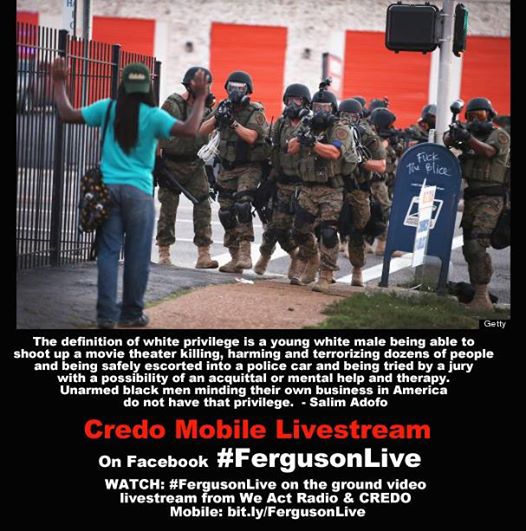
10599394_717380508311895_7027393843189443889_n“Every 28 hours across America a black person is killed by security guard, police officer or some other executive of the state,” Georgetown University professor Michael Eric Dyson said on the recent “Face the Nation,” adding that President Obama needs to use his “unique position” to explain the rage emanating from Ferguson, MO:

[Obama needs to explain] to white people whose white privilege in one sense obscures from them what it means that their children can walk home every day and be safe. They’re not fearful of the fact that somebody will kill their child who goes to get some ice tea and some candy from a store.”
— Michael Eric Dyson on August 17 Face the Nation

The Torah portion known as “Eikev [heel]” calls us to consider whether we might be, however inadvertently, tugging on the heel of a brother. And Mishkan T’filah‘s adaptation of words taken from this portion demands that we avoid making “gods of own comfort or power.”

Meanwhile, the Torah portion known as “Eikev [heel]” calls us to consider whether we might be, however inadvertently, tugging on the heel of a brother. And Mishkan T’filah‘s adaptation of words taken from this portion demands that we avoid making “gods of own comfort or power.”

If we turn from Sinai

The portion Eikev (Deuteronomy 7:12 – 11:25) includes verses that make up the second full paragraph of the Shema. These words, Deuteronomy 11:13-21, are included within tefillin as well. This passage, therefore, appears several times in many prayerbooks. But it’s far less prominent in, or missing entirely from, some liberal prayerbooks.It’s easy to see why a passage that speaks of reward and punishment as a direct result of the People’s actions was omitted or diminished in Reform Prayerbooks. (See, e.g., Richard Sarason on the Three Paragraphs of the Shema.) But Mishkan T’filah (URJ, 2007) includes, as an alternative reading, a thematic paraphrase of the Shema’s second paragraph.

The reading — by Richard Levy, a member of the editorial committee for the prayerbook and an author of many contemporary liturgical pieces — can be found on page two of these Mishkan T’filah sample pages:


But if we turn from Sinai’s words
and serve only what is common and profane,
making gods of our own comfort or power,
then the holiness of life will contract for us;
our world will grow inhospitable.

Let us therefore lace these words
into our passion and our intellect,
and bind them as a sign upon our hands and eyes….
— from Mishkan T’filah, p.67 and p.235

Levy’s is one of a number of approaches to this paragraph that take what theologian Judith Plaskow calls “a more naturalistic” view, focusing on the need to avoid thinking that “we can trample on or transcend the constraints of nature.”

The passage also seems to capture what another theologian, Elliott Dorff, calls the insistence that God is ultimately just. He points out that the ancient Rabbis had trouble with the way reward and punishment are described in this portion. Still, he says, they included this passage as a central part of the prayers because of their “deep faith in the ultimate justice of God as the metaphysical backdrop and support for human acts of justice.”

(Both Dorff and Plaskow quotes are from Jewish Lights’ My Jewish Prayerbook, vol 1: The Shema and its Blessings)

I see this idea reflected in the passage which is recited when laying tefillin on the hand (wrapping around the finger three times):

  • I will betroth you to me forever;
  • I will betroth you to me through justice and rule of law, kindness and compassion;
  • I will betroth you to me in trust, and you will know that I am God

— Hosea 2:21-22

Continue reading Heel-dom: gods of comfort and power

Tzipporah’s Eye View at the DC Sermon Slam

I have always lived among priests and prophets. I know that some divine encounters prove more terrifying than illuminating. And I believe there is much to be learned about Revelation by turning away from Sinai’s thunder and lightening.

Consider for a moment that time Miriam and Aaron complained about Moses and his black wife and God responded by covering Miriam with white scales. [Numbers 12:1ff. Tzipporah also appears in Exodus chapters 3, 4, and 18]…


…So, what does this incident tell you about Revelation?

Follow me for a moment on a “tzipporah-eye view,” looking two directions at once to see ahead. [“Tzipporah” = “bird”]

One bird’s eye focuses in on the siblings, without regard to gender. Here are three powerful individuals, all within spitting distance, shall we say, of divine Revelation. Genuine caring and concern between the siblings is evident, and each is deeply committed to community and the evolving Torah.

And yet, this story shows, understanding anyone else’s piece of Revelation – even the teaching of a prophet sibling, whom you love and respect – has always been hard. How much more so must non-siblings in your time work to understand each other’s perspectives!…

Recording from DC’s recent Sermon Slam, a project of Open Quorum. Background notes and sources.
Full text.


Continue reading Tzipporah’s Eye View at the DC Sermon Slam

God’s Favor, God’s Prayer

Berakhot 7a discusses the topic of God’s prayer:

R. Johanan says in the name of R. Jose: How do we know that the Holy One, blessed be He, says prayers? Because it says: Even them will I bring to My holy mountain and make them joyful in My house of prayer (Isaiah 56:7; more below). It is not said, ‘their prayer’, but ‘My prayer’ [תְּפִלָּתִי]; hence [you learn] that the Holy One, blessed be He, says prayers.

What does He pray? — R. Zutra b. Tobi said in the name of Rab: ‘May it be My will that My mercy may suppress My anger, and that My mercy may prevail over My [other] attributes, so that I may deal with My children in the attribute of mercy and, on their behalf, stop short of the limit of strict justice.’…

Isaiah 56:7
וַהֲבִיאוֹתִים אֶל-הַר קָדְשִׁי, וְשִׂמַּחְתִּים בְּבֵית תְּפִלָּתִי–עוֹלֹתֵיהֶם וְזִבְחֵיהֶם לְרָצוֹן, עַל-מִזְבְּחִי: כִּי בֵיתִי, בֵּית-תְּפִלָּה יִקָּרֵא לְכָל-הָעַמִּים
Even them will I bring to My holy mountain, and make them joyful in My house of prayer; their burnt-offerings and their sacrifices shall be acceptable upon Mine altar; for My house shall be called a house of prayer for all peoples.
–“Old” JPS translation (borrowed from Mechon-Mamre)

Continue reading God’s Favor, God’s Prayer

On-Line Resources for Torah and More

To avoid repeatedly typing the same citations, I set up the “Source Materials” page several years ago. As National Blog Posting Month has progressed, I’ve been updating resources and links. There are now 30 new or updated sources, including some very cool interactive tools, on this revised on-line learning page.

As part of NaBloPoMo (National Blog Posting Month), a cousin of NaNoWriMo (National Novel Writing Month), “A Song Every Day” plans thirty daily posts with some connection to the number 30.

NaBloPoMo_November_blogroll_large
TOP

Purposefully Blue

The peculiar blue [תכלת, tekhelet] thread used in tzitzit [ritual fringes] (Numbers 15:37-41) also appears prominently in the construction of Tabernacle (Exodus 25ff). It is used in the inner curtains and the loops that connect them; it also appears throughout the priestly vestments.

Why this blue?

It has been taught: R. Meir used to say: Why is blue [תכלת] specified from all the varieties of colours? Because blue resembles [the colour of] the sea, and the sea resembles [the colour of] heaven, and heaven resembles [the colour of] the Throne of Glory, as it is said: And they saw the God of Israel and there was under His feet as it were a paved work of sapphire stone [לבנת הספיר], and as it were the very heaven for clearness (Exod. 24:10) and it is written: The likeness of a throne as the appearance of a sapphire stone [אֶבֶן-סַפִּיר] (Ezek 1:26).
— Sotah 17a (also: Menachot 43b and Chullin 89a)

Kedushat Levi links the above passage about blue, תכלת, to the stages of a creative act, beginning and ending with its purpose [תכלית]:

[A project from thought to completion] has undergone four distinct stages. 1) original mental image of the project; 2) clarification of the details, etc. 3) translating thought into deed. 4) carrying out the intention which originally prompted the project. [Punctuation follows translation.] When the original mental image of the project is seen reflected after its successful completion, the person inhabiting this building will experience a sense of satisfaction and joy.
— Kedushat Levi, p. 475 (see Source Materials for full citation)

Continue reading Purposefully Blue

Folding, Half-Shekels, and Ego

One of the 30-cubit, goat-hair curtains on the outside of the Tabernacle is folded over the front of the tent (Exodus 26:9; see Thirty Cubits and Cloaking) for more on the curtains). Two aspects of this are emphasized in the commentary of Kedushat Levi, among others:

Folding: Folding [כפל, khaphal] is related to the idea of “klipah” [קלפה], the protective shell covering God’s Light in the world, according to mystical teaching. Kedushat Levi links the folding of the curtain and God’s cloaking, to protect humans from what they cannot withstand, adding that “folding over” implies reinforcing something not otherwise as strong as necessary. (Kedushat Levi, p. 473; full citations for Kedushat Levi, Stone Chumash in Source Materials.)

Half: Kedushat Levi also emphasizes the fact that the curtain is folded in half. He links “half” to “awe” through a play on the Hebrew words: the curtain, folded in “half” [חצי, chatzi], is linked via “crush” [מחץ, machatz] to “awe.” (More below.)

Additional thoughts on the concept of “half,” regarding the command to collect a half-shekel as part of the census embedded in the Tabernacle story, suggest a different direction:

Many commentators interpret homelitically that the requirement of half a coin alludes to the concept that no Jew is complete unless he joins with others; as long as we are in isolation, each of us is only “half” of our full potential.
— Stone Chumash, on Exodus 30:13

Combining these views on folding and half seem to suggest that any approach to God is best accomplished in community.
Continue reading Folding, Half-Shekels, and Ego

Cloaking Improves Vision

Readers of Moby Dick have long skimmed the whaling sections. Love-story followers generally hurry through the “war” part of War and Peace, while others skip through the boring relationship stuff to focus on land distribution. Likewise, many Bible readers’ eyes glaze over at the close of Exodus: Some 200+ Torah verses describe plans for the Tabernacle and its furnishings. Another 200+ verses describe the actual work. Four entire weekly Torah readings are dedicated to the details of the Tabernacle, with Ki Tisa’s story of the Golden Calf in between.

Some teachers focus on general messages extracted from these passages: the importance of working collaboratively, supporting community infrastructure, or honoring the arts, for example. But others take an allegorical view, mining details rather than glossing over them. Kedushat Levi (Rabbi Levi Yitzchak of Berditchev, 1740 – 1809) is one of the later. And some of those details surround the number 30.
Continue reading Cloaking Improves Vision

Thirty Cubits in the Tabernacle

The inside of the Tabernacle, the desert worship space of the Israelites, is 30 cubits long. (This is worked out from directions for various components, described in Exodus 26-27.) An inside covering is composed of ten panels of “twisted linen, and indigo and purple and crimson, with cherubim, designer’s work,” each measuring 28 cubits by 4 cubits (Alter’s translation; citation below). Eleven goat-hair panels of 30 cubits by 4 cubits create an additional covering over the whole construction. (Explicit instructions in Exodus 26:1 and 26:7).

The inside coverings are joined so “that the Tabernacle be one whole” (Exodus 26:6).

26:6) that the Tabernacle be one whole
This phrase leads Abraham ibn Ezra to muse over how unity in the greater world is constituted by an interlocking of constituent parts that become a transcendent whole, as in the unity of microcosm and macrocosm. One need not read this section homelitically, as he does, in order to see the power of summation of this particular phrase.
— Alter, Robert. The Five Books of Moses: A Translation with Commentary. (NY: Norton, 2004)

Continue reading Thirty Cubits in the Tabernacle