UPDATE 8/29/25: Typos in copying from We Will Not Cancel Us corrected
Repentance and repair must be year-round efforts, but the Jewish calendar emphasizes these needs as a new year approaches. For help in this work, many Jews turn to a centuries-old, five-step process outlined by Maimonides, AKA “Rambam” (acronym for R‘ Moses ben Maimon):
Beyond some quotations and a few questions, I haven’t got much to offer.
But the questions strike me as non-negotiable, given all we face in- and outside Jewish communities… living in DC and with many friends and family in Chicago, I am so conscious of the disasters coming our way if we cannot figure out how to resist in ways that don’t cause more damage….
Naming Harm and Starting to Change
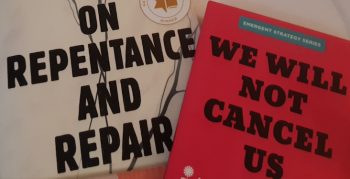
This year, I am exploring these steps within the “unthinkable thoughts” of adrienne maree brown’s We Will Not Cancel Us:
I’ll start with the scariest unthinkable thought for me, which is that maybe we as a species are in a state of apocalyptic fatigue — exhausted in the face of all the changes and endings we are living through. Our current collective circumstances require us to think about death, to grieve, and to consider that everything we have known has to change or come to an end. [p.33]
I, we, have to be able to discern what is me/us and what is fear.
Which leads to my next unthinkable thought: do I really know the difference between my discernment and my fear? [p.37]
…We are full of justified rage. And we want to release that rage. And one really fast and easy way to do this is what I experience as knee jerk collective punishment in movements. [p.40]
We are afraid, and we think it will assuage our fears and make us safer if we can clarify an enemy, a someone outside of ourselves who is to blame, who is guilty, who is the origin of the harm. Can we acknowledge that trauma and conflict can distort our perspective of responsibility and blame in ways that make it difficult to see the roots of the harm? [p.42-43, emphasis added]
…The tools of swift predatory justice feel good to use, familiar, groove in the hand easily from repeated use and training, briefly satisfying. But these tools are often blunt and senseless.
Unless we have an analysis of abolition and dismantling systems of oppression, we will not realize what’s in our hands, we will never put the predator’s tools down and figure out what our tools are and can be.
My third unthinkable thought — why does it feel like we are committed to punishment, and enjoying it? Why do our movements more and more often feel like we are moving with sharp teeth against ourselves? And what is at stake because of that pattern, that feeling? Why does it feel like someone pointing at someone else and saying: “that person is harmful!,” and with no questions or process or time or breath, we are collectively punishing them, tearing them, and anyone protecting them, to shreds?
Sometimes we even do it with the language of transformative justice: claiming that we are going to give them room to grow. They need to disappear completely to be accountable. We are publishing shaming them so that they will learn do do better.
Underneath this logic I hear: we are good and we are getting rid of the “bad” people in our community or movement. We are affirming our rightness and power. [p.44-45, emphasis added]
Knee-jerk call outs say: those who cause harm or mess up or disagree with us cannot change and cannot belong. They must be eradicated. The bad things in the world cannot change, we must disappear the bad until there is only good left.
But one layer under that, what I hear is:
We cannot change.
We do not believe we can create compelling pathways from being harm doers to being healed, to growing.
We do not believing we can hold the complexity of a gray situation.
We do not believe in our own complexity. [p.57-58]
— We Will Not Cancel Us: And Other Dreams of Transformative Justice by adrienne maree brown. AK Press, 2020.
Institutional and Movement Repair
The crucial perspectives of We Will Not Cancel Us return me to Rambam’s process, as R’ Ruttenberg describes it: Maimonides discussion of transformation “precedes his discussion of amends/reparations and apologies. He doesn’t spell out his thinking explicitly, but I think he was trying to tell us that apologies, and even amends and reparations, don’t truly have the needed effect if the work to become different isn’t already underway….The goal here isn’t amends. It’s transformation.” p.34, On Repentance and Repair.
One tricky aspect of work here involves our participation in a variety of institutions: “How can and should we think about the work of repentance when not a single person, but a rather a body, made of many actors with different roles is causing harm?…What are the obligations–and limits to the obligations–of the individuals in charge, and what does repentance look like when undertaken by an institution?” p. 101, On Repentance and Repair.
Again, beyond the questions, I haven’t got much to offer. But I believe we have to be asking them. And the questions lead me back to adrienne maree brown:
“I can’t help but wonder who benefits from movements that engage in public infighting, blame, shame, and knee-jerk call outs? I can’t help but see the state grinning, gathering all the data it needs, watching us weaken ourselves. Meanwhile, the conflicts are unresolved, and/or harm continues.” p. 54 We Will Not Cancel Us
Laws of Repentance, a late 12th Century work, is part of the enormous Mishneh Torah and can be found in several translations at Sefaria. (Useful background on Mishneh Torah as a whole). R’ Danya Ruttenberg provides an overview of Rambam’s five steps and explores them in the context of personal, public, institutional, and national repair: On Repentance and Repair: Making Amends in An Unapologetic World (Beacon Press, 2022).
Figuring out what kind of community is being constituted, under what rules and expectations, across what kind of timeline, and for what purpose, is a constant challenge — in- and outside of Judaism. As the high holidays approach, and we prepare to declare our collective sins and beg forgiveness, it’s worth considering what and who we mean when we say “forgive us.”
Decades back, Riv-Ellen Prell — anthropologist, Professor Emerita of American Studies at the U. of Minnesota; bio at Jewish Women’s Archives — published a book of scholarship on the Havurah movement. Prayer & Community: The Havurah in American Judaism centers on a community to which Prell had belonged and obtained permission to study. What she found back in 1989 still has great relevance to communities struggling at the intersection of politics and worship.
For anyone who wants to dig really deep, check out The Papers of Riv-Ellen Prell” (research, fieldwork, and correspondence regarding Westwood Free Minyan in Los Angeles and related studies.)
See also: Empowered Judaism : what independent minyanim can teach us about building vibrant Jewish communities. Rabbi Ellie Kaunfer. Jewish Lights Publishing, Woodstock, Vt., 2010
Community Words
Jewish liturgy is filled with references to “the People” [העם, ha-am] or “Your People” [עםך, amkhah, commonly with masculine singular suffix], sometimes “the people Yisrael” or “Jewish people” [עם ישראל, am yisrael]. Biblically — and so in the prayerbook — am can also mean “nation,” as in Yisraelites, or as in “other nation.” Related expressions in bible and prayer including adah [עדה, congregation], kahal or kehillah [קהילה, community], and tzibur [צבור, public/worship gathering]. In addition, Jewish tradition speaks of minyan [מנין, quorum] and havurah [חברה, fellowship].
Community Words: alt text below
Jewish prayer often situates “us” in a group that extends beyond any present gathering, physical or virtual — far into the past and into a hoped-for future.
Community Questions
Questions of alignment with larger movements, in- and outside of Judaism, are always present for individual Jewish communities. In these days of collapse, however, as individual congregations and groups become unmoored from anchoring umbrella-institutions, the questions become more complicated.
What is the community’s relationship to political movements in, and beyond, the US?
What is communal relationship to principles of labor and abolitionist organizing?
How do fundamental values — egalitarianism, transparency, mutual aid, collective decision-making, e.g. — manifest in our communities?
What can we expect of one another in a time of so much collapse?
These and so many other questions need asking, just at a time when so many of us — individually and in our collectives — have very little capacity. What’s a community to do?
Image description: Hebrew and English words: Tzibur — public group. community — kehillah. Folk [Latin and Hebrew characters] Minyan — quorum. Adah — congregation. Fellowship — havurah.
As Rosh Chodesh Elul approaches, rough draft of an al chet [litany of missing the mark] in hopes of awakening us to some areas of error we might try to fix as the Days of Awe draw near. Part of series: Calendar Notes for a Summer of Collapse
Selichot for Institutions, Elul 5785
New text for Elul 5785 (by V. Spatz, CC BY-SA-NC) with **quotations from Machzor Lev Shalem (Rabbinical Assembly, 2010)**
Two-page document is designed for praying, sharing, and printing through format that distinguishes machzor quotations and newer text for many readers. Full text also appears in post format below.
The soul is Yours, the body is Your creation
Have compassion on Your handiwork ** (p.225)
In function and in failure, our institutions are Yours as well
Re-orient us to divine sparks and powers within
Save us from ourselves with ourselves under Your guidance
Grant relief to this driven leaf (Lev 26:36)
Have compassion on that which is but dust and ashes
Cast away our sins, be kind to Your creations.
God saw it and appraised it, examined it and plumbed it,
and then God said to human beings:
“The fear of HASHEM — that is wisdom;
departing from sin — that is true knowledge” (Job 28:28) ** (p.224)
Our institutions are at once fragile and ponderous,
fleeting and stagnant, intractable and so easily toppled
conflict and confusion foster many modes of collapse
Keep us from contributing our own brittleness and turmoil
Remind us of connection’s strength and possibility
Help us pursue repair when all seems lost
If you see within me cause for sadness, guide me toward eternal truths
Hear my prayer, God, give ear to my cry; do not disregard my tears;
like all my forebears I am a wanderer, a guest in Your house
Make me an instrument of Your salvation ** (p.228)
My soul yearns for You, though I am afraid of Your judgment
My heart is caught in the web it has spun.
Form me anew, granting me a heart freshly born ** (p.230)
Our understanding is limited, obstacles abound
Our errors serve as brambles, adding pain along the way
We’ve lost ourselves and misled others
Clarify our missteps so we know when we must turn
Teach us to notice stumbling-blocks and dangers in the road
When despair threatens, nudge us back toward hope
We call out in words You taught Moses to use in times of trouble: “HaShem, HaShem, God compassionate and gracious, slow to anger, full of kindness and trust, extending kindness to the thousandth generation, forgiving iniquity, transgression and sin –” (Ex 34:6-7)
For the sin we have committed before You in destroying without thought to the future
For the sin we have committed before You by bowing down to the past
For the sin we have committed before You by focusing on policy in a world on fire
For the sin we have committed before You by thinking crisis overrides all planning and care
For the sin we have committed before You by thoughtlessly allowing ourselves to be led
For the sin we have committed before You by refusing to honor leadership
For the sin we have committed before You by failing to ask how we can help
For the sin we have committed before You by assuming it’s easier to do it all ourselves
For the sin we have committed before You by approving decisions that worry us
For the sin we have committed before You by second-guessing every step
For the sin we have committed before You by treating critique as attack
For the sin we have committed before You by attacking under the guise of help
For the sin we have committed before You by treating lock-step as unity
For the sin we have committed before You by mistaking variety of opinion for inclusion
For the sin we have committed before You by assuming we know too little to offer opinion
For the sin we have committed before You by thinking we know it all
For the sin we have committed before You by assuming our perspectives somehow universal
For the sin we have committed before You by assuming our own experiences unique
For the sin we have committed before You by mistaking outrage for justice
For the sin we have committed before You by succumbing to complacency
For the sin we have committed before You by fearing uncertainty and pause
For the sin we have committed before You by letting uncertainty paralyze us
For the sin we have committed before You by bringing punitive efforts into abolition work
For the sin we have committed before You by using abolition language to absolve real error
For the sin we have committed before You by putting Movement above people
For the sin we have committed before You by failing to keep our eyes on the prize
To all these sins, awaken us, help us recognize harm, and grant us ability to change
Bring us to the day when we can ask that you forgive us, pardon us, and grant us atonement.
Featured image is cropped from earthquake photo by Angelo Giordano via Pixabay
We’re past, just barely, the lowest point in the Jewish calendar. The climb up from the bottom won’t be easy or swift. This post invites a pause at this point of transition between moments “of affliction” and those “of comfort.” (Calendar note below)
The first “haftarah of affliction” (prophetic reading of warning in lead-up to Tisha B’Av) is Jeremiah 1:1 – 2:3. In this passage, God’s conversation with Jeremiah begins with the prophet in the womb (1:5) and then protesting that he is still a youth and “doesn’t know how to speak” (1:6). It closes with a message of God’s nostalgia a long-past honeymoon period with Yisrael (Jer 2:2-3), more positive in divine recollection than in what the Torah tells us of those “wilderness years.”
The third haftarah of affliction, Isaiah 1:1-27, speaks of the People as rebellious children (1:2) and expresses frustration and despair. But it also offers instruction and hope. (See also “How?! A Roadmap for Transformation” post and PDF).) In one noteworthy expression, God proposes a kind of joint process: “Lekhu nah v’nivakh’cha [לְכוּ־נָא וְנִוָּכְחָה], Let us please walk/move together and let’s understand this.” There’s a lot to unpack here, in terms of power dynamics — see also Computing Failures and Babylon. But one key element seems to be that, even in the midst of disaster, there is a way out.
The middle haftarah of affliction, centering on Jer 2:4-28, includes a verse that seems to resonate with many of us this year in particular:
For My people have committed two evils: They have forsaken Me, the fountain of living waters, and hewed them out cisterns, broken cisterns, That can hold no water.
…Some of these remarks were shared in a slightly different form with Tzedek Chicago for Tisha B’Av 5785 and build on learning within that community…
Stone well with wooden cover. Image by Bernd via Pixabay
Moving Toward Post-Upset Relationship
One way to view this series is as a relationship growing up: That is, it begins in reading 1 with an unrealistic view of relationship — as is common both at the start (when expectations may be great) and later on (in missing the good old days that never were) — of romantic sort as well as in collectives and communities. It closes in reading 3 with the instruction to “Learn to do good” (Isaiah 1:17), which refuses to let the relationship just whither, and the request (1:18) that we work this out together to move ahead… in what might seem like a more equitable and/or realistic relationship.
In the middle, we have God acknowledging brokenness — cisterns that are not functioning in nourishing ways — while simultaneously reminding us that we have access to the source, the Fount of Living Water. As if God were saying, through Jeremiah: “You’ve already got Torah, but human language and problems have realy messed up how you’re perceiving and acting on it: You’re trying to hold Torah in shapes that broke long ago.”
The point is, I think, is that we are not without resources and power. In fact, God seems to be furious that we cannot figure out how to use what we have in ways that nourish everyone.
As Rabbi Brant Rosen, at Tzedek Chicago, and Rabbi Jessica Rosenberg, who helped teach the “Facing Collapse Together” workshop, and many others have said recently: Some things we used to rely on are broken beyond repair, and maybe that’s good.
We’ve got a complex set of traditions that we have to sift through to find what still holds water, so to speak. We’re going to have to find some kind of new container for Torah. We have to do this together in community, even as so many structures and relationships are stretched to the brink, if not beyond. The world is putting so much stress on each of us individually, and ripping at our collectives, so we’re going to have to work harder to be sure that we’re building community that honors each of our participants and helps us figure out how to create cisterns that reflect and nourish all.
Shifting Power
Part of the struggle is in learning how to function in, with, and in opposition to power…. which reminds of this prayer-song, published more than four years ago —
— and somehow more poignant, now, as Jews continue to grapple with what influence we have or do not have in government wherever we are (DC doesn’t even have a Senator or voting representation in the House); what avenues are open to stopping US support for genocidal war and land-grab in Gaza AND the West Bank; and what collaborative efforts are possible, given our shifting communal boundaries.
Maybe we’ve got to approach the border, like that sea, anew and find a new song.
Calendar Note:
Here, for anyone interested, is a summary of the time periods known as “The Three Weeks,” “the Nine Days,” and “the Nine Days of Jerry” (or the “Days Between”):
Jeremiah 1:1-2:3 was read this year on Shabbat Pinchas, July 19, 2025.
Jeremiah 2:4-28 was read this year on Shabbat Mattot-Masei (July 26). Ashkenazi tradition ends with Jer 3:4; Sephardic tradition ends with Jer 4:1-2; some communities include additional verses for Rosh Chodesh Av.
Isaiah 1:1-27 was read this year on Shabbat Devarim (Shabbat Chazon), August 1.
Haftarot of Comfort begin with Isaiah 40:1-26, read in 5785 on August 9, on Shabbat Nachamu, and continue through Av and Elul toward the high holidays.
Calendar Notes for a Summer of Collapse — Part 3 (of 10) — songeveryday.org
The “Hows” of this season outline a difficult journey, built into the Jewish calendar. Following this annual journey can remind us that building community is hard work that can easily get off track.
— This piece originally appeared in Matir Asurim’s 5783 Tisha B’Av Mailer —
“How” is the sort of word that is used a lot without getting much attention. But this small, often overlooked word is important to a time of transformation in the Jewish calendar. The word creates a kind of roadmap for heading into, and climbing out of, Tisha B’Av, the lowest point of the Jewish calendar.
“How [Eikhah]” is the first word, and the Hebrew title, of the Book of Lamentations, read on Tisha B’av. It is also a key word in the Torah and prophetic readings for “Shabbat Chazon,” the sabbath of vision, right before. Together, the “how” readings cover a lot of emotional territory.
In English, “how” can be used to express different ideas:
Frustration: “How are we supposed to do this?!”
Disbelief: “How could this happen?
Despair: “How awful!”
Questioning: “How does this work?”
The Hebrew word “eikhah” has similar uses in the Bible, generally, and in readings of this season:
Frustration: Moses re-telling complaints about the People’s behavior in the wilderness:
“Eikhah/How can I, alone, bear the trouble of you!……the burden, and the bickering!” — Deuteronomy 1:12, Torah reading for Shabbat Chazon
Disbelief: God criticizing the People in Isaiah’s prophecy, set in 8th Century BCE:
Eikhah/How has the faithful city become perverse?…She was full of justice righteousness lived in her. But now murderers — “ — Isaiah 1:21, prophetic reading for Shabbat Chazon
Despair: mourning destruction of the First Temple and exile, 6th Century BCE:
“Eikhah/How lonely sits the city!…”
Once great with people! She was great among nations, now alone and vulnerable.
Once a powerhouse, now just one of the ruled.” — Lamentations/Eikhah 1:1,* reading for Tisha B’Av
Questioning: Jews trying to find meaning and move forward through disaster:
“How did we get here?” and “How do we go on?”
— centuries of Jewish teaching about destruction and tragedy
(Bible translations adapted from Jewish Publication Society 1985)
These “Hows” outline a difficult journey, built into the Jewish calendar. Following this annual journey can remind us that building community is hard work that can easily get off track.
How did we get here?
The Book of Deuteronomy opens with Moses and the People at the end of a forty-year journey. They stand on the river’s edge, imagining life on the other side. When they first escaped into thewilderness, a “promised land” seemed just around the corner. Decades later, the People have been through a lot. Mosesis listing their mistakes and his disappointments, crying:
“How can I manage this burden!” (Deut 1:12)
This is a community in trouble and out of balance. Maybe not all that different from our own?
The Book of Isaiah opens a long time later, on the other side of the river. But the vision of a “promised land” now seems like a nightmare. Isaiah tells the People they are focused on the wrong things and have become a burden, even to God:
“Your rituals are a burden to me…Your hands are full of blood.” (Isaiah 1:14-15).
The prophet’s harsh words point to a whole nation troubled, out of balance, and wondering: How could dreams of justice and righteousness go so deeply wrong?
In Lamentations, the Temple is in ruins, and the People face exile. Vision of a “promised land” seems in the past. Tisha B’Av mourns loss of dreams and hopes, as well as lives and homes. This won’t be the only time in history that Jews ask: “How?! How did our visions turn into this painful mess?!” We have always struggled to share burdens in our communities. We’ve always fallen short of our visions. That is one message of the “How” readings. But it’s not the only message.
How do we go on?
The “How” readings also tell us that we are expected to do better, as individuals and society:
Learn to do good. Devote yourselves to justice; Aid the wronged. Uphold the rights of the orphan; Defend the cause of the widow –Isaiah 1:17
Where did our ideas of community fail in the past? What visions must we mourn? Shabbat Chazon prompts us to envision something truly new, and imagine steps toward needed change. Tisha B’Av reminds us to expect failure and to mourn our losses. But the calendar nudges us forward.
There are seven weeks from Tisha B’Av to the new year. The “How” readings give us our homework, well in advance. We have work to do. And that work starts with “Learn.”
Image: Hebrew word Eikhah in Hebrew characters, plus English “How?! How? How!
Many teachings surrounding Tisha B’Av and destruction of the Temples focus on “baseless hatred” — sinat chinam [שנאת חנם] — as a cause. Some focus on rifts between Jews; others take a wider view of community harm. But many threads of such Jewish teachings ask us to use The Nine Days, the period between Rosh Chodesh Av and Tisha B’Av, to reflect on what needs repairing in our various communities.
We might consider these the Nine Days of Curiosity. And one place to pursue such curiosity is the career of Rabbi Akiva mentioned in part 1 (“Summer Breather, Toward Fall“). We can reflect on the “plague of disrespect” that affected 12,000 pairs of his students (B. Yebamot 62b) and consider what this legend teaches.
We might ask, for example: How could anyone miss such a widespread problem under their care? Were the students masking their true feelings? Was there a wider culture of disrespect at work? How were Akiva and the students affected by the difficult political climate in which they were trying to function?
We might also ask: Who among the students saw that there was a problem? Did they approach the teacher? Did they seek out other students? Whose responsibility is a communal problem, small or widespread?
These are just a few questions to spark curiosity for the month of Av.
Purim, Passover and the Omer Period, then Shavuot;
The months of Adar, Nisan, Iyar, and Sivan mark, on the one hand, winter’s overturning, the early (barley) and the later (wheat) harvests; on the other:
unveiling of hidden power, the beginnings of Liberation, the path to Sinai, and Revelation.
After all that, Tammuz holds one minor fast day.
The 17th of Tammuz starts the semi-mourning period of “The Three Weeks” (see below). And that period leads into preparations for the High Holidays and “THE festival” of Sukkot in the fall.
Tammuz itself offers a kind of breather. And For Times Such as These suggests it is a good month to ask:
What’s growing in your garden now? What is feeding you? What does the sun have to offer? Where do you see signs of what’s been destroyed in your communities?
What destruction needs attending to? How are the hurts of your communities/histories manifesting in the collective body?
What grief is unresolved and impacting your community? — Rabbi Ariana Katz & Rabbi Jessica Rosenberg. For Times Such as These: A Radical’s guide to the Jewish Year (Wayne State University Press, 2024), p.249
As Tammuz comes to a close — the month ends this year on July 25 — we can still ponder, carrying our answers or remaining questions into the next phase of the calendar.
The new month of Av begins on Shabbat, July 25-26 (2025) and For Times Such as These suggests that we ask:
NOTE: Av questions relating to love and sex seem better suited to the post-mourning days of the month; again, see calendar notes below, and check out For Times Such as These for more on the Jewish year.
God’s Questions and Ours
God has a lot of questions for us, according to the prophet Jeremiah*:
1) what? [מַה, mem-hey, mah] — Jeremiah 2:5
2-4) where? where? where? [אַיֵּה, alef-yud-hey, ayyeh] — Jer 2:6, 2:8, and 2:28
5) why? [מַדּוּעַ, mem-dalet-vav-ayin, madua‘] — Jer 2:14
6-7) whatsoever? or what-in-any-way? [מַה־לָּךְ, mah+lamed-kaf] — twice in Jer 2:18
8) how? [אֵיךְ, alef-yud-kaf, eikh] — Jer 2:23
Interrogatives are not unusual in biblical Hebrew. But eight in the space of 24 verses has an impact. Together, the piled up questions turn this passage into a kind of awareness demand.
Three of these interrogatives — what, where, and how — are part of questions we might already be asking ourselves, and each other, for the months of Tammuz and Av (see page 1).
In addition, the final question, Eikh [How?], hints at a theme in the next week’s readings, which are dominated by “Eikhah / How?!” as lament.
It’s important to ask specific, seasonal questions — and lean into the lament they raise. And it can be oddly comforting to know that the Jewish calendar is designed to stress this need. But it can also be helpful to imagine a less specific dialogue with the divine, one centered around questions as wake-up call: What? Where? Why? What-in-any-way? How?
———–
*Jeremiah 2:4-28 plus 3:4 is read as the second “haftarah of affliction” in preparation for Tisha B’Av. When, as in 5785/2025, the reading comes on Rosh Chodesh Av, two verses about new moons are added to close the haftarah: Isaiah 66:1, 66:23.
** For language geeks and trivia lovers: The form of “where” in Jeremiah 2 is lengthened from the simpler alef-yud, אַי. The Brown-Driver-Briggs biblical dictionary adds about this form:
used of both persons & things (but never with a verb [contrast אֵיפֹה (eifo, alef-yud-pei-hey)]; oft. in poet. or elevated style, where the answer nowhere is expected…
————————-
Broken Cisterns, Holding Water
Amid all the questions, this chapter of Jeremiah includes the following divine complaint:
For My people have committed two evils: They have forsaken Me, the fountain of living waters, and hewed them out cisterns, broken cisterns, That can hold no water.
— Jer 2:13, (JPS 1917 translation — a little old-fashioned, but chosen for its rhythms)
Water is often linked with Torah and with healing. So God’s complaint might be understood as accusing the people of failing to value God’s teaching and healing, and of creating faulty containers, unsuitable for gathering and preserving God’s life-giving offerings.
A related passage in Proverbs is used for much commentary on Torah, water, and healing:
Proverbs 5:15) Drink water from your own cistern [borkha], Running water from your own well.
16) Your springs will gush forth In streams in the public squares. [Revised JPS 2023]
These teachings, attributed the Talmud’s Rabbi Akiva, focus on the idea of bor [pit/cistern]:
In this season of contemplating all that is broken, in and around us, the Jeremiah and Proverbs images and Rabbi Akiva’s teaching are worth reflection. Here are some questions for this particular season:
In what ways have our Torah-containers broken, over time and more recently?
Are all such breaks “bad”? How might cracks help us move forward differently?
Have we (individuals, communities, society) forsaken divine teaching? How? And, if so, how might we remedy that?
What kinds of containers do we need for communal Torah today?
What kind of work is required to build what is needed?
How does the imagery in Prov 5:15-16 differ from that found in Jeremiah?
— Is one vision more universal than the other?
— Is either more hopeful?
— Many translations, including RJPS, opt for “your own cistern” and “your own well” rather than just “your cistern” and “your well.” What is “ours” or “our own”?
— Does sticking to our (own) Torah caution us from “bad” teaching? limit us in some way? Or does it encourage us to bring out our (own) Torah?
How does Akiva’s imagery differ from that in the biblical passages?
— How does Torah/water get into the cistern in the two sets of images?
— A pit may contain no water to start with, but is all Torah poured in by scholars?
— Consider, too, this story about Akiva himself, water, and a bor:
Speaking of Broken Things
Akiva (c. 50 – 135 CE) is a huge figure in the Talmud and later lore. For this summer of collapse, it’s particularly worth noting that Akiva was a controversial figure in the politics of responding to Roman occupation and that two of the most quoted stories about him involve major tragedy: his 24,000 students who died in a plague of disrespect (B. Yebamot 62b), and “the four who entered Paradise” (B. Chagigah 14b: Wikipedia’s basic page on the legend of Pardes is pretty useful).
The latter story brings us back to stones and water — in a strange, mystical way:
[Akiva told his fellow travelers:] When you reach the stones of pure marble, don’t say, “Water! Water!” As it states, “One who speaks falsehood shall not endure before My eyes” [Psalms 101:7]— Babylonian Talmud, Chagigah 14b
Four men entered pardes [paradise]: Ben Azzai, Ben Zoma, Acher ([“Other”], Elisha ben Abuyah), and Akiva. We are told: “Ben Azzai looked and died; Ben Zoma looked and went mad; Acher destroyed the plants [became a heretic]; Akiva entered in peace [or wholeness, “shalom”] and departed in peace” (B. Chagigah 14b again). Many teachers assume that this means Akiva was of superior mind or spirit. But the story does raise the question: What does it mean to survive in wholeness amid such disaster, for near friends and so many others? Returning to the For Times Such as These questions for Tammuz:
Where do you see signs of what’s been destroyed in your communities?
What destruction needs attending to?
How are the hurts of your communities/histories manifesting in the collective body?
What grief is unresolved and impacting your community?
Toward Tisha B’Av, “Within the Straits,” and Then Beyond: Calendar Notes for Tammuz and Av and Elul — here as PDF (if anyone needs another format for accessibility, please advise) —
Capital punishment and garment fringes. These topics bump against each other in this week’s Torah portion. And the juxtaposition prompts reflection: How do the corners of a garment relate to incarceration and execution? Does grappling with one of the heaviest of issues for our society outweigh other pressing concerns? Amid a constant stream of urgent death penalty crises, where do day-to-day activities and obligations fit? How might these apparently disparate topics inform one another?
This week’s portion is Shelach (Numbers 13:1 – 15:41). It’s an eventful section, full of conflict and disaster, death and the promise of more death-as-punishment to come. The portion concludes with instructions regarding ritual fringes (Num 15:37-41) which comprise the third paragraph of the Shema recitation in most traditions. Immediately prior to that is an incident involving citizens’ arrest, followed by detention and execution, ordered by God and implemented by the entire community (Num 15:32-36). (Verses below)
A lot of teaching over the centuries addresses connections between the law violation in Num 15:32 and the adjacent commandment to wear fringes, tzitzit. One thread of commentary treats tzitzit as a reminder of all the commandments, including Shabbat; the suggestion is that tzitzit can help avoid another violation, like that reported in 15:32. Here, I suggest using the tzitzit for a different reminder.
Keep Them in Mind
The current month of Sivan 5785 / June 2025 is set to include six executions in the US with more ahead. We have already lost 23 individuals to execution in 2025 (29 in the Jewish year of 5785). Meanwhile:
Some of us go about our daily lives without much attention to capital punishment happening in our names and with our tax dollars;
Some of us are concerned about specific cases and/or the death penalty itself; we sign petitions, lobby officials, engage in related prayer and protest;
Some of us, inside or outside, are deeply affected by relationships with those on Death Row and/or victims of capital crimes;
And some of us are on Death Row, regularly experiencing dehumanizing treatment, watching fellows separated for Death Watch and mourning for those executed — often very different individuals from those convicted decades earlier.
We might shift between “some” categories over time or live within more than one. And, just in case the idea that “some of us are on Death Row” seems odd to you, please consider: If you are reading this, you are at least vaguely connected to me (Virginia Avniel Spatz), and that means you two degrees of separation from a Jew on Death Row and another degree away from many others. As with all things in our inequitable society, some among us can live whole lives — in some cases, generations of lives — without personally knowing someone on Death Row or serving a life sentence. But none of us is truly unconnected.
When gathering the four corners to recite the Shema — or at another time that works in our practice — we can hold these “some” categories, within our communities and/or within ourselves, together for a few moments.
Tied Together
As an aid to considering how we are all connected, I share “Tied Together: A meditation on fringes, whom we center, and communal work ahead” (PDF: Tied Together). This meditation focuses on carcerality more generally, rather than on the death penalty specifically. It also suggests categories of vision that might transform our current system.
Alt text: picture of tallit, folded to show four fringes, labeled: asurim [bound] + l’yad [adjacent] + bachutz [outside] + lo nikhla [not impacted]; 317+44+106+132= 599; see PDF for more on graphic and meditation.
To aid, perhaps, in connecting, a few words from my chevruta, Ronald W. Clark, Jr., on Florida’s Death Row:
[Anthony Wainwright] was talking about how good the other burrito was, so I gave him mine. We were talking at the time his warrant was signed, it was 3:54 pm when the front door popped and Wainwright said, they just signed my warrant. I said no! I stuck my mirror out and sure enough there they all are coming down. When they got down here in front of his cell Wainwright said, I already know. Can I take my tablet?* They told him you can take your address book. He had been so stressed out since I got up here. I had heard about it before I even moved up here, guys were telling me at rec that he was stressed out thinking his warrant would be signed. When I got up here, I actually got to see it first hand. That brother couldn’t get it off his mind. Guys up here thought he was paranoid. But I knew from talking to him that he had a legitimate concern.
…Then Friday they signed Michael Bell’s death warrant. They have him scheduled for July 15th. I know him as well. Tommy [Thomas Lee Gudinas] has nine days to live. This Governor is trying to stack the bodies up to walk his self into the Whitehouse. Rick Scott murdered 28 men to get into the U.S. Senate, DeSantis feels that if he out does Scott he will get the Presidency. And he’s on pace to shatter that with two executions a month.
— Ronald W. Clark, Jr., UCI Florida
private correspondence, [May 16 and June 16, 2025) shared with permission
*When a death warrant is signed, the individual is taken from Death Row to “Death Watch,” where their connections are lost to others inside and to those outside, through their electronic tablets.
In closing, may this week’s Torah reading serve as reminder that our obligations extend to all of our community, incarcerated or not, on Death Row or not.
15:32: Now when the Children of Israel were in the wilderness, they found a man picking wood on the Sabbath day.
33: They brought him near, those who found him picking wood, to Moshe and to Aharon, and to the entire community;
34: they put him under guard [va’yanichu oto bamish’mar, וַיַּנִּיחוּ אֹתוֹ בַּמִּשְׁמָר] for it had not been clarified what should be done to him.
35: YHVH said to Moshe: The man is to be put to death, yes, death; pelt him with stones, the entire community, outside the camp!
36: So they brought him, the entire community, outside the camp, and they pelted him with stones, so that he died, as YHVH had commanded Moshe.
37: YHVH said to Moshe, saying:
38: Speak to the Children of Israel and say to them that they are to make themselves tassels [tzitzit, צִיצִת] on the corners of their garments, throughout their generations, and are to put on the corner tassel a thread of blue-violet [tekhelet, תְּכֵלֶת].
39: It shall be a tassel for you, that you may look at it [u-r’item oto, וּרְאִיתֶם אֹתוֹ ] and keep-in-mind [u-z’khartem, וּזְכַרְתֶּם ] all the commandments of YHVH and observe them, that you not go scouting-around after your heart, after your eyes which you go whoring after;
40: in order that you may keep-in-mind [l’ma’an tizk’ru, לְמַעַן תִּזְכְּרוּ ] and observe all my commandments, [va’asitem et-kol-mitzvotai, וַעֲשִׂיתֶם אֶת־כׇּל־מִצְוֺתָי] and [so] be holy to your God! [vi’hayitem kedoshim le’loheikhem, וִהְיִיתֶם קְדֹשִׁים לֵאלֹהֵיכֶם]
41: I am YHVH your God, who took you out of the land of Egypt, to be a God to you; I am YHVH your God!
Guard / Imprison
The Hebrew in Num 15:34 uses the expression “put him under guard [va’yanichu otobamish’mar].” The Aramaic translation uses the verb “אֲסוּרִים, asurim [imprisoned].” This is the same Aramaic verb used in Num 11:28, where Joshua calls on Moshe to restrain (or detain or contain) Eldad and Medad, using a different expression: “כְּלָאֵם, k’la’eim.” Verse 11:28 is one of the rare uses in the Torah of the root kaf-lamed-alef — the root of “carceral,” “prison,” and related words in modern Hebrew.
Presentation title page: “Matir Asurim: Introduction to the Jewish Care Network for Incarcerated People,” Yom Kippur 5785 — Virginia Avniel Spatz. + Tzedek Chicago logo
Some of us have been worshiping together for much of the day. Others may be joining from another context. Either way, I hope this hour will bring focus to one way we can engage in teshuvah/repair for the coming year. The basic concept for this session is that I was asked to share a little about my volunteer work with the organization, Matir Asurim: The Jewish Care Network for Incarcerated People, and bring some text to link that work with Yom Kippur.
Overview, Basics, and Contacts
[SLIDE 2]. The planned shape of the session is:
Basics and contact information for myself and the organization Matir Asurim
Text exploration: Genesis 44
Matir Asurim Guiding Principles
Back to Genesis 44
Thoughts for Yom Kippur and into 5785
So, let’s get started with some basics
[SLIDE 3] Matir Asurim — “One Who Frees Captives”
Who We Are: “We are a collection of Chaplains, Rabbis, Cantors, Kohanot/Hebrew Priestesses, advocates, activists, volunteers, loved ones of incarcerated people, and people with direct experience of incarceration. We are an all volunteer group who began meeting in 2021. We live and work across Turtle Island, in territories, cities, and rural settings of the US and Canada.”
I’ve been volunteering with Matir Asurim for close to two years,
producing the monthly e-newsletter,
serving as a penpal/chevruta partner with an incarcerated Jew,
helping to create resources for readers who are incarcerated,
helping craft materials for outside readers around incarceration,
producing some additional programming,
and working on organizational infrastructure.
We’ll get into some more specifics a bit later. Meanwhile, some contacts:
[Summary] Joseph is 12th of 13 siblings in the family of Jacob, Rachel, Leah, Bilhah, and Zilpah. In his youth, he was the favorite of his father, Jacob, and an annoyance to the rest of the family. So, Joseph’s brothers attempt to get rid of him. Their scheming takes an odd turn, however, and, although his family does not know it, Joseph becomes a powerful government leader in Mitzrayim, second in command to Pharaoh.
When famine strikes in Canaan, Jacob sends the brothers down to Mitzrayim, where grain is plentiful, to beg food. Joseph, still unrecognized by his brothers, treats the brothers to a feast at the palace and grants the requested supplies.
Joseph also orchestrates a criminal charge against the youngest brother – thus creating a situation in which the older siblings can again harm a younger brother, or they can act to avoid such harm.
Genesis 44 starts as the brothers leave the palace with the supplies.
[SLIDE 5] Genesis 44 Revised (2023) Jewish Publication Society translation, via Sefaria
1) Then he [Joseph] instructed his house steward as follows, “Fill the men’s bags with food, as much as they can carry, and put each one’s money in the mouth of his bag.
2) Put my silver goblet in the mouth of the bag of the youngest one, together with his money for the rations.” And he did as Joseph told him.
3) With the first light of morning, the men were sent off with their pack animals.
4) They had just left the city and had not gone far, when Joseph said to his house steward, “Up, go after those men! And when you overtake them, say to them, ‘Why did you repay good with evil?”…
[The house steward follows Joseph’s orders, going after the brothers and accusing them of stealing the goblet.]
12) He searched, beginning with the oldest and ending with the youngest; and the goblet turned up in Benjamin’s bag.
13) At this they rent their clothes. Each reloaded his pack animal, and they returned to the city.
[SLIDE 6] (Genesis 44 cont.)
14) When Judah and his brothers reentered the house of Joseph, who was still there, they threw themselves on the ground before him.
15) Joseph said to them, “What is this deed that you have done? Do you not know that a man like me practices divination?”
16) Judah replied, “What can we say to my lord? How can we plead, how can we prove our innocence? God has uncovered the crime of your servants. Here we are, then, slaves of my lord, the rest of us as much as the one in whose possession the goblet was found.”
17) But [Joseph] replied, “Far be it from me to act thus! Only the man in whose possession the goblet was found shall be my slave; the rest of you go back in peace to your father.”
18) Then Judah went up to him and said, “Please, my lord, let your servant appeal to my lord, and do not be impatient with your servant, you who are the equal of Pharaoh. [Link to bilingual English/Hebrew at Mechon-Mamre]
pray let your servant speak a word in the ears of my lord,
יְדַבֶּר־נָא עַבְדְּךָ דָבָר בְּאׇזְנֵי אֲדֹנִי
and do not let your anger flare up against your servant,
וְאַל־יִחַר אַפְּךָ בְּעַבְדֶּךָ
for you are like Pharaoh!
כִּי כָמוֹךָ כְּפַרְעֹה׃
va’yigash eilav…
This expression, va’yigash eilavis, is worth considering. It comes up in midrash about this Torah story and it appears in Maimonides vocabulary discussion.
Jewish Teachers Discuss “Approaching”
[SLIDE 8] This is a small portion from Maimonides Guide for the Perplexed. Part 1 has many chapters focusing on Hebrew vocabulary.
BTW, I highly recommend checking out Maimonides’ vocabulary chapters, if you can. Sefaria offers free bilingual text with live links to the Tanakh verses mentioned, and I find it a worthwhile exercise to spend some time with the words Maimonides discusses.
Part 1, Chapter 18 is about three similar words: Karov, Naga, and Nagash
קרוב – נגוע – נגוש
Maimonides writes:
“THE three words karab, “to come near,” naga‘, “to touch,” and nagash, “to approach,” sometimes signify “contact” or “nearness in space,” sometimes the approach of man’s knowledge to an object, as if it resembled the physical approach of one body to another.”
He gives examples of each usage, including Gen 44:18: “…And Judah drew near (va-yiggash) unto him”
While we pursue the exchange between Judah and Joseph, it’s worth keeping this expression and the Hebrew vocabulary in mind, more generally: What does it mean to be near to another person in terms of physical space and knowledge of another?
A number of teachers over the centuries have derived lessons from Genesis 44:18. Here are two…
[SLIDE 9] va’yigash eilav yehudah…
It is asked: Judah and Joseph are already in the same room. So, why does the text tell us that Judah vayigash, “drew near” or “came in contact”?
One answer: Jacob ben Asher says:
The last letters of these three words — vayigaSH eilaV yehudaH,shin-vav-hey — spell “shaveh, שָׁוֶה [equal].” Judah’s step forward changes the dynamic, allowing the brothers to speak directly, as equals.
Another answer: The 18th Century teacher, Or Hachayim, from Morocco, cites Prov 27:19: “As face answers to face in water, So does one person’s heart to another”
Building on his teaching, we can see Judah’s step forward as an attempt to create a face-to-face encounter. This was a struggle for Judah, to step across apparent cultural differences and the gap in their positions. The result, ultimately, was reconciliation between the brothers.
This principle of seeking face-to-face interaction can be useful for the season of teshuvah to consider when taking steps in interpersonal reconciliation.
It is also a guiding principle for Matir Asurim as an organization.
Matir Asurim Guiding Concepts
[SLIDE 10] Panim-el-Panim, seeking face-to-face approach, is a guiding principle of Matir Asurim: “Seeking ‘face-to-face’ interactions, despite difference, distance and bars; approaching one another as equals and striving to work in genuine relationship.”
This shapes our penpal relationships, our creation of resources for those who are behind bars, as well as any advocacy on legislation or change of practices, regulations, and conditions inside.
Matir Asurim seeks to provide resources that reflect realities in carceral facilities which often include circumstances that contradict assumptions in much Jewish teaching
reciting prayers or reading Torah right next to toilets;
reciting daily prayers upon waking, which might not align with shacharit, morning prayers, at all;
figuring out how to create community in isolation, when so much of Jewish life assumes access to community (not exclusively an incarceration issue, but a BIG challenge for Jew who are incarcerated)
There are enormous challenges to organizing across bars, and we know that people inside are counting on those of us on the outside to organize and advocate where they cannot.
Still, it’s crucial to take our lead from incarcerated people and those who have experienced incarceration.
All people are created in the image of the Divine.
We all carry a spark of divine goodness as well as the capacity for creative action and transformation.
Teshuva [repentance/return]:
We believe in human resilience and transformation, in our ability to make amends after experiencing and/or perpetrating harm.
We practice this relationally as conflict arises within our organizing, and also strive to create a world that uplifts restorative accountability processes rather than punishment.
Refua Shleima [Complete Healing]:
We work towards collective healing and wholeness, striving to restore balanced relationships within the broader interconnected web of creation and to heal the traumatic effects of white supremacy, colonization, and other systems of oppression that affect our minds and bodies.
Learning from every person:
Learning from every person requires honoring the contributions and voices of people who have been systemically silenced, including through incarceration. In our conversations, we strive to hold awareness around differences in identity and power dynamics.
Kol Yisrael Aravim Zeh Bazeh
[All Jews Are Responsible, One to the Other]/Communal Responsibility:
“All Yisrael is responsible, one for the other.” Jews have many universalist obligations, but we also have a special duty to other Jews.
A little more on this last principle —
[SLIDE 12] Kol Yisrael Aravim Zeh Bazeh
Matir Asurim works with non-Jewish individuals and organizations on issues, trying to address needs of folks who are incarcerated and returning from incarceration in both the US and Canada.
Many non-Jewish groups are larger and better equipped to cope with more general issues, such as solitary confinement and the death penalty. We are also trying to link up with other affected groups regarding what is often called “religious diet.”
But we also focus on specifically Jewish needs: Trying to ensure that incarcerated Jews and those exploring Judaism have access to penpals and spiritual resources. In some carceral facilities, Jews are still offered a Christian bible and told to “ignore the end.” Trying to supply more appropriate resources is one goal. We also seek to fill requests for obtaining a tallit or tefillin – often an issue for those who are not recognized by Aleph (the biggest Jewish organization working in prisons, which provides resources for some Jews but not all).
[SLIDE 13] At a more basic level, we seek to increase awareness in Jewish communities that Jews DO experience incarceration and that we cannot treat incarceration as something that happens to other people.
This awareness also leads, in turn, to more general concerns about incarceration and the toll it takes on individuals, families, and society….
And that takes us back to Maimonides’ idea that “coming near” can be a matter of knowledge as much as one of physical nearness.
Back to “Coming Near”
[SLIDE 14] Back to Genesis 44
[Summary] Judah approaches Joseph and relates the brothers’ previous visit to Mitzrayim for food rations, when Joseph insisted that they return with their youngest brother. Judah includes in his tale the fiction, from years earlier, of a brother killed by a beast and their father’s real grief over the loss. Judah says that incarcerating Benjamin would increase Jacob’s pain and so offers himself as captive instead. At this point, Joseph can no longer restrain himself, clears the room of everyone except his brothers, weeps loudly, and reveals himself.
Gen 45:4-5 – Fox (Schocken) translation:
Then Yosef said to his brothers: I am Yosef. Is my father still alive?
But his brothers were not able to answer him,
for they were terrified before him.
Yosef said to his brothers:
Pray come close to me! [geshu-na eilai גְּשׁוּ־נָא אֵלַי]
They came close. [va’yigashu וַיִּגָּשׁוּ]
He said: I am Yosef your brother, whom you sold into Egypt.
This time, the same verb, nagash, that we saw in Gen 44:18 is used by Joseph to invite approach, and the brother comply. Joseph invites the brothers to hear a truth they previously did not know even though they did know they had a part in causing harm.
In the Torah, Joseph will go on to explain that it’s all good, because even though the brothers meant ill, God meant to put Joseph where he ends up. Still we can consider this verse and what it means for the brothers to hear from Joseph about his direct experience. They come close and learn something they did not know but MUST if they are to understand Joseph’s life and their own roles in the wider world which also includes incarceration as a regular part of its function.
There are ways we all can learn more about the role incarceration plays in our history and our society now and how it impacts individuals and families.
We can opt to get closer to individuals who are or have been incarcerated.
We can also opt to approach through general learning.
[SLIDE 15] They came close: approaching as a matter of knowledge
Explore the complex, interrelated stories of racism, enslavement, and incarceration; of colonialism, displacement and destruction
Learn about the over-representation of Indigenous people in US and Canadian carceral systems
Learn about the Incentive System in the Canadian carceral system
Learn about the Exception Clause in the 13th Amendment to the US Constitution
Learn about the “Auburn system” of incarceration, which predates the US Civil War and the 13th Amendment. We have a video and transcript coming soon about Freeman’s Challenge — and I recommend the book….
One of the things that Robin Bernstein, author of Freeman’s Challenge, says she was trying to do with her book is to stop letting the North off the hook in terms of responsibility for our carceral state. Many of us associate exploiting prisoners for profit with the US South and Reconstruction. But her book describes a prison for profit system that pre-dates the Civil War and originates in the North….
For me, learning about the Auburn system, which originated in upstate New York, was a real shift in my thinking. So, coming on that verse, Gen 45:5 — where Joseph says, “I am the one you sold into imprisonment,” really rings new.
More details on some of the topics above, and some related Jewish texts, are available on Matir Asurim’s Resources page — originally prepared for Passover, but also more widely applicable. For more on Freman’s Challenge, visit this page.
by what can we show ourselves innocent? וּמַה־נִּצְטַדָּק
God has found out your servants’ crime! הָאֱלֹהִים מָצָא אֶת־עֲוֺן עֲבָדֶיךָ
Here we are, servants to my lord, הִנֶּנּוּ עֲבָדִים לַאדֹנִי
so we, גַּם־אֲנַחְנוּ
so the one in whose hand the goblet was found. גַּם אֲשֶׁר־נִמְצָא הַגָּבִיעַ בְּיָדוֹ
[SLIDE 17] When Joseph orchestrates the threatened punishment of Benjamin alone, Judah says “God has found out your servants’ crime!” – ha-elohim, matza et-avon avdeikha
He then repeats the same verb, to find [mem-tzadei-aleph], and offers this poetic statement of collective responsibility:
Many teachers note that Judah seems to be acknowledging the brothers’ long-ago crime. And that verb, mem-tzadei-aleph, finding, might point us to things we might find we are complicit in, like living in a carceral state that relies on ideas of “public safety” leading to people being locked up and tortured.
Judah’s statement — “so we, so the one in whose hand the goblet was found” or “the rest of us as much as he in whose possession the goblet was found” points to an understanding of collective responsibility not unlike what we recite throughout Yom Kippur — when one of us commits a crime, we, all of us, who permitted the conditions that lead to crime, are the ones who sinned.
Rabbi Ammi taught that violent robbery — taking by force or more general oppression — upset the universe to the point of interfering with the most basic of divine blessings. I found this passage (B. Talmud Taanit 7b) exploring prayers for Shemini Atzeret, at the close of Sukkot. This year, the close of Sukkot marks a full Jewish calendar year of disaster and death and grief. The still intensifying process of genocide, greed, and disregard for both humanity and international law seems too clear an example of “the sin of hands” Rabbi Ammi cites.
I began my studies on this hoping for inspiration to craft a prayer or ritual response for the terrible anniversary coming. At this point, I can only share the sources I’ve explored.
Rabbi Ammi tells us “rain is withheld only due to the sin of gezel [robbery, wrong, oppression].” He uses a form of scriptural reasoning that links words and images in one verse to those in another, with each image a powerful one worth considering:
our hands, engaging in acts of violence and appropriating of others’ resources;
God’s hands, holding lightning or covering light;
God spreading out light, which is linked to Torah and to rain;
God filling dark clouds with moisture and emptying them as rain.
identification of prayer and pleading as “remedy” for what ails us and the world.
The last link in the chain of verses is a statement that “remedy” is increased prayer, brought to us through an odd conclusion to the scriptural tour: “prayer [t’fillah]” and “pleading [pegi’ah]” are equated based on God telling Jeremiah that neither one will avail for unrepentant people (Jer 7:16).
This sounds hopeless, with God telling the prophet, in essence: Don’t even try it! These folks have burned all their bridges, so don’t you come crying on their behalf!
And yet…
Debts to Pay, Ways to Mend
God tells Jeremiah to not bother praying or pleading on behalf of the people, because they’re already been offered every opportunity to change and have refused. And yet, the verse that Rabbi Ammi cites is prefaced by crystal clear atonement instruction:
If you really mend your ways and your actions; if you execute justice between one party and another; if you do not oppress the stranger, the orphan, and the widow; if you do not shed the blood of the innocent in this place; if you do not follow other gods, to your own hurt— (Jer 7:5-6)
Rabbi Ammi’s “what is the remedy?” message says what is needed is prayer. But the passage chosen clarifies that true prayer/pleading means self-reflection and change. Prayer/Pleading ALONE are useless. What’s required is “mending your ways and your actions.”
The prayer for rain asks that the blessing “not be withheld because of unpaid debts.” And that means we cannot JUST pray for blessing. We’ve got debts to pay and ways to mend.
Sources in three-column study sheet with color coding (Rain Debts PDF)

![Hebrew and English words: Tzibur -- public group. community -- kehillah. Folk [Latin and Hebrew characters] Minyan -- quorum. Adah -- congregation. Fellowship -- havurah.](https://songeveryday.org/wp-content/uploads/2025/08/community-words.png)







![picture of tallit, folded to show four fringes, labeled: asurim [bound] + l'yad [adjacent] + bachutz [outside] + lo nikhla [not impacted] 317+44+106+132= 599](https://songeveryday.org/wp-content/uploads/2025/06/tzitzit-graphic-for-blog.png)


 "A Song Every Day"