Sandwiched in a Torah portion packed with narrative is “the war of the kings” with Lot’s capture and rescue (Gen. 14). It begins, really, with Abraham and his nephew Lot separating to avoid quarrel over land for cattle herding (Gen. 13). YHVH spoke to Abraham “after Lot had parted from him,” promising “descendants like dust of the earth,” and Abraham dwelt by the oaks of Mamre and built an altar to YHVH.
He is still living by the oaks of Mamre when the fugitive arrives to tell him that his nephew is in trouble, and Abraham sets off to rescue Lot:
And they took Lot, Abram’s brother’s son, who dwelt in Sodom, and his goods, and departed.
And there came one that had escaped, and told Abram the Hebrew [ha Ivri]…”
Does Abraham’s being an “ivri” — a “crosser-over” or “one from the outside” — have anything to do with expectations about him and his response to Lot’s trouble? Why is this the first time Abraham is called by this name? Does being a Hebrew mean retainining sympathy — and a willingness to help — those on the other side?
NOTE
Lech Lecha (Gen. 12:1-17:27) includes the first “say you’re my sister” incident with Abraham and Sarah (Gen. 12:10-20), the weird episode of the Abraham and the covenant of the pieces (Gen. 15:1ff), and the first installments in the tales of Hagar and Ishmael (Gen. 16, 17:17-27).
Two messages from Playing for Change “Songs Around the World” seem in order. If you don’t know this organization, learn and support them — or at least give them a listen….
Sometimes in our lives we all have pain
We all have sorrow
But if we are wise
We know that there’s always tomorrow
An angel encounters Hagar in the wilderness (Gen. 16:7). At this point, she has been introduced to us as maid to Sarah, who has been married to Abraham for ten years without producing a child (16:1). We are told that she was given by Sarah “as wife” to Abraham, that she became pregnant, and subsequently, scorned her mistress (“saw her as lightweight”). Sarah then afflicted Hagar, and Hagar ran away. Out in the wilderness, at the spring on the road, the angel speaks to Hagar.
No one in the story has addressed Hagar before this point. And only after the angel’s inquiry does Hagar speak. These obvious, but easily overlooked points are highlighted in Susan Niditch’s notes in The Torah: A Women’s Commentary and led me to marvel at the power of a few words.
With the fall holidays a few weeks behind us at this point, it’s not a bad idea to pause and (re-)consider* the angel’s query ourselves:
Whence have you come and
where are you going?
But we might also ask: How often have we needed someone to simply inquire and listen? How often do we stop to address someone encountered along the way?
*NOTE
For those observing two days of Rosh Hashanah, the story of Hagar is part of the first morning’s Torah reading.
Let’s return briefly to the questions which plagued author Sebastian Junger, in his suburban Boston youth, and set him a path that eventually led him to write Tribe: On Homecoming and Belonging:
How do you become an adult in a society that doesn’t ask for sacrifice? How do you become a man in a world that doesn’t require courage?
— Tribe, p.xiv
(See “Covenant and Liturgy” for full citation and more)
Previous posts explored the concept of “sacrifice” and how it translates into Judaism. Here are a few notes on “courage.”
Ometz Lev
Like “sacrifice,” the word “courage” comes into English from Old French (corage) based on Latin (cor = heart). In Hebrew, the expression is “ometz lev [אַמִּיץ לֵב]” — “to strengthen or reinforce [ometz]” one’s “heart [lev].”
One Jewish high school offers some useful remarks on how this value [middah] in Judaism might operate at different points in our lives:
Ometz Lev is the courage that allows us to accomplish goals in face of opposition. Often enough, that opposition comes from within us. The need for Ometz Lev (courage/ bravery) is not limited to outward challenges, but also to challenges from within. For example, neurological studies seem to suggest that in comparison to adult brains, adolescent brains have a tougher time maintaining long term focus. Conversely, the middle-aged brain is slower than the adolescent brain in starting a new task. It might take a bit of ometz lev to deal with pushing past natural inclinations.
— from “The Middah of Ometz Lev“
“Moving Traditions,” another teen-focused program, offers four texts for four types of courage people of all age could profitably consider:
Text #1 The Courage to Be Yourself
When the daughters of Yitro mistakenly called Moses an “Egyptian” Moses kept quiet. This is one of the reasons why he was not allowed into the Promised Land.
Moses cried out to the Holy One: Please, if I cannot enter the land in my life at least let my bones be buried there beside the bones of Joseph.
The Holy One said: Even when Joseph was captured, he said that he was a Hebrew.?But you pretended to be something you are not.
—Tanhuma Buber, 134
Text #2 The Courage to Control Impulses
Ben Zoma taught: Who is mighty? Those who conquer their evil impulse. As it is written: “Those who are slow to anger are better than the mighty, and those who rule over their spirit better than those who conquer a city.”
—Pirkey Avot 4:1
Text #3 The Courage to Question Authority
The finest quality of a student is the ability to ask questions that challenge the teacher.
—Solomon Ibn Gabirol
Text #4 The Courage to Rescue Others
Why do you boast yourself of evil, mighty fellow? (Psalms 52:3). David asked Doeg: “Is this really might, for one who sees another at the edge of a pit to push the other into it? Or, seeing someone on top of a roof, to push the person off? Is this might? When can someone truly be called a ‘mighty person’? When there’s an individual who is about to fall into a pit, and that someone seizes the individual’s hand so that he/she does not fall in. Or, when that someone sees another fallen into a pit and lifts the other out of it.”
In the list of general obligations that closed the previous post, the concept of “sacrifice” per se does not appear. This raised the question for me: Is “sacrificing” for the community or for a greater goal a Jewish notion?
A few notes from a brief further exploration:
The substantial entry on “sacrifice” in the Jewish Encyclopedia, as a central example, focuses on the ancient system of ritual and interpretations, through the ages, of that system. Only three paragraphs in the 15,000-word article speak of non-ritual understandings of “sacrifice.” These are based on ancient ideas that study, prayer, and good deeds replace the Temple sacrifices.
The term “sacrifice” comes from a Latin word meaning “to make something holy.” The most common Hebrew equivalent is korban, “something brought near,” i.e., to the altar. (The Torah: A Modern Commentary, edited by W. Gunther Plaut, UAHC Press, 1981, p. 750)in terms of “making something holy,” saying that the “most common Hebrew equivalent is korban, “something brought near,” i.e., to the altar. (The Torah: A Modern Commentary, edited by W. Gunther Plaut, UAHC Press, 1981, p. 750)
In this piece, originally published by the Union for Reform Judaism, Deborah Gettes concludes:
Whether we have sinned or not, whether we have done so intentionally or unintentionally, we still have the desire to move closer to God, to offer our own korbanot. To do so, we must put forth the effort to show kindness, compassion, generosity, and goodwill even if that is not easy. At the same time, we must put forth the effort to study Torah and attend worship services. As Pirkei Avot states, Mitzvah goreret mitzvah: The more good we do, the more good we do. This is really a model for life. Sacrifices are alive and well: They just have to be slightly redefined.
“Prayer is the heart…of significant living,” Gettes notes, quoting Rabbi Morris Adler.
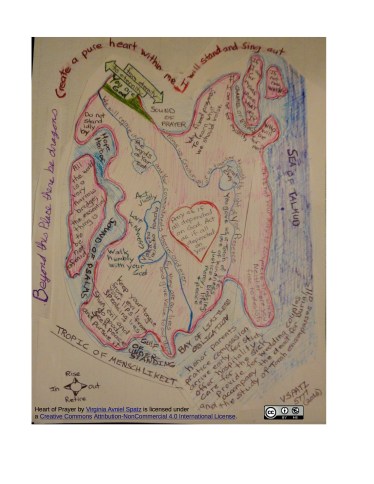
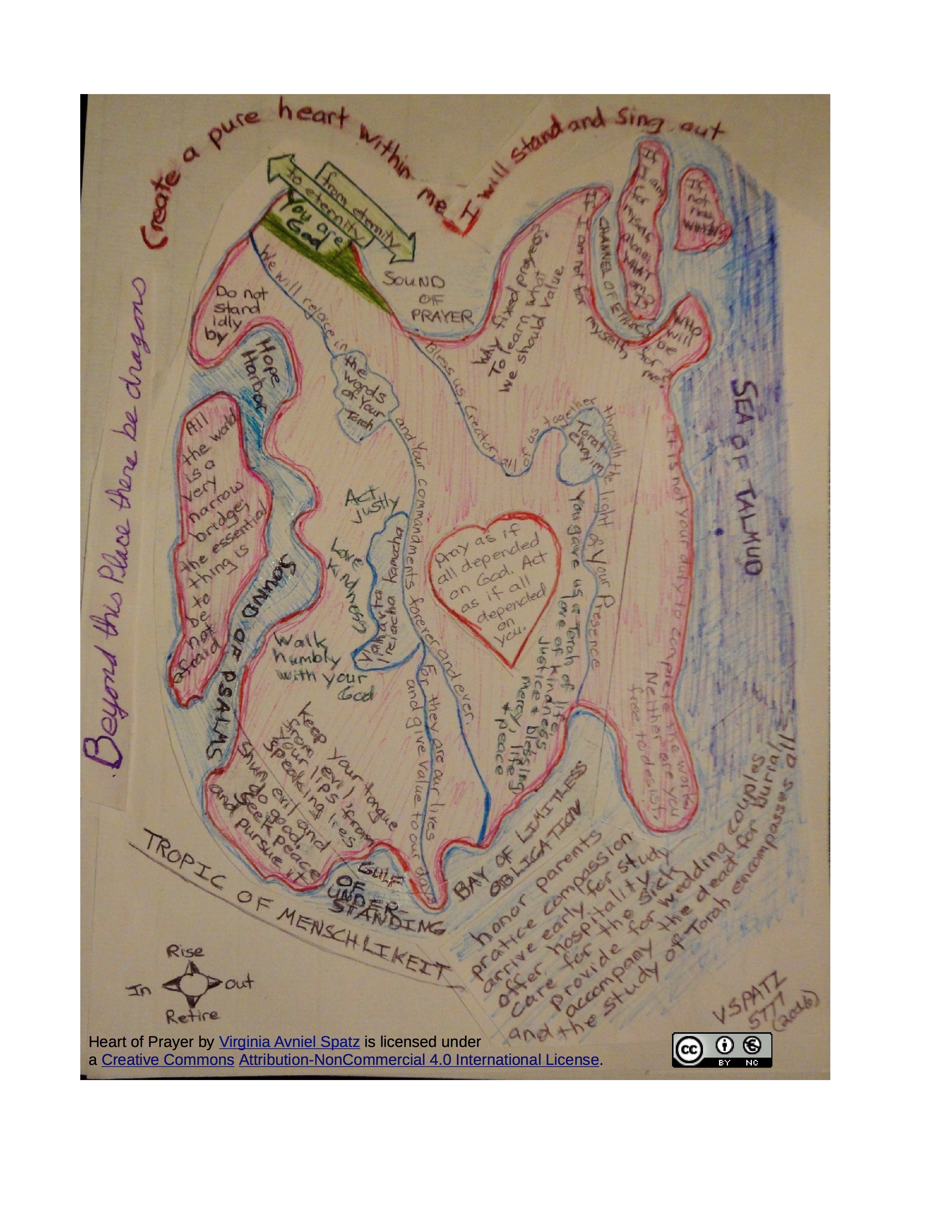
This brings me back to the “heart map” and prayer as an avenue to making Judaism’s “counter-cultural” message and covenant a part of our being. In particular, it puts me in mind of one comment incorporated into the map:
“Why fixed prayer? To learn what we should value…” (a teaching from Rabbi Chaim Stern included in the 1975 Gates of Prayer and in newer Reform prayerbooks.)
“Sacrifice” has been an important concept in baseball since the 1880s and a Christian concept for far longer. The term came into English from Latin, via Old French, and is generally defined as giving up one thing to obtain another.
“Sacrifice” in Hebrew
The word “sacrifice” is sometimes used by English translators of the Hebrew bible, as when Noah performs a ritual action right after leaving the ark:
וַיִּבֶן נֹחַ מִזְבֵּחַ, לַיהוָה; וַיִּקַּח מִכֹּל הַבְּהֵמָה הַטְּהֹרָה, וּמִכֹּל הָעוֹף הַטָּהוֹר, וַיַּעַל עֹלֹת, בַּמִּזְבֵּחַ.
And Noah built an altar [מִזְבֵּחַ] to the LORD and took of every clean animal and of every clean bird and offered [sometimes: “sacrificed”] burnt offerings [וַיַּעַל עֹלֹת] on the altar.
–Genesis 8:20
The Hebrew word for “altar” “mizbeach מִזְבֵּחַ” is linked with “zevach זְבֵּחַ,” one word for biblical sacrifice. But the Torah also uses other words, depending on the purpose and disposition of the offering:
There are also offerings known by their content: “first fruits (bikkurim)” or “wave/sheaf (omer),” for example. Probably the most general term is “korban קָרְבָּן,” from the root for “becoming near.”
“Sacrifice” in Judaism?
A Jew’s obligations to oneself, to other individuals, and to the community are myriad. Here are a few of the most general:
We are warned to be for ourselves as well as for others (Avot 1:14)
We are told that “All Israel is responsible, one for the other [Kol yisrael arevim zeh bazeh]” (Shavuot 39a), and
We are reminded that caring for the poor and practicing lovingkindness are among the obligations without limit (Peah 1:1).
Is “sacrificing” for the community or for a greater goal a Jewish notion?
A pair of questions disturbed journalist Sebastian Junger as a young suburban Boston resident, living “in a time and a place where nothing dangerous ever happened,” he tells us in Tribe: On Homecoming and Belonging:
How do you become an adult in a society that doesn’t ask for sacrifice? How do you become a man in a world that doesn’t require courage?
— Tribe, p.xiv
I found these oft-quoted lines baffling, and I was not alone in this reaction:
I am tempted to remind Junger that sacrifice and courage are necessary in many fields of life, from parenting to volunteering in refugee camps. He could also join a solidarity movement. That is what he claims he is seeking, after all.
—Joanna Bourke in The Guardian
His analysis of life in Boston and its suburbs, for example, totally overlooks the sacrifices made by teachers, nurses, or those fighting for social justice, workers’ rights, against racism or other social ills in his own or other communities as well as the dangers experienced by African Americans or the poor in nearby Somerville or Boston itself.
—Suzanne Gordon in Washington Monthly
But Rabbi Danny Zemel, in his Rosh Hashanah sermon at Temple Micah (DC), explained that he finds these questions “paramount,” understanding them somewhat differently in Jewish terms:
How do we become counter cultural? How do we become breakers of idols?”
Zemel points out that “[the Jewish] covenant commands us to love the stranger because we were strangers in the land of Egypt,” and argues that the synagogue should be a “place where we can learn and absorb” a “counter-cultural” message in a world that can seem to applaud self-interest over group interest. He asks:
How do we learn this call – actually more than just learn it, but feel it in our being? How does it become “us?”
How does it become “us”?
For me, one clear answer is the liturgy, which I tried to express in the “heart map” below. Another is ensuring that we recognize, and regularly celebrate, the many opportunities to prove one’s worth to the community highlighted by Bourke and Gordon above. I remain confused by Junger’s youthful state of mind and join critics of Tribe who find that his “danger” focus led him to glorify war and miss abundant examples of courage.
As it happens, this year’s National Blog Posting Month theme is “Type your heart out.” Look for more daily posts on courage, heart, Judaism, and covenant as November unfolds.
NOTES: Tribe: On Homecoming and Belonging NY. Sebastian Junger. Hatchette Book Group, 2016
Heart map inspired by Personal Geographies: Explorations in Mixed-Media Mapmaking by Jill K. Berry.
The “curse of Ham” — with related ideas about slavery and race, unsupported by the the text itself — emerged over the centuries from the biblical story of Noah. Regardless of our particular faith community’s approach to this curse concept, there is no denying the damage done by what one author calls “the single greatest justification for Black slavery for more than a thousand years” (Goldenberg, The Curse of Ham). Racism and oppression have become inextricably linked with the Noah story.
This moment in U.S. history seems to demand that we acknowledge the damaging legacy of our collective textual heritage. Some readers might find it worthwhile to examine the complex religious career of the “Cursed be Canaan” text, its development in Abrahamic teaching and its role in Western history and culture. A few references are shared here toward that purpose. But we need not pursue an academic route in order to answer the ethical call of this week’s Torah portion.
Immediately after the Flood, God’s introduces a covenant, symbolized by the rainbow (Gen. 9:17): God promises never again to destroy everything by flood, and humans are expected to obey basic laws. The prohibition against shedding human blood and some of the other “Noahide Laws” are specified in this week’s portion; others, according to Jewish tradition, are found in or derived from other passages in Genesis.
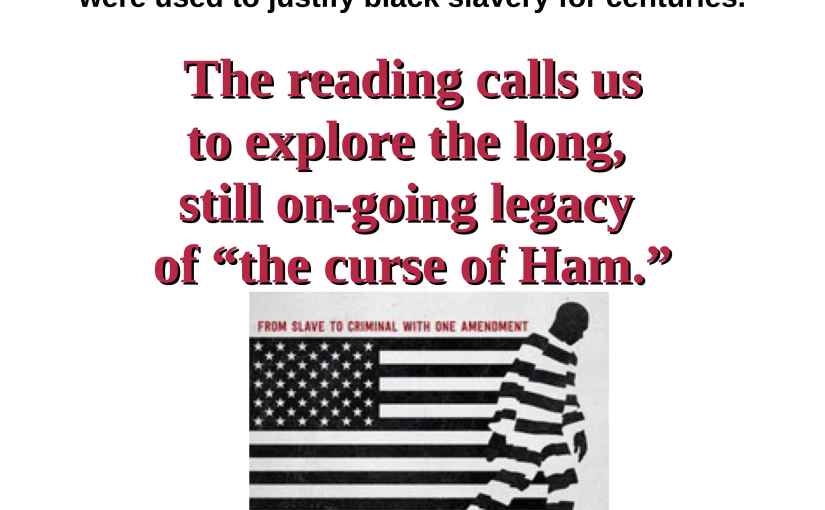
Seeing a rainbow, we are to be reminded of the covenant, of God’s mercy and of our own obligations. Some teachers see the rainbow as a reminder to repent and spur repentance among others. With this in mind, watching Ava DuVarney’s documentary, 13th — about mass incarceration of black people as an extension of slavery — seems a useful step in beginning to respond to the long legacy of “cursed be Canaan.”
Fateful conjunction of slavery and race
Upon realizing “what Ham had done to him,” Noah responded: “Cursed is Canaan; a slave of slaves shall he be to his brothers.” Noah goes on to specify that Canaan, son of Ham, will be a slave to his uncles, Shem and Japheth (Genesis 9:25-27). Only Canaan is mentioned, but the curse is often understood to apply to generations of descendants of all four of Ham’s children. And, while there is no biblical reference to skin color at all, the curse of slavery became associated with black skin.
…it is not clear when to date the fateful conjunction of slavery and race in the Western readings of Noah’s prophecy….the application of the curse to racial slavery was the product of centuries of development in ethnic and racial stereotyping, biblical interpretation, and the history of servitude.
Nevertheless, by the early colonial period, a racialized version of Noah’s curse had arrived in America.
— Stephen R. Haynes. Noah’s Curse, pp.7-8 (citation below)
DuVarney’s 13th looks at slavery — outlawed by the 13th Amendment, except as a punishment for crime whereof the party shall have been duly convicted — and its re-incarnation through mass incarceration. 13th does not explore biblical text or religious teaching. It looks at the U.S. criminal justice system today and its relation to the broader history of racism, oppression and subjugation of black people.
“We take you from 1865 and the abolition of slavery and the enactment of the 13th Amendment all the way to now and this Black Lives Matter movement,” DuVernay told Democracy Now. “And we trace, decade by decade, generation by generation, politician by politician, president by president, each decision and how it has led to this moment.” (more on the movie)
Three of the key Noahide laws are
prohibition on murder, with the reminder that every human is created in God’s image;
prohibition on stealing, understood broadly to include kidnapping and other forms of theft; and
establishment of a courts and a system of law.
What is the rainbow saying with regard to our record on murder, stealing, and courts?
NOTES:
1) The story of the Noah is found in this week’s Torah reading (Genesis 6:9-11:22). The verses discussed here (9:20ff) cryptically describe a post-Flood incident involving drunkenness on Noah’s part and Ham’s witnessing “his father’s nakedness.”
וַיִּיקֶץ נֹחַ, מִיֵּינוֹ; וַיֵּדַע, אֵת אֲשֶׁר-עָשָׂה לוֹ בְּנוֹ הַקָּטָן.
וַיֹּאמֶר, אָרוּר כְּנָעַן: עֶבֶד עֲבָדִים, יִהְיֶה לְאֶחָיו.
Noah awoke from his wine and realized what his small son [Ham], had done to him. And he said, “Cursed is Canaan; a slave of slaves shall he be to his brothers.”
Various explanations have been suggested for why Canaan was cursed rather than Ham. Genesis Rabbah, for example, says that Noah couldn’t curse Ham, because God had already blessed him (Gen 9:1). Another possibility put forth was that Canaan was really the instigator. While the text speaks of individuals and not whole communities, many commentators over the centuries focused on moral factors which they believed might result in one people being subjugated to another. TOP
2) Race and Slavery in early Judaism, Christianity, and Islam. David M. Goldenberg. Princeton, NJ: Princeton University Press, 2003.
[Goldenberg] concludes that in biblical and post-biblical Judaism there are no anti-black or racist sentiments, a finding that some scholars dispute. He also contends that the notion of black inferiority developed later, as blacks were enslaved across cultures. His findings, he said, dovetail with those of other scholars who have not found anti-black sentiment in ancient Greece, Rome or Arabia.
”The main methodological point of the book is to see the nexus between history and biblical interpretation,” Mr. Goldenberg said. ”Biblical interpretation is not static.”
— “From Noah’s Curse to Slavery” in New York Times
3) Stephen R. Haynes. Noah’s Curse: The Biblical Justification of American Slavery. Oxford and NY: Oxford University Press, 2002. BACK
13th: A Documentary
“13th strikes at the heart of America’s tangled racial history, offering observations as incendiary as they are calmly controlled,” writes Rotten Tomatoes, where the film gets a 98% positive rating from critics and a 94% positive audience score.
“A damning but cogent argument for wholesale reconsideration of the so-called prison industrial complex,” is how the Chicago Tribune characterizes 13th.
The New York Times calls it “powerful, infuriating and at times overwhelming.” Many people, this blogger included, report needing to watch the movie in installments.
In addition to some local screenings, 13th streams on Netflix. Sign up for a free month, if you don’t already subscribe or have a friend who does. RETURN
The following prayer, prepared by Virginia Spatz and Rabbi Gerry Serotta, was offered for use during the Yizkor (Memorial) service Yom Kippur, the Day of Atonement, 5777 at Fabrangen Havurah. It is based on the yizkor prayers of several different Jewish traditions, relying strongly on the notion that acts of tzedakah [righteousness, sometimes translated as “charity”] perpetuate the names — “bind up in the bonds of life” — of the deceased. (jump to PDF version)
For Yizkor:
Consider this reflection for those in our neighborhoods lost to state violence in 5776
As we endeavor to return to the Eternal One in these Days of Awe — and into the new year — we carry with us connections to those killed by violence perpetrated in our name in our own country. Among iniquities for which we beg forgiveness is failure to stop police killings, disproportionately affecting the black- and brown-skinned among us, or to address the underlying systemic racism. In this season of return, we ask God to accept our pledges of renewed examination of state power, including militarization of police, and of renewed commitment to human rights for all.
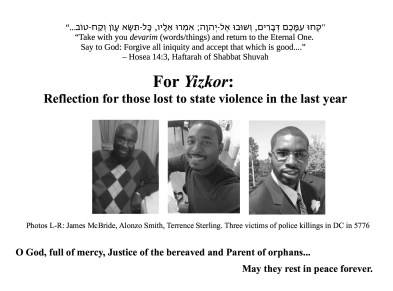
In this Memorial Service, we recall three unarmed black men killed by police in the District last year, along with six other black citizens, and no one of another skin color, killed by police in DC during 5776:
James McBride, 74, Sep 29, 2015.
Unarmed, leaving hospital without signing out. Killed by MedStar Special Police. Death ruled homicide.
Alonzo Smith, 27, Nov 1, 2015.
Unarmed, unexplained circumstances. Killed by Blackout Special Police. Death ruled homicide.
Terrence Sterling, 31, Sep 11, 2016.
Unarmed, shot contrary to protocol/orders. Killed by Metropolitan Police Dept. Death ruled homicide.
Marquesha McMillan, 21, Oct 26, 2015.
Armed with a gun. Killed by Metropolitan Police Department.
James Covington, 62, Nov 2, 2015.
Armed with a gun. Killed by Metropolitan Police Department.
Darick Napper, 34, Nov 19, 2015.
Armed with a knife. Killed by Metropolitan Police Department.
Peter John, 36, Feb 1, 2016.
Armed with a toy gun. Killed by Metropolitan Police Department.
Sherman Evans, 63, June 27, 2016.
Armed with a toy gun. Killed by Metropolitan Police Department.
Sidney Washington, Jr., 21, July 4, 2016.
Part of a July Fourth crowd shooting off fireworks and firearms. Killed by Metro Transit (Special) Police.
O God, full of mercy, Justice of the bereaved and Parent of orphans , take special notice of those lost to state killings in our own country. Master of compassion, shelter under the shadow of Your wings those whose lives ended in violence, often fueled by racial injustice. Grant proper rest for the souls of all who went to their eternal rest through such killings.
May these moments of meditation strengthen the ties linking this community with our most vulnerable and troubled members. I pledge tzedakah/charity to address racial injustices contributing to these deaths. Through such deeds, and through prayer and remembrance, may the souls of the departed be bound up in the bond of life. May they rest in peace forever.
As we approach the high holidays, grass shows up in two haftarah readings. What do these verses tell us in this season of repentance and return? I am pondering. Meanwhile, a recent yahrzeit called to mind the sweetness of grass as well as its transient nature. Does that, too, carry a message for the high holidays?
We learn on Shabbat Nachamu, the Sabbath of Comfort that follows the lowest point in the Jewish calendar, that “all flesh is grass,” and that “grass withers, the flower fades; but the word of our God stands forever” (Isaiah 40:6-8). Three weeks later, on Shabbat Shoftim, we are told “Mortals fare like grass” (Isaiah 51:12). (Full verses and Hebrew below)
Learning to Witness
My father, Delmar G. Spatz — called just plain ‘Spatz’ by most adults, including my mom — was raised in northern Wisconsin. He moved to Chicago after his Army Air Corps service during World Ward Two; he’d been stationed in England but still taught us to sing “How Ya Gonna Keep ’em Down on the Farm (After They’ve Seen Paree).” Spatz met Bette, a native of Chicago. They married in 1951 and settled on the city’s West Side. He died in 1976, the summer I was 16.
The hole my dad left has taken many shapes over the decades. This is his 40th yahrzeit. And it appears to me this year that his death – and his life – form a hollow that creates a lens.
A few weeks ago, my older sister, Martha, and I had the opportunity to discuss some of what he taught us to see. She told me how, in 1968, he walked her out to see the tanks, deployed a few blocks from our apartment in the wake of Martin Luther King’s murder and the subsequent unrest. Later that year, during the Democratic National Convention, Dad sent Martha and a friend downtown to the Prudential Building – then the tallest place around – so they could see without direct risk to themselves what was happening between police and protesters in Grant Park.
That was the year Martha turned 14. I guess my younger siblings, Amy and Bob, and I were considered too young for these particular field trips.
But learning to be a witness was a major part of our education in all the years we had with Dad. He especially emphasized noticing people and circumstances that regularly went unrecognized.
It took me a long time to realize that my classmates were not being taught see the same way my dad wanted us to see. It might take me another 40 years to explore just how the lenses crafted by my dad’s lessons worked – and continue to work – in my life.
Meanwhile, though – in the way each yahrzeit seems to bring its own new facet of blessing – this year I recall another aspect of that lens. I remember Dad teaching me to notice how the strongest blades of grass, when pulled gently from the ground, would yield a hidden, moist taste treat. He helped me recognize that the greenish-white part of a watermelon, the stuff closest to the rind – that so many people toss away – is often the sweetest. And together, on many a horridly hot summer day, we witnessed how sitting absolutely still could call up a breeze more cooling than anything produced by a fan, electric or paper.
— these reflections were shared with Temple Micah on August 20, 2016.
Hark! says one: ‘Proclaim!’ Another says: ‘What shall I proclaim?’
‘All flesh is grass, and its goodness is as the flower of the field;
The grass withers, the flower fades;
because the breath of the LORD blows upon it–surely the people is grass.
The grass withers, the flower fades; but the word of our God stands forever.’
— Isaiah 40:6-8, in Haftarah Va’etchanan
אָנֹכִי אָנֹכִי הוּא, מְנַחֶמְכֶם; מִי-אַתְּ וַתִּירְאִי מֵאֱנוֹשׁ יָמוּת, וּמִבֶּן-אָדָם חָצִיר יִנָּתֵן.
I, even I, am He who comforts you: who are you, that you fear Man who must die, Mortals who fare like grass… — Isaiah 51:12, in Haftarah Shoftim
Hebrew text from Mechon-Mamre.org,
Translation adapated from “Old JPS” and Sefaria.org BACK



 As we endeavor to return to the Eternal One in these Days of Awe — and into the new year — we carry with us connections to those killed by violence perpetrated in our name in our own country. Among iniquities for which we beg forgiveness is failure to stop police killings, disproportionately affecting the black- and brown-skinned among us, or to address the underlying systemic racism. In this season of return, we ask God to accept our pledges of renewed examination of state power, including militarization of police, and of renewed commitment to human rights for all.
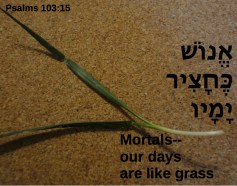 Meanwhile, though – in the way each yahrzeit seems to bring its own new facet of blessing – this year I recall another aspect of that lens. I remember Dad teaching me to notice how the strongest blades of grass, when pulled gently from the ground, would yield a hidden, moist taste treat. He helped me recognize that the greenish-white part of a watermelon, the stuff closest to the rind – that so many people toss away – is often the sweetest. And together, on many a horridly hot summer day, we witnessed how sitting absolutely still could call up a breeze more cooling than anything produced by a fan, electric or paper.
 "A Song Every Day"