Tetzaveh: Something to Notice

Outside the Curtain

“You shall further instruct the Israelites to bring you clear oil of beaten olives for lighting, for kindling lamps regularly [ner tamid]. Aaron and his sons shall set them up in the Tent of Meeting, outside the curtain which is over the Pact, [to burn] from evening to morning before the LORD. It shall be a due from the Israelites for all time, throughout the ages.”
— Exodus/Shemot 27:20-21, JPS/Plaut*
[English bracketed words in the original]

Continue reading Tetzaveh: Something to Notice

Tetzaveh: A Path to Follow

A bell and a pomegranate: erotic poetry and bellman’s verses…

And you shall make on its hem pomegranates of indigo and purple and crimson, on its hem all around, and golden bells within them all around. A golden bell and a pomegranate [paamon zahav v’rimon], a golden bell and a pomegranate, on the hem of the robe all around [al shulei hamil saviv].

A golden bell and a pomegranate, a golden bell and a pomegranate. The sheer splendor of the ornamentation is evoked in poetic incantation through the repetition of the phrase. Judah Halevi, the great medieval Hebrew poet, echoes these words in a delicate, richly sensual love poem, registering an imaginative responsiveness to the sumptuous sensuality of the language here.
— Exodus/Shemot 28:33-34, Alter**

Alter doesn’t give a citation for the “delicate, richly sensual love poem,” its name or first line. (Alas, poor footnote, I knew him well!)*

It seems likely that Alter is referencing the poem T. Carmi, The Penguin Book of Hebrew Verse,** entitles “Song of Farewell” or “Why, O Fair One?”:

Mah lach, tz’viya, tim’n’i tzirayich
midor, tz’laav malui tzirayich

[Why, O fair one, do you withhold your envoys
from the lover whose heart is filled with pain of you?

lu acharei moti b’aznei yaaleh
kol pa’amon zahav alei shulayich

[Oh, after my death, let me still hear
the sound of the golden bells on the hem of your skirt]
–Judah Halevi, T. Carmi’s translation

This type of poem — using biblical imagery for human, sometimes erotic, themes — is quite different from Halevi’s religious poetry. One interesting path to follow is to read a few of Halevi’s poems — and those of his fellow medieval writers — with different subjects or aims. Consider the contrast between religious and secular uses of biblical language and images, described in Alter’s Canon and Creativity: Modern Writing and the Authority of Scripture.**


Double Canonicity

Where Shall I Find You?” — one of Halevi’s religious works — references the Cherubim, for example, from the portion Terumah. This is meant to evoke God’s dwelling place and a longing for a relationship with the divine.

The poem above, on the other hand, uses imagery from the portion Tetzeveh, referencing priestly garb, but unabashedly describes human passion — “radical freedom of allusive play with the Bible” (Alter, p. 47).

Such free use of biblical language might seem blasphemous “from a doctrinal point of view,” Alter writes. “[B]ut the poet does it without compunction, for in his sense of the literary canonicity of the Bible, considerations of doctrine are suspended” (p.50). The Bible, in this view, is a “literary repository of the language of the culture” (p.48).

To read more about Hebrew poets’ varying use of biblical texts, see Canon and Creativity.

*The Bell’s Path

To follow another, somewhat diversionary, path, consider the trail of the bell itself, rather than that of the lush biblical description. Plaut** notes — in reference to Exodus/Shemot 28:34 — that bells were widely used to ward off evil. He cites James Frazer (Folklore in the Old Testament, 1919, and The Golden Bough, 1922), noting that the older work was “updated and republished in Gaster’s book.” This book, in turn —Myth, Legend and Custom in the Old Testament, by Theodor H. Gaster (NY: Harper and Row, 1969) — is listed fully in Plaut’s bibliography and cited by footnote and endnote (yeah!!).

(According to Frazer, as in the poem from Milton here quoted, bells had a prophylactic function, and hence the High Priest was to have a bell attached to his garments so that when he entered the sanctuary he would not die, 28:35)

…the bellman’s drowsy charm
To bless the doors from nightly harm. — John Milton***

What Plaut doesn’t say, but I find interesting, is that night watchmen in the 17th and 18th Centuries CE regaled their customers with rhymes designed to elicit gratuities at the Christmas holidays.

“The benediction which thus broke the stillness of the night was usually cast in a poetical form of such unparalleled atrocity that bellman’s verses have been proverbial ever since” (Frazer , p.456…through Google Books, you can read the entire chapter on “The Golden Bell,” and Frazer cites Lord Macaulay’s History of England, 1871, also available through Google, should you desire further details about bellman and their verses.)

Thus, this one pair of bible verses is associated with some of the best-loved and most reviled poetry ever.** Please see Source Materials for full citations and additional information on Torah translations and commentaries. Note: Tetzaveh is also transliterated Tetsaveh or T’tzavveh.

***Plaut doesn’t name Milton’s poem: Il Penseroso, 1633.

————————————————————–
The “Opening the Book” series is presented in cooperation with the independent, cross-community Jewish Study Center and with Kol Isha, an open group that for many years pursued spirituality from a woman’s perspective at Temple Micah (Reform). “A Song Every Day” is an independent blog, however, and all views, mistakes, etc. are the author’s.
———————————————————————————-

Tetzaveh: Language and Translation

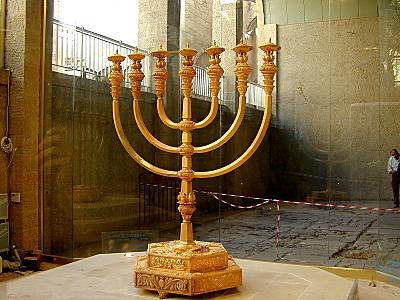
You shall further instruct the Israelites to bring you clear oil of beaten olives for lighting, for kindling lamps regularly [ner tamid]. Aaron and his sons shall set them up in the Tent of Meeting outside the curtain which is over the Pact, from evening to morning before the LORD. It shall be a due from the Israelites for all time, throughout the ages.

[Note:] Kindling lamps regularly. The lights were to be kindled on the lampstand previously described. The translation of [ner tamid] as “perpetual light” or “eternal light” is grammatically inaccurate and is also contradicted by verse 21. (The so-called ner tamid of the synagogue is of much later origin.) — Exodus/Shemot 27:20-21, JPS/Plaut* and commentary

Cassuto* says that tamid is “intrinsically capable of two interpretations: it can mean ‘continuously, without interruption’ — that is the lamps would never be extinguished, either by day or by night; or it can signify ‘regularly’ — that is, the lamps would burn every night; on no night would its light be wanting — as in the expression [olat tamid, ‘continual burnt offering’].” He concludes that the “second sense is more probable” from context.

In addition, Cassuto says that “ner [‘lamp’] is used here in a collective sense: ‘lamps’ or ‘candelabrum.’

For more on the ancient lamp(s), see, e.g., Wikipedia’s article.

Here’s a quick reference on the later, synagogue “ner tamid.” To the right is an example of a new photovoltaic “ner tamid,” designed to save energy; this one was installed at Jewish Reconstructionist Congregation, Evanston, IL.


*Please see Source Materials for complete commentary and Torah/translation citations. Note: Tetzaveh is also transliterated Tetsaveh or T’tzavveh.

————————————————————–
The “Opening the Book” series was originally presented in cooperation with the independent, cross-community Jewish Study Center and with Kol Isha, an open group that for many years pursued spirituality from a woman’s perspective at Temple Micah (Reform). “A Song Every Day” is an independent blog, however, and all views, mistakes, etc. are the author’s.
———————————————————————————-

Is Thanks Ever Simple? – part 2

In light of the challenges I faced when asked to offer simple thanks during one morning’s prayers, I decided to explore the passage, included in many versions of the morning blessings, that begins: “Therefore, we are obliged to acknowledge and thank you…”

Obliged to Thank– Or Not?

This paragraph, which leads to recitation of the Shema, is preceded by the following passage:

You should always fear God inwardly and outwardly, and gratefully acknowledge the truth, and speak truth in your hearts, and rise up early to say:

Master of all worlds, we do not offer our supplications before You based on our righteousness, but rather based on Your great mercy. What are we? What are our lives?….Man barely rises above beast, for everything is worthless [hakol havel].

But we are Your people, the children of Your covenant, the children of Abraham, Your love, to whom You took an oath on Mount Moriah; the descendants of Isaac, his only son, who was bound on the altar; the community of Jacob, Your first-born, whom You called Israel and Jeshurun, on account of Your love for him and joy with him. Therefore…
My People’s Prayerbook: Traditional Prayers, Modern Commentaries,
volume 5:
Birkhot Hashachar (morning blessings)**

Continue reading Is Thanks Ever Simple? – part 2

Is Thanks Ever Simple?-part 1

Or: Don’t think of a Green Hippo!

Recently, the leader of Fabrangen West‘s Birkot Ha-Shachar/Psukei D’Zimra [Morning Blessings and Verses of Song] introduced the service by asking that we consider the pshat [literal meaning] of the prayers. She mentioned a common tendency to hear (or speak) a negative edge to even the most positive sounding statements.

Everyone present seemed to recognize the tendency we were being asked to avoid. I think most of us have witnessed — if not played both roles, at various points in our lives — exchanges that goes something like this:

“That’s a nice shirt [lovely street, informative graphic].”
“What’s wrong with these pants [this neighborhood, the rest of the report]?”

Moreover, one participant explained a parallel version to her young son: “You know how ‘thanks for cleaning your room,’ might also mean, ‘How come you don’t do that more often?’ even if the mom doesn’t say that?”

And after more than a week of struggling with record- and back-breaking snowfalls, I know some of us were following “How wonderful are your works!” with a muttered, “Wonderful, sure! But don’t ‘Your works’ come in smaller packages?” Conversely, one is reminded of Tevye’s plaintive, “I know you look after all our needs… but would it spoil some vast eternal plan, if I were a wealthy man?”

Pshat Prayer

So, I thought the assignment to focus on the various expressions of thanks and praise in the service, trying to avoid hearing or speaking any hidden negatives, seemed appropriate. A reasonable, even simple, request.

And, with that kavanah [intention], I’m pretty sure that I managed relatively unadulterated gratitude for the first blessing: “Blessed are You, Adonai, Our God, Ruler of the Universe, You have given me understanding to see differences clearly, as between day and night.”

But, then I must have entered some sort of don’t-think-of-a-green-hippo state, as we continued reciting blessings:

“…she-asani b’tzalmo” [made in Your image] — “in Your image, with unlimited potential”* — “Well, really, I’m doing as much as I can right now!”

“…bat chorin” [free] — “free, with the ability to choose”* — “You got a problem with my choices?”

“…pokeiach ivrim” [open the eyes of the blind] — “…providing sight and insight”* — “I do SO recognize other people’s perspectives.”

…and on it went. I was failing seriously at this “pshat prayer.” It was an interesting, if somewhat disturbing, experimental result for me — but it wasn’t exactly the (simple) thanks our service leader had urged.

——————————————————————–
* We use Siddur Eit Ratzon, so these English formulations are Joseph Rosenstein’s.
——————————————————————–

Obliged to Thank

Then we came to the verse that begins “L’fichach anachnu chayyvim, l’hodot l’cha…” It’s usually translated as something like, “Therefore we are obliged to (acknowledge and) thank You…” (e.g., Sim Shalom, Metsuda, My People’s Prayerbook**).

Therefore we are obliged.…”That explains it,” I thought: Feeling obligated just isn’t consistent with simple anything — including thanks — for me, anyway. So, regardless of prayerbook contents — BTW, Kol Haneshamah and Mishkan T’filah,** e.g., don’t include this verse or the related paragraphs — maybe the awareness of obligation was making (simple) thanks impossible for me.

With this newly confused kavanah — aiming for simple thanks, which is maybe not possible in a relationship which involves obligation…and what relationship doesn’t? — I continued in the prayerbook:

L’fichach anachnu chayyavim [Because of all the blessings we receive, we are]
l’hodot l’cha, [obliged to acknowlege Your presence in our lives,]
ul’shabbeichacha ul’faercha, [to extol and to honor You,]
ul’vareich u’lkaddeish [to bless and to sanctify You,]
v’lateit shevach v’hodayah lishmecha
[and to give praise and gratitude to You.]
Continue reading Is Thanks Ever Simple?-part 1

Tetzaveh: Great Source(s)

“And it [a robe hemmed with bells] shall be upon Aaron when he serves, so that its sound shall be heard when he comes into [v’nishma kolo b’bo-o] the sanctum before the Lord and when he goes out, that he shall not die.”
— Exodus/Shemot 28:31-38, Alter* translation [bracketed material added]

R. Simeon ben Yohai said: The man who enters his own house, or needless to say the house of his fellow man unexpectedly, the Holy One hates, and I too do not exactly love him.

Rav said: Do not enter your city nor even your own home unexpectedly [footnote: without informing your kin of your coming].

While R. Yohanan was about to go in to inquire about the welfare of R. Hanina, he would first clear his throat in keeping with “And his voice shall be heard when he goeth in [v’nishma kolo b’bo-o] ” (Exod. 28:35)
— Bialik & Ravnitsky, Sefer Ha-Aggadah* (citation to Lev Rabbah 21:8)

Alter notes: “In the ancient Near East, the inner sanctum was a dangerous place. Any misstep or involuntary trespass of the sacred paraphernalia could bring death…The sound of the ringing golden bells on Aaron’s hem goes before him as he enters the sanctum, serving an apotropaic function to shield him from harm in this zone of danger.”

Cassuto* says: “…shall be heard… for it is unseemly to enter the royal palace suddenly; propriety demands that the entry should be preceded by an announcement, and the priest should be careful not to go into the sanctuary irreverently. And likewise when he comes out, as he prostrates himself before departing, the sound of the bells, together with the act of prostration, will constitute a kind of parting blessing on leaving the sanctuary. Lest he die for not showing due reverence for the shrine.”

* See Source Materials for full citations. Note: Tetzaveh is also transliterated Tetsaveh or T’tzavveh.

—————————————————————–
The “Opening the Book” series was originally presented in cooperation with the independent, cross-community Jewish Study Center and with Kol Isha, an open group which for many years pursued spirituality from a woman’s perspective at Temple Micah (Reform). “A Song Every Day” is an independent blog, however, and all views, mistakes, etc. are the author’s.
———————————————————————————-

Terumah: Great Source(s)

Notes on Terumah from study partners, a rabbi and a playwright —

LK —

For a religious culture obsessed with prohibiting (and obliterating) any graven image, how curious that winged golden statues be set above the ark. Even more fascinating is the statement that not from inside the Ark nor even from above it, but instead between the statues will God speak. this “in between” the two cherubim, two statues, two graven images, is the locus of the voice. As Martin Buber taught us, God is uniquely present in the space in between. And, as Kabbalists imagined, the Shekhina, the feminine, indwelling presence of God, resides between the cherubim.

Neither from one cherub nor the other, but from the space created between them — when they confront each other — issues the revelation. Only relationship can imitate life and growth and revelation. And relationship can be created only when one ego realizes that there is another ego of equal importance. It can only be discovered in the presence of another. You simply cannot get there alone, there must always be someone else; it takes two to tango.

Perhaps that is why the prohibition against idolatry does not apply here. Truth be told, we are all only lifeless graven images until we face another and, in so doing, bring our selves and the other to life. And from between that meeting the divine voice issues.

DM–

The Ark of the Covenant and Ezekiel’s wheel could both be called fantasy. But the second is a vision, and the first is a divine instruction. To say an instruction is beyond our understanding is not to say it is impossible of execution.

We say “I do not understand” of the natural world cheerfully, and endeavor to better understand ourselves and call it “science.”

To be dismissive of “natural” evidence is called “ignorance.” To dismiss the divine is called “sophistication.”

–Lawrence Kushner and David Mamet

While reading Five Cities of Refuge: Weekly Reflections on Genesis, Exodus, Leviticus, Numbers, and Deuteronomy (NY: Schocken Books, 2003), the deepest, most interesting spot to inhabit is often, much as Kushner notes above, “between” the offerings of these study partners. Several reviews note differences in the styles of the co-authors. Stan C. Denman of Baylor University notes, in [contemporary review — can no longer (2019) find working link] that Kushner’s insights “often innovative and unconventional, stay within accessible distance from the text of study,” while Mamet’s sometimes seem more tangential, “against the grain of conventional erudition, often with favorable results.”

Denman also discusses a tendency in this book to focus on “‘we Jews’ and the particularities of Jewish ‘victimization,'” a practice the reviewer believes will turn-off non-Jewish readers. In my reading, however, the “victimization” tendency appears almost exclusively in the comments of Mamet: God introduced the name “YHVH,” he tells us at one point, e.g., because “El Shaddai” was too Jewish. Kushner, on the other hand, (simply) reads the bible as a conversation between God and “Israel,” with any reader expected to take spiritual and ethical lessons from their position as part of that collective noun. And so, between — between their religious and more secular writing, between the particular and the universal, between them — we are privileged to witness relationship… the only place, Kushner says above, where the divine dwells.

Five Cities of Refuge is available in hardcover or ebook. At $21.00, this might not be at the top of everyone’s “must-purchase” list, but I recommend checking it out, if you’re able.

See Source Materials for more information/links on this title and others.

————————————————————–

The “Opening the Book” series was originally presented in cooperation with the independent, cross-community Jewish Study Center and with Kol Isha, an open group that for many years pursued spirituality from a woman’s perspective at Temple Micah (Reform). “A Song Every Day” is an independent blog, however, and all views, mistakes, etc. are the author’s.

———————————————————————————-

Terumah: Language and Translation

“And they shall make [v’asu (third person plural)] an ark of acacia wood, two and a half cubits long, a cubit and a half wide, and cubit and a half high. Overlay [v’tzipita (second person masc. singular)]…Cast [v’yazkakta (second person masc. singular)] four gold rings… Make [v’asita (second person masc. singular)]…” — Exodus/Shemot 25:10-13

Why is the third person plural — “they shall make” — employed in verse ten while all the other verbs in making the Tabernacle and its accoutrements are second person masculine singular, as in “[you, male individual] make”?

Contemporary Translation

I don’t know of a commentary directly noting that use of the third person plural here has the effect, grammatically, of including males and females in construction of the all-important ark — and, by extension, Torah study and Torah implementation* — while the second person verb forms generally used in the tabernacle instructions, as throughout Exodus/Shemot, address a masculine singular “you.”

However, this week’s portion begins with “Tell the Israelite people to bring Me gifts: you shall accept gifts for Me from every person [kol ish] whose heart is so moved” (Exodus 25:2). The Torah: A Women’s Commentary (TWC) ** notes here that later verses — Exodus/Shemot 35:22, 35:29 and 36:6 — explicitly include men and women, thus arguing for the translation as “every person,” rather than as the more usual “every man.”

In her “Post-Biblical Interpretations” in the same volume, Ruth Gais (rabbi of Chavurat Lamdeinu) also references comments from Ramban (aka Nachmanides, 13th Century CE) — see section below — on the involvement of “all Israel” in the work (see TWC, p. 468). In addition, however, Ramban comments on Exodus/Shemot 35:22 that the women actually went first, in the bringing of the gifts for the Tabernacle.

Ramban’s reading of the women’s precedence is based on another grammatical point. The text reads: “And they came [va’yabo-u], the men [ha-anashim] with/because of the women [al-nashim], all whose hearts moved them….”

Varieties of Traditional Readings

In her essay, “The ark and its poles,” (in New Studies in Exodus/Shemot), Nechama Leibowitz** explores the third-person-plural vs. second-person-singular topic. While she quotes her usual range of traditional and contemporary commentators, she minces no words in outlining her view of some:

As we have noted the slaving adherence to the literal wording of the text can often blind one to its real inner meaning. This, for instance, is what Ibn Ezra has to observe on the text:

Since the text originally stated: “they shall make Me a sanctuary,” it begins here with the wording; they shall make an ark”

Cassuto similarly observes in his commentary to Exodus (p. 328):

The reversion to the third person plural instead of the 2nd person singular is meant here to link up with the phrase: “the children of Israel shall make Me a sanctuary,” and, first of all, they shall make an ark.

We may justifiably wonder at these literalists…Does not the very faithfullest interpretation of the text, the plainest sense in its profoundest connotation, imply that here we have the singling out of the ark for a special role, the enlisting, in contrast to all the other appurtenances, of all Israel in its making? Must we not admit that the Midrash has plumbed the depths of the text’s plainest and literal sense?

Leibowitz quotes three midrashic sources:

1) R. Judah said in the name of R. Shalom: “Let all come and occupy themselves with the ark so that they should all qualify for the Torah.

2) Ramban (Nachmanides) explained that “all the Israelites should participate in the construction of the ark because of its supremely sacred role in housing the tablets of the Law,” through donation, direct help or “directing their minds to it.”

3) Or Ha-chayyim (Chayyim Ibn Atar, 18th Century CE) stresses that all Israel is required to complete the ark, just as no one Israelite alone can implement the whole Torah: Some laws pertain only to priests or Levites, for example, while a priest would not redeem his own firstborn.

In an endnote to the essay (not included in the on-line version), Leibowitz also quotes Midrash Tanchuma (early medieval commentary):

We find that when the Holy One Blessed be He instructed Moses to build the Tabernacle He used the expression ve-‘asita “thou shalt make” but with regard to [the ark] He said: ve-‘asu “they shall make.” Why? The Holy One Blessed be He wished to stress that the command applied to each and every Israelite alike. No one should have the excuse to say to his fellow: I contributed more to the ark. Therefore I study more and have a greater stake in it than you! (continued below*)

*Bonus Midrashic Note

Proving that the best stuff is often in the footnotes, the quote from Midrash Tanchuma continues:

For this reason the Torah is compared to water, as it is stated: “Ho, whoever is thirsty come to the water” (Isaiah 51:1). Just as no one is ashamed to ask his fellow to give him a drink so no one should be ashamed to ask his junior to teach him Torah. No one should be able to say: I am a Torah scholar and the Torah is my hereditary privilege because my ancestors too were scholars whereas you and your forbears were not scholars but were proselytes. That is why it is written (Deut. 33:4): “An inheritance of the congregation of Jacob.” Whoever is part of the congregation of Jacob including even proselytes who devote themselves to Torah — they are just as important as the High Priest (i.e., they acquire hereditary right by being included in the congregation.” — Leibowitz, New Studies in Exodus/Shemot, p.495

** Please see Source Material for complete translation and commentary citations.

————————————————————–
The “Opening the Book” series was originally presented in cooperation with the independent, cross-community Jewish Study Center and with Kol Isha, an open group that for many years pursued spirituality from a woman’s perspective at Temple Micah (Reform). “A Song Every Day” is an independent blog, however, and all views, mistakes, etc. are the author’s.
———————————————————————————-

Continue reading Terumah: Language and Translation

Armstrong’s Case for God

Religion is hard work. Its insights are not self-evident and have to be cultivated in the same way as an appreciation of art, music or poetry must be developed….

…Religion was not something tacked on to the human consciousness, an optional extra imposed on people by unscrupulous priests. The desire to cultivate a sense of the transcendent may be the defining human characteristic.

…Before the modern period, most men and women were naturally inclined to religion and were prepared to work at it. Today many of us are no longer willing to make this effort, so the old myths seem arbitrary and remote, and in incredible.

Like art, the truths of religion require the disciplined cultivation of a different mode of consciousness. The cave experience [described in a chapter on religious practices of 30,000 to 1500 BCE] always began with the disorientation of utter darkness which annihilated normal habits of mind. Human beings are so constituted that periodically they seek out ekstatis, a “stepping outside” the norm. Today people who no longer find it in a religious setting resort to other outlets: music, dance, art, sex, drugs, or sport. We make a point of seeking out these experiences that touch us deeply within and lift us momentarily beyond ourselves. At such times we feel that we inhabit our humanity more fully than usual experience an enhancement of being. Continue reading Armstrong’s Case for God