Blog

Psalms and Their Superpowers

In recent months, the need for deeper prayer – just to cope with events – has become more urgent for me and, I suspect, for others as well. It seems to me that the world around us is also in urgent need of all the help it can get, in the form of prayer and otherwise.

Mishkan T’filah reminds us that “We join together in prayer because together, we are stronger and more apt to commit to the values of our heritage….”

The older Gates of Prayer tells us that “Some will pray together who cannot pray alone, as many will sing in chorus who would not sing solos.” It also cautions that public worship is different from private worship in a public place.

Here are some thoughts to help us explore what it means to engage in public worship, maybe to better understand what we’re trying to accomplish, individually and collectively, with our prayers.

Toward Communal Prayer

We never pray as individuals, set apart from the rest of the world….Every act of worship is an act of participating in an eternal service, in the service of all souls of all ages.

At times all we do is to utter a word with all our heart, yet it is as if we lifted up a whole world. It is as if someone unsuspectingly pressed a button and a gigantic wheel-work were stormily and surprisingly set in motion.

It’s like being a faucet or a crack in the rocks from which the water emerges. The spring doesn’t make the water. At best, it knows how to get out of the way and open itself wide to the flow. If it’s really blessed and happens to be connected to some sweet, clear water, then it will taste like a revelation to those who encounter it.

The words above are from the 20th Century Rabbi Abraham Joshua Heschel (Man’s Quest for God. Santa Fe, NM: Aurora, 1998) and from the poet and essayist John Barlow (Afterward, Complete Annotated Grateful Dead Lyrics . NY: Simon & Schuster, 2005). I thought both authors captured essential aspects of prayer, particularly public worship –

  • connecting with something larger than ourselves
  • realizing that offering a heartfelt word might be in our power, but anything beyond that is outside our control
  • and recognizing that something that is not us is moving whenever we actually encounter moments of insight or solace or inspiration

As we settle into a house of worship, our city, nation, and globe face intense challenges that we don’t always acknowledge inside these walls. There are undoubtedly many other personal concerns weighing on the hearts of those here this morning.

And yet Shabbat asks us to rejoice and delight in its goodness.

Trying to figure out how to get from the work-a-day world to Shabbat is hard enough. But moving from grief and anger and worry, maybe even despair, to Shabbat is yet another level of challenge. This is where I call on the psalms, with their range of emotions, to exercise their superpower. I find that psalms let us move through difficult states of being to get to praise and joy.

Psalms Work

In particular, psalms attributed to the offspring of Korach offer us an amazing offer us an amazing variety of images to explore as we find our way in prayer.

[Remarks originally prepared for Shabbat Korach]. So, I thought it would be interesting to consider a few of these psalms. They touch on the usual Shabbat morning themes –

  • waking up our bodies, minds, and souls;
  • acknowledging our blessings; and
  • becoming aware of community, before we reach the formal call to worship.


Psalm 84

(text here)
Place
First, like Mah Tovu, which often opens our prayers, this psalm is filled with place language:

  • mishkenotekha, translated as “your places” or “tabernacles” or “sanctuaries,”
  • beitecha, “Your house,” in verse 5
  • beit elohei, “house of my God” in verse 11
  • ken, “nest” in verse 4
  • mizb’chotekha – “your altars”
  • Zion, which is understood in many ways, as both a physical and a metaphorical place, and
  • chatzrot – “courtyards” in verses 3 & 11, which we also find in Psalm 92 the psalm for Shabbat

Travel
But Psalm 84 also includes nearly as many expressions for travel:

  • a soul that is longing to be elsewhere – in those courtyards – in verse 3
  • crossing the Valley and transforming it in verse 7
  • walking from strength to strength in verse 8
  • walking the holy road in verse 12 – and, my favorite
  • “highways in the heart” or the “heart as an easy road”

On the Way/Here
We also find several phrases that suggest states of mind than physical locations
ohalei-rasha: tents of wickedness, or “tents of those estranged from your will”
and histoteif, which my commentary calls an infinitive form of the noun, saf – threshold – used as a gerund, so “standing on the threshold”

This expression sort of encapsulates the psalm’s twin themes of being in a place and simultaneous on the way.

This dual status – being here and on the way – is, I think, part of how prayer works. So let’s make sure that we’re here – body, mind, and soul – as we consider

How beloved are the places we perceive the Holy One
How strongly our souls long for the Courtyards
How even the bird finds a home and the swallow a nest
How happy are they who dwell in God’s house
and how happy are we still on the threshold dreaming of a sweet day in God’s Courtyard

…on this pilgrimage Jews have been taking in one way or another for millenia.

See also “heart highways” for more on Psalm 84.

Psalm 42

(text here)

Psalm 42 is one that takes us through a range of emotions – celebrating kindness by day and song at night, on the one hand, and yet feeling “bent low” and “in tumult.” The throngs were crying in joy and thanksgiving, but that memory brings sadness because the moment of gathering, and perhaps of insight, is passed.

It’s also worth considering, as we explore the idea of prayer, that depths are calling to depths and breakers and waves crashing, but the soul’s desire is compared to longing for a simple drink from a stream. And that seems sufficient. In fact, the psalmist wisely doesn’t desire ocean depths, even while thirsting for the presence of the Living God.

See also “Why Doesn’t She Drink?

Using and Leaving the Psalms

If we don’t manage to transform anything, if only our own perspectives on our own cares, maybe our prayer is not all it could be. And, knowing that everyone here brought at least some burdens that need lifting up, and that our city and country and world need lifting up as well, shouldn’t we use the tools at hand to see if we can do as Heschel described, uttering a heartfelt word in hope of setting off that gigantic wheel-work that lifts the world?

melody

Some related ideas as we prepare to leave the psalms — please see “Melody of Understanding“…

First: Pope Gregory (on PDF) says that God already had us in mind when the psalms were inspired and that they speak to us today “as if they were at this instant pronounced for the first time.” John Barlow notes that the material he helped create continues to grow and reveal itself over time, “resonating with frequencies unheard at the time of their writing.” And Eknath Easwaran suggests that we can respond to sacred text through “attentiveness, persistence, and the desire to move from inspiration to insight to action.”

I add: perhaps together we can help each other dare to be vulnerable enough to drink from that stream, and, if we all walk together through the Valley of Weeping, maybe we can transform it together into that wellspring of life.

Why doesn’t she drink?

כְּאַיָּל, תַּעֲרֹג עַל-אֲפִיקֵי-מָיִם
כֵּן נַפְשִׁי תַעֲרֹג אֵלֶיךָ אֱלֹהִים.
2 The way a deer longs for streams of water,
my soul has longed for you, God of Strength.
— Psalm 42:2 (whole psalm here)

R. Shefa Gold (C-DEEP, Kol Zimra) offers a teaching on this verse:

The deer…is standing at the riverbank. Her longing is for that water that is right there, right in front of her.
— chant and full teaching, “Longing: Kayn Nafshi Ta’arog”

David Blumenstein (Kol Zimra, Fabrangen West) adds another layer:

Why doesn’t she drink?
Deer, vulnerable when they drop their heads, are cautious about drinking.

A few notes about Psalms 42 and 84 (discussed in previous post):
Ps. 42:2 is used in the Kabbalat Shabbat piyut “Yedid Nefesh
Ps. 42:5 opens the Yom Kippur piyut “Eleh Ezkerah
Ps. 42:3 & 84:3 form the refrain of “Tzam’ah Nafshi” by Ibn Ezra (1089-1167) Ps. 84:6 is used in a Yehuda Halevi (1075?-1141) Selichot poem
Ps. 84:5 opens Ashrei, which means that afternoon services begin with celebration of “the house” and/or praise for showing up
Psalm 84:6-8 appear in Christian and Rastafarian songs, celebrating “going to Zion”

heart-highways, God’s strength, the holy road

Content are the ones whose strength comes from you, their heart is an easy road […in whose heart are the highways.]. (Ps. 84:6)
אַשְׁרֵי אָדָם, עוֹז-לוֹ בָךְ
מְסִלּוֹת, בִּלְבָבָם

Some read “highways in the heart” straightforwardly: knowing by heart an actual path to the Temple in Jerusalem and, by extension, paths to other instantiations of God’s house. Thus, we might read: “Happy are they who know the road to Temple Micah [or your local house of worship] and which buses stop nearby.” Or, more broadly: “Happy are those who know what it takes to Jewishly mobilize zir own household.” (Note on translation and more of Psalm 84 below.)

Others see a more metaphorical way to God or “path of the upright.” Jeremiah (31:20) uses the similar “set your heart toward the highway” to mean “get yourselves back to God,” however understood.

The word “m’sillah” [here: “highway” or “road”] is linked to “sullam,” which appears only that once in the Tanakh, when the angels in Jacob’s dream are climbing whatever it is between earth and heaven (Gen 28).

The weird plural – “in their heart” — simply reflects translation messiness, but it also hints that a community has a collective heart-road to navigate. When the Temple stood, the highway not a “personal trip.” Each person brought zir own offering, but the worship process was collective. Moreover, offerings were part of a resource-distribution system with care for the poor and vulnerable as a key element.

“Their heart IS an easy road,” also reinforces the idea that this road-heart is for travel. We are not, as Korach wants, holy (a condition) but on a journey, with God’s help, toward becoming holy. קְדֹשִׁים תִּהְיוּ

The earlier clause, “whose strength comes from you” calls us to humility, remembering that we act in the world with God’s help, and to urgency – God’s strength is surely needed and we better get to it.

Highway travelers cross through “Weeping” and “transform it into a wellspring of life.” Commentary varies: Cisterns shlepped in for travelers? Those with a joyful destination seeing beauty in desolation? Footsteps upon footsteps carving a stream-bed, gradually watering an arid spot?

If we transform nothing, why pray? If we fail to touch that Valley of Weeping, what are we? If not now, when?

Are we – as individuals, as a [prayer] gathering, as a nation – heading somewhere particular?

We join together in prayer because together, we are stronger and more apt to commit to the values of our heritage….
In worship, all should be reminded of the social imperatives of community.
Prayer must move us beyond ourselves. Prayer should not reflect ‘me’; prayer should reflect our values and ideals.
Mishkan T’filah introduction

Psalm 84

FOR THE CONDUCTOR OF THE ETERNAL SYMPHONY [לַמְנַצֵּחַ], ON THE WINE FESTIVAL LYRE [עַל-הַגִּתִּית], BY THE OFFSPRING OF KORACH [לִבְנֵי-קֹרַח], A PSALM

ב  מַה-יְּדִידוֹת מִשְׁכְּנוֹתֶיךָ–    יְהוָה צְבָאוֹת.
2 How beloved are the places we perceive you Arranger of the Heavenly Spheres [How lovely are Thy tabernacles, O LORD of hosts!]
ג  נִכְסְפָה וְגַם-כָּלְתָה, נַפְשִׁי–    לְחַצְרוֹת יְהוָה:
לִבִּי וּבְשָׂרִי–    יְרַנְּנוּ, אֶל אֵל-חָי.
3 My soul pales with languish, longing for your courtyards –
my heart and my flesh cry out [sing for joy] to the Source of life….
ו  אַשְׁרֵי אָדָם, עוֹז-לוֹ בָךְ;    מְסִלּוֹת, בִּלְבָבָם.
6 Content are the ones whose strength comes from you;
their heart is an easy road…. […in whose heart are the highways.]
ז  עֹבְרֵי, בְּעֵמֶק הַבָּכָא–    מַעְיָן יְשִׁיתוּהוּ;
גַּם-בְּרָכוֹת,    יַעְטֶה מוֹרֶה.
7 Those who cross through the Valley of Weeping [Baca] transform it into a wellspring of life. Your rain covers them with blessings.
ח  יֵלְכוּ, מֵחַיִל אֶל-חָיִל;    יֵרָאֶה אֶל-אֱלֹהִים בְּצִיּוֹן.
8 They walk from strength to strength, witnessed by God in Zion….

Translations (c) Pamela Greenberg, The Complete Psalms (NY: Bloomsbury, 2010). [“Old JPS, ” 1917 Jewish Publication Society (public domain) in brackets]
Note: Additional [bracketed] translations included where Greenberg’s differs substantially from more familiar renderings.

Greenberg translates, especially in ascriptions, expressions – like Ha-Gittit above – which others leave or treat as proper nouns.

She uses direct address for God to avoid divine gender and to create a more “pray-able” text. Old JPS and Hebrew script from Mechon-Mamre.org. Full public domain text of Psalm 84 here.

BACK

“If a corpse be found…”

Chapter 21 of Deuteronomy (Shoftim: Deut 16:18-21:9) tells the Israelites what to do, upon entering the land, “if a corpse be found..the identity of the slayer not being known.” This is the elaborate ritual involving the Red Heifer in which the elders of the nearest town must be prepared to declare, “Our hands did not shed this blood…”

It turns out that this is not so simple, according to commentary across the centuries. First of all, many point out, neglect and indifference are sins and not easy ones to disavow.

Abraham Joshua Heschel taught, in the middle of the 20th Century:
“Few are guilty, but all are responsible.” (See The Prophets, and Essays on Moral Grandeur and Spiritual Audacity, Essays edited by Susannah Heschel)

Ibn Ezra, the 12th Century Spanish commentator, writes that elders in Red Heifer cases have some responsibility for the fact of sinfulness was present in their town, without which the crimes could not have occurred.

Samson Raphael Hirsch, a 19th Century commentator, hypothesized that the only case where a body would be left out in the open, in apparent mocking defiance of public officials, would be if town officials had sent a hungry traveling stranger on his way without food and so he resorted to highway robbery. In this case, Hirsch says, the slayer is guiltless and the blameworthy ones are the officials who failed to exercise Jewish communal duty.

Child Trauma

With this background in mind, here is information from the DC Children’s Law Center on factors contributing to child trauma:

  • One in four District of Columbia school-age children lives in poverty – which is defined as living on less than $24,000 for a family of four.
  • Over 4000 public school students were homeless in the 2013-2014 school year.
  • Adult incarceration is higher among DC residents than anywhere else in the country, leaving many children without one or more of their parents.
  • In DC, forty percent of high school students reported hearing or seeing violence in the previous year. This is far higher in some neighborhoods where gunshots and violent crime are constants.
  • — learn more in this report published in June 2015

This Summer in DC

photo: Treona Kelty
photo: Treona Kelty

A friend who ran two day camps in Southeast housing projects this summer had to help children cope with shootings in both locations. Heartbreaking, but not unusual occurrences there. She also returned to her office, after letting camp out early one day, to find a bullet hole in her window and a bullet lodged in the wall behind her desk.

Other friends are coping as we speak this morning (Temple Micah, August 22) with the aftermath of two juveniles shooting at one another on Tuesday, resulting in serious injuries to both boys and the death of the younger one’s mother. I witnessed the shooting death of a 21-year-old in another neighborhood on the same day, as did many people who were on that street, just going about their business, or inside the church while Amari Jenkins was shot outside.

A number of children witnessed the aftermath of both incidents. I know little about the third shooting of that same day. (All readers are encouraged to #SayThisName for each individual lost to homicide in DC; news stories about the high murder rate in DC and other US cities abound.)

A guest on the Education Town Hall, a weekly radio program I help organize, spoke on August 20 of how an annual back-to-school picnic he arranges now provides children with first-aid kits. Why would that be a back-to-school supply? Because, he says, these kids live in a war zone, and we need to acknowledge it.

Blameworthy Elders?

The history and sociology of how this reality developed is too complex for this dvar Torah. But I think the Torah portion is asking us to consider our communal responsibility for helping children cope with situations that endanger them, lest we become as blameworthy as the elders in Hirsch’s hypothetical town.

Early childhood trauma affects the way the brain develops, and trauma in older children makes it difficult, if not impossible, for students to learn, often appearing in attention and behavioral problems in the classroom. The eventual result, according experts, is that trauma is transmitted, through further violence in many cases, if young people are not helped to transform it.

Taking positive action is important in recovering from the helplessness of a traumatic event, according to psychologists. I continue to seek ways to turn the energy of the tragedy I witnessed into something healing. Several possible courses of action, to help us take positive steps amidst this chaos, are shared here “Prayer, Advocacy, and #RippleEffect.”

Murder Pollutes

Returning to the Red Heifer…

The Plaut commentary focuses on the practicality of the ritual, suggesting that it would attract so much attention as to enhance a sense of communal responsibility and help ensure that the murderer is apprehended.

The 15th Century Portuguese commentator, Abarbanel, said the shock value of the ritual would prevent people from forgetting the murder and keep alive the search for the offender.

SayThisNameHowever, the Mishnah (redacted around 200 CE) reports that the Red Heifer ritual had already ceased when crimes of murder multiplied to such a degree that the ritual was no longer feasible. I didn’t have the heart to read what Sanhedrin says about this (Babylonian Talmud, Sanhedrin 27b and forward), and I cannot imagine what the ancient Rabbis would make of DC and other major US cities today.

But it’s clear that we need some new approaches. And I’ve been thinking about that double “tzedek” in this week’s “Tzedek, tzedek tirdof” [“Justice, Justice you shall pursue] (Deut 16:20).

Toward a New Approach

Justice, justice you shall pursue”

Efforts like the #RippleEffect Campaign and Playing for Change Day are no expiation for murder, of course, and they’re no substitute for direct, head-on, immediate action in pursuit of justice. But we’re not all in a position to effectively take up that work —

The direct approach accounts for only the first “justice” in “justice, justice you shall pursue.” I suggest that the second “justice” calls for something completely different.

“Justice, justice you shall pursue”

Maybe a large public ritual PFC Day — one based on music, not blood — can capture a 21st Century world’s attention, to inspire some introspection and improvements, launch some creative energy and community building.

RippleOne of the reasons given for setting up judges at all the gates — at the start of this week’s Torah portion — is to ensure that justice enters into daily life in every location, a little like those ripples of kindness beginning from a variety of centers.

I also know that those of us facing the constant stress and grief of life today in some parts of the District — and what I experience is minor compared to what many others face — need the joy and release and uplifting power of music now more than ever.

Sometimes I image that music is the conduit the prophet Amos had in mind when he said that justice should roll down — or “well up” — like waters (Amos 5:24; see also below). Like water, music can exert its power with flexibility, perhaps in torrents or flood, perhaps through softer means, carrying us great distances, operating in ways we easily sense, and in ways below the surface and beyond our control that help bring transformation.

Stains and Ripples

The ritual of the Red Heifer warned the People that shrugging or hoping someone else would step up was not an option, reminded the elders that the conditions of their town could leave innocent blood on their hands.

This portion tells us that murdered blood pollutes the land and requires atonement.

I have watched a young man’s blood power-washed off concrete, and I can tell you the stain is still there.

We’re going to need some serious creative collective strength to address all the stains from all the murders in this town — and all the youth left to deal with what their elders should be managing.

Power washing doesn’t work.
Force doesn’t work.
More blood won’t work.
We need a new approach. For, now —

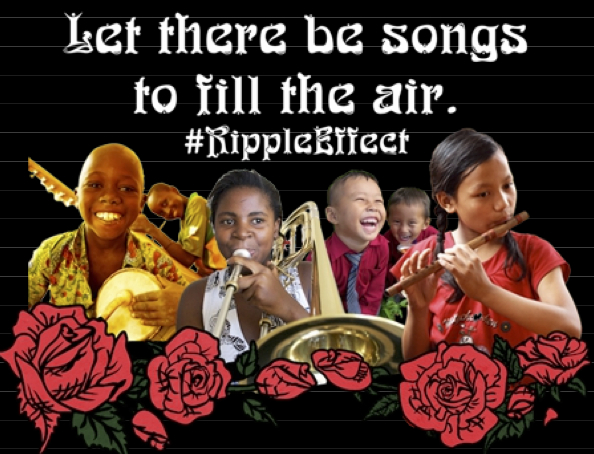
…Let there be songs to fill the air

Ripple in still water
When there is no pebble tossed
Nor wind to blow

Reach out your hand if your cup be empty
If your cup is full may it be again
Let it be known there is a fountain
That was not made by the hands of men
Robert Hunter (Grateful Dead, 1970)


NOTE: Amos, Water, and Justice
I confess that I largely know the quote “until justice rolls down like waters, and righteousness like a might stream,” from its use by Martin Luther King and, consequently, in Maya Lin’s Civil Rights Memorial.

How fascinating and disconcerting, in this context, then, to be reminded just now of what Amos says about music —

Amos 5:כא שָׂנֵאתִי מָאַסְתִּי, חַגֵּיכֶם; וְלֹא אָרִיחַ, בְּעַצְּרֹתֵיכֶם. 21 I hate, I despise your feasts, and I will take no delight in your solemn assemblies.
כב כִּי אִם-תַּעֲלוּ-לִי עֹלוֹת וּמִנְחֹתֵיכֶם, לֹא אֶרְצֶה; וְשֶׁלֶם מְרִיאֵיכֶם, לֹא אַבִּיט. 22 Yea, though ye offer me burnt-offerings and your meal-offerings, I will not accept them; neither will I regard the peace-offerings of your fat beasts.
כג הָסֵר מֵעָלַי, הֲמוֹן שִׁרֶיךָ; וְזִמְרַת נְבָלֶיךָ, לֹא אֶשְׁמָע. 23 Take thou away from Me the noise of thy songs; and let Me not hear the melody of thy psalteries.
כד וְיִגַּל כַּמַּיִם, מִשְׁפָּט; וּצְדָקָה, כְּנַחַל אֵיתָן. 24 But let justice well up as waters, and righteousness as a mighty stream.

BACK

Prayers, Advocacy, and #RippleEffect

Continuing the discussion, at “If a corpse be found…”, about the need for new approaches to meeting our communal responsibilities.

Some possible responses to the trauma and tragedy of multiple murders, particularly in Washington, DC —

Prayer

Residents in some of the most affected neighborhoods of the District are asking for prayers, calling on everyone in and around the city to #Pray4DC, as one united town. If you know others who engage in intercessory prayer, please pass along this prayer concern. And, however you approach such requests yourself, please keep the need for “one DC” in mind.

Also, if you know members or clergy in other congregations who might be willing to prayerfully acknowledge DC’s losses to homicide — as Temple Micah has begun to do — please ask them to sign up for #SayThisName.

Learn and Advocate

Learn a little about child trauma and how it affects learning and then advocate for trauma-sensitive schools – particularly in Washington, DC. The District also needs trauma-response units to help young people on the scene cope with the violence they too often face.

You will find more background and links to several pertinent resources in this recent feature report from the Education Town Hall.)

For DC residents, please note particularly, that the DC Council held a roundtable on this topic in June and should be poised to act.

Playing for Change

This one involves the Grateful Dead — some Temple Micah (DC) people know I hate to let a summer pass without somehow bringing in the Dead. And those who follow such things know this summer is the Dead’s 50th anniversary….

Ripple Effect Campaign

As we began the Standing Prayer, I mentioned the idea of ripples of pain moving outward from a bomb or a bullet and how kindness and prayer can also have a ripple effect. (See “Prayer in the Midst of Bullets and Bombs“)

The #RippleEffect Campaign — named for the Grateful Dead son, “Ripple” — simply involves engaging in acts of kindness or telling about a how an act of kindness affected you… and then encouraging others to do so as well, creating a kindness ripple.

Part of the effort involves social media, for those interested. But it’s certainly not required for the spreading of kindness, or for doing so with the intention of helping to heal all that is broken in DC and beyond.

Playing for Change Day

2015-bnr-PFC_squareA second goal of the Ripple Effect Campaign is to raise awareness and funds for a project called “Playing for Change” that teaches music and dance to young people around the world, including in the U.S. Playing for Change (PFC) helps youth use music for everything from improving education to resolving conflicts, preserving cultural heritage, and building community, locally, and connections worldwide.

PFC Day — with activities in 61 countries last year — is an annual effort, scheduled this year during the Days of Awe.

Organizers say

This day of music, peace, and change keeps instruments, music instruction, and inspiration flowing to children around the world, … and contributes to positive vibration that connects and inspires us all.

Justice, Justice you shall pursue

The related dvar Torah, “If a corpse be found…”, continues the discussion of ripples — ones of pain, outward from bullets and bombs, and ones of healing.

Is anyone else interested in pursuing a Playing for Change activity in DC and/or the Jewish world?

Morning: Blessing, with Echo of Gunshots

How lovely are these tents!
not far from housing that has seen better days
and housing that has seen too many awful ones.

I love the place of Your house, reached through streets
collecting cigarette butts, the odd chicken wing, echoes of homicide.

Through Your abundant love, I enter Your house,
where these peaceful walls remind us: “If I am for myself alone, what am I?”
while a few miles away homes reel from gunshots and mourning,
makeshift memorials of teddy bears and candles pooled with tears and rain.
Meetings and vigils and “let this be the last.”

My prayer seeks a favorable time –
Does joy come in the morning, where weeping has not tarried for the night?
Can we dance together, if we have not yet joined in lament?

You answer with your saving truth:
Your glory’s dwelling-place spans mountain top and pit.
We are shaken and we stand firm.
Remove our sackcloth and dress us to praise You, Source of Healing and Help.

— Virginia Spatz, August 21, 2015

See Mah Tovu [How lovely are your tents] and Psalm 30 in the early morning prayers

…weeping may tarry for the night, but joy cometh in the morning.
…When I was carefree, I thought, “I shall never be shaken.”…
LORD, when I enjoyed your favor, You made me stand firm as a mighty mountain; when You hid Your face, I was terrified….
You turned my lament into dancing;
You removed my sackcloth and girded me with joy

See also, “Prayer Warm Up” and handout on Psalm 30

Prayer Warm-up: From Self to Community

Part of the early morning warm-up for prayers — along with awareness of our blessings and awakening body, soul, and mind — is moving from what Mishkan T’filah [Reform prayerbook] calls “self-fulfillment” to “social imperatives of community.” And that means beginning to move through the individual joys and concerns that we brought with us to a communal awareness — of each other and the world beyond these walls.

…To me it’s a little ironic that Mishkan T’filah editors discuss this in the introduction but don’t include my favorite way to accomplish this — the psalms — in the prayerbook proper….

Psalm 30 in particular, on the handout (Psalms Handout; see below), is a great vehicle for moving through our personal laments and dancing, shaken-ness and solidity, as we become aware of participating in thousands of years and millions upon millions of voices crying out and healing, praising without ceasing.

In this season of Elul, Psalm 27 is also recited, asking God to help us feel the divine presence as we seek to return to ourselves, as individuals and as a People in the new year.

And, finally, I repeat a teaching I learned earlier this summer about the nearness of all we need — like the water right in front of the deer in Psalm 42 — and how it is, even still, for us to experience what sustains us. We do, after all, have to become vulnerable, if only for moment.

Note: Please note that Rabbi Dr. Tzvi Hersh Weinreb’s first name contains a typo on this handout, PsalmsAugust22. My apologies.

See also, “Morning: Blessing, with Echo of Gunshots.”

Prayer in the Midst of Bullets and Bombs

Decades ago, Yehuda Amichai wrote about the diameter of a bomb — thirty centimeters, with circles of pain outward from its center. (English here).

photo: Treona Kelty
photo: Treona Kelty

Similarly, every bullet leaves pain in circles rippling outward.

We also know that kindness has a ripple effect,
and many people think prayer works this way, too.

The 20th Century rabbi Max Kadushin asks us to notice that the Amidah (“Standing prayer,” the central prayer of a Jewish service) begins with one opening blessing formula and then proceeds with a series of prayers that use only a closing formula.

…Jewish blessings are frequently structured with an opening and closing formula book-ending the content. The unusual structure of the Amidah, he says, creates a “cascade of blessing,” growing from the first blessing outward….

If everyone on the outer edges of pain ripples
sends blessings inward,
a lot of healing energy
will wend its way toward those most in need…
with most of us in a position
to both send and receive.

Max Kadushin. Worship and Ethics: A Study in Rabbinic Judaism. (NY: Bloch, 1963)


Treona Kelty is founder of Beautiful U Yes U, see also Facebook.
This photo is from their office this summer.

In All Your Gates

Instructions to appoint judges “for yourselves,” in “all your tribes,” or, more literally, “in all your gates,” opens the Torah portion Shoftim [judges] (Deut 16:18-21:9), and the famous line, “Tzedek, tzedek tirdof… [Justice, justice you shall pursue…],” follows:

שֹׁפְטִים וְשֹׁטְרִים,
תִּתֶּן-לְךָ
בְּכָל-שְׁעָרֶיךָ,
אֲשֶׁר יְהוָה אֱלֹהֶיךָ נֹתֵן לְךָ, לִשְׁבָטֶיךָ; וְשָׁפְטוּ אֶת-הָעָם, מִשְׁפַּט-צֶדֶק.

Judges and officers shalt thou make thee in all thy gates, which the LORD thy God giveth thee, tribe by tribe; and they shall judge the people with righteous judgment.
— Deut. 16:18 (mechon-mamre.org; translation “Old JPS”)

Appoint yourselves judges and police for your tribes in all your settlements that God your Lord is giving you, and make sure that they administer honest judgment for the people.
— another translation, from Bible.Ort.Org

Last week at Temple Micah, the commentary discussed the emphasis, throughout Deuteronomy, on centralizing ritual. In contrast, we see here that judges and justices are to be local concerns.

Julia Watts Belser writes in Torah Queeries:

We are asked to find judges who recognize the landscape of our lives, who have lived in similar terrain and can help us navigate its cliffs and fissures. We are expected to come before judges who expect holiness within us and consequently find it – who know our goodness and consequently call it forth.
–“Setting Yourselves Judges,” pages 250-253

She notes that we all belong to many tribes – pointing out that for example, she is a bisexual rabbi with a disability and that queerness alone means belong both to one tribe and many. She asks how her white skin and wheels and Jewishness intersect, concluding that “no single judge will hold all our answers, and no single officer will provide us with a perfect map.”

I had hoped to discuss various tribes to which we all belong and how they intersect. Events forced my attention toward different local justice issues. But I wanted to share her commentary, which I found inspiring and hope to pursue further another time, before moving in the different direction I was led.

The words of Torah I did write are a bit much, in a number of ways, for one post. So look for more on this shortly.
Continue reading In All Your Gates

Flags, Horns, and Walls

This week’s Torah reading closes the Book of Numbers, leaving the People — who have journeyed for 40 years, losing many people in the process and raising new generations — poised to cross the Jordan. The narrative includes a 42-stage recitation of journeys: “These are the stages of the children of Israel…” (Numbers 33:1-49). Each of the stages is reported as follows: “…and they journeyed FROM [old place]….and they camped [new place].”

One lesson of the reading seems to be the importance of noting every stage on the way. And the repetition of “journeyed from” — forty-two times! — hammers home the idea that you have to leave one place to get to a new one. But events of recent weeks in the nation, as well as some travel of my own, suggest that recognizing where we are is no simple matter.

Flags

In South Carolina a few days ago, the Confederate flag was removed from the State House. (See, e.g., Al Jazeera.) Observers reportedly chanted “USA! USA!” as well as “nah nah nah nah…goodbye,” and the removal was heralded by many as a victory over hate and divisiveness. In addition, other instances of the same flag, in stained-glass windows at the Washington National Cathedral, for example, also face possible removal.

from Al Jazeera
from Al Jazeera

However, there are some who mourn the loss of what they consider a “heritage symbol.”

Still others argue that the US flag, Mount Rushmore, the faces on our currency, and a variety of other national symbols and observances need to go as well. (See, e.g., Black Agenda Report.)

So, if we had to name this stage in our country’s history, what would it be?
Where are we leaving?
Where are we headed?
Are we making a collective journey at all, if we don’t share a starting point?

Horns

Stained-glass window at Kenyon College's Church of the Holy Spirit
Stained-glass window at Kenyon College’s Church of the Holy Spirit

Meanwhile, I am visiting Kenyon College in Gambier, OH, this week, where this image of Moses (right) holds a prominent place in the campus Church of the Holy Spirit.

The horns are based, most scholars think, on a mistranslation of the word קָרַן — as “keren” [“grew horns”] rather than “karan” [“sent forth beams (of light)”] in Exodus 34. They appear most famously on sculptures of Moses by Michelangelo and Donatello (both centuries before the window design).

51GOZ58pcKL._SY344_BO1,204,203,200_The horns were a “widespread medieval negative image of the Jew,” according to My Jewish Learning, and “led to the widespread notion that all Jews had devilish horns.” Moreover:

Der Sturmer cover 1932

The Nazis seized upon the negative Jewish body image and used caricatures and other forms of propaganda to present the Jews as sub-human or as disfigured humans. The Nazi weekly Der Sturmer was famous for disseminating these images. (See right, e.g.; more here).

[Additional, more recent (2013) example.]

In a 1997 history of the church, Perry Lentz says, “in the left-most first window a Moses with a distractingly muscular forearm is bringing the ten commandments.”

A video, used in promoting the “Beyond Walls” program that brought me to Kenyon this week, pans the church windows at a distance too great to discern content, while a young spokesperson declares: “When Kenyon was founded, we were Episcopalian, but now we’re completely non-denominational.”


Continue reading Flags, Horns, and Walls