Derekh Eretz: Pursuing Connections

Vayikra: A Path to Follow quotes a Talmud passage linking this week’s Torah portion to rules of etiquette and ethics. Specifically, the first verse is linked to “Don’t speak until you’ve first called to the person with which you’re trying to communicate” and to “Don’t repeat what anyone says without express permission.”

Either or both of these rules are fine fodder for study and discussion and/or for a congregational dvar torah [“word” of Torah]. For those interested in becoming more comfortable with finding such connections to share with others, here, for what it’s worth, is how I found the quote shared in the previous post.
Continue reading Derekh Eretz: Pursuing Connections

Vayikra: Great Source(s)

By allowing laypersons to make their own sacrifices, under the auspices of the priests, the sacrificial laws gave people a degree of control over their spiritual lives. Inviting people into the sanctuary for the sacrifice, people felt themselves personally invited into God’s earthly home.

In essence, the system of sacrifice provided a metaphor, a method, for the Israelites to reach God, responding to the deep psychological, emotional, and religious needs of the people. Indeed, this is the meaning of the Hebrew word for “sacrifice”; it comes from a verb meaning “to bring near.”

…[Regarding contemporary animal rights concerns:] First, according to the Bible, the life of the animal was its blood (Gen 9:4). Out of respect for that life force, all biblical sources agree that it was forbidden to imbibe blood. …[one] had to return the blood to God, its divine creator, by offering the blood of sacrificial animals on the altar….

In what may seem like an ironic twist, then, these and other dietary rules are founded on the sanctity and inviolability of life. In this way, the sacrificial laws exemplify one of the most exciting characteristics of the book of Leviticus: behind the seeming arcane rituals lies a system of meaning that we can draw into our own, modern lives.
–Jacob Milgrom, Leviticus: A Book of Ritual and Ethics, pp17-18

Milgrom, Jacob. Leviticus: A Book of Ritual and Ethics. Minneapolis, MN: Augsburg Fortress, 2004.

Milgrom’s book and those below provide historical and anthropological perspectives on the book of Leviticus. While academic and detailed, they can help provide some orientation for what can seem a very foreign territory: the sacrificial system.

For a different sort of orientation see “The Rationale of the Sacrifices,” from Nehama Leibovitz.

Academic Works on Leviticus

Purity and Danger. Douglas, Mary. London: Routledge and Kegan Paul, 1966. In this classic of anthropology, we learn: “Defilement is never an isolated event. It cannot occur except in a systematic ordering of ideas.” Much of the frequently referenced chapter, “The Abominations of Leviticus,” is available at Google Books. Douglas has also written other works on Leviticus and the sacrificial system.

Reading Leviticus: A Conversation with Mary Douglas. Sawyer, John F.A., ed. Sheffield, England: Sheffield Academic Press, 1996. Includes one response from another scholar, following each main paper, and subsequent discussion.

Golden Bells and Pomegranates. Visotzky, Burton L. Tuebingen, Germany: Mohr Siebeck, 2003. A study of the 5th Century CE commentary, Leviticus Rabbah.

————————————————————–
The “Opening the Book” series was originally presented in cooperation with the independent, cross-community Jewish Study Center and with Kol Isha, an open group that for many years pursued spirituality from a woman’s perspective at Temple Micah (Reform). “A Song Every Day” is an independent blog, however, and all views, mistakes, etc. are the author’s.
———————————————————————————-


Pekudei: Something to Notice

The colors.

Before we complete the Tabernacle and leave Exodus/Shemot, I must pause to consider the oft-mentioned color trio: “tekhelet, v’argaman v’tolaat shani.” These colors are central in the tent instructions/construction and appear throughout the priestly garments. The same colors are, of course, prominent in contemporary Jewish textiles and other arts.


Tekhelet — Blue, Sky Blue or Indigo.


Argaman — Purple.


Tolaat shani — Scarlet or Crimson.

“Blue Wheat,” “Ode to Overturning Bowers vs. Hardwick” and “Pink Pomegranate” (looks scarlet to me) — above — are all works by DC-area artist Judybeth Greene.


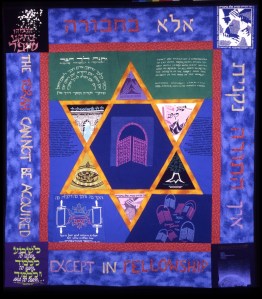
The quilt below was made by Amy Leila Smith, of Blue Feet Studio in Maine, for the National Havurah Committee.

…seems fitting closure for a portion which focuses on weaving, long a woman’s art. See, e.g., Women’s Work, the First 20,000 Years: Women, Cloth and Society in Early Times by Elizabeth Wayland Barber (Norton, 1994).

For more on the special history of tekhelet blue, see Ehud Spanier’s history (details in Source Materials).

[CAUTION on print and internet sources focusing on these three colors, especially tekhelet: Many involved in reconstructing exact colors of the Tabernacle and related work are deeply concerned with preparing for the Third Temple.]

————————————————————–
The “Opening the Book” series was originally presented in cooperation with the independent, cross-community Jewish Study Center and with Kol Isha, an open group that for many years pursued spirituality from a woman’s perspective at Temple Micah (Reform). “A Song Every Day” is an independent blog, however, and all views, mistakes, etc. are the author’s.
———————————————————————————-

Continue reading Pekudei: Something to Notice

Pekudei: Language and Translation

“And these are the names [v’eileh] of the Children of Israel who were coming [ha-ba’im] to Egypt…”
— Exodus/Shemot 1:1

“…throughout their journeys [mas’eyhem].”
— Exodus/Shemot 40:38 (Stone translation*)

A number of commentaries note that the vav (a conjunction which can mean “and” or “but”) is meant to link the narrative of Genesis with that launched with Exodus. In an unusual bit of similarity, both the Stone and Alter* commentaries make this point and also remark that identical words open the genealogy beginning at Genesis/Breishit 46:8.

Stone emphasizes the on-going nature of the narrative by using “were coming” for “ha-ba’im,” while Alter and others use the past tense. JPS* bridges the two with “came, each coming with…”

Alter also notes that the word mas’eyhem [in all their journeyings] uses “the same verbal stem [that] inaugurated the Wilderness narrative in 13:20, ‘And they journeyed from Succoth,'” suggesting that this helps leave a “sense of harmonious consummation,” as the work of the Tabernacle — likened to that of Creation — is completed. “But,” he continues:

the condition in which the Israelites find themselves remains unstable, uncertain, a destiny of wandering through arduous wasteland toward a promised land that is not yet visible on the horizon. The concluding words of Exodus point forward not to the Book of Leviticus, which immediately follows, but to the Book of Numbers, with its tales of Wilderness wanderings, near catastrophic defections, and dangerous tensions between the leader and the led.
— Alter, p.535

Chazak! Chazak! Venitchazeik!
Be strong! Be strong! And may we be strengthened!

* Please see Source Materials for full citations and additional information.

————————————————————–
The “Opening the Book” series was originally presented in cooperation with the independent, cross-community Jewish Study Center and with Kol Isha, an open group that for many years pursued spirituality from a woman’s perspective at Temple Micah (Reform). “A Song Every Day” is an independent blog, however, and all views, mistakes, etc. are the author’s.

Pekudei: Great Source(s)

As Exodus comes to a close, this poem seems appropriate:

“Exodus” by Charles Reznikoff

…But there came a Pharaoh who knew not Joseph
and set us building treasuries and cities,
set us making brick for him and building cities:
we who had been masters of our days and daylight,
free to wander, free to stay.
King and servants, priests and laymen;
soldiers and overseers, and slaves:
this was Egypt’s peace and order,
and in this order we were slaves:
Israel like a bird that a creeping weasel has wounded in the head
or a man knocked against a wall;
the cattle have trampled it — but still it flutters.

But there came a shepherd from the desert,
speaking in the ancient tongue
all but our eldest had forgotten;
and we saw an old man — withered hands and haunches;
and he said to us, stuttering as he spoke:
I bring a message from the God of your fathers
and, in place of these burdens,
I bring you — the yoke of His law.
How pleasant it is, distinguished from the beasts,
to feed upon His law
tasting each syllable
the radiance of our Lord!
If there is bone enough to make the tooth of a key
and ink enough to write two letters of the alphabet —
then fear not the rush of tramping shoes nor the sound of the shouting

and hurry out of this land!
— found in Chapters into Verse

Reznikoff includes notes indicating that the italicized lines at the end of these two stanzas (of a four-stanza poem) “are from the Mishnah (Hullin 3:3 and other places, Danby’s translation).” The ink and bone references can be found in Babylonian Talmud Shabbat 78b.

You can read the entire poem at Google Books. See Source Materials for Chapters into Verse details. The poem is also found in The Poems of Charles Reznikoff

————————————————————–
The “Opening the Book” series was originally presented in cooperation with the independent, cross-community Jewish Study Center and with Kol Isha, an open group that for many years pursued spirituality from a woman’s perspective at Temple Micah (Reform). “A Song Every Day” is an independent blog, however, and all views, mistakes, etc. are the author’s.
———————————————————————————-
Ki Tisa: Language and Translation

Exodus/Shemot 32:25, part of Moses’ confrontation with Aaron regarding the Golden Calf, contains two interesting words for which there are a range of translations. One is a hapax legomenon, a word that appears only once in the Tanakh; the other a common verb, with a root that encompasses three and half columns in my concordance:*

“Moses saw the people, that it was exposed [ki parua hu], for Aaron had exposed them [ki p’raoh aharon] to disgrace [l’shimtzah] among those who rise up against them.” — Stone*

———

“Moses saw that the people were out of control [ki parua hu] — since Aaron had let them get out of control [ki p’raoh aharon] — so that they were a menace [l’shimtzah] to any who might oppose them.”

A menace. Others, “an object of derision.” — JPS/Plaut*

——–

“Now when Moses saw the people: that it had gotten-loose [ki parua hu],

for Aharon had let-it-loose [ki p’raoh aharon] for whispering among their foes [l’shimtzah].”

gotten-loose: The same verb (paro’a) was used in 5:4, where Pharoah complained about the Israelites. for whispering: A derisive kind of whispering. — Fox*

——–

“And Moses saw the people, that it was let loose [ki parua hu], for Aaron had let them loose [ki p’raoh aharon] as a shameful thing [l’shimtzah] to their adversaries.”

The basic meaning of the Hebew paru’a is “to unbind,” as in the unbinding or letting loose of long hair. The sense here is of loosing of all inhibitions in orgiastic frenzy.

The word translated as a “shameful thing,” shimtsah, appears only here and so its meaning is uncertain, though it seems to indicate something strongly negative. “To their adversaries” might conceivably be a euphanims for “themselves,” as the more common word for enemies is sometimes used as a euphemistic substitution in curses.– Alter*

Cassuto* notes use of the root pei-reish-ayin in Numbers/Bamidbar 6:5, e.g, which refers directly to hair, in this case of an individual who took Nazarite vows: “…he shall let the locks [pera’] of hair of his head grow long,’ that is to say, the Nazirite shall allow the hair of his to grow untended” (p.420).

None of the six translation/commentaries links pei-reish-ayin with the Sotah [suspected wife] (Numbers/Bamidbar 5) — in which the priest is to bare [para’] the wife’s head. All note similarities, however, between Moses’ actions regarding the Golden Calf and the priest’s instructions regarding the Sotah.

Cassuto also notes a comparison of this loose/exposed/out of control state with the stiff-necked characterization of verse 9, adding, “In these poetic expressions there is possibly to be heard an echo of the ancient epic poem to which we have alluded earlier” (p.421). Throughout his Exodus commentary, Cassuto refers to “an ancient heroic poem, an epos dating back to earliest times, that told at length of the story of the Egyptian bondage, of the liberation and of the wandering of the children of Israel in the wilderness” (p.2).

* Please see Source Materials for full citations and additional information.

————————————————————–

The “Opening the Book” series was originally presented in cooperation with the independent, cross-community Jewish Study Center and with Kol Isha, an open group that for many years pursued spirituality from a woman’s perspective at Temple Micah (Reform). “A Song Every Day” is an independent blog, however, and all views, mistakes, etc. are the author’s.

———————————————————————————-

Tetzaveh: Something to Notice

Outside the Curtain

“You shall further instruct the Israelites to bring you clear oil of beaten olives for lighting, for kindling lamps regularly [ner tamid]. Aaron and his sons shall set them up in the Tent of Meeting, outside the curtain which is over the Pact, [to burn] from evening to morning before the LORD. It shall be a due from the Israelites for all time, throughout the ages.”
— Exodus/Shemot 27:20-21, JPS/Plaut*
[English bracketed words in the original]

Continue reading Tetzaveh: Something to Notice

Tetzaveh: Language and Translation

You shall further instruct the Israelites to bring you clear oil of beaten olives for lighting, for kindling lamps regularly [ner tamid]. Aaron and his sons shall set them up in the Tent of Meeting outside the curtain which is over the Pact, from evening to morning before the LORD. It shall be a due from the Israelites for all time, throughout the ages.

[Note:] Kindling lamps regularly. The lights were to be kindled on the lampstand previously described. The translation of [ner tamid] as “perpetual light” or “eternal light” is grammatically inaccurate and is also contradicted by verse 21. (The so-called ner tamid of the synagogue is of much later origin.) — Exodus/Shemot 27:20-21, JPS/Plaut* and commentary

Cassuto* says that tamid is “intrinsically capable of two interpretations: it can mean ‘continuously, without interruption’ — that is the lamps would never be extinguished, either by day or by night; or it can signify ‘regularly’ — that is, the lamps would burn every night; on no night would its light be wanting — as in the expression [olat tamid, ‘continual burnt offering’].” He concludes that the “second sense is more probable” from context.

In addition, Cassuto says that “ner [‘lamp’] is used here in a collective sense: ‘lamps’ or ‘candelabrum.’

For more on the ancient lamp(s), see, e.g., Wikipedia’s article.

Here’s a quick reference on the later, synagogue “ner tamid.” To the right is an example of a new photovoltaic “ner tamid,” designed to save energy; this one was installed at Jewish Reconstructionist Congregation, Evanston, IL.


*Please see Source Materials for complete commentary and Torah/translation citations. Note: Tetzaveh is also transliterated Tetsaveh or T’tzavveh.

————————————————————–
The “Opening the Book” series was originally presented in cooperation with the independent, cross-community Jewish Study Center and with Kol Isha, an open group that for many years pursued spirituality from a woman’s perspective at Temple Micah (Reform). “A Song Every Day” is an independent blog, however, and all views, mistakes, etc. are the author’s.
———————————————————————————-

Terumah: Great Source(s)

Notes on Terumah from study partners, a rabbi and a playwright —

LK —

For a religious culture obsessed with prohibiting (and obliterating) any graven image, how curious that winged golden statues be set above the ark. Even more fascinating is the statement that not from inside the Ark nor even from above it, but instead between the statues will God speak. this “in between” the two cherubim, two statues, two graven images, is the locus of the voice. As Martin Buber taught us, God is uniquely present in the space in between. And, as Kabbalists imagined, the Shekhina, the feminine, indwelling presence of God, resides between the cherubim.

Neither from one cherub nor the other, but from the space created between them — when they confront each other — issues the revelation. Only relationship can imitate life and growth and revelation. And relationship can be created only when one ego realizes that there is another ego of equal importance. It can only be discovered in the presence of another. You simply cannot get there alone, there must always be someone else; it takes two to tango.

Perhaps that is why the prohibition against idolatry does not apply here. Truth be told, we are all only lifeless graven images until we face another and, in so doing, bring our selves and the other to life. And from between that meeting the divine voice issues.

DM–

The Ark of the Covenant and Ezekiel’s wheel could both be called fantasy. But the second is a vision, and the first is a divine instruction. To say an instruction is beyond our understanding is not to say it is impossible of execution.

We say “I do not understand” of the natural world cheerfully, and endeavor to better understand ourselves and call it “science.”

To be dismissive of “natural” evidence is called “ignorance.” To dismiss the divine is called “sophistication.”

–Lawrence Kushner and David Mamet

While reading Five Cities of Refuge: Weekly Reflections on Genesis, Exodus, Leviticus, Numbers, and Deuteronomy (NY: Schocken Books, 2003), the deepest, most interesting spot to inhabit is often, much as Kushner notes above, “between” the offerings of these study partners. Several reviews note differences in the styles of the co-authors. Stan C. Denman of Baylor University notes, in [contemporary review — can no longer (2019) find working link] that Kushner’s insights “often innovative and unconventional, stay within accessible distance from the text of study,” while Mamet’s sometimes seem more tangential, “against the grain of conventional erudition, often with favorable results.”

Denman also discusses a tendency in this book to focus on “‘we Jews’ and the particularities of Jewish ‘victimization,'” a practice the reviewer believes will turn-off non-Jewish readers. In my reading, however, the “victimization” tendency appears almost exclusively in the comments of Mamet: God introduced the name “YHVH,” he tells us at one point, e.g., because “El Shaddai” was too Jewish. Kushner, on the other hand, (simply) reads the bible as a conversation between God and “Israel,” with any reader expected to take spiritual and ethical lessons from their position as part of that collective noun. And so, between — between their religious and more secular writing, between the particular and the universal, between them — we are privileged to witness relationship… the only place, Kushner says above, where the divine dwells.

Five Cities of Refuge is available in hardcover or ebook. At $21.00, this might not be at the top of everyone’s “must-purchase” list, but I recommend checking it out, if you’re able.

See Source Materials for more information/links on this title and others.

————————————————————–

The “Opening the Book” series was originally presented in cooperation with the independent, cross-community Jewish Study Center and with Kol Isha, an open group that for many years pursued spirituality from a woman’s perspective at Temple Micah (Reform). “A Song Every Day” is an independent blog, however, and all views, mistakes, etc. are the author’s.

———————————————————————————-

Armstrong’s Case for God

Religion is hard work. Its insights are not self-evident and have to be cultivated in the same way as an appreciation of art, music or poetry must be developed….

…Religion was not something tacked on to the human consciousness, an optional extra imposed on people by unscrupulous priests. The desire to cultivate a sense of the transcendent may be the defining human characteristic.

…Before the modern period, most men and women were naturally inclined to religion and were prepared to work at it. Today many of us are no longer willing to make this effort, so the old myths seem arbitrary and remote, and in incredible.

Like art, the truths of religion require the disciplined cultivation of a different mode of consciousness. The cave experience [described in a chapter on religious practices of 30,000 to 1500 BCE] always began with the disorientation of utter darkness which annihilated normal habits of mind. Human beings are so constituted that periodically they seek out ekstatis, a “stepping outside” the norm. Today people who no longer find it in a religious setting resort to other outlets: music, dance, art, sex, drugs, or sport. We make a point of seeking out these experiences that touch us deeply within and lift us momentarily beyond ourselves. At such times we feel that we inhabit our humanity more fully than usual experience an enhancement of being. Continue reading Armstrong’s Case for God