New Year: (Re-)New Relationships

Prepare for the new Jewish year by joining with others working to “Stop the Hate” in the last weeks of 5778. The #AllOutDC rally celebrates a united, diverse community and promotes further work to dismantle white supremacy.

The rally is “creating a space for our movements to establish relationships with one another, learn from each other’s experiences, acknowledge and dismantle oppression within our spaces, and build a more loving, more powerful community in DC.” Participating in and/or financially supporting this fully-permitted gathering in Freedom Plaza on August 12 is a useful way to mark Rosh Hodesh Elul and begin the work needed for a better new year.

StopGraphic.jpg

Our very existence is resistance and we are coming together to celebrate ourselves, our ancestors, and our generations to come, through our voices, art, music, community members, and accomplices. We will not destroy white supremacy on August 12th, but we are part of the local and global ongoing resistance to those who wish us harm.

The #AllOutDC rally announcement continues:

“We will join together to chip away at these hateful forces, and build a world of justice and love. We will be there in peace and solidarity, but we will not back down.

“We need you to come out and join us to show that we will love and defend each other. We’ll rally in solidarity to protect our communities and reject racism, sexism, transphobia, anti-Semitism, Islamophobia, ableism, and all forms of hate and oppression.

“We will show a united community in the face of alt-right hate.”

In addition to Freedom Plaza rally, other approaches include a three-day mobilization organized by Black Lives Matter DC and direct action from #DefendDC. Actions are also planned in other locations affected by “unite the right” calls and/or standing in solidarity with “Stop the Hate” work.

Spin grief’s straw into gold: Moving on from Tisha B’Av

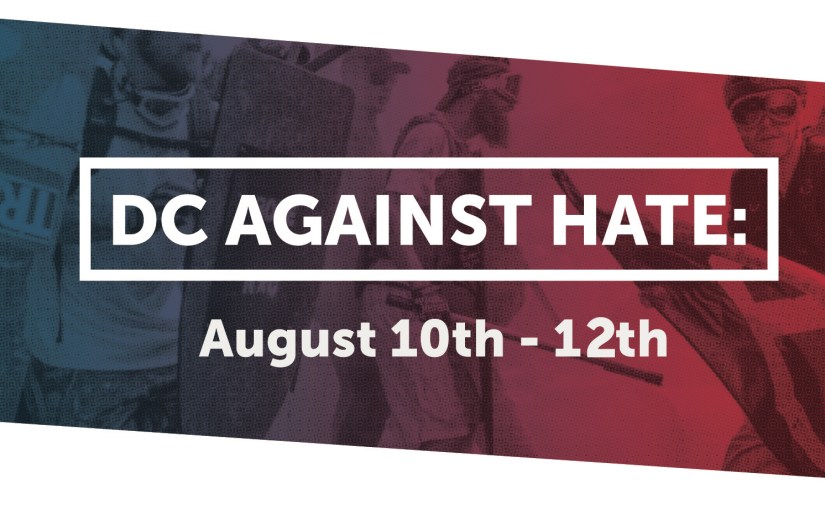
UPDATE: Please note that the “DC Against Hate” website has been updated with more details about three inter-connected actions. See also this blog’s update.

Jewish tradition teaches that much was lost in our history due to “baseless hatred” and that few things require more of our attention than making our communities welcoming to all, strangers included. We use Tisha B’Av — the day of mourning for destruction and calamities over the ages, the lowest point of the Jewish calendar — to help us consider all that needs changing if we are to move toward a better new year for all. (Tisha B’Av fell on 7/21-22 this year, and the new year begins 9/10-11.)

The month of Elul, an important point in this journey and the last of the old year, starts on August 12 this year — which happens to be the date a group of Klan and Nazi supporters have chosen for their “Unite the Right II” rally in DC, celebrating the anniversary of the violence at Charlottesville, VA last year (because they were refused a permit in Charlottesville).

National and local Jewish groups are planning responses, but none have been announced yet (7/24), to the best of my knowledge. Meanwhile, I hope Jews, in DC and beyond, are thinking of ways to celebrate Rosh Chodesh Elul, by joining with others who oppose baseless hatred and maltreatment of strangers and the most vulnerable among us.

…get back to work
you don’t have forever

…the wounded world
is still in your hands

…get on with it
gather grief like straw
spin it into something like gold
— from Alicia Suskin Ostriker’s “Drone”
The Book of Seventy
Pittsburgh: Univ. of Pittsburgh Press, 2009.

Some of us will be joining already planned mobilization efforts standing together for “ICE abolition, open borders, dismantling the prison industrial complex, and ending the settler colonial system. We will confront fascism, antisemitism, Islamophobia, white supremacy, and state violence.”

Others will find alternative ways to move into the new year with (re-)new commitment to opposing hate in its many forms.

I pray that none of us will be silent in the face of Klan- and Nazi-supporters gathering outside the White House.

DC Against Hate.jpg

“Lean on Me” Day

Please swallow your pride
if I have things you need to borrow
for no one can fill
those of your needs
that you won’t let show
— Bill Withers, “Lean on Me,” 1972
(AZ Lyrics)

Many of us have loved the song, “Lean on Me,” for a long, long time. And, as it happens, July 8 is the anniversary of the single hitting #1 on the Billboard Hot 100. So, here are some thoughts about the song, which has been on my mind a lot recently, particularly the line above about letting needs show.

Things You Need to Borrow

How often is a failure to communicate needs at the heart of a serious problem, between friends, in a couple, or in a larger group? And yet, how regularly do people hope for someone(s) who will know their needs without them having to ask?

Withers has said many times — to the Soul Train crowd in 1974, to NPR in 2007, and often in between — that the song is meant to be about friendship. And one of its great strengths is the powerful sense of mutuality: Lean on me now, because I’ll need to lean on you later. But how does that work, in real life, especially when needs go unexpressed?

There are a lot of Jewish teachings around friendship and community. For example, just a few lines from Pirkei Avot [Ethics of the Ancestors]:

  • Make for yourself a mentor, acquire for yourself a friend and judge every person as meritorious. (1:6)
  • If I am not for me, who will be for me? And when I am for myself alone, what am I? And if not now, then when? (1:14)
  • …Do not separate yourself from the community. Do not believe in yourself until the day of your death. Do not judge your fellow until you come to his place…. (2:4)
  • The honor of your friend should be as dear to you as your own… (2:10)
  • Do not assuage the anger of your friend at the time of his anger; do not console him at the time when his deceased lies before him; do not question him at the time of his vow; and do not seek to see him at the time of his humiliation. (4:18)

These teachings suggest that we should know a great deal about others: “the place” of our fellows as well as our friends’ anger, grief, vows, humiliations, and honor. We are asked here to anticipate, or act to obviate, lots of emotional needs, while other parts of the tradition speak more to meeting our fellows’ physical needs. In this way, Pirkei Avot seems to be asking us to make sure that there’s plenty for everyone “to borrow,” without vulnerable people necessarily having to put needs on display.

Still, the “Lean on Me” advice to swallow pride and speak up remains important, if for no other reason than to keep our friends from failing in their duties.

A Shift of Understanding

The mutuality and inter-connectedness of the whole “Lean on Me” concept is brought home by a slight change to one line, in Playing for Change’s 2015 “Song Around the World” version. Withers sang, “I just might have a problem that you’ll understand” (I’ll lean on you). But Playing for Change has it, instead: “You just might have a problem that you don’t understand” (You can lean on me). And their video, with its mixing of performances from so many people, generations, and locales around the world seems to emphasize that people in any one situation might have problems that could benefit from a wider perspective.

Playing for Change’s “Songs Around the World” give physical embodiment to the idea that we all lean on each other…to make music and for so many other things. [Descriptions follow embedded video below].

The original —

The above is video from NBC’s “The Midnight Special” (March 1974).
Description: Most of the video shows Withers at the piano in front of a studio audience, some close ups of him, some panning of audience; near the close of the video is a still of the album cover from the 1972 “Still Bill,” which included this song.

And Playing for Change —

The above video is one in a series of “Songs Around the World” staged by the non-profit Playing for Change.
Description:
The opening guitar chords are performed by Renard Poche of New Orleans, followed by Robert Lutti in Livorno Italy. Niki La Rosa, of Rome Italy, begins the lyrics. Grandpa Elliott, a New Orleans street musician, is heard singing the chorus, while we see: drumming on a beach in Chennai, India; a group of students in Kigali, Rawanda; and young dancers in Kirina, Mali. Elliott then appears briefly.

The “things you have to borrow” verse is sung by Clarence Bekker, Suriname native performing in Amsterdam. Bekker’s voice continues while we see Poche again and then Keiko Komaki of Kagoshima Japan is seen playing keyboard. Musicians and vocal artists in Chicago, Melbourne, Los Angeles and other locations join the mix. Titi Tsira, from Guguletha, South Africa, sings the “right up the road” verse. [More details as time permits, but hope this gives an idea of the visuals.]

Call and Response

Thanks to Bill Withers and so many others for helping us all believe there is someone to help carry a difficult load or just plain carry on while reminding us all that we need to be that someone as well:

Lean on me when you’re not strong
And I’ll be your friend
I’ll help you carry on
For it won’t be long
‘Til I’m gonna need somebody to lean on

If there is a load
You have to bear
That you can’t carry,
I’m right up the road
I’ll share your load
If you just call me.
— Bill Withers, 1972 (from AZ Lyrics

Korach and Dysfunctional Systems

Earlier this week, my town experienced a police-involved killing, and an elected representative of the community was on the scene shortly afterward. He told reporters he did not want to repeat he-said/she-said but was awaiting video and other evidence: “My job is to get the facts – what happened.”

I’m sure many readers know or can guess the specifics, but I’m leaving them out because I think this situation, like the tale of Korach and his followers — a narrative, which Jews read this week in the annual Torah cycle (Numbers 16:1-18:32), about community and power — has something more universal to teach.

The Official Job

My first thought on hearing this official say his job was to “get the facts” was: No, that’s the job of police detectives and journalists; your job is legislative, budgetary, and related responses to the town’s many challenges. I realized immediately, however, that my first thought came from a fantasy world.

Leaving the facts to journalists and police only works in a world where community members can rely on those individuals and their institutions to pursue the full story, where some level of trust exists.

Officials from some other parts of town have the luxury of sticking to the duties for which they were elected, the privilege of living and working where basic systems appear to be functioning — at least for the people they represent. In the hugely unlikely event that a police-involved killing (God forbid any more anywhere) were to arise on the streets of some other districts in town, elected representatives and constituents could continue their own work, while expecting investigative professionals to do theirs.

This particular official, however, operates amid systems which have long since ceased to function for too many of the people he represents.

So, what exactly is his job? Can it possibly be similar to those of his official colleagues?

The Rebellion

In the bible story, Korach and his followers accuse Moses and Aaron of exalting themselves over the congregation of God. Although teachers over the centuries have made efforts to find some merit in Korach’s argument, he remains the poster child for the evils of greed, self-aggrandizement, and self-interested politics.

We also read that Dathan and Abiram call Moses unfit to lead the People, given that his leadership has already resulted in them being condemned to die in the wilderness (Num 16:13). Just a few chapters earlier, God announced a punishment, following the incident of the spies, for all the adults: “your carcasses shall drop in this Wilderness. Your children will roam for forty years and bear your guilt…” (Num 14:32-33).

The argument from Dathan and Abiram fares no better, in the bible narrative, than Korach’s initial challenge, and the result is catastrophic:

So Moses stood up and went to Dathan and Abiram, and the elders of Israel followed him. He spoke to the assembly, saying, “Turn away from near the tents of these wicked men, and do not touch anything of theirs, lest you perish because of all their sins.” So they got themselves up from near the dwelling of Korah, Dathan, and Abiram, from all around….

When he finished speaking all these words, the ground that was under them split open. The earth opened its mouth and swallowed them and their households, and all the people who were with Korach, and the entire wealth.
— Num 16:26-27, 31-32

Things go from bad to worse in the bible story, and the Children of Israel eventually tell Moses: “Behold! we perish, we are lost, we are all lost….Will we ever stop perishing?” (Num 17:27-28)

Our Job

Every year when we come to this Torah portion, I find myself worrying about the failures of communication involved in the rebellions and wondering how differently things might have evolved, given better listening.

Why are Moses and Aaron, and God, so surprised and unhinged by the People’s lapse of faith (in the spies incident, previous portion)? What if God had just heard their worries instead of responding so negatively to their hesitation?

Why are Moses and Aaron, and God, unable to hear the people’s desperation and anger, in the face of completely failed expectations?

And what is our job, as community members — and, if appropriate, as Jews — whether we live in an area suffering from severe system break-down or not? How might better listening, and closer attention to circumstances behind complaints and rebellion, change things?

Jacob’s Dream and What’s Ours

Exploring Babylon Chapter 7.2

In the previous episode of #ExploringBabylon, I shared a pair of midrashim about Jacob’s Dream (Gen 28:12) from Midrash Tanchuma-Yelammedenu Vayetze 2. In Dream “Version #2,” God blames Jacob’s lack of faith, evidenced by his failure to ascend the ladder, for future oppression of Israel by Babylon, Persia, Greece, and Rome:

…since you did not have faith, your descendants will be oppressed by these four kingdoms with imposts, taxes on their crops, and poll-tax.
— Tanchuma Vayetze 2 cont. (Berman, p.186; full citation in previous post)

Version #2 concludes with a promise that the people will be saved due to the practice of pe’ah [corners], i.e., not harvesting one’s fields entirely, but leaving the corners for the poor (Lev 19:9-10, 23:22). Chapter 7.1 noted a few questions that this raises about the relationship between oppression and taxes, on the one hand, and faith, on the other. Here are further thoughts.

Let’s begin with the commandment of pe’ah, and travel backward through the midrashic territory.

Removing Wealth

1) Pe’ah, we learned, may be compared to withholding tax: “One does not even own one’s income until one has separated out the portion for the poor,” like “taxes that are withheld from income; it never really was yours anyway” (Jeffrey Spitzer, “Pe’ah: The Corners of Our Fields“). The mitzvah of pe’ah, and the associated attitude toward one’s earnings, is what will save the people from annihilation, according to Dream Version #2.

Biblical and rabbinic text focus a great deal on what individuals owe to the community, particularly to the most vulnerable — and pe’ah is just one of many related mitzvot that we might understand, following Spitzer, as akin to taxation for the public good. But ancient “taxation,” in ancient Jewish views, was something else.

2) The oppression, suffered under four kingdoms in Dream Version #2, encompasses “imposts, taxes on their crops, and poll-tax.” These taxes remove wealth from the local community for the needs of empire — be it Babylon, Persia, Greece, or Rome. Removing wealth from subject populations served to support the empire while also reducing the chance of rebellion in the provinces.

Such taxes, imposed from outside, were not viewed in Jewish tradition as commonweal-supporting. In addition, some ancient taxes were specifically designed to be punitive, such as poll-taxes on Jews in the wake of the 1st Century CE rebellion; diverting taxes from the Temple in Jerusalem to instead finance a temple for Jupiter in Rome was seen (and intended) as a particular affront.

3) In Dream Version #2, God announces that the kind of tax-oppression Jews experienced, as subjects of four foreign empires, can be explained by Jacob’s lack of faith and failure to ascend the ladder.

We don’t get Jacob’s side of the story. But we have a small clue in the text that follows the dream. When Jacob awakens, he makes a vow using an “if-then” construction:

And Jacob vowed a vow, saying: ‘If God will be with me, and will keep me in this way that I go, and will give me bread to eat, and raiment to put on, so that I come back to my father’s house in peace, then shall the LORD be my God…and of all that Thou shalt give me I will surely give the tenth unto Thee.’
— Gen 28:20-22

Most commentators read this, as discussed in “Jacob’s Contract with God,” as conditional only “in the way any contract or agreement is conditional” or as another form of affirming the covenantal relationship God has just announced. But I hear something else.

What’s Ours

Jacob, on the road to Haran, has just lost his home and any mundane sense of security. He hopes the sojourn will be temporary but does not yet know for sure and is not assured of future success, or even of shelter ahead. God’s promise is amazing, but Jacob sins by not grasping it.

“For all this they sinned still, and believed not in His wondrous works” (Psalm 78:32), we read in Dream Version #2. “Jacob” has shifted from a patriarch alone on the road to his national persona, which includes us.

We know from later text and tradition that the covenant God established with Abraham and Sarah, with Isaac and Rebecca, now reiterated with Jacob, obligates us to sharing resources in the ways outlined above, the mitzvah of pe’ah being a prime example. We are meant to acknowledge, all the time, in our thought and in our economic behavior that whatever we have is by the grace of God and not because we’re somehow entitled.

But Jacob, in his vow, sounds very like most of us most of the time: willing enough to give tzedakah, or otherwise contribute to the community, only after our own financial security is assured. This is a luxury denied to many.

And we have a great deal of work to do, as individuals, as communities, and on the national scale in the U.S., to examine what is ours and re-think how “our” stuff is distributed. This holiday of Thanksgiving calls those of us who are not of indigenous descent to carefully examine “ours” in the context of this land and its bounty. We must also look, nationally, at what is “ours” in the context of labor stolen from millions of enslaved people.

This is what I hear in Jacob’s dream. What about you?


“POLL TAX”
When I first encountered the midrash about poll-taxes, I confess my first thought was this was some kind of anachronistic reference to voting rights. For anyone else who may be confused….

“Poll,” meaning “head,” is used in two common, inter-related ways: Poll-taxes, since ancient times, are levied per person, as opposed to taxes on crops (income) or property, and imposed for a variety of reasons; history has seen a number of poll-taxes specifically aimed at Jewish communities. Poll is also used in voting contexts, where each “head” has a say in an election.

These two uses collide in the United States, where poll-taxes — in the sense of taxes on an individual, rather than on income or property — were used as a barrier to the polling place. The 24th Amendment made such use on the federal level unconstitutional in 1964, and subsequent rulings outlawed their use in state elections. Prior to that, poll taxes were used to prevent many people, primarily black citizens of the South, from exercising the right to vote.
BACK

Babylon, Taxes, and Thanksgiving

Exploring Babylon Chapter 7.1

Jacob heads back “there,” home of his mother’s and his grandparents’ people, in this week’s Torah portion, Vayetze (Gen 28:10-32:3; for more on “there“). But a great deal happens in the few verses between his leaving Beer Sheva and his arrival in Haran, and some of it sheds light for #ExploringBabylon.

In flight, after stealing his brother’s blessing (last week’s portion), Jacob pauses for the night:

וַיַּחֲלֹם, וְהִנֵּה סֻלָּם מֻצָּב אַרְצָה, וְרֹאשׁוֹ, מַגִּיעַ הַשָּׁמָיְמָה; וְהִנֵּה מַלְאֲכֵי אֱלֹהִים, עֹלִים וְיֹרְדִים בּוֹ
And he dreamed, and behold a ladder set up on the earth, and the top of it reached to heaven; and behold the angels of God ascending and descending on it.
— Gen 28:12 (Old JPS translation)

This dream, particularly its image of angels first ascending and then descending, has been the source of many tales and lessons. One such commentary, from Midrash Tanchuma (c. 500-800 CE), involves Babylon and taxes, and leads us to consider what Judaism demands regarding economic justice.

The Four Exiles

Earlier in #ExploringBabylon, we encountered two midrashim reading four exiles, or foreign dominations, into biblical text without apparent connection to exile: The first involved the earliest stages of Creation, Gen 1:2 (see “Babylon and the Beginning“); the second, the Binding of Isaac, Gen 22:13 (see “Entangled and Free“). Midrash Tanchuma Vayetze 2 uses a similar trope.

As in the previous examples, national exile is nowhere explicit in the biblical text, but an anxious uncertainty in the story provides a link. Here, Jacob’s precarious, liminal situation and God’s dream promise to “keep you wherever you go and bring you back into this land” (Gen 28:15), is linked to Israel’s national fate.

Two versions of dream commentary contain small variations that make for big midrashic differences. (The translations below are from Midrash Tanchuma-Yelammedenu, by Samuel A. Berman. Hoboken, NJ: Ktav, 1996).

Ascent and Descent

In version #1 of the dream midrash, God shows Jacob four specific angels:

  • the guardian angel of Babylon ascending seventy rungs of the ladder and descending,
  • the guardian angel of Media ascending fifty-two rungs of the ladder and descending,
  • the guardian angel of Greece ascending one hundred [I’ve also seen 180] rungs of the ladder and descending, and
  • the guardian angel of Edom ascending the ladder

Tanchuma Vayetze 2 (Berman, p.185)

Jacob could not see an end to this fourth angel’s ascent and so “cried out in terror: Perhaps Edom will never be compelled to descend.” God’s response is described with a combination of verses from the Tanakh:

Therefore fear thou not, O Jacob My servant, saith the LORD; neither be dismayed, O Israel; for, lo, I will save thee from afar, and thy seed from the land of their captivity; and Jacob shall again be quiet and at ease, and none shall make him afraid.

Though thou make thy nest as high as the eagle, and though thou set it among the stars, I will bring thee down from thence, saith the LORD.
— Jer 30:10, Obad 4

Here, as in the Creation (Gen 1:2) and the Akedah (Gen 22:13) midrashim, three of the four exiles/dominations are complete. The final domination persists: the “wicked empire,” rule of Teman (an Edomite clan), and Edom, in the Creation, Akedah, and Dream midrashim, respectively, all ways of referring to Rome. In the earlier midrashim, oppression will end with a messianic spirit (Creation story) and the ram’s horn (Akedah). Here, Roman rule seems endless, and Jacob despairs.

This version stops with Jacob’s despair and God’s assurance.

Faith and Taxes

In Version #2, “R. Berechiah, in the name of R. Helbo, and R. Simeon the son of Yosinah, maintained” that Jacob sees the fourth angel descend and God then asks Jacob why he does not ascend.

Whereupon our patriarch Jacob became distressed and asked: Shall I too be forced to descend, just as these are? The Holy One, blessed be He, responded: If you ascend, you will not be required to descend. Nevertheless, he did not ascend, for his faith was not sufficiently strong.
— Tanchuma Vayetze 2 cont. (Berman, pp.185-186)

R. Simeon ben Yosinah adds an interpretation of Ps 78:32, “For all this they sinned still, and believed not in His wondrous works,” to make Jacob’s failure more explicit:

The Holy One, blessed be He, said to Jacob: If you had ascended and trusted Me, you would never have been compelled to descend, but since you did not have faith, your descendants will be oppressed by these four kingdoms with imposts, taxes on their crops, and poll-tax.
— Tanchuma Vayetze 2 cont. (Berman, p.186)

Similarly to the midrashim on Gen 1:2 and 22:13, Version #2 has Jacob cry out: “Will this oppression continue forever?”

As in Version #1 above, God’s response is taken from Jer 30:10. Here, however, a second verse(30:11) is used to explain in detail how Jacob will survive while other nations perish. The key involves economic justice:

That is to say, “I will make an end of all the nations” (Jer 30:11) that reap their fields completely, but since the people of Israel do not reap their fields completely, “of thee I will not make an end.”
— Tanchuma Vayetze 2 cont. (Berman, p.186)


Economic Justice

The “people of Israel do not reap completely” refers to the mitzvah of “corners [pe’ah],” found in Leviticus:

And when ye reap the harvest of your land, thou shalt not wholly reap the corner of thy field, neither shalt thou gather the gleaning of thy harvest.
And thou shalt not glean thy vineyard, neither shalt thou gather the fallen fruit of thy vineyard; thou shalt leave them for the poor and for the stranger: I am the LORD your God.
— Lev 19:9-10; also Lev 23:22

The declaration that “corners” has “no prescribed measure” — that is, no upper limit — opens Mishnah tractate Pe’ah. Importance of this mishnah (Pe’ah 1:1) is stressed by its inclusion as a passage for daily study in many prayerbooks.

Jeffrey Spitzer, of American Hebrew Academy (Greesboro, NC), provides an overview of the mitzvah and its contemporary applications, for My Jewish Learning. He suggests equating pe’ah with withholding tax:

One does not even own one’s income until one has separated out the portion for the poor; one holds them briefly in trust for the poor. The challenge is to consider one’s tzedakah like the taxes that are withheld from income; it never really was yours anyway.
— Spitzer, “Pe’ah: The Corners of Our Fields

This withholding model helps explain the link between Jacob’s dream, as portrayed in this midrash, and ancient Israel’s national economic behavior. The upcoming Thanksgiving holiday in the U.S., and the economics of “Black Friday,” make this a particularly good time to consider what R. Simeon ben Yosinah meant us to learn from Jacob’s dream. More on this in chapter 7.2 of #ExploringBabylon. Meanwhile —

Questions to Consider

(1) What is the relationship between the midrash’s claim that Jacob lacks faith and the vow he makes when he awakens?

Consider what Jacob tells God the morning after the dream:

And Jacob vowed a vow, saying: ‘If God will be with me, and will keep me in this way that I go, and will give me bread to eat, and raiment to put on, so that I come back to my father’s house in peace, then shall the LORD be my God, and this stone, which I have set up for a pillar, shall be God’s house; and of all that Thou shalt give me I will surely give the tenth unto Thee.’
— Gen 28:20-22

Deuteronomy 10:18 says that God “loves the stranger, giving him food and raiment,” and some commentators say Jacob was asking no more than this. But, might it be that Jacob is showing a lack of faith by demanding the equivalent of income to which he is not (yet) entitled?

(2) How does the concept of pe’ah at the close of midrash version #2 relate to the particular kind of oppression the people experience?

(3) What can we learn from R. Simeon ben Yosinah’s labeling of taxes as oppression?

Notes

Of related interest: See this article on ancient taxation. Note how often taxes, especially those imposed by foreign powers, are discussed in the Talmud and other ancient records (including Christian Gospels). More on Rome and ancient Israel.


Sulam
Or perhaps a stairway. The Hebrew word “sulam” סֻלָּם is a one of those words used only once in the Tanakh (“hapax legomenon“), so determining exact meaning is a challenge.
TOP


Edom
The Book of Obadiah (21 verses in its entirety) is introduced as “the vision of Obadiah…concerning Edom.” Obadiah is dated to the period leading to Babylonian Captivity, during which it seems that Edom switched alliances. Centuries later, when the Roman, and then the Byzantine, Empire ruled the entire region — until mid-7th Century CE — “Edom” came to stand in for this seemingly endless outside force.
BACK


Jeremiah 30:11
“For I am with thee, saith the LORD, to save thee; for I will make a full end of all the nations whither I have scattered thee, but I will not make a full end of thee; for I will correct thee in measure, and will not utterly destroy thee.”
— Jer 30:11

Tanchuma Vayetzei’s third teaching about Jacob’s ladder concludes with an explanation of this “correct thee in measure” phrase:

I will punish you, O Israel, in this world in order to cleanse you of your iniquities for the sake of the world-to-come. Hence it is said: And he dreamed.
— Tanchuma Vayetzei 2

RETURN

Babylon: Entangled and Free

Exploring Babylon: Chapter 4.1

The ram stuck in the bush*, where Abraham finds him during the Binding of Isaac incident, reminded long-ago teachers of their own situation and their past Captivity in Babylon:

Throughout that day, Abraham saw the ram become entangled in a tree, break loose, and go free; become entangled in a bush, break loose, and go free; then again become entangled in a thicket, break loose, and go free.

The Holy One said, “Abraham, even so will your children be entangled in many kinds of sin and trapped within successive kingdoms – from Babylon to Medea, from Medea to Greece, from Greece to Edom.”

Abraham asked, “Master of the universe, will it be forever thus?”

God replied, “In the end they will be redeemed at [the sound of] the horns of this ram, as is said, ‘The Lord shall blow the horn [shofar] when He goes forth in the whirlwinds at Teman [Edom] [וְיָצָא כַבָּרָק חִצּוֹ; וַאדֹנָי יְהוִה בַּשּׁוֹפָר יִתְקָע, וְהָלַךְ בְּסַעֲרוֹת תֵּימָן]'” (Zech 9:14).
— Bialik & Ravnitsky, The Book of Legends/Sefer Ha-aggadah 42:45**

Like earlier commentary, which found these same periods of foreign control — Babylon, Medea, Greece, and Rome — in the second verse of the Creation story, this midrash promises future Redemption. (See “Babylon and the Beginning.”) Also, as in the previous midrash, everything depends on human repentance.

As Erica Brown puts it, this midrash teaches:

Wrong-doing will always catch us up in its thorny hold….The ram’s horn, the penitential cry of it, will remind us that we need not be stuck in the thicket. We can extricate ourselves.
— Brown, Confronting Scandal: How Jews Can Respond when Jews Do Bad Things. (Woodstock VT: Jewish Lights, 2010). p.125


Entangled

…and that brings us round again to the original intention behind this blog: The Exodus is, of course, the foundational story of Judaism, and there are many important lessons for our time and place to be gleaned from it and the Genesis stories which lead us there. There’s no escaping, however, that the Exodus is, in essence, the tale of a violent and permanent parting of oppressed and oppressor peoples.

And that metaphor has limits when it comes to trying to work out how people who share circumstances with both the oppressed and the oppressor, and generally have no intention to flee, can envision and work toward a better world.

Our tradition has long offered another metaphor: the far more complex and ambiguous narrative of exile, oppression and redemption. Thus, #ExploringBabylon was launched to consider ways our current realities reflect the multivalent image of Babylon, in the hope that this will help Jews in the U.S. find new visions for the future….

and Free

It is noteworthy that the midrash quoted above — as well as the one based on Genesis 1:2 (cited in the earlier post) — omits the Exodus when speaking of past instances of the people being “stuck.” For the teachers who wrote both midrashim, the Exodus was not in question: God and the people and the Torah remained in relationship born of that experience. What was in question was how the people, who by this time knew how hard it was to honor that relationship amid a complex world, were going to extricate themselves from their current entanglement.
ShofarHand

Questions for Consideration

  • Are we, as individuals and communities of Jews, hearing the ram’s horn today?
  • What are some of the thorny communal places we’re being called to address?
  • Is there a role for some kind of communal repentance?
  • Can the larger Jewish narrative, of being entangled and free and entangled again, help us find a way out of the thicket?


NOTES

* See this week’s Torah portion, Vayera (Genesis 18:1 – 22:24):
“And Abraham lifted up his eyes, and looked, and behold behind him a ram caught in the thicket by his horns. And Abraham went and took the ram, and offered him up for a burnt-offering in the stead of his son.
וַיִּשָּׂא אַבְרָהָם אֶת-עֵינָיו, וַיַּרְא וְהִנֵּה-אַיִל, אַחַר, נֶאֱחַז בַּסְּבַךְ בְּקַרְנָיו; וַיֵּלֶךְ אַבְרָהָם וַיִּקַּח אֶת-הָאַיִל, וַיַּעֲלֵהוּ לְעֹלָה תַּחַת בְּנוֹ.”
— Genesis 22:13
TOP

** This paragraph comes at the end of a three-page commentary on “The Binding of Isaac.” The The Book of Legends footnote cites Pesikta Rabbati 40:6 here. (Pesikta Rabbati is a holiday-based compilation of midrash, which is dated to Land of Israel, c.600 – c.900 CE.) But I cannot confirm the citation — and for all it’s extraordinary benefits, The Book of Legends English version does tend to muff citations — the verse from Zechariah above, e.g., is cited as “9:4” (The biblical reference is correct in the Hebrew version, but there is no chapter/verse with the Pesikta Rabbiti citation — way more than necessary, probably, but there it is.)
BACK

Babylon: Babel’s (Distant) Background

Exploring Babylon: Chapter 3.1

The Hebrew “Bavel” is translated into English as “Babel” in Genesis and as “Babylon” when it appears elsewhere in the Tanakh. Bavel as Babel shows up in a total of two verses in the entire Torah text: Gen 10:10, Nimrod’s legacy — “the beginning of his kingdom was Babel, and Erech, and Accad, and Calneh, in the land of Shinar,” and Gen 11:9, the close of what is usually called “The Tower of Babel” story. Bavel, now Babylon, is not mentioned again until 2 Kings 17:30, during the exile of the northern kingdoms.

After that, the Concordance (Even-Shoshan 1998) lists 281 additional appearances Bavel in the prophets and two in Psalm 137. Down the road, we’ll explore Babylon references in the later Tanakh. For now, let’s return to the Genesis.

Babel and Babylon

Jewish commentary on Gen 11:1-9 often treats the Bavel of Genesis as a place apart from history and geography. The focus is on the Babel tale’s placement in the Torah: after the Flood — when Noah’s descendants were told to “be fruitful and multiply and fill the earth” (Gen 9:1) — and before Terah, Abraham, Sarah, and Lot leave Ur (Gen 11:31). Babylon is far in the background, often unremarked.

For example, Rabba Sara Hurwitz, of Yeshivat Maharat, recently shared a lovely, powerful dvar torah for the Torah portion Noach (Gen 6:9-11:32):

And God models how to exist in a world of diversity. In verse 7, when God goes down to mete out their punishment, God says: “Come let US go down.”

Rashi, addressing the question of who God is talking to, suggests that God “took counsel with the Angels, with his judicial court.” Surely God knows how to mete out judgment and punishment, as he has already done unilaterally in the Torah without discussing it with the Angels? Perhaps, God turns to them to asses their thoughts on the sin of the people, to hear their opinion, to debate the pros and cons of scattering the people all over the world. By addressing the Angels, God models how to collaborate with others. Diverse ideas, when debated in a respectful manner, can lead to growth, greater productivity, and ultimately harmony.

…The challenge with diversity is to reject the tendency toward segregating, and running away from conflict. For out of conflict, when we are willing to confront one another with healthy debate, tolerance is born…
— Hurwitz, ָ”Harmony, not Conformity

Hurwitz’s dvar torah is about Babel, not Babylon. She mentions no historical city or empire. Plenty of homelies, in- and outside the Orthodox world, identify Babel with Babylon and incorporate views of the latter; idol-worship, smugness of place, and failure to follow God’s commandments are common themes linking Babel and Babylon. However large a role Babylon plays in any given dvar torah, the overarching point is to help us better understand the Torah, ourselves, and our obligations as Jews — not to tease out insights on life in ancient Babylon.

Still, Jewish bible study has long examined the relationship of the historical, geographical Babylon to the Babel of Genesis 11. For thousands of years, that discussion has returned again and again to concepts of unity and difference, centralizing and dispersing. And for thousand of years, intentionally or not, those discussions have incorporated political ideas about these themes.

Because Babylon, in its many guises, is never far away from Jewish consciousness. Remember: We’ve already found Babylon in the primordial stuff of Creation and in the formation of the first earthling….

It’s Complicated

Erin Runions analyses Babylon as a complex, often contradictory, theme in U.S. culture and politics. From a non-Jewish academic perspective, she writes about the Tower:

The Tower of Babel appears in political and religious discourse when people want to think about what holds the United States together in the face of its racial and cultural diversity. Because the Babelian creation of diverse languages is typically read as both God’s will and at the same time a punishment, the story lends itself well to representing a range of attitudes about difference. A confusing ambivalence about unity and about too much diversity emerges. Via the Babel story, Babylon is sometimes used to promote tolerance toward sexual and ethnic difference, insofar as U.S. Americans see themselves as benevolent toward difference. At other times it is used to stigmatize and attack difference as embodying a problematic unity without moral distinctions.
The Babylon Complex: Theopolitical Fantasies of War, Sex, and Sovereignty (NY: Fordham University Press, 2014), p. 22-23

Runions calls Babylon “a surprisingly multivalent symbol” in U.S. culture and politics and then dedicates 300 pages to unpacking its complexities. Much of The Babylon Complex is outside the scope of this blog’s project. But Runions’s work illuminates how the surrounding culture understands and uses the concept of Babylon — and those insights are crucial, however tangential.

We’ll explore The Babylon Complex further another day. For the moment, let’s return to Rabba Hurwitz’s image of God modeling “how to collaborate with others” and add a postscript.

Different Folks

This past week, Playing for Change re-shared this video — one of my favorites among an enormous menu of great, community-building music. Sly Stewart’s great lines —

You love me
you hate me
You know me and then
Still can’t figure out the bag I’m in

seem so appropriate to this stage of #ExploringBabylon and Hurwitz’s charge to us.

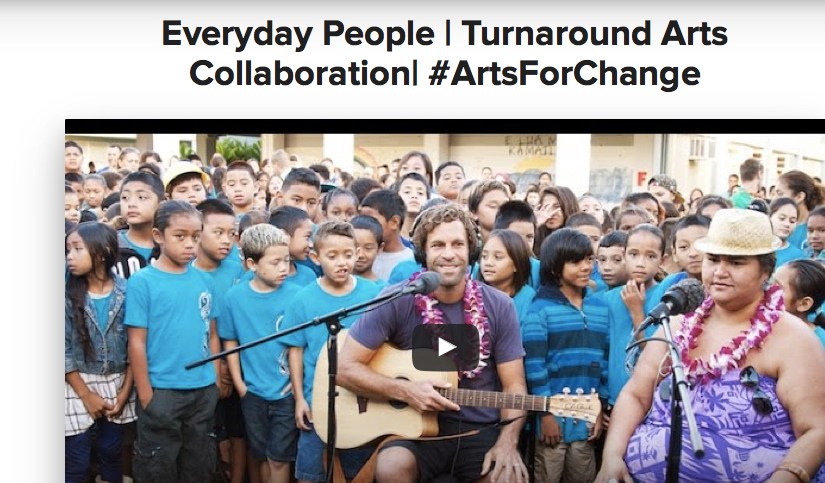
Plus: Who doesn’t need hundreds of children singing and dancing to Sly and the Family Stone’s “Everyday People”?!

More here for those interested, about TurnAround Arts and Playing for Change.

God’s Presence Accompanied Them

Exploring Babylon: Chapter 1.2

Deuteronomy closes with hopes, on the banks of the Jordan and declarations of Israel’s particular relationship to God:

So Israel dwelt in safety
the fountain of Jacob alone…

Happy are you, O Israel!
Who is like you, a people saved by the LORD,
the shield of your help,
and the sword of your triumph!
–Deut 33:28-29

Much later, after Israel had experienced more trial and loss and exile, the idea developed that God was in exile along with the People, as much in need of rescue as the People. In particular, Sukkot prayers include a verse, “Ani va-ho” — sometimes translated as “Yourself and us!” or “Rescue me and the divine name!” — followed by another that begs:

As You rescued the communities You exiled to Babylonia, and Your merciful Presence accompanied them — so save us.

This line of thought, which has been developing for centuries, is mean to teach that “when there is suffering in the world, God is not on the side of the oppressors. Rather God is with the oppressed and suffers with them” (from Or Hadash: A Commentary on Siddur Sim Shalom; download and more at Rabbinical Assembly).

The idea that “God is with the oppressed” is too often, I fear, used as a sort of universal Coup-fourré card, a “safety” to correct any “hazard,” so as to stay on the road.

…For those who never played the old card game Mille Borne, maybe “ace in the hole” or “Get out of jail free” card will make more sense; but I find Coup-fourré — the process whereby one is able to surmount a pitfall and keep rolling along — more apt here….

It is way too easy to let “God is with the oppressed” console the already comfortable while leaving the afflicted with their travails. As we enter the new year, I think it’s time for the comfortable among us to examine our “safety” cards.


Following God’s Example

We must ask ourselves where we are when there is suffering and injustice in the world. It’s not enough to be concerned or write letters or even stand out in the street in protest — although all of those things are important. God went into exile with us, and something similar is required of us, if we are to make any progress on racial and ethnic justice issues.

We must take steps to remove any sense that we are somehow entitled to dwell in safety — as we find Israel at the close of Deuteronomy — when others cannot. If God could join us in exile, we can work to dismantle White Supremacy and other protections that can never be equally shared. Where there is suffering in the world, we cannot simply declare ourselves “on the freedom side.”

We’ve got to follow God’s example, to the extent we are able, and be willing to be vulnerable, explore what it’s really like in Babylon, not just our romantic ideas about it from outside. We have to look carefully at any place where oppression thrives and ask, “how we are complicit?” Really, deeply, honestly ask ourselves and our communities: “Which side are you on, my people, which side are you on?”

And then take action, even if it means compromising our own safety or sense of self.

NOTE: A version of this mini-dvar [word, sermon] was given at Fabrangen and Tikkun Leil Shabbat joint Simchat Torah celebration, 10/11/17.

“Babylon” (Bavel) means many things in Judaism and in U.S. popular culture. Join “A Song Every Day” in Exploring Babylon over the next 40 weeks.


Which Side Are You On?

Background on the song/chant —

Florence Reece (more here) wrote “Which side are you on?” lyrics in 1931 as part of labor organizing effort —

Freedom Singers adapted it for the mid-20th Century Civil Rights movement —

A version of this is still used, as in #BlackBrunch in Oakland (above), but protestors in the Movement for Black Lives also use a combination song and chant, as in this snippet:

Chant: [Example Leader] was a Freedom Fighter
who taught us how to fight
We gonna fight all day and night
until we get it right

Sing: Which side are you on, my people, which side are you on?
We’re on the freedom side!

Sukkot and Babylon

Exploring Babylon: Chapter 1.1

“As You rescued the communities You exiled to Babylonia and Your merciful Presence accompanied them — so save us.” — from “Ani Va-ho,” a Sukkot prayer

Prayers begging for rescue and mercy often take the format, “You helped them; help us.” The unusual aspect of this prayer, recited each day of Sukkot in Conservative and Orthodox Jewish liturgies, is its implication that God needs saving, too. Long before Eleazar Kallir (c.570–c.640 CE) developed this poem, however, Jews were teaching that God follows the People into exile.

“These bold interpretations are a way of saying that when there is suffering in the world, God is not to be found on the side of the oppressors” (Or Hadash festival supplement; link below. Click here for basics on ancient Sukkot practices).

Fragility and Sukkot

Many centuries of prayers linked the fragility of Sukkot with exile. For example:

…In the merit of the Mitzvah of Sukkah, redeem us from exile,
protect us, that our enemies not reign over us.
And gather us from the four corners of the earth
and rescue us from captivity and from false imprisonment.
Let no evil eye rule over us ever.
Rebuild Your Holy Temple and restore your presence to Jerusalem….
– from Machzor Rav Peninim (R. Moses ben Hayyim Alshekh c1508-1600)

A different perspective appeared with Haskalah [“Enlightenment”]:


For thousands of years
Israel has been a wandering people.
Our houses are but fragile huts –
And these huts have been torn asunder too many times
By unrest and the hatred of others.
We have only your mercy to thank
That we have not perished from the earth.
Your compassion has held us and carried us
Through storm and flood, over every abyss
That has threatened to devour us,
And now, after generations of wandering,
You have allowed us to taste the sweetness of home.
Thanks to you, we have found a homeland –
A beautiful, wonderful country
That recognizes us as its children.
Safe and free, like ancient Israel
In the shade of its palm and fig trees,
We rest beneath the tent of peace
Provided to us by the law,
Along with all our brothers and sisters in this land….
– “On the first days of Sukkot”
in Fanny Neuda’s Hours of Devotion (1855)

The “homeland” Neuda had in mind was her native Moravia. The first edition of Hours of Devotion was published in German and included a blessing specifically naming Emperor Franz Joseph. Neuda’s family supported Haskalah, promoting the limited citizenship then allowed to Jews as well as sermons in the vernacular, modernizations of of prayers, and other religious adaptations that led to the Reform Movement. The prayerbook was later translated into Yiddish and was being reprinted in both languages up through the early part of the 20th Century.

Some Questions for Consideration

  • Where does the fragility of your personal Sukkot experience take you?
  • In what ways do you feel protected by a “tent of peace, provided to us by law”?
  • In what ways does your experience reflect exile, as expressed by Machzor Rav Peninim?
  • What about the fragility of the Jewish community, locally and worldwide?
  • And what about the wider world?
  • Are there lessons to be drawn from identifying ourselves and God as together in need of rescue?


sukkah78
Spatz-O’Brien sukkah, Oct. 2017

NOTES

In Temple days, hoshanot were recited while circling the altar on Sukkot; some denominations still recite them, while circling the bima — once on the first six days of the Sukkot and seven times on the seventh day, Hoshana Rabba. Hoshana is a contraction of hosha [save] and na [please]. Eleazar Kallir’s hoshana poem is known by its first line: “ani va-ho.”

ani va-ho hoshi’a na” from Mishnah Sukkah 4:5 is variously translated as “Save Yourself and us,” “I and You, may You deliver us both,” or “Please rescue me and the divine name.” Babylonian Talmud (Shabbat 104a) explains that “ho” is one of God’s names.

See commentaries on this prayer in Conservative Siddur Lev Shalem and Orthodox The Koren Mesorat Harav Siddur. Or Hadash: A commentary on Siddur Sim Shalom‘s festival supplement is (available for download here).
See also pages 110-111 in Abraham Joshua Heschel’s Heavenly Torah (more here).

Many Jews, including the Reform movement, do not observe Hoshana Rabba — or perform the hoshanot prayers during the rest of Sukkot.

BACK