Police Brutality Memorial Prayers

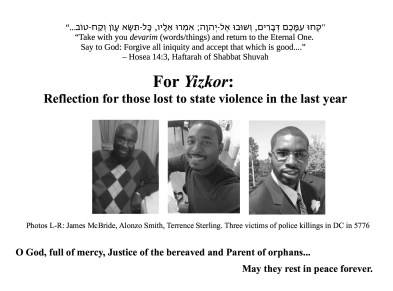
The following prayer, prepared by Virginia Spatz and Rabbi Gerry Serotta, was offered for use during the Yizkor (Memorial) service Yom Kippur, the Day of Atonement, 5777 at Fabrangen Havurah. It is based on the yizkor prayers of several different Jewish traditions, relying strongly on the notion that acts of tzedakah [righteousness, sometimes translated as “charity”] perpetuate the names — “bind up in the bonds of life” — of the deceased. (jump to PDF version)

For Yizkor:

Consider this reflection for those in our neighborhoods lost to state violence in 5776

yizkorpolicebrutality As we endeavor to return to the Eternal One in these Days of Awe — and into the new year — we carry with us connections to those killed by violence perpetrated in our name in our own country. Among iniquities for which we beg forgiveness is failure to stop police killings, disproportionately affecting the black- and brown-skinned among us, or to address the underlying systemic racism. In this season of return, we ask God to accept our pledges of renewed examination of state power, including militarization of police, and of renewed commitment to human rights for all.

In this Memorial Service, we recall three unarmed black men killed by police in the District last year, along with six other black citizens, and no one of another skin color, killed by police in DC during 5776:

  • James McBride, 74, Sep 29, 2015.
    Unarmed, leaving hospital without signing out. Killed by MedStar Special Police. Death ruled homicide.
  • Alonzo Smith, 27, Nov 1, 2015.
    Unarmed, unexplained circumstances. Killed by Blackout Special Police. Death ruled homicide.
  • Terrence Sterling, 31, Sep 11, 2016.
    Unarmed, shot contrary to protocol/orders. Killed by Metropolitan Police Dept. Death ruled homicide.
  • Marquesha McMillan, 21, Oct 26, 2015.
    Armed with a gun. Killed by Metropolitan Police Department.
  • James Covington, 62, Nov 2, 2015.
    Armed with a gun. Killed by Metropolitan Police Department.
  • Darick Napper, 34, Nov 19, 2015.
    Armed with a knife. Killed by Metropolitan Police Department.
  • Peter John, 36, Feb 1, 2016.
    Armed with a toy gun. Killed by Metropolitan Police Department.
  • Sherman Evans, 63, June 27, 2016.
    Armed with a toy gun. Killed by Metropolitan Police Department.
  • Sidney Washington, Jr., 21, July 4, 2016.
    Part of a July Fourth crowd shooting off fireworks and firearms. Killed by Metro Transit (Special) Police.

O God, full of mercy, Justice of the bereaved and Parent of orphans , take special notice of those lost to state killings in our own country. Master of compassion, shelter under the shadow of Your wings those whose lives ended in violence, often fueled by racial injustice. Grant proper rest for the souls of all who went to their eternal rest through such killings.

May these moments of meditation strengthen the ties linking this community with our most vulnerable and troubled members. I pledge tzedakah/charity to address racial injustices contributing to these deaths. Through such deeds, and through prayer and remembrance, may the souls of the departed be bound up in the bond of life. May they rest in peace forever.

Here is a printable PDF with DC losses included [yizkorreflection5777]
TOP

“Let us search and try our ways”: Trouble to See prelude

The lowest point of the Jewish calendar, the day of mourning known as Tisha B’av, commemorating destruction of the Temples and other calamities, calls us:

“Let us search and try our ways, and return to the LORD” (Lamentations 3:40).

As we move on from this day, through the season of repentance and beyond, I invite Jews — and others interested — to join me in an effort to “search and try our ways,” looking closely at the ways in which race has formed our lives and the life of this country so that we might build something new.

Here is my beginning, with resources and background —

Trouble to See #1: Expelling Creases from the Fold

Trouble to See #2: Beyond Central Casting

Trouble to See #3: Beyond the Romance

Trouble to See #4: Peeling Back Some Tricky Layers

Trouble to See Related Resources

Trouble to See #4: Peeling Back Some Tricky Layers

MicahNext6
Peeling back another layer….

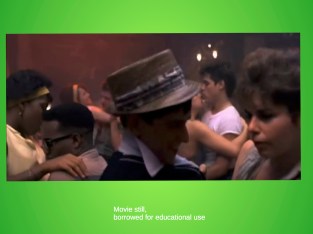
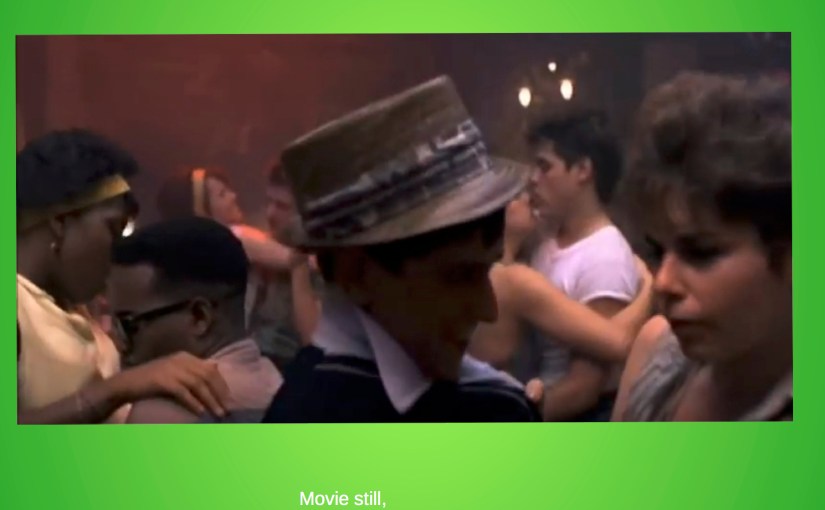
A few more layers of racial-justice-related issues to peel back in taking “Trouble to See,” using the fictional world of “Dirty Dancing” as an aid (see “Beyond the Romance“).

Consider that the integrated dance floor — where  non-Jewish staff mix after hours — is moving to Otis Redding, The Contours, and other African American performers. We know – even if the young dancers don’t yet – that white performers will achieve far more financial and popular success with versions of the same music adapted for white audiences. In the main ballroom, the mambo and meringue are all the rage (topic for another day, perhaps.) And so, if we look more closely at the dance floors, we might notice the fine line between cultural sharing and cultural appropriation.

We know, too — from our vantage point in 2016 — that prominent among the promoters of black music will be Jews, sometimes recognized as supporting important black music and sometimes seen as using black music to support themselves. See, for example, varying views on the earlier history of Chess Records as well as later involvement of Jews in soul and other music genres.

Here is just one contemporary remark, illustrating a common viewpoint, from a website devoted to hip hop music:

And the sad truth is that rappers might be rich while they are hot, but Jews and other white men that own the labels (and thus own the music) continue to stay rich after the rappers have faded off the scene.

The Civil Rights movement did not address these dynamics. Focusing on marches and sit-ins of the 1960s does not give us a perspective that is wide or deep enough to help us consider the complicated history of Jews and Racial Justice.

A Deeper Layer

At least from the early 20th Century, mainstream, White press and popular sentiment railed against music considered too sexually explicit and encouraging of inappropriate behavior in its fans. The story was repeated with ragtime, blues, jazz, rock and roll, up through hip hop. At each stage, what White people performed on stage and did on the dance floor was eventually accepted, while “Black music” was continually viewed in many quarters as retaining some “jungle” element:

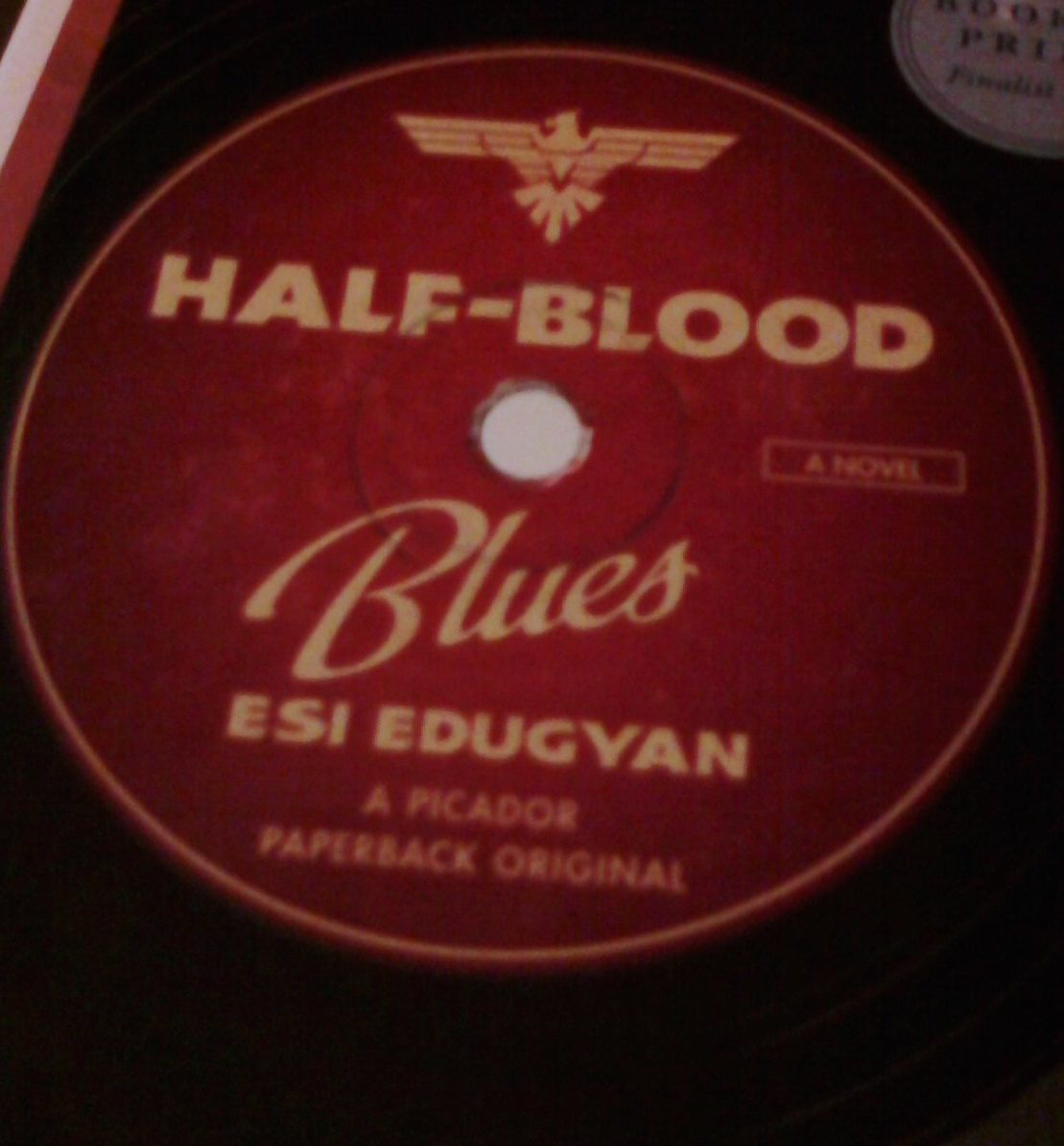
“Jazz. Here in Germany it become something worse than a virus. We was all of us damn fleas, us Negroes and Jews and low-life hoodlums, set on playing that vulgar racket, seducing sweet blond kids into corruption and sex. It wasn’t music, it wasn’t a fad. It was a plague sent out by the dread black hordes, engineered by the Jews. Us Negroes, see, we was only half to blame – we just can’t help it. Savages just got a natural feel for filthy rhythms, no self-control to speak of. But the Jews, brother, now they cooked up this jungle music on purpose. All part of their master plan to weaken Aryan youth, corrupt its janes, dilute its bloodlines.

“…we was officially degenerate.

“…And poor damn Jews, clubbed to a pulp in the streets, their shopfronts smashed up, their axes ripped from their hands. Hell. When that old ivory-tickler Volker Schramm denounced his manager Martin Miller as a false Aryan, we know Berlin wasn’t Berlin no more. It had been a damn savage decade.”
— Sid, Black musician narrator, in Half-Blood Blues by Esi Edyugan (NY: Picador, 2011), p.78-79

Half-Blood Blues is set in Germany, but the illustration of how Jews and Blacks were viewed in the 30s in Berlin has a parallel in U.S. history. As with many other groups of new immigrants to the U.S., Jews were once considered exotic, often hyper-sexualized degenerates. When the U.S. eagerly and legally classified people by race, Jews were non-White. The lynching of Robert Frank, a Jew accused of raping a “White” girl, in the early part of the 20th Century is part of that non-White Jewish history.

half-bloodThe view that Jews are involved in Jazz “on purpose,” while Blacks cannot help themselves, had parallels in the U.S. as well. Jews are occasionally still subject to this stereotyping in U.S. mainstream press and public opinion. It is all too common still, in 2016, in White Supremacist comments, including some from current candidates for office. But Black people in 1963 regularly faced this kind of stereotyping – still do in 2016 – and this has dangerous repercussions in everything from housing to education. It has particularly deadly ramifications in policing.

The related image of Black youth as part of a “thug life,” promoted by the hip hop industry, benefited and still benefits quite a few people outside black neighborhoods, non-Jews and Jews, who do not live with the consequences of that image in their daily lives.

Related References

Collis, John. The Story of Chess Records. NY: Bloomsbury, 1998. See also 4-part YouTube series called “The Chess Records Story”

Stratton, Jon. Jews, Race, and Popular Music. Surrey, England: Ashgate, 2009.

White, Miles. From Jim Crow to Jay-Z: Race, Rap, and the Performance of Masculinity. Univ. of Illinois Press, 2011.

Whitfield, Stephen J. American Space, Jewish Time: Essays in Modern Culture and Politics. North Haven, CT: Archon Books, 1988

and a few notes:
Half-Blood Blues stands on its own as literature and entertainment. It’s also a great opportunity to turn the neck, getting perspectives — from a black woman writer (from contemporary Canada) describing the lives of black musicians in Berlin in the 1930s — we might otherwise miss. This particular story also gives us a non-Jewish narrator, a Black man at risk for reasons unrelated to Jewish heritage, relating the rise of the Nazis from a vantage point we don’t often see.

The novel touches on the history of Rhineland Bastards. Learn more at USHMM, the U.S. Holocaust Memorial Museum website.

Trouble to See #3: Beyond the Romance

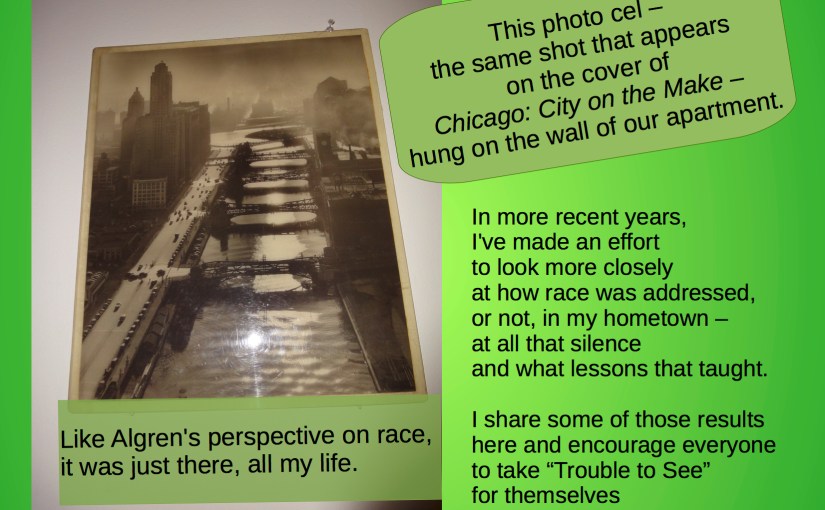
I never visited the Catskills in the heyday of Jewish resorts. But Eleanor Bergstein’s portrait of one liminal summer there reflects something essential in my own experience, albeit in a non-Jewish neighborhood of Chicago, and in the story of “Jews and Racial Justice.” Thus #3 of “Trouble to See,” my singular excursion — with background and resources — into the topic of Jews and Racial Justice.

I do realize that many viewers actually enjoy the movie, “Dirty Dancing,” for its dance and music and love story. (I don’t think anyone loves the plot-line about the dancer facing a life-threatening, illegal abortion – although it represents another important a chapter in our history.) But I am pretty sure that Bergstein and I are not alone in also holding a soft spot in our hearts for a time when, as she puts it, “you could reach out your hand, and if your heart was pure, you thought you could change the world forever.”

Beyond the Catskills

The Chicago school boycott of 1963 is less well-known than other events of that year in the Civil Rights movement. But it illustrates a great deal about the Chicago of my youth, organization in the Black community to achieve equity, and efforts in many quarters to create positive change that would work for all residents and all neighborhoods.

Nevertheless, Chicago remained one of the most hyper-segregated cities anywhere, with powerful color lines as well as lines between areas welcoming to Irish and Italian, Lithuanian and Ukrainian residents, etc. Sociologists at the time called the neighborhood change we experienced “invasion-succession.” There may be a less war-like term for it now. But it was pretty devastating for all concerned:

Near my home, Urban Renewal razed one whole commercial strip, replacing it with rubble and a sign that read, “Courtesy: Richard J. Daley, Mayor.” They eventually put up a senior citizens home, at that point isolated from pedestrian traffic and with virtually nowhere for residents to walk. A few blocks away, the Arson Squad was kept busy while owners of another commercial strip bailed. In the same time period, we later learned, the Chicago Police Department’s “Red Squad” – organized decades earlier to root out communists and others they considered subversive – infiltrated the Organization for a Better Austin, which, along with the rival Town Hall Assembly, was supposedly attempting to create a stable, integrated neighborhood.

There were more than 80, mostly White, students in our class in first grade. We graduated with 24 students, a very different mix of kids, and we were the last graduating class of the school. Despite many community meetings, the Archdiocese of Chicago decided not to prioritize neighborhood stabilization, instead closing first the local high school and then the elementary school, where I was a student, followed shortly afterward by the church. Patterns similar to this were seen in places like Philadelphia when synagogues fled the city.

Beyond the Romance of Civil Rights

All of the above made for a pretty wild ride in my first 14 years on the planet, as my family remained in the same apartment while everything changed around us. Eventually, our landlord decided to sell, and – after exploring affordable options inside the city – we moved a mile west, to the village of Oak Park. The whole thing left me with pretty dim views of every major institution charged with promoting the common good. And also with some very particular ideas about how racial integration does and does not work — and what it can and cannot accomplish.

I retain a deep affection for that brief sliver of struggle-filled, yet hopeful, time – when we thought a better, racially just world was right around the corner. As grown-ups, though, I think we have a responsibility — “we,” meaning here “White” people, in general, and Jewish communities, in particular — have to look beyond any romantic views of Civil Rights. We have to admit that, exciting as that season might have been, full of possibility and hope, we let ourselves ignore some of the realities. And, even though we probably couldn’t have known any better then, now we must look seriously at what has transpired since then and ensure that we make different choices today, ones that work for all parties involved.

In the meantime, regardless of past history and how it evolved, economic and political equity did not appear. As a journalist covering two of the poorest wards in the city,  both predominantly black, I can testify that whole areas of the District  have been been short-changed for generations on education, housing, and employment opportunities while being over-policed and over-incarcerated.

So, I want to go back to the fictional Catskills and take the trouble to see a little more carefully.

Continued in “Trouble to See #4”

Trouble to See #2: Beyond Central Casting

further thoughts and references on Jews and Racial Justice….

from PBS program on Ethiopian Jews

“Bernie Sanders Looks Like Everyone’s Jewish Grandpa…,” read a headline on the Jewish Daily Forward website earlier this election season. But Sanders doesn’t look anything like these Jewish men, some of whom are probably grandpas, or like many Sephardic grandpas. He doesn’t look like the grandparents of many Jewish children in the United States. Bernie Sanders looks like Jewish grandpas from only one part of the world.

The blurb was meant to be cute, sure, but it still promotes an extremely limited view of who “looks Jewish.” (Sadly, the Forward lets the same sloppy “Jewish looks” idea inform news stories as well.) This, in turn, helps validate widespread challenging of anyone who doesn’t look like “a Jew” Central Casting might send.

Jews of color, in particular, report being frequently singled out and questioned about their background — despite that fact that this is contrary to a number of Jewish teachings.

This is just one way in which Jewish communities have work to do, more than most of us would like to admit,
in the area of racial justice.

(How) Are You Jewish?!

Not all Jews of color are Jews by choice. But the Talmud’s specific stress on not embarrassing a proselyte or child of a proselyte (Baba Metzia 58b) seems apropos. As does Jewish law forbidding differentiating between Jews by choice and Jews by blood (see, e.g., Yebamot 47b).

More generally, Jewish tradition teaches “verbal wrongs”
are more serious than monetary ones
and that shaming a person in public is the same as shedding blood
(Baba Metzia 58b, again).

It is sometimes argued that people are “merely curious” and not attempting to shame a person who looks “different.” But this ignores what Jews of color, and others who don’t necessarily resemble Ashkenazi Jews, have repeatedly said: Being harassed with demands to explain yourself and your connection to Judaism is not welcoming; it is exhausting to be singled out all the time and demoralizing to have one’s identity challenged.

Micah810_53Michael Twitty, an African American Jew, describes how other Jews regularly question his presence in Jewish space and often demand: “Were you born Jewish?” (Jews United for Justice “Racial Justice Seder“)

MaNishtana, “100% Black, 100% Jewish, 0% Safe,” has his identity challenged so often, he says, that he finally penned a book entitled Fine, thanks. How Are You, Jewish?

In her famous poem, “Hebrew Mamita,” Vanessa Hidary speaks about a man complimenting her with, “You don’t look Jewish. You don’t act Jewish.” Eventually, she develops this  response:

Bigging up all people who are a little miffed
‘cuz someone tells you you don’t look like
or act like your people. Impossible.
Because you are your people.
You just tell them they don’t look. period.
listen here

Jewish Diversity and Racial Justice

One organization that has been working for years to “foster an expanding Jewish community that embraces its differences,” is Be’chol Lashon: In Every Tongue. Among their offerings are research, resources, and diversity-celebrating materials.

Recognizing and celebrating diversity within Jewish communities also means addressing the discrimination and risk that fellow Jews face because of their color. See, e.g., “#MyJewish and Why It Matters.” This is another crucial element in the story of Jews and Racial Justice. (more soon)

NOTE

The same publication has made factual errors in the past based on assumptions about who “looks Jewish.”
BACK

Trouble to See #1: Expelling a Crease or Two

[updated 8/15] At the invitation of Temple Micah‘s Lunch and Learn program (8/10/16), I shared some thoughts about Jews and Racial Justice. I appreciate the opportunity. As promised, I offer the references cited for anyone who wants to explore further: Jews and Racial Justice reference page. I also include below a link to the SongRiseDC rendition of Ella’s Song (from Ella Baker & Sweet Honey and the Rock) that I was unable to share during the talk.

And just to clarify: I share in these “Trouble to See” posts some views which are not my own, for purposes of learning and discussion. But nothing here is the view of Temple Micah.

Skip ahead:
Expelling Creases from the Fold
Trouble to See

Through this talk, I succeeded in annoying a number of people — including myself — for a whole variety of reasons. (I’d like to think that’s some sign of success, given the topic.) At best what I shared can only be the beginning of a long, complicated — and, ultimately, very difficult — conversation.

Trouble to See

We began this afternoon, and I hope we can all continue exploring, with the idea of taking “trouble to see,” based on commentary about Moses at the Burning Bush.  MicahTrouble1


Here’s the commentary —


and the questions I hope we can ask, as we look back on what we think we know about race and racial justice:MicahTrouble2

This is the original post, from 2015, exploring the idea of taking “trouble to see” following the death of Walter Scott.

BACK

Expelling Creases from the Fold

Creases

As part of this exercise in turning the neck, taking “trouble to see” aspects of our past experience in new light, I shared a portion of my memoir/essay, “Skins,” which will appear in the forthcoming Expelling Creases from the Fold, an anthology published by Liberated Muse Arts Group. Thanks to Liberated Muse for allowing me to share this material in advance of its publication.

Here’s a link to the full talk. The reading of “Skins” begins around minute 18:00. (Not the best quality video, sorry. Looking forward to the anthology!!)
BACK

Ella’s Song

Sorry I could not share the SongRise version of “Ella’s Song” during the lunch today. For all in the room today — and anyone else who does not know “Ella’s Song” — as SongRise’s Sarah Beller explains in her introduction: The lyrics are words of Ella Baker, one of the founders of Student Nonviolent Coordinating Committee, and the music was created by Sweet Honey and the Rock.

Last note: the SongRise video cuts off mid-way through their second powerful number, “A Change is Gonna Come.” more on that later…
BACK

Matot: Heavy Tongue, or the House of Cards theory of bible study

I want to begin by acknowledging my teacher, Max Ticktin z”l, for whom the period of shloshim is coming to a close and whose connections to Temple Micah are more varied and interesting than I knew before he died. Max taught me — and others in several generations — a lot about who is and is not an enemy, of ourselves personally and of the People Israel.

Dvar torah on parashat Matot, Temple Micah 7/30/16

These remarks focus on the story of vengeance, Numbers 30:1ff. This is an odd and troubling story in many ways. I chose to study it, in part because I worry about the consequences of failing to examine the uglier parts of our tradition, and in part because its very oddness makes it interesting.

A few odd things

One odd thing is that we are told Pinchas was the priest of the campaign, but we are not told who the military leader was.

Another odd thing is how the otherwise terse story stops to tell us that Pinchas brought the “holy utensils” — which many commentators believe means the Ark — and the shofar. This makes the whole thing sound terrifyingly like something out of “Raiders of the Lost Ark” (Paramount 1981) or any of our contemporary wars that make use of religious iconography to wreak havoc on perceived enemies.

It seems to me — although I didn’t find commentary saying this, exactly — that the religious details, the priest, the holy utensils, and the shofar, hint at the spiritual aspect of the story. However distasteful and scary most of us find this today, the idea that a war should be fought to kill some people in order to preserve other people’s spiritual health, that was a part of biblical storytelling.

Midianites and Moabites, Balak and Pinchas

The Torah and many commentaries are clear that this whole issue with the Midianites is a war on people who tempted the Israelites into idolatrous behavior. We might think (and many commentaries remark) that the problem would be with the Moabites because it was the Moabites with whom Israel engaged in harlotry and idolatry in what is called here “the matter of Baal Peor.”

Back at the close of parashat Balak, we are told that Israel became “attached to Baal Peor and the wrath of God flared up against them” (citation). Moses and the judges had just ordered the Israelites to turn on one another and kill men attached to Baal Peor when the Israelite male, Zimri, and the Midianite female, Cozbi, perform what is generally understood to be public sex acts at the Tent of Meeting. Then Pinchas runs them through with a spear, stopping a plague we had not been told was happening. Just the one Midianite, Cozbi, is mentioned there. But both nations collaborated in hiring Balaam to curse Israel. So perhaps they were collaborating in the incidents involving Baal Peor, too. However it came to be, God told Moses back in chapter 25, at the start of parashat Pinchas, to harass [tsaror] the Midianites and kill them because they had attached [tsorerim] Israel “through the conspiracy against you [the Israelites] in the matter of Peor.”

Hasidic commentary says this harassing is a sort of eternal command, because the temptation to the Israelites will persist. The idea is that once they have tasted debauchery, it will be impossible to keep desire from arising again. So Israel must now be eternally harassing those who harassed them with temptation.

If the Israelites could have been warned some other way to be eternally vigilant to stop evil urges in themselves, we might have an easier time with the lesson. But that is not what Or HaChaim teaches, and that is not how the Torah text unfolds. Instead….

God tells Moses to harass the Midianites in chapter 25. And then we have a census and some legal material, a list of offerings, and a long treatise on vows. After all that, here in chapter 31, God tells Moses to take vengeance — now the verb is different, nekom –against the Midianites.

This is another odd bit and one of my favorites.

Another odd thing

Back when the whole mess started, we have a break between portions introduced right at the height of the Baal Peor matter. Israel’s idolatry and the incident of Zimri & Cozbi ends parashat Balak. Pinchas is rewarded for his action that stops Cozbi & Zimri in the next portion. And that’s where we see the command to harass Midian, at the start of parshat Pinchas.

The portion break suggests that the story was just too far out of control and the Rabbis wanted to cool things off….This is a very famous break, often discussed in the commentary. For more, see “Pinchas and the scary friend….But that’s a later, conscious choice of how we are to read and learn this text. The Torah itself inserts the five-chapter break between the precipitating events and God’s call for harassment, on the one hand, and, on the other hand, this episode of vengeance.

Moreover, we have so many odd things in both places. Pinchas acts to stop a plague that is not mentioned before it stops. Moses and God speak of a conspiracy against the Israelites involving sexual misconduct. But the only conspiracy we’re told about in the text is the one to hire Balaam to curse the people. Balaam is blamed (in commentary and in the text here) for whatever sexual acts and idolatry are happening, even though the last we heard of him, he went home after blessing Israel with words we still celebrate every morning in the prayers. (See, e.g., “Balak prayer links”.)

Missing Bits

I think the missing bits and the halting way the story is told suggest a struggle — with facts, perhaps, or with feelings and ideologies that lead to death and disaster. If we take nothing else away from this, I believe the Torah wants to ensure that conspiracy and war and people turning on one another is not read smoothly or accepted easily.

Avivah Zornberg, the brilliant and very Freudian teacher of Torah, believes the Torah itself has an unconscious that is suppressing trauma. (See The Murmuring Deep, citation coming). I’m not sure I buy her whole theory, but I do think we should listen to the pauses and the stuttering and the weird missing bits as closely as we listen to the story tht reads more easily… maybe more closely.

Midianites: enemies?

And meanwhile Moses, who argued with God so many times before has nothing to say in the text in support of the Midianites who protected and nurtured him in his youth. Nothing to say about his extended family and the legacy of Jethro, his father-in-law, who contributed so much to his own learning and helped Israel set up a judicial system.

It’s not much of a surprise that we don’t hear from Zipporah, as we rarely hear from women, even ones who face down God to save their husbands from death (see the “night incident” at the inn in early Exodus; citation coming). But Moses has nothing to say on her behalf?

We’re not the first generation to notice the oddness of this incident and Moses’s close connection to Midianites. Early commentary says that is why, although God tells Moses to exact vengeance, Moses sends others and stays back himself. Of course, this says nothing about the fact that he lets it happen, anyway, even appears to orchestrate it; it also discounts the fact that Moses is quite aged here and perhaps unable to command in battle.

But the interesting point to note, I think, is that Numbers Rabbah acknowledged the relationship between Moses and Midian, and tries to address how hard it all was and how thoroughly entangled were all the players here.

The contemporary biblical literary teacher Robert Alter says this about Baal Peor in chapter 25:

The Israelite attitude toward its neighbors appears to have oscillated over time and within different ideological groups between xenophobia, a fear of being drawn off its own spiritual path by its neighbors, and an openness to alliance and interchange with surrounding peoples.

–Alter’s Torah commentary

In reference to this passage in chapter 31, he says:

Either two conflicting traditions are present in these texts, or, if we try to conceive this as a continuous story, Moses, after the Baal Peor episode reacts with particular fury against the Midianiate women (not to speak of all the males) because he himself is married to one of them and feels impelled to demonstrate his unswerving dedication to protecting Israel from alien seduction. But it must be conceded that the earlier picture of the Midianite priest Jethro, Moses’s father-in-law, as a virtual monotheist and a benign councilor to Israel does not accord with the image in these chapters of the Midianite women enticing the Israelits to pagan excesses.

One more possibility comes to mind….

House of Cards theory of bible analysis

Maybe there was a conspiracy involving Balaam and the Midianite kings but orchestrated by some other entity for reasons of their own, some kind of House-of-Cards-type plot to discredit the Midianites and turn Israel against them — or to make us believe Midian and Israel were enemies and would always be. Maybe the plot was so successful that Moses turned against his own earlier supporters because of it, so successful that the narrator can make us believe the story really moves from “go kill more people to undo you own spiritual troubles” to instructions for how to become ritually clean after carrying out more vengeance. But whichever Frank Underwood was behind the plot is no longer available — to look  us straight in the eye, breaking the Torah’s fourth wall, so to speak  — and confess what’s really going on and why, or to at least offer another version of the truth.

This is not too different from Zornberg’s unconscious theory. Because they both boil down to the fact that the Torah itself cannot say, maybe no longer knows, what caused the People to lose their spiritual way and then turn on neighbors and allies in an attempt to cope, make some sense of it.  But the Torah is still able to tell us in its stuttering way, full of missing bits and confusion, that the tale is maybe not as straightforward as it might sometimes be portrayed, that vengeance is not a simple matter with a clear beginning and end, that it’s not something that ends well…or even ends:

In the middle of his rant to the leaders for not killing enough, Moses is somehow back to a lecture on ritual purity after touching the dead. And we are not told at this point if his ranting instructions were carried out (and we know from later stories in Tanakh that there are plenty of Midianites still in the land).

A heavy tongue returns

It occurred to me late in preparing these remarks that perhaps the rambling and stuttering of this story is related to what Shelley Grossman described here about Moses a few weeks ago: his aging and use of an old playbook and how he no longer has his siblings at his side. Remember, too, that Moses tried to refuse the Exodus mission, back at the Burning Bush, by telling God he was “heavy-mouthed” and “heavy-tongued” (Alter’s words). At the time, God told Moses not to worry because Aaron could speak. But now, Aaron and Miriam are gone and we have, instead, Pinchas — Aaron’s grandson whom we first meet when he is in the middle of a violent act, committing a killing that we are later told is part of a covenant of peace.

So maybe what we witness here is a story that is moving forward under emerging leadership but related by a man who has reverted to heavy-tongue, reporting to us that his own demise will follow on the heels of vengeance on people he once knew as family and fellow monotheists. Maybe it’s a kind of last gift to Moses — and to us — that the old, heavy-mouthed stuttering voice comes through to warn us that no such tale can be told without stumbling and missing bits.

NOTES

Max David Ticktin (1922 – 2016)

There are many on-line obituaries and memorials to Max. My favorite is this one by Rabbi Arthur Waskow. And in the way of such things, I was carrying the Torah through the Micah congregation just a few days after Max’s funeral and, even though Max did not attend services at Micah would not have been there to touch me with his tzitzit, I found myself equal parts profoundly sad at the knowledge that we would all be missing his touch and deeply grateful for the myriad ways he had already touched so many of us.

BACK

The Torah Portion

The Torah portion Matot is comprised of Numbers 30:2 – 32:42. Temple Micah is following the schedule of readings used in Israel and, therefore, one week ahead of many congregations in the diaspora at this point in the calendar.
BACK

Counting and Community Gun Violence

This past Thursday, June 2, would have been Hadiya Pendleton’s 19th birthday. She was killed before her sixteenth in a Chicago park on January 29, 2013 – making news at the time because she’d just returned from performing in Obama’s second Inaugural Parade.

That spring, Hadiya’s classmates at King College Prep started a nonviolence effort, known as Project Orange Tree, in her memory. That evolved into #WearOrange for Gun Violence Awareness Day, now observed nationally on June 2. In the spirit of this awareness day, I offer a glimpse into the world of Hadiya and the three friends who were with her when she was shot,  taken from a 2013 Chicago Trib article:

Kyra

The next day, Kyra was back in gym class. As always. The teacher was taking attendance. As always.As he proceeded through the alphabet toward the P’s, she wondered: Would he call Hadiya Pendleton?

When he didn’t, students cried.

…And like the rest of Hadiya’s friends, Kyra counted the Tuesdays since Hadiya died.

Tuesday, week one.
Tuesday, week two.
Tuesday, week three…. ….

Danetria

…For years, [Danetria] had fought depression.

“If you do run away,” Hadiya promised, “you can come to my house. I can tell my mom the whole situation, and she’ll understand.”

With Hadiya gone, Danetria wondered, “Who am I going to talk to now?”

….A month after Hadiya died, Danetria turned 16. It was coincidentally, Tuesday, week four. No balloons, no sweet 16 cake, just a quiet birthday dinner with [her boyfriend] Lawrence and his mom…. ….

Klyn

…Over the next few weeks, [Klyn] wrote letters to Hadiya in a notebook.

One day, bored in math class at [her new school], she was writing a letter when she started to cry.

“What’s wrong?” her classmates asked. If she were still at King, she thought, they’d know.

She wrote letters to the two young men charged in the killings, too. She told them she feels bad for them, bad that they have been so warped by a system that would make them think killing was OK.

She never sent the letters, and she lost the notebook, but it felt good to lay her anger and confusion out on the lined pages.

The Tuesdays passed, her loneliness didn’t…. ….

Conclusion/Citation

…[The three teens no longer saw each other regularly when they met up in spring 2013.] It was, coincidentally, the 13th Tuesday after Hadiya’s death, but they don’t count Tuesdays so much anymore. They count months. Monday made three months.

— Jennifer Delgado, Bridget Doyle and Mary Schmich
much more in the thorough Tribune article, including video links

The article’s time-counting motif seems fitting for the period of the Omer, when we enumerate the days and the weeks between Passover and Shavuot. June 4, for example, was 42 days of the Omer, making six weeks. Some would also call it the day of malchut b’yesod — translated as something like “nobility in bonding” — based on a mystical counting system.

Similarly, the losses associated with Hadiya’s death were reckoned in small and large ways – in gym class and in long-term desolation — as well as in ways harder to express.

“That bullet did a lot more than just kill my baby,” Cleopatra Cowley-Pendleton has said.

But we can also count the ways, small and large and harder to express, that Hadiya’s bright spark continues to inspire conversation and thought, prayer and action. The toll of shootings like Hadiya’s — psychologically, economically, educationally, and otherwise — is staggering. But the blessing of her memory is enormous, too.

Learn More, Connect

Remarks given at Temple Micah (DC), June 4, 2016
See also 2013 post and yahrzeit remarks 2014
Visit Hadiya’s Promise for more on the Pendleton’s work
See “OrangeOut: Race and Gun Sense” for more on Project Orange Tree and the need for community-sensitive responses to gun violence
See also  Community-Sensitive Gun Sense
Resources: Holistic Approaches and People of Color

Confronting Jackals of Injustice

“Who will confront the wickedness of all the raw racial hatred marinating in this free land?” asked Rev. T. Anthony Spearman during the North Carolina Council of Churches recent “Seminar on Race, Power, and Privilege.” The powerful sermon begins with a text from 2 Samuel 21: When her sons and five other men are subject to an extrajudicial execution and left without burial, Rizpah mounts a single-handed protest. She maintains a vigil for six months — “risking her own safety and sanity,” as Rev. Spearman describes it — until King David is finally moved to order proper burial for all seven men.

“Back around 9th Century BCE, [Rizpah] would have been my choice for mother of the year,” Rev. Spearman declares. “In all of antiquity there may of a certainty be none as devoted, radical or courageous.” He elaborates:

In her world, she had no authority. Hers was a voiceless life. She was devoid of power…a victim of what seems to be this nation’s cherished legacy, the hierarchy of human values that are known as …classicism, sexism, and racism.

detail of 1875 painting by George Becker. See, e.g., Heroines of the Bible in Art (1900)
George Becker, 1875 (Detail). See, e.g., Heroines of the Bible in Art (C. E. Clement, Boston, 1900)

Allan Aubrey Boesak says this mother does what she does — risks, resists, and reconciles an entire nation — all by her lonesome and silent self. She demonstrates how to truly beat a sword into a plowshare by doing justly, loving mercy and walking justly with her God.

…[Rizpah’s witness] is not dissimilar to that of Sybrina Fulton, Lesley [McSpadden] Brown, Samaria Rice..

From the beginning of the harvest til the rain fell down, her motherly heart was broken but her devotion was fully intact. For about six months R risks her safety and sanity to drive away the vultures of viciousness, the vultures of vulgarity, the vultures of victimization…. the jackals of injustice…

…although in anguish for the dead, her actions were on behalf of the living…only two of the young men were her sons, she fought on behalf of them all.
— from T. Anthony Spearman’s April 23 sermon (full sermon below)

Rev. Spearman notes that Rizpah’s story is not currently in Christianity’s common lectionary — it is also missing from annual Jewish reading cycles — and suggests its inclusion so that more people would be prompted to follow her example. Meanwhile, Rev. Spearman calls us:

Our times are in search of those with spirit of Rizpah, those who will rise up and do justice, love mercy and walk humbly with their God, those who will stand against the ones who keep making and upholding unjust laws.

Is there anyone willing to bend the moral arc just a little bit more?
Anyone willing to repent for the deaths of so many of our sons and our daughters?
Who will shoo the vultures away from the corpse of Michael Brown and Freddie Gray?
Who will discourage the jackals from ravaging the transgender body of Zella Ziona?
…demanding the repeal of House Bill 2?
Who will rise up and…confront the wickedness of all the raw racial hatred marinating in this land?

It’s time for us to confront racism. It’s time for us to confront privilege, it’s time for us to confront power.
— Spearman (full sermon in video below)                                                              NC Council of Churches’ Critical Issues Seminar: Race, Power, and Privilege

Six Months is a Long Vigil

Six months is a long time for the sort of vigil Rizpah kept: “Can you just imagine the gruesome scene with those seven blood-covered bodies…,” Rev. Spearman asks, offering graphic details and concluding with “and the noble Rizpah protecting them from the scavengers waiting to gorge themselves on those corpses.”

buttonSix months is also a long time for the sort of vigil Beverly Smith has been keeping: Alonzo Fiero (Zo) Smith, age 27, died in custody of DC special police officers (SPO), November 1, 2015, in confusing circumstances that included no criminal charges; his death was ruled a homicide with compression of the torso (SPO knelt on his back, for one example) a contributing factor. For six months, Ms. Smith has been demanding accountability for what happened to her son. And, just like Rizpah, and the mothers of many other victims of police brutality, Ms. Smith is demanding justice for others as well as her own child. She waits still.

On May 1, the sixth-month anniversary of Zo’s homicide, District residents joined Ms. Smith in a march and rally honoring his memory and demanding, in his name, community control of police. (Read about Zo’s case and his mother’s campaign in East of the River and the Washington Informer; learn about the Justice 4 Zo community)

And, of course, many parents and concerned community members — including some whom Rev. Spearman included in his sermon — have been keeping similar vigil in one way or another for much longer. (See, e.g., Listening to Voices of Grief and Struggle.) Many of those involved in these struggles have joined together in groups like Mothers Against Police Brutality and Coalition of Concerned Mothers.

Where Were Rizpah’s Neighbors?

Rev. Spearman and Allan Aubrey Boesak, whom he cites, note that Rizpah accomplished what she did “all by her lonesome and silent self.” This rightly characterizes the bible story and highlights the power of one individual to make a difference. But it leaves open the question of what Rizpah’s neighbors were doing — or not doing — for the months she kept her vigil alone:

Did neighbors just shake their heads at Rizpah while going about their own business? Were most people too caught up in demands of their own lives to involve themselves? Or, perhaps, fearing to speak out against King David? Or, just maybe, were some of Rizpah’s fellow citizens working elsewhere, in whatever ways were available to them, in support of her protest? Did groups organize solidarity actions that didn’t make it into Second Samuel?

Rizpah’s example of solo action is inspiring and important. And I would hope that each of us answers, “I will,” when faced with Rev. Spearman’s query: “Who will rise up and…confront the wickedness of all the raw racial hatred marinating in this land?” But I also pray that none of us is left, like Rizpah, to face those “vultures of viciousness” or “jackals of injustice” alone.

LongworthRev. Spearman is incoming president of the NC Council of Churches and senior pastor of St. Philip African Methodist Episcopal Zion Church in Greensboro. He is active in the Forward Together Movement/Moral Mondays.

I had the honor of meeting and protesting with Rev. Spearman as part of a Black Lives Matter Die-In at the U.S. House of Representatives in early 2015.

BACK

April 22: 1968 and 2016

Who can say we’ve actually left Egypt?

poor_peoples_campaign_flyer_article
from the King Archive

April 22, 1968 was the original launch date for the Poor People’s Campaign. As we approach the beginning of Passover, on April 22, 2016, the very basic demands of 1968 have yet to materialize. Can your seder, or your Passover week, include some moments to reflect on how far we’ve (not) come in the last 50 years and consider how we might do better?

Here is a link to King’s remarks in the Campaign press release, a month before his assassination.

Here are some sources on the Campaign itself, which drew thousands to Washington, and included Resurrection City, erected on the National Mall in May:

A New Telling

In the 48 years since the Poor People’s Campaign, too little has changed, on the one hand. See, e.g: The Unfinished March and The Unfinished March: an Overview.

On the other hand, we have seen decades of generational poverty and violence and other oppressive conditions disproportionately affecting communities of color. And one thing which has changed in recent decades is the further development of Whiteness Studies, exploring the facts and impact of systemic racism.

Is there is room in your Passover and Omer practice for THAT maggid, for recalling — and telling the young or uninformed — how it is that Whiteness developed in this country and what it has meant? Follow #WhitenessHistoryMonth on Twitter, and see more below, for some bits to include.

Who can say we’ve actually left? “Wherever you live, it is probably Egypt,” Michael Walzer wrote.

…Do you live in a place in which some people are more equal than others? In America, the unemployment rate for African-Americans is nearly twice as high as it is for whites. Black people are five times as likely to be incarcerated as whites. Infant mortality in the black community is twice as high as it is among whites. America is a golden land, absolutely, and for Jews, it has been an ark of refuge. But it has not yet fulfilled its promise….
[Updated, additional statistics**]
…aren’t we still commanded to bring everyone out of Egypt?
New American Haggadah (Boston: Little, Brown, 2012)

Some generally related resources:
American Jewish World Service
Jews for Racial and Economic Justice

More coming soon. Please share your ideas and sources.

I believe the “Seeing White” album, with some #WhitenessHistoryMonth contributions is visible to all. (If not, I’ll work on other options.)


**Newer, and additional, statistics

Unemployment still nearly twice as high for black Americans as for whites (NPR), as noted in New American Haggadah. In fact, Black Americans with college degrees have higher unemployment that White Americans without a high school diploma (EPI).

Infant mortality among black families is still twice that found in white families, while Native Americans experience an infant mortality rate 150% that of white Americans. (CDC)

Black people in the U.S. are now SIX times more likely to be incarcerated as white people (NAACP), up from five times when New American Haggadah was published. The Sentencing Project finds similar disparity for Hispanic Americans. In addition, here is the growing disparity for U.S. school children:

For black children born in 1978, by the time they reached the age of 14, 14% had experienced a parent’s incarceration. For children born twelve years later, the rate rose to one quarter of black children witnessing a parent’s incarceration. The rate rose for white children as well – from 1% of white children born in 1978 having an incarcerated parent by the time they reached age 14 to 3% of white children born in 1990 experiencing a parent’s incarceration.
Education Town Hall

BACK