Interconnection and Stepping Away

An unusual incense, associated with the high holidays, calls us to recognize — and then to welcome and integrate — the more difficult aspects of ourselves and our communities. Many teachings focus on one of the ketoret‘s components, which is foul-smelling on its own but sweet-smelling in compound: Often this fact is used to call Jews to unity and to remind us that not only can we pray with the wayward among us, and within each of us, but we must. What do we do with this teaching as our institutions collapse around us and our communities struggle to find space for all?

This is part of a series on Summer of Collapse.

This post was substantially updated just before noon ET, following its first posting in the wee hours of Sep 9 (16 Elul 5785), including the addition of the “Seat of Compassion” section and a link to “Stepping Away in Hope and Prayer.”

A few basic texts regarding the ritual incense/ketoret, with its foul-smelling component, chelbenah, are below. Here is an exploration of connections with the season of teshuvah/return.

This Year’s Challenge

In her book, Sacred Therapy, Estelle Frankel describes connections between ketoret and Yom Kippur:

In the mystical tradition, the ketoret was understood to be a symbol of unity and interconnectedness within and among people. According to Jewish law, it had to be made from eleven different spices, including chelbenah, or galbanum. Though chelbenah itself is foul smelling, it was an essential ingredient of the sweet-smelling ketoret offering, for according to legend, when the chelbenah was joined with the ten other ingredients, it actually added sweetness to the ketoret’s sweet fragrance.

The inclusion of the chelbenah in the ketoret suggests that when we are joined together as a community, we atone for one another. Even the sinners and schleppers among us add to the perfection and fragrance of the whole. In commemoration of the chelbenah, on the eve of Yom Kippur prior to the chanting of the opening Kol Nidre prayer, Jews recite the following invocation, which formally welcomes the sinners among them to join in and be accepted back into the community: “With permission of God and the permission of the community, we hereby give ourselves permission to pray alongside the sinners.”

…so, too, according to this way of thinking, each of us must welcome and reintegrate our own inner chelbehah on Yom Kippur. In this interpretation the chelbenah is taken to symbolize the quality or part of ourselves that is least developed and least desirable–our shadow, if you will. To the degree that we deny or reject this part, it remains split off and becomes an adversarial force in our lives. The inclusion of the chelbenah among the sweet spices of the ketoret reaches us that we must integrate our weaknesses and vulnerabilities into the totality of our being. When we do, they can actually add potency to the sweetness of our lives.
— Estelle Frankel, Sacred Therapy: Jewish Spiritual Teachings on Emotional Healing and Inner Wholeness (Shambala, 2005). p.161-162

Much of Sacred Therapy‘s focus here is on self-forgiveness and integrating parts of ourselves that we may have been trying to ignore. But Frankel also addresses what the incense means for us in community:

The vital message…is that no part of the self, nor any individual community member, may be cut off from the whole. In order for us to come into our wholeness, all parts of the self must be held together as one. And when we join together as a collective, something greater constellates than the simple sum of individuals. Joined together, we atone for one another, for what one of us may lack another makes up for, and one person’s weakness may evoke another’s strength. In community, then, we find our wholeness and healing. On Yom Kippur, Jews cease to view themselves as isolated individual persons but as members of an interconnected web, a community in which each person takes responsibility for the sins of the collective….

Yom Kippur is a time when we each gather up the broken pieces of our lives–as the ancient Israelites gathered up the broken pieces of the first tablets–and try to reestablish a sense of wholeness and coherence both as individual people and as a community. Despite whatever has been broken or shattered through our own mistakes or fate itself, Yom Kippur, the day of at-one-ment, gives us a chance to heal and be whole once more.
–Frankel, Sacred Therapy, p.162-3

Trying to reestablish wholeness and coherence as a community is enormously challenging this year, for many reasons. Atonement and healing among Jews around Zionism and the state of Israel may not be possible at all at the present moment. Jews have much work to do, particularly at the new year, to clarify which “we” is meant in our prayers. We must grapple with how we are, or are not, responsible for one another.

The challenges are not small. And there is a strong temptation to cut off what or who seems to be impeding our attempts at coherence. (See also “Repentance, Repair, and Cancellation” and “The Predator’s Tools.”) But ejecting people or defining them out of the community is not necessarily the solution we might like it to be: As Frankel points out, cutting off parts of ourselves and our communities leaves an “adversarial force in our lives.” We might think we’re leaving something, or someone, behind, but our “broken pieces” do not simply disappear. Moreover, the collapse around us and the many pressures on us this year make mending more difficult….meaning we must exercise more caution regarding ruptures.

Coherence and Brokenness

Many “broken pieces,” within ourselves and our communities, result from harsh judgment in place of compassion. Through Jewish teaching, therapy examples, and meditations, Sacred Therapy explores the effort to move from judgment to compassion. (See e.g.,”Finding the Seat of Compassion.”) On the more general topic, she writes:

Unfortunately, many of us spend a great deal more time sitting in harsh judgment (din) than practicing compassion (rachamim) or forgiveness. We are more concerned with what’s wrong with ourselves and others than with what’s right. We obsess about our own imperfections and are all too ready to criticize our friends, family, and associates whenever they fall short of our expectations. When we get stuck in our “judging mind,” life begins to seem like an endless series of disappointments! And when we relentlessly judge and find fault with ourselves and others, we unfortunately often end up worsening the problems we think we are trying to remedy.


…when we support and lovingly care for those who are ill or suffering, we sweeten an experience that would otherwise be harsh and unbearable (din).

Similarly, when we find a way to transform situations of anger and discord between people into harmonious, loving connections, we sweeten the judgments.
–Frankel, Sacred Therapy, p. 188-189, p.196

Frankel notes that work to “sweeten” harsh judgment should not be expected of us when “someone is hurting us or taking advantage of us.” In such cases, she says, it may be necessary to “set firm limits,” instead, at least temporarily (p.197). And yet…

There are, however, many situations in our daily lives when we do have the power to “sweeten” things, particularly in relation to our own harsh judgments about ourselves and others. We also have many opportunities to transform angry and aggressive verbal exchanges into respectful, loving exchanges. We have the power to set the tone of conflicts so that our discourse with others is characterized by mutual compassion and empathy. And ultimately, when we succeed at transforming potentially contentious relations into mutually empathic exchanges, we open up the flow of divine rachamim in our own lives. For as the rabbis said, “According to the quality one uses to deal with others, by that very quality is one dealt with.”*
–Frankel, Sacred Therapy, p.197
*footnote references B. Meg 12b

In some cases, we will decide, at least temporarily, to separate ourselves, as individuals or as subsets of larger communities, from one whole in order to gain wholeness in another. In some cases, the quest for coherence might leave us feeling more torn and lonely than whole. The reminder of the incense, however, is that we actually need one another and cannot atone all alone.

Judging and Sweetening

We know from our own experiences, as well as from midrashic tradition, that pure judgment is not tenable in the long run. Breishit Rabbah 12:15 tells us: “At first God thought to create the world through the quality of judgment (din), but realizing that the world could not endure at this level, God added on the quality of compassion (rachamim).” And yet too many of our communal institutions, and too many of our community expectations are too willing to stay with “judging mind.”

Being quick to judge, while refusing to engage with dissent or difference, fosters a brittle, easily shattered collective. (Again, see We Will Not Cancel Us and discussion here.) Rules and procedures which discourage sweetening leave many, avoidable “broken pieces.” Sacred Therapy suggests that we can re-member the lost and broken bits; we can retrain ourselves to be more compassionate; we can return to ourselves. This is not easy for any individual and harder for a group. But the new year is a reminder that change is possible and that we can transform — or if necessary, step away from — a situation in which breakage is the norm and softening is not valued.

In that spirit, I share the personal, “Stepping Away in Hope and Prayer,” along with more general, warm wishes that we all find — through the final weeks of 5785 and the coming year — better ways to integrate the wayward among us, and within each of us, in our communities, our mutual aid, and our prayers.

Incense rising, just wisps of smoke, cropped from image by József Szabó from Pixabay

Incense rising cropped from image by József Szabó from Pixabay

Texts Regarding Ketoret/Incense

Exodus 30:34-35

And YHVH said to Moses: Take the herbs stacte, onycha, and galbanum [חֶלְבְּנָה, chelbenah]—these herbs together with pure frankincense; let there be an equal part of each. Make them into incense [קְטֹרֶת, ketoret], a compound expertly blended, refined, pure, sacred.

Midrash: Joy (not atonement)

The sin-offering is brought because of sin and guilt; the burnt offering is brought because of a thought in one’s heart; the peace-offerings are brought to atone for violations of a positive commandment, while incense [הַקְּטֹרֶת, ha-ketoret] is brought, not because of sin or transgression or guilt, but only out of sheer joy [ אֶלָּא עַל הַשִּׂמְחָה, elah ‘al ha-simchah]. Hence, Ointment and incense rejoice the heart.
–Midrash Tanhuma, Tetzaveh 15

Chelbenah in Hassidic teaching

Rebbe Nathan Sternhartz of Nemirov (1780–1845) on chelbenah (full text at Sefaria):

This concept of beirur of the good points also relates to the incense-offering, which included among its ingredients the foul-smelling chelbenah. The ketoret signifies finding and refining the good even in Jewish sinners, who are likened to chelbenah. This is similar to what Chazal teach, that “any prayer that does not also include the prayers of Jewish sinners is not a suitable prayer.” For the ketoret dimension of prayer is primarily fulfilled by finding and refining good points even in Jewish sinners, who are represented by the chelbenah.

This is also the significance of the ketoret being comprised of eleven spices—that is, ten spices aside from the chelbenah. These ten fragrant substances represent the Ten Types of Melody, the melodies made by finding and refining the good in Jewish sinners, who themselves signify the eleventh ingredient, the chelbenah.

–Likutei Halakhot, Orach Chaim (morning conduct) 1:5-6

Talmud: Wage Dispute

Babylonian Talmud Yoma 38a speaks of artisans who made the special Temple incense and a wage dispute in which less skilled artisans are brought in but cannot make the incense rise properly, so the original workers are hired back at twice the wage.

Finding the Seat of Compassion

For decades now, I’ve returned frequently to Frankel’s teaching, “Finding the Seat of Compassion,” and highly recommend checking it out and employing it. (Borrow a virtual copy from Archive.org, visit your local library, or get a copy from Bookshop.) Here’s part of the “Seat of Compassion” passage:

“…Whenever you notice that you are stuck in a place of judgment, whether of yourself or of someone else, try to imagine what it would be like if you stepped away from the judging position and viewed the same person or situation from the perspective of rachamim. You can try practicing this as a meditation in which you visualize these two qualities–judgment and compassion–literally as two seats. Imagine yourself getting up and moving away from that seat of judgment and sitting on the seat of compassion….

“…You will be surprised by how many opportunities there are in the course of an ordinary day to come from a place of compassion rather than judgment.”

— Estelle Frankel, Sacred Therapy: Jewish Spiritual Teachings on Emotional Healing and Inner Wholeness. Shambala, 2003. p.205

-#-

Luxury and Sin: A dictionary path

Is “living in luxury” the root of all “sin [chet]”?

The high holiday liturgy is filled with the word, “chet,” usually translated as “sin,” as in the prominent confession:

“For the sin we have sinned… […עַל חֵטְא שֶׁחָטָאנוּ, al chet sh’chatanu…].”

One root-meaning of chet is “[to miss], to fail, err, sin.” Archery metaphors abound this time of year. And considering how, where, and why we “missed the mark” is an important endeavor for the season. But rarely** are we asked to focus on another definition for the same root letters: “living in luxury” or “well-dressed, polished, cleansed.” Exploring the intersection of “luxury” and “sin” can be an important addition to our self-reflections.

There are plenty of resources out there for exploring the intersection of wealth, privilege, and “sin.” See this year’s Hill Havurah resources, for just one example. But here, as an offering for this season of return and repentance, is a basic exploration of the dictionary path less traveled.

**In fact, I don’t know of any such discussions and would appreciate any citations.


Please note: Geekier details appear further below, following an attempt at a more narrative approach.

Although this is my own exploration, this post was inspired by Elul studies at SVARA: The traditionally radical yeshiva, and by learning with Hill Havurah and sister organization, Mount Moriah Baptist Church.

Image is a pile of gold bricks. Photo by Pixabay on Pexels.com

Chet I, Chet II

The biblical lexicon, Brown-Driver-Briggs, has only one long entry for “chet,” based on the root “miss the mark,” with comparison to an Arabic word with a similar root-meaning. The Jastrow Dictionary, however, offers word has two separate entries for the same root-letters: The second (II) is the commonly cited “miss the mark,” and the first (I) is “to live in luxury, to be like a nobleman, to be well-dressed, clean &c.” based on a root-meaning “to stroll idly, saunter.”

The chet I entry is filled with references to midrashic texts that develop meaning through word-play and sound associations. (The full Jastrow entry can be found at Sefaria.)

The first example finds that “chet” means “purify” through a word-play around Leviticus 1:5 (sacrificial slaughter [veshacḥat] of a bull) with “cleansing” [chat] centered on a body part that bends [shach]. (See bend below.)

Examples of “chet” used to mean “to be gratified” and “to ask petulantly” are also explored. (See gratification below.)

An example linking “chet” with luxury centers on a midrash involving Abraham refusing gifts from the King of Sodom and Daniel refusing gifts from Balshezar. (See luxury below.)

The chet I entry does not offer straightforward grammar to explain the nature of sin in biblical or rabbinic thought. It does present a fascinating glimpse at rabbinic word-play over the centuries. And the mere existence of this entry offers food for thought on links between wealth and sin:

  • What can we learn from the examples of Abraham and Daniel rejecting wealth from rulers associated with excess and oppression?
  • Why did Jastrow include this speculative exploration here? And how can it help us this season of return, repentance, and repair?
  • With this entry as preamble to the one on “missing the mark,” what might we learn about how “living in luxury” and “being accustomed to comfort” affect our ability to hit the mark in all manner of thought and action?

Further exploration of the chet I examples follow, with some additional details also linked.

Luxury and Its Rejection

The chet I entry includes several citations to commentary on the Song of Songs, Shir HaShirim Rabbah. (Jastrow uses the Latin-based abbreviation “Cant.” to refer to the bible book [“Canticles”] and “Cant. R.” to refer to the midrash collection.)

Shir HaShirim Rabbah, dated roughly to 800-1000 CE, offers homelitical explanations for each phrase in the Song of Songs. To illustrate a reflexive form of “chet” as “to show one’s self a nobleman, to be generous, proud,” Jastrow references a midrash on Song of Songs 7:7, “How fair you are and how pleasant you are, love, in delights.”

The phrase, “love, in delights,” is explained with reference to biblical incidents involving riches:

  • Abraham refuses gifts (“excuses himself”) from the King of Sodom (Gen 14:22-23) after helping the king recover captured people and goods;
  • Daniel refuses gifts (“excuses himself”) from Belshazar (Dan 5:16-17), while providing him the service of reading “the writing on the wall.”

In each case, the biblical hero would have been expected to accept goods and recognition for services rendered. Refusing could seem insulting. In these instances, however, Abraham and Daniel are praised for doing so. The King of Sodom and Belshazar are associated, in their respective biblical stories, with a variety of excesses in their conduct and oppression in their rule. Abraham and Daniel stand in contrast. Their refusals to take “earthly delights” are understood as expressing love of God.

It seems clear that both the bible stories and the midrash hold Abraham and Daniel as righteous; it is less obvious (to me, anyway) how the midrash and grammar function: Who, in the midrash, exemplifies this sauntering show of luxury?

  1. Are Abraham and Daniel showing themselves as noble, generous and proud, that is, (avoiding sin by) rejecting luxury? OR
  2. Are the King of Sodom and Belshazzar showing themselves as noble, generous and proud, that is, (committing the sin of) flaunting luxury?

Abraham is clear and succinct that his rejection of the gifts is about NOT giving credit to the apparently generous King of Sodom:

I will not take so much as a thread or a sandal strap of what is yours; you shall not say, ‘It is I who made Abram rich.’ — Gen 14:23

Daniel’s response to Belshazzar is more complex:

You may keep your gifts for yourself, and give your presents to others. But I will read the writing for the king, and make its meaning known to him….
[to Belshazzar] You exalted yourself against the Lord of Heaven, and had the vessels of [God’s] temple brought to you. You and your nobles, your consorts, and your concubines drank wine from them and praised the gods of silver and gold, bronze and iron, wood and stone, which do not see, hear, or understand; but the God who controls your lifebreath and every move you make—[God] you did not glorify!
[Eventually, Daniel is given the gifts at Belshazzar’s command, and then Belshazzar is killed.]
— Dan 5:17, 23, [29-30]

While both Abraham and Daniel end up with riches at various points in their stories, cautionary elements remain in their tales and in Jewish commentary over the centuries. (See also “Belshazzar and the Wall.”)

The chet I entry offers opportunities to consider these tales in the approach to the high holidays or in other consideration of “sin” and what it means to “miss the mark.”

BACK to Chet I, Chet II


Gratification

The chet I examples for “being raised in luxury, being delicate” include more commentary from Shir HaShirim Rabbah as well as some from Kohelet Rabbah, commentary on Ecclesiastes dated to about 750 – 900 CE. In addition, this meaning is supported by citations to the Targum, Aramaic translation of the Torah, from the early centuries of the Common Era:

The man who is gentle [דְמֶחְטֵי, d’mechtei] and refined among you will look with evil eyes upon his brother, and the wife who reposes on his bosom, and upon the rest of his children who remain.
She who is delicate [דִמְחַטַיְיתָא, dimchatai’eta] and luxurious among you, who has not ventured to put the sole of her foot upon the ground from tenderness and delicacy, will look with evil eyes upon the husband of her bosom, upon her son and her daughter.
— Targum for Deut 28:54, 56

Worth noting, if only as evidence for complex interactions between the related words and their meanings, is the entry for the word, “chitui [חִיטּוּי, חִטּוּי].” It includes both the “cleansing, purification” and the “delicacy, luxury, enjoyment” meanings of chet, citing both chet I and chet II.

BACK to Chet I, Chet II


Bend

The chet I entry includes citation to a word-play around Leviticus 1:5 (sacrificial slaughter of a bull). Jastrow’s citation appears in a passage about kosher slaughter techniques for ordinary, non-sacrificial food (Babylonian Talmud, Chullin ([חולין], “ordinary”). The meaning “to make look well, polish, dress, cleanse, prepare” is derived from a play on the Hebrew for slaughter [veshacḥat]:

Slaughter is conducted “from the place where the animal bends [shach],” i.e., the neck; it is purified [chattehu] through letting the blood run out, “cleansing.” Additional citations are to Lev 14:52 (“v’chitei ha-bayit [you shall purity the house]…”) and Psalms 51:9 (“Purge me [techatte’eni] with hyssop and I will be pure.”)

Further discussion in Chullin asks if slaughter could be conducted from the tail, which is also bent. But this is countered with the idea that the tail is perpetually bent, and the requirement is for a body part which is usually erect but bent for slaughter.

It is not explicit in the cited discussion at Chullin 27a, but it is noteworthy that “bending” is key here. The bending aspect of slaughter is also discussed at Rereading4Liberation.


BACK to Chet I, Chet II


Chet I, Chet II: More Details

A Dictionary of the Targumim, Talmud Bavli and Yerushalmi, and the Midrashic Literature, edited by Professor Marcus Jastrow, was first published in 1903. It is available in many editions (although I do not believe newer versions differ from older ones). It can now be accessed through Wikipedia and Sefaria. More on Jastrow in the 1906 Jewish Encyclopedia.

Jastrow thanks earlier scholars:

In conclusion, the author begs to state his indebtedness to Jacob Levy’s Targumic and Neo-Hebrew Dictionaries, where an amount of material far exceeding the vocabularies of the Arukh and Buxtorf’s Lexicon Hebraicum et Chaldaicum is accumulated, which alone could have encouraged and enabled the author to undertake a task the mere preparation for which may well fill a lifetime.
— preface 1903, p.XIII

Jacob Levy (1819-1892) published the two-volume Wörterbuch über die Talmudim und Midrashim in Leipzig in 1867-68. The same publishers issued new editions in 1876 and 1881. These include an appendix by Heinrich Leberecht Fleischer (1801-1888), described by Wikipedia as “a German orientalist.” (I think these references are only available in German.)

In Jastrow, Fleischer’s appendix to Levy’s dictionary is referenced directly as “Fl. to Levy Targ. Dict.” These references, including the one in chet I, are infrequent.

BACK to Chet I, Chet II

Chet-tet-aleph/chet-tet-yud [חטי, חָטָא] has two separate entries in the Jastrow Dictionary. The second is the commonly cited “miss the mark” (II). The first entry (I) in Jastrow for chet-tet-aleph/chet-tet-yud [חטי, חָטָא] is quite different:

[to stroll idly, saunter (v. Fl. to Levy Targ. Dict. I 424,2)] to live in luxury, to be like a nobleman, to be well-dressed, clean &c. (cmp. פנק, פרנק).

The full Jastrow entry can be found at Sefaria. And here, for convenience, are the two verbs listed for comparison:

פָּנַק (b. h.; cmp. פּוּק) [to go out,] to be a freeman; to live in luxury (cmp. חָטָא I).

פִּרְנֵק (Parel of פָּנַק) to delight; to treat with dainties.
Hithpa. – הִתְפַּרְנֵק to enjoy dainties. Cant. R. to VII, 2 מִתְפַּרְנְקִין, v. חָטָא I.

The midrash contains a repeated expression, with a reflexive form of chet: “…שֶׁהָיָה מִתְחַטֵּא, she-hayah mit-chatei…” — translated as “excuses himself.”

for Abraham: שֶׁהָיָה מִתְחַטֵּא עַל מֶלֶךְ סְדוֹם

for Daniel שֶׁהָיָה מִתְחַטֵּא עַל בֵּלְשַׁצַּר.

BACK to luxury —– BACK to Chet I, Chet II

BOTH Chet I and Chet II

There is at least one spot where the Jastrow dictionary references BOTH meanings, chet I and chet II. Jastrow entry for the word, “chitui” includes both the “cleansing, purification” and the “delicacy, luxury, enjoyment” meanings.

חִיטּוּי, חִטּוּי m. (v. חטי I, II) [reference here to the verb chet-tet-yud entries I and II] 1) cleansing, purification. Sifré Num. 126 לכלל ח׳ under the law of purification (ref. to Num. XIX, 12, Naz. 61ᵇ טהרה). —2) delicacy, luxury, enjoyment.—Pl. חִיטּוּיִין. Cant. R. to VII, 2 חיטטין (corr. acc.), v. חָטָא I.

חִיטּוּיָא m. ch. (v. preced.2) , being raised in luxury, being delicate. Targ. Y. I Deut. XXVIII, 56. [Some ed. חִיטוֹיָא.]

BACK to Gratification

Rambam, Octavia Butler, and Atonement

Aaron Levy Samuels wrote “Letter from Octavia Butler to Rabbi Moses Maimonides” in his book, Yarmulkes & Fitted Caps. (Austin, 2013). Visit his website. For this high holiday season, I added some texts from Octavia Butler and Maimonides here to support some of my favorite passages.

Aaron Levy Samuels also shares these additional resources for the high holidays here (Not Free to Desist site).

Climbing Toward Repair 5781

Yesterday was the pits. In the Jewish calendar, Tisha B’av [the 9th day of the 11th month; July 29-30 in 2020] is the lowest point of “the Three Weeks” of progressively deeper mourning and reading of prophetic chastisements. Today, we begin the slow climb up, through the seven weeks of comfort and Elul’s wake-up calls, toward the new year. Rosh Hashanah, the beginning of the new year, 5781, coincides with Sep 18-20, 2020 in the Gregorian calendar.

The prophetic reading from last week — known as the “Sabbath of Vision” — warns us to take heed NOW in our preparations for the coming holiday season:

Your new moons and fixed seasons
Fill Me with loathing; [this is God speaking]
They are become a burden to Me,
And when you lift up your hands,
I will turn My eyes away from you;
Though you pray at length, I will not listen.
Your hands are stained with crime
I cannot endure them.
Wash you, make you clean,
put away the evil of your doings from before My eyes,
cease to do evil; learn to do well;
seek justice, relieve the oppressed,
judge the fatherless, plead for the widow.
“Come, let us reach an understanding, —says the LORD.
Be your sins like crimson, They can turn snow-white;
Be they red as dyed wool, They can become like fleece.”
– Isaiah 1:14-18

It won’t be enough to mark the high holidays, recite the proper words, hear the shofar [ram’s horn], and skip some meals. None of that, by itself, will create change, for us or for the wider world. So, now is the time to reflect and prepare, to move from the mournful “How?!” of Lamentations, read on Tisha B’av, to the “how?” of individual and collective action to repair our relationships and the world around us.

For white Jews in particular, now is the time — we have seven weeks beginning today — to redouble our efforts to face our history, our role in systems that uphold white supremacy, and the work ahead of us in dismantling those systems.

For each of the weeks and days ahead, let’s commit to learning and building toward #Repair5781.

Visit Repair5781 Page for some resources.

The Well of Sight, Seeing, Seen

Ishmael, Isaac, and a Reunion of Cousins” raised questions about what it means for Isaac to settle at Beer Lahai Roi, the wellspring that is already home to Ishmael, after the brothers have buried their father, Abraham. The Shalom Center proposes bringing this story (Gen 25:7-11) into the Days of Awe to suggest “turning and healing” of the painful Torah passages read at Rosh Hashanah. And in the context of the high holidays, the wellspring’s history seems particularly powerful.

On the run from ill-treatment by Sarah, Hagar has a divine encounter in the wilderness. An angel finds her at a wellspring on the road and demands: Where have you come from and where are you going? (Gen 16:8). An essential question for individuals at the season of repentance and return. Also key for “renewing the cousinship” of Blacks and Jews, another relationship in need of “turning and healing.”

At the conclusion of Hagar’s wilderness encounter, we read:

וַתִּקְרָא שֵׁם-יְהוָה הַדֹּבֵר אֵלֶיהָ, אַתָּה אֵל רֳאִי: כִּי אָמְרָה, הֲגַם הֲלֹם רָאִיתִי–אַחֲרֵי רֹאִי
עַל-כֵּן קָרָא לַבְּאֵר, בְּאֵר לַחַי רֹאִי–הִנֵּה בֵין-קָדֵשׁ, וּבֵין בָּרֶד
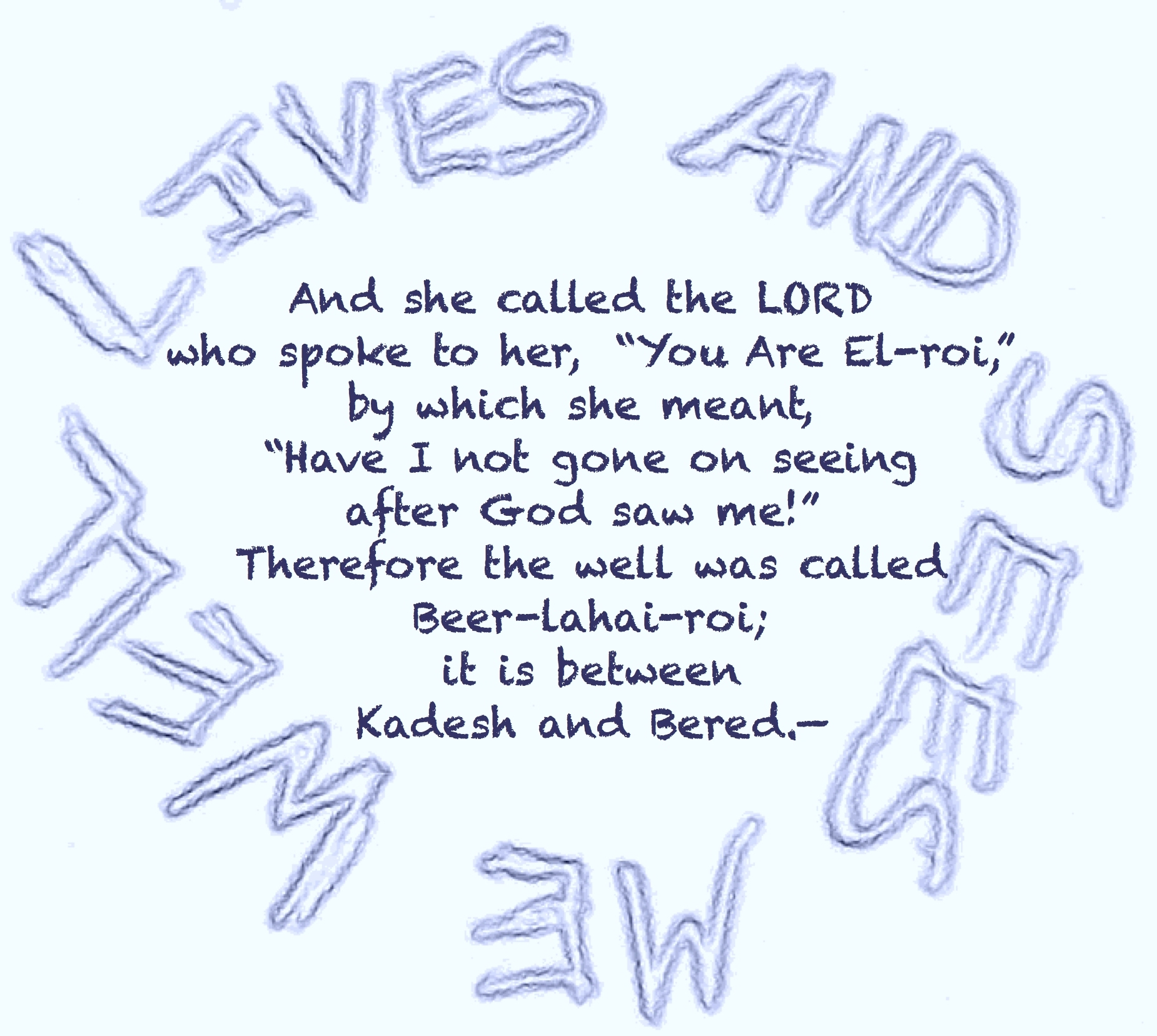
And she called the LORD who spoke to her, “You Are El-roi,” by which she meant, “Have I not gone on seeing after God saw me!”
Therefore the well was called Beer-lahai-roi; it is between Kadesh and Bered.—
— Gen 16:13-14

In her 1984 Texts of Terror, Phyllis Trible pointed out extraordinary aspects of this story, including the fact that Hagar names God — the only biblical character to do so (more here). And the name she uses has a lot to tell us.

El-roi” is translated in a variety of ways and sometimes, as in the 1985 JPS (above), not translated. But all the renderings revolve around sight: God of vision, God of my seeing, God who sees me. This, I think, points to one meaning of Isaac moving to this place: Reconciliation in unlikely if estranged parties cannot see and feel seen, so the brothers both settling in a place of seeing bodes well.

“Renewing the cousinship” of Blacks and Jews requires a lot of seeing. Coming to a place with a powerful history of seeing by/of oppressed and traumatized people could be a great beginning.

SeesMe_graphic

Police Brutality Memorial Prayers

The following prayer, prepared by Virginia Spatz and Rabbi Gerry Serotta, was offered for use during the Yizkor (Memorial) service Yom Kippur, the Day of Atonement, 5777 at Fabrangen Havurah. It is based on the yizkor prayers of several different Jewish traditions, relying strongly on the notion that acts of tzedakah [righteousness, sometimes translated as “charity”] perpetuate the names — “bind up in the bonds of life” — of the deceased. (jump to PDF version)

For Yizkor:

Consider this reflection for those in our neighborhoods lost to state violence in 5776

yizkorpolicebrutality As we endeavor to return to the Eternal One in these Days of Awe — and into the new year — we carry with us connections to those killed by violence perpetrated in our name in our own country. Among iniquities for which we beg forgiveness is failure to stop police killings, disproportionately affecting the black- and brown-skinned among us, or to address the underlying systemic racism. In this season of return, we ask God to accept our pledges of renewed examination of state power, including militarization of police, and of renewed commitment to human rights for all.
In this Memorial Service, we recall three unarmed black men killed by police in the District last year, along with six other black citizens, and no one of another skin color, killed by police in DC during 5776:

  • James McBride, 74, Sep 29, 2015.
    Unarmed, leaving hospital without signing out. Killed by MedStar Special Police. Death ruled homicide.
  • Alonzo Smith, 27, Nov 1, 2015.
    Unarmed, unexplained circumstances. Killed by Blackout Special Police. Death ruled homicide.
  • Terrence Sterling, 31, Sep 11, 2016.
    Unarmed, shot contrary to protocol/orders. Killed by Metropolitan Police Dept. Death ruled homicide.
  • Marquesha McMillan, 21, Oct 26, 2015.
    Armed with a gun. Killed by Metropolitan Police Department.
  • James Covington, 62, Nov 2, 2015.
    Armed with a gun. Killed by Metropolitan Police Department.
  • Darick Napper, 34, Nov 19, 2015.
    Armed with a knife. Killed by Metropolitan Police Department.
  • Peter John, 36, Feb 1, 2016.
    Armed with a toy gun. Killed by Metropolitan Police Department.
  • Sherman Evans, 63, June 27, 2016.
    Armed with a toy gun. Killed by Metropolitan Police Department.
  • Sidney Washington, Jr., 21, July 4, 2016.
    Part of a July Fourth crowd shooting off fireworks and firearms. Killed by Metro Transit (Special) Police.

O God, full of mercy, Justice of the bereaved and Parent of orphans , take special notice of those lost to state killings in our own country. Master of compassion, shelter under the shadow of Your wings those whose lives ended in violence, often fueled by racial injustice. Grant proper rest for the souls of all who went to their eternal rest through such killings.

May these moments of meditation strengthen the ties linking this community with our most vulnerable and troubled members. I pledge tzedakah/charity to address racial injustices contributing to these deaths. Through such deeds, and through prayer and remembrance, may the souls of the departed be bound up in the bond of life. May they rest in peace forever.

Here is a printable PDF with DC losses included [yizkorreflection5777]
TOP

To open, moving “days between”

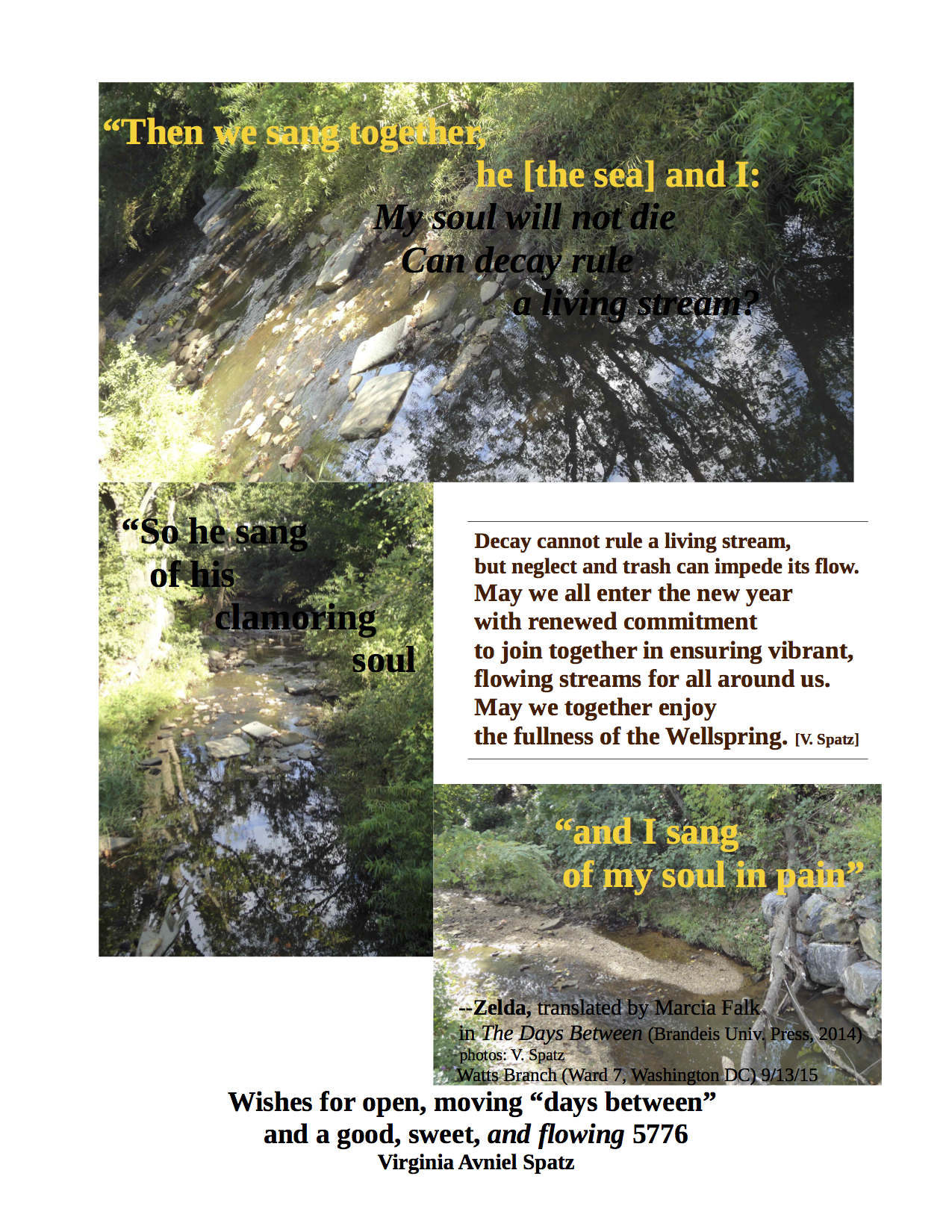
In her The Days Between, Marcia Falk writes of the “We cast into the depths” declaration of Tashlikh, the Rosh Hashana afternoon ritual of symbolic sin/crumb/twig tossing: “We seek in this declaration to free ourselves from whatever impedes our moving into the new year with clarity, lightness, and hope.”

In addition, I suggest, we need to look at where we might be responsible for impeding anyone else’s movement, clarity, lightness, or hope — and prepare to open that blockage wherever possible.

Open, moving “days between” to all,
followed by a good, sweet, and flowing 5776

WattsTashlikh

The Days Between: Blessings, Poems, and Directions of the heart for the Jewish High Holiday Season. Marcia Falk. (Waltham, MA: Brandeis University Press, 2014)

In Need of New Language

The Central Conference of American Rabbis (CCAR) needs new God-language and is asking for input. Here are two cents, which I hope will be useful to the CCAR and all who happen upon them.

Searching for Reform perspectives on the Amidah, I stumbled upon a “RavBlog” post relating to one of the blessings. Rabbi Leon Morris, a member of the editorial team for the Reform movement’s inchoate machzor, asked: How “Current” Should a Prayer Book Be?

His post raises a number of questions, ones I’m not sure the author intended but ones the CCAR — and the rest of us — would do well to consider.
Continue reading In Need of New Language

Blessings and Distance

R. Joshua b. Levi said: One who sees a friend after a lapse of thirty days says: Blessed is He who has kept us alive and preserved us and brought us to this season.* If after a lapse of twelve months he says: Blessed is He who revives the dead.**
— Babylonian Talmud, Berakhot 58b

*Shehecheyanu,” for short [full blessing text]
** Kolel: The Adult Centre for Adult Jewish Learning presents both blessings as outlined in Berakhot 58b and another option for blessing upon seeing a long-lost friend.
Continue reading Blessings and Distance

Psalm 27 for the season (4 of 4)

“If you’re not 20 minutes early, you’re late,” my ballet teacher, Marie Paquet, used to tell her adult students: Without time to leave behind the outside world and prepare to focus, warm up physically and mentally, class could be frustrating, even dangerous. Over the years, I’ve realized that her adage also applies to worship services. Still, life and public transportation don’t always support early arrival to services.

But necessity, as I’m sure “they” rarely say, is the mother of invention in kavanah [intention]….

This past Shabbat, Shabbat Sukkot, I entered the sanctuary un-early and a little frazzled. Moreover, this particular service skipped over some introductory prayers that ordinarily help me focus. This left me struggling to follow the service. But, then, in a moment provided for silent prayer, I stopped struggling and simultaneously “heard,” quite clearly:

“On Your behalf, my heart says: ‘Seek My face!'” (Psalms 27:8)

I wish I could say that this verse instantly helped me find my way into the service. But I can say that I my inability to keep up became suddenly irrelevant. Moreover, I stumbled into a three-part message encapsulating the fall holidays. I am hoping it will carry — for me and others, I hope — the essence of the season of teshuva into the mundane, post-holiday world.
Continue reading Psalm 27 for the season (4 of 4)