Maintaining Self and Struggle

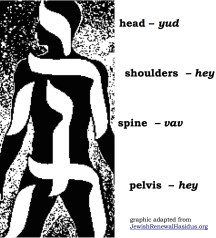
A meditation linking God’s four-letter name – YHVH (yud-hey-vav-hey) – with the human body/soul can help focus on God’s presence and power in our lives. I have relied on this meditation since Rabbi David Shneyer taught it to me some years ago.

yhvhgraphic
The variation presented here, incorporates a teaching from the prophet Micah on what God requires of us —

הִהִגִּיד לְךָ אָדָם, מַה-טּוֹב; וּמָה-יְהוָה דּוֹרֵשׁ מִמְּךָ,
כִּי אִם-עֲשׂוֹת מִשְׁפָּט וְאַהֲבַת חֶסֶד, וְהַצְנֵעַ לֶכֶת, עִם-אֱלֹהֶיךָ.
You have been told, human, what is good,
that is, the traits that God expects from you:
acting justly, a passion for loving kindness, and walking humbly with your God.
– Micah 6:8 (translation from Siddur Eit Ratzon)

It is offered as support for social justice work in difficult times.

Shared here are the bones of the practice, so to speak, along with a PDF with additional graphics, 4-part Meditation, for easy carrying in a pocket or bag. Originally intended for use at the start of the day, this brief practice also serves throughout the day, especially when circumstances threaten to pull us off center, to realign with divine connection and our own strength and flexibility.

Fabrangen West tried a group chant based on this practice at the December 2016 gathering. Several participants more knowledgeable about renewal hasidus and kabbalah found connections between the sefirot and the words of the Micah verse. Further thoughts on this meditation — or on other Jewish practices for times of challenge — are welcome.

As always, “A Song Every Day” seeks comments or guest posts.

(1) Begin

Begin with meditation or chant using the four-letter name to focus on God’s presence before and within:


(2) “You’ve been told, human…”

Cycle through first half of verse, Y-H-V-H, head to legs, several times. At each reflection stage, try to release any barriers to embodying those attributes God expects; where appropriate, note areas in need of further attention:

  • (Y) Consider your humanity and connection to God. If you are feeling depleted, this is a moment to be open to the spiritual support you need.
  • (H) Is anything – distraction, anger, injury, e.g. – impeding your ability to reach for “what is good”? If so, can you release the barrier now? Or,should you set aside more time for this, to keep your reach from straying?
  • (V) Are you centered, with YHVH as backbone? What might pull you away? How are you working to stay upright?
  • (H) Are you prepared to pursue what God seeks of you? Does body or soul require attention first? Ready for more instruction? (Or ↑)


(3) “…acting justly, a passion for loving kindness,
and walking humbly with your God.”

Cycle through second half of verse, Y-H-V-H, head to legs, several times. Again, at each reflection stage, release barriers if you can and make note of areas where further attention, including assistance from others, would be helpful:

  • (Y) Are you committed to embodying the traits we are told to share with God?
  • (H) Do you join hands with others, or just push your own ideas, in acting justly? Do you need more partners, assistance? To whom can you reach out?
  • (V) Is your spine ready to stand and bend in loving kindness? Do you need help – maybe learning or rest – to avoid damage to yourself or others?
  • (H) Ready to take steps in the world, humbly with your God, and in healthy company with others, in the struggle? (Or ↑)

Brief journaling – either at this point, before closing out the meditation, or shortly afterward – can be helpful.

(4) Close

Return to a chant of the four-letter Name, preparing to bring your newly-aligned self into the outside world and the on-going struggle.

verseandgraphic


Warring Nations, Sibling Tears

The Torah portion Toldot (Gen. 25:19 – 28:9) illustrates the struggles of nations and individuals. We are simultaneously the inheritors of this mess and the participants – all of them – in the heart-breaking. So, I want to look at the sad state we’re in and see if we can find a way through by considering different aspects of the story.

Opening and Closing Angst

toldotRebecca’s story in this portion is bookended by two moments of terrible angst, both involving her children as individuals and as nations. She cries, “If so, why am I?” and learns that she carries two warring nations in her womb (Gen. 25:22ff).

— not unlike our situation right now, as U.S. citizens, I think.

Toward the end of the portion we are told that Jacob headed off “to Paddan-aram, to Laban the son of Bethuel the Aramean, brother of Rebecca, mother of Jacob and Esau.” (Gen. 27:45)

Her stated hope – that Jacob will remain with Laban just long enough for Esau’s wrath to cool – is not realized in her lifetime. Later, Isaac’s death is reported, but hers is not. So this is the last image in the Torah that we have of Rebecca: an individual who somehow birthed two nations, and then worked to manipulate their fates, now holding out hope for reconciliation between them, as one seethes and the other inherits, and she watches them part.

At no point in this portion do we see the extreme hospitality and generosity she exhibited at the well where she gave Eleazar a drink and watered his camels. We don’t see it from her, it’s not present in Isaac’s wranglings over the wells, and its antithesis appears when Jacob refuses to share food with his hungry brother without forcing Esau into a permanent abdication of rights.

Lentil Disaster and Beyond

Rabbi Elliot Cosgrove points out in a 2011 drash:

Jacob and Esau could not share a bowl of lentil soup without provocation, never mind a Thanksgiving dinner. Unlike modern psychology, the Torah does not find the primary shaper of human identity between parent and child, but rather between siblings. — “Brother, Can You Spare a Blessing?

And the state of the siblings in this portion is a deep and painful mess.

In addition to the lentil disaster, there is the deception over the blessing and Esau’s threat to kill Jacob because of it.

We learn from a 19th Century midrash that Rebecca convinced Jacob to flee, saying:

Whichever of you will be slain I shall be bereaved in one day, since one will be no more, slain, and the murderer of his brother will be detested by me as an enemy and stranger, and will be, in my eyes, as non-existing. I will thus be bereaved of both of them.
Em Lemikra: A commentary on Pentateuch (R. Elijah Benamozegh; 1823-1900)
found in Neshama Leibowitz Studies in Genesis: “Mother of Jacob and Esau”

An important midrashic thought to remind us that any murder destroys at least two lives. And I think it suggest that, like Rebecca, we are partially responsible for creating – or allowing – conditions that can lead to murder and we might consider our responsibility to help create better conditions that could prevent murders.

And then, even when murder is avoided, we still have to cope with Esau’s cry.

A Sibling’s Cry

As their story unfolds, we learn – from at least disparate two threads of commentary – that a single cry from Esau had repercussions for Jacob for centuries and into the current day.

After Isaac gave the blessing to Jacob, Esau “cried with a loud and bitter cry” (27:34): וַיִּצְעַק צְעָקָה, גְּדֹלָה וּמָרָה עַד-מְאֹד

Breishit Rabbah points to a similar expression in the Esther story after Mordechai learns of the edict against the Jews (4:1):

Jacob made Esau break out into a cry but once, and where was he punished for it? In Shushan the capital, as it says: “And he cried with a loud and bitter cry.” (וַיִּזְעַק זְעָקָה גְדוֹלָה וּמָרָה*)

*“cry” is spelled differently in the two verses, but Nechama Leibowitz calls the phrases identical, and clearly Breishit Rabbah saw a link.

In this midrash, the twins shift from individual brothers to nations, as retribution for tears of Esau, the man, comes – in God’s own time – to Jacob, the nation of Israel. As Leibowitz explains it: “The Almighty, who takes note of our tears, also takes note of those shed by the wicked Esau. They also are noted and cry out for retribution.” (Note: The “wicked” is Leibowitz’s adjective, one common in traditional interpretations.)

The Zohar also tells us that the tears of Esau do not exist solely within this portion’s narrative: Instead, it is taught that the Messiah will not come until Esau’s tears have stopped flowing. (Zohar II, Shemot 12b; more below)

It seems that both Esau and Jacob are understood as their national selves in the Zohar’s understanding. In both commentaries, however, Esau’s tears blur into a much something larger than one man’s injury.

Sibling Tears Today

As it happens, my older sister, Martha, and I had a chance over the summer to discuss the state of the nation and of our extended family. Martha reminded me that our dad – whose 40th yahrzeit passed in August – used to say that peace, in any kind of communal or national sense, was impossible until brothers learned to get along. And, he said, the bible taught how unlikely that was. Still, we were led to believe, as I recall, that the fate of the world rested on our small shoulders whenever any of the four of us had a minor spat.

While I doubt that our dad knew Breishit Rabbah or the Zohar, he managed to convey a similar sense, on the one hand, of the magnitude and persistence of interpersonal injuries and, on the other hand, of our power to affect change on a communal or national level by improving relationships with those closest to us.

At a recent program on racial justice, held at Adas Israel, an activist and teacher, black woman and a Jew, Yavilah McCoy stressed the importance of being what she calls “proximate” to the people with whom we are struggling for justice – in both senses, that is, those we oppose and those we join in common struggle. Proximity is the only way people learn and change, she said.

McCoy gave an example that stuck with me: If your auntie badmouths your mom, you don’t write to the New York Times about it; you talk to auntie and mom. And that, she said, is how injuries are resolved.

So, that’s what I’d like to discuss:

  • What are our possibilities for resolving very old and very painful circumstances between brother individuals and brother nations?
  • When are we Rebecca? When Esau? And when Jacob?
  • And when are we Isaac, who seems so damaged and confused himself that he lets everyone else do the emotional work?

One last note: Centuries of commentary appear to speak of the persistence of Esau’s tears without claiming that he should have received the blessing or even that anyone in the story should have behaved differently.

Postscript on brothers, etc.

The portion drifts constantly from the personal to the national, beginning with the opening verse –

וְאֵלֶּה תּוֹלְדֹת יִצְחָק, בֶּן-אַבְרָהָם: אַבְרָהָם, הוֹלִיד אֶת-יִצְחָק.
“This is the line” – or: “these are the offspring” – “of Isaac son of Abraham – Abraham begot Isaac” (24:19).

There are several traditional explanations for starting the line of Isaac with “Abraham begot Isaac.” One idea that caught my attention is from the 13th Century teacher, Chizkuni: The odd phrasing emphasizes that Abraham not only sired Isaac but raised him, and he did so after his name and destiny were changed to Abraham, “father of multitude of nations” (Gen 17:5).


The stress on “multitude of nations” is particularly important to consider at this point, poised between the lineage of Ishmael – which includes twelve princes by their nations (25:16) – and that of Isaac, which will include Esau and Jacob, who are both brothers and nations.

NOTES:

In the Midrash it is written: “Messiah, son of David, will not come until the tears of Esau have ceased to flow.” The children of Israel, who are God’s children, pray for mercy day and night; and shall they weep in vain so long as the children of Esau shed tears? But “the tears of Esau” – that does not mean the tears which the people of the earth weep and you do not weep; they are the tears that all human being weep when the ask something for themselves, and pray for it. And truly: Messiah, son of David, will not come until such tears have ceased to flow, until you weep because the Divine Presence is exiled, and because you year for its return.
— Martin Buber. The Way of Man/Ten Rungs, p. 199
NY: Citadel Press, 2006 (Ten Rungs, originally published Schocken 1947)

See also “Tears of Sorrow, Tears of Redemption” by Rabbi Toba Spitzer on Kol Nidre 5762 (shortly after 9/11/2001):

Maybe this is what we can learn out of the depths of the tragedy we have witnessed. That redemption will come when all tears have ceased, when all sources of suffering have been repaired. Our redemption is somehow linked to the fate of even those whom we consider our enemies. Their tears and ours are ultimately not so different.

The human spirit is so large when we allow it to be; the incredible outpouring of bravery and love and money in these past two weeks is testament to that. Let’s not squander this opportunity to make the most of what we’ve learned about ourselves, the good and the bad. Let’s name the sins that need to be named, let’s confess them together, and then let’s come together to begin to imagine a better way. Let’s dry Esau’s tears, and our own, and begin to figure out what it will take to make redemption real.
(Zohar II, Shemot 12b)

BACK

Map Your Heart Out: A Few Sources

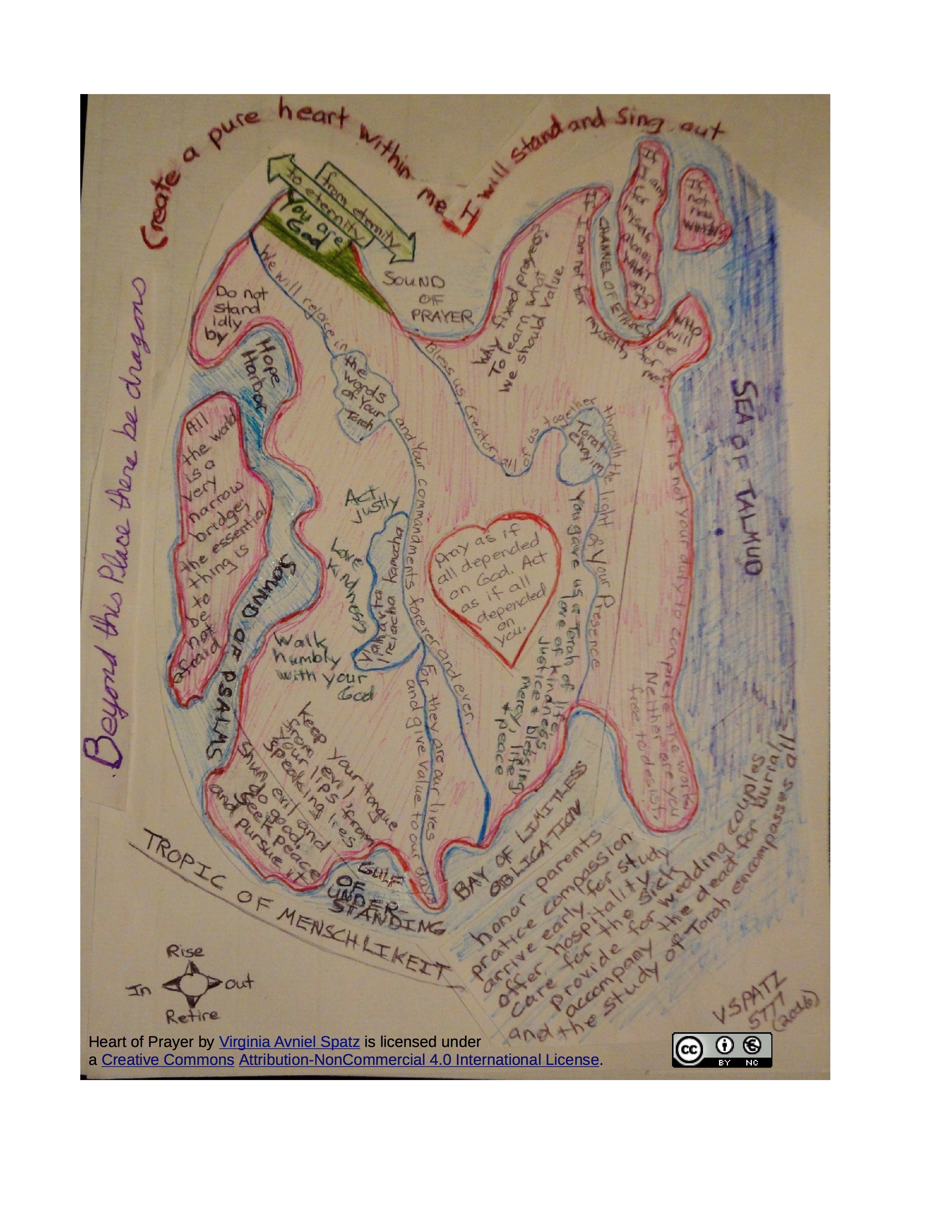
Here, as promised a few days back, are some of the sources that I included in my prayer “heart map”….

Overall structure is formed by two lines from this kavanah [intention] for the Amidah:

heart_corner

Create a pure heart within me
let my soul wake up in Your light.
Open me to Your Presence;
flood me with Your holy spirit.
Then I will stand and sing out
— Stephen Mitchell, based on Psalm 51
Mishkan T’filah, p.75

Orientation

Orienting the map is the phrase, “From eternity to eternity, You are God [מן העולם ו’עד העולם אתה אל],” from the “Nishmat” prayer, in the Shabbat/Festival morning service. Also near the top of the map, to highlight its influence — like minerals in the hills, carried by rivers and run-off to parts below — is this brief commentary:

Why fixed prayers?
To learn what we should value,
what we should pray for…
— Chaim Stern, p. 437 Mishkan T’filah

This note comes from the prominent liturgist Rabbi Chaim Stern (1930-2001); it was also found in Gates of Prayer (1975) and other Reform prayerbooks.

Connection and Points Beyond

Two rivers, running the length of the heart territory and connecting various regions, begin with “We will rejoice in the words of Your Torah…” and “Bless us, Creator, all of us…” (The first is from the Evening service, before the Shema; the second, from the Morning service, at the close of the Amidah).

The prayers themselves remind us over and over again of connections between prayer, study, and acting for justice in the world. See also, to take just two examples, Max Kadushin’s Worship and Ethics (1963, republished 2001 by Global Publications) and Marcia Prager’s Path of Blessing (NY: Belltower, 1998).

At one edge of the map, the injunction, “Do not stand idly by (Leviticus 19:16), hugs “Hope Harbor.” Farther beyond, outside the heart and its surrounding waters, the terrain is less certain.


NOTE

Here’s a link to some background on this project and my whole map. Also linked is information about cordiform maps more generally and about the book suggesting “Personal Geographies.”

The graphic aspect was very helpful to me, but I don’t think it’s necessary to draw or color in order to consider what prayers or texts would play a prominent roll in your own “heart map.”
BACK

Teapots in Babylon

“This is what travelers discover: that when you sever the links of normality and its claims, when you break off from the quotidian, it is the teapots that truly shock. Nothing is so awesomely unfamiliar as the familiar that discloses itself at the end of a journey.” This week, I’ve been hearing Psalm 137 among these lines from Cynthia Osick’s “The Shock of Teapots” (Metaphor & Memory. NY: Knopf, 1989). The result sounds like this:

How is that we have a teapot,
symbol of normalcy, and even comfort,
amidst all this confusion and fear?
Are we to enjoy and share
cups of tea here
in this strange, oppressive land?

The opening lines of Psalm 137 are primarily about the challenge of expressing joy, and making music in particular, distant from Zion, mocked and alienated from oppressors. But I think we also hear something like the “shock of teapots” — normalcy, even comfort, or celebration here!?

By the rivers of Babylon,
there we sat down,
yea, we wept, when we remembered Zion.
There, upon the willows, we hung up our harps.
For there our captors asked of us words of song,
and our tormentors asked of us mirth:
‘Sing us one of the songs of Zion.’
How shall we sing the LORD’S song in a foreign land?
–Ps. 137:1-4, translation sort of a mishmash based on Old JPS
Complete Old JPS and Hebrew here

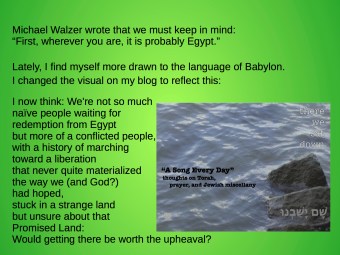
MicahNext12Of course, many people, in the US and elsewhere, have long been conscious of living in Babylon. So the puzzlement and shock expressed by so many in this past week is a little surreal to some.**

My personal connection to the language of “Babylon” has been growing for some time as the central liberation story of Judaism — being freed from Egypt — seems unsuited to circumstances where Jews, as individuals often profiting from White privilege, and as a people are too often Pharaoh. See, e.g., “April 22: 1968 and 2016” (Who can say we’ve actually left Egypt?). The “Trouble to See” series from which graphic at right is taken, was published over the summer. And a few years back, “A Mountain Called Zion,” offered thoughts on “Zion” and how close/distant it is, as well as a nice link to Jimmy Cliff’s “Waters of Babylon.”

Most importantly for further exploration, this blog welcomes comments and guest blogs from Jews and non-Jews.

Normalcy on Good Hope Road

Yesterday I posted the following on Facebook:

OK, so I’m walking down Good Hope Road in Southeast DC and there’s this guy standing on the sidewalk with his car doors open blaring that song “FDT” — the one which goes, “…I like white folks, but I don’t like you…” with a chorus of “[expletive deleted] [president elect].” Cheered me right up.
#AnacostiaUnmapped #LoveDC #NotmyPresident

One friend, not a DC resident, asked “why?” and it took me some time to come up with a response other than “maybe you had to be there.” What warmed my heart, I now think, was the normalcy of the scene for Good Hope Road, although the place is undergoing gentrification. Moreover, the song was not something written in a flurry on election night. Folks had been playing the piece, from the rapper/writer YG, for some time:

“You gave us your reason to be President, but we hate yours.”

They were playing it on November 7 and they were playing it on November 10.  The sentiments — which are to the point, if crude (“FDT“) — hadn’t changed with election results. It was a little like discovering a teapot at the end of a journey.

Time to Go!

In one common cycle of Torah readings, this is the week of Lekh Lekha [“Go!” or “Go (to/for yourself),” often transliterated Lech Lecha]. And so, whether this week was a shock to, or a confirmation of, your reality, events are calling us to embark on a new journey, toward better individual and collective selves…maybe even out of Babylon.

**NOTE

Many posts on this blog are “political” in plenty of ways, but direct attention to electoral politics is a rarity. There is no getting around it this week, though. And, here is a powerful and cogent exploration of what was meant by “surreal” above:

 For a lot of people of color, this election was really about trying to find the lesser of two evils. America asked us: “How do you prefer your racism — blatant or systemic?”

— “On ‘Woke’ White People advertising their shock that racism just won a presidency

BACK

Foreign and Familiar

In this week’s Torah portion, two of the central characters receive new names: Abram becomes Abraham (Gen 17:4), and Sarai, Sarah (17:15). God announces this to Abraham as part of a statement of the covenant between them. Both Abraham אַבְרָהָם and Sarah שָׂרָה now have a “ה” (hey) in their names. Thus, each now carries a letter from God’s four-letter name yud-hey-vav-hey, which is fodder for much commentary.

Rabbi Michal Shekel notes, in addition, that Hagar’s name was always spelled with a hey: “There was no reason to change her name, because she already had a measure of the Divine presence.” Shekel adds:

One can read the tradition as saying that Hagar is an outsider, the other, alien to God, by interpreting her name as Hey gar, “Adonai is foreign.” Yet all her actions in chapter 16 prove that this is not so….Hagar is no stranger to God; she is comfortable with God’s presence in a way that is less formal than God’s relationship with Abraham or Sarah….Hagar fulfills the destiny of her name, hey gar, “Adonai dwells” with her.
— from “What’s in a Name?” Lech Lecha
The Women’s Torah Commentary. Jewish Lights, 2000

Might both — the foreignness and the familiarity of God — be true, for us if not for Hagar?

message to the Hebrew

Sandwiched in a Torah portion packed with narrative is “the war of the kings” with Lot’s capture and rescue (Gen. 14). It begins, really, with Abraham and his nephew Lot separating to avoid quarrel over land for cattle herding (Gen. 13). YHVH spoke to Abraham “after Lot had parted from him,” promising “descendants like dust of the earth,” and Abraham dwelt by the oaks of Mamre and built an altar to YHVH.

He is still living by the oaks of Mamre when the fugitive arrives to tell him that his nephew is in trouble, and Abraham sets off to rescue Lot:

And they took Lot, Abram’s brother’s son, who dwelt in Sodom, and his goods, and departed.

And there came one that had escaped, and told Abram the Hebrew [ha Ivri]…”

Does Abraham’s being an “ivri” — a “crosser-over” or “one from the outside” —  have anything to do with expectations about him and his response to Lot’s trouble? Why is this the first time Abraham is called by this name? Does being a Hebrew mean retainining sympathy — and a willingness to help — those on the other side?

NOTE

Lech Lecha (Gen. 12:1-17:27) includes the first “say you’re my sister” incident with Abraham and Sarah (Gen. 12:10-20), the weird episode of the Abraham and the covenant of the pieces (Gen. 15:1ff), and the first installments in the tales of Hagar and Ishmael (Gen. 16, 17:17-27).

BACK

Whence have you come?

An angel encounters Hagar in the wilderness (Gen. 16:7). At this point, she has been introduced to us as maid to Sarah, who has been married to Abraham for ten years without producing a child (16:1). We are told that she was given by Sarah “as wife” to Abraham, that she became pregnant, and subsequently, scorned her mistress (“saw her as lightweight”). Sarah then afflicted Hagar, and Hagar ran away. Out in the wilderness, at the spring on the road, the angel speaks to Hagar.

No one in the story has addressed Hagar before this point. And only after the angel’s inquiry does Hagar speak. These obvious, but easily overlooked points are highlighted in Susan Niditch’s notes in The Torah: A Women’s Commentary and led me to marvel at the power of a few words.

With the fall holidays a few weeks behind us at this point, it’s not a bad idea to pause and (re-)consider* the angel’s query ourselves:

Whence have you come and
where are you going?

But we might also ask: How often have we needed someone to simply inquire and listen? How often do we stop to address someone encountered along the way?

*NOTE

For those observing two days of Rosh Hashanah, the story of Hagar is part of the first morning’s Torah reading.

Covenant and Liturgy

A pair of questions disturbed journalist Sebastian Junger as a young suburban Boston resident, living “in a time and a place where nothing dangerous ever happened,” he tells us in  Tribe: On Homecoming and Belonging:

How do you become an adult in a society that doesn’t ask for sacrifice? How do you become a man in a world that doesn’t require courage?
— Tribe, p.xiv

I found these oft-quoted lines baffling, and I was not alone in this reaction:

I am tempted to remind Junger that sacrifice and courage are necessary in many fields of life, from parenting to volunteering in refugee camps. He could also join a solidarity movement. That is what he claims he is seeking, after all.
Joanna Bourke in The Guardian

His analysis of life in Boston and its suburbs, for example, totally overlooks the sacrifices made by teachers, nurses, or those fighting for social justice, workers’ rights, against racism or other social ills in his own or other communities as well as the dangers experienced by African Americans or the poor in nearby Somerville or Boston itself.
Suzanne Gordon in Washington Monthly

But Rabbi Danny Zemel, in his Rosh Hashanah sermon at Temple Micah (DC), explained that he finds these questions “paramount,” understanding them somewhat differently in Jewish terms:

How do we become counter cultural? How do we become breakers of idols?”

Zemel points out that “[the Jewish] covenant commands us to love the stranger because we were strangers in the land of Egypt,” and argues that the synagogue should be a “place where we can learn and absorb” a “counter-cultural” message in a world that can seem to applaud self-interest over group interest. He asks:

How do we learn this call – actually more than just learn it, but feel it in our being? How does it become “us?”

How does it become “us”?

For me, one clear answer is the liturgy, which I tried to express in the “heart map” below. Another is ensuring that we recognize, and regularly celebrate, the many opportunities to prove one’s worth to the community highlighted by Bourke and Gordon above. I remain confused by Junger’s youthful state of mind and join critics of Tribe who find that his “danger” focus led him to glorify war and miss abundant examples of courage.

As it happens, this year’s National Blog Posting Month theme is “Type your heart out.” Look for more daily posts on courage, heart, Judaism, and covenant as November unfolds.

heart

NOTES:
Tribe: On Homecoming and Belonging NY. Sebastian Junger. Hatchette Book Group, 2016

Heart map inspired by Personal Geographies: Explorations in Mixed-Media Mapmaking by Jill K. Berry.

Noah, Covenant, and “Cursed be Canaan”

Curse and Covenant

The “curse of Ham” — with related ideas about slavery and race, unsupported by the the text itself — emerged over the centuries from the biblical story of Noah. Regardless of our particular faith community’s approach to this curse concept, there is no denying the damage done by what one author calls “the single greatest justification for Black slavery for more than a thousand years” (Goldenberg, The Curse of Ham). Racism and oppression have become inextricably linked with the Noah story.

This moment in U.S. history seems to demand that we acknowledge the damaging legacy of our collective textual heritage. Some readers might find it worthwhile to examine the complex religious career of the “Cursed be Canaan” text, its development in Abrahamic teaching and its role in Western history and culture. A few references are shared here toward that purpose. But we need not pursue an academic route in order to answer the ethical call of this week’s Torah portion.

Immediately after the Flood, God’s introduces a covenant, symbolized by the rainbow (Gen. 9:17): God promises never again to destroy everything by flood, and humans are expected to obey basic laws. The prohibition against shedding human blood and some of the other “Noahide Laws” are specified in this week’s portion; others, according to Jewish tradition, are found in or derived from other passages in Genesis.

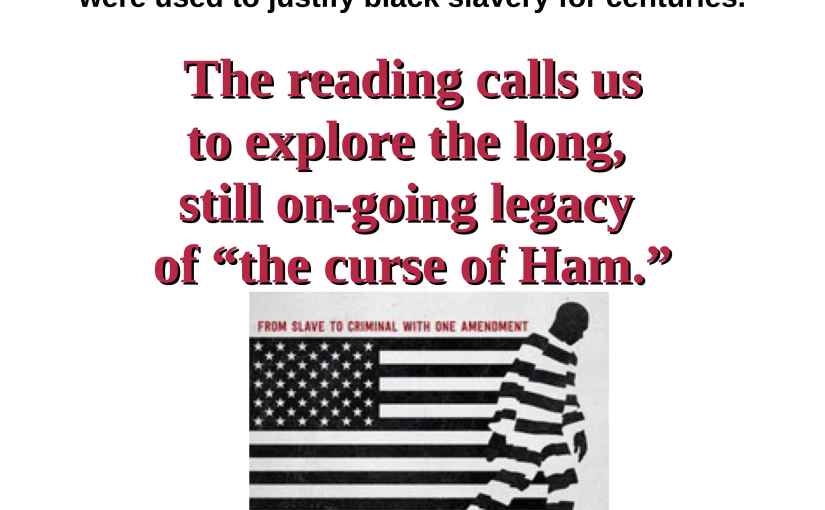
Seeing a rainbow, we are to be reminded of the covenant, of God’s mercy and of our own obligations. Some teachers see the rainbow as a reminder to repent and spur repentance among others. With this in mind, watching Ava DuVarney’s documentary, 13th — about mass incarceration of black people as an extension of slavery — seems a useful step in beginning to respond to the long legacy of “cursed be Canaan.”

Fateful conjunction of slavery and race

Upon realizing “what Ham had done to him,” Noah responded: “Cursed is Canaan; a slave of slaves shall he be to his brothers.” Noah goes on to specify that Canaan, son of Ham, will be a slave to his uncles, Shem and Japheth (Genesis 9:25-27). Only Canaan is mentioned, but the curse is often understood to apply to generations of descendants of all four of Ham’s children. And, while there is no biblical reference to skin color at all, the curse of slavery became associated with black skin.

…it is not clear when to date the fateful conjunction of slavery and race in the Western readings of Noah’s prophecy….the application of the curse to racial slavery was the product of centuries of development in ethnic and racial stereotyping, biblical interpretation, and the history of servitude.

Nevertheless, by the early colonial period, a racialized version of Noah’s curse had arrived in America.
— Stephen R. Haynes. Noah’s Curse, pp.7-8 (citation below)

noahgraphicDuVarney’s 13th looks at slavery — outlawed by the 13th Amendment, except as a punishment for crime whereof the party shall have been duly convicted — and its re-incarnation through mass incarceration. 13th does not explore biblical text or religious teaching. It looks at the U.S. criminal justice system today and its relation to the broader history of racism, oppression and subjugation of black people.

“We take you from 1865 and the abolition of slavery and the enactment of the 13th Amendment all the way to now and this Black Lives Matter movement,” DuVernay told Democracy Now. “And we trace, decade by decade, generation by generation, politician by politician, president by president, each decision and how it has led to this moment.” (more on the movie)


Three of the key Noahide laws are

  • prohibition on murder, with the reminder that every human is created in God’s image;
  • prohibition on stealing, understood broadly to include kidnapping and other forms of theft; and
  • establishment of a courts and a system of law.

What is the rainbow saying with regard to our record on murder, stealing, and courts?

NOTES:

1) The story of the Noah is found in this week’s Torah reading (Genesis 6:9-11:22). The verses discussed here (9:20ff) cryptically describe a post-Flood incident involving drunkenness on Noah’s part and Ham’s witnessing “his father’s nakedness.”

וַיִּיקֶץ נֹחַ, מִיֵּינוֹ; וַיֵּדַע, אֵת אֲשֶׁר-עָשָׂה לוֹ בְּנוֹ הַקָּטָן.
וַיֹּאמֶר, אָרוּר כְּנָעַן: עֶבֶד עֲבָדִים, יִהְיֶה לְאֶחָיו.
Noah awoke from his wine and realized what his small son [Ham], had done to him. And he said, “Cursed is Canaan; a slave of slaves shall he be to his brothers.”

Various explanations have been suggested for why Canaan was cursed rather than Ham. Genesis Rabbah, for example, says that Noah couldn’t curse Ham, because God had already blessed him (Gen 9:1). Another possibility put forth was that Canaan was really the instigator. While the text speaks of individuals and not whole communities, many commentators over the centuries focused on moral factors which they believed might result in one people being subjugated to another.
TOP


2) Race and Slavery in early Judaism, Christianity, and Islam. David M. Goldenberg. Princeton, NJ: Princeton University Press, 2003.

[Goldenberg] concludes that in biblical and post-biblical Judaism there are no anti-black or racist sentiments, a finding that some scholars dispute. He also contends that the notion of black inferiority developed later, as blacks were enslaved across cultures. His findings, he said, dovetail with those of other scholars who have not found anti-black sentiment in ancient Greece, Rome or Arabia.

”The main methodological point of the book is to see the nexus between history and biblical interpretation,” Mr. Goldenberg said. ”Biblical interpretation is not static.”
— “From Noah’s Curse to Slavery” in New York Times

BACK


3) Stephen R. Haynes. Noah’s Curse: The Biblical Justification of American Slavery. Oxford and NY: Oxford University Press, 2002.
BACK


13th: A Documentary

“13th strikes at the heart of America’s tangled racial history, offering observations as incendiary as they are calmly controlled,” writes Rotten Tomatoes, where the film gets a 98% positive rating from critics and a 94% positive audience score.

“A damning but cogent argument for wholesale reconsideration of the so-called prison industrial complex,” is how the Chicago Tribune characterizes 13th.

See also The Guardian, Black Youth Project’s review, with more at DuVernay’s website. The National Review‘s response is also fascinating in its way.

The New York Times calls it “powerful, infuriating and at times overwhelming.” Many people, this blogger included, report needing to watch the movie in installments.

In addition to some local screenings, 13th streams on Netflix. Sign up for a free month, if you don’t already subscribe or have a friend who does.
RETURN

Grass Roots: a holiday question and memorial reflection

As we approach the high holidays, grass shows up in two haftarah readings. What do these verses tell us in this season of repentance and return? I am pondering. Meanwhile, a recent yahrzeit called to mind the sweetness of grass as well as its transient nature. Does that, too, carry a message for the high holidays?

We learn on Shabbat Nachamu, the Sabbath of Comfort that follows the lowest point in the Jewish calendar, that “all flesh is grass,” and that “grass withers, the flower fades; but the word of our God stands forever” (Isaiah 40:6-8). Three weeks later, on Shabbat Shoftim, we are told “Mortals fare like grass” (Isaiah 51:12). (Full verses and Hebrew below)

Learning to Witness

My father, Delmar G. Spatz — called just plain ‘Spatz’ by most adults, including my mom — was raised in northern Wisconsin. He moved to Chicago after his Army Air Corps service during World Ward Two; he’d been stationed in England but still taught us to sing “How Ya Gonna Keep ’em Down on the Farm (After They’ve Seen Paree).” Spatz met Bette, a native of Chicago. They married in 1951 and settled on the city’s West Side. He died in 1976, the summer I was 16.

The hole my dad left has taken many shapes over the decades. This is his 40th yahrzeit. And it appears to me this year that his death – and his life – form a hollow that creates a lens.

A few weeks ago, my older sister, Martha, and I had the opportunity to discuss some of what he taught us to see. She told me how, in 1968, he walked her out to see the tanks, deployed a few blocks from our apartment in the wake of Martin Luther King’s murder and the subsequent unrest. Later that year, during the Democratic National Convention, Dad sent Martha and a friend downtown to the Prudential Building – then the tallest place around – so they could see without direct risk to themselves what was happening between police and protesters in Grant Park.

That was the year Martha turned 14. I guess my younger siblings, Amy and Bob, and I were considered too young for these particular field trips.

But learning to be a witness was a major part of our education in all the years we had with Dad. He especially emphasized noticing people and circumstances that regularly went unrecognized.

It took me a long time to realize that my classmates were not being taught see the same way my dad wanted us to see. It might take me another 40 years to explore just how the lenses crafted by my dad’s lessons worked – and continue to work – in my life.

grass2Meanwhile, though – in the way each yahrzeit seems to bring its own new facet of blessing – this year I recall another aspect of that lens. I remember Dad teaching me to notice how the strongest blades of grass, when pulled gently from the ground, would yield a hidden, moist taste treat. He helped me recognize that the greenish-white part of a watermelon, the stuff closest to the rind – that so many people toss away – is often the sweetest. And together, on many a horridly hot summer day, we witnessed how sitting absolutely still could call up a breeze more cooling than anything produced by a fan, electric or paper.
— these reflections were shared with Temple Micah on August 20, 2016.

Haftarah Verses from Isaiah

קוֹל אֹמֵר קְרָא, וְאָמַר מָה אֶקְרָא; כָּל-הַבָּשָׂר חָצִיר, וְכָל-חַסְדּוֹ כְּצִיץ הַשָּׂדֶה.
יָבֵשׁ חָצִיר נָבֵל צִיץ, כִּי רוּחַ יְהוָה נָשְׁבָה בּוֹ; אָכֵן חָצִיר, הָעָם.
יָבֵשׁ חָצִיר, נָבֵל צִיץ; וּדְבַר-אֱלֹהֵינוּ, יָקוּם לְעוֹלָם.

Hark! says one: ‘Proclaim!’ Another says: ‘What shall I proclaim?’
‘All flesh is grass, and its goodness is as the flower of the field;
The grass withers, the flower fades;
because the breath of the LORD blows upon it–surely the people is grass.
The grass withers, the flower fades; but the word of our God stands forever.’
— Isaiah 40:6-8, in Haftarah Va’etchanan

אָנֹכִי אָנֹכִי הוּא, מְנַחֶמְכֶם; מִי-אַתְּ וַתִּירְאִי מֵאֱנוֹשׁ יָמוּת, וּמִבֶּן-אָדָם חָצִיר יִנָּתֵן.
I, even I, am He who comforts you: who are you, that you fear Man who must die, Mortals who fare like grass… — Isaiah 51:12, in Haftarah Shoftim

Hebrew text from Mechon-Mamre.org,
Translation adapated from “Old JPS” and Sefaria.org
BACK