Vayikra: Great Source(s)

By allowing laypersons to make their own sacrifices, under the auspices of the priests, the sacrificial laws gave people a degree of control over their spiritual lives. Inviting people into the sanctuary for the sacrifice, people felt themselves personally invited into God’s earthly home.

In essence, the system of sacrifice provided a metaphor, a method, for the Israelites to reach God, responding to the deep psychological, emotional, and religious needs of the people. Indeed, this is the meaning of the Hebrew word for “sacrifice”; it comes from a verb meaning “to bring near.”

…[Regarding contemporary animal rights concerns:] First, according to the Bible, the life of the animal was its blood (Gen 9:4). Out of respect for that life force, all biblical sources agree that it was forbidden to imbibe blood. …[one] had to return the blood to God, its divine creator, by offering the blood of sacrificial animals on the altar….

In what may seem like an ironic twist, then, these and other dietary rules are founded on the sanctity and inviolability of life. In this way, the sacrificial laws exemplify one of the most exciting characteristics of the book of Leviticus: behind the seeming arcane rituals lies a system of meaning that we can draw into our own, modern lives.
–Jacob Milgrom, Leviticus: A Book of Ritual and Ethics, pp17-18

Milgrom, Jacob. Leviticus: A Book of Ritual and Ethics. Minneapolis, MN: Augsburg Fortress, 2004.

Milgrom’s book and those below provide historical and anthropological perspectives on the book of Leviticus. While academic and detailed, they can help provide some orientation for what can seem a very foreign territory: the sacrificial system.

For a different sort of orientation see “The Rationale of the Sacrifices,” from Nehama Leibovitz.

Academic Works on Leviticus

Purity and Danger. Douglas, Mary. London: Routledge and Kegan Paul, 1966. In this classic of anthropology, we learn: “Defilement is never an isolated event. It cannot occur except in a systematic ordering of ideas.” Much of the frequently referenced chapter, “The Abominations of Leviticus,” is available at Google Books. Douglas has also written other works on Leviticus and the sacrificial system.

Reading Leviticus: A Conversation with Mary Douglas. Sawyer, John F.A., ed. Sheffield, England: Sheffield Academic Press, 1996. Includes one response from another scholar, following each main paper, and subsequent discussion.

Golden Bells and Pomegranates. Visotzky, Burton L. Tuebingen, Germany: Mohr Siebeck, 2003. A study of the 5th Century CE commentary, Leviticus Rabbah.

————————————————————–
The “Opening the Book” series was originally presented in cooperation with the independent, cross-community Jewish Study Center and with Kol Isha, an open group that for many years pursued spirituality from a woman’s perspective at Temple Micah (Reform). “A Song Every Day” is an independent blog, however, and all views, mistakes, etc. are the author’s.
———————————————————————————-

Pekudei: A Path to Follow

Speaking of weaving and women’s work…

SERAKH BAT ASHER THE HISTORIAN ADDS: Since we were principally a sheepherding people in ancient times, Israelite women mostly wove wool. Some even say that it was we women of Israel who first introduced colored wool garments into Egypt. For did not Joseph have a splendid “coat of many colors”!

THE SAGES IN OUR OWN TIME ADD: Modern scholars have found pictures of colored garments in Egyptian tomb paintings dating from about the time Jacob’s clan supposedly arrived in Goshen. Anad not only did the Israelite women bring technical expertise to Egypt; they probably acquired from their Egyptian sisters the special technique of splicing and twisting linen that first appears in Canaan about the time the Israelites would have arrived from the Nile Delta.

MIRIAM ADDS: As it is written: “EACH WOMAN SHALL BORROW FROM HER NEIGHBORS” (3:22)

BERURIAH THE SCHOLAR TEACHERS: The Torah describes the women in the wilderness who spin linen and goats’ hair “WITH THEIR HANDS” as “WISEHEARTED” (35:25). Similarly in the Book of Proverbs (31:13, 19, 22, 24-25), a “WOMAN OF VALOR” is described largely in terms of her weaving skills:

She looks for wool and flax
And sets her hand to them with a will….
She sets her hand to the distaff;
Her fingers work the spindle….
She makes covers for herself:
Her clothing is linen and purple….
She makes cloth and sells it,
And offers a girdle to the merchant,
She is clothed with strength and splendor.
— Ellen Frankel, The Five Books of Miriam*

And weaving women’s work

Some final thoughts, paths to pursue — on the portion, the Book of Exodus and Passover — from the work of more contemporary wise women:

It’s good to meet with friends at the well, because it’s hard work hauling water, and doing innumerable humble chores, like so many women have for so long. Of course men also strive, like Jacob and Moses lifting stone well covers, but I’m thinking about Rivka watering all those camels; that was heavy duty (Genesis 24.46). Rachel, Hagar, Miriam and Zipporah have dramatic associations with wells. In Torah stories women spend a lot of time bearing water. Although much of that kind of work is easily perceived as insignificant, or sentimentalized as a labor of love, the world we know and ha’olam haba, depend upon it….

In this American song* a woman brings water to a man working in the fields. It comes from the history of people whose slave labor built the wealth of our nation….

What if we learned to respect and to know about all the people who have ever done for us?
Don’t let the work of their hands go unsung,
— Amy Brookman, Exodus1verse8 *link updated from the one in original post, which is gone now

AND THEN I SIT. “Dom l’Yah, v’hitcholello.” “Be still,” Psalm 37 tells us,”and wait for God.”
The final sentence of The Book of Exodus, the manual for our liberation, tells us that we must cultivate an awareness of God’s mysterious presence, characterized by the Divine cloud in the day and an inner fire at night. This awareness will guide us throughout our journeys.
— From Torah Journeys, Shefa Gold


Chazkei! Chazkei! Venitchazeik!
Be strong! Be strong! And may we be strengthened!

* Please see Source Materials for full citations and additional information.

————————————————————–
The “Opening the Book” series was originally presented in cooperation with the independent, cross-community Jewish Study Center and with Kol Isha, an open group that for many years pursued spirituality from a woman’s perspective at Temple Micah (Reform). “A Song Every Day” is an independent blog, however, and all views, mistakes, etc. are the author’s.

———————————————————————————-

Vayakhel: Language and Translation

Moses said to the Children of Israel, “See, HASHEM has proclaimed by name, Bezalel son of Uri son of Hur, of the tribe of Judah. He filled him with Godly spirit, with wisdom, insight, and knowledge, and with every craft…”
Shemot/Exodus 35:30-31

Continue reading Vayakhel: Language and Translation

Pekudei: Something to Notice

The colors.

Before we complete the Tabernacle and leave Exodus/Shemot, I must pause to consider the oft-mentioned color trio: “tekhelet, v’argaman v’tolaat shani.” These colors are central in the tent instructions/construction and appear throughout the priestly garments. The same colors are, of course, prominent in contemporary Jewish textiles and other arts.


Tekhelet — Blue, Sky Blue or Indigo.


Argaman — Purple.


Tolaat shani — Scarlet or Crimson.

“Blue Wheat,” “Ode to Overturning Bowers vs. Hardwick” and “Pink Pomegranate” (looks scarlet to me) — above — are all works by DC-area artist Judybeth Greene.


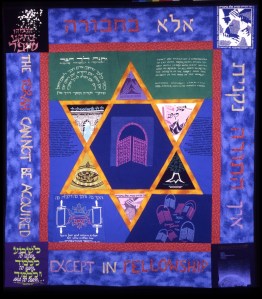
The quilt below was made by Amy Leila Smith, of Blue Feet Studio in Maine, for the National Havurah Committee.

…seems fitting closure for a portion which focuses on weaving, long a woman’s art. See, e.g., Women’s Work, the First 20,000 Years: Women, Cloth and Society in Early Times by Elizabeth Wayland Barber (Norton, 1994).

For more on the special history of tekhelet blue, see Ehud Spanier’s history (details in Source Materials).

[CAUTION on print and internet sources focusing on these three colors, especially tekhelet: Many involved in reconstructing exact colors of the Tabernacle and related work are deeply concerned with preparing for the Third Temple.]

————————————————————–
The “Opening the Book” series was originally presented in cooperation with the independent, cross-community Jewish Study Center and with Kol Isha, an open group that for many years pursued spirituality from a woman’s perspective at Temple Micah (Reform). “A Song Every Day” is an independent blog, however, and all views, mistakes, etc. are the author’s.
———————————————————————————-
Continue reading Pekudei: Something to Notice

Pekudei: Language and Translation

“And these are the names [v’eileh] of the Children of Israel who were coming [ha-ba’im] to Egypt…”
— Exodus/Shemot 1:1

“…throughout their journeys [mas’eyhem].”
— Exodus/Shemot 40:38 (Stone translation*)

A number of commentaries note that the vav (a conjunction which can mean “and” or “but”) is meant to link the narrative of Genesis with that launched with Exodus. In an unusual bit of similarity, both the Stone and Alter* commentaries make this point and also remark that identical words open the genealogy beginning at Genesis/Breishit 46:8.

Stone emphasizes the on-going nature of the narrative by using “were coming” for “ha-ba’im,” while Alter and others use the past tense. JPS* bridges the two with “came, each coming with…”

Alter also notes that the word mas’eyhem [in all their journeyings] uses “the same verbal stem [that] inaugurated the Wilderness narrative in 13:20, ‘And they journeyed from Succoth,'” suggesting that this helps leave a “sense of harmonious consummation,” as the work of the Tabernacle — likened to that of Creation — is completed. “But,” he continues:

the condition in which the Israelites find themselves remains unstable, uncertain, a destiny of wandering through arduous wasteland toward a promised land that is not yet visible on the horizon. The concluding words of Exodus point forward not to the Book of Leviticus, which immediately follows, but to the Book of Numbers, with its tales of Wilderness wanderings, near catastrophic defections, and dangerous tensions between the leader and the led.
— Alter, p.535

Chazak! Chazak! Venitchazeik!
Be strong! Be strong! And may we be strengthened!

* Please see Source Materials for full citations and additional information.

————————————————————–
The “Opening the Book” series was originally presented in cooperation with the independent, cross-community Jewish Study Center and with Kol Isha, an open group that for many years pursued spirituality from a woman’s perspective at Temple Micah (Reform). “A Song Every Day” is an independent blog, however, and all views, mistakes, etc. are the author’s.

Vayakhel: A Path to Follow

In this portion, and this portion alone, the women of the children of Israel are identified as a significant group within the larger whole,” writes R. Nancy H. Weiner in her dvar Torah, “Of Women and Mirrors.”

The Torah unequivocally highlights that women are participating in the single most important sacred endeavor of the community of Israel’s collective existence: the building of the mishkan, the place in which God’s presence will dwell among the people and travel with them as they journey toward the Promised Land.

And then the narrative takes a significant turn. The efforts of the entire community become the backdrop for the tasks taken on by the great (male) architects and craftsmen of the mishkan. The portion mentions the contributions of women only once more as it describes the labors of Betzalel, the chief architect of the mishkan. The Torah says, “He made the laver of copper and its stand of copper, with the mirrors of the women who served at the entrance of the Tent of Meeting (Exod 38:8)…
— Weiner, in The Women’s Torah Commentary

One path to follow is to look at the role of women in the ancient Israelite world. The work of Tikva Frymer-Kensky comes to mind as a starting point.

But Weiner herself suggests another path: “…[Women] are not the only victims of collective amnesia…” Look at less visible Jewish communities of today — Kulanu or Bechol Lashon [In Every Tongue].

The entire piece, “Of Women and Mirrors,” is available at GoogleBooks, The Women’s Torah Commentary.*

* Please see Source Materials for full citations and additional information.

————————————————————–
The “Opening the Book” series was originally presented in cooperation with the independent, cross-community Jewish Study Center and with Kol Isha, an open group that for many years pursued spirituality from a woman’s perspective at Temple Micah (Reform). “A Song Every Day” is an independent blog, however, and all views, mistakes, etc. are the author’s.

Vayakhel: Something to Notice

“…but the materials were more than enough [vehoter] for all the work that had to be done.” — Exodus/Shemot 36:7

Construction of the Tabernacle in the desert was an act that paralleled the creation of heaven and earth and corresponded to all known aspects of the order in which G’d created the universe, (B’rachot 55). Seeing that this was so, Betzalel, the chief architect of the project was granted the wisdom to understand how the letters of the aleph bet were to be used in carrying out all the details of the task entrusted to him.

Nowadays, this ability of Betzalel at the time of his building of the Tabernacle, has been granted to the righteous Torah scholars of varying degrees, who are able to reveal insights into the Torah that have not previously been revealed. By doing so, they become partners of G’d in His creation of the universe. Betzalel also imposed restrictions on himself in his use of the gift G’d gave him, so as not to preempt the Torah scholars throughout the ages an to thereby prevent them from revealing new insights. This is what is meant by the word [vehoter], “there was an overabundance,” i.e. there was enough holy spirit that had been provided to enable Betzalel and his assistants to build the Tabernacle, but instead of exhausting it at the time, Betzalel, in his modesty, was content to leave a surfeit of it to be used by Torah scholars, who in a way are also Torah “architects,” to delight their audiences with their insights in their respective generations.
— Rabbi Levi Yitzchak of Berditchev, Kedushat Levi,* p.525-6

* Please see Source Materials for full citation and additional information.

————————————————————–
The “Opening the Book” series was originally presented in cooperation with the independent, cross-community Jewish Study Center and with Kol Isha, an open group that for many years pursued spirituality from a woman’s perspective at Temple Micah (Reform). “A Song Every Day” is an independent blog, however, and all views, mistakes, etc. are the author’s.
———————————————————————————-

Continue reading Vayakhel: Something to Notice

Pekudei: Great Source(s)

As Exodus comes to a close, this poem seems appropriate:

“Exodus” by Charles Reznikoff

…But there came a Pharaoh who knew not Joseph
and set us building treasuries and cities,
set us making brick for him and building cities:
we who had been masters of our days and daylight,
free to wander, free to stay.
King and servants, priests and laymen;
soldiers and overseers, and slaves:
this was Egypt’s peace and order,
and in this order we were slaves:
Israel like a bird that a creeping weasel has wounded in the head
or a man knocked against a wall;
the cattle have trampled it — but still it flutters.

But there came a shepherd from the desert,
speaking in the ancient tongue
all but our eldest had forgotten;
and we saw an old man — withered hands and haunches;
and he said to us, stuttering as he spoke:
I bring a message from the God of your fathers
and, in place of these burdens,
I bring you — the yoke of His law.
How pleasant it is, distinguished from the beasts,
to feed upon His law
tasting each syllable
the radiance of our Lord!
If there is bone enough to make the tooth of a key
and ink enough to write two letters of the alphabet —
then fear not the rush of tramping shoes nor the sound of the shouting

and hurry out of this land!
— found in Chapters into Verse

Reznikoff includes notes indicating that the italicized lines at the end of these two stanzas (of a four-stanza poem) “are from the Mishnah (Hullin 3:3 and other places, Danby’s translation).” The ink and bone references can be found in Babylonian Talmud Shabbat 78b.

You can read the entire poem at Google Books. See Source Materials for Chapters into Verse details. The poem is also found in The Poems of Charles Reznikoff

————————————————————–
The “Opening the Book” series was originally presented in cooperation with the independent, cross-community Jewish Study Center and with Kol Isha, an open group that for many years pursued spirituality from a woman’s perspective at Temple Micah (Reform). “A Song Every Day” is an independent blog, however, and all views, mistakes, etc. are the author’s.
———————————————————————————-

Vayakhel: Great Source(s)

He made the laver out of copper, and its base out of copper, from the mirrors of the serving women (tzovot) who served at the entrance of the tabernacle. — Ex. 38:8

Miriam was a teacher of women. — Targum Micah 6:4

“Each of you is made in the image of God,” Miriam explained. “Your soul and your speech are like God’s, and your body is God’s dwelling place. Each of you embodies the Divine presence in a different way. When you look into your mirror, you see a woman, bu you also see the Divine image. If a man were to look into your mirror, he would see a man, but he would also see God. This is what the Torah means when it says: God created the adam in his own image, in the image of God he created him, male and female he created them. God is like the mirror: God remains the same, but reflects each of our images differently, men and women, young and old. This is why, when we study together, we can reveal different facets of the Torah to each other. Each of us is different reflection of the One.”

…They made a covenant with one another to return again and again to the door of the Tent of Meeting, to pray, to study and see the their faces in the basin made form their mirrors. And in that company Miriam was often heard to teach: On account of the one God’s many images is the Eternal called Adonai Tze’vaot, Lord of Hosts; and some say, Adonai Tzovot, God of the women who serve the Divine dwelling-place.
— Jill Hammer, “The Mirror”

This midrash can be found in All the Women Followed Her (see Source Materials for details) and in Sisters at Sinai.

————————————————————–
The “Opening the Book” series was originally presented in cooperation with the independent, cross-community Jewish Study Center and with Kol Isha, an open group that for many years pursued spirituality from a woman’s perspective at Temple Micah (Reform). “A Song Every Day” is an independent blog, however, and all views, mistakes, etc. are the author’s.

———————————————————————————-

Ki Tisa: A Path to Follow

Adonai, Adonai, el rachum v’chanun…” — Exodus/Shemot 34:6-7

The soul is part of God. And therefore when the soul calls out to God in prayer, part of God is, as it were, calling out to God’s own self. So, when our text says that God passed by Moses’ face, it means that Moses was overcome by reverence and filled with fear and love. And just this is the reason that the word “Adonai” is repeated. The first mentioning of “Adonai” is actually the aspect of God within Moses calling to its other, universal presence. Continue reading Ki Tisa: A Path to Follow