Vayakhel: Something to Notice

“…but the materials were more than enough [vehoter] for all the work that had to be done.” — Exodus/Shemot 36:7

Construction of the Tabernacle in the desert was an act that paralleled the creation of heaven and earth and corresponded to all known aspects of the order in which G’d created the universe, (B’rachot 55). Seeing that this was so, Betzalel, the chief architect of the project was granted the wisdom to understand how the letters of the aleph bet were to be used in carrying out all the details of the task entrusted to him.

Nowadays, this ability of Betzalel at the time of his building of the Tabernacle, has been granted to the righteous Torah scholars of varying degrees, who are able to reveal insights into the Torah that have not previously been revealed. By doing so, they become partners of G’d in His creation of the universe. Betzalel also imposed restrictions on himself in his use of the gift G’d gave him, so as not to preempt the Torah scholars throughout the ages an to thereby prevent them from revealing new insights. This is what is meant by the word [vehoter], “there was an overabundance,” i.e. there was enough holy spirit that had been provided to enable Betzalel and his assistants to build the Tabernacle, but instead of exhausting it at the time, Betzalel, in his modesty, was content to leave a surfeit of it to be used by Torah scholars, who in a way are also Torah “architects,” to delight their audiences with their insights in their respective generations.
— Rabbi Levi Yitzchak of Berditchev, Kedushat Levi,* p.525-6

* Please see Source Materials for full citation and additional information.

————————————————————–
The “Opening the Book” series was originally presented in cooperation with the independent, cross-community Jewish Study Center and with Kol Isha, an open group that for many years pursued spirituality from a woman’s perspective at Temple Micah (Reform). “A Song Every Day” is an independent blog, however, and all views, mistakes, etc. are the author’s.
———————————————————————————-
Continue reading Vayakhel: Something to Notice

Pekudei: Great Source(s)

As Exodus comes to a close, this poem seems appropriate:

“Exodus” by Charles Reznikoff

…But there came a Pharaoh who knew not Joseph
and set us building treasuries and cities,
set us making brick for him and building cities:
we who had been masters of our days and daylight,
free to wander, free to stay.
King and servants, priests and laymen;
soldiers and overseers, and slaves:
this was Egypt’s peace and order,
and in this order we were slaves:
Israel like a bird that a creeping weasel has wounded in the head
or a man knocked against a wall;
the cattle have trampled it — but still it flutters.

But there came a shepherd from the desert,
speaking in the ancient tongue
all but our eldest had forgotten;
and we saw an old man — withered hands and haunches;
and he said to us, stuttering as he spoke:
I bring a message from the God of your fathers
and, in place of these burdens,
I bring you — the yoke of His law.
How pleasant it is, distinguished from the beasts,
to feed upon His law
tasting each syllable
the radiance of our Lord!
If there is bone enough to make the tooth of a key
and ink enough to write two letters of the alphabet —
then fear not the rush of tramping shoes nor the sound of the shouting

and hurry out of this land!
— found in Chapters into Verse

Reznikoff includes notes indicating that the italicized lines at the end of these two stanzas (of a four-stanza poem) “are from the Mishnah (Hullin 3:3 and other places, Danby’s translation).” The ink and bone references can be found in Babylonian Talmud Shabbat 78b.

You can read the entire poem at Google Books. See Source Materials for Chapters into Verse details. The poem is also found in The Poems of Charles Reznikoff

————————————————————–
The “Opening the Book” series was originally presented in cooperation with the independent, cross-community Jewish Study Center and with Kol Isha, an open group that for many years pursued spirituality from a woman’s perspective at Temple Micah (Reform). “A Song Every Day” is an independent blog, however, and all views, mistakes, etc. are the author’s.
———————————————————————————-

Vayakhel: Great Source(s)

He made the laver out of copper, and its base out of copper, from the mirrors of the serving women (tzovot) who served at the entrance of the tabernacle. — Ex. 38:8

Miriam was a teacher of women. — Targum Micah 6:4

“Each of you is made in the image of God,” Miriam explained. “Your soul and your speech are like God’s, and your body is God’s dwelling place. Each of you embodies the Divine presence in a different way. When you look into your mirror, you see a woman, bu you also see the Divine image. If a man were to look into your mirror, he would see a man, but he would also see God. This is what the Torah means when it says: God created the adam in his own image, in the image of God he created him, male and female he created them. God is like the mirror: God remains the same, but reflects each of our images differently, men and women, young and old. This is why, when we study together, we can reveal different facets of the Torah to each other. Each of us is different reflection of the One.”

…They made a covenant with one another to return again and again to the door of the Tent of Meeting, to pray, to study and see the their faces in the basin made form their mirrors. And in that company Miriam was often heard to teach: On account of the one God’s many images is the Eternal called Adonai Tze’vaot, Lord of Hosts; and some say, Adonai Tzovot, God of the women who serve the Divine dwelling-place.
— Jill Hammer, “The Mirror”

This midrash can be found in All the Women Followed Her (see Source Materials for details) and in Sisters at Sinai.

————————————————————–
The “Opening the Book” series was originally presented in cooperation with the independent, cross-community Jewish Study Center and with Kol Isha, an open group that for many years pursued spirituality from a woman’s perspective at Temple Micah (Reform). “A Song Every Day” is an independent blog, however, and all views, mistakes, etc. are the author’s.

———————————————————————————-

Ki Tisa: A Path to Follow

Adonai, Adonai, el rachum v’chanun…” — Exodus/Shemot 34:6-7

The soul is part of God. And therefore when the soul calls out to God in prayer, part of God is, as it were, calling out to God’s own self. So, when our text says that God passed by Moses’ face, it means that Moses was overcome by reverence and filled with fear and love. And just this is the reason that the word “Adonai” is repeated. The first mentioning of “Adonai” is actually the aspect of God within Moses calling to its other, universal presence. Continue reading Ki Tisa: A Path to Follow

Ki Tisa: Something to Notice

Sections of this week’s portion figure prominently in Arguing with God: A Jewish Tradition, by Anson Laytner (Northvale, NJ: Jason Aronson, 1990).

Anson explores rabbinic use of Moses’ arguments (p.49ff). He describes liturgical use of verse 32:12 — “turn from Your fierce wrath, and repent the evil against Your people” — in an 11th Century CE piyut (liturgical poem) recited on Mondays and Thursdays as part of Tachanun [supplication] (p.122ff). In addition, he outlines the “complete law-court argument prayer” which Moses offers immediately after the Golden Calf incident, Exodus/Shemot 32:9-14:

Here is manifest an example of complete law-court argument prayer: an opening address (verse 11), a defense argument (verses 12a, 13), a plea (or petition) (verse 12b), and a divine response (indirect) (verse 14). But the threat of destruction is not ended. Although God relents of His plan (verse 14), He still requires further appeasement…(Exodus 32:30-35)

The second argument should be considered as a continuation of the first, although structurally each can stand alone. First of all, it pursues the same line of argumentation as does the first. Second, it provides the real conclusion to the story (that is God’s actual sentence and its execution [verses 33-35]). Third, Moses’ ultimatum, “erase me,” seems to be a direct response to God’s offer in verse 10 to make of Moses a great nation. Fourth, Moses’ recounting of the event, in Deuteronomy 9:26-29, blends the two arguments of the Exodus story into a single unit. Finally, both arguments are needed to save the people fully.

— Anson, p.10-11

Continue reading Ki Tisa: Something to Notice

Ki Tisa: Language and Translation

Exodus/Shemot 32:25, part of Moses’ confrontation with Aaron regarding the Golden Calf, contains two interesting words for which there are a range of translations. One is a hapax legomenon, a word that appears only once in the Tanakh; the other a common verb, with a root that encompasses three and half columns in my concordance:*

“Moses saw the people, that it was exposed [ki parua hu], for Aaron had exposed them [ki p’raoh aharon] to disgrace [l’shimtzah] among those who rise up against them.” — Stone*

———

“Moses saw that the people were out of control [ki parua hu] — since Aaron had let them get out of control [ki p’raoh aharon] — so that they were a menace [l’shimtzah] to any who might oppose them.”

A menace. Others, “an object of derision.” — JPS/Plaut*

——–

“Now when Moses saw the people: that it had gotten-loose [ki parua hu],

for Aharon had let-it-loose [ki p’raoh aharon] for whispering among their foes [l’shimtzah].”

gotten-loose: The same verb (paro’a) was used in 5:4, where Pharoah complained about the Israelites. for whispering: A derisive kind of whispering. — Fox*

——–

“And Moses saw the people, that it was let loose [ki parua hu], for Aaron had let them loose [ki p’raoh aharon] as a shameful thing [l’shimtzah] to their adversaries.”

The basic meaning of the Hebew paru’a is “to unbind,” as in the unbinding or letting loose of long hair. The sense here is of loosing of all inhibitions in orgiastic frenzy.

The word translated as a “shameful thing,” shimtsah, appears only here and so its meaning is uncertain, though it seems to indicate something strongly negative. “To their adversaries” might conceivably be a euphanims for “themselves,” as the more common word for enemies is sometimes used as a euphemistic substitution in curses.– Alter*

Cassuto* notes use of the root pei-reish-ayin in Numbers/Bamidbar 6:5, e.g, which refers directly to hair, in this case of an individual who took Nazarite vows: “…he shall let the locks [pera’] of hair of his head grow long,’ that is to say, the Nazirite shall allow the hair of his to grow untended” (p.420).

None of the six translation/commentaries links pei-reish-ayin with the Sotah [suspected wife] (Numbers/Bamidbar 5) — in which the priest is to bare [para’] the wife’s head. All note similarities, however, between Moses’ actions regarding the Golden Calf and the priest’s instructions regarding the Sotah.

Cassuto also notes a comparison of this loose/exposed/out of control state with the stiff-necked characterization of verse 9, adding, “In these poetic expressions there is possibly to be heard an echo of the ancient epic poem to which we have alluded earlier” (p.421). Throughout his Exodus commentary, Cassuto refers to “an ancient heroic poem, an epos dating back to earliest times, that told at length of the story of the Egyptian bondage, of the liberation and of the wandering of the children of Israel in the wilderness” (p.2).

* Please see Source Materials for full citations and additional information.

————————————————————–

The “Opening the Book” series was originally presented in cooperation with the independent, cross-community Jewish Study Center and with Kol Isha, an open group that for many years pursued spirituality from a woman’s perspective at Temple Micah (Reform). “A Song Every Day” is an independent blog, however, and all views, mistakes, etc. are the author’s.

———————————————————————————-

Tetzaveh: Something to Notice

Outside the Curtain

“You shall further instruct the Israelites to bring you clear oil of beaten olives for lighting, for kindling lamps regularly [ner tamid]. Aaron and his sons shall set them up in the Tent of Meeting, outside the curtain which is over the Pact, [to burn] from evening to morning before the LORD. It shall be a due from the Israelites for all time, throughout the ages.”
— Exodus/Shemot 27:20-21, JPS/Plaut*
[English bracketed words in the original]

Continue reading Tetzaveh: Something to Notice

Tetzaveh: A Path to Follow

A bell and a pomegranate: erotic poetry and bellman’s verses…

And you shall make on its hem pomegranates of indigo and purple and crimson, on its hem all around, and golden bells within them all around. A golden bell and a pomegranate [paamon zahav v’rimon], a golden bell and a pomegranate, on the hem of the robe all around [al shulei hamil saviv].

A golden bell and a pomegranate, a golden bell and a pomegranate. The sheer splendor of the ornamentation is evoked in poetic incantation through the repetition of the phrase. Judah Halevi, the great medieval Hebrew poet, echoes these words in a delicate, richly sensual love poem, registering an imaginative responsiveness to the sumptuous sensuality of the language here.
— Exodus/Shemot 28:33-34, Alter**

Alter doesn’t give a citation for the “delicate, richly sensual love poem,” its name or first line. (Alas, poor footnote, I knew him well!)*

It seems likely that Alter is referencing the poem T. Carmi, The Penguin Book of Hebrew Verse,** entitles “Song of Farewell” or “Why, O Fair One?”:

Mah lach, tz’viya, tim’n’i tzirayich
midor, tz’laav malui tzirayich

[Why, O fair one, do you withhold your envoys
from the lover whose heart is filled with pain of you?

lu acharei moti b’aznei yaaleh
kol pa’amon zahav alei shulayich

[Oh, after my death, let me still hear
the sound of the golden bells on the hem of your skirt]
–Judah Halevi, T. Carmi’s translation

This type of poem — using biblical imagery for human, sometimes erotic, themes — is quite different from Halevi’s religious poetry. One interesting path to follow is to read a few of Halevi’s poems — and those of his fellow medieval writers — with different subjects or aims. Consider the contrast between religious and secular uses of biblical language and images, described in Alter’s Canon and Creativity: Modern Writing and the Authority of Scripture.**


Double Canonicity

Where Shall I Find You?” — one of Halevi’s religious works — references the Cherubim, for example, from the portion Terumah. This is meant to evoke God’s dwelling place and a longing for a relationship with the divine.

The poem above, on the other hand, uses imagery from the portion Tetzeveh, referencing priestly garb, but unabashedly describes human passion — “radical freedom of allusive play with the Bible” (Alter, p. 47).

Such free use of biblical language might seem blasphemous “from a doctrinal point of view,” Alter writes. “[B]ut the poet does it without compunction, for in his sense of the literary canonicity of the Bible, considerations of doctrine are suspended” (p.50). The Bible, in this view, is a “literary repository of the language of the culture” (p.48).

To read more about Hebrew poets’ varying use of biblical texts, see Canon and Creativity.

*The Bell’s Path

To follow another, somewhat diversionary, path, consider the trail of the bell itself, rather than that of the lush biblical description. Plaut** notes — in reference to Exodus/Shemot 28:34 — that bells were widely used to ward off evil. He cites James Frazer (Folklore in the Old Testament, 1919, and The Golden Bough, 1922), noting that the older work was “updated and republished in Gaster’s book.” This book, in turn —Myth, Legend and Custom in the Old Testament, by Theodor H. Gaster (NY: Harper and Row, 1969) — is listed fully in Plaut’s bibliography and cited by footnote and endnote (yeah!!).

(According to Frazer, as in the poem from Milton here quoted, bells had a prophylactic function, and hence the High Priest was to have a bell attached to his garments so that when he entered the sanctuary he would not die, 28:35)

…the bellman’s drowsy charm
To bless the doors from nightly harm. — John Milton***

What Plaut doesn’t say, but I find interesting, is that night watchmen in the 17th and 18th Centuries CE regaled their customers with rhymes designed to elicit gratuities at the Christmas holidays.

“The benediction which thus broke the stillness of the night was usually cast in a poetical form of such unparalleled atrocity that bellman’s verses have been proverbial ever since” (Frazer , p.456…through Google Books, you can read the entire chapter on “The Golden Bell,” and Frazer cites Lord Macaulay’s History of England, 1871, also available through Google, should you desire further details about bellman and their verses.)

Thus, this one pair of bible verses is associated with some of the best-loved and most reviled poetry ever.** Please see Source Materials for full citations and additional information on Torah translations and commentaries. Note: Tetzaveh is also transliterated Tetsaveh or T’tzavveh.

***Plaut doesn’t name Milton’s poem: Il Penseroso, 1633.

————————————————————–
The “Opening the Book” series is presented in cooperation with the independent, cross-community Jewish Study Center and with Kol Isha, an open group that for many years pursued spirituality from a woman’s perspective at Temple Micah (Reform). “A Song Every Day” is an independent blog, however, and all views, mistakes, etc. are the author’s.
———————————————————————————-

Tetzaveh: Language and Translation

You shall further instruct the Israelites to bring you clear oil of beaten olives for lighting, for kindling lamps regularly [ner tamid]. Aaron and his sons shall set them up in the Tent of Meeting outside the curtain which is over the Pact, from evening to morning before the LORD. It shall be a due from the Israelites for all time, throughout the ages.

[Note:] Kindling lamps regularly. The lights were to be kindled on the lampstand previously described. The translation of [ner tamid] as “perpetual light” or “eternal light” is grammatically inaccurate and is also contradicted by verse 21. (The so-called ner tamid of the synagogue is of much later origin.) — Exodus/Shemot 27:20-21, JPS/Plaut* and commentary

Cassuto* says that tamid is “intrinsically capable of two interpretations: it can mean ‘continuously, without interruption’ — that is the lamps would never be extinguished, either by day or by night; or it can signify ‘regularly’ — that is, the lamps would burn every night; on no night would its light be wanting — as in the expression [olat tamid, ‘continual burnt offering’].” He concludes that the “second sense is more probable” from context.

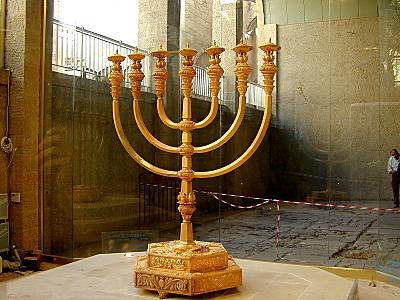
In addition, Cassuto says that “ner [‘lamp’] is used here in a collective sense: ‘lamps’ or ‘candelabrum.’

For more on the ancient lamp(s), see, e.g., Wikipedia’s article.

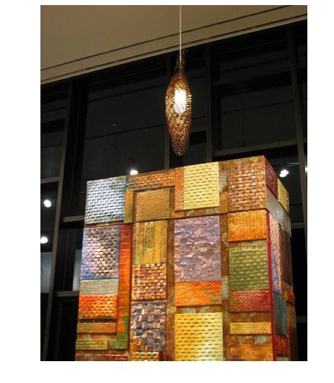
Here’s a quick reference on the later, synagogue “ner tamid.” To the right is an example of a new photovoltaic “ner tamid,” designed to save energy; this one was installed at Jewish Reconstructionist Congregation, Evanston, IL.


*Please see Source Materials for complete commentary and Torah/translation citations. Note: Tetzaveh is also transliterated Tetsaveh or T’tzavveh.

————————————————————–
The “Opening the Book” series was originally presented in cooperation with the independent, cross-community Jewish Study Center and with Kol Isha, an open group that for many years pursued spirituality from a woman’s perspective at Temple Micah (Reform). “A Song Every Day” is an independent blog, however, and all views, mistakes, etc. are the author’s.
———————————————————————————-