Moses said to the Children of Israel, “See, HASHEM has proclaimed by name, Bezalel son of Uri son of Hur, of the tribe of Judah. He filled him with Godly spirit, with wisdom, insight, and knowledge, and with every craft…”
— Shemot/Exodus 35:30-31
Author: vspatz
Pekudei: Something to Notice
The colors.
Before we complete the Tabernacle and leave Exodus/Shemot, I must pause to consider the oft-mentioned color trio: “tekhelet, v’argaman v’tolaat shani.” These colors are central in the tent instructions/construction and appear throughout the priestly garments. The same colors are, of course, prominent in contemporary Jewish textiles and other arts.

Tekhelet — Blue, Sky Blue or Indigo.

Argaman — Purple.

Tolaat shani — Scarlet or Crimson.
“Blue Wheat,” “Ode to Overturning Bowers vs. Hardwick” and “Pink Pomegranate” (looks scarlet to me) — above — are all works by DC-area artist Judybeth Greene.
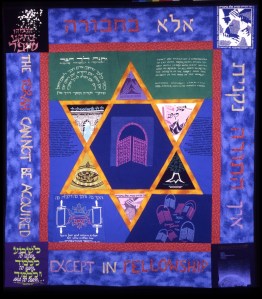
The quilt below was made by Amy Leila Smith, of Blue Feet Studio in Maine, for the National Havurah Committee.
…seems fitting closure for a portion which focuses on weaving, long a woman’s art. See, e.g., Women’s Work, the First 20,000 Years: Women, Cloth and Society in Early Times by Elizabeth Wayland Barber (Norton, 1994).
For more on the special history of tekhelet blue, see Ehud Spanier’s history (details in Source Materials).
[CAUTION on print and internet sources focusing on these three colors, especially tekhelet: Many involved in reconstructing exact colors of the Tabernacle and related work are deeply concerned with preparing for the Third Temple.]
————————————————————–
The “Opening the Book” series was originally presented in cooperation with the independent, cross-community Jewish Study Center and with Kol Isha, an open group that for many years pursued spirituality from a woman’s perspective at Temple Micah (Reform). “A Song Every Day” is an independent blog, however, and all views, mistakes, etc. are the author’s.
———————————————————————————-
Pekudei: Language and Translation
“And these are the names [v’eileh] of the Children of Israel who were coming [ha-ba’im] to Egypt…”
— Exodus/Shemot 1:1
“…throughout their journeys [mas’eyhem].”
— Exodus/Shemot 40:38 (Stone translation*)
A number of commentaries note that the vav (a conjunction which can mean “and” or “but”) is meant to link the narrative of Genesis with that launched with Exodus. In an unusual bit of similarity, both the Stone and Alter* commentaries make this point and also remark that identical words open the genealogy beginning at Genesis/Breishit 46:8.
Stone emphasizes the on-going nature of the narrative by using “were coming” for “ha-ba’im,” while Alter and others use the past tense. JPS* bridges the two with “came, each coming with…”
Alter also notes that the word mas’eyhem [in all their journeyings] uses “the same verbal stem [that] inaugurated the Wilderness narrative in 13:20, ‘And they journeyed from Succoth,'” suggesting that this helps leave a “sense of harmonious consummation,” as the work of the Tabernacle — likened to that of Creation — is completed. “But,” he continues:
the condition in which the Israelites find themselves remains unstable, uncertain, a destiny of wandering through arduous wasteland toward a promised land that is not yet visible on the horizon. The concluding words of Exodus point forward not to the Book of Leviticus, which immediately follows, but to the Book of Numbers, with its tales of Wilderness wanderings, near catastrophic defections, and dangerous tensions between the leader and the led.
— Alter, p.535
Chazak! Chazak! Venitchazeik!
Be strong! Be strong! And may we be strengthened!
* Please see Source Materials for full citations and additional information.
————————————————————–
The “Opening the Book” series was originally presented in cooperation with the independent, cross-community Jewish Study Center and with Kol Isha, an open group that for many years pursued spirituality from a woman’s perspective at Temple Micah (Reform). “A Song Every Day” is an independent blog, however, and all views, mistakes, etc. are the author’s.
Vayakhel: A Path to Follow
In this portion, and this portion alone, the women of the children of Israel are identified as a significant group within the larger whole,” writes R. Nancy H. Weiner in her dvar Torah, “Of Women and Mirrors.”
The Torah unequivocally highlights that women are participating in the single most important sacred endeavor of the community of Israel’s collective existence: the building of the mishkan, the place in which God’s presence will dwell among the people and travel with them as they journey toward the Promised Land.
And then the narrative takes a significant turn. The efforts of the entire community become the backdrop for the tasks taken on by the great (male) architects and craftsmen of the mishkan. The portion mentions the contributions of women only once more as it describes the labors of Betzalel, the chief architect of the mishkan. The Torah says, “He made the laver of copper and its stand of copper, with the mirrors of the women who served at the entrance of the Tent of Meeting (Exod 38:8)…
— Weiner, in The Women’s Torah Commentary
One path to follow is to look at the role of women in the ancient Israelite world. The work of Tikva Frymer-Kensky comes to mind as a starting point.
But Weiner herself suggests another path: “…[Women] are not the only victims of collective amnesia…” Look at less visible Jewish communities of today — Kulanu or Bechol Lashon [In Every Tongue].
The entire piece, “Of Women and Mirrors,” is available at GoogleBooks, The Women’s Torah Commentary.*
* Please see Source Materials for full citations and additional information.
————————————————————–
The “Opening the Book” series was originally presented in cooperation with the independent, cross-community Jewish Study Center and with Kol Isha, an open group that for many years pursued spirituality from a woman’s perspective at Temple Micah (Reform). “A Song Every Day” is an independent blog, however, and all views, mistakes, etc. are the author’s.
Vayakhel: Something to Notice
“…but the materials were more than enough [vehoter] for all the work that had to be done.” — Exodus/Shemot 36:7
Construction of the Tabernacle in the desert was an act that paralleled the creation of heaven and earth and corresponded to all known aspects of the order in which G’d created the universe, (B’rachot 55). Seeing that this was so, Betzalel, the chief architect of the project was granted the wisdom to understand how the letters of the aleph bet were to be used in carrying out all the details of the task entrusted to him.
Nowadays, this ability of Betzalel at the time of his building of the Tabernacle, has been granted to the righteous Torah scholars of varying degrees, who are able to reveal insights into the Torah that have not previously been revealed. By doing so, they become partners of G’d in His creation of the universe. Betzalel also imposed restrictions on himself in his use of the gift G’d gave him, so as not to preempt the Torah scholars throughout the ages an to thereby prevent them from revealing new insights. This is what is meant by the word [vehoter], “there was an overabundance,” i.e. there was enough holy spirit that had been provided to enable Betzalel and his assistants to build the Tabernacle, but instead of exhausting it at the time, Betzalel, in his modesty, was content to leave a surfeit of it to be used by Torah scholars, who in a way are also Torah “architects,” to delight their audiences with their insights in their respective generations.
— Rabbi Levi Yitzchak of Berditchev, Kedushat Levi,* p.525-6
* Please see Source Materials for full citation and additional information.
————————————————————–
The “Opening the Book” series was originally presented in cooperation with the independent, cross-community Jewish Study Center and with Kol Isha, an open group that for many years pursued spirituality from a woman’s perspective at Temple Micah (Reform). “A Song Every Day” is an independent blog, however, and all views, mistakes, etc. are the author’s.
———————————————————————————-

Pekudei: Great Source(s)
As Exodus comes to a close, this poem seems appropriate:
“Exodus” by Charles Reznikoff
…But there came a Pharaoh who knew not Joseph
and set us building treasuries and cities,
set us making brick for him and building cities:
we who had been masters of our days and daylight,
free to wander, free to stay.
King and servants, priests and laymen;
soldiers and overseers, and slaves:
this was Egypt’s peace and order,
and in this order we were slaves:
Israel like a bird that a creeping weasel has wounded in the head
or a man knocked against a wall;
the cattle have trampled it — but still it flutters.
But there came a shepherd from the desert,
speaking in the ancient tongue
all but our eldest had forgotten;
and we saw an old man — withered hands and haunches;
and he said to us, stuttering as he spoke:
I bring a message from the God of your fathers
and, in place of these burdens,
I bring you — the yoke of His law.
How pleasant it is, distinguished from the beasts,
to feed upon His law
tasting each syllable
the radiance of our Lord!
If there is bone enough to make the tooth of a key
and ink enough to write two letters of the alphabet —
then fear not the rush of tramping shoes nor the sound of the shouting
and hurry out of this land!
— found in Chapters into Verse
Reznikoff includes notes indicating that the italicized lines at the end of these two stanzas (of a four-stanza poem) “are from the Mishnah (Hullin 3:3 and other places, Danby’s translation).” The ink and bone references can be found in Babylonian Talmud Shabbat 78b.
You can read the entire poem at Google Books. See Source Materials for Chapters into Verse details. The poem is also found in The Poems of Charles Reznikoff
————————————————————–
The “Opening the Book” series was originally presented in cooperation with the independent, cross-community Jewish Study Center and with Kol Isha, an open group that for many years pursued spirituality from a woman’s perspective at Temple Micah (Reform). “A Song Every Day” is an independent blog, however, and all views, mistakes, etc. are the author’s.
———————————————————————————-
Vayakhel: Great Source(s)
He made the laver out of copper, and its base out of copper, from the mirrors of the serving women (tzovot) who served at the entrance of the tabernacle. — Ex. 38:8
Miriam was a teacher of women. — Targum Micah 6:4
“Each of you is made in the image of God,” Miriam explained. “Your soul and your speech are like God’s, and your body is God’s dwelling place. Each of you embodies the Divine presence in a different way. When you look into your mirror, you see a woman, bu you also see the Divine image. If a man were to look into your mirror, he would see a man, but he would also see God. This is what the Torah means when it says: God created the adam in his own image, in the image of God he created him, male and female he created them. God is like the mirror: God remains the same, but reflects each of our images differently, men and women, young and old. This is why, when we study together, we can reveal different facets of the Torah to each other. Each of us is different reflection of the One.”
…They made a covenant with one another to return again and again to the door of the Tent of Meeting, to pray, to study and see the their faces in the basin made form their mirrors. And in that company Miriam was often heard to teach: On account of the one God’s many images is the Eternal called Adonai Tze’vaot, Lord of Hosts; and some say, Adonai Tzovot, God of the women who serve the Divine dwelling-place.
— Jill Hammer, “The Mirror”
This midrash can be found in All the Women Followed Her (see Source Materials for details) and in Sisters at Sinai.
————————————————————–
The “Opening the Book” series was originally presented in cooperation with the independent, cross-community Jewish Study Center and with Kol Isha, an open group that for many years pursued spirituality from a woman’s perspective at Temple Micah (Reform). “A Song Every Day” is an independent blog, however, and all views, mistakes, etc. are the author’s.
———————————————————————————-
Ki Tisa: A Path to Follow
“Adonai, Adonai, el rachum v’chanun…” — Exodus/Shemot 34:6-7
The soul is part of God. And therefore when the soul calls out to God in prayer, part of God is, as it were, calling out to God’s own self. So, when our text says that God passed by Moses’ face, it means that Moses was overcome by reverence and filled with fear and love. And just this is the reason that the word “Adonai” is repeated. The first mentioning of “Adonai” is actually the aspect of God within Moses calling to its other, universal presence. Continue reading Ki Tisa: A Path to Follow
Ki Tisa: Something to Notice
Sections of this week’s portion figure prominently in Arguing with God: A Jewish Tradition, by Anson Laytner (Northvale, NJ: Jason Aronson, 1990).
Anson explores rabbinic use of Moses’ arguments (p.49ff). He describes liturgical use of verse 32:12 — “turn from Your fierce wrath, and repent the evil against Your people” — in an 11th Century CE piyut (liturgical poem) recited on Mondays and Thursdays as part of Tachanun [supplication] (p.122ff). In addition, he outlines the “complete law-court argument prayer” which Moses offers immediately after the Golden Calf incident, Exodus/Shemot 32:9-14:
Here is manifest an example of complete law-court argument prayer: an opening address (verse 11), a defense argument (verses 12a, 13), a plea (or petition) (verse 12b), and a divine response (indirect) (verse 14). But the threat of destruction is not ended. Although God relents of His plan (verse 14), He still requires further appeasement…(Exodus 32:30-35)
The second argument should be considered as a continuation of the first, although structurally each can stand alone. First of all, it pursues the same line of argumentation as does the first. Second, it provides the real conclusion to the story (that is God’s actual sentence and its execution [verses 33-35]). Third, Moses’ ultimatum, “erase me,” seems to be a direct response to God’s offer in verse 10 to make of Moses a great nation. Fourth, Moses’ recounting of the event, in Deuteronomy 9:26-29, blends the two arguments of the Exodus story into a single unit. Finally, both arguments are needed to save the people fully.
— Anson, p.10-11
Ki Tisa: Language and Translation
Exodus/Shemot 32:25, part of Moses’ confrontation with Aaron regarding the Golden Calf, contains two interesting words for which there are a range of translations. One is a hapax legomenon, a word that appears only once in the Tanakh; the other a common verb, with a root that encompasses three and half columns in my concordance:*
“Moses saw the people, that it was exposed [ki parua hu], for Aaron had exposed them [ki p’raoh aharon] to disgrace [l’shimtzah] among those who rise up against them.” — Stone*
———
“Moses saw that the people were out of control [ki parua hu] — since Aaron had let them get out of control [ki p’raoh aharon] — so that they were a menace [l’shimtzah] to any who might oppose them.”
A menace. Others, “an object of derision.” — JPS/Plaut*
——–
“Now when Moses saw the people: that it had gotten-loose [ki parua hu],
for Aharon had let-it-loose [ki p’raoh aharon] for whispering among their foes [l’shimtzah].”
gotten-loose: The same verb (paro’a) was used in 5:4, where Pharoah complained about the Israelites. for whispering: A derisive kind of whispering. — Fox*
——–
“And Moses saw the people, that it was let loose [ki parua hu], for Aaron had let them loose [ki p’raoh aharon] as a shameful thing [l’shimtzah] to their adversaries.”
The basic meaning of the Hebew paru’a is “to unbind,” as in the unbinding or letting loose of long hair. The sense here is of loosing of all inhibitions in orgiastic frenzy.
The word translated as a “shameful thing,” shimtsah, appears only here and so its meaning is uncertain, though it seems to indicate something strongly negative. “To their adversaries” might conceivably be a euphanims for “themselves,” as the more common word for enemies is sometimes used as a euphemistic substitution in curses.– Alter*
Cassuto* notes use of the root pei-reish-ayin in Numbers/Bamidbar 6:5, e.g, which refers directly to hair, in this case of an individual who took Nazarite vows: “…he shall let the locks [pera’] of hair of his head grow long,’ that is to say, the Nazirite shall allow the hair of his to grow untended” (p.420).
None of the six translation/commentaries links pei-reish-ayin with the Sotah [suspected wife] (Numbers/Bamidbar 5) — in which the priest is to bare [para’] the wife’s head. All note similarities, however, between Moses’ actions regarding the Golden Calf and the priest’s instructions regarding the Sotah.
Cassuto also notes a comparison of this loose/exposed/out of control state with the stiff-necked characterization of verse 9, adding, “In these poetic expressions there is possibly to be heard an echo of the ancient epic poem to which we have alluded earlier” (p.421). Throughout his Exodus commentary, Cassuto refers to “an ancient heroic poem, an epos dating back to earliest times, that told at length of the story of the Egyptian bondage, of the liberation and of the wandering of the children of Israel in the wilderness” (p.2).
* Please see Source Materials for full citations and additional information.
————————————————————–
The “Opening the Book” series was originally presented in cooperation with the independent, cross-community Jewish Study Center and with Kol Isha, an open group that for many years pursued spirituality from a woman’s perspective at Temple Micah (Reform). “A Song Every Day” is an independent blog, however, and all views, mistakes, etc. are the author’s.
———————————————————————————-
