Blog

Miriam, Amalek, Memory, and Mouths

This dvar torah is about remembering and how Jewish memory is built with the help of our prayerbooks. Some of what I learned in preparing today’s remarks can be found in this handout.

The end of the handout is the result of the earlier parts of my studies, a brief exploration into Mishkan T’filah and earlier drafts of the siddur, mostly focusing on one pair of pages where we find: “Six Torah episodes are to be remembered each day, to refine our direction.”

The “Six Torah episodes” section can be found on pages 43 and 205 in the actual Mishkan T’filah, on page 12 in the handout, shared here.
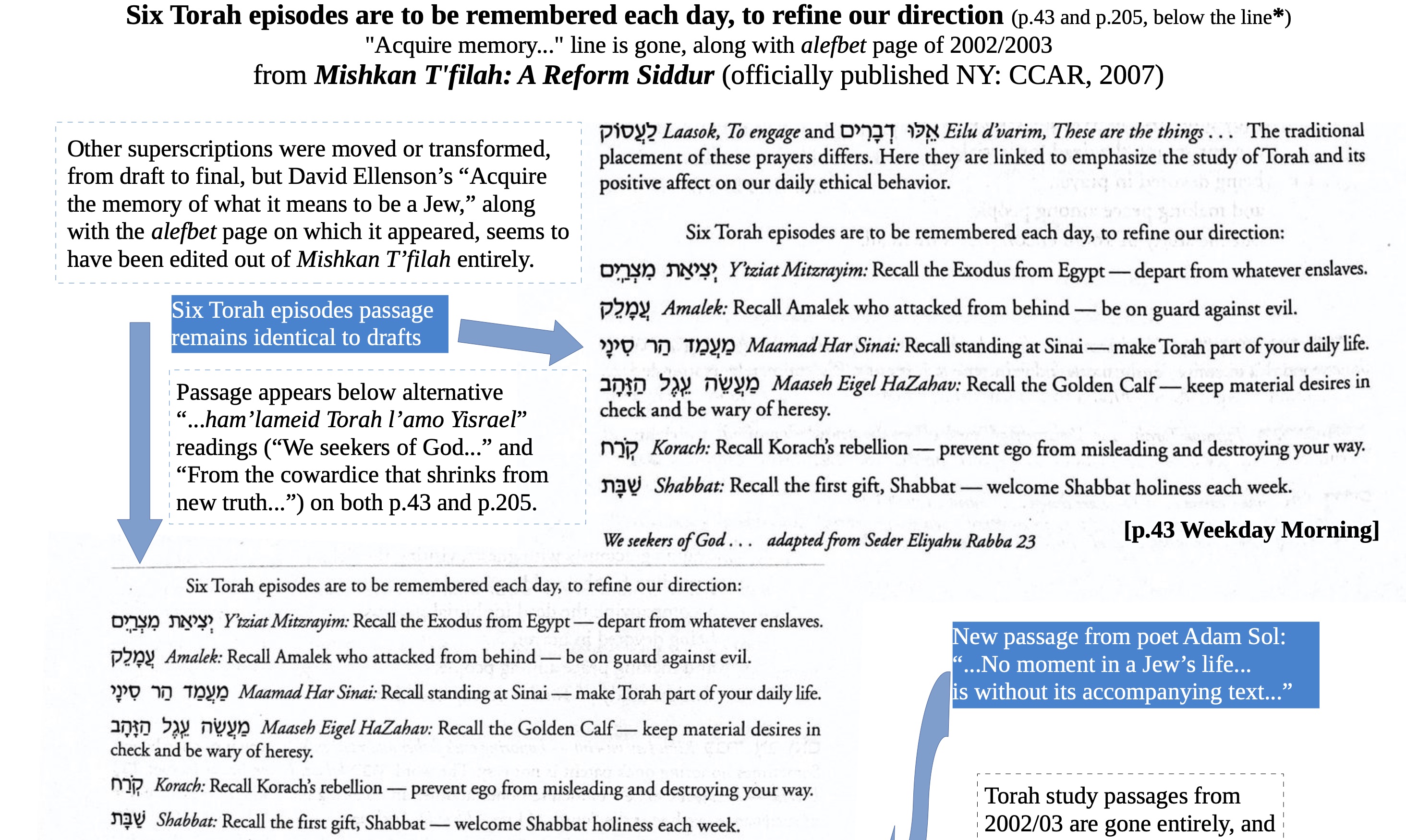
full text version can be found here

In similar passages (more on this later) in other prayer books, “What God did to Miriam” is included here. I turned to older drafts of Mishkan T’filah, hoping they might clue me into why Miriam is not on this page.

Endnote Deadend

An endnote in the published siddur says the Six Torah episodes were “adapted from a Sephardic siddur.” But it doesn’t specify which or say what was adapted. I could find no example anywhere, Ashkenazi or Sephardic, in another siddur which changes the verses so as to omit Miriam, as Mishkan T’filah does. Every other example over the last 1000 years seems to focus on the same six incidents, all of which include a Torah verse demanding that we “remember” and/or “not forget.” Only Mishkan T’filah uses a different list. Only Mishkan T’filah leaves out specific Torah verses. And only Mishkan T’filah adds in Korach — about whom we have no memory admonition in the Torah.

These seem significant differences, and I thought it a little odd that so much changed over the course of the drafts, while this passage remained static through five years or more of edits. (See the handout for some notes on changes that did occur over the drafts.) No one I asked — including some Temple Micah clergy, current and past, and other people I thought might know — had an explanation. Rabbi Gerry Serotta, who served as interim rabbi some years ago, sent a query on my behalf to the siddur’s chief editor, Rabbi Elyse Frishman, and to Rabbi David Ellenson. If we hear back, I’ll let you know.

Improvement by Removal?

Meanwhile, Rabbi Gerry and I guessed that removing Miriam had been an attempt to respond to feminist criticism about how Miriam is usually remembered: 1) focusing on her case of tzaraat, a skin condition, rather than on anything she actually did or who she was; 2) remembering “What God did to Miriam” in a way that accuses her of lashon hara [evil speech], although that is unclear in the text; and 3) blames Miriam alone, while the text clearly states that both Aaron and Miriam spoke against Moses (Numbers 12:1ff).

If it’s true that the change was made due to feminist sensibilities, it seems ironic — and oddly instructive — that, as a result, Miriam is… just gone.


Acquiring Memory

In my travels through older prayerbook drafts, I was intrigued by the adage, attributed to David Ellenson: “Acquire the memory of what it means to be a Jew.”

This prompted me to wonder:

  • What did the siddur editors want us to remember with this set of episodes?
  • What does it mean that Miriam is not on the page?
  • What would it mean if she were there?
  • What does it mean that Mishkan T’filah made this change without explanation?
  • Would the passage land differently, had an explanation been included?

From there I followed many other branches of wondering, more generally, about how memory, and Jewish identity, are formed by our practice and our prayerbooks. That brings me to older material I found relating to the Six Remembrances.

On page three of the handout is a Talmudic source arguing why the verb “remember” should be understood to mean “repeat it with your mouth.” The link between speech and remembering is an old one in Jewish thought. The passage from Sifra discusses four of the verses in the Six or Ten Remembrances.

full text version can be found here

In addition to these four, the Exodus and the Revelation at Mount Sinai are included. Here, page 6 of handout, is a typical example of how the Six Remembrances appear in contemporary prayerbooks —
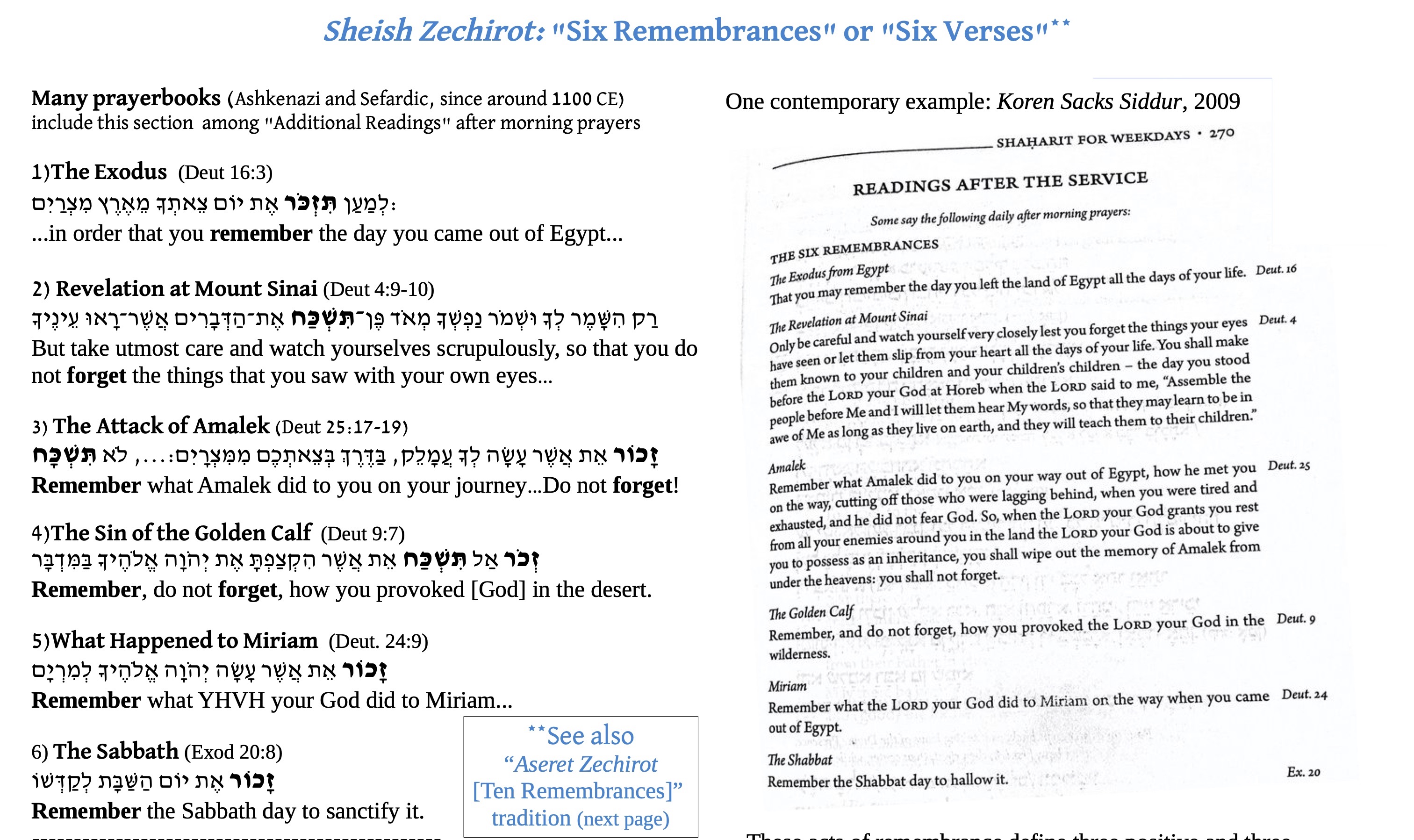
full text version can be found here

Intentions and Remembering

In addition to Mishkan T’filah’s “to refine our direction,” other intentions introduce these remembrances: from a simple “some say,” to “for the sake of unification of the divine name…” and “those who recite these are assured a place in the world to come.” (See page 2 of the handout for these various intentions and page 6 for details of how the Six and Remembrances and the “Six Torah episodes” differ.)

The Sifra passage also includes an expression that really caught my attention — the idea of “heart-forgetfulness,” apparently something that can be fixed with thought, while speech is required in other cases…..

This might be a good thing to keep in mind during Elul, thinking about what can be repaired by thought and memory and what requires speaking aloud.

Back to Miriam

Now, back to Miriam, who is not on the Mishkan T’filah pages but IS in this week’s Torah portion (now last week’s, Ki Teitzei, Deut. 21:10 – 25:19 — pages 7 and 8 of the handout). Deuteronomy 24:9 is one of only 12 times her name appears in the Torah.

Rabbinic imagination saw Miriam’s Well in the white space between her death and the lack of water in the next verse. And many other stories and lessons surround Miriam. But she appears in four incidents in the Torah — named three times and “his sister” in another — and is mentioned twice more. That’s it. That’s all she wrote about Miriam.

full text version can be found here

There is a lot of commentary about the two verses in this week’s portion– the one telling the listener to heed the priests in matters of tzaraat (Deut 24:8) and the following one telling us to remember what God did to Miriam.

What God did to Miriam is related in Numbers 12. The demand that we remember what God did to Miriam is usually understood as a warning to guard the tongue, due to links in commentary between tzaraat and sins of the tongue. But it’s crucial to note that there is no direct link — either in this week’s portion or in Numbers 12 or elsewhere in Torah text — between Miriam and evil speech.

What and How We Remember

The story in Numbers 12 is full of obscure imagery, and Miriam’s tzaraat is the same condition Moses experienced at the Burning Bush, where it was part of his recognition as a prophet, and not understood as punishment at all. Early Jewish teachers chose to make Miriam an object lesson rather than following another set of interpretations with a different set of lessons.

None of the other Six or Ten Remembrances involve an individual, so — regardless of initial intention — Jewish thought and law were greatly influenced by the linkage that developed between Miriam, and women in general, and evil speech.

  • But, is that a good reason to remove the text from recitation?
  • Does that facilitate forgetting of a helpful kind?
  • What is gained and what is lost in removing a passage with difficult associations?
  • Might it be better to keep it in and work to understand and re-interpret?

Theologian Judith Plaskow discusses this in a piece on this week’s portion, “Tzaraat and Memory.” I highly recommend reading the whole thing — either in The Torah: A Women’s Commentary, in print, or on My Jewish Learning.

Writing in 2008, Plaskow raises the issue of how progress can actually be a challenge to memory and to further progress. I’ll add that her conclusion can also apply to the appearance of progress, as when a problematic text is removed from regular recitation or consideration, or when we make changes that don’t always benefit the most harmed or vulnerable.

She writes, referencing the other important “memory” verses in this week’s portion:

We blot out the memory of Amalek when we create Jewish communities in which the perpetual exclusion of some group of people — or the denial of women’s rights — are so contrary to current values as to be almost incredible. Yet, if we are to safeguard our achievements, we can also never forget to remember the history of inequality and the decisions and struggles that have made more equitable communities possible.


What We Remember, What We Fix

I’ve been watching a series of mysteries focusing on women in the mid-1960s. (For fellow mystery fans: Ms. Fisher’s Modern Murder Mysteries, set in 1964-65 Melbourne, Australia, a delightful set of sequels to Miss Fisher’s Murder Mysteries, set in the same area in the late 1920s.) And I’ve noticed that I am remembering, quite viscerally, how it FELT, as a girl and young woman, to have limited rights, opportunities, and expectations. And also of how dangerous it could be back then, in physical, legal, and psychic ways, for women and also for queer people and for many others….And I’m on the young side for these experiences; others have longer histories with inequality.

This exploration also reminded me of, on the one hand, how grateful I was to have to explain such things to our children as they were growing up. So many conversations that centered around: Queer people were forbidden from expressing their identity or acting on their sexuality, let alone getting married?! Women weren’t allowed to what?! US law defined whiteness as property and prevented Black people from what?!

On the other hand, I remember the desire to let them go on asking questions like “Do you have to be a mommy to lead services?” without ever realizing how impossible that question would have been in my youth and how painful it was for all of us who didn’t see ourselves reflected in leadership roles…or at all.

There is a strong tension between wanting to build a world with more equity and inclusivity, on the one hand, and the responsibility to never forget that we are sitting in a place built by damage; with many wounds still present, often unhealed, and so much work still to do. Continuing to REMEMBER, and recite, difficult passages can cause harm. But failing to remember carries it’s own risk.

The same applies in many ways to teshuva: When might it be appropriate to forget or not mention old harm, and when must we work to remember and confront? In other words, maybe, when are we dealing with heart-forgetfulness and when with something that requires us to use our mouths?

As I tried to figure out what happened with Miriam and the Six Torah episodes, I kept remembering these lines, from a song about memory and loss —

If you hear that same sweet song again,
will you know why?

— “Bird Song,” by Robert Hunter (1941-2019) & Jerry Garcia, z”l (1942-1995)
first performed Feb 19, 1971. “for Janis [Janis Joplin (1943-1970)]”

How much do we lose, and what do we gain, when we forget to remember why we chose to remember or forget?

This dvar Torah was originally prepared, and offered in a slightly different form, for Temple Micah (DC), 5781.


Handout in PDF and text versions

Full text version of handout for anyone who cannot easily do graphics is posted here.

BACK to TOP

Remedy of the Bima?

Updated August 23, 2021

Gittin 55a states that an individual who experienced the theft of a beam, which was then built into a large structure, must receive the value of the beam as reparation. This ruling is מפני תקנת השבים, due to or because of…

תקנת השבים

outside (standard) translation of takanat ha-sh’vim:* a phrase meaning “[Rabbinic] Law of Penitence”

תקנת השבים

inside (word-by-word) translation: a phrase with roots תקנ “repair” [tiken] and שׁוב “return” [shuv] — something like the “repair of the returning” or the “remedy of reparation” (“Inside” translations don’t sound like smooth English.)

תקנת השבים

This is far-fetched grammar-wise, but it captures an important aspect of what’s on my mind regarding this text. Shifting focus, however grammatically fanciful: might we read בים [bim] as related to בימה “stage, platform, bima“?

…The modern Hebrew verb, “to stage” בים, biyem, was created from בימה. The Klein dictionary (c. 1983 CE) says בימה was originally a Greek loan word, but Jastrow (c. 1883) says specifically that this is NOT so, arguing that the Greek word βῆμα would be spelled with an aleph in Hebrew, rather than a hey. Either way, though, the examples Jastrow gives for בימה are all about holding forth, making announcements, hearing from distinguished speakers, etc. So, it doesn’t seem like a big leap to bima-ing as a verb meaning to hold forth from a raised position (metaphorically and physically)….

The result would be something like, “remedy of that which is bima-ed,” suggesting that those who experienced theft are entitled to reparation from a bima, for all that was taught, from positions of power, over the centuries, continuing to build up a bigger and stronger bira [large structure] of systemic racism.

How much bima-ing has continued to raise up many laudable-sounding ideas while failing to note:

  • that we sit on unceded, stolen land;
  • that our country was historically built with stolen labor;
  • that today stolen labor continues in our prisons and other inequitable systems;
  • that some among us experience relative security built at the cost of well-being, freedom, and sometimes the very lives of others, including Black, Indigenous, queer, and other people whose human rights have long been a stolen beam still built into a structure that benefits others; and
  • that Jews have often been complacently “bima-ed” around these topics for a long time?
photo intended as a random example of a bima — image details below

Heading into the Days of Awe this year, I wonder about the need to take more responsibility, from the pew, for what goes on from the bima:

If our Jewish communities are not hearing from those who teach Torah, in its many forms, about our obligations in regard to stolen beams, then do we, from the pews, have a responsibility to “remedy that which is bima‘ed”?

How do we do that?

What if we cannot (immediately) change the bima-ing? Then what?

What, exactly, is our responsibility — individually and collectively — when it comes to learning and what we are taught to act on as a community?

This is a musing prompted by this year’s Elul learning through SVARA: The Traditionally Radical Yeshiva. For a different musing, prompted by last year’s studies, see “About that stolen beam…

beam illustration — details below


takanat ha-sh’vim: This is a transliteration of the phrase as worked out in Beit Midrash [House of Study] of SVARA: The Traditionally Radical Yeshiva. The Talmud gives us no vowels, and the work of the Beit Midrash is to explore possible meanings before settling on one or more. Deciding how to vocalize, or transliterating too soon, prematurely limits the meaning….but I’m including this, and other transliterations, here for convenience.

BACK

Image descriptions and credits:

Beam illustration: Stone Lintel Beam.jpg from Wikimedia Commons (4.0 Attribution-Share Alike), adapted annotations

Image description: simple drawing of a brick wall with an opening and lintel beam. Added notations read: “Stolen? Beam” and “Built into a large structure”

Bima Image: Synagogue of Villa Dominguez (Argentina): The Torah Ark and the Bimah

123- Villa Dominguez – Synagogue.JPG — Wikimedia Commons 4.0 Attribution-Share Alike.

Image description: Inclined smooth wooden reading table, covered in cloth, facing ornate wooden ark in a synagogue empty of people.

Or Olam: the light ahead and within

Seeking pieces of liturgy and other resources for uplift, as we try to move from the depths of Av to the new year, I’ve found myself returning again and again to “Eternal Light” — based on a line from the high holiday prayers — as composed by Norma Brooks and recorded by “Psalm Full of Soul” with guest artists The Blind Boys of Alabama (recording below).

Or Olam — Eternal Light

“Infinite light is preserved in life’s treasure-house; ‘Lights from darkness’ said God — it was so.” — from the piyyut “Or Olam

“And the light of the moon shall become like the light of the sun, and the light of the sun shall become sevenfold, like the light of the seven days, when the LORD binds up His people’s wounds and heals the injuries it has suffered.” — Isaiah 30:26

These lines, from an ancient liturgical poem by Yose ben Yose (4th-5th Centuries CE) are added to the Yotzeir Or blessing on the High Holy Days. They refer to a Talmudic legend (Chagigah 12a) that the brilliant primordial light of Creation, too powerful for mortal eyes, was hidden away by God, and is preserved for the righteous in the world-to-come.

— liturgical verse and commentary from Mishkan Hanefesh for Rosh Hashanah (CCAR, 2015)

Each of us is a repository of life. We are where life is stored, and this eternal light rests inside each of us, waiting for us to manifest it with our actions. When we act justly, we bring this light into the world, answering God’s dictum, “Lights from the darkness!” When we help another, we bring the “it was so” into the present, an ongoing creation of light in darkness (R David Kominsky, b. 1971)

— commentary from Mishkan Hanefesh continued

The song, “Eternal Light,” is based on “Or Olam” and its commentary, as well as on Gen 1:3-5 and Isaiah 30:36 and 45:7. The same line appears in Rosh Hashanah and Yom Kippur liturgies (see p.178 in Mishkan Hanefesh for Yom Kippur, e.g.) Video here, with lyrics, is shared with kind permission of Norma Brooks, composer. Full credits below.

For more musical inspiration, including some pieces for the high holidays, check out Norma Brooks’ earlier album, Bountiful Light, created with the help of musicians and choir members from DC and beyond.

Image description: Video is basically one static pair of images overlaid throughout with the song lyrics. Image 1 is a photo of the eight performers at recording session: Blind Boys of Alabama with “Psalm Full of Soul,” that is, Vanessa R. Williams, Vince Evans, and Norma Brooks. Image 2 is the album cover showing Psalm Full of Soul logo and a picture of Vanessa, Vince, an Norma laughing together. Static text: “Psalm Full of Soul ‘Eternal Light.’ Composer: Norma Brooks. Vocal Soloist: Vanessa R. Williams. Featuring guest artists The Blind Boys of Alabama.” On top of the static graphic, lyrics appear in a text box as song progresses. (Lyrics can also be found below.)


“Eternal Light” lyrics (Norma Brooks)

Eternal, eternal light
Source of life, source of life
Light of creation, God’s living treasure
O holy light, God’s holy light

Light from darkness
Light from darkness
God spoke, and it was so
Light from darkness
Light from darkness
Creator of heaven and earth

Eternal, eternal light
Source of life, source of life
Light of creation, God’s living treasure
O holy light, O holy light

O holy light, eternal light

When the light of the moon
Shall be as the light of the sun
And the light of the sun
Shall be sevenfold
As the light of the seven days,
Seven days of the week
Oh, in the future
There will be a more perfect light
The light resides
Within Each one of us,
Just waiting for us
Just waiting for us
To act justly, to act with purity,
Clarity and joy

The ongoing creation
Of light from darkness
O holy light, O holy light
Eternal light, O holy light

Eternal, eternal light
Source of life, source of life
Light of creation, God’s living treasure
O holy light, God’s holy light

BACK

Credits for “Eternal Light”
Guest Artists: The Blind Boys of Alabama (Jimmy Carter, Ben Moore, Joey Williams, Paul Beasley)
Vocal Soloist: Vanessa R. Williams
Keyboards: Vince Evans
Guitar: Alvin White
Bass: Bryan Fox
Drums: J.C. Jefferson
Choir: Rhonda Burnett Chapman, Byron Nichols, Michael White, Vanessa R. Williams
“Psalm Full of Soul” (c) 2008

RETURN

Hallelu Avdei Adonai

UPDATE 9/22/21: Friends of Cantor Richard Kaplan share with sadness the news of his death on the first day of Sukkot 5782, 9/21/21.

This chant, which comes from Iraqi Jewish tradition, uses the phrase “Praise God, Servants of God” from Psalm 113:1 as a chorus and acrostic verses highlighting attributes of God: Mightiest of the mighty, Blessed among blessed, Greatest of the great…Guardian among guardians, Sustainer among sustainers. Here is a captioned version of the chant as presented in the 2000 “Tuning the Soul: Worlds of Jewish Sacred Music,” from Richard Kaplan & Michael Ziegler.

This video adapts, with permission, the one found on Kaplan’s YouTube channel by adding the lyrics with no other changes.

A note on teachers and transmission: I first learned the chant from Amy Smith and Bill Savedoff who taught it to Fabrangen Havurah for the high holidays years ago. Members of Fabrangen reported hearing the tune from a nearby synagogue when they were living in Jerusalem and helped our son share it during the service when he was bar mitzvah….again, years back. This video was prepared to share with Hill Havurah, 5781/2021. But a video with the fast-paced lyrics might be of use to many.

Whence Comes Help: After Tisha B’av

With Tisha B’av behind us, we are meant to be climbing upward, from the calendar’s deepest point, toward the new year. But how can we begin the climb while disasters mount around us and reasons to mourn continue to grow? Psalm 121 speaks to a moment such as this. I’ve found myself turning again and again in recent days to the Nefesh Mountain version of “Esa Einai.” And to this idea that there is stability, despite the constant change…even the mountains are shifting:

“Change is ceaseless, and transformation knows no pause. The dynamism both exhilarates and exhausts the spirit; no wonder that we seek stability amidst this endless process.” Thus writes R’ Everett Gendler in a commentary on Psalm 121. He then suggests that Psalm 121’s expression “mei-ayin” — usually translated as “from where?” — carries “echoes of the Creative Nothingness, the Divine Void, the AYIN” and that God’s four-letter Name [YHVH] hints at “stability amidst ceaseless process.” (Full comment found in Kol Haneshamah: Shabbat Vehagim. Reconstructionist Press, 1996, p.215.)

Thanks to Nefesh Mountain for creating their uplifting music, and for permission to share their “Esa Einai” along with this commentary as part of an effort to begin looking upward.

Learn more about Nefesh Mountain, and check out their newest album, “Songs for the Sparrows,” just released in June.

Eicha for my city and others, 5781

Alas! How lonely sits the city
Once great with joyful people!
New horrors fill horizons now
while old pain never left
Each new loss diminishes
the streets themselves bereft

Bitterly we weep all night
cheeks wet with tears unseen
If we are to join together,
we must widen this choir of woe
When some cries are background noise
what’s the meaning of “friend” and “foe”?

City crying out with loss:
six-year-old child shot to death
joining a list, far too long,
of youth killed in past years.
Community grief so deep for some
while others escape most tears.

Down our roads, more peril
desolation, violence, fear
systems that crush and jail
separate, cage, and hate
Borders come in many shapes
Too often closed, that welcome gate

Evidence mounts. But do we act?
ICE camps remain; racism persists.
Policing prospers, yet safety eludes
Some thrive, while too many do without.
Must we ignore some of our truths
in chasing a joint goal to shout?

Forging coalition is struggle, tougher in anguish.
Inside affliction, can we hear another cry?
It is painful and complex, but we must keep trying
trying to heed the whole sound
I know you can hear it, God once declared loudly:
that voice of a sibling crying up from the ground

–V. Spatz, songeveryday.org CC-BY-SA


Back in 2019, a number of Jewish communities were marking Tisha B’av with vigils and protests, attempting to demonstrate that Jews will not turn our backs on refugees arriving in this country and on immigrant neighbors already here. The original “Eichah: for my city and maybe for yours” (2019) asked us to consider the following:

  • Recognize many ways our country has long separated families, caged and brutalized people?
  • Cry with our local, national and international communities, refugees and not, who lend different voices to the chorus of “How lonely sits this place!”?
  • Send prayer energy to our many beleaguered communities, near and far?
  • Commit to exploring, in the days to come, ways in which we are complicit in so much suffering and ways we might take up action for repair?

On this Tisha B’av, 7/18/21, DC-area Jews please acknowledge:

  • Nyiah Courtney, age 6, shot to death in Ward 8 on 7/16/21 (the 108th homicide in DC, 2021)

And remember:

  • Makiyah Wilson, age 10, shot to death in Ward 7 on 7/16/18
  • Karon Brown, age 11, shot to death in Ward 8 on 7/18/19

Here is the 2019 version, “Eichah: for my city and maybe for yours.” And here is a PDF to use and share of this version.

Reparations Background

New page, just posted, shares resources about reparations, from Jewish and non-Jewish or more general sources. REPARATIONS RESOURCES

RECONSTRUCTIONIST NEWS: Save the Date – Day of Learning on Reparations Join Reconstructing Judaism for a Day of Learning on the topic of reparations as we move into the month of Elul on Aug. 8 starting at 11 a.m. EDT. Stay tuned for more information and a link to register for this event! — from ReconstructingJudaism.org

REFORM NEWS: The Union for Reform Judaism issued a resolution on studying the issue. The resolution itself includes some background and references. The resolution then called for Reform congregations and members to support HR40; to “take active steps to redress the destructive effects of historic and ongoing systemic racism, including through education…”; and to commit to “assessment and evaluation to strengthen our own institutions’ efforts to combat implicit and explicit bias and promote racial equity.” There must be a report somewhere on what congregations and members have done in response in the ensuing year and half; will share when found.

See also —

Remembering and Reckoning

“Until That Day: What Are We?”

A first draft, April 17, 2021 of a poem in response to Yehuda Amichai’s “And Who Will Remember the Rememberers?” (associated with Israel’s Memorial Day, 4th of Iyar) — V. Spatz


“Until That Day: What Are We?”

Verses for a Day We Don’t Yet Have,

have yet to acknowledge we need.

Generations of memory-veterans stagger

with weights carried by elders and ancestors

and boulders we watch children try to bear.

The current generation of fresh loss has members

of ripe old age who mourn alongside children

some still in a school team’s bright colors.

Who, beyond the circles of near loss, acknowledge the rememberers?

//

How does a monument come into being?

A bullet shatters a life and a lamppost sprouts

flowers and stuffed animals, balloons and banners.

A mirror’s adornment or a headlight’s unblinking stare

lead onto a road some call “hope,” but too many know as “dread.”

Vigil upon vigil and protest unending, the battle never recedes,

and tears rarely dry in some communities

while others pause now and then to note the numbers

maybe read the names.

But who, beyond the circles of near loss, acknowledge the remembers?

And where is that national day of reckoning

as yet unimagined?

//

How would we stand on such a day?

Erect or stooped, in mourning or guilt.

Collective protest of death lost in recognition

of our long participating in a system that kills.

//

Every joyful birth sends another child into a jumble,

a landscape lush with potential deaths:

“They looked suspicious.” “I thought it was my taser.”

“I feared for my life.” “I gave 12 seconds of thought.”

When, beyond the circles of near loss, will we truly acknowledge

Adam Toledo, James Lionel Johnson, Dominique Williams,

Rakia Boyd, Terrence Sterling, Anthony Louis,

LaQuan McDonald, India Kager, Oscar Grant,

Archie Williams, Gary Hopkins Jr., Alonzo Fiero Smith…

Can we ever truly mourn and still continue to live

in a system that kills this way?

Until we all remember the rememberers

until we all stand in a day of reckoning,

what are we?

If one is unprotected: a prayer for DC and beyond

As the District of Columbia begins absorbing crowds seeking to engage in “wild protest,” DC’s mayor is asking locals to “stay home” or “stay out of the downtown area.” Community and religious leaders were encouraged to share the “stay home and stay safe” message.

The DC Council’s statement also urges people to avoid protest areas but includes some nuance: “We recognize that downtown is home to residents and businesses whose rights must be respected and protected as we work to keep all safe, including residents who are currently homeless,” they write, asking the mayor and police to prioritize the protection of these groups.

Black Lives Matter-DC, earlier issued a call “asking all DC residents to hold the city officials and businesses accountable” for the failure to oppose white supremacist attacks in November and December. In addition, their statement “also calls upon Black and brown people, if possible, to avoid Trump support rallies and actions. They ask that Black and brown residents stay alert and vigilant during the upcoming white supremacist invasion.” Full statement here —

With these three calls in mind, and in solidarity with religious institutions who are attempting to respond to the threats, I share this prayer. It is based on one from Jewish morning prayers:


Blessed is THE SOURCE OF ALL, who forms humans in wisdom, with possibilities for communication and connection. Before the vastness and weight of THE DIVINE, we recognize and acknowledge essential networks, within us and around. Any disruption or blockage threatens survival and health of the whole.

None of us are free, if one of us is chained.

We are never truly safe, if one is unprotected.

Amid sources of division, keep us mindful of interconnectedness, collective responsibility and strength.

Blessed is THE HEALER and THE SUSTAINER of ALL CONNECTION.

For a more visual presentation, here’s a JPG with the text on a background image of a network, with denser connections at center. Text is identical to that above; image is by Gerd Altmann from Pixabay

Here’s a PDF with background image and full text for easier sharing.