Some Say 400 Cubits: Slow Dancing with Talmud

I first learned the story of “The Oven of Akhnai” (B. Baba Metzia 59a-59b) in the context of Imma Shalom, wife of Rabbi Eliezer, and her teaching about “the gate of wounded feelings.” I learned more about Rabbi Eliezer’s life, post-Akhnai, from a class on one of the Nine Talmudic Readings of Emmanuel Levinas. In addition, I’ve seen and heard the text referenced in many a commentary emphasizing that “Torah is not in heaven.” (See notes below on Akhnai, Imma Shalom, and Levinas.) For the first time, however, I am now reading the story in a small community of learners grappling directly with the text as it appears in the Babylonian Talmud…

…word by word,
sometimes syllable by syllable,
through Aramaic and Hebrew,
without relying on previous translation,
until we’ve discerned, at least tentatively,
each word’s root and tense,
gender, number, and possible meanings.
We learn how the words work with one another,
how “technical” expressions like “it is taught,” add clues,
how we, together with our study partners,
and then as a group with our teacher,
can work together to explore
what the text might be saying
and what that says about Jewish thought….

For this “Contemplative Bet Midrash,” taught by SVARA Fellow Rabbi Lauren Tuchman, we are asked to set aside any previous meetings and encounter the text as though for the first time. (For more on SVARA: The Traditionally Radical Yeshiva, visit their website.)

We are encouraged to look up every word, even ones we (think we) know, in order to consider a variety of possible definitions.

SVARA-Inspired Slow Dance

The opening line of our text, for example, tells us “they cut it into pieces,” without explaining who cut what or why. So, we test out “circle” and “dance” and “everyday” before settling on “sand” as the best definition for “חול (chol),” the substance between these unexplained pieces.

We learn that these pieces and sand are “the oven of Akhnai,” and then ask, right along with the voice of the Gemara: “What is this, Akhnai?”

We experience as passing strange the introduction of a carob tree as a point of proof in this argument. Our studies paused this past week right after “they” tell Rabbi Eliezer, “we don’t take evidence from carob trees.” And from this cliff-hanging perspective, I notice things I previously missed.

I’ve never noticed before how this story begins with an image of brokenness — “they cut it into pieces” — and then introduces Rabbi Eliezer already in opposition to the Hakhamim (“Wise Ones,” that is, scholars holding the majority opinion in this case). Previous passes through this material made clear there was a dispute of some magnitude, but I never noticed the extremes of response here, even before we reach the carob tree and what follows:

  • Rabbi Eliezer does not just argue but brings “all the responses (or refutations or arguments) in the world [כל תשובות שבעולם (khol teshuvot sh’ba-olam)],” while
  • the Hakhamim refuse to accept (any) arguments from him, [ולא קיבלו הימנו (v’lo kivalu heimenu)],” rather than simply disagreeing.

“They refused to accept (anything) from him.”

When our learning for one week paused at this point, that phrase just seemed so stark. (Despite attempts to meet the text anew, I’m sure my reaction is influenced to some extent by previous encounters. Still.)

BabaMetzia1

You are There

Along with feeling the starkness of Rabbi Eliezer’s rejection, I understood the frustration of a community that had made a decision and still heard “all the refutations in the world” from one individual. After all, I’ve been there often enough: watching participants in a community meeting come to a difficult decision while one person — for better or worse in the long run — just cannot get on board….

…Some readers might remember when Walter Cronkite (1916-2009) did those “You Are There” reports, like this one when he speaks from the midst of the Chicago Fire on October 18, 1871. There is a big difference between such a “report,” however contrived, and more distant approaches to history….

One of the effects of the SVARA-inspired slow pace through the material, I’m realizing, is a little like those Cronkite reports: I am there in a way I had not been before.

Learning unfamiliar jargon — or “technical terms” — of the Talmud, as SVARA-inspired spaces encourage, also promotes the “you are there” experience. Some other Talmud studies have included such terms, but I’ve never before been in a group where the practice is to stick with one bit of text until we all have the basics of how it arrived. I now know, for example, that “we learned there” [t’nan hatam] doesn’t reference something taught elsewhere in Babylon or in Jerusalem: instead, it means “elsewhere in the text” (and I am now able to locate the citations on the page). Rabbi Tuchman teaches us to recognize shifts from Mishnah to Gemara and back and make sure we know who is speaking to whom and when. Being asked to constantly orient ourselves within the text makes for a different experience of it.

When the carob tree gets up and moves 100 cubits for Rabbi Eliezer’s proof, the rabbinical report includes the expression, “but some tell it” [v’amri lah], and the alternative recollection: “400 cubits.” In the past, I’ve read this, without giving it much weight, as two variants of a fantastic tale. But, in this word-by-word, step-by-step shuffle with the text I hear two sets of witnesses telling me that they were there. Now, so am I.

Another Cliff-Hanger

Rabbi Lauren Tuchman’s Contemplative Bet Midrash left us all, at the end of our last session, in the midst of a dispute about cooking that has spiraled into strange realms. A group of Hakhamim have made their decision, while Rabbi Eliezer, so convinced of his own point of view, moves from verbal arguments to calling on supernatural “proof.” Witnesses saw the carob tree move 100 cubits, though some say it was 400 cubits. But the Hakhamim don’t accept that as “evidence” in this oven dispute.

Where will the frustration, anger, pride, arguments and magic lead? How will community kashrut standards be effected? What will be the result of those decisions in terms of holiness? What will be the effect on the community?

I confess to an inclination to read ahead or binge watch to the conclusion. But one of the things this slow dance teaches is that any such conclusion would be meaningless. The real goal is not to “finish” the story, maybe choosing to be #TeamEliezer or #TeamHakhamim along the way. The goal — at least as I understand things this week — is to consider the story together with others, sharing insights and concerns, and to experience together real fears for how this will all turn out for the individuals and the community involved. And that includes us.

It’s uncomfortable, even a little scary, up here on this cliff. But we won’t get down on our own.


NOTES on the Oven of Akhnai, Imma Shalom, and Women in the Talmud NOTES:

  • Akhnai
  • Imma Shalom
  • Levinas and The Akhnai Story
    • Levinas, Emmanuel. Nine Talmudic Readings. Annette Aronowicz, trans. Bloomington, IN: Indiana University Press, 1990. Lectures 1963-1975 in French
    • Rabbi Goldie Milgram, Reclaiming Judaism, offered a series of classes on the Levinas chapters at National Havurah Committee Summer Institute
    • The chapter, “Desacralization and Disenchantment,” looks at Sanhedrin 67a-68a, which describes the end of Rabbi Eliezer’s life. (It was this chapter I had the opportunity to explore in a long-ago week-long class at the Institute.)

BACK to top
Coalition and Redemption

What does change taste like? [this page updated on 3/18/21]

How do we know whether we’re really getting out of that narrow place of servitude or just dragging the whole of that mythical Egypt with us but calling it change? This year [2019], approach Passover with some new imagery, focusing on how we build coalition and move together toward redemption. It starts, this short book suggests, in being honest about how the “millstone that is Egypt” affects different populations differently: In the fight for racial justice in the U.S., we are NOT all marching together from the same starting point — that millstone has been weighing differently on Black and brown and white populations for many decades.

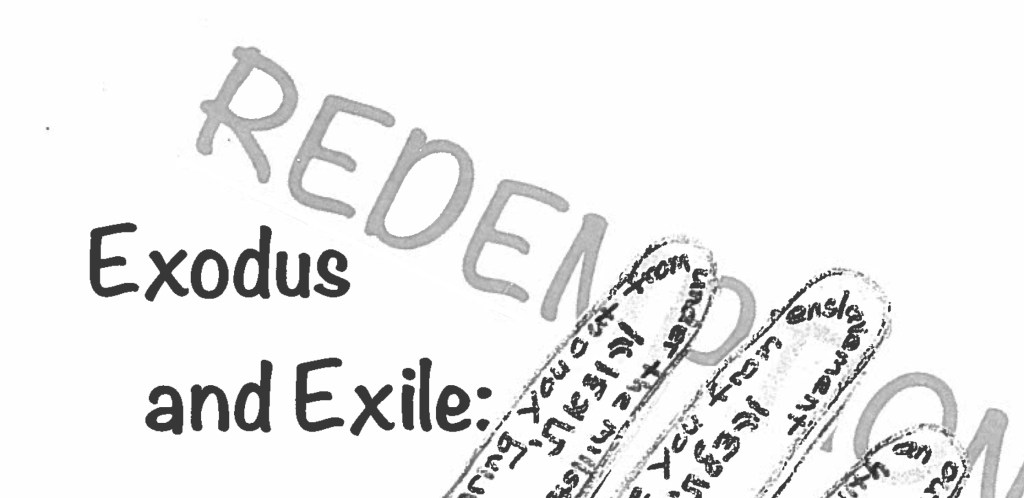
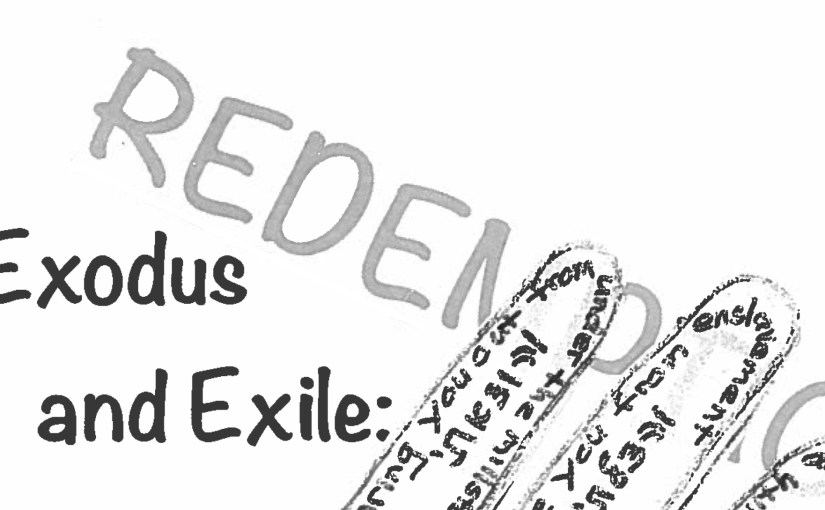
Exodus and Exile: Thoughts on Coalition and Redemption focuses on what it means to leave a place, people, or ideas behind and head out toward something that works better for everyone. It is meant to prompt some new thinking, particularly around racial justice issues.

A PDF download is available here, free of charge. UPDATE: Print copies are now available (See below). If you are able to contribute to the cost of this project, please consider doing so through the “A Song Every Day” Support link.

The book will be challenging to some for different reasons. It was challenging to me for many reasons, too. I am still considering this a BETA version with the hope that a fuller work, including additional perspectives, will develop in time. Comments and suggestions are welcome.

Some Essential Connections and Thanks

Thanks to Rabbi Gerry Serotta, director of the Interfaith Council of Greater Washington [former, now retired], for much support and teaching over the years and, in particular, for encouragement and ideas that helped shape this project. Thanks to Norman Shore, independent teacher of Torah in the DC area, for his support and teaching over many years and, in particular, for encouragement and corrections as my thinking evolved on the blog, “A Song Every Day.” Thanks to Rabbi Hannah Spiro, of Hill Havurah, for her enthusiasm and detailed comments on an earlier version.

Thanks also to Barbara Green, Bob Rovinksy (z”l), Norman Shore, and others who have supported “A Song Every Day” financially. And thanks to readers of earlier versions for comments and corrections and to those who contributed thoughts over the years, on the blog and via Facebook or other platform, on related topics.

I am also deeply appreciative of the work of every author quoted here, living or not. I am in particular dept to Rabbi Arthur Waskow, Phyllis Trible, Galit Hasan-Rokem, Rabbi Shais Rishon (MaNishtana), and Marc Dollinger. I am also grateful to DC’s Cross-River (Black-Jewish) Dialogue for helping hone my thinking.

All errors of interpretation, spelling or grammar, or any other kind are mine.

ORDERING AND DOWNLOAD

Download Exodus and Exile: Thoughts on Coalition and Redemption. (PDF HERE)

Print copies are available for a contribution of $6 or more, to help defray printing and other hard costs. Please use Support link and be sure to include your postal address. [2021 note: email songeveryday (at) gmail (dot) com to check on availability.]

Adulting through Chanukah, part 1

In “Hanukkah for Grown-Ups,” Marianne Novak describes differences between Purim — another holiday that is not commanded in the bible but delineated later by the Rabbinic tradition — and Hanukkah (I’ll uses JOFA’s spelling here for simplicity):

With Hanukkah, Antiochus enforced severe decrees but didn’t chose a specific doomsday for the Jewish people, as Haman does in Megillat Esther [the Purim story]. The Jews in the Persian Empire had no choice to but act. It was do or die. but with Hanukkah, it took the understanding of a small section of the Jewish community to see that the situation was indeed dire. They had to make the decision alone: There was no clear voice from God…It took adult initiative to comprehend why rebellion was the only viable option for the future of the Jewish people.
— “Shema Bekolah: Hear Her Voice series
from The Jewish Orthodox Feminist Alliance

This reminds me of Psalm 30, verses 7-8, in which the psalmist describes terror when God’s face is hidden:

וַ֭אֲנִי אָמַ֣רְתִּי בְשַׁלְוִ֑י בַּל־אֶמּ֥וֹט לְעוֹלָֽם׃

When I was untroubled, I thought, “I shall never be shaken,”

יְֽהוָ֗ה בִּרְצוֹנְךָ֮ הֶעֱמַ֪דְתָּה לְֽהַרְרִ֫י עֹ֥ז הִסְתַּ֥רְתָּ פָנֶ֗יךָ הָיִ֥יתִי נִבְהָֽל׃

for You, O Lord, when You were pleased, made [me] firm as a mighty mountain. When You hid Your face, I was terrified.

The expression is sometimes employed to mean that God is not apparent to the individual due to their own or the community’s sin. In the Purim story and some other narratives, common readings see God’s hand throughout, however lost and frightened the actors within the story may be. In the Joseph story, as well, Jacob and his sons take many actions — including selling Joseph into slavery — without narrative direction from God. But eventually Joseph declares that it was all God’s doing: “God has sent me ahead of you to ensure your survival on earth, and to save your lives in an extraordinary deliverance” (Genesis 45:7).

In her piece on Hanukkah, Novak concludes:

…It was truly a miracle that a small group of Jews from within a Jewish community was able to rededicate Israel to Judaism. When we publicize the miracles of Hanukkah, we not only note God’s hand in the story but also remind ourselves that we can take responsibility for the survival of our people. By being conscientious and thoughtful Jewish adults, we also have faith that God will then come and help us.

This is a powerful, troubling conclusion. In the times of Antiochus and the Maccabean revolt, as at most other times in Jewish history, I suspect, there are a number of small groups seeking to rededicate Israel to Judaism. Yes, we must take responsibility for the survival of our people, but — without direct command from God — we must tread very carefully as none of us know WHICH of our many small groups has chosen the direction that will succeed or how any damage we do to one another on the way may not be repaired.

23 of 30 on Psalm 30
No Longer National Novel Writing Month, but continuing the focus on Psalm 30 (“Thirty on Psalm 30”) begun as a NaNoWriMo-Rebel project. Whole series (so far).


NOTE: This new piece — which arrived through snail mail! — was not yet posted on their website, as of Dec. 7, although there are plenty of other fine teachings on this holiday and many other topics. I suspect this piece will be posted soon. And anyone interested can join their snail-mail list.
BACK

For Beverly: may mourning turn to dance FOR YOU

Alonzo (“Zo”) Fiero Smith, 1/2/1988-11/1/2015, was a poet, father, and teacher. Zo was killed, at age 27, in custody of special police in DC, a stone’s throw from the apartment of his mother, Beverly Smith. I’ve written in the past about Zo’s case, about special policing in DC and beyond, and related topics. This post is for Zo’s mother, Beverly.

Beverly_rain
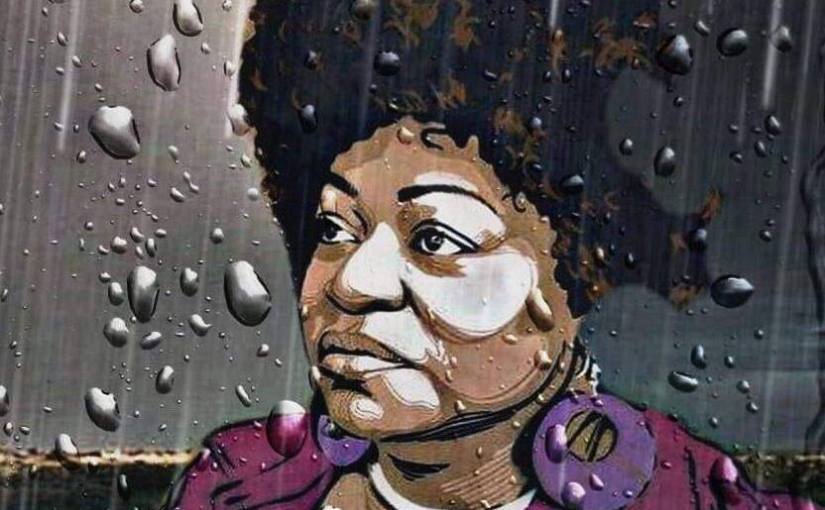
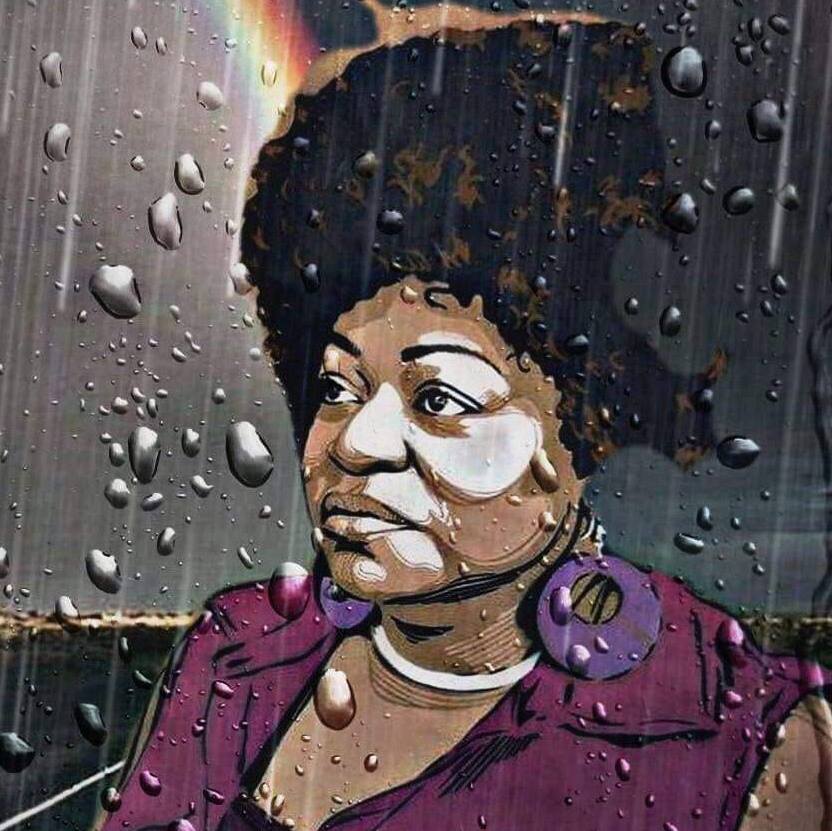
Beverly Smith, portrait by Pamela Brooks, both active in Coalition of Concerned Mothers

…weeping may tarry for the night,
but joy comes in the morning…
To You, GOD, I called…
Can dust praise you? Can it speak of your truth?
Hear and answer…
…You turned my mourning into dance for me,
You undid my sackcloth and girded me with joy —
that I might sing of Your glory and not be silent:
HASHEM my God, I thank You, always
— from Psalm 30

As her son’s death anniversary approached, and throughout this day [this post was written in large part on 11/1/18], I have often thought of Beverly’s efforts to speak truth and her determination to not be silent — about Zo’s case as well as broader needs — even in her grief and as she faces serious health challenges. I see her rejoice over her grandchildren and celebrate with friends, as well.

From Our Varied Places

With its range of emotions, from despair to ecstasy, Psalm 30 resonates differently for different people and times. Individuals reading or reciting this psalm on their own might relate to different phrases on different days, or use its variety to work through complex layers of feelings at one time. Psalm 30 should also remind us that our community encompasses, at any given moment, people in very different places, prompting us to acknowledge the varied ways our neighbors may be calling out for someone to “hear and answer.”

In this difficult period of national turmoil, Psalm 30 can help us notice how we can all cry out together from our various situations and states of mind — griefs, or joys, that may be brand new, or three or 20 or 400 years old. We don’t need everyone in the same place or of the same mind to care for one another, work together, and, for those so inclined, pray with and for one another.

On this particular November 1, I find that weeping — for Louisville, for Pittsburgh, for Zo and other victims of police brutality, for the unequal weight of our dreadful system of white supremacy — is more present for me than joy.

In the time that I’ve known Beverly Smith, I’ve seen her turn mourning into dance, as she has generously shared Zo’s story and allowed her own pain to help others focus on needed change. If we look carefully at the Hebrew in Psalm 30:12, though, we see that it reads, “turn my mourning into לְמָחוֹל לִי dancing for me].”

So, my prayer for Beverly on this anniversary of her son’s death, at the hands of a system some of us like to think is meant to protect us, is that this year will not only turn her mourning into dance (for others), but turn it into dance for her.

1 of 30 on Psalm 30
As a National Novel Writing Month Rebel, I write each day of November while not aiming to produce a novel. This year I focus on Psalm 30 in the hope that its powerful language will help us through these days of turmoil and toward something new, stronger and more joyful, as individuals and as community. Whole series (so far)

New Year: (Re-)New Relationships

Prepare for the new Jewish year by joining with others working to “Stop the Hate” in the last weeks of 5778. The #AllOutDC rally celebrates a united, diverse community and promotes further work to dismantle white supremacy.

The rally is “creating a space for our movements to establish relationships with one another, learn from each other’s experiences, acknowledge and dismantle oppression within our spaces, and build a more loving, more powerful community in DC.” Participating in and/or financially supporting this fully-permitted gathering in Freedom Plaza on August 12 is a useful way to mark Rosh Hodesh Elul and begin the work needed for a better new year.

StopGraphic.jpg

Our very existence is resistance and we are coming together to celebrate ourselves, our ancestors, and our generations to come, through our voices, art, music, community members, and accomplices. We will not destroy white supremacy on August 12th, but we are part of the local and global ongoing resistance to those who wish us harm.

The #AllOutDC rally announcement continues:

“We will join together to chip away at these hateful forces, and build a world of justice and love. We will be there in peace and solidarity, but we will not back down.

“We need you to come out and join us to show that we will love and defend each other. We’ll rally in solidarity to protect our communities and reject racism, sexism, transphobia, anti-Semitism, Islamophobia, ableism, and all forms of hate and oppression.

“We will show a united community in the face of alt-right hate.”

In addition to Freedom Plaza rally, other approaches include a three-day mobilization organized by Black Lives Matter DC and direct action from #DefendDC. Actions are also planned in other locations affected by “unite the right” calls and/or standing in solidarity with “Stop the Hate” work.

Spin grief’s straw into gold: Moving on from Tisha B’Av

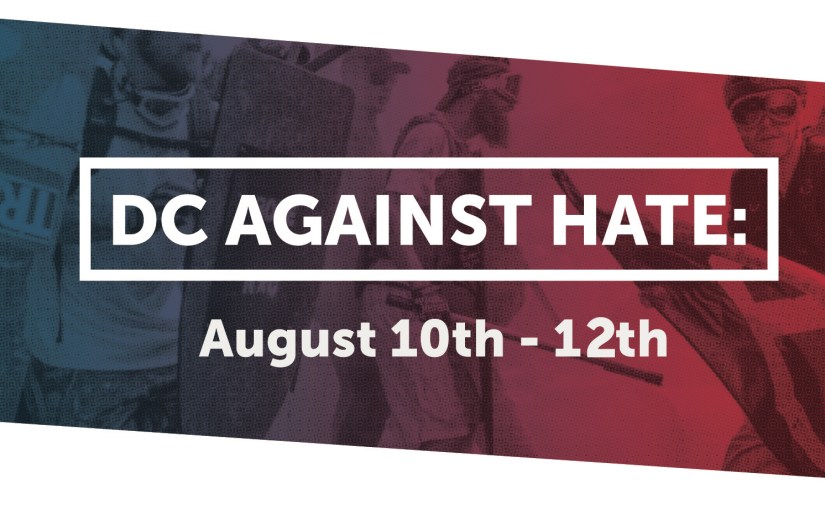
UPDATE: Please note that the “DC Against Hate” website has been updated with more details about three inter-connected actions. See also this blog’s update.

Jewish tradition teaches that much was lost in our history due to “baseless hatred” and that few things require more of our attention than making our communities welcoming to all, strangers included. We use Tisha B’Av — the day of mourning for destruction and calamities over the ages, the lowest point of the Jewish calendar — to help us consider all that needs changing if we are to move toward a better new year for all. (Tisha B’Av fell on 7/21-22 this year, and the new year begins 9/10-11.)

The month of Elul, an important point in this journey and the last of the old year, starts on August 12 this year — which happens to be the date a group of Klan and Nazi supporters have chosen for their “Unite the Right II” rally in DC, celebrating the anniversary of the violence at Charlottesville, VA last year (because they were refused a permit in Charlottesville).

National and local Jewish groups are planning responses, but none have been announced yet (7/24), to the best of my knowledge. Meanwhile, I hope Jews, in DC and beyond, are thinking of ways to celebrate Rosh Chodesh Elul, by joining with others who oppose baseless hatred and maltreatment of strangers and the most vulnerable among us.

…get back to work
you don’t have forever

…the wounded world
is still in your hands

…get on with it
gather grief like straw
spin it into something like gold
— from Alicia Suskin Ostriker’s “Drone”
The Book of Seventy
Pittsburgh: Univ. of Pittsburgh Press, 2009.

Some of us will be joining already planned mobilization efforts standing together for “ICE abolition, open borders, dismantling the prison industrial complex, and ending the settler colonial system. We will confront fascism, antisemitism, Islamophobia, white supremacy, and state violence.”

Others will find alternative ways to move into the new year with (re-)new commitment to opposing hate in its many forms.

I pray that none of us will be silent in the face of Klan- and Nazi-supporters gathering outside the White House.

DC Against Hate.jpg

“Lean on Me” Day

Please swallow your pride
if I have things you need to borrow
for no one can fill
those of your needs
that you won’t let show
— Bill Withers, “Lean on Me,” 1972
(AZ Lyrics)

Many of us have loved the song, “Lean on Me,” for a long, long time. And, as it happens, July 8 is the anniversary of the single hitting #1 on the Billboard Hot 100. So, here are some thoughts about the song, which has been on my mind a lot recently, particularly the line above about letting needs show.

Things You Need to Borrow

How often is a failure to communicate needs at the heart of a serious problem, between friends, in a couple, or in a larger group? And yet, how regularly do people hope for someone(s) who will know their needs without them having to ask?

Withers has said many times — to the Soul Train crowd in 1974, to NPR in 2007, and often in between — that the song is meant to be about friendship. And one of its great strengths is the powerful sense of mutuality: Lean on me now, because I’ll need to lean on you later. But how does that work, in real life, especially when needs go unexpressed?

There are a lot of Jewish teachings around friendship and community. For example, just a few lines from Pirkei Avot [Ethics of the Ancestors]:

  • Make for yourself a mentor, acquire for yourself a friend and judge every person as meritorious. (1:6)
  • If I am not for me, who will be for me? And when I am for myself alone, what am I? And if not now, then when? (1:14)
  • …Do not separate yourself from the community. Do not believe in yourself until the day of your death. Do not judge your fellow until you come to his place…. (2:4)
  • The honor of your friend should be as dear to you as your own… (2:10)
  • Do not assuage the anger of your friend at the time of his anger; do not console him at the time when his deceased lies before him; do not question him at the time of his vow; and do not seek to see him at the time of his humiliation. (4:18)

These teachings suggest that we should know a great deal about others: “the place” of our fellows as well as our friends’ anger, grief, vows, humiliations, and honor. We are asked here to anticipate, or act to obviate, lots of emotional needs, while other parts of the tradition speak more to meeting our fellows’ physical needs. In this way, Pirkei Avot seems to be asking us to make sure that there’s plenty for everyone “to borrow,” without vulnerable people necessarily having to put needs on display.

Still, the “Lean on Me” advice to swallow pride and speak up remains important, if for no other reason than to keep our friends from failing in their duties.

A Shift of Understanding

The mutuality and inter-connectedness of the whole “Lean on Me” concept is brought home by a slight change to one line, in Playing for Change’s 2015 “Song Around the World” version. Withers sang, “I just might have a problem that you’ll understand” (I’ll lean on you). But Playing for Change has it, instead: “You just might have a problem that you don’t understand” (You can lean on me). And their video, with its mixing of performances from so many people, generations, and locales around the world seems to emphasize that people in any one situation might have problems that could benefit from a wider perspective.

Playing for Change’s “Songs Around the World” give physical embodiment to the idea that we all lean on each other…to make music and for so many other things. [Descriptions follow embedded video below].

The original —

The above is video from NBC’s “The Midnight Special” (March 1974).
Description: Most of the video shows Withers at the piano in front of a studio audience, some close ups of him, some panning of audience; near the close of the video is a still of the album cover from the 1972 “Still Bill,” which included this song.

And Playing for Change —

The above video is one in a series of “Songs Around the World” staged by the non-profit Playing for Change.
Description:
The opening guitar chords are performed by Renard Poche of New Orleans, followed by Robert Lutti in Livorno Italy. Niki La Rosa, of Rome Italy, begins the lyrics. Grandpa Elliott, a New Orleans street musician, is heard singing the chorus, while we see: drumming on a beach in Chennai, India; a group of students in Kigali, Rawanda; and young dancers in Kirina, Mali. Elliott then appears briefly.

The “things you have to borrow” verse is sung by Clarence Bekker, Suriname native performing in Amsterdam. Bekker’s voice continues while we see Poche again and then Keiko Komaki of Kagoshima Japan is seen playing keyboard. Musicians and vocal artists in Chicago, Melbourne, Los Angeles and other locations join the mix. Titi Tsira, from Guguletha, South Africa, sings the “right up the road” verse. [More details as time permits, but hope this gives an idea of the visuals.]

Call and Response

Thanks to Bill Withers and so many others for helping us all believe there is someone to help carry a difficult load or just plain carry on while reminding us all that we need to be that someone as well:

Lean on me when you’re not strong
And I’ll be your friend
I’ll help you carry on
For it won’t be long
‘Til I’m gonna need somebody to lean on

If there is a load
You have to bear
That you can’t carry,
I’m right up the road
I’ll share your load
If you just call me.
— Bill Withers, 1972 (from AZ Lyrics

Black and Jewish Communities Sharing History

UPDATED 9/3/18

We Act Radio “Sharing History” for the District and for every place where black and Jewish communities have some things to learn about one another.

Listen here —

“We Act Radio: Black and Jewish Communities Sharing History”
Audio excerpts below

Previous We Act Radio piece, “Misunderstandings are growing…”

Our “Junetenth Building Bridges” party led to further meetings between some interested community members and the launching of the “Cross River (Black and Jewish) Dialogue.” Stay tuned for more as this work develops. Our first effort was the placement of this essay on the Anniversary of Charlottesville in the Forward’s Scribe section.

juneteenth_sharing.jpg

Audio Excerpts:
…Jews always know, from history, that any sense of physical security or relative economic ease is a fragile thing, easily destroyed by the kind of hate speech that labels Jews as others to fear and defeat. We know it’s not a long stretch from muttered conspiracies about Jews controlling world capital to crowds chanting, “Jews will not replace us.” And we can’t forget how quickly co-existence in Europe devolved into destruction and death camps.

At the risk of sounding flip, I adapt a slogan from my youth: “Just because a Jew seems paranoid or over-reacting doesn’t mean folks aren’t out to get them.”

By the same token, if someone from east of DC’s Anacostia River sounds overly-sensitive or paranoid, it doesn’t mean they’re wrong….

…Black people know from history that any level of economic ease or sense of physical security – such as the ability to enjoy a public park, or close one’s eyes in a common college space, or meet colleagues in a coffee house, or work or vacation or walk to grandma’s house – is an extremely fragile thing. It’s not a long stretch from a few muttered remarks about people not knowing their place to a police call that can so quickly destroy one life, or many. And black communities in the U.S. today suffer disproportionate levels of incarceration, unemployment, and poverty because of centuries of anti-Black sentiment, policy, and action.

The city of DC, like much of this country, has arranged life for many White people so that the dangers and suffering black communities face today are out of sight and out of mind. Another result of our segregated lives, in DC & much of the country, is that black and Jewish communities are too often strangers, even when our communities overlap. This means we are too readily convinced to believe evil stories about the other without easy avenues of communication to correct misunderstandings or opportunities for community building.

We Act Radio, WPFW, and additional partners are working on opportunities for more bridge building, including an Election Day-Juneteenth gathering.
Juneteenth Building Bridges Election Watch Party

Korach and Dysfunctional Systems

Earlier this week, my town experienced a police-involved killing, and an elected representative of the community was on the scene shortly afterward. He told reporters he did not want to repeat he-said/she-said but was awaiting video and other evidence: “My job is to get the facts – what happened.”

I’m sure many readers know or can guess the specifics, but I’m leaving them out because I think this situation, like the tale of Korach and his followers — a narrative, which Jews read this week in the annual Torah cycle (Numbers 16:1-18:32), about community and power — has something more universal to teach.

The Official Job

My first thought on hearing this official say his job was to “get the facts” was: No, that’s the job of police detectives and journalists; your job is legislative, budgetary, and related responses to the town’s many challenges. I realized immediately, however, that my first thought came from a fantasy world.

Leaving the facts to journalists and police only works in a world where community members can rely on those individuals and their institutions to pursue the full story, where some level of trust exists.

Officials from some other parts of town have the luxury of sticking to the duties for which they were elected, the privilege of living and working where basic systems appear to be functioning — at least for the people they represent. In the hugely unlikely event that a police-involved killing (God forbid any more anywhere) were to arise on the streets of some other districts in town, elected representatives and constituents could continue their own work, while expecting investigative professionals to do theirs.

This particular official, however, operates amid systems which have long since ceased to function for too many of the people he represents.

So, what exactly is his job? Can it possibly be similar to those of his official colleagues?

The Rebellion

In the bible story, Korach and his followers accuse Moses and Aaron of exalting themselves over the congregation of God. Although teachers over the centuries have made efforts to find some merit in Korach’s argument, he remains the poster child for the evils of greed, self-aggrandizement, and self-interested politics.

We also read that Dathan and Abiram call Moses unfit to lead the People, given that his leadership has already resulted in them being condemned to die in the wilderness (Num 16:13). Just a few chapters earlier, God announced a punishment, following the incident of the spies, for all the adults: “your carcasses shall drop in this Wilderness. Your children will roam for forty years and bear your guilt…” (Num 14:32-33).

The argument from Dathan and Abiram fares no better, in the bible narrative, than Korach’s initial challenge, and the result is catastrophic:

So Moses stood up and went to Dathan and Abiram, and the elders of Israel followed him. He spoke to the assembly, saying, “Turn away from near the tents of these wicked men, and do not touch anything of theirs, lest you perish because of all their sins.” So they got themselves up from near the dwelling of Korah, Dathan, and Abiram, from all around….

When he finished speaking all these words, the ground that was under them split open. The earth opened its mouth and swallowed them and their households, and all the people who were with Korach, and the entire wealth.
— Num 16:26-27, 31-32

Things go from bad to worse in the bible story, and the Children of Israel eventually tell Moses: “Behold! we perish, we are lost, we are all lost….Will we ever stop perishing?” (Num 17:27-28)

Our Job

Every year when we come to this Torah portion, I find myself worrying about the failures of communication involved in the rebellions and wondering how differently things might have evolved, given better listening.

Why are Moses and Aaron, and God, so surprised and unhinged by the People’s lapse of faith (in the spies incident, previous portion)? What if God had just heard their worries instead of responding so negatively to their hesitation?

Why are Moses and Aaron, and God, unable to hear the people’s desperation and anger, in the face of completely failed expectations?

And what is our job, as community members — and, if appropriate, as Jews — whether we live in an area suffering from severe system break-down or not? How might better listening, and closer attention to circumstances behind complaints and rebellion, change things?

Learning to See

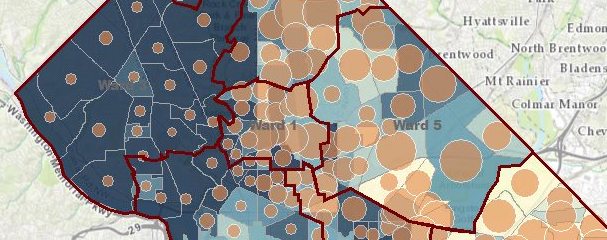
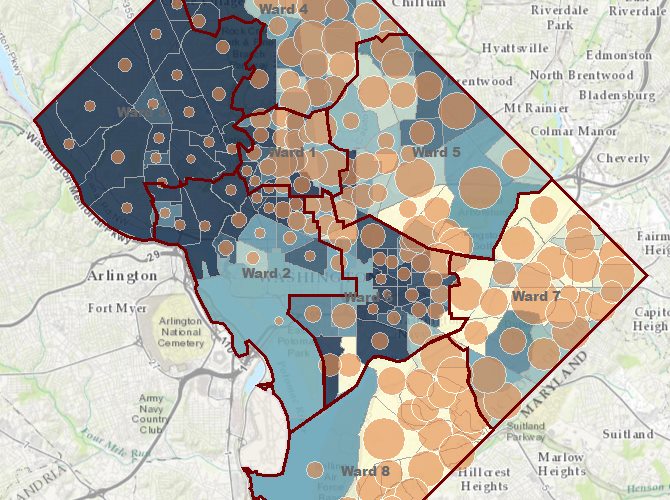
Where one lives plays a crucial role in determining access to opportunity, and learning to see “opportunity” and its effects is an important part of understanding our world and how to pursue justice in it. “Opportunity mapping,” a creation of the Kirwan Institute at Ohio State University, helps us visualize access to education, health, employment, housing, transportation, and public safety.

Students in the “Mapping Inequity in DC” class at the Maret School in the District of Columbia created an Opportunity Map, under the director of their teacher, Ayo Heinegg Maywood. The results, even for people who knew — or at least suspected — the expected outcome, are staggering. Here is what the students tell us:

This opportunity map suggests that in the 2010-14 period, opportunity (access to quality health, education, housing, public safety, and employment) is clearly concentrated geographically in the Northwest of Washington DC (particularly ward 3), an area that is disproportionately white and wealthy.
— visit “Opportunity Map for DC” for much more detail

This information is relevant to all who live, work, or worship in the District — and to those who otherwise care about the city and its residents, as well as anyone who just wants to understand how “opportunity” works. It’s of special interest to Temple Micah, a synagogue less than one mile from Maret.

The congregation, originally located in Southwest and called “Southwest Hebrew Congregation,” changed its name to “Temple Micah” — to reflect the prophet’s vision that “nation shall not lift up sword against nation, neither shall they learn war any more” — in 1968. In 1995, after a struggle to find an existing worship space for renovation or land for building near the old location, Temple Micah moved quite a distance, to the Glover Park neighborhood (Northwest DC, in Ward 3).

Social Justice efforts, including some partnerships with organizations in the “old neighborhood,” have long been central to Temple Micah. But the “new” location — that is, Temple Micah’s home for more than two decades! — brings different realities. One of them is that the congregation is now firmly situated within the area that Maret students found to be “disproportionately white and wealthy.”

The work of Maret’s “Opportunity Map” project is helping us visualize what most of us have long known, but may not have seen quite so clearly, about our own city and our place in it. Read more in this sermon — known in Hebrew as dvar [word of] Torah — which focuses on the call to keep our hands open to the poor and needy (Re’eh, Deut. 11:26-16:17):

  • How we visualize and speak about people in poverty is part of caring for the needy.
  • How we see circumstances and history contributing to poverty influences the flow of blessing; and
  • Paying attention to whom we view as brothers is part of how we train our hearts and hands and minds to respond.

Especially as we head into the season of reflection and repentance, the information in this mapping project can help us better understand our world and its needs.


opportunity