Hatred of Haters and Turbulent Branching of Thoughts

Put an end to the hatred of haters
those who have made me their foe

Search me out with shovel and torchlight, God
know my heart by means of compassion.

Understand the turbulent branching of my thoughts.

See the road that brings me sadness,
and lead me instead on the path of eternal life.
— Ps. 139:22-24
translation is by Pamela Greenberg,
The Complete Psalms: The Book of Prayer Songs in a New Translation. NY: Bloomsbury, 2010

Psalm 139 is one that Jews use at times of trouble to ask for guidance. Eight years ago, just about this time, Pamela Greenberg gave permission for a DC-based group to use her translation for a program in solidarity with Women of the Wall. Many of the sentiments expressed at that time of trouble are just as applicable to this Elul. And her translation of the psalms has provided much solace and challenge in the intervening eight years. Several verses are illustrated here with a particular prayer intention for my hometown of 30 years at this time of unrest and a prayer for all who are experiencing “turbulent branching of thoughts” and seeking an “end to the hatred of haters.”

The new month begins on August 11-12.

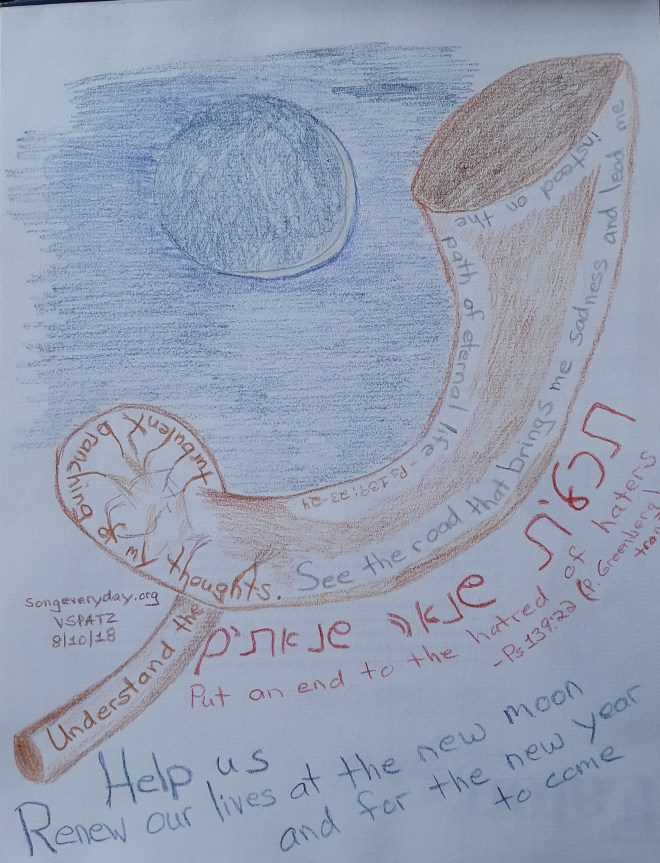
new moon shofar

Description of graphic: a sliver of a bright new moon in a dark sky in the background, with the central image a shofar with a single twist near its mouthpiece at the bottom left and its horn upward near the top right. Below the shofar are the words in English, “Put an end to the hatred of haters,” and the Hebrew from Ps. 139:22 — תַּכְלִית שִׂנְאָה שְׂנֵאתִים

Scrolling across the shofar are the words, also from Greenberg’s translation of Psalm 139: Understand the turbulent branching of my thoughts [lettering here includes “branches” that reach up to entwine]. See the road that brings me sadness and lead me instead on the path of eternal life.

Under the shofar is a simple new month prayer for Elul: Help us Renew our lives at the new moon and for the new year to come.

Spin grief’s straw into gold: Moving on from Tisha B’Av

UPDATE: Please note that the “DC Against Hate” website has been updated with more details about three inter-connected actions. See also this blog’s update.

Jewish tradition teaches that much was lost in our history due to “baseless hatred” and that few things require more of our attention than making our communities welcoming to all, strangers included. We use Tisha B’Av — the day of mourning for destruction and calamities over the ages, the lowest point of the Jewish calendar — to help us consider all that needs changing if we are to move toward a better new year for all. (Tisha B’Av fell on 7/21-22 this year, and the new year begins 9/10-11.)

The month of Elul, an important point in this journey and the last of the old year, starts on August 12 this year — which happens to be the date a group of Klan and Nazi supporters have chosen for their “Unite the Right II” rally in DC, celebrating the anniversary of the violence at Charlottesville, VA last year (because they were refused a permit in Charlottesville).

National and local Jewish groups are planning responses, but none have been announced yet (7/24), to the best of my knowledge. Meanwhile, I hope Jews, in DC and beyond, are thinking of ways to celebrate Rosh Chodesh Elul, by joining with others who oppose baseless hatred and maltreatment of strangers and the most vulnerable among us.

…get back to work
you don’t have forever

…the wounded world
is still in your hands

…get on with it
gather grief like straw
spin it into something like gold
— from Alicia Suskin Ostriker’s “Drone”
The Book of Seventy
Pittsburgh: Univ. of Pittsburgh Press, 2009.

Some of us will be joining already planned mobilization efforts standing together for “ICE abolition, open borders, dismantling the prison industrial complex, and ending the settler colonial system. We will confront fascism, antisemitism, Islamophobia, white supremacy, and state violence.”

Others will find alternative ways to move into the new year with (re-)new commitment to opposing hate in its many forms.

I pray that none of us will be silent in the face of Klan- and Nazi-supporters gathering outside the White House.

DC Against Hate.jpg

Learning to See

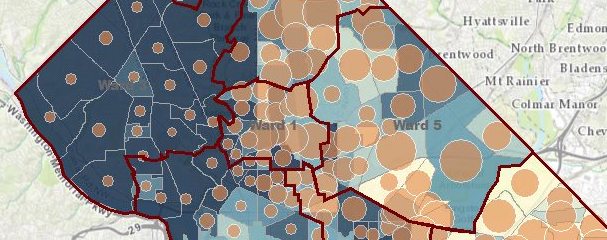
Where one lives plays a crucial role in determining access to opportunity, and learning to see “opportunity” and its effects is an important part of understanding our world and how to pursue justice in it. “Opportunity mapping,” a creation of the Kirwan Institute at Ohio State University, helps us visualize access to education, health, employment, housing, transportation, and public safety.

Students in the “Mapping Inequity in DC” class at the Maret School in the District of Columbia created an Opportunity Map, under the director of their teacher, Ayo Heinegg Maywood. The results, even for people who knew — or at least suspected — the expected outcome, are staggering. Here is what the students tell us:

This opportunity map suggests that in the 2010-14 period, opportunity (access to quality health, education, housing, public safety, and employment) is clearly concentrated geographically in the Northwest of Washington DC (particularly ward 3), an area that is disproportionately white and wealthy.
— visit “Opportunity Map for DC” for much more detail

This information is relevant to all who live, work, or worship in the District — and to those who otherwise care about the city and its residents, as well as anyone who just wants to understand how “opportunity” works. It’s of special interest to Temple Micah, a synagogue less than one mile from Maret.

The congregation, originally located in Southwest and called “Southwest Hebrew Congregation,” changed its name to “Temple Micah” — to reflect the prophet’s vision that “nation shall not lift up sword against nation, neither shall they learn war any more” — in 1968. In 1995, after a struggle to find an existing worship space for renovation or land for building near the old location, Temple Micah moved quite a distance, to the Glover Park neighborhood (Northwest DC, in Ward 3).

Social Justice efforts, including some partnerships with organizations in the “old neighborhood,” have long been central to Temple Micah. But the “new” location — that is, Temple Micah’s home for more than two decades! — brings different realities. One of them is that the congregation is now firmly situated within the area that Maret students found to be “disproportionately white and wealthy.”

The work of Maret’s “Opportunity Map” project is helping us visualize what most of us have long known, but may not have seen quite so clearly, about our own city and our place in it. Read more in this sermon — known in Hebrew as dvar [word of] Torah — which focuses on the call to keep our hands open to the poor and needy (Re’eh, Deut. 11:26-16:17):

  • How we visualize and speak about people in poverty is part of caring for the needy.
  • How we see circumstances and history contributing to poverty influences the flow of blessing; and
  • Paying attention to whom we view as brothers is part of how we train our hearts and hands and minds to respond.

Especially as we head into the season of reflection and repentance, the information in this mapping project can help us better understand our world and its needs.


opportunity

Word- and Picture-Power

This season reminds us – even if we didn’t have recent events screaming reminders at us – that words, and related mind-pictures have tremendous power. And this Torah portion (Re’eh: Deut. 11:26-16:17) warns us that we have an individual and a collective responsibility to ensure that word- and picture-power in the community does not endanger the flow of blessing or somehow impede God’s Mercy from manifesting.

The commandment to see and to recognize blessing and curse, both individually and collectively, is complicated and challenging.

If each of us is challenged to see, as part of a collective awakening, we are also challenged as a community to honor what others see. And what may look like blessing from one perspective might appear as a curse in other quarters.

Complete dvar Torah: The Commandment to See

Grass Roots: a holiday question and memorial reflection

As we approach the high holidays, grass shows up in two haftarah readings. What do these verses tell us in this season of repentance and return? I am pondering. Meanwhile, a recent yahrzeit called to mind the sweetness of grass as well as its transient nature. Does that, too, carry a message for the high holidays?

We learn on Shabbat Nachamu, the Sabbath of Comfort that follows the lowest point in the Jewish calendar, that “all flesh is grass,” and that “grass withers, the flower fades; but the word of our God stands forever” (Isaiah 40:6-8). Three weeks later, on Shabbat Shoftim, we are told “Mortals fare like grass” (Isaiah 51:12). (Full verses and Hebrew below)

Learning to Witness

My father, Delmar G. Spatz — called just plain ‘Spatz’ by most adults, including my mom — was raised in northern Wisconsin. He moved to Chicago after his Army Air Corps service during World Ward Two; he’d been stationed in England but still taught us to sing “How Ya Gonna Keep ’em Down on the Farm (After They’ve Seen Paree).” Spatz met Bette, a native of Chicago. They married in 1951 and settled on the city’s West Side. He died in 1976, the summer I was 16.

The hole my dad left has taken many shapes over the decades. This is his 40th yahrzeit. And it appears to me this year that his death – and his life – form a hollow that creates a lens.

A few weeks ago, my older sister, Martha, and I had the opportunity to discuss some of what he taught us to see. She told me how, in 1968, he walked her out to see the tanks, deployed a few blocks from our apartment in the wake of Martin Luther King’s murder and the subsequent unrest. Later that year, during the Democratic National Convention, Dad sent Martha and a friend downtown to the Prudential Building – then the tallest place around – so they could see without direct risk to themselves what was happening between police and protesters in Grant Park.

That was the year Martha turned 14. I guess my younger siblings, Amy and Bob, and I were considered too young for these particular field trips.

But learning to be a witness was a major part of our education in all the years we had with Dad. He especially emphasized noticing people and circumstances that regularly went unrecognized.

It took me a long time to realize that my classmates were not being taught see the same way my dad wanted us to see. It might take me another 40 years to explore just how the lenses crafted by my dad’s lessons worked – and continue to work – in my life.
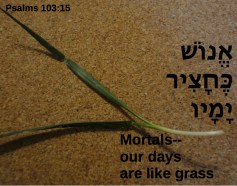
grass2Meanwhile, though – in the way each yahrzeit seems to bring its own new facet of blessing – this year I recall another aspect of that lens. I remember Dad teaching me to notice how the strongest blades of grass, when pulled gently from the ground, would yield a hidden, moist taste treat. He helped me recognize that the greenish-white part of a watermelon, the stuff closest to the rind – that so many people toss away – is often the sweetest. And together, on many a horridly hot summer day, we witnessed how sitting absolutely still could call up a breeze more cooling than anything produced by a fan, electric or paper.
— these reflections were shared with Temple Micah on August 20, 2016.

Haftarah Verses from Isaiah

קוֹל אֹמֵר קְרָא, וְאָמַר מָה אֶקְרָא; כָּל-הַבָּשָׂר חָצִיר, וְכָל-חַסְדּוֹ כְּצִיץ הַשָּׂדֶה.
יָבֵשׁ חָצִיר נָבֵל צִיץ, כִּי רוּחַ יְהוָה נָשְׁבָה בּוֹ; אָכֵן חָצִיר, הָעָם.
יָבֵשׁ חָצִיר, נָבֵל צִיץ; וּדְבַר-אֱלֹהֵינוּ, יָקוּם לְעוֹלָם.

Hark! says one: ‘Proclaim!’ Another says: ‘What shall I proclaim?’
‘All flesh is grass, and its goodness is as the flower of the field;
The grass withers, the flower fades;
because the breath of the LORD blows upon it–surely the people is grass.
The grass withers, the flower fades; but the word of our God stands forever.’
— Isaiah 40:6-8, in Haftarah Va’etchanan

אָנֹכִי אָנֹכִי הוּא, מְנַחֶמְכֶם; מִי-אַתְּ וַתִּירְאִי מֵאֱנוֹשׁ יָמוּת, וּמִבֶּן-אָדָם חָצִיר יִנָּתֵן.
I, even I, am He who comforts you: who are you, that you fear Man who must die, Mortals who fare like grass… — Isaiah 51:12, in Haftarah Shoftim

Hebrew text from Mechon-Mamre.org,
Translation adapated from “Old JPS” and Sefaria.org
BACK

Broken-Heartedness and the Days of Awe

One common, powerful theme of the high holidays is the idea of the broken heart. This is encapsulated prominently in the blowing of the shofar, with its shevarim [shattered] call. (See, e.g., The Shofar as Prayer at My Jewish Learning.)

All who hear the ram’s horn — during the preparatory month of Elul and the Days of Awe — are meant to experience a broken heart. And, so according to this story, is the one who sounds the shofar:

Rabbi Wolf, shofar blower in the synagogue of the Baal Shem Tov, has been studying special intentions for his annual role, but loses his crib sheet on the bima; forgetting everything, he blows the shofar with a broken heart. The Baal Shem Tov tells him,

“In the Palace of the King there are many rooms and halls, and each door to a room or a hall has a different key. But there is a better way to enter than to use the key, and this is to use an ax, which can open the locks of all the doors. The same is true of proper intentions. They are the keys to each and every gate, and every opening has the proper intention for it. However, the broken heart is an ax. It allows every person to enter all the gates and the halls of the King of Kings, the Holy One, Blessed be He.”
— Moshe Chaim Kalman, Or Yesharim.
see also The Light and Fire of the Baal Shem Tov.
Yitzhak Buxbaum. NY: Continuum, 2006.

Broken-heartedness is often described as requisite for prayer, particularly at the Days of Awe, as in this teaching from Abraham of Slonim (19th Century CE):

You should act in prayer as if you were a farmer: first you plow, then you seed, afterward you water, and finally things begin to grow. In prayer, first you have to dig deeply to open your heart, then you place the words of prayer in your heart, then you allow your heart to cry.
— found in Machzor Lev Shalem

Outside McPherson Square Metro Station, 9/15/15
At McPherson Square Metro Station, 9/15/15

In a season dedicated to atonement and forgiveness, reminders to open one’s heart are important. But how are we meant to respond to this call when our hearts are already broken? when we’re just barely hanging on?

Around the corner from the temporary synagogue where Fabrangen Havurah holds high holiday services, this message was painted on the sidewalk.

…An alternative thought for Shabbat Shuvah [the sabbath of “return”].

Morning: Blessing, with Echo of Gunshots

How lovely are these tents!
not far from housing that has seen better days
and housing that has seen too many awful ones.

I love the place of Your house, reached through streets
collecting cigarette butts, the odd chicken wing, echoes of homicide.

Through Your abundant love, I enter Your house,
where these peaceful walls remind us: “If I am for myself alone, what am I?”
while a few miles away homes reel from gunshots and mourning,
makeshift memorials of teddy bears and candles pooled with tears and rain.
Meetings and vigils and “let this be the last.”

My prayer seeks a favorable time –
Does joy come in the morning, where weeping has not tarried for the night?
Can we dance together, if we have not yet joined in lament?

You answer with your saving truth:
Your glory’s dwelling-place spans mountain top and pit.
We are shaken and we stand firm.
Remove our sackcloth and dress us to praise You, Source of Healing and Help.

— Virginia Spatz, August 21, 2015

See Mah Tovu [How lovely are your tents] and Psalm 30 in the early morning prayers

…weeping may tarry for the night, but joy cometh in the morning.
…When I was carefree, I thought, “I shall never be shaken.”…
LORD, when I enjoyed your favor, You made me stand firm as a mighty mountain; when You hid Your face, I was terrified….
You turned my lament into dancing;
You removed my sackcloth and girded me with joy

See also, “Prayer Warm Up” and handout on Psalm 30

Who Is a Jew and how would the Forward recognize her?

UPDATE, 11/15, 13:36: Both the Jewish Telegraph Agency and the Forward have replaced the original photo with different ones: JTA’s article is now accompanied by a photo of an open Torah held by jacketed arms, adorned with a prayer shawl; the Forward‘s new photo shows three males in kippot (head coverings) with dreidels (Chanukah tops). Neither photo seems to have any relationship to non-Jews at the Torah, but the one that was clearly a mistake is now gone. No correction or apology in either place, however, and it is not clear whether JTA is correcting the mistake with other outlets that might be using their article.
Continue reading Who Is a Jew and how would the Forward recognize her?

Yet More on Psalm 27 (3 of 4)

The close of Psalm 27 —

קַוֵּה, אֶל-יְהוָה: חֲזַק, וְיַאֲמֵץ לִבֶּךָ; וְקַוֵּה, אֶל-יְהוָה.

Hope in the LORD; strengthen yourself, let your heart take courage, and hope in the Lord [Psalm 27:14]

— is often cited as a motivational aphorism, particularly for the penitential season. This is its role in this meditation for Elul, for example.

Psalms 27:14 is employed in the Babylonian Talmud as a proof-text for appropriate attitude in prayer. The passage includes a discussion on prayer and hope, including — like the question Langston Hughes asks in “Harlem” — what happens to hope deferred.

Psalms 27:14 stands out in that it uses the second person (command) form, while the previous 13 verses are in the first person: “God is My light…whom should I fear?” etc. This raises the question: Whose heart is to hope?
Continue reading Yet More on Psalm 27 (3 of 4)

More Exploring Psalm 27 (2 of 4)

Psalm 27 includes a powerful “single request,” one that is frequently offered as a song:

One thing have I asked of the LORD, that will I seek after:
that I may dwell in the house of the LORD all the days of my life,
to behold the graciousness of the LORD, and to visit early in His temple.
אַחַת, שָׁאַלְתִּי מֵאֵת-יְהוָה– אוֹתָהּ אֲבַקֵּשׁ:
שִׁבְתִּי בְּבֵית-יְהוָה, כָּל-יְמֵי חַיַּי;
לַחֲזוֹת בְּנֹעַם-יְהוָה, וּלְבַקֵּר בְּהֵיכָלוֹ

— Psalms 27:4, JPS 1917, borrowed from Mechon-Mamre
full translation at Mechon-Mamre; others linked here

Continue reading More Exploring Psalm 27 (2 of 4)