Chanukah and the Five Powers

Exploring Babylon Chapter 10

This week in the Jewish calendar (mid-December 2017), we meet the major foreign powers with which ancient Judaism struggled:

  • In the Torah-reading cycle, Joseph is already in Mitzrayim, setting the stage for the whole clan of Yisrael to move, and eventually become enslaved, there.
  • Chanukah (in 2017: 12/12-12/20), reminds us of events in the Seleucid (“Syrian-Greek“) Empire.
  • The haftarah for Shabbat Chanukah, from Zechariah, is set just after the Babylonian Captivity, during Persian rule.
  • In addition, the game of dreidel is sometimes explained with reference to Roman soldiers, and other aspects of the holiday relate to this later empire.

Mitzrayim, Greece, Babylon, Persia, and Rome. That’s a lot of foreign powers converging on any one week.

And there are aspects of Chanukah that tend to equate or conflate oppressors and different experiences of exile. For example, all five of the foreign powers show up in one of the post popular Chanukah songs, based on the 13th Century piyyut, “Ma’oz Tzur.” (More on this soon.) So, there’s an impulse, on the one hand, to roll all the opponents into one enormous, amorphous threat to scrappy, little Yisrael. On the other hand, there’s a tradition of aiming to universalize the Chanukah story, making it into everyman’s battle against tyranny everywhere. Insights can be gleaned by comparing and combining the foreign powers that turn up together this week. But it’s worth examining each of these empires, and its particular arc through Jewish history and thought, to see what light it sheds — on its own and in conjunction with the others.

Doing a thorough exploration is an enormous job, but perhaps we can start where we are, on this day of the third candle of Chanukah.

One Candle: Mikeitz (Mitzrayim)

Mitzrayim has a lot to say about exile and the challenges of a non-homogeneous society, in this week’s Torah portion (Mikeitz, Gen 41:1 – 44:17) alone:

  • Joseph’s precarious status and employment situation, here taking an upswing (Gen 41:41-46) after slavery, a rise to power and fall into incarceration (and, before the pharaoh who doesn’t know Joseph and enslaves all his descendants);
  • New clothes for a new position;
  • A new, foreign name for Joseph;
  • A new, foreign spouse, read alternatively as Asenath joining Yisrael or as Joseph’s acceptance into Mitzrayimite society;
  • Names for Joseph’s children that reflect experience in exile; and
  • Food issues.

Joseph, “the Hebrews,” and the Mitrayimites each eat separately, “because it was abhorrent to the Mitrayimites [כִּי־תוֹעֵבָ֥ה הִ֖וא לְמִצְרָֽיִם]” (Gen 43:32). What was abhorrent? The possibilities are many, including, from various commentators: extremely different customs and manners , snobbery on the part of the Mitzrayimites, and religious taboo (one theory: Mitrayimites revered animals, like the cow, while Hebrews ate beef).

Two Candles: Mikeitz and Chanukah

The story of the Maccabees is multi-layered, and many scholars point to the twin layers of internal strife within Yisrael and the precipitating Greek pressure:

The power the Greeks sought and the threat they posed was not just military, and so it could not be resolved by military means alone; their threat was as much to the identity, faith, and practice of the Jews. What is more, the threat came not just from the Greeks but from the Jews themselves, many of whom, according to the sources, had opted voluntarily to assimilate or gave in rather than resist Greek orders….
— Gila Sacks, “Creating Light Each Day ” (2013)
from JOFA’s Shema Bekolah [hear her voice] series

This dynamic has never yet ceased to be relevant to Jewish communities, in- or outside Israel. When this candle’s light is burned side-by-side with the one from Mikeitz, the combine light raises a host of new questions about Joseph’s story.

Three Candles: Mikeitz, Chanukah, and Zechariah

The Haftarah for Shabbat Chanukah is Zechariah 2:14-4:7. The first eight chapters of Zechariah’s prophecy are dated to 520-518 BCE, during the reign of Darius I of Persia. This is just after the conquest of Babylon, when Judeans were permitted to return and rebuild in Jerusalem. Work on the Temple had stalled “when the leadership refused to allow local population to join in the labor…, and this group interfered with the building down to the second year of Darius 1” (M. Fishbane, JPS Haftarah Commentary. Philadelphia: Jewish Publication Society, 2002, p.163).

Zechariah’s prophecy, which includes several visions, supports a leadership duo for the effort ahead: Joshua ben Jehozadak, heir to the priesthood, and Zerubbabel ben Sheathiel, royal heir. Chapter 4 relates a vision in which Zechariah is shown a complex candelabra of seven lamps, “with a bowl on top of it,” and an olive tree on each side. The prophet asks for the meaning of this, and the angel responds in verses 4:6-14 — beginning with “prologue” (4:6-7) and then interpreting the lamps and trees.

In between, the prophecy includes a comforting declaration: “Zerubbabel’s hands have founded this House and Zerubbabel’s hands shall complete it….Does anyone scorn a day of small beginnings?” (4:9-10).

All of this is part of God’s promise to return from exile along with the people (Zech 1). And the JPS commentary also includes a midrash around the word “gullah [bowl],” that is at the head of the candelabrum (Zech 4:2). One of the themes of Zechariah is that God is at the “head,” but God and the people are united in both “exile (golah)” and “redemption (ge’ulah).”

That’s one aspect of Zechariah, taken on its own. And it can surely lend further light the whole topic of foreign powers. But the Chanukah haftarah stops at what Fishbane called “prologue” above:

Then he explained to me as follows: “This is the word of the LORD to Zerubbabel: Not by might, nor by power, but by My spirit—said the LORD of Hosts.
וַיַּעַן וַיֹּאמֶר אֵלַי, לֵאמֹר, זֶה דְּבַר-יְהוָה, אֶל-זְרֻבָּבֶל לֵאמֹר
לֹא בְחַיִל, וְלֹא בְכֹחַ–כִּי אִם-בְּרוּחִי, אָמַר יְהוָה צְבָאוֹת:

Whoever you are, O great mountain in the path of Zerubbabel, turn into level ground!
For he shall produce that excellent stone; it shall be greeted with shouts of ‘Beautiful! Beautiful!’”
מִי-אַתָּה הַר-הַגָּדוֹל לִפְנֵי זְרֻבָּבֶל, לְמִישֹׁר;
וְהוֹצִיא, אֶת-הָאֶבֶן הָרֹאשָׁה–תְּשֻׁאוֹת, חֵן חֵן לָהּ
— Zechariah 4:6-7

In doing so, Fishbane says, the Rabbis not only emphasize that Zerubbabel’s success will be through God’s spirit alone but “transformed the text into a divine warning. Groups wishing to ‘force the end’ through military might, or support projects promising restoration of the Temple, are given divine notice of the futility of their plans” (p.165).

It’s this appearance of Zechariah that shows up this week, with Mikeitz and the story of Chanukah. And taken together, the three candles shed a different light.


NOTES
Note 1:
To avoid confusion, I’m using “Yisrael,” as both the name given to Jacob after his divine wrestling match (Gen 32:22-32) and the name of the ancient people, as distinguished from the contemporary nation of “Israel.” I also use “Mitzrayim” to similarly distinguish biblical land/culture from any historical location. For the sake of simplicity, I’m leaving as is “Greece,” “Babylon,” “Persia,” and “Rome.” 
TOP

Toward a Jewish Bible Reader’s Self-Inventory

Most of us are aware that our individual backgrounds strongly influence how we read anything. But how often do we fall into the trap of thinking that wherever we stand is normal, with other views somehow divergent or marginal?

When it comes to the Bible, we are all reading and interpreting through many layers of influence — personal, family, communal, political, etc. How often, however, do we pause to examine our own filters and those of familiar commentaries and background sources?

Fortress Press Self-Inventories

I recently ran across the Bible Readers’ Self-Inventory in the Peoples’ Companion to the Bible:

The point of the following self-inventory is that none of us comes to the Bible as a “blank slate.” Its goal is to assist you in identifying and reflecting on some of the factors at work in the way you read or hear the Bible and to gain a stronger sense of your own voice as an interpreter of the Bible.
— p. xxix

Working through the inventory helped me articulate choices I regularly make when selecting Bible commentaries to study and cite. It also helped me better understand many of the factors at work in my reading. The self-inventory also prompted me to re-consider some habits that are not necessarily serving my own, newly articulated, reading and interpretation goals.

The self-inventory was also instructive in ways the authors probably did not intend. The Fortress Press inventories were explicitly designed for students in Christian bible or seminary studies. Some of the questions were, as a consequence, a little awkward for an older, non-student. More importantly, answering questions as a Jew required a fair amount of mental gymnastics to translate Christian assumptions about Bible and Bible-reading influences into something that reflected Jewish experience.

In the end, I found the experience worthwhile, and I recommend the basic practice. I’m also grateful to those who designed the inventories and encouraged students to consider factors at work in their Bible reading. But I think we need, for Jewish readers of the Bible, a self-inventory more in tune with Judaism and Jewish community dynamics.

Jews’ Bible Self-Inventory

Here is the PDF: Jews’ Self Inventory for Bible Readers. Jews and other interested Bible readers willing to test-drive this instrument are invited to use it, comment on it, and share results.

A copy is also posted at Academia.edu, and anyone who uses that forum is encouraged to share and/or comment there.

This DRAFT is based – sometimes closely, more often loosely – on the inventories in the Peoples’ Companion to the Bible and Reading from This Place (full citations below). The self-inventory shared here, while indebted to the Fortress Press versions, centers common Jewish encounters with Tanakh [Torah, Prophets and Writings].

If anyone knows of an existing self-inventory aimed at Jewish Bible readers, please advise.

CITATIONS:
“A Self-Inventory for [Christian] Bible Readers” appears in the Peoples’ Companion to the Bible (DeYoung, Gafney, etal., eds. Minneapolis: Fortress Press, 2010, xxix-xxxii.) Find related resources and a link to download “Introduction,” which includes the self-inventory, at this Fortress Press product page.

An earlier version appears in “Framing [Christian] Biblical Interpretation at New York Theological Seminary: A Student Self-Inventory on Biblical Hermeneutics,” by N.K. Gottwald. (Reading from This Place, Vol. 1: Social Location and Biblical Interpretation in the United States. F. F. Segovia and Mary Ann Tolbert, eds. Minneapolis: Fortress, 1995. 256-261.)

Find links to both versions and some additional information on this resource page.

Babylon and Rachel’s Offering

Exploring Babylon Chapter 8.2

The last episode of #ExploringBabylon focused on the biblical Rachel and her connection to “back home” for the family of Abraham and Sarah, as described in Vayetze (last week’s Torah portion, Gen 28:10-32:3); Rachel’s death and burial on the road, as related in Vayishlach (this week’s portion, Gen 32:4-36:43), was also raised (See “The Babylon Road.”) There is so much more to explore on the road to Ephrath (Gen 35:16-21, Jer 31:14-16). This post begins with one contemporary commentary on one ancient midrash.

Rachel, “Arch-Lamenter”

While the Jacob/Israel clan is still traveling — away from “back home” for Rachel and Leah, and toward the new home for the extended family — the time for Rachel to give birth arrives. Rachel labors with her second child and dies just as her son is born and named: first by his mother, Ben-oni [son of my pain, son of my strength]; and then by his father, Benjamin [son of right, or south, side].

Rachel thus gives birth to the only child of Jacob/tribe of Israel born in “the Land.” But she doesn’t live to participate in the life of the land. Jacob buries Rachel on the side of the road, rather than in the family burial property which is not too far away (Gen 35:16-20). As noted in Chapter 8.1, this burial spot is interpreted as prescient on Jacob’s part, in terms of later exile of his descendants. And the death and burial leave Rachel in a particularly evocative position.

Bodies Performing in the Ruins: The Lamenting Mother in Ancient Hebrew Texts,” by Galit Hasan-Rokem, describes one midrash which links Rachel’s separation from her child in death with Israel’s separation from future children in exile. Hasan-Rokem summarizes one of the long proems opening Lamentations Rabbah (5th Century CE). In it Moses shows the patriarchs the death and destruction in the aftermath of the Babylonian attack on Jerusalem.

“After the patriarchs and Moses have failed to move the heart of the angry father God,” she says, “a remarkable scene is acted out.” Hasan-Rokem then quotes Lam. Rabbah (I am cutting her quoted text into paragraphs for easier reading):

At that moment Rachel leapt before the Holy One, blessed be He, and said:
“Lord of the universe, you know that Jacob your servant loved me exceedingly, and toiled for my father on my behalf for seven years. And at the end of seven years, when the time of my marriage arrived, my father advised that my sister should replace me, and I suffered greatly because his counsel became known to me. And I informed my husband and I gave him a sign so that he might distinguish between my sister and me, and my father would be unable to replace me.

“Later, I repented and suppressed my desire, and took pity on my sister so that she would not be shamed. In the evening, they substituted my sister for me with my husband, and I gave my sister all the signs that I had agreed on with my husband, so that he would believe that she was Rachel. More than that, I went under the bed upon which he lay with my sister, and when he spoke to her and she remained silent, I gave all the answers so that he would not recognize my sister’s voice.”

Up to this point, the narrative follows the tale in the Babylonian Talmud Baba Batra 123a, explicating the enigmatic line, “And it came to pass in the morning, behold! it was Leah”  (Gen 29:25). Then comes Rachel’s contribution to the pleading before God, followed by God’s response:

“I was gracious, I was not jealous, and spared her shame and dishonour. If I, only flesh and blood, dust and ashes, was not jealous of my rival and spared her shame and dishonour, why should you, the everlasting and compassionate King, be jealous of idolatry, which is insubstantial, and exile my children who were slain by the sword, and let their enemies do with them what they wish?”

Forthwith, the mercy of the Holy One, blessed be He, was stirred, and He said: “For your sake, Rachel, I will restore Israel to their place. And so it was written:

Thus said the Lord:
A voice was heard in Ramah
lamentation and bitter weeping,
Rachel weeping for her children,
refusing to be comforted for her children,
because they are no more
(Jeremiah 31:14).

And it is written:

Thus says the LORD:
Refrain your voice from weeping,
And your eyes from tears,
For your work shall be rewarded, says the LORD,
And they shall come back from the land of the enemy
(Jeremiah 31:15).

And it is written:

There is hope in your future, says the LORD,
That your children shall come back to their own border
(Jeremiah 31:16)

–Lam. Rabbah proem 24, quoted in Hasan-Rokem
For another translation, and much more about Rachel in midrash, see Jewish Women’s Archive


Partner in Redemption

Hasan-Rokem comments that Rachel is offering as token “not her premature death…but rather her life, the enduring of the burning passion of the added seven years of longing between her and Jacob” (p.57). The burning passion is significant, in this context, as an illustration of

the transformation of stored-up erotic energy into the power that can produce a lament so effective it will move even the angry and despotic Divine Majesty….Rachel emerges almost as a weeping goddess, and certainly as a partner to God in the act of redemption.
— “Bodies Performing in the Ruins,” p.57

The author’s thesis in this paper involves the “Babylonian legacy of lamenting gods and especially goddesses,” which will have to be a topic for another day. But her description of Rachel offering “not her premature death…but rather her life” can also point us to the significance of another aspect of this midrash.

Rachel tells God, “I was gracious, I was not jealous, and spared [my sister’s] shame and dishonour,” arguing that, if she, with her limited human resources, managed to behave without jealousy, God should davka be able to overlook idolatry. How many lessons are here for people struggling to function with integrity and flexibility in a diverse, often contradictory, world? This model is at least as important, I think, as Rachel’s lament in moving God and serving as partner in redemption.


Galit Hasan-Rokem. “Bodies Performing in Ruins: The Lamenting Mother in Ancient Hebrew Texts.”
IN Perspectives on Jewish Texts and Contexts, edited by Vivian Liska.
Volume 2: Lament in Jewish Thought: Philosophical, Theological, and Literary Perspectives
Ilit Ferber and Paula Schwebel eds. (Berlin: de Gruyter, 2014)
This article is available through Academia (dot) edu.
This article offers a number of insights relevant to #ExploringBabylon, which will have to await another day.
BACK

Babylon and the Writing on the Wall

Exploring Babylon: Chapter 5.1

The song, “Mene, Mene, Tekel” (Harold Rome, 1939) takes its name and chorus from the original, now proverbial, “writing on the wall” (Daniel 5:25):

MENE MENE TEKEL UPHARSIN
מְנֵא מְנֵא, תְּקֵל וּפַרְסִין

Rome’s satirical translation of the “writing on the wall” seems as appropriate to 2017 as to 1939, and it’s quite faithful to the biblical text:

King, stop your frolicking, stop your flaunting
you’ve been weighed and you’re found wanting
all your days are numbered days
the Lord don’t like dictators or dictators ways
— H. Rome “Mene, Mene, Tekel”
(Joe Glazer’s version; full lyrics, original and adapted)

This song also leads to further questions about how we understand and interact with sacred text, particularly at times of crisis. And it will give us a slightly different perspective for #ExploringBabylon.

Music of Protest and Power

When new, the song was banned from the radio and protested by both the Daily Worker and the Catholic Archdiocese of New York, among others. It was a later addition to the already controversial musical revue, Pins and Needles, November 1937 to June 1940. The satirical revue ran for 1108 shows, a record for Broadway shows at the time, and was performed throughout most of its run by amateurs from the International Ladies’ Garment Workers’ Union.

Labor and other social justice issues were frequent topics for Rome (1908 – 1993). For more, see 1993 NY Times obituary and the 2014 biography (Lyrical Satirical Harold Rome: A biography of the composer-lyricist. Tighe E Zimmers).

Joe Glazer (1918-2006), known as “Labor’s Troubadour,” often performed “Mene, Mene, Tekel” along with other organizing and protest songs (2006 NY Times obituary). Glazer settled in Silver Spring, MD and lent his voice — including renditions of this song — to early Jews United for Justice Labor Seders.

In a 1981 live performance, Glazer introduced the song’s historical and biblical background:

I want to close with one of the great song’s by Harold Rome. He wrote it at the height of Hilter’s move through Europe, Africa…he was gonna invade England. He was taking over everything, it looked pretty, pretty dark.

Old Harold Rome he took out the Bible, and he checked the Book of Daniel. He saw that old Belshazzar — he was riding high one day, and he got his comeuppance, because he saw the handwriting on the wall. It said: “MENE MENE TEKEL UPHARSIN,” in old Aramaic. “You have been weighed in the balances and you have been found wanting.”

He just took that story and he wrote it up. And that’s what helped to bring old Hitler down, I’ll tell you that.
— from “The Jewish Immigrant Experience in America”
Collector Records, Smithsonian Folkways

Smithsonian Folkways shares Glazer’s introduction and song here–

Rome’s 1962 Anniversary recording, lyrics (Rome and Glazer versions), and more posted here.

Guests were Shagging

Most of Glazer’s alterations to Rome’s lyrics are stylistic, including rhythm and story-telling preferences, and some changes to dialect. One of the biggest changes is the use of “the joint was jumping” in place of Rome’s “guests were shagging.” And this raises some interesting questions about study and use of the bible.

In the US in the 1930s, “shagging” was a relatively new term for a form of jazz dance. Swing dancers, especially in the South, still use the term, although the style has changed over the decades.

Someone more familiar with the history of British slang would know if “shag” was used in the 1930s for sexual intercourse — and if such usage was commonly known in the US; this would create a double-entendre. But it seems likely that the primary meaning in “Mene, Mene, Tekel” was that the banquet included spirited dancing, maybe something like this (from “A Day at the Races”) —

— or maybe this instruction video from Arthur Murray.

By the latter part of the 20th Century, the dance meaning was less generally current, and the Britishism had gained popularity in the US. So saying the “guests were shagging” at that point, when the song was in Glazer’s repertoire, could just sound crude.

This tiny example of how a change in language usage — even among primary speakers of the language alive to recall some of the shifting — is offered as a reminder of just how complex a project it is to interpret an ancient text that has traveled continents and cultures.

It can also point to a bit of what (mostly Christian) bible scholars call “reception history,” that is, how sacred text is understood and used in different generations. More on the general concept in the future.

Guests were Shagging?

Whatever Rome originally intended by “shagging” — an eager student of Broadway and dance could no doubt uncover this, if it’s not already known — sexuality and partner dancing are always closely entwined. Moreover, we are told in the Book of Daniel that Belshazzar is feasting with his “consorts and concubines” — “court and concubines” in the song lyrics (both versions). In addition, sexual license is an aspect of the ill-repute Babylon developed through the centuries (partly via Christian Scripture). More on this later, too.

In this respect, it’s unclear how much “sex” is included in any description of dancing at Belshazzar’s party. But the descriptions of partying in “Mene, Mene, Tekel” don’t sound like a condemnation of sexy jazz dancing, or of anyone but the king.

A musically-oriented interpreter with an ear to Europe in 1939 knows that the Reich was banning jazz as “degenerate music,” for its Jewish and Black associations. (See US Holocuast Memorial Museum just to start.) In that context, what does it mean that “guests were shagging, horns were blowin'” during Belshazzar’s banquet?

We have a hint in the song’s conclusion:

Now, the king of Babylon was slain
But the children of the Lord remain
All his idols turned to rust
crumbled are his kingdom and his power to dust

It’s not the dancers and horn players who turn to dust but the king and his power. More on all this as we continue #ExploringBabylon.

NOTES

Note 1: Daniel and the Writing
The Book of Daniel comes to us partially Hebrew and partially, including Chapter Five, in Aramaic. These four words on the wall, and Daniel’s interpretation of those mysterious words, is the heart of this chapter’s story. So, the words are generally left untranslated and rendered (IN ALL CAPS, e.g) so as to stand out.

It’s pronounced something like “menny, menny, teckle, oo-farseen.”

And this is the writing that was inscribed: MENE MENE, TEKEL UPHARSIN.
This is the interpretation of the thing: MENE, God hath numbered thy kingdom, and brought it to an end.
TEKEL, Thou art weighed in the balances, and art found wanting.
PERES, thy kingdom is divided, and given to the Medes and Persians.’
Then commanded Belshazzar, and they clothed Daniel with purple, and put a chain of gold about his neck, and made proclamation concerning him, that he should rule as one of three in the kingdom.
In that night Belshazzar the Chaldean king was slain.
— Daniel 5:25-30 (Old JPS) Mechon-Mamre

TOP

Chana Bloch: Her Memory For a Poetic Blessing

Chana Bloch, poet, translator, and teacher, died on May 19, 2017. Among her major translation projects are the Song of Songs with Ariel Bloch (then husband) and, with Chana Kronfeld, Yehuda Amichai’s Open Closed Open (NY: Harcourt, 2000). For several years, she edited Persimmon Tree, a publication of the arts by women over 60.

Bloch’s poem about beginnings, “Chez Pierre, 1961,” appeared in Poetry Magazine (1990) and in the more recent collection Far Out: Poems of the 60s. Her final literary work, The Moon Is Almost Full, is due out in September of this year.

“Questions of Faith” a substantial interview about Bloch’s experience of Judaism.

May her memory be for a blessing

Obituaries:
Jewish Weekly
Tablet

Amichai’s Love and the Entwives

A highway detours in order to give two lovers some privacy in their “bit of eternity,” in the opening stanza of Yehuda Amichai’s “Pinecones in the Tree Above.” Several stanzas later, “she is the walled public garden of the city, and he, the road which moves away from her” (Abramson, p.101 — see notes below).

YA 46
from “Pinecones on the Tree Above” in Collected Poems

Like Pine Cones, Ents and Entwives

The “Pine Cones” series is the second set of love poems [after “Six Poems for Tamar”] published in a collection called “Now and in Other Days” (1955). The garden/road stanza is, as Abramson notes, one of eight short portraits of the same lovers: “like two associations in one mind: as he is referred to, so is she; they are like two lightbulbs in a lamp each one alone too dark but together lighted they are a festival of light….They are like two stones at the bottom of a hill, secluded and alone…”

Each stanza consists of rhymed couplets, which, Abramson continues: “affirm the isolated perfection of love; yet even at their most serene the lovers are separate entities, two lightbulbs, two stones, two numbers. The poems offer an apparent affirmation of love, yet separateness and isolation are implicit in them.” (Abramson, see below)

Considering this stanza, readers find many contrasts, some of them Freudian, between the movement-oriented man and the enclosure-focused woman. For me, the contrast Amichai draws is reminiscent of Tolkein’s wandering Ents and their inability to connect with the more settled Entwives (The Lord of the Rings — full citation below)

Ents are Middle Earth’s very old, male, tree-like creatures who have somehow “lost” their female counterparts, the Entwives. They’re not dead, just missing and missed, Treebeard (AKA Fangorn) tells the hobbits:

…the Ents gave their love to things that they met in the world, and the Entwives gave their thought to other things, for the Ents loved the great trees, and the wild woods, and the slopes of the high hills…But the Entwives gave their minds to the lesser trees, and to the meads in the sunshine beyond the feet of the forests…Entwives desired order, and plenty, and peace (by which they meant that things should remain where they had set them). So the Entwives made gardens to live in. But we Ents went on wandering, and we only came to the gardens now and again.
The Two Towers

“They walked together…”

Treebeard’s description of the old days for Ents and Entwives sounds a little like Jeremiah’s prophetic vision of God and Israel, together in the desert just after leaving Egypt:

When the world was young, and the woods were wide and wild, the Ents and the Entwives – and there were Entmaidens then: ah! the loveliness of Fimbrethil, of Wandlimb the lightfooted, in the days of our youth! – they walked together and they housed together.
The Two Towers

The devotion of your youth, Your love as a bride— How you followed Me in the wilderness, In a land not sown.
— Jer. 2:2

The “Pine Cones” lovers reflect the togetherness of the above metaphors — when the lovers appear like two stones, e.g., together resting at the bottom of a hill, watching seasons pass. But they do not find Amichai’s concept of “true love,” according to Abramson: “Ahavah be-emet [true love], the coupling of both spirit and flesh, is still undiscovered and it is only for a brief moment that the bulbs achieve a “festival of light,” unbounded unity in each other…”

And that undiscovered territory, she argues, has additional implications:

The notion of separateness offered by the couplets in “Pine Cones,” implying that the lovers have failed to achieve perfect unity, indicates their separation also from God.
— Glenda Abramson. The Writing of Yehuda Amichai: A Thematic Approach.
Albany: SUNY Press, 1989, p.101

“Our hearts did not go on growing in the same way,” Treebeard says of Ents and Entwives. The prophets of Israel, Jeremiah included, tell us that reconciliation between God and the People is still possible, although disappointment and anger have reigned for centuries. And what of Amichai’s lovers? Our study group still has four stanzas of “Pine Cones” to translate and discuss, but I do see that the last word of the poem is הפרידה [separation]. Stay tuned.

Notes:

Abramson, Glenda. The Writing of Yehuda Amichai: A Thematic Approach. Albany: SUNY Press, 1989.

Amichai, Yehuda. Collected Poems [5 vols.]. Jerusalem: Schocken, 2002-2004 [Shirei Yehuda Amichai]. “Pinecones on the Tree Above” i

Harshav, Benjamin & Barbara. Yehuda Amichai: A Life of Poetry 1948-1994. NY: Harper Collins, 1995. NOTE: the “highway” stanza is included in the Harshavs’ selected translations; the garden/road stanza is omitted.
TOP

Tolkein, J.R.R. The Two Towers (Book 2 of 3, The Lord of the Rings). London: George Allen and Unwin, 1954.

For more on Ents —

  • Tolkein, Christopher. Treason of Isengard: The History of The Lord of the Rings, Part Two (The History of Middle-Earth, Vol. 7). Boston: Houghton Mifflin, 1989.
  • Not All Who Wander Are Lost (Middle Earth blog), particularly “What Happened to the Entwives

BACK

Distance, part 2

The distance between people and God, and if/how that distance may be bridged, is a major question in theology, philosophy, and the arts, including contemporary Hebrew poetry. The previous post looked at related ways that “touch” [Hebrew: נָגַע] occurs both in Maimonides’ Guide for the Perplexed and in some verses from Yehuda Amichai. The distance between people and God is explored in a different way in the poetry of Leah Goldberg, according to Rabbi Dalia Marx in “Israeli ‘Secular’ Poets Encounter God.”

Goldberg’s God

Marx’s essay explores three Israeli poets, all considered “secular” rather than “religious,” in order to show that “religiosity and engagement with God are not limited to classical forms of prayer and to ‘religious’ circles.” In addition to Goldberg, poets discussed are Yona Wallach (1944-1985) and Orit Gidali (b. 1974).

Marx analyzes several Goldberg poems, including the series “From the Songs of Zion.” This four-poem series, Marx tells us, looks at the question raised in Psalm 137: How can we sing God’s song in a strange land? It concludes with “Journeying Birds” (translated here by Marx):

That spring morning
heaven grew wings.
Wandering westward,
the living heavens recited
T’fillat Haderekh: [22]
“Our God,
bring us in peace
beyond the ocean
beyond the abyss,
and return us in fall
to this tiny land
for she has heard our songs.” [23]
— Leah Goldberg IN Marx, pp.188-189

The essay continues:

Unlike Goldberg’s other poems discussed here, “Journeying Birds” reflects no distance from God — who appears like the God of tradition and who is addressed in a heartfelt prayer for a safe journey. Yet the prayer emanates from the mouth of birds, not the poet’s. What is impossible for her, who does not possess the language of prayer, can be uttered freely and naturally by the birds.

This is not a typical poem for Goldberg in the sense that she uses a familiar liturgical phrase, T’fillat Haderekh, even drawing upon its contents, which, traditionally, asks God “to bring us to our destination for life…and peace…and to return us to our homes in peace.” Like traditional Jewish prayer too, the birds speak in the first person plural [24]. Goldberg, by contrast, could only address “my God,” not the “traditional God” of common Jewish prayer [25].

…Goldberg often writes about birds, who symbolize, for her, joy and freedom. [26]. In this very native and local poem she allows birds to address the ineffable with a joyful prayer that she cannot make herself.
— Marx, “Israeli ‘Secular’ Poets Encounter God,”
IN Encountering God, p.189

The comment above about Goldberg’s use of “my God” refers to two poems also discussed in Marx’s essay: “I Saw My God at the Cafe” and “The Poems of the End of the Journey, 3.” The former does not address God, but describes “my God” in the third person. The latter begins, “Teach me, my God…,” and remains singular and personal throughout:

Teach me, my God, to bless and to pray
Over the secret of the withered leaf, on the glow of ripe fruit…
…Lest my day become for me simply habit.
— Goldberg, from “The Poems of the End of the Journey”
Poems II. Tel Aviv: Hakibbutz Hame’uchad, 1986

NOTE: See Marx’s essay for her translations and discussion of these poems. The full three-part “Poems of the Journey’s End,” translated by Rachel Tzvia Back, appears as a Haaretz poem of the week. (Requires a little patience with ads, but the poem will show up, free of charge).

Tradition and Alienation

In “Poems of the Journeys End,” Goldberg “negotiates with the living God from whom she feels alienated,” Marx tells us: “Traditional prayers are a manifestation of faith; this one is a supplication for faith to arise” (Encountering God, p. 188).

Perhaps it’s a question of chicken and egg, in terms of who picks up a siddur in the first place. But traditional prayers, in contrast to Marx’s declaration, are filled with words and imagery meant to spark a prayerful attitude…a sense of faith, one might say, which the siddur does not take for granted. (Imagining that we are imitating choruses of angels, joining our voices with “all living things who praise,” outright begging God to “open our lips.”)

Moreover, far from being new or unique in Goldberg’s poem(s), a feeling of distance or alienation from God is a major theme in the Book of Psalms. The Jerusalem Commentary on Psalms, e.g., includes a category called “descriptions of the spiritual distress of the psalmist, who feels himself far away from God” (p.xxiii).

It seems hard to believe, in fact, that Goldberg’s “Poems of the Journeys End” is not in active in dialogue with these themes in the psalms:

And he shall be like a tree planted by streams of water,
that brings forth its fruit in its season, and whose leaf does not wither;
and all that it produces prospers.
— Psalm 1:3

So teach us to number our days, that we may get us a heart of wisdom.
— Psalm 90:12

But, somehow, her poetry seems to be read as oddly disconnected from the tradition that helped forge it:

As the orison of an ever-receding horizon, Lea Goldberg’s poems blur the line between the secular and religious divide. They reach for a “contiguity” (Dan Miron’s term) between tradition and a breach with that tradition, awakening anew the religious power of the Hebrew language. And so, this volume of poetry speaks uniquely to this generation of Jewish readers. It should be kept by one’s bedside, read as meditations, “blessings” or “hymns of praise” each morning and night, just as God renews Creation each day (Psalms 104), in the glory of dappled-things, a “withered leaf” or “ripe fruit”, reviving “all things counter, original, spare, and strange” (Gerard Manley Hopkins, “Pied Beauty”), so that your words do not blur in vulgar gibberish, so that your days not turn mundane.
— Rachel Adelman, 2005 review of a Goldberg volume

Hers? Mine? Ours?

Psalms are an odd hybrid of poetry and prayer. It’s not clear where they would fall when Marx declares, in “Israeli ‘Secular’ Poets Encounter God,” that prayer and poetry share an affinity but differ in essentials. But it seems odd that Marx makes so much of Goldberg’s shift from first-person singular to plural in the three poems discussed, without even mentioning that the psalms also include first-person singular and plural language, for both narrator and address to God.

Marx concludes her essay by reiterating the hope, expressed by poet Avot Yeshurun, that “Hebrew literature should renew prayer.” And she does make her point that ‘secular’ poets participate in a “vivacious religious sentiment…far richer and more bountiful than initially expected” (Encountering God, pp.196-197). But her decision to contrast poetry with “traditional prayer,” without mentioning psalms serves to dissociate Goldberg’s work from its background.

Psalms have, it seems, been considered somewhat old-fashioned for millenia —

When the sages in the Second Temple period composed the prayers and blessings that all Jews are obligated to recite, they created new texts rather than selecting chapters from Psalms….The main reason for this tendency seems to have been that the psalms were written in an ancient poetic style not easily understood in the Second Temple period. The rabbis used a style similar to the spoken language of their day, so that ordinary Jews could understand them.
Jerusalem Commentary on the Psalms, p. xliii

— but also demand their own renewal: “Sing unto the LORD a new song” (Psalm 149:1).

Goldberg’s “withered leaf” and desire to avoid the mundane are a fine example of renewing an old theme — except when authors, like Adelman, fail to mention the theme being renewed.

NOTES

“Israeli Secular Poets Encounter God” by Rabbi Dalia Marx
IN Encountering God: El Rachum V’chanun: God Merciful and Gracious. Lawrence A. Hoffman, editor. Woodstock, NY: Jewish Lights, 2016
Full paper also posted on Academia
TOP

Marx’s end-notes:

22. T’fillat Haderekh (literally, “the Road Prayer”) is the title of the traditional prayer for beginning a journey.

23. Leah Goldberg, Milim Achronot (Last Words) (Tel Aviv, 1957) reprinted in Poems II, 221 (my translation, DM).
BACK

24. Talmud, Berakhot 29b

25. For another exception, see Amir, “Prophecy and Halachah,” 52-53.
[Yehoyado Amir, “Prophecy and Halachah: Toward Non-Orthodox Religious Praxis in (Eretz) Israel. Tikvah Working Paper 06/12 (New York: NYU School of Law, 2012)]

26. Lieblich, Learning about Lea, 237
[Amia Lieblich, Learning about Lea (London: Athena Press, 2003)]
BACK

Oved with an Ayin

Confusion sometimes arises from the similarity, in English transliteration and in pronunciation, between two prominent words in the haggadah: ‘oved‘ meaning ‘slave’ and ‘oved‘ in the phrase “Arami oved avi,” from Deuteronomy 26:5. The previous post provided a little background on “‘oved‘ with an aleph.” And here, as promised, are a few examples of the word ‘avadim‘ as in “avadim hayinu [we were slaves].”

oved‘ with an ayin: Exodus

Words from the root עבד (oved — ayin-bet-dalet) appear frequently in the Torah and later books of the Tanakh, with many instances in the Exodus story.

For example, Pharaoh is told “let My people go, that they may serve Me” in Exodus 7:16, 8:1, 10:3,…:

שַׁלַּח עַמִּי,
וְיַעַבְדֻנִי.
“…let My people go, that they may serve Me.”
— Exodus 10:3

Pharaoh responds several times, telling Moses “Go ye, serve the LORD…” with some restrictions added:

לְכוּ
עִבְדוּ
אֶת-יְהוָה
רַק צֹאנְכֶם וּבְקַרְכֶם, יֻצָּג: גַּם-טַפְּכֶם, יֵלֵךְ עִמָּכֶם–
Go ye, serve the LORD;
only let your flocks and your herds be stayed; let your little ones also go with you.’
— Exodus 10:24

Later, reference is made again and again to the Israelites leaving “Egypt and the house of bondage.” (Exodus 10:3, 10:14, 20:2,…)

וַיֹּאמֶר מֹשֶׁה אֶל-הָעָם, זָכוֹר אֶת-הַיּוֹם הַזֶּה אֲשֶׁר
יְצָאתֶם מִמִּצְרַיִם
עֲבָדִים מִבֵּית
And Moses said unto the people:
‘Remember this day,
in which ye came out from Egypt,
out of the house of bondage;
— Exodus 13:3

When we recite Hallel at Passover and on other festival days, we reflect on our status as servant now only to God:

אָנָּה יְהוָה,
עַבְדֶּךָ: כִּי-אֲנִי
בֶּן-אֲמָתֶךָ אֲנִי-עַבְדְּךָ,
פִּתַּחְתָּ, לְמוֹסֵרָי.
Now, ABUNDANT ONE,
I am your servant.
I, your servant, child of your servant,
I whose fetters you have opened up.
— Psalm 116:16, Kol Haneshamah
in this prayerbook, NAMES in all caps substitute for YHVH

I beseech Thee, O LORD,
for I am Thy servant;
I am Thy servant,
the son of Thy handmaid; Thou hast loosed my bands.
— Psalm 116:16 JPS 1917

More Bondage and Servants

Forms of ‘oved‘ with an ayin, meaning servant or bondman, appear at many points in the Tanakh. Here are pre-Exodus examples:

In Genesis, we are told that Canaan will be cursed, becoming “servant of servants” or “lowest of slaves” — עֶבֶד עֲבָדִים (Gen 9:25)

When Judah and his brothers are in Egypt during the drought in Canaan and are caught in an apparent theft, Judah says to Joseph: “…we are your bondmen” —
הִנֶּנּוּ עֲבָדִים (Gen 44:16)

Post-Exodus, the people are meant to serve God alone. Should economic circumstances place one Israelite in bond to another, that must be a temporary status: “And if he be not redeemed by any of these means [just outline above], then he shall go out in the year of jubilee, he, and his children with him.” (Lev. 25:54)

כִּי-לִי בְנֵי-יִשְׂרָאֵל,
עֲבָדִים–עֲבָדַי הֵם,
אֲשֶׁר-הוֹצֵאתִי אוֹתָם מֵאֶרֶץ מִצְרָיִם: אֲנִי, יְהוָה אֱלֹהֵיכֶם.
For unto Me the children of Israel are
servants; they are My servants
whom I brought forth out of the land of Egypt: I am the LORD your God.
— Leviticus 25:55

When Nebuchadrezzar, king of Babylon, threatens Jerusalem, the prophet Jeremiah attributes the disaster to the people’s reneging on this command: “but afterwards they turned, and caused the servants and the handmaids, whom they had let go free [at the jubilee], to return, and brought them into subjection for servants and for handmaids” (Jer 34:11).

Later, when the exiles are allowed to return, Ezra remarks on God’s favor, despite the people’s sins:

כִּי-עֲבָדִים
אֲנַחְנוּ–וּבְעַבְדֻתֵנוּ, לֹא עֲזָבָנוּ אֱלֹהֵינוּ;
For we are bondmen;
yet our God hath not forsaken us in our bondage,
-Ezra 9:9

Avadim

posted on this seventh day of the Omer 5777, with this prayer:
“In remembrance of the Exodus from Egypt, we pray that you release all whose bodies and spirits remain captive and enable us to extend Your outstretched arm in the process of liberation.” (see Ritual Well)

Why is This ‘Oved’ Different from The Other Seder ‘Oved’?

“When do we eat?” is often identified as the fifth question at the Passover seder, after the prescribed four about dipping and reclining, bitter herbs and unleavened bread. Just as often, in my experience, people are asking about two Hebrew words that look identical in English transliteration: ‘oved‘ meaning ‘slave’ and ‘oved‘ in the phrase “Arami oved avi,” from Deuteronomy 26:5.

The Hebrew words for “slave,” “work,” and “worship” or “service” all have the same root. (More on “oved with an ayin” in a future post). But I have never heard anyone question the meaning of “avadim hayinu…” which appears near the start of the Passover telling: “We were slaves, and now we’re free.”

Note the letter ayin at the start of the word “avadim [slaves].”

Avadim.jpg
Avadim hayinu

The Deuteronomy verse, “Arami oved avi…” is another story. The ‘oved‘ with an aleph lends itself to several relatively straightforward translations as well as a traditional homelitical reading based on the biblical character most commonly identified with Aram.

Note the letter “aleph” at the start of “oved [lost, perished, fugitive,…].”

AramiOvedAvi.jpg
Arami oved avi

For discussion of “Who is Arami?” and “What does it mean to be oved?” in the Deuteronomy setting and in the Passover Haggadah, see “Ki Tavo: A Path to Follow.” Here, just to explore Hebrew vocabulary a bit more, is a little background on the word ‘oved‘ (with an aleph) itself.

oved‘ with an aleph

Forms of ‘oved‘ (with an aleph) appear frequently in biblical text. Here are a few instances, along with some translations.

Jeremiah 9:11 —

מִי-הָאִישׁ הֶחָכָם וְיָבֵן אֶת-זֹאת
וַאֲשֶׁר דִּבֶּר פִּי-יְהוָה אֵלָיו וְיַגִּדָהּ;
עַל-מָה
אָבְדָה
הָאָרֶץ, נִצְּתָה כַמִּדְבָּר מִבְּלִי עֹבֵר.
Who is the wise man, that he may understand this?
And who is he to whom the mouth of the LORD hath spoken,
that he may declare it?
Wherefore is the land
perished and laid waste
like a wilderness, so that none passeth through?
— JPS 1917 translation

…Why is the land in ruins
— JPS 1999

Micah 7:2 —

אָבַד
חָסִיד מִן הָאָרֶץ,
וְיָשָׁר בָּאָדָם אָיִן:
The godly man is perished out of the earth,
and the upright among men is no more
— JPS 1917

The pious are vanished from the land
— JPS 1999

Psalms 9:7 —

אָבַד
זִכְרָם הֵמָּה
…their very memorial is perished.
— JPS 1917

…their very names are lost.
— JPS 1999 with note: “meaning of Hebrew uncertain”

Ezekiel 12:22 —

בֶּן-אָדָם, מָה-הַמָּשָׁל הַזֶּה לָכֶם,
עַל-אַדְמַת יִשְׂרָאֵל, לֵאמֹר:
יַאַרְכוּ, הַיָּמִים,
וְאָבַד,
כָּל-חָזוֹן.
‘Son of man, what is that proverb
that ye have in the land of Israel, saying:
The days are prolonged,
and every vision faileth?
— JPS 1917

…every vision comes to naught“?
— JPS 1999

One more point of comparison, just because Temple Micah’s Hebrew poetry group encountered this modern Hebrew instance — over studies during the Shabbat of Passover — and noted how ‘obed‘ with an aleph and ‘obed‘ with an ayin sound alike to most English-speaking, and to some Hebrew-speaking, ears.

Lost

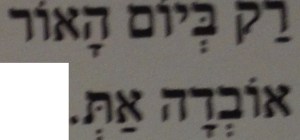
Yehuda Amichai’s “Shir Ha-Chut La-Machut [Poem of the Needle for the Thread]” has not been published in English translation. Our group rendered this line from the poem as “Only in the day, you are lost in the light,” or “Only in the daylight, are you lost.” (We struggled with the expression “b’yom ha-ohr.”)

And, finally, here are several versions of Deuteronomy 26:5 —

וְעָנִיתָ וְאָמַרְתָּ לִפְנֵי יְהוָה אֱלֹהֶיךָ,
אֲרַמִּי אֹבֵד אָבִי,
וַיֵּרֶד מִצְרַיְמָה,
וַיָּגָר שָׁם בִּמְתֵי מְעָט; וַיְהִי-שָׁם,
לְגוֹי גָּדוֹל עָצוּם וָרָב.
And thou shalt speak and say before the LORD thy God:
‘A wandering Aramean was my father,
and he went down into Egypt,
and sojourned there, few in number;
and he became there a nation, great, mighty, and populous.
— JPS 1917

…’My father was a fugitive Aramean…’
— JPS 1999

‘An Aramean Astray my Ancestor”
— Everett Fox translation, 1995

posted on this sixth day of the Omer 5777, with this prayer:
“In remembrance of the Exodus from Egypt, we pray that you release all whose bodies and spirits remain captive and enable us to extend Your outstretched arm in the process of liberation.” (see Ritual Well)

Maintaining Self and Struggle

A meditation linking God’s four-letter name – YHVH (yud-hey-vav-hey) – with the human body/soul can help focus on God’s presence and power in our lives. I have relied on this meditation since Rabbi David Shneyer taught it to me some years ago.

yhvhgraphic
The variation presented here, incorporates a teaching from the prophet Micah on what God requires of us —

הִהִגִּיד לְךָ אָדָם, מַה-טּוֹב; וּמָה-יְהוָה דּוֹרֵשׁ מִמְּךָ,
כִּי אִם-עֲשׂוֹת מִשְׁפָּט וְאַהֲבַת חֶסֶד, וְהַצְנֵעַ לֶכֶת, עִם-אֱלֹהֶיךָ.
You have been told, human, what is good,
that is, the traits that God expects from you:
acting justly, a passion for loving kindness, and walking humbly with your God.
– Micah 6:8 (translation from Siddur Eit Ratzon)

It is offered as support for social justice work in difficult times.

Shared here are the bones of the practice, so to speak, along with a PDF with additional graphics, 4-part Meditation, for easy carrying in a pocket or bag. Originally intended for use at the start of the day, this brief practice also serves throughout the day, especially when circumstances threaten to pull us off center, to realign with divine connection and our own strength and flexibility.

Fabrangen West tried a group chant based on this practice at the December 2016 gathering. Several participants more knowledgeable about renewal hasidus and kabbalah found connections between the sefirot and the words of the Micah verse. Further thoughts on this meditation — or on other Jewish practices for times of challenge — are welcome.

As always, “A Song Every Day” seeks comments or guest posts.

(1) Begin

Begin with meditation or chant using the four-letter name to focus on God’s presence before and within:


(2) “You’ve been told, human…”

Cycle through first half of verse, Y-H-V-H, head to legs, several times. At each reflection stage, try to release any barriers to embodying those attributes God expects; where appropriate, note areas in need of further attention:

  • (Y) Consider your humanity and connection to God. If you are feeling depleted, this is a moment to be open to the spiritual support you need.
  • (H) Is anything – distraction, anger, injury, e.g. – impeding your ability to reach for “what is good”? If so, can you release the barrier now? Or,should you set aside more time for this, to keep your reach from straying?
  • (V) Are you centered, with YHVH as backbone? What might pull you away? How are you working to stay upright?
  • (H) Are you prepared to pursue what God seeks of you? Does body or soul require attention first? Ready for more instruction? (Or ↑)


(3) “…acting justly, a passion for loving kindness,
and walking humbly with your God.”

Cycle through second half of verse, Y-H-V-H, head to legs, several times. Again, at each reflection stage, release barriers if you can and make note of areas where further attention, including assistance from others, would be helpful:

  • (Y) Are you committed to embodying the traits we are told to share with God?
  • (H) Do you join hands with others, or just push your own ideas, in acting justly? Do you need more partners, assistance? To whom can you reach out?
  • (V) Is your spine ready to stand and bend in loving kindness? Do you need help – maybe learning or rest – to avoid damage to yourself or others?
  • (H) Ready to take steps in the world, humbly with your God, and in healthy company with others, in the struggle? (Or ↑)

Brief journaling – either at this point, before closing out the meditation, or shortly afterward – can be helpful.

(4) Close

Return to a chant of the four-letter Name, preparing to bring your newly-aligned self into the outside world and the on-going struggle.

verseandgraphic