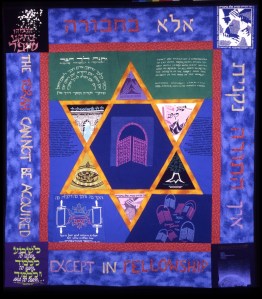
Thirty Cubits in the Tabernacle

The inside of the Tabernacle, the desert worship space of the Israelites, is 30 cubits long. (This is worked out from directions for various components, described in Exodus 26-27.) An inside covering is composed of ten panels of “twisted linen, and indigo and purple and crimson, with cherubim, designer’s work,” each measuring 28 cubits by 4 cubits (Alter’s translation; citation below). Eleven goat-hair panels of 30 cubits by 4 cubits create an additional covering over the whole construction. (Explicit instructions in Exodus 26:1 and 26:7).

The inside coverings are joined so “that the Tabernacle be one whole” (Exodus 26:6).

26:6) that the Tabernacle be one whole
This phrase leads Abraham ibn Ezra to muse over how unity in the greater world is constituted by an interlocking of constituent parts that become a transcendent whole, as in the unity of microcosm and macrocosm. One need not read this section homelitically, as he does, in order to see the power of summation of this particular phrase.
— Alter, Robert. The Five Books of Moses: A Translation with Commentary. (NY: Norton, 2004)

Continue reading Thirty Cubits in the Tabernacle

Passover and Awakening

Now when a man becomes aware that he is falling asleep and begins to nod and he is afraid that a strong, heavy sleep may overcome him, the best advice for him is for him to request his friend to wake him from time to time or that he should go among people where a light shines brightly….the friend should know something of the great loss sleep brings and how necessary it is to awaken the sleeper…
— from R. Aaron Roth‘s “Agitation of the Soul” [1934] IN The Schocken Book of Jewish Mystical Testimonies: A unique and inspiring collection of accounts by people who have encountered God from Biblical times to the present, NY: Schocken, 1997. Louis Jacobs, translation/commentary

Passover seems to me one of the times when Jews are called upon to reflect on past awakenings and to commit to awakening themselves and others.
Continue reading Passover and Awakening

A House of Prayer for All People?

“…to the poor person who is with you [et-he’ani imach]…” (Exodus 22:24)

Listen! 
Did that study group just ask “us” to consider the plight of “the poor”?
Did that prayer just focus on “the needy” as though we were weren’t present? 
Is this house of prayer really for all people?

Listen! 
Recognize the special burdens of relative wealth, but don’t assume everyone here bears them. 
Acknowledge privilege but don’t assume everyone present enjoyed its fruits. 
And never speak as though “the poor” are not in the house. 

Listen!
Can you hear the sounds of loss and fear, struggle and stress all around you?  
Know the difference between sleeping on a park bench and moving in with friends when house payments fail; 
Realize that worrying about whether one will eat today is different from making excuses to skip business lunches; 
Understand that dropping out of college is more catastrophic than struggling on without textbooks or funds to visit home; 
And be aware that never having a day of economic ease sits on one’s consciousness differently than losing one’s pension. 
But remember that no challenge is easy to manage just because someone else is facing a greater — or a different — one.
Hear, and honor, everyone’s experience.

Only then, when all have listened and all have heard. Only then, when our language and our minds make room for the full variety around us… only then, together, will our “light blaze forth like the dawn” and our “wounds quickly heal.”

(2012, CC BY-NC-SA)

Then Israel Sang: Leadership Variation

“Then,” after safely crossing the Sea of Reeds, the Egyptians’ pursuit thwarted, “Moses and the Israelites sang…Miriam took her timbrel…and all the women followed her” (Exodus/Shemot 15:1, 20-21). “Then” — forty years later, after God tells Moses: “Assemble the people that I may give them water” (Numbers/Bamidbar 21:16) and without apparent prompting or leading — “Israel sang this song:”

Come up, O well — sing to it —
The well which the chieftans dug,
which the nobles of the people started
With maces, with their own staffs.
–Numbers/Bamidbar 21:17-18 (JPS translation**)

Continue reading Then Israel Sang: Leadership Variation

Pekudei: A Path to Follow

Speaking of weaving and women’s work…

SERAKH BAT ASHER THE HISTORIAN ADDS: Since we were principally a sheepherding people in ancient times, Israelite women mostly wove wool. Some even say that it was we women of Israel who first introduced colored wool garments into Egypt. For did not Joseph have a splendid “coat of many colors”!

THE SAGES IN OUR OWN TIME ADD: Modern scholars have found pictures of colored garments in Egyptian tomb paintings dating from about the time Jacob’s clan supposedly arrived in Goshen. Anad not only did the Israelite women bring technical expertise to Egypt; they probably acquired from their Egyptian sisters the special technique of splicing and twisting linen that first appears in Canaan about the time the Israelites would have arrived from the Nile Delta.

MIRIAM ADDS: As it is written: “EACH WOMAN SHALL BORROW FROM HER NEIGHBORS” (3:22)

BERURIAH THE SCHOLAR TEACHERS: The Torah describes the women in the wilderness who spin linen and goats’ hair “WITH THEIR HANDS” as “WISEHEARTED” (35:25). Similarly in the Book of Proverbs (31:13, 19, 22, 24-25), a “WOMAN OF VALOR” is described largely in terms of her weaving skills:

She looks for wool and flax
And sets her hand to them with a will….
She sets her hand to the distaff;
Her fingers work the spindle….
She makes covers for herself:
Her clothing is linen and purple….
She makes cloth and sells it,
And offers a girdle to the merchant,
She is clothed with strength and splendor.
— Ellen Frankel, The Five Books of Miriam*

And weaving women’s work

Some final thoughts, paths to pursue — on the portion, the Book of Exodus and Passover — from the work of more contemporary wise women:

It’s good to meet with friends at the well, because it’s hard work hauling water, and doing innumerable humble chores, like so many women have for so long. Of course men also strive, like Jacob and Moses lifting stone well covers, but I’m thinking about Rivka watering all those camels; that was heavy duty (Genesis 24.46). Rachel, Hagar, Miriam and Zipporah have dramatic associations with wells. In Torah stories women spend a lot of time bearing water. Although much of that kind of work is easily perceived as insignificant, or sentimentalized as a labor of love, the world we know and ha’olam haba, depend upon it….

In this American song* a woman brings water to a man working in the fields. It comes from the history of people whose slave labor built the wealth of our nation….

What if we learned to respect and to know about all the people who have ever done for us?
Don’t let the work of their hands go unsung,
— Amy Brookman, Exodus1verse8 *link updated from the one in original post, which is gone now

AND THEN I SIT. “Dom l’Yah, v’hitcholello.” “Be still,” Psalm 37 tells us,”and wait for God.”
The final sentence of The Book of Exodus, the manual for our liberation, tells us that we must cultivate an awareness of God’s mysterious presence, characterized by the Divine cloud in the day and an inner fire at night. This awareness will guide us throughout our journeys.
— From Torah Journeys, Shefa Gold


Chazkei! Chazkei! Venitchazeik!
Be strong! Be strong! And may we be strengthened!

* Please see Source Materials for full citations and additional information.

————————————————————–
The “Opening the Book” series was originally presented in cooperation with the independent, cross-community Jewish Study Center and with Kol Isha, an open group that for many years pursued spirituality from a woman’s perspective at Temple Micah (Reform). “A Song Every Day” is an independent blog, however, and all views, mistakes, etc. are the author’s.

———————————————————————————-

Vayakhel: Language and Translation

Moses said to the Children of Israel, “See, HASHEM has proclaimed by name, Bezalel son of Uri son of Hur, of the tribe of Judah. He filled him with Godly spirit, with wisdom, insight, and knowledge, and with every craft…”
Shemot/Exodus 35:30-31

Continue reading Vayakhel: Language and Translation

Pekudei: Something to Notice

The colors.

Before we complete the Tabernacle and leave Exodus/Shemot, I must pause to consider the oft-mentioned color trio: “tekhelet, v’argaman v’tolaat shani.” These colors are central in the tent instructions/construction and appear throughout the priestly garments. The same colors are, of course, prominent in contemporary Jewish textiles and other arts.


Tekhelet — Blue, Sky Blue or Indigo.


Argaman — Purple.


Tolaat shani — Scarlet or Crimson.

“Blue Wheat,” “Ode to Overturning Bowers vs. Hardwick” and “Pink Pomegranate” (looks scarlet to me) — above — are all works by DC-area artist Judybeth Greene.


The quilt below was made by Amy Leila Smith, of Blue Feet Studio in Maine, for the National Havurah Committee.

…seems fitting closure for a portion which focuses on weaving, long a woman’s art. See, e.g., Women’s Work, the First 20,000 Years: Women, Cloth and Society in Early Times by Elizabeth Wayland Barber (Norton, 1994).

For more on the special history of tekhelet blue, see Ehud Spanier’s history (details in Source Materials).

[CAUTION on print and internet sources focusing on these three colors, especially tekhelet: Many involved in reconstructing exact colors of the Tabernacle and related work are deeply concerned with preparing for the Third Temple.]

————————————————————–
The “Opening the Book” series was originally presented in cooperation with the independent, cross-community Jewish Study Center and with Kol Isha, an open group that for many years pursued spirituality from a woman’s perspective at Temple Micah (Reform). “A Song Every Day” is an independent blog, however, and all views, mistakes, etc. are the author’s.
———————————————————————————-

Continue reading Pekudei: Something to Notice

Pekudei: Language and Translation

“And these are the names [v’eileh] of the Children of Israel who were coming [ha-ba’im] to Egypt…”
— Exodus/Shemot 1:1

“…throughout their journeys [mas’eyhem].”
— Exodus/Shemot 40:38 (Stone translation*)

A number of commentaries note that the vav (a conjunction which can mean “and” or “but”) is meant to link the narrative of Genesis with that launched with Exodus. In an unusual bit of similarity, both the Stone and Alter* commentaries make this point and also remark that identical words open the genealogy beginning at Genesis/Breishit 46:8.

Stone emphasizes the on-going nature of the narrative by using “were coming” for “ha-ba’im,” while Alter and others use the past tense. JPS* bridges the two with “came, each coming with…”

Alter also notes that the word mas’eyhem [in all their journeyings] uses “the same verbal stem [that] inaugurated the Wilderness narrative in 13:20, ‘And they journeyed from Succoth,'” suggesting that this helps leave a “sense of harmonious consummation,” as the work of the Tabernacle — likened to that of Creation — is completed. “But,” he continues:

the condition in which the Israelites find themselves remains unstable, uncertain, a destiny of wandering through arduous wasteland toward a promised land that is not yet visible on the horizon. The concluding words of Exodus point forward not to the Book of Leviticus, which immediately follows, but to the Book of Numbers, with its tales of Wilderness wanderings, near catastrophic defections, and dangerous tensions between the leader and the led.
— Alter, p.535

Chazak! Chazak! Venitchazeik!
Be strong! Be strong! And may we be strengthened!

* Please see Source Materials for full citations and additional information.

————————————————————–
The “Opening the Book” series was originally presented in cooperation with the independent, cross-community Jewish Study Center and with Kol Isha, an open group that for many years pursued spirituality from a woman’s perspective at Temple Micah (Reform). “A Song Every Day” is an independent blog, however, and all views, mistakes, etc. are the author’s.

Vayakhel: A Path to Follow

In this portion, and this portion alone, the women of the children of Israel are identified as a significant group within the larger whole,” writes R. Nancy H. Weiner in her dvar Torah, “Of Women and Mirrors.”

The Torah unequivocally highlights that women are participating in the single most important sacred endeavor of the community of Israel’s collective existence: the building of the mishkan, the place in which God’s presence will dwell among the people and travel with them as they journey toward the Promised Land.

And then the narrative takes a significant turn. The efforts of the entire community become the backdrop for the tasks taken on by the great (male) architects and craftsmen of the mishkan. The portion mentions the contributions of women only once more as it describes the labors of Betzalel, the chief architect of the mishkan. The Torah says, “He made the laver of copper and its stand of copper, with the mirrors of the women who served at the entrance of the Tent of Meeting (Exod 38:8)…
— Weiner, in The Women’s Torah Commentary

One path to follow is to look at the role of women in the ancient Israelite world. The work of Tikva Frymer-Kensky comes to mind as a starting point.

But Weiner herself suggests another path: “…[Women] are not the only victims of collective amnesia…” Look at less visible Jewish communities of today — Kulanu or Bechol Lashon [In Every Tongue].

The entire piece, “Of Women and Mirrors,” is available at GoogleBooks, The Women’s Torah Commentary.*

* Please see Source Materials for full citations and additional information.

————————————————————–
The “Opening the Book” series was originally presented in cooperation with the independent, cross-community Jewish Study Center and with Kol Isha, an open group that for many years pursued spirituality from a woman’s perspective at Temple Micah (Reform). “A Song Every Day” is an independent blog, however, and all views, mistakes, etc. are the author’s.