Joni and Dinah

Chapter 34 of Genesis begins with a woman going to visit neighbors. It is one of very few instances in Genesis — maybe the only one? — of an apparently friendly, non-transactional interaction with folks of the surrounding culture. And one of the few instances in Genesis in which a woman has any agency. This episode is part of the Torah portion Vayishlach (Gen 32:4-36:43). The commentary is inspired by Joni Mitchell and “The Last Waltz,” concert and film, as well as Dinah’s story

CONTENT WARNING: What follows is mostly about music and crossing boundaries of various kinds in contemporary society. But Dinah’s story cannot be separated from disturbing underlying topics, including misogyny, racism, and sexual violence.

UPDATED afternoon of 12/5/25: mostly edits to correct typos and awkward grammar; some new phrasing in the Joni Mitchell, Now and Then section and a few new paragraphs at the end. Apologies for any confusion… still thinking.

Existing in Public

In Genesis 34:1, Dinah, “went out [teitzei] to see the women of the land.” The single verse relating this scene describes Dinah as “daughter of Leah, whom she had borne to Jacob.” (More below on Dinah and her going out, and a little about her parents.)

This “going out” is the only verb attributed to Dinah and the only time that other women are mentioned in Chapter 34. One verb. One verse of agency. And no voice.

The text itself does not criticize Dinah for going out or denigrate the women she went to visit. But the consequences of this one woman exercising agency and existing in public for the space of one verse are dramatic and dire. This reverberates in so many aspects of US society today, and in history, where simply existing in public is understood by some as provocation:

  • walking or driving while Black;
  • being queer in public;
  • living with brown skin or other signs of “possible immigrant” status;
  • being “too Jewish” or Jewish in the “wrong place” or the “wrong” kind of Jewish;
  • playing sports without identifying strongly with one gender;
  • existing as a transgender person;
  • expressing support for Palestine;
  • appearing in any way that resists authoritarianism;
  • what we used to call “doing your own thing” among folks strongly committed to some other way of being.

At various points in US history, whatever white people performed on stage or dance floor was eventually accepted as mainstream, while “Black music” was/is continually viewed as dangerous and in need of policing by white nationalism:

Jazz. Here in Germany it become something worse than a virus. We was all of us damn fleas, us Negroes and Jews and low-life hoodlums, set on playing that vulgar racket, seducing sweet blond kids into corruption and sex. It wasn’t music, it wasn’t a fad. It was a plague sent out by the dread black hordes, engineered by the Jews. Us Negroes, see, we was only half to blame – we just can’t help it. Savages just got a natural feel for filthy rhythms, no self-control to speak of. But the Jews, brother, now they cooked up this jungle music on purpose. All part of their master plan to weaken Aryan youth, corrupt its janes, dilute its bloodlines.

…we was officially degenerate.

…And poor damn Jews, clubbed to a pulp in the streets, their shopfronts smashed up, their axes ripped from their hands. Hell. When that old ivory-tickler Volker Schramm denounced his manager Martin Miller as a false Aryan, we know Berlin wasn’t Berlin no more. It had been a damn savage decade.
–Sid, Black musician narrator, in Esi Edyugan’s Half-Blood Blues: A Novel Picador, 2011 p.78-79

Further discussion of Edyugan’s novel, racial and music history, and how Germany in the 1930s relates to US history and my own story; plus whole series from 2016 on related topics.

In a somewhat similar vein, women’s and queer people’s existence continues to be viewed as dangerous in many quarters and in need of policing by cishet men and white nationalists.

Joni Mitchell, Then and Now

With US Thanksgiving, I am often reminded of “The Last Waltz” as a film and soundtrack, both of which have been important parts of my world for decades. And, most years, I re-discover how angry I still am at the film’s treatment of Joni Mitchell as an artist and human being. It is only in the last 10 or 15 years, that I’ve learned just how much of the film’s presentation was NOT what the original concert offered; instead, Martin Scorsese chose, and popular attitudes to women permitted, deliberate manipulation of concert footage in ways that denigrate Mitchell and every woman, in- and beyond the arts.

Details here —

I wrote the above piece a few years ago, in a week associated with a different part of the Torah, and on the heels of Mitchell’s surprise appearance at Newport that year (2022). I recently updated some of this post’s language for clarity and to add a few new links.

This year (2025), I had the opportunity to attend a tribute to “The Last Waltz” at a music venue just outside of Chicago. In many ways it was a great concert and a terrific experience. However, unless I misunderstood his meandering words, the musician-emcee called Joni Mitchell a tramp while introducing “Coyote.” I think he believed he was being funny, and maybe he meant to illustrate double-standards that existed then and still operate. But I was mostly struck with how hard the world can still — after 50 years! — push back when many people are just trying to exist, live their life, and engage their art.

Defending and Celebrating “Going Out”

We only get his one verse, in the midst of such a wildly disturbing story, that tells of Dinah’s going out. And we don’t learn much, if anything, about the rest of the family engaging with local culture or making friends. Is the Torah trying to tell us how dangerous it is to be going out into the surrounding culture? If so, when did that emphasis come into the telling? And what might we learn by focusing on the importance of going out and what we miss if we fear it or are attacked for doing so?

UPDATE 12/5 afternoon, four paragraphs and image added here:

When Esau and Jacob meet, after decades apart, the Torah text includes dots above the word va-yishakeihu [and he kissed him] in Genesis 33:4: “Esau ran to meet him; he embraced him, flung himself upon his neck, and kissed him. And they wept.”

Va-yishakeihu with dots (Gen 33:4)

For centuries, Jewish teaching has used these dots to suggest that the text be read in opposition to its straightforward meaning: instead of kissing Jacob, Esau was insincere in his greeting or perhaps trying to bite or otherwise do Jacob harm. (Find the text and commentary at Sefaria.)

As part of the deliberate demonization of Esau, unsupported by the Torah itself, this dotted reading is one of my least favorite aspects of Torah commentary. It seems very like Scorsese’s use of interview footage to completely alter how viewers are introduced to Joni Mitchell. And all too resonant with dangerous propaganda through the ages. However, the dots also offer a powerful example of how Jewish tradition has always found a way to read with some skepticism, even change the text where warranted.

Jacob went out; Leah went out; Dinah went out. Maybe we, too, can go out into Torah readings that put us in better touch with our families, our neighbors, and the world at large. Where Torah has been weaponized, we can learn to acknowledge harm and promote better readings. And where our culture, in- and outside of Judaism, has tricked us into thinking the worst of others, maybe we can work to undo the propaganda.

NOTES

Dinah Went Out

Prior to Genesis 34, Dinah is previously mentioned only at her birth and naming (Gen 30:21). Dinah, daughter of Leah and Jacob, has no voice of her own in the text, and we never hear from Leah or any other women of Jacob’s household or the town regarding her fate. Instead, men act on and about Dinah: She is an object — of lust or love, depending on translation/interpretation — for the prince, who is seen lurking here in R. Crumb’s illustration —

comic frame for Gen 34:1 shows Dinah visiting with a few women while Shechem looks on from nearby.
R. Crumb’s The Illustrated Book of Genesis, Norton, 2009.**

Then Dinah is the object of various decisions and actions by the prince, his father, other men of the local town, and her own father and brothers. Over the centuries, Dinah’s “going out” has been variously interpreted as

  • involving herself — for better or worse, depending on the commentary’s perspectives and biases — in the existing culture;
  • spying on the women of the land;
  • showing off her wealth;
  • seeking women’s companionship in a non-romantic sense;
  • checking out the women as potential romantic partners;
  • seeking inappropriate attention, with some teachers insisting that a woman seeking any attention at all is inappropriate (and potentially dangerous);
  • acting forward, as Leah’s going out to meet Jacob (Gen 30:16) is often characterized, with the implication that women must be restrained;
  • simply moving through the world, which the text itself does not condemn, perhaps akin to Jacob’s going out to find his way (Gen 28:10).

**Alt Text: graphic frame for Gen 34:1-2 shows Dinah visiting congenially with a few women in what appears to be a public square, while the prince looks on from behind a nearby building column. R. Crumb’s Illustrated Book of Genesis uses Robert Alter’s 1996 translation: “And Dinah, Leah’s daughter, whom she had borne to Jacob, went out to see some of the daughters of the land. And Shechem, the son of Hamor the Hivite, prince of the Land, saw her…”

Commentary on Dinah’s Story

Rashi (11th Century CE France) notices that Leah previously “went out” (Gen 30:16): “like mother, like daughter.” Rashi adds a note about the need for men to subdue wives from public activity.

Ibn Ezra (12th Century CE Spain) says: AND DINAH WENT OUT. Of her own accordas in: She did not ask her parents’ permission.

Ramban (13th Century CE Spain) says “bat Leah” is links Dinah to Simeon and Levi, who are also children of Leah and so are moved to avenge her [due to perceived defilement]

The Torah: A Women’s Commentary (CCAR Press, 2008) notes that Jephthah’s daughter “went out to meet him,” using the same yud-tzadei-aleph verb (Judges 11:34) with horrible consequences. That volume has more on Dinah. See also “The Debasement of Dinah” and “A Story that Biblical Authors Keep Revising” Dinah and Schechem” at TheTorah.com.

Women’s Archive on Dinah in historical midrash.

Some relatively contemporary notes on Dinah. While some people treat Anita Diamant’s novel, The Red Tent (St. Martin’s Press, 1997), as midrash, the author herself says it is historical fiction.

An exploration of Dinah as transgender.

Note also that Leah goes on to live with Jacob on “the land,” while Rachel seems strongly linked to her family’s original home, “back there,” and dies on the road giving birth to the only child born in “the land.” (More on these aspects of the story found in this older post.)

Notes on “subdue it/her”

Rashi and Genesis Rabbah to Gen 34:1

Rashi cites Genesis Rabbah (4th Century, Talmudic Israel), which uses Gen 34:1 as proof text for why men should subdue their wives: Gen 1:28 tells humans to “…fill the earth and subdue it/her [mil’u et ha-‘aretz v’khivshuha…].” The Hebrew verb construction v’khivshuha uses the feminine direct object ha [it/her] to match the feminine noun ‘aretz. Commentary plays on that grammatical feature to read “subdue her [the woman],” rather than the more common “subdue it [the earth],” bringing Gen 34:1-3 as explanation: “the man subdues his wife so she should not go out in public, as any woman who goes out in public will ultimately falter.” Implication is that Dinah “faltered” by allowing herself to come in contact with Shekhem (Gen 34:2); depending on reading of va-y’aneiha, this means either that Dinah allowed herself to be “humbled” by consensual association with Shekhem or that she made herself vulnerable to physical attack or social violation by “going out,” i.e, simply being a woman in public space.

-#-

Musical Legacies

I am intrigued by disagreement among sources, including origins for a piece of music. So, I am sharing here some things I recently discovered trying to find the right citation for “Return Again,” often sung during the Days of Awe.

The song seems to have begun, as many compositions of Shlomo Carlebach (1925 – 1994), z”l, apparently did, as a wordless niggun. (See brief note on Carlebach‘s controversial legacy with links to more information.)

Shlomo Carlebach put Hebrew lyrics (from festival musaf) to the tune:

V'hashev kohanim leavodatam 
velevi'im leshiram ulezimram
ve'hashev yisrael linveihem
[Restore the priests to their service,
the Levites to their song and psalmody,​
and Israel to their habitatio​ns.]

[See Zemirot Database and, e.g., Spotify.]

English lyrics, lawsuit, citations

English lyrics came later. Rafael Simcha (Ronnie) Kahn says he wrote them, and this short video shows Carlebach citing “our friend Ronnie Kahn” for the English.

In 2019, Kahn filed suit against Shlomo’s daughters, Nechama and Nedara, over ownership of the song. Kahn vs. Carlebach, claims there was a joint copyright filed in the 1970s, improperly amended later. In June 2023, a US District Court Judge upheld Kahn’s right to sue, while also dismissing some claims. (See also CaseText and Archive.org.)

Zemirot Database for the English notes permission from Nechama Carlebach and cites Shlomo as (sole) author.

Shaina Noll’s (1992) version credits S. Carlebach and The Carlebach Family.

A number of sources in the last five years or so list S. Carlebach for the tune and R. Kahn for the lyrics.

More background

Cantor/composer Jeff Klepper shares some history here on a 2002 listserv, Hanashir. (Klepper’s slightly dated website; bio at Temple Sinai; see also Hava Nashira).

The Hanashir note includes different lyrics attributed to Rafael Simcha Kahn:

"Return again, Return again,
Return to the home of your soul;
You who have strayed, Be not afraid,
You're safe in the house of the Lord"

The note on the 2002 Hanashir list does not discuss the purported lyric shift, from “You who have strayed…in the house of the Lord” to “Return to who you are…born and reborn again.”

…The substantial differences might explain why the video (also linked above), identified as from 1976 and posted by Kahn, is cut off so early in the tune. (There could, of course, be many other reasons for the video’s length.)…

Hanashir does discuss one word change, however:

At a certain point, Shlomo, who started singing his niggun with Ronnie's words as well as the original Hebrew ones, changed the first verse to "...Return to the land of your soul"-- making it more of a (religious, obviously) Zionist verse and less of a general "spiritual" one. I [Robert Cohen] personally thought it was a change for the worse, as it particularized and narrowed whom it might speak to.  Ronnie's words, I thought, spoke to every Jew--as the verse in tefillah does.

Complex legacies

I [Virginia Spatz] personally find it fascinating that this (decades old) discussion focused on the shift from “home” to “land,” while assuming that liturgy about restoration of the Temple spoke to “every Jew.”

I find it fascinating that we have this archived discussion still — however informal it was at the time, and however fleeting it was assumed to be. I wonder, even as I participate in it, about the ethics of referencing a communication that was not written for long-term consumption.

I find it fascinating that the musical and Jewish worlds cannot easily answer the simple query: who wrote this song?

And I find it fascinating and important for us to consider how we honor and build on the work of those who came before us. What kinds of changes are appropriate, as we bring forward materials from the past, and what kinds of acknowledgements are needed?

Featured image is heading from legal filing: “United States District Court, Eastern District of New York. Ronnie Kahn, Plaintiff, -against- Neshama Carlebach and Nedara Carlebach, defendants.”

Something to Talk About: Split Binding Version

I have a very intense relationship with the book, For Times Such As These: A Radical’s Guide to the Jewish Year by Rabbi Ariana Katz and Rabbi Jessica Rosenberg. (Excerpt here: Tammuz in Times Such as These).

Having been told that it was in the works and pre-ordering it quite early, I felt involved with it before I ever held it in my hands. I’m a big fan of its authors and of Wayne State University Press, with its Jewish studies and midwest-focused titles. Then, as it happened, that fall 2023 pre-order proved a tremendous blessing in ways none of us could have imagined: In those post-Sukkot months, genocidal attacks on the West Bank, as well as Gaza, were launched with justifications based on Jewish survival and Jewish teaching; so many Jews and Jewish institutions seemed ready to turn their backs on Jewish values, so just knowing that there was a book on the way testifying to possibilities of living and organizing in Jewish integrity was a lifeline.

I participated in an on-line book event for Tu B’shvat on January 18 (2024), apparently received one of the first copies Wayne State mailed out (in late January), had my copy signed at the first book reading of the national tour (at Red Emma’s in Baltimore, March 3), and joined a second tour event in Washington, DC (May 22; more on the book and its authors’ tour).

For a book that some would still consider brand new [just over five months together, when I wrote this in July 2024] , me and my copy have been through a lot together. And, today, while deep in conversation, the book’s binding split and some pages began sliding free.

showing several loose pages
pages sliding out of perfect-bound book

…Now, maybe I was too rough. Maybe the perfect-binding did not quite live up to its name. Or, possibly, the break was some kind of organic result of considering the calamities of the month of Tammuz and questions like: “How are the hurts of your communities’ histories manifesting in the collective body?”…

However the binding break happened, I found myself thinking it was a little soon for this particular volume to join the “well-loved/much-used” stage of our relationship: Do we even know one another well enough for that!? Those thoughts led, as these things do with me, to new lyrics for “Something to Talk About.”

So, here, in honor of this whirlwind start to what I expect will be a long, loving, and fruitful relationship, is “Something to Talk About: Me and For Times Such As These” — with love and respect to Shirley Eikhard and Bonnie Raitt.

“Something to Talk About: Me and For Times Such As These

Ooh, Ooh…. People are talking, talking about reading
I hear them whisper, you won’t believe it
They think we’re lovers kept under covers
I just ignore it, but they keep saying
We meet just a little too much
Lean just a little too close
We stay just a little too long
Maybe they’re seein’ something we don’t, darling

Let’s give ’em something to talk about
How ’bout little something to talk about
How about words?

I feel so clumsy, did not expect it
you split your binding, could we be rushing, baby ?
It took the rumor to start things rumbling
Now it seems we’re already tumbling
Travelin’ through Jewish days
Cyclin’ through the whole year long
I’m hoping that you’re up for this trip
If we both know it, let’s really show it, baby

Let’s give ’em something to talk about, babe
A little mystery to figure out
Let’s give ’em something to talk about
I want your love!

Original lyrics by Shirley Eikhard (1955-2022), famously performed by Bonnie Raitt, beginning with 1991 “Luck of the Draw” album

Shirley Eikhard and Bonnie Raitt versions —

A little background on Eikhard [Archive link might be slow to open] and “six songs you should know

Split Binding (Re-)Union

Sometimes, when I wear a book out, I find a new copy. In some cases (Finnegans Wake is one), I keep the old one for sentimental reasons but use the newer copy for practical reasons. With a few books, however, the split-binding copy is the one I continue to use.

Here are the Jewish studies volumes that remain with me, for regular reference, despite binding mishaps:

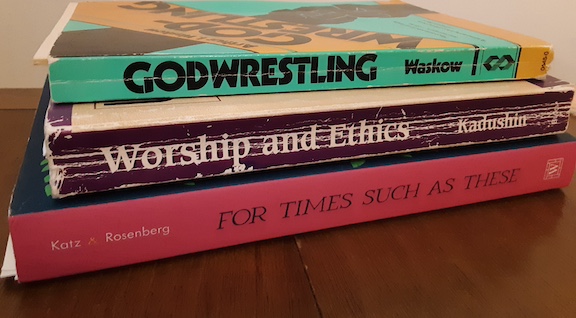
  • Max Kadushin. Worship and Ethics: A Study in Rabbinic Judaism. Bloch Publishing, 1963. (Scotch-tape inside)
  • Arthur I. Waskow. God-Wrestling. Schocken Books, 1978. (Binder clip on open side)
  • Rabbi Ariana Katz and Rabbi Jessica Rosenberg. For Times Such and These: A Radical’s Guide to the Jewish Year. Wayne State University Press, 2024. (String somehow seemed appropriate for this one, but it will depend on shelf situation.)

Statistically speaking, this house has many books on subjects similar to these three. And surely it must be accidental that these particular three comprise the “broken binding/still used” category. Nevertheless, the three books do seem to belong together, both in terms of theme and in terms of how essential I have found each to be, at different points in my life. So, I cannot shake the urge to anthropomorphize my new-ish book by insisting that it prematurely, purposely joined the broken-binding-brigade.

Looking at these three books, I recall that Max Ticktin (June 30, 1920 – July 3, 2016) , z”l, found Kadushin very dry as a JTS professor and was puzzled by my enthusiasm for this work, while he loved Arthur Waskow’s writing and was proud of his connections to Fabrangen Havurah. I cannot help wondering what Max would have made of For Times Such and These. I am quite sure he would have applauded this line: “We read Korah and ask, how do we organize in ways where all of us get to bring our unique and varied skills and power?” (p.326). And maybe that’s the through-line for the books in my broken-binding-brigade.

Image descriptions: 1) stack of three paper-back books — God-Wrestling, Worship and Ethics, and For Times Such as These — showing loose pages and wear. 2) Three books — For Times Such as These, God-Wrestling, and Worship and Ethics — shown cover out: first, held together by string; second, with a large binder-clip; third shows ragged pages (bound with tape).

-#-

What Kind of Country Is It?

Moses told the scouts to go up and “…see what kind of country it is. Are the people who dwell in it strong or weak, few or many? Is the country in which they dwell good or bad? Are the towns they live in open or fortified? Is the soil rich or poor? Is it wooded or not? And take pains to bring back some of the fruit of the land.” — Numbers 13:18-25

The video below is part of an attempt to “scout out the land” and prompt consideration of what kind of questions we ask about a place that is new to us, and why.

Note to Tzedek Chicago Torah Study participants — you’re welcome to check it out in advance, but I plan to include this in our exploration of parashat Shelach on June 29. To all: maybe I’ll post something more about the actual portion; maybe not.

Video takes a bit to load — also here is link that might work more smoothly.

TEXT used in video The video displays some words, including song lyrics, and that is also available in separate document for anyone who prefers to read in this form. Text of June 29 commentary video (PDF).

200 The USIA film at National Archives (a little more info below, but I cannot find a link to the original music used). NOTE: Video is full of LOTS OF STRONG STROBING

200+ with US Blues The video posted by @LongStrangeTrip710 incorporates the 1973 studio version, from Mars Hotel, of “US Blues.” NOTE: video includes the original film, which contains lots of STRONG strobing.

US BLUES Here’s a link to the lyrics at Dead net. Plenty of performances by (Grateful) Dead and friends available on YouTube, etc.

More Credits/Info

I think this is all the credits, but let me know if I missed something. No full, frame-by-frame image-description for the video, however here’s a summary: Still images from a 1975 “psychedelic” film made as USIA propaganda for 1976 US Bicentennial; includes video performances from Fifth Dimension, Gil Scott-Heron, and Rhiannon Giddens with Paul Simon, plus audio from Chocolate City and some other music. Includes quotes from Numbers 13.

200 The USIA film at National Archives and more about the Bicentennial film project. Slightly more about work of Vince Collins at IMDB.

AQUARIUS “Aquarius/Let the Sunshine In” was part of “Hair” and released on the 1969 Age of Aquarius album by the Fifth Dimension (Basic information). The video shown came without much explanation from an “Oldies” music channel.

CHOCOLATE CITY Lyrics, credits, and slightly more background for “Chocolate City” and George Clinton’s website.


WHITEY ON THE MOON Two performances by Gil Scott-Heron included: 1970 “Small Talk at 125th and Lenox” album, Flying Dutchman Records, and 1982 “Black Max,” widely available on on internet, although not sure about ownership and don’t know if it’s streamed anywhere; if DVD is an option, try your local library. (Basic info general Wiki and filmmaker’s page) See also this image , from 5783 Shavuot teaching on “faces,” with some words and images from Gil Scott-Heron.

RIVERS/DC TunesConversations Toward Repair” (We Act Radio) page includes credits for Roberta Flack’s “River” and Brent Peterson’s “Clean Rivers.” A brief clip from Rare Essence’s “Don’t Mute DC” was later included in regular intro music.

AMERICAN TUNE Paul Simon, 1973 “There Goes Rhymin’ Simon” Columbia Records (1973 lyrics). Note that the author changed the lyrics in recent years. Brief Billboard note about 2022 Grammy performance with Rhiannon Giddens, for “Homeward Bound: a Grammy salute to the songs of Paul Simon.” In summer 2022, Rolling Stone credited Giddens with changing the lyrics, but Giddens stresses that Simon made the change.

“It’s also very important to say that Paul changed the lyrics, not me – and this song has become one that is so dear to my heart for its ability to say what I have been feeling for a long time.” — July 28, 2022 — @RhiannonGiddens on X

X [formerly Twitter] post from @RhiannonGiddens about Paul Simon’s lyric change.

Footnote to “Setting Out”

Blues musician Bob Margolin, who was on- and off-stage with Muddy Waters, for the 1976 Last Waltz concert, just posted the below reminiscence on his Facebook page. It’s a lovely story in its way, but it’s it’s also another illustration of what life was like for Joni Mitchell and her few female peers back then.

“Joni Mitchell with Rick Danko at a The Last Waltz, 1976. I was there with Muddy Waters. In the green room, she thanked Muddy for his music. Muddy didn’t know who she was, he didn’t know about young Rock Stars. But her beauty was breathtaking. Muddy hit on her. She backed out of it gracefully. She probably did that many times every day. A couple of months ago, I listened to a playlist of her greatest hits on Amazon Music. I was deeply moved by the width and depth of her artistry. For many of us it is a big thrill that she played at the Newport Folk Festival last weekend. Me too, I cried. She conquered time and illness and gave us a gift we didn’t expect. Thank you Joni Mitchell”

Image Description: Still showing stage with Rick Danko playing guitar and Joni Mitchell playing hers, facing a microphone to sing.

Posting this as a footnote to yesterday’s “Setting Out

Setting Out

This week’s Torah reading [July 26, 2022/ 27 Tamuz 5782] includes a series of stages reported like this:

The people-Yisrael set out from [_Place X_]
va-yisu bnei-Yisrael
and encamped in [_Place Y_ ]
va’yachanu
E.g., (Num 33:5):

The people-Yisrael set out from Ramses
and encamped at Succot.
וַיִּסְעוּ בְנֵֽי־יִשְׂרָאֵל מֵרַעְמְסֵס
וַֽיַּחֲנוּ בְּסֻכֹּֽת
va-yisu bnei-Yisrael mei-ra’amseis
va’yachanu b’sukot

This series of journeying stages, or “marches,” begins at the start of the second portion in this week’s double-Torah-reading: Matot (Numbers 30:2-32:42) and Masei (Numbers 33:1- 36:13). The idea of leaving one stage to reach another was reverberating for me while Joni Mitchell sang at the recent Newport Folk Festival:

Late last night, I heard the screen door slam
and a big yellow taxi took away my old man
don’t it always seem to go
you don’t know what you’ve lost til it’s gone

Watching video from Mitchell’s surprise appearance on 7/24/22, I was reminded of something I learned many years ago, from Amy Brookman at Fabrangen Havurah, in reference to the portion Masei: We have to “set out” to get to anywhere new.

From One Stage…

It is now possible to see Mitchell’s “The Last Waltz” performances — The Band’s farewell at Winterland, 11/25/1976 (Thanksgiving) — via The Band on Music Vault. Robbie Robertson and the crowd enthusiastically welcome Mitchell, and she performs three songs: “Coyote,” Shadows and Light,” and “Furry Sings the Blues.” (Details on these pieces at JoniMitchell.com). Earlier Mitchell sings harmony — from backstage — on Neil Young’s “Helpless,” her unseen contributions allowing for her later, proper welcome to the stage. On Mitchell’s third number, Young — who has already performed “Helpless” and “Four Strong Winds” — joins her on harmonica. In short: The Band went to some pains to ensure that both Mitchell and Young were recognized as artists, individually, while also including collaborative performances. Martin Scorcese, however, made other choices for the film.

B/W raw footage from The Band on MV: Mitchell’s “Coyote” with the Band at The Last Waltz
B/W raw footage from The Band on MV: Mitchell’s “Shadow and Light” with The Band at The Last Waltz.
B/W raw footage from The Band on MV: Mitchell’s “Fury Sings the Blues” with the Band at The Last Waltz, plus Neil Young on harmonica.

When Mitchell appears in the 1978 Scorcese documentary, only “Coyote” is included — the film includes only one number from most of the guest performers; and I believe the director made the choices — and she is introduced on the heels of an interview segment called “Women on the Road” (see below). That is, Scorcese chose to place Mitchell’s welcome onto the stage immediately after leering interview remarks from about “women” as objects. To be extra clear: the director of a concert documentary chose to introduce an influential musician and composer with ugly, sexist and unrelated blither, rather than, say, thoughts about musical composition or influences — which the documentary does also include — or just with Robbie Robertson announcing, as in the above raw footage, “Joni Mitchell. Right!” (as the audience yells her name before she appears).

…”The Last Waltz” film includes studio performances by Emmylou Harris and the Staple Singers sisters (Cleotha [1934-2013], Pervis [1935-2021], and Mavis), but Mitchell is the only woman featured on stage during the concert. And I’ve come to think of that image, one woman among a stage full of men, as a kind of encapsulation of how the industry functioned then. (A cropped section of that final stage grouping is the feature image for this blog; description below.) See also footnote from a musician present at the time. [This paragraph was corrected in 2025, clarifying who was on stage in 1976 and who was filmed in studio and added to the film.]…

The film’s presentation of Joni Mitchell has been stuck in my consciousness since I first saw it at a theater in 1977. On the one hand, this was a boorish artistic move by one man; on the other, it was emblematic of a time. In both ways, experience of the film shaped my brain and body, in ways that I can sometimes recognize today and in ways that I probably do not even know. [Raw footage was not available back then, and I was not in the audience.]

….And, for the record: I do love and recommend the movie, for all the anger I harbor toward its director over many of its specifics. It’s available through Kanopy streaming and local libraries. (Rhino offers an extended anniversary soundtrack including numbers originally omitted.)

…to Another

On July 24, 2022 at Newport, Mitchell was surrounded by musicians of different musical backgrounds, gender identities, skin colors, and ages — many of them born long after Mitchell’s last appearance at Newport, in 1969, or her participation in The Band’s “Last Waltz” at Winterland in 1976.

Comparing the two images — Mitchell surrounded by collaborative, supportive (really, adoring) fellow performers in 2022 and Mitchell a powerful, lone woman actively denigrated by the filmmaker (if not her fellow performers) — brought me to that idea, from this week’s Torah portion, of needing to leave one stage in order to get to another. Of course, Mitchell’s reception and introduction in 2022 owes much to the strength of her long career and her personal hard road to physical recovery.

But this is not just a personal progression: We, as a society, had to leave the 1970s to get to later stages in the musical world and beyond. Watching the varied musicians collaborate with Mitchell through “Big Yellow Taxi” and the other numbers shared by Newport Folk Festival, I couldn’t help but think:

yes, often we don’t know what is lost til it’s gone; but sometimes, it’s a blessing to watch that taxi pull away.


Some background footage, FYI:

Here is some material from the film (inexpertly shared, complete with clutter from my den and an annoying lamp reflection):

Beginning: from early in the film — one of the few times we see the director — Martin Scorcese and Robertson talk about “The Last Waltz” concept

1:19 Robertson explains, backstage, that Ronnie Hawkins first hired him saying, “well, son, it doesn’t pay much, but you’ll get more pussy than Frank Sinatra.” This is spliced into the launch of Ronnie Hawkins’ performance on stage.

1:43 “Women on the Road,” as the scene is called on the DVD: backstage interview with band members. At 2:55 Levon Helm (1940-2012) offers “I thought you weren’t supposed to talk about it too much” — earning him my personal, undying gratitude from my teenage years onward. Rick Danko (1943-1999) says something about how “as we’ve grown, so have the women,” and Richard Manuel (1943-1986) just leers.

WARNING: Both Canadian and U.S. Confederate flags appear on the walls in this interview scene. (I don’t know enough about The Band to add any context beyond that most of the band were Canadian born and bred, and they wrote songs about the U.S. South.)

clips from “The Last Waltz” shown, complete with the clutter in my den and annoying lamp reflection

This haphazard presentation of clips from “The Last Waltz” is fair use for purposes of review and discussion; it does not include the actual performance of “Coyote” from the 1978 documentary. The latter is widely available on YouTube, etc. in form that will be easier to enjoy — without violating copyright

BACK


Image description:

L-R in still from 1978 Doc — so all in clothes popular at the time: Dr. John, Joni Mitchell, Neil Young, Rick Danko, Robbie Robertson on stage at The Last Waltz concert. Dr. John is wearing a baret and sunglasses, looking at distance. Joni is wearing a long-sleeve leotard-type top and lots of necklaces, looking a little annoyed and (accidentally?) facing the camera. Neil is wearing a t-shirt with an open workshirt over it, smiling in a buzzed kind of way, looking outside the frame. Rick and Robbie are looking down at their guitars, but only Rick’s guitar is visible; both are wearing long-sleeve button-down shirts.

RETURN

“One of Me” and Genesis 2

There is no “man” or “woman” in the early part of Genesis, even after “the human” is created (twice). The first Torah portion, Breishit (Gen 1:1-6:8), read this week as the cycle begins again for the new year, gives two versions of humanity’s genesis. Neither one includes the word “ish” at the outset:

  • We are introduced to the earthling or the human in 1:26-27, and told ha-adam is in God’s image and male [zachar] and female [nekevah]. (Here are a few additional notes and translations for comparison.)
  • God crafts ha-adam from ha-adamah [“the earth” or maybe “arable land”] in Gen 2:7 (and ha-adam gets singular masculine grammar treatment).

We do not see the word “ish [man]” until after isha [woman] is created and recognized by ha-adam as “bone of my bone and flesh of my flesh” (Gen 2:23). Subsequently, we read of ha-adam and ha-isha or ishto, usually translated as “the man” and “the woman” or “his wife [literally: his woman].”

Just prior to this, God introduces the human to all the other creates that have been created, but —

…no fitting helper was found.

Gen 2:20

There was no helper appropriate, or corresponding or opposite, [k’negdo] to the human — what the King James Version called a “help-meet.”

Not sure the Genesis text actually supports this reading, but this week I am seeing Elton John as “ezer k’negdo” for Lil Nas X.

…There has been a great deal written, ancient and current and in between, about what these verses might imply about gender and about relationships of various kinds. And there are so many layers of gender and sexuality to be explored in discussing Lil Nas X or Elton John or Dolly Parton. But it’s almost Shabbat, and that’s not my area of expertise/primary experience, and this is meant to be just a short thought…

One of Me

Recently Lil Nas X released “One of Me.” It’s an important work on its own (full lyrics), and it’s important that Elton John is featured on the song. In addition, the two of them appear together in a video advertisement. (Usually my inclination is to suspect advertisers of capitalizing on pain, but in this case I applaud Uber Eats for providing this urgently needed creative space, whatever their motives. Video “One of Me” for Uber Eats.)

Watching the elder (b. 1947) stand so publicly with the younger (b. 1999) has an enormous power. (Especially for someone raised in a home where “shush” was the only permitted, and the most polite, thing to say about Elton John’s sexuality, and anyone who remembers when the public was not kind to him.)

Without making any claims as to how the actual individuals involved — Montero Lamar Hill and Reginald Dwight or their public alter egos — feel about this, I see Elton John as ezer k’negdo, that corresponding-helper, for Lil Nas X, an elder appearing “opposite” in a way that allows the younger to appear more clearly as himself…to the world at large, if not to himself. Seems especially poignant in relation to a song about how so many want him to be something else.

Could something like that be meant when ha-adam says —

At last! This time! Bone of my bone and flesh of my flesh”

Gen 2:23

after first seeing ha-isha?

Not sure the text supports this, but also not sure in this instance how much I care about being exact: Is is possible that we all have the power to serve as ezer k’negdo to others? to use our own selves in positive ways to help others see themselves more fully?


Elton John in a Lil Nas X cowboy get up and Lil Nas X in Elton’s feathers. More than that would be very hard to describe. But if requested, I’ll search out a video description.

Full official video from Lil Nas X below

not going to try to provide a video description, but if requested will try to find one

Full album — https://lilnasx.lnk.to/MonteroAlbum

Charity associated with this album — Central Alabama Alliance Resource & Advocacy Center — if you click through from the YouTube link there is a matching grant.

Singing and Praying about Enemies

“Ooh sha sha, we’ve got to live together,” voices used to tell me, from under my pillow at night. “What the world needs now is love … love between my brothers and my sisters …everybody get together, smile on your brother.” They promised “change is gonna come” and an “answer blowin’ in the wind,” later asking: “What’s going on? …. War, what is it good for? (Good God, y’all) … Why can’t we be friends?”

Daily messages from my transistor and from people around me were very far removed from the language of “enemies” and “wicked” in the Book of Psalms.

I did not grow up among Bible readers or folks who relied on psalms for comfort or instruction. As I became a Bible reader and a Psalms reciter as an adult, I’ve struggled to reconcile all those years of “love everybody right now!” with some of the darker images in sacred text and prayer.

Once, a long while back, R’ Joel Alter launched a Jewish Study Center class I attended by saying that some people find it unhelpful to focus on enemies but that, for the purposes of that class (on the Book of Deuteronomy), we would not debate the topic: “Don’t tell me we don’t have enemies.” I don’t think I’d said anything myself about my problems with the concept of enemies in sacred text, but Joel’s comment definitely spoke right to me, and started to shift my perspective.

Nevertheless, I remain anxious about psalms that say things like, “a host encamps against me” (Ps. 27:4) or “let God’s enemies be scattered” (Ps. 68:2) or that speak of “the wicked,” rather than wickedness. (Beruria, who taught her husband, Rabbi Meir, to pray for an end to “sins” rather than “sinners,” is my hero!) After all: Who gets to declare someone wicked or enemy of God?

I do love some psalms and find them deeply moving. I enjoy studying psalms. I joyfully, or mournfully, as the occasion demands, add my voice when psalms are part of the liturgy. I recite psalms when someone is ill or in dire straits. Still, though, when the world around me seems especially threatening, I often prefer to lean on Bill Withers or let Sly and the Family Stone carry me away.

photo: Joe Haupt (image description, full credit below)

Recently, however, I’ve had my perspective shifted again by the psalm medleys of Adam Gottlieb and OneLove. In one recent example (“Duppy Medley, with Psalm 27, below), his translation and the musical context prepare me for lines like, “when armies come at me, my heart will hold.” I could try to explain why I think this works for me. Instead, I’ll just share the video and ask how this lands for you this Elul.

This link allows Spotify users to pre-save Psalm 1 Medley, which includes a fantastic minor key “Hammer Song.” No cost, just need a Spotify account.

Here is the Patreon page for Adam Gottlieb & OneLove. Becoming a patron gives access to the Psalm 1 Medley before the September 2 release date and lots of other content.


And, here, for some different forms of uplift:

Sly Stone’s “Everyday People,” brought to you by Turnaround Arts (school groups around the country);

Bill Withers offering his own “Lean on Me” with audience participation; and

Playing for Change’s Song Around the World version of “Lean on Me.”


NOTES

“Everyday People,” Sly and the Family Stone 1968. “What the World Needs Now is Love,” Jackie DeShannon 1965. “The Hammer Song,” Martha and the Vandellas 1963 (Seeger and Hayes, 1949). “Get Together,” Youngbloods 1968. “A Change is Gonna Come,” Sam Cooke 1964. “Blowin’ in the Wind,” Bob Dylan 1962. “What’s Going On,” Marvin Gaye 1970. “War,” Edwin Starr, 1970. “Why can’t we be friends,” War 1975.

Rabbi Joel Alter was then a relatively recent graduate of the Jewish Theological Seminary and a regular teacher for DC’s cross-community Jewish Study Center after his day job in formal Jewish education. He is now a congregational rabbi in Milwaukee. Tagging him here with thanks and greetings.

BACK

There were once some highwaymen [or: hooligans] the neighbourhood of R. Meir who caused him a great deal of trouble. R. Meir accordingly prayed that they should die. His wife Beruria said to him: How do you make out [that such a prayer should be permitted]? Because it is written (Ps. 104:35): Let hatta’im cease? Is it written hot’im? It is written hatta’im! Further, look at the end of the verse: and let the wicked men be no more. Since the sins will cease, there will be no more wicked men! Rather pray for them that they should repent, and there will be no more wicked. He did pray for them, and they repented. — Soncino translation, Babylonian Berakhot 10a. For more on this story, see also this PDF from a psalms study class a few years back.


RETURN

Image description: plastic rectangular transistor radio from the 1950s. Single dial and volume control. Photo: Joe Haupt via Wikimedia. License Attribution-Share Alike Creative Commons 2.0. Official name: “Vintage General Electric 5-Transistor Radio, Model 677 (Red), GE’s First Commercially Produced Transistor Radio, Made in the USA, Circa 1955.”

Video description: Musicians performing live in a small, possibly home-based (decidedly not fancy) studio. Guitarist/vocalist on one side; drummer, guitarist, and additional percussionist on the other side.

Or Olam: the light ahead and within

Seeking pieces of liturgy and other resources for uplift, as we try to move from the depths of Av to the new year, I’ve found myself returning again and again to “Eternal Light” — based on a line from the high holiday prayers — as composed by Norma Brooks and recorded by “Psalm Full of Soul” with guest artists The Blind Boys of Alabama (recording below).

Or Olam — Eternal Light

“Infinite light is preserved in life’s treasure-house; ‘Lights from darkness’ said God — it was so.” — from the piyyut “Or Olam

“And the light of the moon shall become like the light of the sun, and the light of the sun shall become sevenfold, like the light of the seven days, when the LORD binds up His people’s wounds and heals the injuries it has suffered.” — Isaiah 30:26

These lines, from an ancient liturgical poem by Yose ben Yose (4th-5th Centuries CE) are added to the Yotzeir Or blessing on the High Holy Days. They refer to a Talmudic legend (Chagigah 12a) that the brilliant primordial light of Creation, too powerful for mortal eyes, was hidden away by God, and is preserved for the righteous in the world-to-come.

— liturgical verse and commentary from Mishkan Hanefesh for Rosh Hashanah (CCAR, 2015)

Each of us is a repository of life. We are where life is stored, and this eternal light rests inside each of us, waiting for us to manifest it with our actions. When we act justly, we bring this light into the world, answering God’s dictum, “Lights from the darkness!” When we help another, we bring the “it was so” into the present, an ongoing creation of light in darkness (R David Kominsky, b. 1971)

— commentary from Mishkan Hanefesh continued

The song, “Eternal Light,” is based on “Or Olam” and its commentary, as well as on Gen 1:3-5 and Isaiah 30:36 and 45:7. The same line appears in Rosh Hashanah and Yom Kippur liturgies (see p.178 in Mishkan Hanefesh for Yom Kippur, e.g.) Video here, with lyrics, is shared with kind permission of Norma Brooks, composer. Full credits below.

For more musical inspiration, including some pieces for the high holidays, check out Norma Brooks’ earlier album, Bountiful Light, created with the help of musicians and choir members from DC and beyond.

Image description: Video is basically one static pair of images overlaid throughout with the song lyrics. Image 1 is a photo of the eight performers at recording session: Blind Boys of Alabama with “Psalm Full of Soul,” that is, Vanessa R. Williams, Vince Evans, and Norma Brooks. Image 2 is the album cover showing Psalm Full of Soul logo and a picture of Vanessa, Vince, an Norma laughing together. Static text: “Psalm Full of Soul ‘Eternal Light.’ Composer: Norma Brooks. Vocal Soloist: Vanessa R. Williams. Featuring guest artists The Blind Boys of Alabama.” On top of the static graphic, lyrics appear in a text box as song progresses. (Lyrics can also be found below.)


“Eternal Light” lyrics (Norma Brooks)

Eternal, eternal light
Source of life, source of life
Light of creation, God’s living treasure
O holy light, God’s holy light

Light from darkness
Light from darkness
God spoke, and it was so
Light from darkness
Light from darkness
Creator of heaven and earth

Eternal, eternal light
Source of life, source of life
Light of creation, God’s living treasure
O holy light, O holy light

O holy light, eternal light

When the light of the moon
Shall be as the light of the sun
And the light of the sun
Shall be sevenfold
As the light of the seven days,
Seven days of the week
Oh, in the future
There will be a more perfect light
The light resides
Within Each one of us,
Just waiting for us
Just waiting for us
To act justly, to act with purity,
Clarity and joy

The ongoing creation
Of light from darkness
O holy light, O holy light
Eternal light, O holy light

Eternal, eternal light
Source of life, source of life
Light of creation, God’s living treasure
O holy light, God’s holy light

BACK

Credits for “Eternal Light”
Guest Artists: The Blind Boys of Alabama (Jimmy Carter, Ben Moore, Joey Williams, Paul Beasley)
Vocal Soloist: Vanessa R. Williams
Keyboards: Vince Evans
Guitar: Alvin White
Bass: Bryan Fox
Drums: J.C. Jefferson
Choir: Rhonda Burnett Chapman, Byron Nichols, Michael White, Vanessa R. Williams
“Psalm Full of Soul” (c) 2008

RETURN

Hallelu Avdei Adonai

UPDATE 9/22/21: Friends of Cantor Richard Kaplan share with sadness the news of his death on the first day of Sukkot 5782, 9/21/21.

This chant, which comes from Iraqi Jewish tradition, uses the phrase “Praise God, Servants of God” from Psalm 113:1 as a chorus and acrostic verses highlighting attributes of God: Mightiest of the mighty, Blessed among blessed, Greatest of the great…Guardian among guardians, Sustainer among sustainers. Here is a captioned version of the chant as presented in the 2000 “Tuning the Soul: Worlds of Jewish Sacred Music,” from Richard Kaplan & Michael Ziegler.

This video adapts, with permission, the one found on Kaplan’s YouTube channel by adding the lyrics with no other changes.

A note on teachers and transmission: I first learned the chant from Amy Smith and Bill Savedoff who taught it to Fabrangen Havurah for the high holidays years ago. Members of Fabrangen reported hearing the tune from a nearby synagogue when they were living in Jerusalem and helped our son share it during the service when he was bar mitzvah….again, years back. This video was prepared to share with Hill Havurah, 5781/2021. But a video with the fast-paced lyrics might be of use to many.