
Trees, Streams, Vision

An offering for the week of Va-yera’ (Gen 18:1 – 22:24) — some images I hope are suggest rest and hope and the possibility of hospitality and re-building.

Featured image is detail from illustration shared below from Sandow Birk’s American Qur’an (Norton, 2016). Learn about the amazing American Qur’an and check out more of his work.

A Tree/Orchard
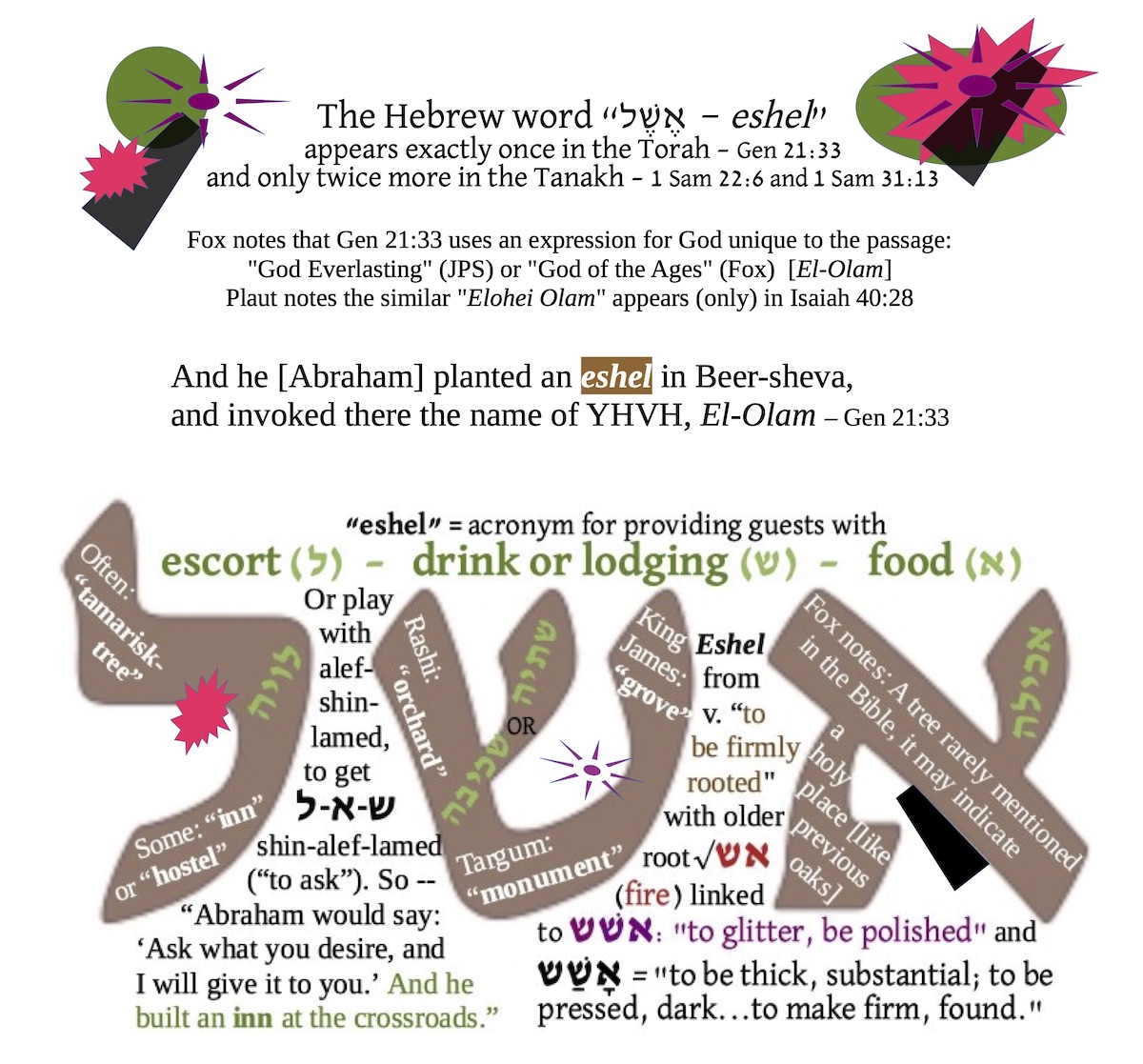
Image description for ESHEL

and more on Planting Trees and this portion

Illuminating Scriptural Connections: A Qur’anic Commentary on the Torah, by Rick Sopher and Abdulla Galadari (JPS, 2026), points out connections between parashat va-yera’ and text of the Qur’an. Sopher and Galadari reference 51:24, where “Abraham’s honored guests,” the “unfamiliar folk” appear. A footnote in my copy of the Qur’an* gives cross citations to 11:69ff and 15:51ff. The latter section, in which the righteous sit amid gardens and streams, is illustrated here —

* Learn about JPS’s new resource

** The Message of the Qur’an, translation by Muhammad Asad (The Book Foundation, 1980).

Gardens and Streams
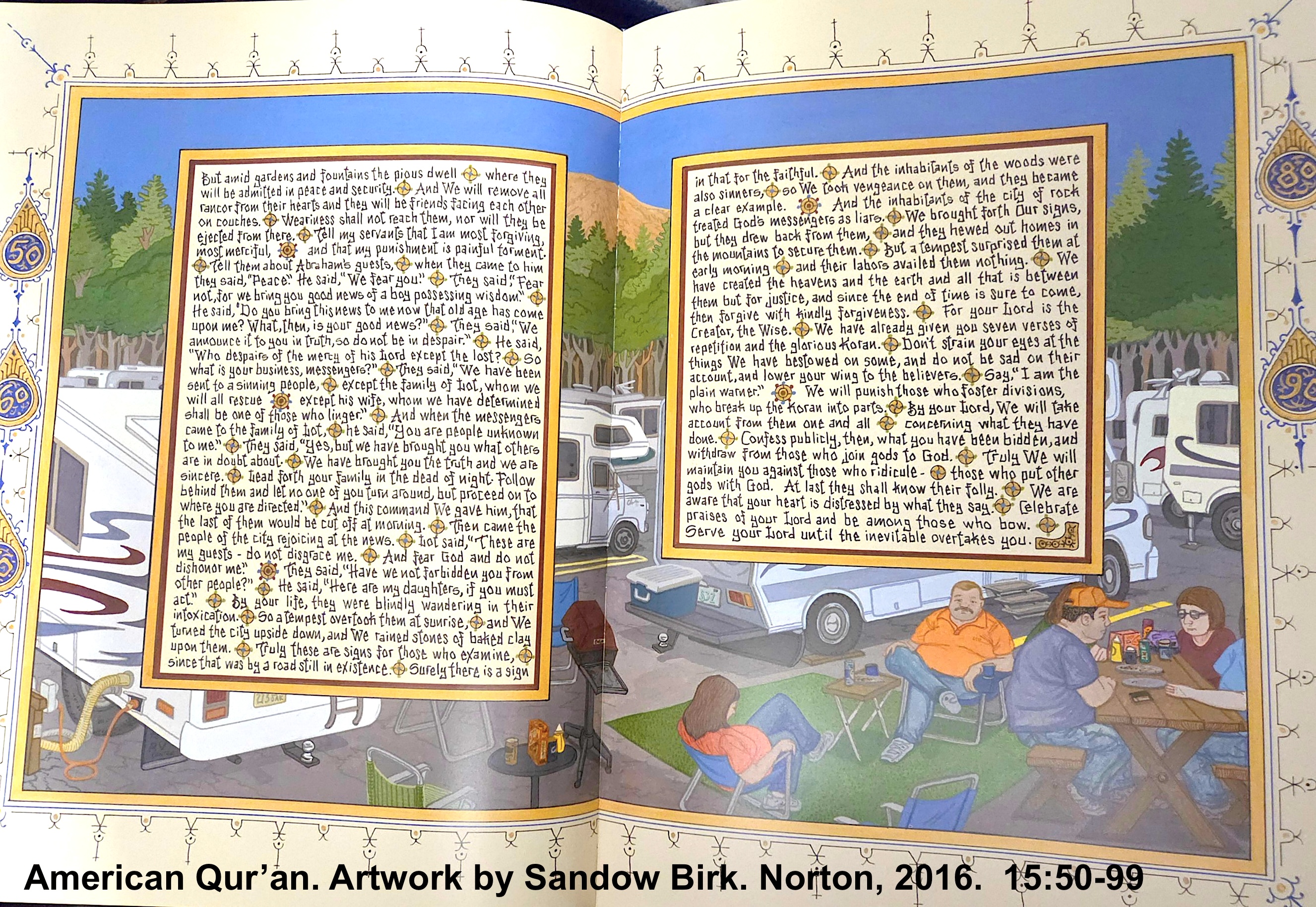
Two pages from the illustrated American Qur'an by Sandow Birk (Norton, 2016). A large picnic area, where contemporary caravans and trucks are parked and people are sharing meals and conversation among the trees.

Image description for Qur’an 15:50-99: Two pages from the illustrated American Qur’an by Sandow Birk (Norton, 2016). A large picnic area, where contemporary caravans and trucks are parked and people are sharing meals and conversation among the trees.

A Vision

Some Hagar-related resources, including the poem, “All Good,” by Mohja Kahf with notes she added when giving permission to share her poem.

Hajar pours water that becomes
a subtle, sweet, and heretofore unheard of wine.
Sarah laughs again, more deeply.
Abraham is radiant. Everyone, this time
around, can recognize
in the eyes of every other,
the flickering light of the Divine. — Kahf, 2016

“All Good,” in Hagar Poems, University of Arkansas Press, 2016

Va-yera: Language and Translation

Scholars and translators seem more or less evenly split on reading Genesis/Breishit 22:13 “v’hinei-ayil achar [“and behold-a ram behind”]. Many commentators point out that “behold–a ram behind” is a bit odd. Acharav — “behind him” — would make more sense grammatically.
Continue reading Va-yera: Language and Translation

Va-yera: A Path to Follow

There are a great many paths to follow from this week’s portion. One to consider is Hagar’s path from runaway (fleeing from Sarah in last week’s portion, Lekh Lekha) to exile. Another path to consider is that from Ishmael’s near sacrifice in the desert to Isaac’s near sacrifice on Mount Moriah.
Continue reading Va-yera: A Path to Follow

Va-yera: Great Source(s)

“Let us examine the other figures in [the Akedah], in addition to Abraham and Isaac,” writes Dr. Sander L. Gilman in “The Joy of Waiting.” He suggests turning attention to the servants who also journey to Mount Moriah and wait while Abraham and Isaac climb. ”

These two servants, most probably men, are stock figures…While our eyes follow the central figures in the drama (Abraham and his son Isaac), these two figures recede from our attention (Islamic readings have it that the son is Ishmael rather than Isaac [Qur’an 37:101-13]).”

What is striking when we sit and wait with the servants while Abraham takes Isaac off into the distance, where the silhouette of Mount Moriah looms, is the boredom of every life, the very unmanliness of inaction… (p. 25; p.27 The Modern Men’s Torah Commentary, Jeffrey K. Salkin, ed.*)

In this essay on Va-yera, which is available through the collection’s preview on GoogleBooks, Gilman argues that the ability to wait is part of “a Jewish masculine identity” and “a role to be embraced.”

The act of waiting, for Jews, is not being impotent or passive; it is engaging in meaningful activities of daily life, those so often dismissed as the activities done to pass the time.

…Being Jewish is waiting productively by acting self-consciously in the world, as if we were Abraham’s servants. For remember that Maimonides states in Sefer Ha-mitzvot that the 497th mitzvah is to “help others load their beast” (Deuteronomy 22:4). — p. 29

*See Source Materials, for complete citation and more information. Check out the Gilman essay in the print collection for the endnotes, which include an interesting array of bottom sources — from Joseph Soloveitchik to Woody Allen; the entire collection is worth a look, as well.

————————————————————–
Click on the “WeeklyTorah” tag for more resources on the weekly portion throughout the year, or on a portion name for parashah-specific notes. (The series began with Numbers; posts for Genesis, Exodus and Leviticus are being drafted, week-by-week.) You can also zero-in on particular types of “Opening the Book” posts by clicking Language and Translation, Something to Notice, a Path to Follow, or Great Source in the tag cloud.
Continue reading Va-yera: Great Source(s)