Tetzaveh: Language and Translation

You shall further instruct the Israelites to bring you clear oil of beaten olives for lighting, for kindling lamps regularly [ner tamid]. Aaron and his sons shall set them up in the Tent of Meeting outside the curtain which is over the Pact, from evening to morning before the LORD. It shall be a due from the Israelites for all time, throughout the ages.

[Note:] Kindling lamps regularly. The lights were to be kindled on the lampstand previously described. The translation of [ner tamid] as “perpetual light” or “eternal light” is grammatically inaccurate and is also contradicted by verse 21. (The so-called ner tamid of the synagogue is of much later origin.) — Exodus/Shemot 27:20-21, JPS/Plaut* and commentary

Cassuto* says that tamid is “intrinsically capable of two interpretations: it can mean ‘continuously, without interruption’ — that is the lamps would never be extinguished, either by day or by night; or it can signify ‘regularly’ — that is, the lamps would burn every night; on no night would its light be wanting — as in the expression [olat tamid, ‘continual burnt offering’].” He concludes that the “second sense is more probable” from context.

In addition, Cassuto says that “ner [‘lamp’] is used here in a collective sense: ‘lamps’ or ‘candelabrum.’

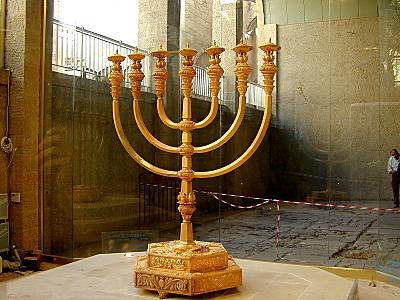
For more on the ancient lamp(s), see, e.g., Wikipedia’s article.

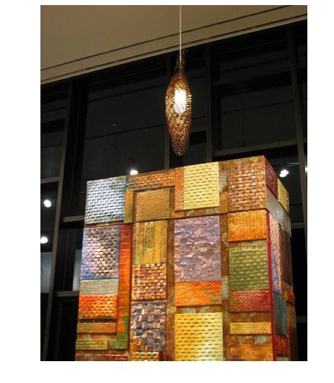
Here’s a quick reference on the later, synagogue “ner tamid.” To the right is an example of a new photovoltaic “ner tamid,” designed to save energy; this one was installed at Jewish Reconstructionist Congregation, Evanston, IL.


*Please see Source Materials for complete commentary and Torah/translation citations. Note: Tetzaveh is also transliterated Tetsaveh or T’tzavveh.

————————————————————–
The “Opening the Book” series was originally presented in cooperation with the independent, cross-community Jewish Study Center and with Kol Isha, an open group that for many years pursued spirituality from a woman’s perspective at Temple Micah (Reform). “A Song Every Day” is an independent blog, however, and all views, mistakes, etc. are the author’s.
———————————————————————————-

Tetzaveh: Great Source(s)

“And it [a robe hemmed with bells] shall be upon Aaron when he serves, so that its sound shall be heard when he comes into [v’nishma kolo b’bo-o] the sanctum before the Lord and when he goes out, that he shall not die.”
— Exodus/Shemot 28:31-38, Alter* translation [bracketed material added]

R. Simeon ben Yohai said: The man who enters his own house, or needless to say the house of his fellow man unexpectedly, the Holy One hates, and I too do not exactly love him.

Rav said: Do not enter your city nor even your own home unexpectedly [footnote: without informing your kin of your coming].

While R. Yohanan was about to go in to inquire about the welfare of R. Hanina, he would first clear his throat in keeping with “And his voice shall be heard when he goeth in [v’nishma kolo b’bo-o] ” (Exod. 28:35)
— Bialik & Ravnitsky, Sefer Ha-Aggadah* (citation to Lev Rabbah 21:8)

Alter notes: “In the ancient Near East, the inner sanctum was a dangerous place. Any misstep or involuntary trespass of the sacred paraphernalia could bring death…The sound of the ringing golden bells on Aaron’s hem goes before him as he enters the sanctum, serving an apotropaic function to shield him from harm in this zone of danger.”

Cassuto* says: “…shall be heard… for it is unseemly to enter the royal palace suddenly; propriety demands that the entry should be preceded by an announcement, and the priest should be careful not to go into the sanctuary irreverently. And likewise when he comes out, as he prostrates himself before departing, the sound of the bells, together with the act of prostration, will constitute a kind of parting blessing on leaving the sanctuary. Lest he die for not showing due reverence for the shrine.”

* See Source Materials for full citations. Note: Tetzaveh is also transliterated Tetsaveh or T’tzavveh.

—————————————————————–
The “Opening the Book” series was originally presented in cooperation with the independent, cross-community Jewish Study Center and with Kol Isha, an open group which for many years pursued spirituality from a woman’s perspective at Temple Micah (Reform). “A Song Every Day” is an independent blog, however, and all views, mistakes, etc. are the author’s.
———————————————————————————-

Terumah: Great Source(s)

Notes on Terumah from study partners, a rabbi and a playwright —

LK —

For a religious culture obsessed with prohibiting (and obliterating) any graven image, how curious that winged golden statues be set above the ark. Even more fascinating is the statement that not from inside the Ark nor even from above it, but instead between the statues will God speak. this “in between” the two cherubim, two statues, two graven images, is the locus of the voice. As Martin Buber taught us, God is uniquely present in the space in between. And, as Kabbalists imagined, the Shekhina, the feminine, indwelling presence of God, resides between the cherubim.

Neither from one cherub nor the other, but from the space created between them — when they confront each other — issues the revelation. Only relationship can imitate life and growth and revelation. And relationship can be created only when one ego realizes that there is another ego of equal importance. It can only be discovered in the presence of another. You simply cannot get there alone, there must always be someone else; it takes two to tango.

Perhaps that is why the prohibition against idolatry does not apply here. Truth be told, we are all only lifeless graven images until we face another and, in so doing, bring our selves and the other to life. And from between that meeting the divine voice issues.

DM–

The Ark of the Covenant and Ezekiel’s wheel could both be called fantasy. But the second is a vision, and the first is a divine instruction. To say an instruction is beyond our understanding is not to say it is impossible of execution.

We say “I do not understand” of the natural world cheerfully, and endeavor to better understand ourselves and call it “science.”

To be dismissive of “natural” evidence is called “ignorance.” To dismiss the divine is called “sophistication.”

–Lawrence Kushner and David Mamet

While reading Five Cities of Refuge: Weekly Reflections on Genesis, Exodus, Leviticus, Numbers, and Deuteronomy (NY: Schocken Books, 2003), the deepest, most interesting spot to inhabit is often, much as Kushner notes above, “between” the offerings of these study partners. Several reviews note differences in the styles of the co-authors. Stan C. Denman of Baylor University notes, in [contemporary review — can no longer (2019) find working link] that Kushner’s insights “often innovative and unconventional, stay within accessible distance from the text of study,” while Mamet’s sometimes seem more tangential, “against the grain of conventional erudition, often with favorable results.”

Denman also discusses a tendency in this book to focus on “‘we Jews’ and the particularities of Jewish ‘victimization,'” a practice the reviewer believes will turn-off non-Jewish readers. In my reading, however, the “victimization” tendency appears almost exclusively in the comments of Mamet: God introduced the name “YHVH,” he tells us at one point, e.g., because “El Shaddai” was too Jewish. Kushner, on the other hand, (simply) reads the bible as a conversation between God and “Israel,” with any reader expected to take spiritual and ethical lessons from their position as part of that collective noun. And so, between — between their religious and more secular writing, between the particular and the universal, between them — we are privileged to witness relationship… the only place, Kushner says above, where the divine dwells.

Five Cities of Refuge is available in hardcover or ebook. At $21.00, this might not be at the top of everyone’s “must-purchase” list, but I recommend checking it out, if you’re able.

See Source Materials for more information/links on this title and others.

————————————————————–

The “Opening the Book” series was originally presented in cooperation with the independent, cross-community Jewish Study Center and with Kol Isha, an open group that for many years pursued spirituality from a woman’s perspective at Temple Micah (Reform). “A Song Every Day” is an independent blog, however, and all views, mistakes, etc. are the author’s.

———————————————————————————-

Terumah: Language and Translation

“And they shall make [v’asu (third person plural)] an ark of acacia wood, two and a half cubits long, a cubit and a half wide, and cubit and a half high. Overlay [v’tzipita (second person masc. singular)]…Cast [v’yazkakta (second person masc. singular)] four gold rings… Make [v’asita (second person masc. singular)]…” — Exodus/Shemot 25:10-13

Why is the third person plural — “they shall make” — employed in verse ten while all the other verbs in making the Tabernacle and its accoutrements are second person masculine singular, as in “[you, male individual] make”?

Contemporary Translation

I don’t know of a commentary directly noting that use of the third person plural here has the effect, grammatically, of including males and females in construction of the all-important ark — and, by extension, Torah study and Torah implementation* — while the second person verb forms generally used in the tabernacle instructions, as throughout Exodus/Shemot, address a masculine singular “you.”

However, this week’s portion begins with “Tell the Israelite people to bring Me gifts: you shall accept gifts for Me from every person [kol ish] whose heart is so moved” (Exodus 25:2). The Torah: A Women’s Commentary (TWC) ** notes here that later verses — Exodus/Shemot 35:22, 35:29 and 36:6 — explicitly include men and women, thus arguing for the translation as “every person,” rather than as the more usual “every man.”

In her “Post-Biblical Interpretations” in the same volume, Ruth Gais (rabbi of Chavurat Lamdeinu) also references comments from Ramban (aka Nachmanides, 13th Century CE) — see section below — on the involvement of “all Israel” in the work (see TWC, p. 468). In addition, however, Ramban comments on Exodus/Shemot 35:22 that the women actually went first, in the bringing of the gifts for the Tabernacle.

Ramban’s reading of the women’s precedence is based on another grammatical point. The text reads: “And they came [va’yabo-u], the men [ha-anashim] with/because of the women [al-nashim], all whose hearts moved them….”

Varieties of Traditional Readings

In her essay, “The ark and its poles,” (in New Studies in Exodus/Shemot), Nechama Leibowitz** explores the third-person-plural vs. second-person-singular topic. While she quotes her usual range of traditional and contemporary commentators, she minces no words in outlining her view of some:

As we have noted the slaving adherence to the literal wording of the text can often blind one to its real inner meaning. This, for instance, is what Ibn Ezra has to observe on the text:

Since the text originally stated: “they shall make Me a sanctuary,” it begins here with the wording; they shall make an ark”

Cassuto similarly observes in his commentary to Exodus (p. 328):

The reversion to the third person plural instead of the 2nd person singular is meant here to link up with the phrase: “the children of Israel shall make Me a sanctuary,” and, first of all, they shall make an ark.

We may justifiably wonder at these literalists…Does not the very faithfullest interpretation of the text, the plainest sense in its profoundest connotation, imply that here we have the singling out of the ark for a special role, the enlisting, in contrast to all the other appurtenances, of all Israel in its making? Must we not admit that the Midrash has plumbed the depths of the text’s plainest and literal sense?

Leibowitz quotes three midrashic sources:

1) R. Judah said in the name of R. Shalom: “Let all come and occupy themselves with the ark so that they should all qualify for the Torah.

2) Ramban (Nachmanides) explained that “all the Israelites should participate in the construction of the ark because of its supremely sacred role in housing the tablets of the Law,” through donation, direct help or “directing their minds to it.”

3) Or Ha-chayyim (Chayyim Ibn Atar, 18th Century CE) stresses that all Israel is required to complete the ark, just as no one Israelite alone can implement the whole Torah: Some laws pertain only to priests or Levites, for example, while a priest would not redeem his own firstborn.

In an endnote to the essay (not included in the on-line version), Leibowitz also quotes Midrash Tanchuma (early medieval commentary):

We find that when the Holy One Blessed be He instructed Moses to build the Tabernacle He used the expression ve-‘asita “thou shalt make” but with regard to [the ark] He said: ve-‘asu “they shall make.” Why? The Holy One Blessed be He wished to stress that the command applied to each and every Israelite alike. No one should have the excuse to say to his fellow: I contributed more to the ark. Therefore I study more and have a greater stake in it than you! (continued below*)

*Bonus Midrashic Note

Proving that the best stuff is often in the footnotes, the quote from Midrash Tanchuma continues:

For this reason the Torah is compared to water, as it is stated: “Ho, whoever is thirsty come to the water” (Isaiah 51:1). Just as no one is ashamed to ask his fellow to give him a drink so no one should be ashamed to ask his junior to teach him Torah. No one should be able to say: I am a Torah scholar and the Torah is my hereditary privilege because my ancestors too were scholars whereas you and your forbears were not scholars but were proselytes. That is why it is written (Deut. 33:4): “An inheritance of the congregation of Jacob.” Whoever is part of the congregation of Jacob including even proselytes who devote themselves to Torah — they are just as important as the High Priest (i.e., they acquire hereditary right by being included in the congregation.” — Leibowitz, New Studies in Exodus/Shemot, p.495

** Please see Source Material for complete translation and commentary citations.

————————————————————–
The “Opening the Book” series was originally presented in cooperation with the independent, cross-community Jewish Study Center and with Kol Isha, an open group that for many years pursued spirituality from a woman’s perspective at Temple Micah (Reform). “A Song Every Day” is an independent blog, however, and all views, mistakes, etc. are the author’s.
———————————————————————————-

Continue reading Terumah: Language and Translation
Terumah: A Path to Follow

As for the tabernacle, make [ta-aseh] it of ten strips of cloth; make these of fine twisted linen, of blue, purple, and crimson yards, with a design of cherubim worked into them….Five of the cloths shall be joined to one another. Make loops of blue wool…make fifty loops on one cloth, and fifty loops on the edge…And make fifty gold clasps, and couple the cloths to one another with the claps, so that the tabernacle becomes one whole. — Exodus/Shemot 26:1-5

Continue reading Terumah: A Path to Follow

Mishpatim: Something to Notice

People of holiness shall you be to Me: you shall not eat flesh of an animal that was torn in the field [t’reifah]; to the dog shall you throw it. — Exodus/Shemot 22:30

The Hebrew “treif” — Yiddish, “trayf” — comes from the verb taraf (tav-reish-feh), “to prey, devour,” and came to mean, more generally, “unfit to eat” or unkosher.

—————————————
The “Opening the Book” series was originally presented in cooperation with the independent, cross-community Jewish Study Center and with Kol Isha, an open group that for many years pursued spirituality from a woman’s perspective at Temple Micah (Reform). “A Song Every Day” is an independent blog, however, and all views, mistakes, etc. are the author’s.

Mishpatim: Great Source(s)

“When you encounter your enemy’s ox or ass wandering, you must take it back to him.” — Exodus 23:4

One of the important features found in Mishpatim regarding the regulating of behavior in the public sphere is when it deals with those situations wherein there is a breakdown within the normal and expected realities that generally govern this sphere. Such a breakdown undermines peaceful coexistence between society’s members….

…the Torah is attempting to create men who, in their interactions with others, are governed by a sense of responsibility to act not in accordance with their own interests, but rather in accordance with the needs, hopes, and aspirations of the other. If Hillel (Talmud, Shabbat 31a) states that the fundamental principle governing our moral interactions is “what is hateful to you, do not do to others,” the laws of lost property dictate and teach us that you are not the sole barometer of what is right and what is necessary, but, rather, the other person who is in need of your assistance. It is your responsibility to truly see the other — to be senstive to their needs and desires and then to respond with moral activism. — Hartman, p.117, 121

This quote is taken from R. Donniel Hartman’s essay, “A Man in Public,” IN The Modern Men’s Torah Commentary.* The entire essay can be read at http://books.google.com. The brief article discusses some of the related issues in Jewish law, such as how to determine when an article is “ownerless.”

Shemot/Exodus 23:4 is frequently referenced in explorations of Jewish values generally and, more specifically, with regard to “hakem takem imo” — lifting up/aiding those in distress. It is cited, along with other verses from this week’s portion, in Hershey H. Friedman’s “Creating a Company Code of Ethics: Using the bible as a guide.” (Also see Talmud as a Business Guide at Academia.edu)See also, Nechama Leibowitz,* “Two Acts of Help.”

* Please see Source Materials for complete citations and more details.

——————
The “Opening the Book” series was originally presented in cooperation with the independent, cross-community Jewish Study Center and with Kol Isha, an open group that for many years pursued spirituality from a woman’s perspective at Temple Micah (Reform). “A Song Every Day” is an independent blog, however, and all views, mistakes, etc. are the author’s.

Mishpatim: Language and Translation

In Exodus/Shemot 22:20-23, God commands the people not to “wrong* or oppress a stranger, for you were strangers in the land of Egypt” (Plaut/Stern translation**), adding a note about also caring for widows and orphans and concluding with one of those dire warnings that is apparently so unspeakable, the text breaks off, causing some translators to resort to ellipsis, before presenting a very specific threat:

Oh, if you afflict, afflict them…
For (then) they will cry, cry out to me,
and I will hearken, hearken to their cry,
my anger will flare up
and I will kill you with the sword,
so that your wives become widows, and your children, orphans!– Fox**

If you [dare to] cause him pain…! for if he shall cry out to Me, I shall surely hear his outcry. My wrath shall blaze and I shall kill you by the sword, and your wives will be widows and your children orphans. — Stone**

Continue reading Mishpatim: Language and Translation

Mishpatim: A Path to Follow

This portion’s many rules/laws [mishpatim] are followed by powerful narrative (chapter 24) which includes the people’s famous utterance — “we will do and we will listen [or hearken/heed/obey]!” — and an episode in which a group of Israelites “beheld God, and they ate and drank” (Exodus/Shemot 24:3, 7, 11).

There is a great deal of commentary on “na’aseh v’nishma,” which is variously translated as “we will do and we will obey” (Stone*) or “we will do and we will hearken/listen,” (Fox*) or “we will do and we will heed” (Alter*). Some of the earliest can be found in Shabbat 88a-b in the Babylonian Talmud*:

R. Eleazar said: When the Israelites gave precedence to ‘we will do’ over “we will hearken,’ a Heavenly Voice went forth and exclaimed to them, Who revealed to My children this secret, which is employed by the Ministering Angels, as it is written, Bless the Lord, ye angels of his. Ye might in strength, that fulfill his word. That hearken unto the voice of his word [Ps. 103:20] first they fulfill and then they hearken?

Some other places to explore paths leading from this verse are: Schwartz’s Tree of Souls,* Reform Judaism magazine’s piece on “Healing the World,” R. Jill Jacobs’ article “Do First, Understand Later” on My Jewish Learning.

For another path, consider a contemporary midrash with many notes on the “lunch with God” episode, Exodus/Shemot 24:9-11, see “One Woman’s Conclusion.

* For complete citations and more details on Torah commentaries and other works — including a link to the Babylonian Talmud in PDF — please see Source Materials.

————–
The “Opening the Book” series was originally presented in cooperation with the independent, cross-community Jewish Study Center and with Kol Isha, an open group that for many years pursued spirituality from a woman’s perspective at Temple Micah (Reform). “A Song Every Day” is an independent blog, however, and all views, mistakes, etc. are the author’s.