In the mid-20th Century, the Exodus story (neither Charlton Heston nor Christian Bales, but the second book of the bible) became part of the underpinnings of the Civil Rights Movement in the United States. Today, as a new civil rights movement evolves, how can we use the ancient Exodus narrative to once again help us explore key issues and increase understanding and involvement?
Continue reading First Steps in an Exodus from Racism
Author: vspatz
General writing and archives at Vspatz.net. Most frequent writing on Jewish topics, at songeveryday.org and Rereading4Liberation.com.
Getting Exodus Right: Watch the Women and Learn (or: Family Travail Becomes Community Action)
A coffin in Egypt closes the Book of Genesis (Genesis 50:26), and the Exodus story is launched with a basket on the Nile (Exodus 2:3). Joseph’s death, which closely follows that of his father, Jacob (Gen 49:33), brings to an end the patriarchal stories. With Exodus, the focus shifts to the Israelite story, beginning with midwives Shifrah and Puah, Yocheved (Moses’ mother), Miriam (Moses’ sister), and Pharaoh’s daughter. Our focus is thus shifted, as one book ends and the next begins, from death to birth and from stories of individual and family struggle to a communal struggle toward liberation. So, too, in the United States today, we are moving:
- from individual circles of mourning for black persons killed by police to a national movement against police brutality across the country, and
- from disjoint demands addressing various forms of racial inequity to a collective struggle for racial justice.
In addition, men dominate at the close of Genesis, while Exodus opens with women in the lead; similarly, women have been primary leaders in the #BlackLivesMatter movement.
The Exodus story looks, on the face of it, like a violent and permanent parting of oppressed and oppressor peoples. But there are elements — particularly evident in watching what the women do at the beginning of the Exodus story — of the tale that can help us learn respectful coexistence.
Change of Mindset
Failure to dehumanize: The Egyptian midwives model for us at Exodus 1:15-22, using Pharaoh’s racist assumptions about the baby-popping Hebrew women to protect the Israelite community. (more on this)
Vision: Moses’ mother shows immense faith in her Egyptian neighbors, assuming that someone will rescue the child. And at least one Egyptian does rescue a child. Both women, thereby, refuse to dehumanize the other. (more on vision)
Passover is still months away (April 3-April 11, 2015). But Jews and Christians, along with others to whom the Exodus story speaks, can begin now to explore how we can use this ancient tale to change today’s realities, in our own communities and beyond. A few more “Passover Lessons” —
- Crossers-Over
- “From Privilege, Activism
- Maybe We’re All Riff Raff
- Rabbis, Rome and Slaves
- “School for Freedom”
— from a 2012 crowd-sourcing.
What else can we learn?
Let’s start now to figure it out!
And let’s NOT WAIT to begin learning and acting
Continue reading Getting Exodus Right: Watch the Women and Learn (or: Family Travail Becomes Community Action)
Do not stand idly by Fox endangerment of your brothers
UPDATE: The Baltimore Fox-affiliate WBFF fired the reporter and photographer who doctored video to create this story (see below). The producer who assigned this story received only a one-day suspension, and the Fox network has not taken responsibility for its lies, defamation of character, or incitement to violence. See City Paper update on this story (12/31/14). The petition is on-going.
“They were terrified,” reads Genesis 42:35, as 11 of Jacob’s sons realize that their brother Joseph faked evidence that would link them to crime against the state [theft from Pharaoh’s household]. Just a few days ago, a Fox station in Baltimore similarly faked evidence of a crime against the state. Bible readers know that Joseph faked the crime for his own reasons, and that the act will eventually leads to a sort of reconciliation in this troubled family. Nonetheless, the brothers and their father are rightly terrified at the dangerous manipulation. Fox acted for its own reasons, as well, but it remains to be seen if there is any kind of reconciliation possible in this situation.
The shortest version: My friend, Kymone Freeman of We Act Radio, was at the large protest march in DC on December 13. He was filmed by C-SPAN holding a mic and portable amp while people are chanting “We won’t stop ’til killer cops are in cell blocks.” But Fox aired the clip, severely edited — on December 21, after the deaths of two police officers in NYC — claiming it was a chant of “kill a cop.”
Insult to injury: Tawanda Jones, who was filmed leading the chant, has been an especially peaceful activist, who persists in advocating for indictment of “killer cops” — including those responsible for death of her brother, Tyrone West, in custody of Baltimore City Police last year — while insisting that the existence of bad (“killer”) police tarnish the reputations of the entire force, which she supports.
Anyone who does evil, according to a medieval Jewish source, “is punished not only for the specific victim but for all who sorrow for him, as it is said, ‘Now comes the reckoning for his blood’ (Genesis 42:22)” — Sefer Hasidim, 131 (found in Zornberg’s Genesis: The Beginning of Desire, on the Joseph story).
- This Fox story has not only damaged the specific victims — Tawanda Jones, Kymone Freeman, and others at the Dec. 13 march — but so many more.
- Fox perpetrated reckless endangerment of individuals and a whole community.
These lies would never have aired without dangerous, racist assumptions
— on the part of Fox staff and viewers — behind them.
Jews know this story.
Anyone who has studied Jewish history knows this story.
Anyone who has studied black history knows this story.
Anyone who has studied Muslim history knows this story.
We all know this story!
It’s time to change the story!!
More Background
Here is a bit more background, the WBFF “apology,” and Kymone’s petition petition in response to being used in this ugly, dangerous manipulation.
Here is Tawanda Jones’ interview with the station that defamed her:
Note, please, that the interviewer has the audacity to say to Ms. Jones “you seem sincere,” as though THEIR distortion of her views deserved as much credence as HER OWN. Also, please note that Ms. Jones says the false story “killed a piece of me.” The Talmudic adage, “Just as the sword can kill so can the tongue” (Arachin 15b), seems amazingly and heart-breakingly apt.
Please read and consider signing and sharing.
Deeper Responses
Kindling Hope with the Fourth Candle
How is Chanukah kindling hope for you and others this season?
In memory of Rekia Boyd, killed at age 22, another victim of (off-duty) police violence from my first hometown, I am kindling hope with ChanukahAction by supporting Ferguson Action Demand #2: contacting the USDOJ to demand a comprehensive review of systemic abuses by local police departments, including publication of data relating to racially biased policing, and the development of best practices.”
It was Rekia Boyd whom I chose to memorialize at the the 4-1/2-hour die-in in front of the USDOJ on December 8, organized to promote human rights for black and brown people in the U.S. While I never knew her, she is forever in my heart (and inspired this prayer).
May every act of remembrance — candle-lighting, mourners’ kaddish, memorial prayer — bind the victims of racial bias more tightly into our national consciousness
and collective commitment to change.
Here is the fourth candle Chanukah Action:
Options for taking action:
Option 1: Share the following message on social media (Facebook, Twitter, etc.): “I support Ferguson Action’s call for a Comprehensive Review of systemic abuses by local police departments, including the publication of data relating to racially biased policing, and the development of best practices. http://www.fergusonaction.com/demands”Option 2: The Department of Justice has been identified as a primary target in the fight to end racialized police violence. This Chanukah, contact the Department of Justice and voice your support for change. Here is a sample script you can use:
“Hello, my name is _______. I am calling to urge the Department of Justice to: Conduct a comprehensive review of systemic abuses by local police departments Publish data related to racially biased policing Develop best practices for racially just law enforcement. Repurpose funds to support community-based alternatives to incarceration.”
You may contact the Department of Justice at: 202-353-1555 or by email at AskDOJ@usdoj.gov.
Here is the full Action Toolkit (PDF).
I am taking this action in advance of tonight’s 4th candle in order to enjoy Shabbat when it comes in this evening, right after Chanukah candle-lighting, and to allow for my participation in the local #BlackYouthMatter #SouthEastMatters action just across the river from my DC home.
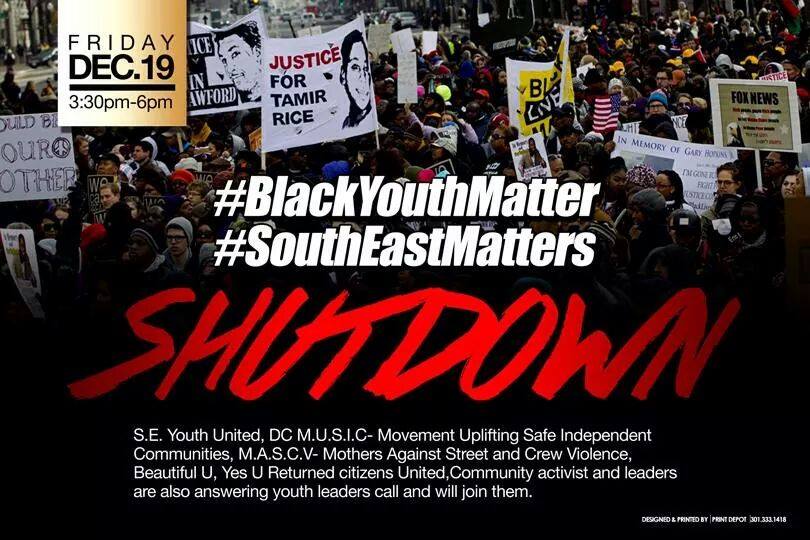
May the light of our candles and actions help bring about a new way of seeing, in our own lives and in the country.
Chanukah Rededicates Jews to the Fight
Samuel L. Jackson’s challenge, Chanukah-style.
[Everybody knows that I can’t sing, but]
I can hear my neighbor calling I can’t breathe
Now I’m in the struggle and I can’t leave
Calling out the violence that racism breeds
We ain’t gonna stop til people are free
Chanukah rededicates Jews to the fight
So I’m lighting one candle to increase the light
Hoping someone more tuneful will take up the chant!
Chag sameach [joyful festival] to all
Visit http://www.ChanukahAction.org for resources
BTW, here’s the challenge:
Power, Language, and Settling: Questions from Joseph’s Story
The Joseph story, which begins in this week’s Torah portion raises questions about language, about power and how it is used, and about the possibility of learning an entirely new narrative about a story of which we are a part:
- How does the language we use, even inside our own heads, affect the way we view an encounter?
- How does the way one individual is described affect our views of others who share some background with that individual?
- What does it mean for one person or group of persons to have power over another? Is it as changeable as a garment? Do we recognize when we are wearing a garment of power?
- Do we sometimes pretend a sense of brotherhood when it suits us and drop it when it doesn’t?
- Can we, today — like the biblical Joseph — create circumstances that lead to a “dizzying awareness of new narrative” that leads to different action?
- Do we, as individuals or as part of a collective, try to settle for our own peace, even if we know others are suffering? How hard do we, like the biblical Jacob, work to remain oblivious to strife before us, even if we helped engender it?
Finally: what does this portion say about “living in the midst of history” and entering the eight days of Chanukah, designed to bring us out of the lowest level of light?
Continue reading Power, Language, and Settling: Questions from Joseph’s Story
Praying with Voices of Grief and Struggle
Jewish memorial prayers ask that souls of the departed be bound up among the living. The living help in this process by doing acts of tzedakah – translated as charity, righteousness, or justice – in the name of their departed loved ones. In that spirit, and inspired by my “die-in” experience on December 8, I offer the following prayer:
May the souls of
Sean Bell
Alan Blueford
Dale Graham
Gregory Chavis
Archie Elliot
Clinton Allen
Maurice Donald
Oscar Grant
Ramarley Graham
John Crawford III
and others lost to police violence
find eternal shelter and rest.
May each personal and communal act of remembrance
bring further solace to their mothers and others who loved these individuals in life.
May the myriad acts of protest for justice
conducted in their names
bind their souls more deeply among the living.
May each die-in act,
symbolically embodying the last moments of the departed,
bind their deaths more tightly into our national consciousness
and collective commitment to change.
As the souls of
Sean Bell
Alan Blueford
Dale Graham
Gregory Chavis
Archie Elliot
Clinton Allen
Maurice Donald
Oscar Grant
Ramarley Graham
John Crawford III
and so many others,
our brothers, our teachers,
rest in eternal Light.
May we continue to find
illumination in their everlasting brightness.
And let us say: Amen.
Dwelling Within a Fallible Construction
Sukkot is the holiday “most closely associated with the Oral Law,” according to Rabbi Joseph Soloveitchik, as so much of the holiday — from identifying “p’ri eitz hadar” [“fruit of goodly trees”] (Lev 23:40) to determining what constitutes a sukkah — is determined via Oral Law (see below). Taking this thought one step further: Throughout this holiday, we dwell, more literally than usual, within a divine-human collaborative construction.
 Each year, we erect a new structure resembling the ones our ancestors built but using the materials and hands available to us at the time. Each year, our conception of Torah carries the teachings of our ancestors but makes use of new insights and adaptations to changing circumstances.
Sukkot asks us to dwell, for a time, deeply in shakiness: for some this translates into awareness that all depends, ultimately, on God; for others, the focus is on interdependence with others in living through forces far beyond our control.
In the sukkah we also dwell, for a time, deeply in an awareness of the human, fallible construction of our Torah understanding and of our abilities, individually and collectively, to put Torah into practice.
As we prepare to leave the sukkah, we may hope that next year’s construction will be of even stronger, more beautiful materials erected by even surer hands. But that hope for the future need not throw doubt on the value of this year’s construction or diminish our enjoyment in this year’s dwelling place.
Only through the Oral Law, can we identify the words
פרי עץ הדר with an etrog, the fruit of the citron tree. The Beit HaLevi (Derush 18) suggests that it was on Yom Kippur, when Moses came down with the second Tablets, that the Oral Law was conferred on the people of Israel. But while Yom Kippur commemorates the giving of the Oral Law, Sukkot is the holiday which actually celebrates it. The Sadducees and Pharisees argued about some very basic rules involving the Sukkot festival. Indeed, what is a sukka? What should its height be? From what materials may it be made? The vast majority of the rules of Sukkot are oral traditions from Sinai. Sukkot is therefore the festival of the Oral Law.
— Koren Mesorat HaRav Siddur p.891-893
Surrounded by Big Things: Jonah, Harvey, and Yom Kippur
One of the things we might notice about Jonah is that he’s a little hard to follow: one minute, minding his own business, in his own land, and next thing he’s on the way to Joppa, on the ship, in the hold, tossed out into the sea, in the fish’s belly; then in Nineveh; and finally sitting outside the city arguing with God about a gourd. In honor of Jonah and his varied travels, these remarks go a number of different places, and, in an even deeper homage to Jonah, I can’t really promise that we’ll understand the point in the end. But I do hope it will be an interesting ride.
Continue reading Surrounded by Big Things: Jonah, Harvey, and Yom Kippur
Maybe: Janis Joplin, the Chantels, and Jonah
“Maybe” is not always comfortable in a world that values black and white, in or out, yes or no. But the Book of Jonah, recited on Yom Kippur afternoon, suggests that coming to terms with “maybe” is a key lesson of these days between “it is written” and “it is sealed.” And two musical approaches to “Maybe” help illuminate Jonah’s struggles with concept.
Continue reading Maybe: Janis Joplin, the Chantels, and Jonah
 "A Song Every Day"