God’s Presence Accompanied Them

Exploring Babylon: Chapter 1.2

Deuteronomy closes with hopes, on the banks of the Jordan and declarations of Israel’s particular relationship to God:

So Israel dwelt in safety
the fountain of Jacob alone…

Happy are you, O Israel!
Who is like you, a people saved by the LORD,
the shield of your help,
and the sword of your triumph!
–Deut 33:28-29

Much later, after Israel had experienced more trial and loss and exile, the idea developed that God was in exile along with the People, as much in need of rescue as the People. In particular, Sukkot prayers include a verse, “Ani va-ho” — sometimes translated as “Yourself and us!” or “Rescue me and the divine name!” — followed by another that begs:

As You rescued the communities You exiled to Babylonia, and Your merciful Presence accompanied them — so save us.

This line of thought, which has been developing for centuries, is mean to teach that “when there is suffering in the world, God is not on the side of the oppressors. Rather God is with the oppressed and suffers with them” (from Or Hadash: A Commentary on Siddur Sim Shalom; download and more at Rabbinical Assembly).

The idea that “God is with the oppressed” is too often, I fear, used as a sort of universal Coup-fourré card, a “safety” to correct any “hazard,” so as to stay on the road.

…For those who never played the old card game Mille Borne, maybe “ace in the hole” or “Get out of jail free” card will make more sense; but I find Coup-fourré — the process whereby one is able to surmount a pitfall and keep rolling along — more apt here….

It is way too easy to let “God is with the oppressed” console the already comfortable while leaving the afflicted with their travails. As we enter the new year, I think it’s time for the comfortable among us to examine our “safety” cards.


Following God’s Example

We must ask ourselves where we are when there is suffering and injustice in the world. It’s not enough to be concerned or write letters or even stand out in the street in protest — although all of those things are important. God went into exile with us, and something similar is required of us, if we are to make any progress on racial and ethnic justice issues.

We must take steps to remove any sense that we are somehow entitled to dwell in safety — as we find Israel at the close of Deuteronomy — when others cannot. If God could join us in exile, we can work to dismantle White Supremacy and other protections that can never be equally shared. Where there is suffering in the world, we cannot simply declare ourselves “on the freedom side.”

We’ve got to follow God’s example, to the extent we are able, and be willing to be vulnerable, explore what it’s really like in Babylon, not just our romantic ideas about it from outside. We have to look carefully at any place where oppression thrives and ask, “how we are complicit?” Really, deeply, honestly ask ourselves and our communities: “Which side are you on, my people, which side are you on?”

And then take action, even if it means compromising our own safety or sense of self.

NOTE: A version of this mini-dvar [word, sermon] was given at Fabrangen and Tikkun Leil Shabbat joint Simchat Torah celebration, 10/11/17.

“Babylon” (Bavel) means many things in Judaism and in U.S. popular culture. Join “A Song Every Day” in Exploring Babylon over the next 40 weeks.


Which Side Are You On?

Background on the song/chant —

Florence Reece (more here) wrote “Which side are you on?” lyrics in 1931 as part of labor organizing effort —

Freedom Singers adapted it for the mid-20th Century Civil Rights movement —

A version of this is still used, as in #BlackBrunch in Oakland (above), but protestors in the Movement for Black Lives also use a combination song and chant, as in this snippet:

Chant: [Example Leader] was a Freedom Fighter
who taught us how to fight
We gonna fight all day and night
until we get it right

Sing: Which side are you on, my people, which side are you on?
We’re on the freedom side!

Sukkot and Babylon

Exploring Babylon: Chapter 1.1

“As You rescued the communities You exiled to Babylonia and Your merciful Presence accompanied them — so save us.” — from “Ani Va-ho,” a Sukkot prayer

Prayers begging for rescue and mercy often take the format, “You helped them; help us.” The unusual aspect of this prayer, recited each day of Sukkot in Conservative and Orthodox Jewish liturgies, is its implication that God needs saving, too. Long before Eleazar Kallir (c.570–c.640 CE) developed this poem, however, Jews were teaching that God follows the People into exile.

“These bold interpretations are a way of saying that when there is suffering in the world, God is not to be found on the side of the oppressors” (Or Hadash festival supplement; link below. Click here for basics on ancient Sukkot practices).

Fragility and Sukkot

Many centuries of prayers linked the fragility of Sukkot with exile. For example:

…In the merit of the Mitzvah of Sukkah, redeem us from exile,
protect us, that our enemies not reign over us.
And gather us from the four corners of the earth
and rescue us from captivity and from false imprisonment.
Let no evil eye rule over us ever.
Rebuild Your Holy Temple and restore your presence to Jerusalem….
– from Machzor Rav Peninim (R. Moses ben Hayyim Alshekh c1508-1600)

A different perspective appeared with Haskalah [“Enlightenment”]:


For thousands of years
Israel has been a wandering people.
Our houses are but fragile huts –
And these huts have been torn asunder too many times
By unrest and the hatred of others.
We have only your mercy to thank
That we have not perished from the earth.
Your compassion has held us and carried us
Through storm and flood, over every abyss
That has threatened to devour us,
And now, after generations of wandering,
You have allowed us to taste the sweetness of home.
Thanks to you, we have found a homeland –
A beautiful, wonderful country
That recognizes us as its children.
Safe and free, like ancient Israel
In the shade of its palm and fig trees,
We rest beneath the tent of peace
Provided to us by the law,
Along with all our brothers and sisters in this land….
– “On the first days of Sukkot”
in Fanny Neuda’s Hours of Devotion (1855)

The “homeland” Neuda had in mind was her native Moravia. The first edition of Hours of Devotion was published in German and included a blessing specifically naming Emperor Franz Joseph. Neuda’s family supported Haskalah, promoting the limited citizenship then allowed to Jews as well as sermons in the vernacular, modernizations of of prayers, and other religious adaptations that led to the Reform Movement. The prayerbook was later translated into Yiddish and was being reprinted in both languages up through the early part of the 20th Century.

Some Questions for Consideration

  • Where does the fragility of your personal Sukkot experience take you?
  • In what ways do you feel protected by a “tent of peace, provided to us by law”?
  • In what ways does your experience reflect exile, as expressed by Machzor Rav Peninim?
  • What about the fragility of the Jewish community, locally and worldwide?
  • And what about the wider world?
  • Are there lessons to be drawn from identifying ourselves and God as together in need of rescue?


sukkah78
Spatz-O’Brien sukkah, Oct. 2017

NOTES

In Temple days, hoshanot were recited while circling the altar on Sukkot; some denominations still recite them, while circling the bima — once on the first six days of the Sukkot and seven times on the seventh day, Hoshana Rabba. Hoshana is a contraction of hosha [save] and na [please]. Eleazar Kallir’s hoshana poem is known by its first line: “ani va-ho.”

ani va-ho hoshi’a na” from Mishnah Sukkah 4:5 is variously translated as “Save Yourself and us,” “I and You, may You deliver us both,” or “Please rescue me and the divine name.” Babylonian Talmud (Shabbat 104a) explains that “ho” is one of God’s names.

See commentaries on this prayer in Conservative Siddur Lev Shalem and Orthodox The Koren Mesorat Harav Siddur. Or Hadash: A commentary on Siddur Sim Shalom‘s festival supplement is (available for download here).
See also pages 110-111 in Abraham Joshua Heschel’s Heavenly Torah (more here).

Many Jews, including the Reform movement, do not observe Hoshana Rabba — or perform the hoshanot prayers during the rest of Sukkot.

BACK

Siddur as Hometown: Don’t Dismiss the Travel Guide

When the ancient Rabbis want to etch something in memory and make it part of regular practice and belief, they stick it in the siddur. I cannot specific cite a source for this pronouncement, which I included in a recent dvar torah — although Berakhot, the Babylonian Talmud’s Tractate on Blessing, is one source that lends lots of support to this idea.

The prayerbook is such a rich environment, but it’s easy to miss most of it as we pass through. We often treat the siddur like our own hometown: we can imagine why others are fascinated and seeking to learn more, but we just want to traverse it to get wherever we’re trying to reach; a travel guide for the place we’ve been living for decades seems beside the point. Additional teachings that have developed over the centuries, to explain why things are (or are not) in the siddur and elaborate on ideas contained in the prayers, can be terrific resources, though.

Here are a few:

  • The dvar torah on Parashat Re’eh, mentioned above: The Commandment to See
  • Small archive of Divrei Tefillah, words about prayer, produced by congregants at Congregation Rodfei Zedek (Chicago); dvar by Rebecca Milder is quoted in above
  • Elaborate Making Prayer Real website, with articles and webinars and more; related to book by Rabbi Mike Comins, released in 2010 (and frequently quoted on THIS blog).
  • Re-recommend exploring something along the lines of “Map Your Heart Out

interlude: Summer 5777

Tammuz is interlude, reiteration, steady growth,” writes Debbie Perlman, describing the month in the Jewish calendar which began this past weekend. She goes on to reference sprinklers, weeds, and fields already planted, concluding:

Hear us as we move into this time of increase,
As we gather up sunlight and breezes and rains
To lay aside against the unknowns ahead.
Hear us as we call You in truth.
— from “Ninety-One: Rosh Chodesh Tammuz”
IN Flames to Heaven: New Psalms for Healing & Praise

A few words about “interlude” and gathering up “against the unknowns ahead.”

“Against the Unknowns Ahead”

Taking a wide view of the Jewish calendar, we’re in a sort of dip between two peaks: Shavuot, festival of “receiving Torah,” and Simchat Torah, festival of “rejoicing in the Torah.”

For seven weeks, beginning on the second night of Passover, we counted “up” to Shavuot. The next milestone on the calendar, 40 days later, commemorates the incident of the Golden Calf — in other words, our failure to “receive” Torah very well. The Fast of Tammuz (this year: 7/11/17) launches a downward swing with “The Three Weeks” and Tisha B’Av, mourning loss of both Temples and other calamities faced by the Jewish people.

From that lowest point (9 Av, this year: 8/1/17), we begin the climb toward the new year, through the high holidays, Sukkot and, finally, Simchat Torah (this year: 10/13/17).

But right now, we’re still in the 40 days between Shavuot and the Fast of Tammuz. Reading ourselves into the Exodus story: We are still in the early days of liberty from Egyptian slavery; Moses is still on the mountain, obtaining the first tablets, which have yet to be smashed. We know nothing about the Golden Calf or the Spies and the decades of tromping in the desert, realizing the best we can hope for is that the next generation will make it out. Today, still, is about anticipation and hope for immediate changes in the life of our community.

From the vantage point of the Exodus story, this is a great time to “lay aside against the unknowns.” With a view to the Jewish calendar — and to the civic calendar in the U.S. — this is an important interlude to shore up resources for the challenging days ahead.

“When you come…”

The Torah potion Ki Tavo (“When You Come…”; Deut 26:1-29:8) is bookmarked by two fascinating passages: Near the beginning is he passage we read at the Passover seder, recapping our ancestors’ journey and our own through the Exodus; toward the end, we are told that it took forty years for us to understand what happened.

Deuteronomy 26: 5-10

וְעָנִיתָ וְאָמַרְתָּ לִפְנֵי יְהוָה אֱלֹהֶיךָ, אֲרַמִּי אֹבֵד אָבִי, וַיֵּרֶד מִצְרַיְמָה, וַיָּגָר שָׁם בִּמְתֵי מְעָט; וַיְהִי-שָׁם, לְגוֹי גָּדוֹל עָצוּם וָרָב.
And thou shalt speak and say before the LORD thy God: ‘A wandering Aramean was my father, and he went down into Egypt, and sojourned there, few in number; and he became there a nation, great, mighty, and populous.

וַיָּרֵעוּ אֹתָנוּ הַמִּצְרִים, וַיְעַנּוּנוּ; וַיִּתְּנוּ עָלֵינוּ, עֲבֹדָה קָשָׁה
And the Egyptians dealt ill with us, and afflicted us, and laid upon us hard bondage.

וַנִּצְעַק, אֶל-יְהוָה אֱלֹהֵי אֲבֹתֵינוּ; וַיִּשְׁמַע יְהוָה אֶת-קֹלֵנוּ,
וַיַּרְא אֶת-עָנְיֵנוּ וְאֶת-עֲמָלֵנוּ וְאֶת-לַחֲצֵנוּ
And we cried unto the LORD, the God of our fathers, and the LORD heard our voice, and saw our affliction, and our toil, and our oppression.

וַיּוֹצִאֵנוּ יְהוָה, מִמִּצְרַיִם, בְּיָד חֲזָקָה וּבִזְרֹעַ נְטוּיָה, וּבְמֹרָא גָּדֹל–וּבְאֹתוֹת, וּבְמֹפְתִים.
And the LORD brought us forth out of Egypt with a mighty hand, and with an outstretched arm, and with great terribleness, and with signs, and with wonders.

[these two verses are not part of the Haggadah:]
וַיְבִאֵנוּ, אֶל-הַמָּקוֹם הַזֶּה; וַיִּתֶּן-לָנוּ אֶת-הָאָרֶץ הַזֹּאת, אֶרֶץ זָבַת חָלָב וּדְבָשׁ.
And He hath brought us into this place, and hath given us this land, a land flowing with milk and honey.

וְעַתָּה, הִנֵּה הֵבֵאתִי אֶת-רֵאשִׁית פְּרִי הָאֲדָמָה, אֲשֶׁר-נָתַתָּה לִּי, יְהוָה;
וְהִנַּחְתּוֹ, לִפְנֵי יְהוָה אֱלֹהֶיךָ, וְהִשְׁתַּחֲוִיתָ, לִפְנֵי יְהוָה אֱלֹהֶיךָ.
And now, behold, I have brought the first of the fruit of the land, which Thou, O LORD, hast given me.’ And thou shalt set it down before the LORD thy God, and worship before the LORD thy God.

Deuteronomy 29: 1-3

וַיִּקְרָא מֹשֶׁה אֶל-כָּל-יִשְׂרָאֵל, וַיֹּאמֶר אֲלֵהֶם:
אַתֶּם רְאִיתֶם, אֵת כָּל-אֲשֶׁר עָשָׂה יְהוָה לְעֵינֵיכֶם בְּאֶרֶץ מִצְרַיִם, לְפַרְעֹה וּלְכָל-עֲבָדָיו, וּלְכָל-אַרְצוֹ
And Moses called unto all Israel, and said unto them: Ye have seen all that the LORD did before your eyes in the land of Egypt unto Pharaoh, and unto all his servants, and unto all his land;

הַמַּסּוֹת, הַגְּדֹלֹת, אֲשֶׁר רָאוּ, עֵינֶיךָ–הָאֹתֹת וְהַמֹּפְתִים הַגְּדֹלִים, הָהֵם.
the great trials which thine eyes saw, the signs and those great wonders;

וְלֹא-נָתַן יְהוָה לָכֶם לֵב לָדַעַת, וְעֵינַיִם לִרְאוֹת וְאָזְנַיִם לִשְׁמֹעַ, עַד, הַיּוֹם הַזֶּה.
but the LORD hath not given you a heart to know, and eyes to see, and ears to hear, unto this day.

Shabbat Ki Tavo falls this year between Labor Day, the traditional end of the U.S. “summer vacation” (9/4/17), and Rosh Hashanah, the beginning of the new year (9/21/17). A sort of meta-interlude.

Now, in the interlude of early Tammuz, perhaps we can begin to “gather up sunlight and breezes and rains,” our communities’ stories and our own, in preparation for the travels ahead.

Chana Bloch: Her Memory For a Poetic Blessing

Chana Bloch, poet, translator, and teacher, died on May 19, 2017. Among her major translation projects are the Song of Songs with Ariel Bloch (then husband) and, with Chana Kronfeld, Yehuda Amichai’s Open Closed Open (NY: Harcourt, 2000). For several years, she edited Persimmon Tree, a publication of the arts by women over 60.

Bloch’s poem about beginnings, “Chez Pierre, 1961,” appeared in Poetry Magazine (1990) and in the more recent collection Far Out: Poems of the 60s. Her final literary work, The Moon Is Almost Full, is due out in September of this year.

“Questions of Faith” a substantial interview about Bloch’s experience of Judaism.

May her memory be for a blessing

Obituaries:
Jewish Weekly
Tablet

Amichai’s Love and the Entwives

A highway detours in order to give two lovers some privacy in their “bit of eternity,” in the opening stanza of Yehuda Amichai’s “Pinecones in the Tree Above.” Several stanzas later, “she is the walled public garden of the city, and he, the road which moves away from her” (Abramson, p.101 — see notes below).

YA 46
from “Pinecones on the Tree Above” in Collected Poems

Like Pine Cones, Ents and Entwives

The “Pine Cones” series is the second set of love poems [after “Six Poems for Tamar”] published in a collection called “Now and in Other Days” (1955). The garden/road stanza is, as Abramson notes, one of eight short portraits of the same lovers: “like two associations in one mind: as he is referred to, so is she; they are like two lightbulbs in a lamp each one alone too dark but together lighted they are a festival of light….They are like two stones at the bottom of a hill, secluded and alone…”

Each stanza consists of rhymed couplets, which, Abramson continues: “affirm the isolated perfection of love; yet even at their most serene the lovers are separate entities, two lightbulbs, two stones, two numbers. The poems offer an apparent affirmation of love, yet separateness and isolation are implicit in them.” (Abramson, see below)

Considering this stanza, readers find many contrasts, some of them Freudian, between the movement-oriented man and the enclosure-focused woman. For me, the contrast Amichai draws is reminiscent of Tolkein’s wandering Ents and their inability to connect with the more settled Entwives (The Lord of the Rings — full citation below)

Ents are Middle Earth’s very old, male, tree-like creatures who have somehow “lost” their female counterparts, the Entwives. They’re not dead, just missing and missed, Treebeard (AKA Fangorn) tells the hobbits:

…the Ents gave their love to things that they met in the world, and the Entwives gave their thought to other things, for the Ents loved the great trees, and the wild woods, and the slopes of the high hills…But the Entwives gave their minds to the lesser trees, and to the meads in the sunshine beyond the feet of the forests…Entwives desired order, and plenty, and peace (by which they meant that things should remain where they had set them). So the Entwives made gardens to live in. But we Ents went on wandering, and we only came to the gardens now and again.
The Two Towers

“They walked together…”

Treebeard’s description of the old days for Ents and Entwives sounds a little like Jeremiah’s prophetic vision of God and Israel, together in the desert just after leaving Egypt:

When the world was young, and the woods were wide and wild, the Ents and the Entwives – and there were Entmaidens then: ah! the loveliness of Fimbrethil, of Wandlimb the lightfooted, in the days of our youth! – they walked together and they housed together.
The Two Towers

The devotion of your youth, Your love as a bride— How you followed Me in the wilderness, In a land not sown.
— Jer. 2:2

The “Pine Cones” lovers reflect the togetherness of the above metaphors — when the lovers appear like two stones, e.g., together resting at the bottom of a hill, watching seasons pass. But they do not find Amichai’s concept of “true love,” according to Abramson: “Ahavah be-emet [true love], the coupling of both spirit and flesh, is still undiscovered and it is only for a brief moment that the bulbs achieve a “festival of light,” unbounded unity in each other…”

And that undiscovered territory, she argues, has additional implications:

The notion of separateness offered by the couplets in “Pine Cones,” implying that the lovers have failed to achieve perfect unity, indicates their separation also from God.
— Glenda Abramson. The Writing of Yehuda Amichai: A Thematic Approach.
Albany: SUNY Press, 1989, p.101

“Our hearts did not go on growing in the same way,” Treebeard says of Ents and Entwives. The prophets of Israel, Jeremiah included, tell us that reconciliation between God and the People is still possible, although disappointment and anger have reigned for centuries. And what of Amichai’s lovers? Our study group still has four stanzas of “Pine Cones” to translate and discuss, but I do see that the last word of the poem is הפרידה [separation]. Stay tuned.

Notes:

Abramson, Glenda. The Writing of Yehuda Amichai: A Thematic Approach. Albany: SUNY Press, 1989.

Amichai, Yehuda. Collected Poems [5 vols.]. Jerusalem: Schocken, 2002-2004 [Shirei Yehuda Amichai]. “Pinecones on the Tree Above” i

Harshav, Benjamin & Barbara. Yehuda Amichai: A Life of Poetry 1948-1994. NY: Harper Collins, 1995. NOTE: the “highway” stanza is included in the Harshavs’ selected translations; the garden/road stanza is omitted.
TOP

Tolkein, J.R.R. The Two Towers (Book 2 of 3, The Lord of the Rings). London: George Allen and Unwin, 1954.

For more on Ents —

  • Tolkein, Christopher. Treason of Isengard: The History of The Lord of the Rings, Part Two (The History of Middle-Earth, Vol. 7). Boston: Houghton Mifflin, 1989.
  • Not All Who Wander Are Lost (Middle Earth blog), particularly “What Happened to the Entwives

BACK

Distance, part 2

The distance between people and God, and if/how that distance may be bridged, is a major question in theology, philosophy, and the arts, including contemporary Hebrew poetry. The previous post looked at related ways that “touch” [Hebrew: נָגַע] occurs both in Maimonides’ Guide for the Perplexed and in some verses from Yehuda Amichai. The distance between people and God is explored in a different way in the poetry of Leah Goldberg, according to Rabbi Dalia Marx in “Israeli ‘Secular’ Poets Encounter God.”

Goldberg’s God

Marx’s essay explores three Israeli poets, all considered “secular” rather than “religious,” in order to show that “religiosity and engagement with God are not limited to classical forms of prayer and to ‘religious’ circles.” In addition to Goldberg, poets discussed are Yona Wallach (1944-1985) and Orit Gidali (b. 1974).

Marx analyzes several Goldberg poems, including the series “From the Songs of Zion.” This four-poem series, Marx tells us, looks at the question raised in Psalm 137: How can we sing God’s song in a strange land? It concludes with “Journeying Birds” (translated here by Marx):

That spring morning
heaven grew wings.
Wandering westward,
the living heavens recited
T’fillat Haderekh: [22]
“Our God,
bring us in peace
beyond the ocean
beyond the abyss,
and return us in fall
to this tiny land
for she has heard our songs.” [23]
— Leah Goldberg IN Marx, pp.188-189

The essay continues:

Unlike Goldberg’s other poems discussed here, “Journeying Birds” reflects no distance from God — who appears like the God of tradition and who is addressed in a heartfelt prayer for a safe journey. Yet the prayer emanates from the mouth of birds, not the poet’s. What is impossible for her, who does not possess the language of prayer, can be uttered freely and naturally by the birds.

This is not a typical poem for Goldberg in the sense that she uses a familiar liturgical phrase, T’fillat Haderekh, even drawing upon its contents, which, traditionally, asks God “to bring us to our destination for life…and peace…and to return us to our homes in peace.” Like traditional Jewish prayer too, the birds speak in the first person plural [24]. Goldberg, by contrast, could only address “my God,” not the “traditional God” of common Jewish prayer [25].

…Goldberg often writes about birds, who symbolize, for her, joy and freedom. [26]. In this very native and local poem she allows birds to address the ineffable with a joyful prayer that she cannot make herself.
— Marx, “Israeli ‘Secular’ Poets Encounter God,”
IN Encountering God, p.189

The comment above about Goldberg’s use of “my God” refers to two poems also discussed in Marx’s essay: “I Saw My God at the Cafe” and “The Poems of the End of the Journey, 3.” The former does not address God, but describes “my God” in the third person. The latter begins, “Teach me, my God…,” and remains singular and personal throughout:

Teach me, my God, to bless and to pray
Over the secret of the withered leaf, on the glow of ripe fruit…
…Lest my day become for me simply habit.
— Goldberg, from “The Poems of the End of the Journey”
Poems II. Tel Aviv: Hakibbutz Hame’uchad, 1986

NOTE: See Marx’s essay for her translations and discussion of these poems. The full three-part “Poems of the Journey’s End,” translated by Rachel Tzvia Back, appears as a Haaretz poem of the week. (Requires a little patience with ads, but the poem will show up, free of charge).

Tradition and Alienation

In “Poems of the Journeys End,” Goldberg “negotiates with the living God from whom she feels alienated,” Marx tells us: “Traditional prayers are a manifestation of faith; this one is a supplication for faith to arise” (Encountering God, p. 188).

Perhaps it’s a question of chicken and egg, in terms of who picks up a siddur in the first place. But traditional prayers, in contrast to Marx’s declaration, are filled with words and imagery meant to spark a prayerful attitude…a sense of faith, one might say, which the siddur does not take for granted. (Imagining that we are imitating choruses of angels, joining our voices with “all living things who praise,” outright begging God to “open our lips.”)

Moreover, far from being new or unique in Goldberg’s poem(s), a feeling of distance or alienation from God is a major theme in the Book of Psalms. The Jerusalem Commentary on Psalms, e.g., includes a category called “descriptions of the spiritual distress of the psalmist, who feels himself far away from God” (p.xxiii).

It seems hard to believe, in fact, that Goldberg’s “Poems of the Journeys End” is not in active in dialogue with these themes in the psalms:

And he shall be like a tree planted by streams of water,
that brings forth its fruit in its season, and whose leaf does not wither;
and all that it produces prospers.
— Psalm 1:3

So teach us to number our days, that we may get us a heart of wisdom.
— Psalm 90:12

But, somehow, her poetry seems to be read as oddly disconnected from the tradition that helped forge it:

As the orison of an ever-receding horizon, Lea Goldberg’s poems blur the line between the secular and religious divide. They reach for a “contiguity” (Dan Miron’s term) between tradition and a breach with that tradition, awakening anew the religious power of the Hebrew language. And so, this volume of poetry speaks uniquely to this generation of Jewish readers. It should be kept by one’s bedside, read as meditations, “blessings” or “hymns of praise” each morning and night, just as God renews Creation each day (Psalms 104), in the glory of dappled-things, a “withered leaf” or “ripe fruit”, reviving “all things counter, original, spare, and strange” (Gerard Manley Hopkins, “Pied Beauty”), so that your words do not blur in vulgar gibberish, so that your days not turn mundane.
— Rachel Adelman, 2005 review of a Goldberg volume

Hers? Mine? Ours?

Psalms are an odd hybrid of poetry and prayer. It’s not clear where they would fall when Marx declares, in “Israeli ‘Secular’ Poets Encounter God,” that prayer and poetry share an affinity but differ in essentials. But it seems odd that Marx makes so much of Goldberg’s shift from first-person singular to plural in the three poems discussed, without even mentioning that the psalms also include first-person singular and plural language, for both narrator and address to God.

Marx concludes her essay by reiterating the hope, expressed by poet Avot Yeshurun, that “Hebrew literature should renew prayer.” And she does make her point that ‘secular’ poets participate in a “vivacious religious sentiment…far richer and more bountiful than initially expected” (Encountering God, pp.196-197). But her decision to contrast poetry with “traditional prayer,” without mentioning psalms serves to dissociate Goldberg’s work from its background.

Psalms have, it seems, been considered somewhat old-fashioned for millenia —

When the sages in the Second Temple period composed the prayers and blessings that all Jews are obligated to recite, they created new texts rather than selecting chapters from Psalms….The main reason for this tendency seems to have been that the psalms were written in an ancient poetic style not easily understood in the Second Temple period. The rabbis used a style similar to the spoken language of their day, so that ordinary Jews could understand them.
Jerusalem Commentary on the Psalms, p. xliii

— but also demand their own renewal: “Sing unto the LORD a new song” (Psalm 149:1).

Goldberg’s “withered leaf” and desire to avoid the mundane are a fine example of renewing an old theme — except when authors, like Adelman, fail to mention the theme being renewed.

NOTES

“Israeli Secular Poets Encounter God” by Rabbi Dalia Marx
IN Encountering God: El Rachum V’chanun: God Merciful and Gracious. Lawrence A. Hoffman, editor. Woodstock, NY: Jewish Lights, 2016
Full paper also posted on Academia
TOP

Marx’s end-notes:

22. T’fillat Haderekh (literally, “the Road Prayer”) is the title of the traditional prayer for beginning a journey.

23. Leah Goldberg, Milim Achronot (Last Words) (Tel Aviv, 1957) reprinted in Poems II, 221 (my translation, DM).
BACK

24. Talmud, Berakhot 29b

25. For another exception, see Amir, “Prophecy and Halachah,” 52-53.
[Yehoyado Amir, “Prophecy and Halachah: Toward Non-Orthodox Religious Praxis in (Eretz) Israel. Tikvah Working Paper 06/12 (New York: NYU School of Law, 2012)]

26. Lieblich, Learning about Lea, 237
[Amia Lieblich, Learning about Lea (London: Athena Press, 2003)]
BACK

Oved with an Ayin

Confusion sometimes arises from the similarity, in English transliteration and in pronunciation, between two prominent words in the haggadah: ‘oved‘ meaning ‘slave’ and ‘oved‘ in the phrase “Arami oved avi,” from Deuteronomy 26:5. The previous post provided a little background on “‘oved‘ with an aleph.” And here, as promised, are a few examples of the word ‘avadim‘ as in “avadim hayinu [we were slaves].”

oved‘ with an ayin: Exodus

Words from the root עבד (oved — ayin-bet-dalet) appear frequently in the Torah and later books of the Tanakh, with many instances in the Exodus story.

For example, Pharaoh is told “let My people go, that they may serve Me” in Exodus 7:16, 8:1, 10:3,…:

שַׁלַּח עַמִּי,
וְיַעַבְדֻנִי.
“…let My people go, that they may serve Me.”
— Exodus 10:3

Pharaoh responds several times, telling Moses “Go ye, serve the LORD…” with some restrictions added:

לְכוּ
עִבְדוּ
אֶת-יְהוָה
רַק צֹאנְכֶם וּבְקַרְכֶם, יֻצָּג: גַּם-טַפְּכֶם, יֵלֵךְ עִמָּכֶם–
Go ye, serve the LORD;
only let your flocks and your herds be stayed; let your little ones also go with you.’
— Exodus 10:24

Later, reference is made again and again to the Israelites leaving “Egypt and the house of bondage.” (Exodus 10:3, 10:14, 20:2,…)

וַיֹּאמֶר מֹשֶׁה אֶל-הָעָם, זָכוֹר אֶת-הַיּוֹם הַזֶּה אֲשֶׁר
יְצָאתֶם מִמִּצְרַיִם
עֲבָדִים מִבֵּית
And Moses said unto the people:
‘Remember this day,
in which ye came out from Egypt,
out of the house of bondage;
— Exodus 13:3

When we recite Hallel at Passover and on other festival days, we reflect on our status as servant now only to God:

אָנָּה יְהוָה,
עַבְדֶּךָ: כִּי-אֲנִי
בֶּן-אֲמָתֶךָ אֲנִי-עַבְדְּךָ,
פִּתַּחְתָּ, לְמוֹסֵרָי.
Now, ABUNDANT ONE,
I am your servant.
I, your servant, child of your servant,
I whose fetters you have opened up.
— Psalm 116:16, Kol Haneshamah
in this prayerbook, NAMES in all caps substitute for YHVH

I beseech Thee, O LORD,
for I am Thy servant;
I am Thy servant,
the son of Thy handmaid; Thou hast loosed my bands.
— Psalm 116:16 JPS 1917

More Bondage and Servants

Forms of ‘oved‘ with an ayin, meaning servant or bondman, appear at many points in the Tanakh. Here are pre-Exodus examples:

In Genesis, we are told that Canaan will be cursed, becoming “servant of servants” or “lowest of slaves” — עֶבֶד עֲבָדִים (Gen 9:25)

When Judah and his brothers are in Egypt during the drought in Canaan and are caught in an apparent theft, Judah says to Joseph: “…we are your bondmen” —
הִנֶּנּוּ עֲבָדִים (Gen 44:16)

Post-Exodus, the people are meant to serve God alone. Should economic circumstances place one Israelite in bond to another, that must be a temporary status: “And if he be not redeemed by any of these means [just outline above], then he shall go out in the year of jubilee, he, and his children with him.” (Lev. 25:54)

כִּי-לִי בְנֵי-יִשְׂרָאֵל,
עֲבָדִים–עֲבָדַי הֵם,
אֲשֶׁר-הוֹצֵאתִי אוֹתָם מֵאֶרֶץ מִצְרָיִם: אֲנִי, יְהוָה אֱלֹהֵיכֶם.
For unto Me the children of Israel are
servants; they are My servants
whom I brought forth out of the land of Egypt: I am the LORD your God.
— Leviticus 25:55

When Nebuchadrezzar, king of Babylon, threatens Jerusalem, the prophet Jeremiah attributes the disaster to the people’s reneging on this command: “but afterwards they turned, and caused the servants and the handmaids, whom they had let go free [at the jubilee], to return, and brought them into subjection for servants and for handmaids” (Jer 34:11).

Later, when the exiles are allowed to return, Ezra remarks on God’s favor, despite the people’s sins:

כִּי-עֲבָדִים
אֲנַחְנוּ–וּבְעַבְדֻתֵנוּ, לֹא עֲזָבָנוּ אֱלֹהֵינוּ;
For we are bondmen;
yet our God hath not forsaken us in our bondage,
-Ezra 9:9

Avadim

posted on this seventh day of the Omer 5777, with this prayer:
“In remembrance of the Exodus from Egypt, we pray that you release all whose bodies and spirits remain captive and enable us to extend Your outstretched arm in the process of liberation.” (see Ritual Well)

Why is This ‘Oved’ Different from The Other Seder ‘Oved’?

“When do we eat?” is often identified as the fifth question at the Passover seder, after the prescribed four about dipping and reclining, bitter herbs and unleavened bread. Just as often, in my experience, people are asking about two Hebrew words that look identical in English transliteration: ‘oved‘ meaning ‘slave’ and ‘oved‘ in the phrase “Arami oved avi,” from Deuteronomy 26:5.

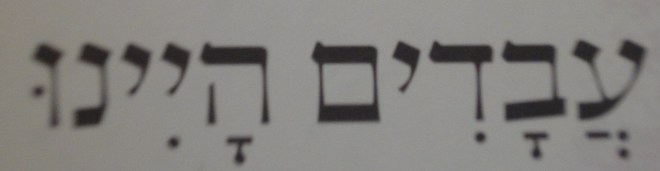
The Hebrew words for “slave,” “work,” and “worship” or “service” all have the same root. (More on “oved with an ayin” in a future post). But I have never heard anyone question the meaning of “avadim hayinu…” which appears near the start of the Passover telling: “We were slaves, and now we’re free.”

Note the letter ayin at the start of the word “avadim [slaves].”

Avadim.jpg
Avadim hayinu

The Deuteronomy verse, “Arami oved avi…” is another story. The ‘oved‘ with an aleph lends itself to several relatively straightforward translations as well as a traditional homelitical reading based on the biblical character most commonly identified with Aram.

Note the letter “aleph” at the start of “oved [lost, perished, fugitive,…].”

AramiOvedAvi.jpg
Arami oved avi

For discussion of “Who is Arami?” and “What does it mean to be oved?” in the Deuteronomy setting and in the Passover Haggadah, see “Ki Tavo: A Path to Follow.” Here, just to explore Hebrew vocabulary a bit more, is a little background on the word ‘oved‘ (with an aleph) itself.

oved‘ with an aleph

Forms of ‘oved‘ (with an aleph) appear frequently in biblical text. Here are a few instances, along with some translations.

Jeremiah 9:11 —

מִי-הָאִישׁ הֶחָכָם וְיָבֵן אֶת-זֹאת
וַאֲשֶׁר דִּבֶּר פִּי-יְהוָה אֵלָיו וְיַגִּדָהּ;
עַל-מָה
אָבְדָה
הָאָרֶץ, נִצְּתָה כַמִּדְבָּר מִבְּלִי עֹבֵר.
Who is the wise man, that he may understand this?
And who is he to whom the mouth of the LORD hath spoken,
that he may declare it?
Wherefore is the land
perished and laid waste
like a wilderness, so that none passeth through?
— JPS 1917 translation

…Why is the land in ruins
— JPS 1999

Micah 7:2 —

אָבַד
חָסִיד מִן הָאָרֶץ,
וְיָשָׁר בָּאָדָם אָיִן:
The godly man is perished out of the earth,
and the upright among men is no more
— JPS 1917

The pious are vanished from the land
— JPS 1999

Psalms 9:7 —

אָבַד
זִכְרָם הֵמָּה
…their very memorial is perished.
— JPS 1917

…their very names are lost.
— JPS 1999 with note: “meaning of Hebrew uncertain”

Ezekiel 12:22 —

בֶּן-אָדָם, מָה-הַמָּשָׁל הַזֶּה לָכֶם,
עַל-אַדְמַת יִשְׂרָאֵל, לֵאמֹר:
יַאַרְכוּ, הַיָּמִים,
וְאָבַד,
כָּל-חָזוֹן.
‘Son of man, what is that proverb
that ye have in the land of Israel, saying:
The days are prolonged,
and every vision faileth?
— JPS 1917

…every vision comes to naught“?
— JPS 1999

One more point of comparison, just because Temple Micah’s Hebrew poetry group encountered this modern Hebrew instance — over studies during the Shabbat of Passover — and noted how ‘obed‘ with an aleph and ‘obed‘ with an ayin sound alike to most English-speaking, and to some Hebrew-speaking, ears.

Lost

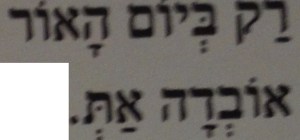
Yehuda Amichai’s “Shir Ha-Chut La-Machut [Poem of the Needle for the Thread]” has not been published in English translation. Our group rendered this line from the poem as “Only in the day, you are lost in the light,” or “Only in the daylight, are you lost.” (We struggled with the expression “b’yom ha-ohr.”)

And, finally, here are several versions of Deuteronomy 26:5 —

וְעָנִיתָ וְאָמַרְתָּ לִפְנֵי יְהוָה אֱלֹהֶיךָ,
אֲרַמִּי אֹבֵד אָבִי,
וַיֵּרֶד מִצְרַיְמָה,
וַיָּגָר שָׁם בִּמְתֵי מְעָט; וַיְהִי-שָׁם,
לְגוֹי גָּדוֹל עָצוּם וָרָב.
And thou shalt speak and say before the LORD thy God:
‘A wandering Aramean was my father,
and he went down into Egypt,
and sojourned there, few in number;
and he became there a nation, great, mighty, and populous.
— JPS 1917

…’My father was a fugitive Aramean…’
— JPS 1999

‘An Aramean Astray my Ancestor”
— Everett Fox translation, 1995

posted on this sixth day of the Omer 5777, with this prayer:
“In remembrance of the Exodus from Egypt, we pray that you release all whose bodies and spirits remain captive and enable us to extend Your outstretched arm in the process of liberation.” (see Ritual Well)

Rivers of His Hands

“The rivers of his hands [נהרות ידיו] poured into his good deeds,” reads the Yehuda Amichai poem “My Father.” The Hebrew Poetry group at Temple Micah discussed this poem on Shabbat, and I later recalled some background which seems related.

Rabbi Meir says in Pirkei Avot:

Anyone who involves himself in Torah for its own sake merits many things…and the secrets of the Torah are revealed to him, and he becomes like an ever-strengthening spring, and like a river that does not stop [וּכְנָהָר שֶׁאֵינוֹ פוֹסֵק]…
— Pirkei Avot 6:1, from Sefaria

In addition, the biblical concept of “נָהָר — nahar” provides further relevant background.

A River Goes Out

River images are pretty common in biblical text. The word “נָהָר — nahar” is used 120 times in the Hebrew bible, with 98 uses translated as “river,” according to this concordance . (The word is also rendered “flood” or “floods” or “streams.” Strong’s Exhaustive Concordance is widely available on the web and very handy; here’s more about this Christian resource.) But the first “nahar” in particular seems related to both the verse from Avot and Amichai’s poem.

“A river comes forth from Eden to water the garden.”
V’nahar yotzei me’eden lehashkot et hagan
וְנָהָר יֹצֵא מֵעֵדֶן
— Genesis 2:10

Noting that the river “yotzei [goes out, comes forth]” from Eden, a contemporary teacher writes:

How ironic. Wouldn’t the river be more likely to water the Garden if it flowed INTO the Garden? The deepest answer is that Torah is compared to lifegiving waters. The more one gives Torah over to others the more watering comes back in return. The more one teaches, the more one learns. The more we give of ourselves to others, the more we get back in return.
blog of Rabbi Baruch Binyamin Hakohen Melman

Amichai’s poem, “My Father,” says nothing about Torah. But the images he shares seem consistent with — and I’d argue, built on — biblical and rabbinic ideas of rivers sustained by their “going out.”