Rough Draft for a Rough Season

As Rosh Chodesh Elul approaches, rough draft of an al chet [litany of missing the mark] in hopes of awakening us to some areas of error we might try to fix as the Days of Awe draw near. Part of series: Calendar Notes for a Summer of Collapse

Selichot for Institutions, Elul 5785

New text for Elul 5785 (by V. Spatz, CC BY-SA-NC) with **quotations from Machzor Lev Shalem (Rabbinical Assembly, 2010)**

Two-page document is designed for praying, sharing, and printing through format that distinguishes machzor quotations and newer text for many readers. Full text also appears in post format below.

Skip to in-post format. Download/open as PDF —

Selichot (Forgiveness) Prayers for Institutions

The soul is Yours, the body is Your creation Have compassion on Your handiwork ** (p.225)

In function and in failure, our institutions are Yours as well
Re-orient us to divine sparks and powers within
Save us from ourselves with ourselves under Your guidance


Grant relief to this driven leaf (Lev 26:36)
Have compassion on that which is but dust and ashes

Cast away our sins, be kind to Your creations.

God saw it and appraised it, examined it and plumbed it,
and then God said to human beings:

“The fear of HASHEM — that is wisdom;
departing from sin — that is true knowledge”
(Job 28:28) ** (p.224)

Our institutions are at once fragile and ponderous,
fleeting and stagnant, intractable and so easily toppled
conflict and confusion foster many modes of collapse

Keep us from contributing our own brittleness and turmoil
Remind us of connection’s strength and possibility
Help us pursue repair when all seems lost


If you see within me cause for sadness, guide me toward eternal truths

Hear my prayer, God, give ear to my cry; do not disregard my tears;
like all my forebears I am a wanderer, a guest in Your house

Make me an instrument of Your salvation ** (p.228)

My soul yearns for You, though I am afraid of Your judgment

My heart is caught in the web it has spun.
Form me anew, granting me a heart freshly born ** (p.230)


Our understanding is limited, obstacles abound
Our errors serve as brambles, adding pain along the way
We’ve lost ourselves and misled others

Clarify our missteps so we know when we must turn
Teach us to notice stumbling-blocks and dangers in the road
When despair threatens, nudge us back toward hope


We call out in words You taught Moses to use in times of trouble: “HaShem, HaShem, God compassionate and gracious, slow to anger, full of kindness and trust, extending kindness to the thousandth generation, forgiving iniquity, transgression and sin –” (Ex 34:6-7)

For the sin we have committed before You in destroying without thought to the future
For the sin we have committed before You by bowing down to the past

For the sin we have committed before You by focusing on policy in a world on fire
For the sin we have committed before You by thinking crisis overrides all planning and care

For the sin we have committed before You by thoughtlessly allowing ourselves to be led
For the sin we have committed before You by refusing to honor leadership

For the sin we have committed before You by failing to ask how we can help
For the sin we have committed before You by assuming it’s easier to do it all ourselves

For the sin we have committed before You by approving decisions that worry us
For the sin we have committed before You by second-guessing every step

For the sin we have committed before You by treating critique as attack
For the sin we have committed before You by attacking under the guise of help

For the sin we have committed before You by treating lock-step as unity
For the sin we have committed before You by mistaking variety of opinion for inclusion

For the sin we have committed before You by assuming we know too little to offer opinion
For the sin we have committed before You by thinking we know it all

For the sin we have committed before You by assuming our perspectives somehow universal
For the sin we have committed before You by assuming our own experiences unique

For the sin we have committed before You by mistaking outrage for justice
For the sin we have committed before You by succumbing to complacency

For the sin we have committed before You by fearing uncertainty and pause
For the sin we have committed before You by letting uncertainty paralyze us

For the sin we have committed before You by bringing punitive efforts into abolition work
For the sin we have committed before You by using abolition language to absolve real error

For the sin we have committed before You by putting Movement above people
For the sin we have committed before You by failing to keep our eyes on the prize

To all these sins, awaken us, help us recognize harm, and grant us ability to change
Bring us to the day when we can ask that you forgive us, pardon us, and grant us atonement.


Featured image is cropped from earthquake photo by Angelo Giordano via Pixabay

Kaddish Resources 2024

Sharing some kaddish translations and interpretations

Everett Fox’s translation of mourner’s kaddish, found in Anita Diamant, Saying Kaddish: How to Comfort the Dying, Bury the Dead, and Mourn as a Jew. Schocken, 1999. NOTE: Some add “…v’al kol Yishmael, v’al kol yoshvei tevel [and all Ishmael and all who dwell on earth]” after v’al kol Yisrael” in the last verse. Fox’s kaddish translation (PDF — sometimes used for Tzedek Chicago Torah study). Also found at Open Siddur

Richard Heiberger’s translation, for National Havurah Committee, in memory of Mary Morris Heiberger (1946-2003). NHC kaddish (PDF — prepared for Tzedek Chicago’s Hebrew Learning Community)

Mourners’ Kaddish in Times of War and Violence by R’ Arthur Waskow

Interpretive kaddish by Rabbi Zalman Schacter-Shalomi

Mourners’ Kaddish for Everyday by Debra Cash (a poem found at Ritual Well)

A few older posts on kaddish

Exploring Kaddish and More on Kaddish (2014)

Jewish Mourning and Pets (2021)

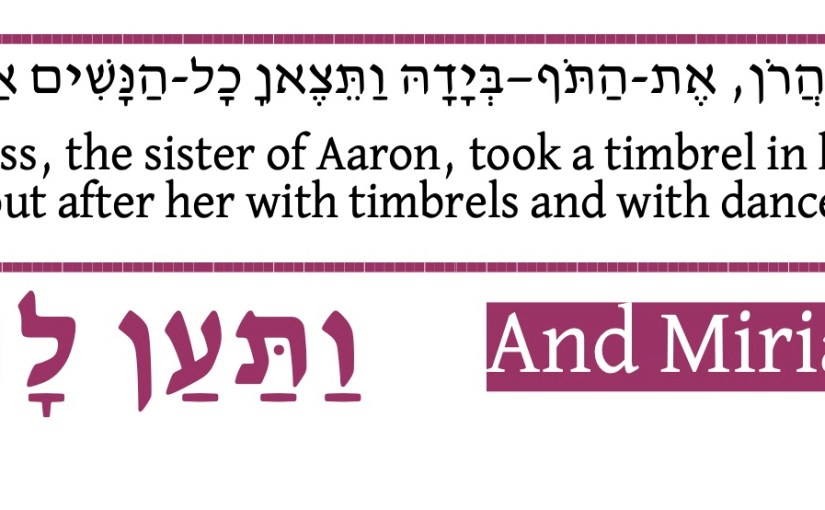
Miriam, Amalek, Memory, and Mouths

This dvar torah is about remembering and how Jewish memory is built with the help of our prayerbooks. Some of what I learned in preparing today’s remarks can be found in this handout.

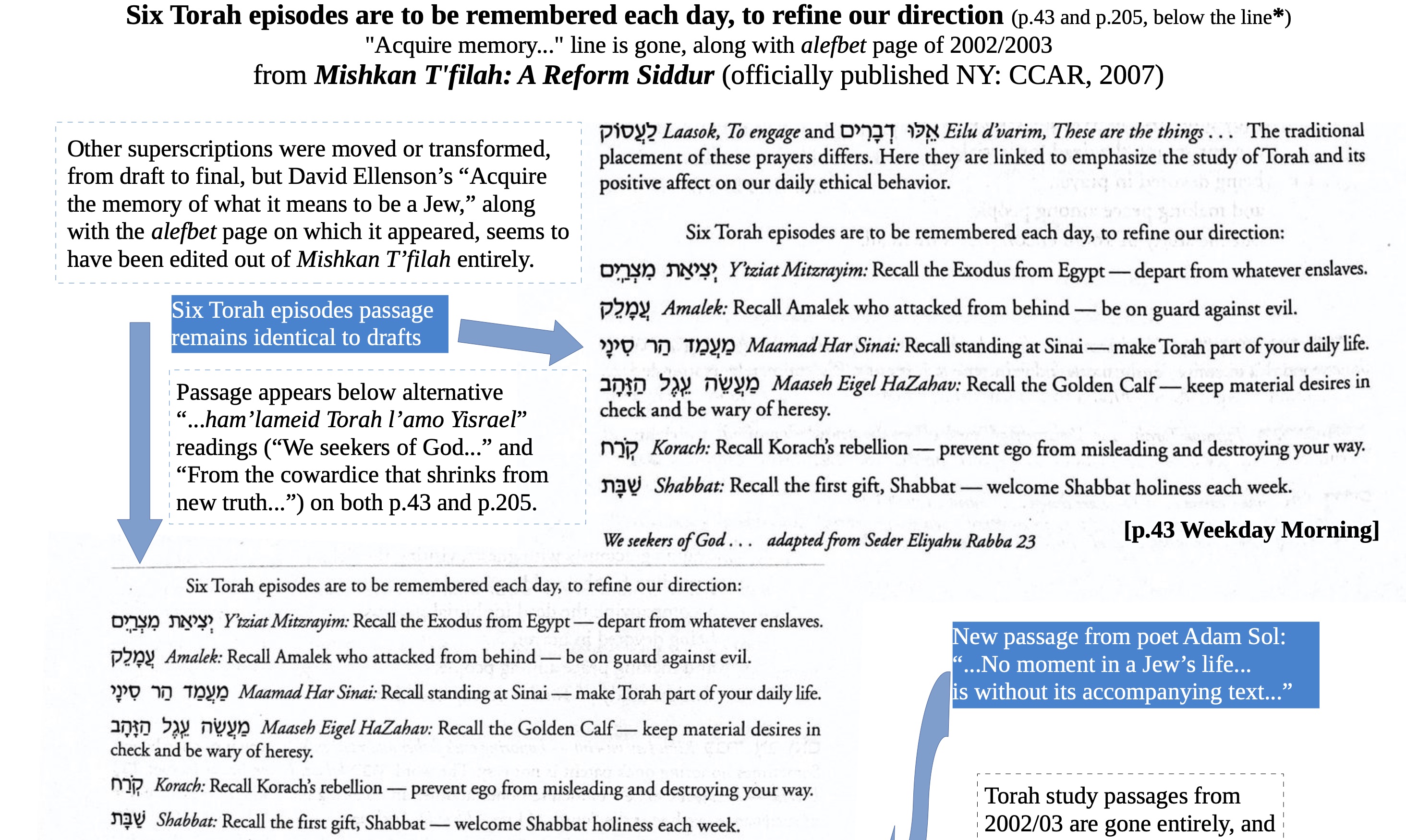
The end of the handout is the result of the earlier parts of my studies, a brief exploration into Mishkan T’filah and earlier drafts of the siddur, mostly focusing on one pair of pages where we find: “Six Torah episodes are to be remembered each day, to refine our direction.”

The “Six Torah episodes” section can be found on pages 43 and 205 in the actual Mishkan T’filah, on page 12 in the handout, shared here.

full text version can be found here

In similar passages (more on this later) in other prayer books, “What God did to Miriam” is included here. I turned to older drafts of Mishkan T’filah, hoping they might clue me into why Miriam is not on this page.

Endnote Deadend

An endnote in the published siddur says the Six Torah episodes were “adapted from a Sephardic siddur.” But it doesn’t specify which or say what was adapted. I could find no example anywhere, Ashkenazi or Sephardic, in another siddur which changes the verses so as to omit Miriam, as Mishkan T’filah does. Every other example over the last 1000 years seems to focus on the same six incidents, all of which include a Torah verse demanding that we “remember” and/or “not forget.” Only Mishkan T’filah uses a different list. Only Mishkan T’filah leaves out specific Torah verses. And only Mishkan T’filah adds in Korach — about whom we have no memory admonition in the Torah.

These seem significant differences, and I thought it a little odd that so much changed over the course of the drafts, while this passage remained static through five years or more of edits. (See the handout for some notes on changes that did occur over the drafts.) No one I asked — including some Temple Micah clergy, current and past, and other people I thought might know — had an explanation. Rabbi Gerry Serotta, who served as interim rabbi some years ago, sent a query on my behalf to the siddur’s chief editor, Rabbi Elyse Frishman, and to Rabbi David Ellenson. If we hear back, I’ll let you know.

Improvement by Removal?

Meanwhile, Rabbi Gerry and I guessed that removing Miriam had been an attempt to respond to feminist criticism about how Miriam is usually remembered: 1) focusing on her case of tzaraat, a skin condition, rather than on anything she actually did or who she was; 2) remembering “What God did to Miriam” in a way that accuses her of lashon hara [evil speech], although that is unclear in the text; and 3) blames Miriam alone, while the text clearly states that both Aaron and Miriam spoke against Moses (Numbers 12:1ff).

If it’s true that the change was made due to feminist sensibilities, it seems ironic — and oddly instructive — that, as a result, Miriam is… just gone.


Acquiring Memory

In my travels through older prayerbook drafts, I was intrigued by the adage, attributed to David Ellenson: “Acquire the memory of what it means to be a Jew.”

This prompted me to wonder:

  • What did the siddur editors want us to remember with this set of episodes?
  • What does it mean that Miriam is not on the page?
  • What would it mean if she were there?
  • What does it mean that Mishkan T’filah made this change without explanation?
  • Would the passage land differently, had an explanation been included?

From there I followed many other branches of wondering, more generally, about how memory, and Jewish identity, are formed by our practice and our prayerbooks. That brings me to older material I found relating to the Six Remembrances.

On page three of the handout is a Talmudic source arguing why the verb “remember” should be understood to mean “repeat it with your mouth.” The link between speech and remembering is an old one in Jewish thought. The passage from Sifra discusses four of the verses in the Six or Ten Remembrances.

full text version can be found here

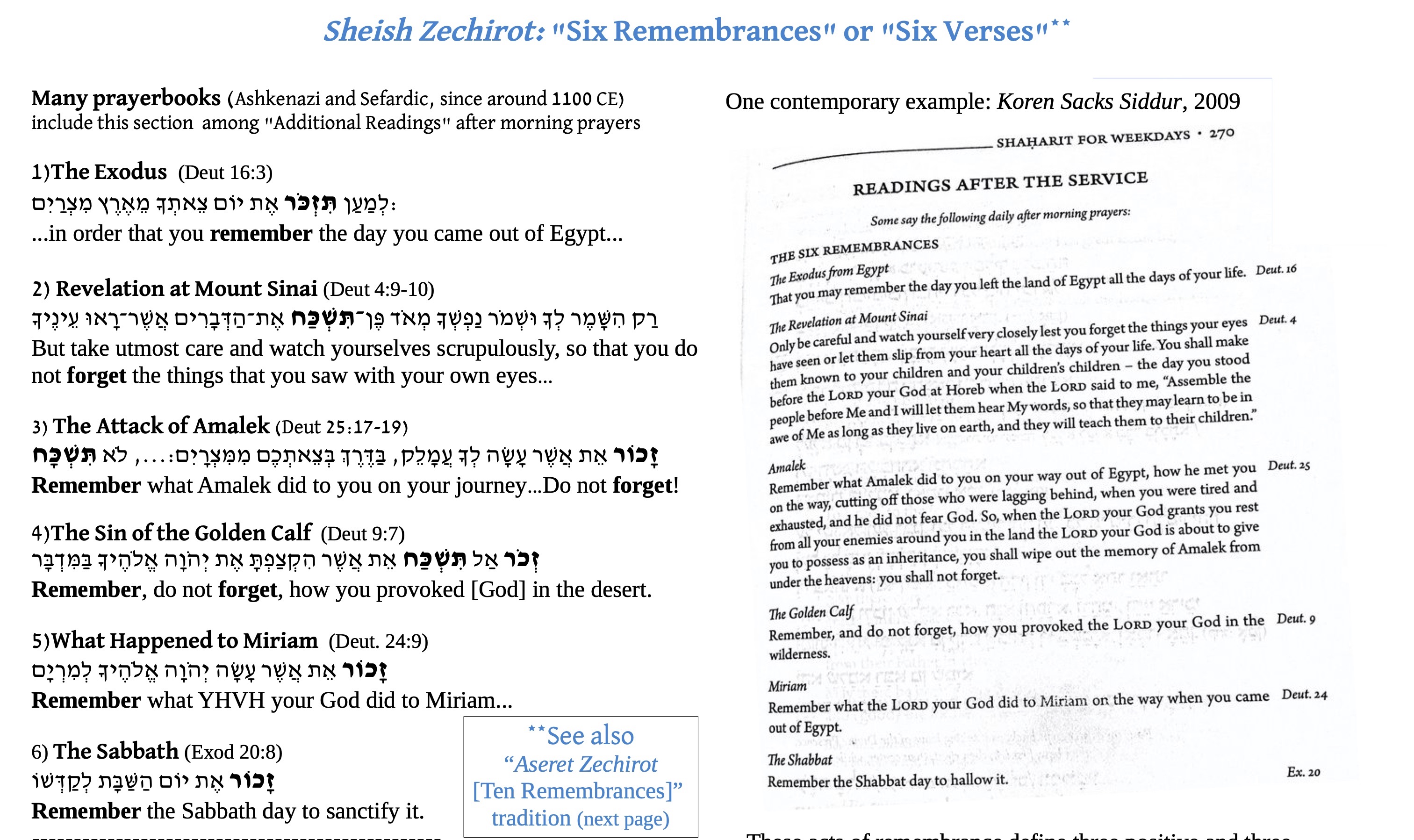
In addition to these four, the Exodus and the Revelation at Mount Sinai are included. Here, page 6 of handout, is a typical example of how the Six Remembrances appear in contemporary prayerbooks —

full text version can be found here

Intentions and Remembering

In addition to Mishkan T’filah’s “to refine our direction,” other intentions introduce these remembrances: from a simple “some say,” to “for the sake of unification of the divine name…” and “those who recite these are assured a place in the world to come.” (See page 2 of the handout for these various intentions and page 6 for details of how the Six and Remembrances and the “Six Torah episodes” differ.)

The Sifra passage also includes an expression that really caught my attention — the idea of “heart-forgetfulness,” apparently something that can be fixed with thought, while speech is required in other cases…..

This might be a good thing to keep in mind during Elul, thinking about what can be repaired by thought and memory and what requires speaking aloud.

Back to Miriam

Now, back to Miriam, who is not on the Mishkan T’filah pages but IS in this week’s Torah portion (now last week’s, Ki Teitzei, Deut. 21:10 – 25:19 — pages 7 and 8 of the handout). Deuteronomy 24:9 is one of only 12 times her name appears in the Torah.

Rabbinic imagination saw Miriam’s Well in the white space between her death and the lack of water in the next verse. And many other stories and lessons surround Miriam. But she appears in four incidents in the Torah — named three times and “his sister” in another — and is mentioned twice more. That’s it. That’s all she wrote about Miriam.

full text version can be found here

There is a lot of commentary about the two verses in this week’s portion– the one telling the listener to heed the priests in matters of tzaraat (Deut 24:8) and the following one telling us to remember what God did to Miriam.

What God did to Miriam is related in Numbers 12. The demand that we remember what God did to Miriam is usually understood as a warning to guard the tongue, due to links in commentary between tzaraat and sins of the tongue. But it’s crucial to note that there is no direct link — either in this week’s portion or in Numbers 12 or elsewhere in Torah text — between Miriam and evil speech.

What and How We Remember

The story in Numbers 12 is full of obscure imagery, and Miriam’s tzaraat is the same condition Moses experienced at the Burning Bush, where it was part of his recognition as a prophet, and not understood as punishment at all. Early Jewish teachers chose to make Miriam an object lesson rather than following another set of interpretations with a different set of lessons.

None of the other Six or Ten Remembrances involve an individual, so — regardless of initial intention — Jewish thought and law were greatly influenced by the linkage that developed between Miriam, and women in general, and evil speech.

  • But, is that a good reason to remove the text from recitation?
  • Does that facilitate forgetting of a helpful kind?
  • What is gained and what is lost in removing a passage with difficult associations?
  • Might it be better to keep it in and work to understand and re-interpret?

Theologian Judith Plaskow discusses this in a piece on this week’s portion, “Tzaraat and Memory.” I highly recommend reading the whole thing — either in The Torah: A Women’s Commentary, in print, or on My Jewish Learning.

Writing in 2008, Plaskow raises the issue of how progress can actually be a challenge to memory and to further progress. I’ll add that her conclusion can also apply to the appearance of progress, as when a problematic text is removed from regular recitation or consideration, or when we make changes that don’t always benefit the most harmed or vulnerable.

She writes, referencing the other important “memory” verses in this week’s portion:

We blot out the memory of Amalek when we create Jewish communities in which the perpetual exclusion of some group of people — or the denial of women’s rights — are so contrary to current values as to be almost incredible. Yet, if we are to safeguard our achievements, we can also never forget to remember the history of inequality and the decisions and struggles that have made more equitable communities possible.


What We Remember, What We Fix

I’ve been watching a series of mysteries focusing on women in the mid-1960s. (For fellow mystery fans: Ms. Fisher’s Modern Murder Mysteries, set in 1964-65 Melbourne, Australia, a delightful set of sequels to Miss Fisher’s Murder Mysteries, set in the same area in the late 1920s.) And I’ve noticed that I am remembering, quite viscerally, how it FELT, as a girl and young woman, to have limited rights, opportunities, and expectations. And also of how dangerous it could be back then, in physical, legal, and psychic ways, for women and also for queer people and for many others….And I’m on the young side for these experiences; others have longer histories with inequality.

This exploration also reminded me of, on the one hand, how grateful I was to have to explain such things to our children as they were growing up. So many conversations that centered around: Queer people were forbidden from expressing their identity or acting on their sexuality, let alone getting married?! Women weren’t allowed to what?! US law defined whiteness as property and prevented Black people from what?!

On the other hand, I remember the desire to let them go on asking questions like “Do you have to be a mommy to lead services?” without ever realizing how impossible that question would have been in my youth and how painful it was for all of us who didn’t see ourselves reflected in leadership roles…or at all.

There is a strong tension between wanting to build a world with more equity and inclusivity, on the one hand, and the responsibility to never forget that we are sitting in a place built by damage; with many wounds still present, often unhealed, and so much work still to do. Continuing to REMEMBER, and recite, difficult passages can cause harm. But failing to remember carries it’s own risk.

The same applies in many ways to teshuva: When might it be appropriate to forget or not mention old harm, and when must we work to remember and confront? In other words, maybe, when are we dealing with heart-forgetfulness and when with something that requires us to use our mouths?

As I tried to figure out what happened with Miriam and the Six Torah episodes, I kept remembering these lines, from a song about memory and loss —

If you hear that same sweet song again,
will you know why?

— “Bird Song,” by Robert Hunter (1941-2019) & Jerry Garcia, z”l (1942-1995)
first performed Feb 19, 1971. “for Janis [Janis Joplin (1943-1970)]”

How much do we lose, and what do we gain, when we forget to remember why we chose to remember or forget?

This dvar Torah was originally prepared, and offered in a slightly different form, for Temple Micah (DC), 5781.


Handout in PDF and text versions

Full text version of handout for anyone who cannot easily do graphics is posted here.

BACK to TOP
If one is unprotected: a prayer for DC and beyond

As the District of Columbia begins absorbing crowds seeking to engage in “wild protest,” DC’s mayor is asking locals to “stay home” or “stay out of the downtown area.” Community and religious leaders were encouraged to share the “stay home and stay safe” message.

The DC Council’s statement also urges people to avoid protest areas but includes some nuance: “We recognize that downtown is home to residents and businesses whose rights must be respected and protected as we work to keep all safe, including residents who are currently homeless,” they write, asking the mayor and police to prioritize the protection of these groups.

Black Lives Matter-DC, earlier issued a call “asking all DC residents to hold the city officials and businesses accountable” for the failure to oppose white supremacist attacks in November and December. In addition, their statement “also calls upon Black and brown people, if possible, to avoid Trump support rallies and actions. They ask that Black and brown residents stay alert and vigilant during the upcoming white supremacist invasion.” Full statement here —

With these three calls in mind, and in solidarity with religious institutions who are attempting to respond to the threats, I share this prayer. It is based on one from Jewish morning prayers:


Blessed is THE SOURCE OF ALL, who forms humans in wisdom, with possibilities for communication and connection. Before the vastness and weight of THE DIVINE, we recognize and acknowledge essential networks, within us and around. Any disruption or blockage threatens survival and health of the whole.

None of us are free, if one of us is chained.

We are never truly safe, if one is unprotected.

Amid sources of division, keep us mindful of interconnectedness, collective responsibility and strength.

Blessed is THE HEALER and THE SUSTAINER of ALL CONNECTION.

For a more visual presentation, here’s a JPG with the text on a background image of a network, with denser connections at center. Text is identical to that above; image is by Gerd Altmann from Pixabay

Here’s a PDF with background image and full text for easier sharing.

Lights for Liberty: An Intention

Rabbi Yose son of Judah taught: Two ministering angels, one good and one evil, accompany a person home on the Sabbath eve. If a lamp is burning, table set, and seating arranged, the good angel says, “May it be thus on the next Sabbath,” and the evil angel unwillingly answers “amen.” If not, the evil angel says, “May it be thus on the next Sabbath,” and the good angel unwillingly answers “amen.” (based on B. Shabbat 119b)

For too many Sabbaths, our national home has been devoid of safety, nourishment, and comfort for those seeking refuge and asylum, and for many others in our midst. Each week of these conditions reinforces toleration of the same next week, with our good angels, however unwillingly, answering “amen.” This Friday, we gather for a turning point, calling forth new and better angels.

In the spirit of “Lights for Liberty,” in Washington DC and beyond, a prayer:

Holy One, wherever lamps are burning,
tables set, and seating arranged on Sabbath Eve,
nurture those gatherings;
inspire all who experience this sanctuary in time
to renewed effort toward safety, nourishment, and comfort for all.

Hear this, too, Holy One —
wherever light is lacking,
food sparse, and conditions rough this week,
accept no prayer — angel or human — on our behalf for a continuation of suffering.
Let no appearance of indifference, helplessness, or political confusion
be understood as a plea in our name for the perpetuation of evil.

Holy One, we welcome the Sabbath
in gratitude for its peace and blessing
and we dedicate ourselves, and beg Your help,
to extend that peace and blessing to those most in need.
Help us, as we work to end the horrors perpetuated in our name.
May this week’s lamps and tables and seating persist and multiply. And we all say: Amen

For study passages and another prayer, visit Jews United for Justice resource page. Here is a PDF of this kavanah with Talmudic introduction (not shared on the JUFJ website).

Visit http://www.lightsforliberty.org for details of July 12 anti-Concentration Camp gatherings around the country.

Visit https://jufj.org for details about DC- and Baltimore-area Jewish justice efforts.

Visit https://www.neveragainaction.com/ for national Jewish responses.

Siddur as Hometown: Don’t Dismiss the Travel Guide

When the ancient Rabbis want to etch something in memory and make it part of regular practice and belief, they stick it in the siddur. I cannot specific cite a source for this pronouncement, which I included in a recent dvar torah — although Berakhot, the Babylonian Talmud’s Tractate on Blessing, is one source that lends lots of support to this idea.

The prayerbook is such a rich environment, but it’s easy to miss most of it as we pass through. We often treat the siddur like our own hometown: we can imagine why others are fascinated and seeking to learn more, but we just want to traverse it to get wherever we’re trying to reach; a travel guide for the place we’ve been living for decades seems beside the point. Additional teachings that have developed over the centuries, to explain why things are (or are not) in the siddur and elaborate on ideas contained in the prayers, can be terrific resources, though.

Here are a few:

  • The dvar torah on Parashat Re’eh, mentioned above: The Commandment to See
  • Small archive of Divrei Tefillah, words about prayer, produced by congregants at Congregation Rodfei Zedek (Chicago); dvar by Rebecca Milder is quoted in above
  • Elaborate Making Prayer Real website, with articles and webinars and more; related to book by Rabbi Mike Comins, released in 2010 (and frequently quoted on THIS blog).
  • Re-recommend exploring something along the lines of “Map Your Heart Out

Maintaining Self and Struggle

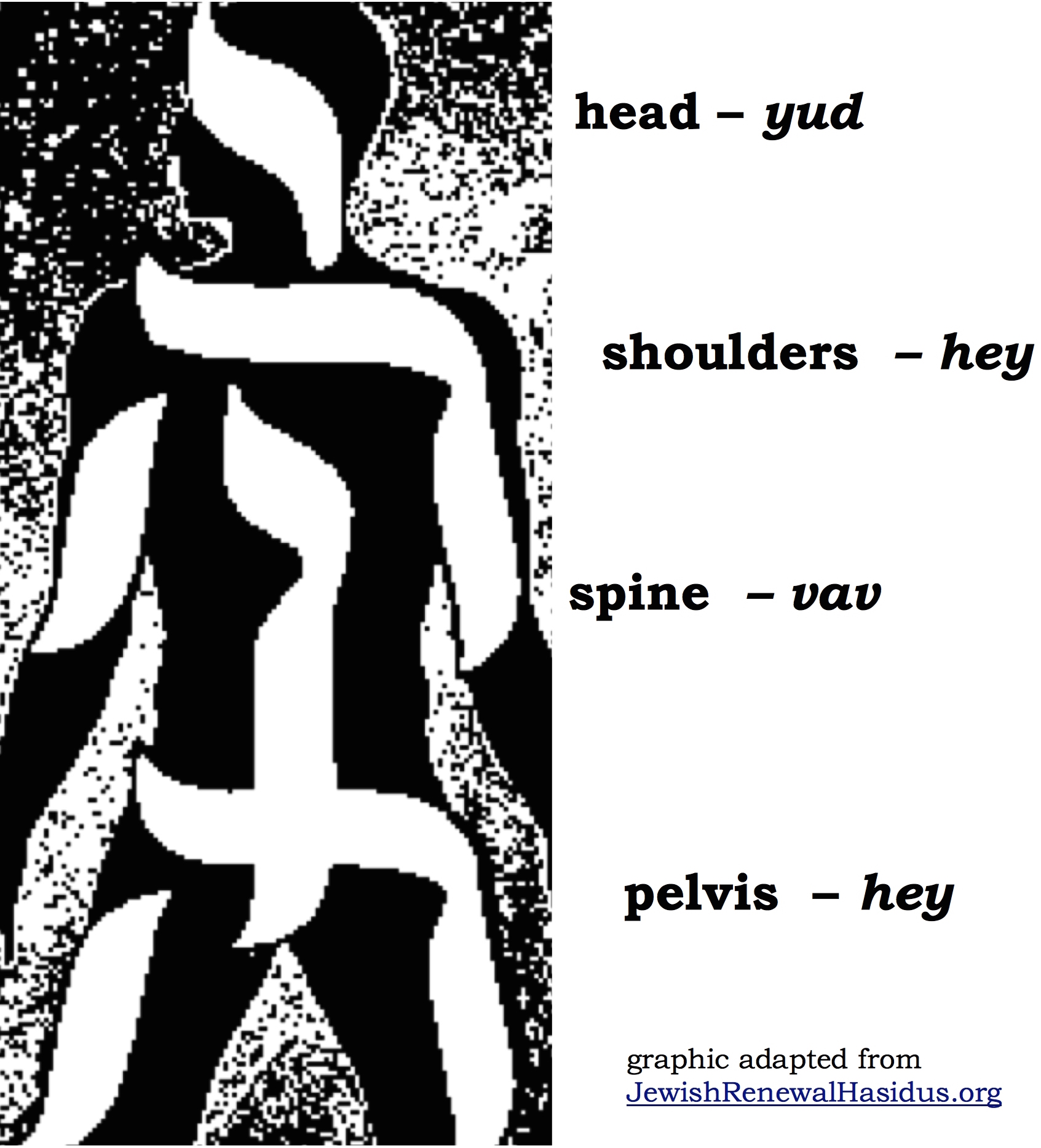
A meditation linking God’s four-letter name – YHVH (yud-hey-vav-hey) – with the human body/soul can help focus on God’s presence and power in our lives. I have relied on this meditation since Rabbi David Shneyer taught it to me some years ago.

yhvhgraphic
The variation presented here, incorporates a teaching from the prophet Micah on what God requires of us —

הִהִגִּיד לְךָ אָדָם, מַה-טּוֹב; וּמָה-יְהוָה דּוֹרֵשׁ מִמְּךָ,
כִּי אִם-עֲשׂוֹת מִשְׁפָּט וְאַהֲבַת חֶסֶד, וְהַצְנֵעַ לֶכֶת, עִם-אֱלֹהֶיךָ.
You have been told, human, what is good,
that is, the traits that God expects from you:
acting justly, a passion for loving kindness, and walking humbly with your God.
– Micah 6:8 (translation from Siddur Eit Ratzon)

It is offered as support for social justice work in difficult times.

Shared here are the bones of the practice, so to speak, along with a PDF with additional graphics, 4-part Meditation, for easy carrying in a pocket or bag. Originally intended for use at the start of the day, this brief practice also serves throughout the day, especially when circumstances threaten to pull us off center, to realign with divine connection and our own strength and flexibility.

Fabrangen West tried a group chant based on this practice at the December 2016 gathering. Several participants more knowledgeable about renewal hasidus and kabbalah found connections between the sefirot and the words of the Micah verse. Further thoughts on this meditation — or on other Jewish practices for times of challenge — are welcome.

As always, “A Song Every Day” seeks comments or guest posts.

(1) Begin

Begin with meditation or chant using the four-letter name to focus on God’s presence before and within:


(2) “You’ve been told, human…”

Cycle through first half of verse, Y-H-V-H, head to legs, several times. At each reflection stage, try to release any barriers to embodying those attributes God expects; where appropriate, note areas in need of further attention:

  • (Y) Consider your humanity and connection to God. If you are feeling depleted, this is a moment to be open to the spiritual support you need.
  • (H) Is anything – distraction, anger, injury, e.g. – impeding your ability to reach for “what is good”? If so, can you release the barrier now? Or,should you set aside more time for this, to keep your reach from straying?
  • (V) Are you centered, with YHVH as backbone? What might pull you away? How are you working to stay upright?
  • (H) Are you prepared to pursue what God seeks of you? Does body or soul require attention first? Ready for more instruction? (Or ↑)


(3) “…acting justly, a passion for loving kindness,
and walking humbly with your God.”

Cycle through second half of verse, Y-H-V-H, head to legs, several times. Again, at each reflection stage, release barriers if you can and make note of areas where further attention, including assistance from others, would be helpful:

  • (Y) Are you committed to embodying the traits we are told to share with God?
  • (H) Do you join hands with others, or just push your own ideas, in acting justly? Do you need more partners, assistance? To whom can you reach out?
  • (V) Is your spine ready to stand and bend in loving kindness? Do you need help – maybe learning or rest – to avoid damage to yourself or others?
  • (H) Ready to take steps in the world, humbly with your God, and in healthy company with others, in the struggle? (Or ↑)

Brief journaling – either at this point, before closing out the meditation, or shortly afterward – can be helpful.

(4) Close

Return to a chant of the four-letter Name, preparing to bring your newly-aligned self into the outside world and the on-going struggle.

verseandgraphic


Map Your Heart Out: A Few Sources

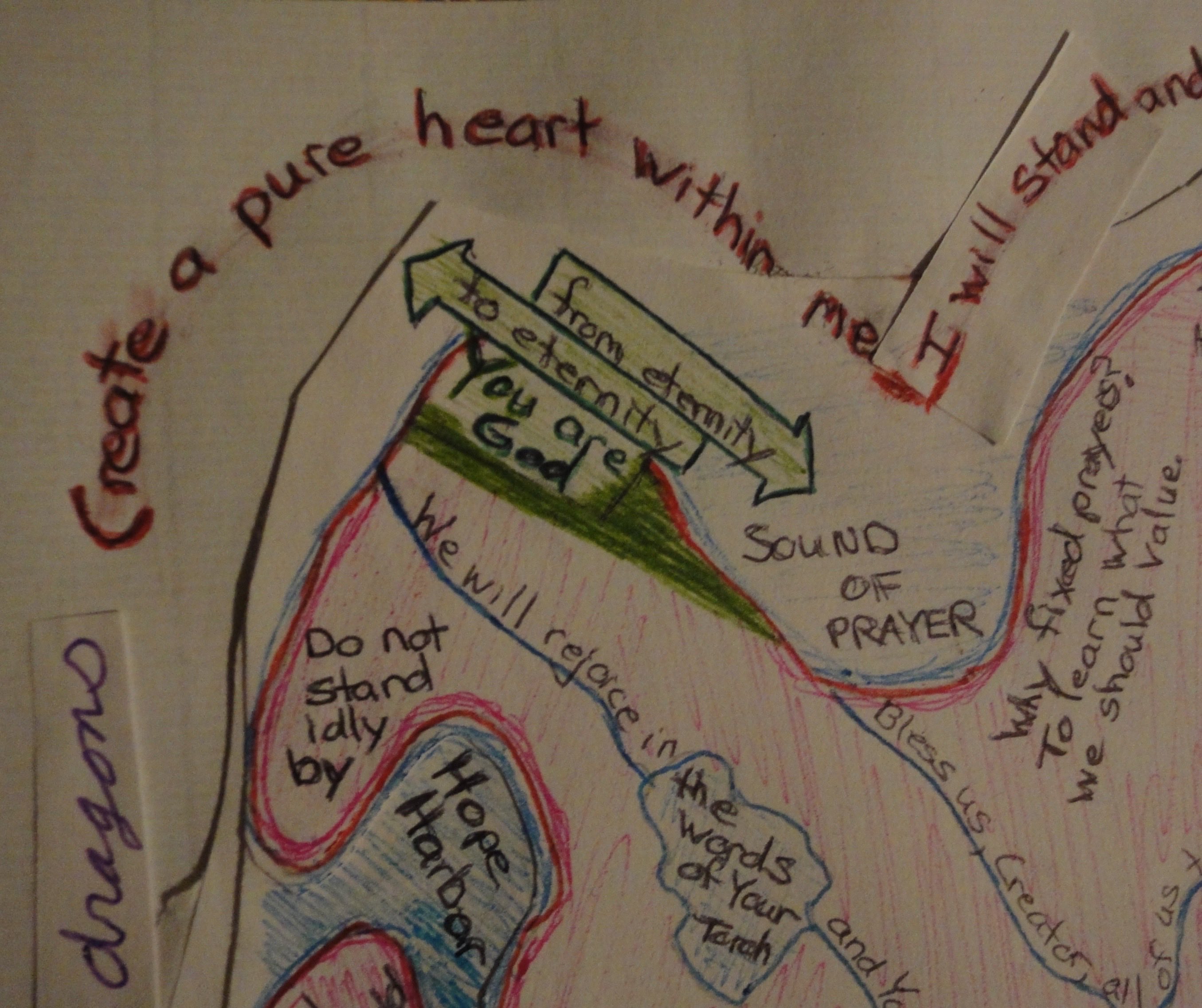
Here, as promised a few days back, are some of the sources that I included in my prayer “heart map”….

Overall structure is formed by two lines from this kavanah [intention] for the Amidah:

heart_corner

Create a pure heart within me
let my soul wake up in Your light.
Open me to Your Presence;
flood me with Your holy spirit.
Then I will stand and sing out
— Stephen Mitchell, based on Psalm 51
Mishkan T’filah, p.75

Orientation

Orienting the map is the phrase, “From eternity to eternity, You are God [מן העולם ו’עד העולם אתה אל],” from the “Nishmat” prayer, in the Shabbat/Festival morning service. Also near the top of the map, to highlight its influence — like minerals in the hills, carried by rivers and run-off to parts below — is this brief commentary:

Why fixed prayers?
To learn what we should value,
what we should pray for…
— Chaim Stern, p. 437 Mishkan T’filah

This note comes from the prominent liturgist Rabbi Chaim Stern (1930-2001); it was also found in Gates of Prayer (1975) and other Reform prayerbooks.

Connection and Points Beyond

Two rivers, running the length of the heart territory and connecting various regions, begin with “We will rejoice in the words of Your Torah…” and “Bless us, Creator, all of us…” (The first is from the Evening service, before the Shema; the second, from the Morning service, at the close of the Amidah).

The prayers themselves remind us over and over again of connections between prayer, study, and acting for justice in the world. See also, to take just two examples, Max Kadushin’s Worship and Ethics (1963, republished 2001 by Global Publications) and Marcia Prager’s Path of Blessing (NY: Belltower, 1998).

At one edge of the map, the injunction, “Do not stand idly by (Leviticus 19:16), hugs “Hope Harbor.” Farther beyond, outside the heart and its surrounding waters, the terrain is less certain.


NOTE

Here’s a link to some background on this project and my whole map. Also linked is information about cordiform maps more generally and about the book suggesting “Personal Geographies.”

The graphic aspect was very helpful to me, but I don’t think it’s necessary to draw or color in order to consider what prayers or texts would play a prominent roll in your own “heart map.”
BACK

Life, Liberty, and the Promise of Peace

Readers may have noticed a long silence on this blog. But I have not been entirely silent.

At start of June 2015, I began an additional blog, #SayThisName, to mark those lost to homicide and police action in the District of Columbia. Since then, I have personally typed out and said aloud the names of 95 individuals lost in our city in less than six months. The list includes friends of friends, a domestic murder-suicide a few blocks from my home, and a shooting on the steps of a church across from my work. I glimpsed a few seconds of the latter scene nearly three months ago, and the picture rarely leaves me for long. These are not statistics or abstractions. And this recitation has, it seems, captured a large part of my voice.

I am grateful to Temple Micah (DC), one of my spiritual homes, for their practice — several months old now — of listing the names of those lost to violence in the city as we rise to recite Mourners Kaddish. It is clearly having an effect on many in the congregation, including our new rabbi, Susan Landau, who is also new to DC. While guns are not behind every death in our town, they play a big role. And Rabbi Landau is joining with others nationally to address this problem.

Rabbi Landau spoke powerfully at the interfaith “United to Stop Gun Violence,” November 3, at the National Cathedral.

Project End Gun Violence activists with Rep. Elizabeth Esty (D-CT 5th, Newtown-Sandy Hook) at the Cathedral 11/3/15

Rabbi Landau’s remarks begin at 23:00 above.
Imam Talib Shareef of DC’s Masjid Muhammad speaks at 28:00.
Film includes other local and national activists, prayers, and song.

Many national groups working on gun violence from one angle or another participated in the November 3 event. Some of the resources shared there appear on this page.

See also this blog with resources on childhood trauma, a big part of the situation.

Additional related sources: “Stragglers on the Road Away from Bondage” and “Honoring a Teacher,” and “Meditations on Morning Blessings.”

Prayer Draft

To support National Gun Violence Prevention Sabbath, which is coming up December 10-14, 2015, I am crafting a prayer to be part of Temple Micah (DC) services on that weekend.

It is based on the prayer “for our country” in Mishkan T’filah, the most recent prayerbook of the Central Conference of American Rabbis. (Mishkan T’filah, NY: CCAR, 2007. This prayer is on p.258 here.)

[this blog originally shared a draft for comments]

Here is an updated version for considering, sharing, and, most importantly, for praying!

Prayer Amid Gun Violence Prayer Amid Gun Violence

Broken-Heartedness and the Days of Awe

One common, powerful theme of the high holidays is the idea of the broken heart. This is encapsulated prominently in the blowing of the shofar, with its shevarim [shattered] call. (See, e.g., The Shofar as Prayer at My Jewish Learning.)

All who hear the ram’s horn — during the preparatory month of Elul and the Days of Awe — are meant to experience a broken heart. And, so according to this story, is the one who sounds the shofar:

Rabbi Wolf, shofar blower in the synagogue of the Baal Shem Tov, has been studying special intentions for his annual role, but loses his crib sheet on the bima; forgetting everything, he blows the shofar with a broken heart. The Baal Shem Tov tells him,

“In the Palace of the King there are many rooms and halls, and each door to a room or a hall has a different key. But there is a better way to enter than to use the key, and this is to use an ax, which can open the locks of all the doors. The same is true of proper intentions. They are the keys to each and every gate, and every opening has the proper intention for it. However, the broken heart is an ax. It allows every person to enter all the gates and the halls of the King of Kings, the Holy One, Blessed be He.”
— Moshe Chaim Kalman, Or Yesharim.
see also The Light and Fire of the Baal Shem Tov.
Yitzhak Buxbaum. NY: Continuum, 2006.

Broken-heartedness is often described as requisite for prayer, particularly at the Days of Awe, as in this teaching from Abraham of Slonim (19th Century CE):

You should act in prayer as if you were a farmer: first you plow, then you seed, afterward you water, and finally things begin to grow. In prayer, first you have to dig deeply to open your heart, then you place the words of prayer in your heart, then you allow your heart to cry.
— found in Machzor Lev Shalem

Outside McPherson Square Metro Station, 9/15/15
At McPherson Square Metro Station, 9/15/15

In a season dedicated to atonement and forgiveness, reminders to open one’s heart are important. But how are we meant to respond to this call when our hearts are already broken? when we’re just barely hanging on?

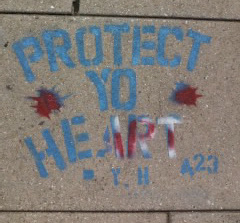
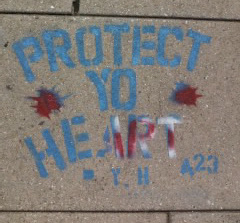
Around the corner from the temporary synagogue where Fabrangen Havurah holds high holiday services, this message was painted on the sidewalk.

…An alternative thought for Shabbat Shuvah [the sabbath of “return”].